

|
시장보고서
상품코드
2154319
로보틱스 부품 : 시장 점유율 분석, 업계 동향과 통계, 성장 예측(2026-2031년)Robotics Components - Market Share Analysis, Industry Trends & Statistics, Growth Forecasts (2026 - 2031) |
||||||
 Mordor Intelligence
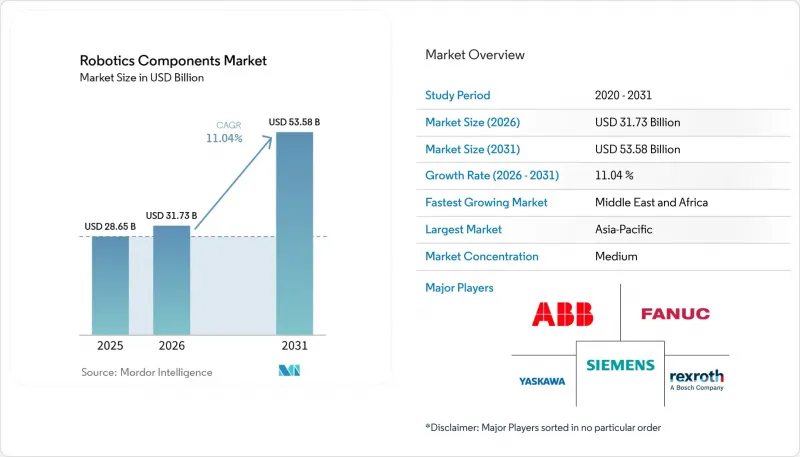
에 따르면 로봇 용부품 시장 규모는 2025년 286억 5,000만 달러에서 2026년에는 317억 3,000만 달러로 확대하며, 2031년까지 535억 8,000만 달러에 달할 것으로 예측되고 있으며, 2026-2031년에 CAGR은 11.04%를 기록할 전망입니다.
전 세계 로봇 부품 시장의 동향 및 인사이트
노동력 부족과 제조업 임금 상승
인구 감소로 인해 몇몇 주요 제조업 국가에서 자동화에 대한 지속적인 수요가 발생하고 있습니다. 한국, 일본, 독일, 중국은 산업용 로봇의 주요 사용국으로 남아 있는 한편, 노동 연령 인구 감소에 직면해 있습니다. 한국은 세계에서 가장 높은 로봇 밀도를 자랑하며, 미국에서는 2025년에 3만 8,000대의 산업용 로봇이 도입되어 연간 도입 대수 기준으로 역대 3위를 기록했습니다. 이러한 상황으로 인해 반복적인 수작업의 대체는 주기적인 구매라기보다는 보다 장기적인 경영 판단이 되고 있습니다. 로보틱스 부품 시장은 로봇 도입 대수가 증가함에 따라 혜택을 보고 있으며, 모터, 액추에이터, 드라이브, 제어 전자 기기에 대한 수요가 증가하고 있습니다. 따라서 자동화 공급업체는 생산 근로자 채용 및 유지에 어려움을 겪고 있는 시설을 포함해, 더 광범위한 공장에서의 수요를 예상하여 계획을 수립할 수 있습니다.
AI를 활용한 지각 기능과 엣지 모션 제어
인공지능은 임베디드 비전, 제어, 모션 하드웨어를 통해 로봇에 점점 더 가까워지고 있습니다. NVIDIA는 자사의 Cosmos 3 Edge 정책 모델이 Jetson Thor 하드웨어에서 15Hz의 속도로 추론 1회당 32개의 로봇 동작을 생성한다고 발표했습니다. 보쉬 렉스로트는 로컬 머신 비전 및 검사 워크로드를 처리하기 위해 ctrlX COREplus 플랫폼에 옵션인 Hailo-8 가속기를 추가했습니다. 페스트(Fest)는 2026년 6월, 사전 프로그래밍이나 템플릿 없이 낯선 물체나 무작위로 배치된 물체의 그립 지점을 식별하는 ‘GripperAI’를 발표했습니다. 로봇 부품 시장 공급업체들에게 이러한 기능은 통합형 센서, 프로세서, 컨트롤러, 엔드 이펙터에 대한 수요를 높이고, 로컬 처리를 위해 설계된 시스템의 가치를 향상시킵니다. 또한 공급업체 간의 경쟁을 데이터를 로컬에서 처리하고 비정형 환경에서도 신속하게 대응할 수 있는 컴포넌트 패키지로 전환시키고 있습니다.
높은 초기 비용과 자동화 투자 회수 기간의 장기화
자본 비용은 로봇 부품 시장에 여전히 큰 장벽으로 작용하고 있으며, 특히 계획 기간이 짧은 중소규모 제조업체의 경우 그 영향이 두드러집니다. 비전 시스템, 엔드 이펙터, 안전 인클로저를 갖춘 6축 산업용 로봇 셀에는 일반적으로 10만-30만 달러의 초기 비용이 필요합니다. 투자 회수에는 가동률이나 인건비 절감 효과에 따라 3년 7년이 걸릴 수 있습니다. ‘Robotics-as-a-Service(RaaS)’ 모델은 지출을 정기적인 운영 비용으로 전환함으로써 이러한 장벽을 낮춥니다. 2026년 1분기 북미 로봇 수주 중 창고·물류 사업자가 60%를 차지했는데, 이는 부분적으로 구독형 도입을 반영한 결과입니다. 특수한 기어박스, 맞춤형 액추에이터 및 특별 주문 센서는 여전히 서비스 기반 모델에 그다지 적합하지 않아, 비용에 민감한 용도에서의 도입 지연을 계속해서 초래하고 있습니다.
부문 분석
2025년, 로봇용 부품 시장에서 모터의 점유율은 19.75%를 차지했습니다. 이는 모든 유형의 로봇에 관절의 토크와 속도를 공급하는 원천이 필요하기 때문입니다. 서보 모터와 브러시리스 직류 모터는 산업용 로봇, 협업 로봇, 서비스 로봇에 널리 사용되고 있습니다. 머신 비전 시스템은 검사가 규칙 기반의 광학 방식에서 인공지능을 활용한 3D 분석으로 전환됨에 따라 2031년까지 연평균 성장률(CAGR) 13.51%로 확대될 것으로 예측됩니다. SICK사는 2026년 6월, 동적인 물류 환경을 위해 카메라의 위치 데이터와 LiDAR를 단일 출력으로 통합한 ‘Triton Floor-LOC’ 위치 파악 시스템을 출시했습니다. 이러한 센서 융합으로의 전환은 비전 시스템의 기술적 부가가치를 높이고 있습니다. 또한 협동 로봇이나 휴머노이드 로봇 도입시 힘 감각 피드백과 유연한 집게 기능이 요구됨에 따라 센서와 엔드 이펙터의 중요성도 높아지고 있습니다.
로봇 부품 시장에서는 액추에이터, 드라이브 및 컨트롤러, 동력 전달 부품, 제어 전자기기, 통신 부품, 그리고 전원 공급 장치가 나머지 수익 기반을 차지하고 있습니다. Nidec Drive Technology는 Automate 2026에서 다양한 적재 중량 요구 사항을 충족하기 위해 FLEXWAVE 변형파 기구 및 KINEX 사이클로이드 기어 기구를 강조했습니다. Bosch Rexroth에 따르면 ctrlX OS는 애플리케이션에 따라 컨트롤러에서 직접 인공지능(AI) 기반의 비전 및 모션 제어 워크로드를 실행할 수 있도록 지원합니다. 산업용 IoT(IIoT) 아키텍처에는 신뢰성 높은 네트워크와 중단 없는 전력 공급이 요구되지만, 각 공급업체들은 모터, 기어, 인코더 및 센싱 기능을 단일 액추에이터 패키지에 통합하는 경향을 강화하고 있습니다. 이러한 통합으로 인해 단가가 상승함에 따라 시간적 제약 하에서 작업하는 시스템 통합사업자에게 개별 부품을 구매하는 매력은 줄어들고 있습니다.
지역별 분석
아시아태평양은 최대 도입 지역이자 정밀 기어박스, 서보 모터, 산업용 센서의 주요 생산 거점이기 때문에 2025년 매출의 59.14%를 차지했습니다. 2025년 전 세계 산업용 로봇 도입 대수의 79%를 아시아가 차지했으며, 해당 지역 전체의 도입 대수는 13% 증가했습니다. 중국, 일본, 한국이 이 지역의 판매 대수에 가장 크게 기여했습니다. 중국은 표준 모터 및 구동용 전자기기 분야에서 비용 면에서 우위를 점하고 있는 반면, 일본은 정밀 스트레인 웨이브 기어박스 및 RV 감속기 분야에서 강점을 유지하고 있습니다. 인도에서는 전자기기 조립 및 자동차 생산을 통해 수요가 확대되고 있으며, 한국의 자동화 전자기기 부문에서는 비전 시스템, 센서, 정밀 액추에이터에 대한 수요가 증가하고 있습니다.
북미와 유럽은 로봇 부품 시장에서 두 번째로 큰 수요 지역이지만, 현재 상황은 다릅니다. 미국의 로봇 도입 대수는 2025년에 3만 8,000대에 달해, 2024년 대비 11% 증가했습니다. 2026년 1분기 북미 지역의 수주 중 60%는 창고 및 물류 사업자가 차지했습니다. 캐나다에서는 2025년 도입 대수가 6% 증가한 반면, 멕시코에서는 3년 연속 감소세를 보였습니다. 또한 유럽에서는 투자 부진, 에너지 비용 급등, 어려운 경제 상황을 배경으로 산업용 로봇 도입 대수가 14% 감소했습니다. 장비 교체 및 사이버 보안 요건 강화로 인해 공급업체의 비용은 증가하고 있지만, 기준 상향 조정은 유럽의 유서 깊은 벤더들을 저사양 수입품으로부터 보호하는 역할도 하고 있습니다.
중동 및 아프리카는 2031년까지 연평균 성장률(CAGR) 13.73%로 확대될 것으로 예측되며, 이는 로봇 부품 시장에서 지역별 가장 빠른 성장 속도입니다. 이는 공급업체들이 그동안 서비스가 충분히 미치지 못했던 지역의 수요를 확보하려 하고 있기 때문입니다. 산업 다각화, E-Commerce 물류에 대한 투자, 그리고 현지 제조업의 발전이 수요를 지원하고 있는 반면, 사우디아라비아의 ‘비전 2030’과 아랍에미리트(UAE)의 ‘두바이 로봇공학 및 자동화 프로그램’은 석유화학, 식품 가공, 물류 분야에 대한 자본 투자를 촉진하고 있습니다. 남미는 브라질과 아르헨티나가 주도하는 비교적 소규모의 개발도상 지역으로, 도입은 자동차 및 식품 가공 분야에 집중되어 있습니다. 또한 ‘로보틱스 애즈 어 서비스(RaaS)’는 중규모 식품 제조업체에게 초기 비용을 절감할 수 있는 수단이 됩니다. 인프라 격차와 환율 변동은 여전히 이 지역의 많은 지역에서 구매 결정의 걸림돌이 되고 있습니다.
기타 혜택:
- 엑셀 형식의 시장 예측(ME) 시트
- 3개월간의 애널리스트 지원
자주 묻는 질문
목차
제1장 서론
- 조사 전제조건과 시장 정의
- 조사 범위
제2장 조사 방법
제3장 개요
제4장 시장 구도
- 시장 개요
- 시장 성장 촉진요인
- 시장 성장 억제요인
- 업계 밸류체인 분석
- 규제 상황
- 기술 전망
- 거시경제 요인이 시장에 미치는 영향
- Porter's Five Forces 분석
제5장 시장 규모와 성장 예측
- 컴포넌트별
- 로봇 유형별
- 최종사용자 산업별
- 지역별
- 북미
- 미국
- 캐나다
- 멕시코
- 남미
- 브라질
- 아르헨티나
- 기타 남미 국가
- 유럽
- 독일
- 영국
- 프랑스
- 이탈리아
- 스페인
- 기타 유럽 국가
- 아시아태평양
- 중국
- 일본
- 인도
- 한국
- 기타 아시아태평양 국가
- 중동 및 아프리카
- 중동
- 사우디아라비아
- 아랍에미리트
- 튀르키예
- 기타 중동 국가
- 아프리카
- 남아프리카공화국
- 나이지리아
- 기타 아프리카 국가
- 중동
- 북미
제6장 경쟁 구도
- 시장 집중도
- 전략적 동향
- 시장 점유율 분석
- 기업 개요
- ABB Ltd.
- FANUC Corporation
- Yaskawa Electric Corporation
- Siemens AG
- Bosch Rexroth AG
- Harmonic Drive Systems Inc.
- Nabtesco Corporation
- Kollmorgen Corporation
- Maxon International AG
- Nidec Corporation
- SCHUNK SE & Co. KG
- ATI Industrial Automation, Inc.
- Festo SE & Co. KG
- SMC Corporation
- THK Co., Ltd.
- SICK AG
- Staubli International AG
- Parker Hannifin Corporation
- Rockwell Automation, Inc.
- OnRobot A/S
제7장 시장 기회와 향후 전망
KSA 26.10.23According to Mordor Intelligence, the robotics components market size is projected to expand from USD 28.65 billion in 2025 to USD 31.73 billion in 2026, and to USD 53.58 billion by 2031, registering a CAGR of 11.04% between 2026 and 2031.
Global Robotics Components Market Trends and Insights
Labor Shortages and Rising Manufacturing Wages
Demographic decline is creating durable demand for automation in several major manufacturing economies. South Korea, Japan, Germany, and China are facing smaller working-age populations while remaining major users of industrial robots. South Korea had the highest robot density worldwide, and the United States recorded 38,000 industrial robot installations in 2025, its third-highest annual total. These conditions make replacement of repetitive manual work a longer-term operating decision rather than a cyclical purchase. The Robotics components market benefits as more robots are installed, requiring motors, actuators, drives, and control electronics. Automation suppliers can therefore plan around demand from a wider group of plants, including facilities that have struggled to recruit and retain production workers.
AI-Enabled Perception and Edge Motion Control
Artificial intelligence is moving closer to the robot through embedded vision, control, and motion hardware. NVIDIA stated that its Cosmos 3 Edge policy model produces 32 robotic actions per inference at 15 Hz on Jetson Thor hardware. Bosch Rexroth added an optional Hailo-8 accelerator to its ctrlX COREplus platform for local machine vision and inspection workloads. Festo introduced GripperAI in June 2026 to identify gripping points for unfamiliar and randomly positioned items without prior programming or templates. For robotics components market suppliers, these capabilities raise demand for integrated sensors, processors, controllers, and end effectors, and they increase the value of systems designed for local processing. They also shift supplier competition toward component packages that can process data locally and respond quickly in unstructured settings.
High Upfront Cost and Lengthy Automation Payback
Capital costs remain a major obstacle for the robotics components market, particularly among small- and mid-sized manufacturers with shorter planning horizons. A six-axis industrial robot cell with vision, end effectors, and safety enclosures commonly requires USD 100,000 to USD 300,000 upfront. Payback can take 3 to 7 years, depending on utilization and labor savings. Robotics-as-a-service models reduce this barrier by shifting spending toward recurring operating payments. Warehousing and logistics providers represented 60% of North American robotics orders in the first quarter of 2026, partly reflecting subscription-based deployments. Specialized gearboxes, custom actuators, and tailored sensors remain less suited to service-based models, which continues to slow adoption in cost-sensitive applications.
Other drivers and restraints analyzed in the detailed report include:
- Reshoring, Nearshoring, and Factory Automation Incentives
- Expansion of High-Mix Electronics and Semiconductor Production
- Scarcity of Robotics Integration and Validation Talent
For complete list of drivers and restraints, kindly check the Table Of Contents.
Segment Analysis
Motors accounted for 19.75% of the Robotics components market share in 2025 because every robot type requires a source of joint torque and velocity. Servo motors and brushless direct-current motors are widely used across industrial, collaborative, and service robots. Machine vision systems are projected to expand at a 13.51% CAGR through 2031 as inspection moves from rule-based optics toward artificial intelligence-enabled 3D analysis. SICK released its Triton Floor-LOC localization system in June 2026, which combines camera position data and LiDAR into a single output for dynamic logistics environments. This move toward sensor fusion raises the technical content and value of vision systems. Sensors and end effectors also gain importance as collaborative and humanoid deployments require force feedback and flexible gripping.
Within the robotics components market, actuators, drives and controllers, power transmission components, control electronics, communication components, and power supplies account for the remaining revenue base. Nidec Drive Technology highlighted FLEXWAVE strain-wave and KINEX cycloidal gear architectures at Automate 2026 to address different payload needs. Bosch Rexroth said ctrlX OS supports application-based deployment of artificial intelligence vision and motion control workloads directly on the controller. Industrial Internet of Things architectures require dependable networking and uninterrupted power, while suppliers increasingly combine motor, gear, encoder, and sensing functions into a single actuator package. This integration increases unit value and makes separate component purchases less attractive for integrators working under time constraints.
Complete Report Scope:
- By Component
- Actuators
- Motors
- Drives and Controllers
- Sensors
- Machine Vision Systems
- End Effectors
- Power Transmission Components
- Control Electronics
- Power Supply Components
- Communication Components
- By Robot Type
- Industrial Robots
- Service Robots
- Collaborative Robots
- By End-user Industry
- Automotive
- Electronics and Semiconductors
- Healthcare and Medical Devices
- Aerospace and Defense
- Food and Beverage
- Logistics and Warehousing
- Other End-user Industries
- By Geography
- North America
- United States
- Canada
- Mexico
- South America
- Brazil
- Argentina
- Rest of South America
- Europe
- Germany
- United Kingdom
- France
- Italy
- Spain
- Rest of Europe
- Asia-Pacific
- China
- Japan
- India
- South Korea
- Rest of Asia-Pacific
- Middle East and Africa
- Middle East
- Saudi Arabia
- United Arab Emirates
- Turkey
- Rest of the Middle East
- Africa
- South Africa
- Nigeria
- Rest of Africa
- Middle East
- North America
Geography Analysis
Asia-Pacific accounted for 59.14% of revenue in 2025 because it is the largest installation region and an important production base for precision gearboxes, servo motors, and industrial sensors. Asia accounted for 79% of global industrial robot installations in 2025, and installations across the region increased 13%. China, Japan, and South Korea contributed the most to regional volumes. China has a cost advantage in standard motors and drive electronics, while Japan retains strength in precision strain-wave gearboxes and RV reducers. India is adding demand through electronics assembly and automotive production, while South Korea's automated electronics sector requires vision systems, sensors, and precision actuators.
North America and Europe are the next-largest demand areas in the robotics components market, but their current conditions differ. United States robot installations reached 38,000 units in 2025, up 11% from 2024. Warehousing and logistics providers represented 60% of North American orders in the first quarter of 2026. Canada recorded 6% growth in installations in 2025, while Mexico saw its third consecutive annual decline, and Europe's industrial robot installations fell 14% amid weaker investment, high energy costs, and challenging economic conditions. Updated machinery and cybersecurity requirements add costs for suppliers, although higher standards can protect established European vendors from lower-specification imports.
The Middle East and Africa are projected to expand at a 13.73% CAGR through 2031, the fastest regional pace in the robotics components market, as suppliers seek to capture demand in previously underserved geographies. Industrial diversification, e-commerce logistics investment, and local manufacturing development support demand, while Saudi Arabia's Vision 2030 and the United Arab Emirates' Dubai Robotics and Automation Program direct capital toward petrochemicals, food processing, and logistics. South America remains a smaller developing region led by Brazil and Argentina, where adoption is concentrated in automotive and food processing, and robotics-as-a-service can reduce initial costs for mid-sized food manufacturers. Infrastructure gaps and foreign exchange volatility still constrain purchasing decisions across much of the region.
- ABB Ltd.
- FANUC Corporation
- Yaskawa Electric Corporation
- Siemens AG
- Bosch Rexroth AG
- Harmonic Drive Systems Inc.
- Nabtesco Corporation
- Kollmorgen Corporation
- Maxon International AG
- Nidec Corporation
- SCHUNK SE & Co. KG
- ATI Industrial Automation, Inc.
- Festo SE & Co. KG
- SMC Corporation
- THK Co., Ltd.
- SICK AG
- Staubli International AG
- Parker Hannifin Corporation
- Rockwell Automation, Inc.
- OnRobot A/S
Additional Benefits:
- The market estimate (ME) sheet in Excel format
- 3 months of analyst support
TABLE OF CONTENTS
1 INTRODUCTION
- 1.1 Study Assumptions and Market Definition
- 1.2 Scope of the Study
2 RESEARCH METHODOLOGY
3 EXECUTIVE SUMMARY
4 MARKET LANDSCAPE
- 4.1 Market Overview
- 4.2 Market Drivers
- 4.2.1 Labor Shortages and Rising Manufacturing Wages
- 4.2.2 AI-Enabled Perception and Edge Motion Control
- 4.2.3 Reshoring, Nearshoring, and Factory Automation Incentives
- 4.2.4 Expansion of High-Mix Electronics and Semiconductor Production
- 4.2.5 Collaborative and Humanoid Robot Commercialization
- 4.2.6 Sensor Fusion for Autonomous Logistics and Inspection
- 4.3 Market Restraints
- 4.3.1 High Upfront Cost and Lengthy Automation Payback
- 4.3.2 Scarcity of Robotics Integration and Validation Talent
- 4.3.3 Precision Gearbox, Actuator, and Rare-Earth Supply Constraints
- 4.3.4 Functional Safety, Cybersecurity, and Liability Compliance Burden
- 4.4 Industry Value-Chain Analysis
- 4.5 Regulatory Landscape
- 4.6 Technological Outlook
- 4.7 Impact of Macroeconomic Factors on the Market
- 4.8 Porter's Five Forces Analysis
- 4.8.1 Threat of New Entrants
- 4.8.2 Bargaining Power of Suppliers
- 4.8.3 Bargaining Power of Buyers
- 4.8.4 Threat of Substitutes
- 4.8.5 Competitive Rivalry
5 MARKET SIZE AND GROWTH FORECASTS (VALUE)
- 5.1 By Component
- 5.1.1 Actuators
- 5.1.2 Motors
- 5.1.3 Drives and Controllers
- 5.1.4 Sensors
- 5.1.5 Machine Vision Systems
- 5.1.6 End Effectors
- 5.1.7 Power Transmission Components
- 5.1.8 Control Electronics
- 5.1.9 Power Supply Components
- 5.1.10 Communication Components
- 5.2 By Robot Type
- 5.2.1 Industrial Robots
- 5.2.2 Service Robots
- 5.2.3 Collaborative Robots
- 5.3 By End-user Industry
- 5.3.1 Automotive
- 5.3.2 Electronics and Semiconductors
- 5.3.3 Healthcare and Medical Devices
- 5.3.4 Aerospace and Defense
- 5.3.5 Food and Beverage
- 5.3.6 Logistics and Warehousing
- 5.3.7 Other End-user Industries
- 5.4 By Geography
- 5.4.1 North America
- 5.4.1.1 United States
- 5.4.1.2 Canada
- 5.4.1.3 Mexico
- 5.4.2 South America
- 5.4.2.1 Brazil
- 5.4.2.2 Argentina
- 5.4.2.3 Rest of South America
- 5.4.3 Europe
- 5.4.3.1 Germany
- 5.4.3.2 United Kingdom
- 5.4.3.3 France
- 5.4.3.4 Italy
- 5.4.3.5 Spain
- 5.4.3.6 Rest of Europe
- 5.4.4 Asia-Pacific
- 5.4.4.1 China
- 5.4.4.2 Japan
- 5.4.4.3 India
- 5.4.4.4 South Korea
- 5.4.4.5 Rest of Asia-Pacific
- 5.4.5 Middle East and Africa
- 5.4.5.1 Middle East
- 5.4.5.1.1 Saudi Arabia
- 5.4.5.1.2 United Arab Emirates
- 5.4.5.1.3 Turkey
- 5.4.5.1.4 Rest of the Middle East
- 5.4.5.2 Africa
- 5.4.5.2.1 South Africa
- 5.4.5.2.2 Nigeria
- 5.4.5.2.3 Rest of Africa
- 5.4.5.1 Middle East
- 5.4.1 North America
6 COMPETITIVE LANDSCAPE
- 6.1 Market Concentration
- 6.2 Strategic Moves
- 6.3 Market Share Analysis
- 6.4 Company Profiles (includes Global Level Overview, Market Level Overview, Core Segments, Financials as available, Strategic Information, Market Rank/Share, Products and Services, Recent Developments)
- 6.4.1 ABB Ltd.
- 6.4.2 FANUC Corporation
- 6.4.3 Yaskawa Electric Corporation
- 6.4.4 Siemens AG
- 6.4.5 Bosch Rexroth AG
- 6.4.6 Harmonic Drive Systems Inc.
- 6.4.7 Nabtesco Corporation
- 6.4.8 Kollmorgen Corporation
- 6.4.9 Maxon International AG
- 6.4.10 Nidec Corporation
- 6.4.11 SCHUNK SE & Co. KG
- 6.4.12 ATI Industrial Automation, Inc.
- 6.4.13 Festo SE & Co. KG
- 6.4.14 SMC Corporation
- 6.4.15 THK Co., Ltd.
- 6.4.16 SICK AG
- 6.4.17 Staubli International AG
- 6.4.18 Parker Hannifin Corporation
- 6.4.19 Rockwell Automation, Inc.
- 6.4.20 OnRobot A/S
7 MARKET OPPORTUNITIES AND FUTURE OUTLOOK
- 7.1 White-Space and Unmet-Need Assessment


