

|
시장보고서
상품코드
2154320
산업 보안 : 시장 점유율 분석, 업계 동향과 통계, 성장 예측(2026-2031년)Industrial Security - Market Share Analysis, Industry Trends & Statistics, Growth Forecasts (2026 - 2031) |
||||||
 Mordor Intelligence
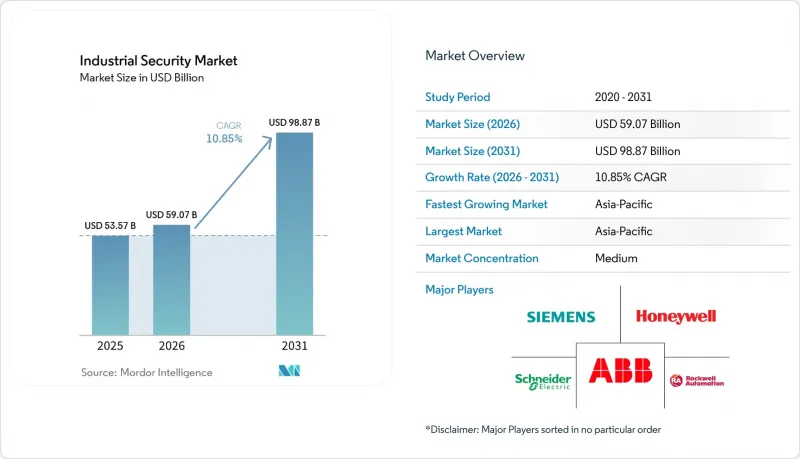
에 따르면 산업 보안 시장 규모는 2025년에 535억 7,000만 달러로 평가되며, 2026년 590억 7,000만 달러에서 확대하며, 2031년까지 988억 7,000만 달러에 달할 것으로 예측됩니다.
예측 기간(2026-2031년) 동안 연평균 성장률(CAGR)은 10.85%에 달할 것으로 전망됩니다.
글로벌 산업 보안 시장의 동향 및 인사이트
IT와 OT의 융합 및 인더스트리 4.0에 따른 현대화
OT의 에어 갭이 좁아짐에 따라 네트워크로 연결된 공장의 산업 보안에 대한 지출이 증가하고 있습니다. 제조업체들은 현재 히스토리안 서버, 원격 모니터링 플랫폼 및 엔지니어링 워크스테이션을 과거에는 격리되어 있던 네트워크로 연결하고 있습니다. 공격자가 기업의 IT 시스템에 대한 접근 권한을 획득할 경우, 이러한 각 연결은 횡방향 이동 경로로 악용될 가능성이 있습니다. TXOne Networks의 보고서에 따르면 OT 보안 사고의 96%는 IT 수준의 침해에서 기인하며, 이는 융합 경계에서 전용 보호 조치의 필요성을 여실히 보여주고 있습니다. ‘프랑스 2030’ 및 아시아태평양의 유사한 스마트 제조 프로그램을 통해 클라우드 연결과 실시간 분석이 생산 환경으로 확대되고 있습니다. 이러한 프로젝트로 인해 산업 보안 시장에서 네트워크 세분화, 프로토콜 검사 및 지속적인 모니터링에 대한 수요가 증가하고 있습니다.
중요 인프라에 대한 랜섬웨어 및 사이버-물리 공격
랜섬웨어는 산업 운영자에게 단순한 데이터 탈취 문제가 아니라 업무 중단 위험으로 대두되고 있습니다. Dragos사는 2025년에 산업 조직을 표적으로 삼은 랜섬웨어 그룹 119건을 확인했습니다(2024년의 80건에서 증가). 또한 이 그룹들이 전 세계 3,300개 조직에 영향을 미쳤다고 보고했습니다. 보고된 피해 조직의 3분의 2 이상을 제조업이 차지했습니다. 2025년, OT(운영 기술)에 특화된 랜섬웨어의 평균 잠복 기간은 42일에 달했으나, OT를 포괄적으로 가시화하고 있는 조직에서는 잠복 기간이 5일에 그쳤습니다. CISA, 연방수사국(FBI), 에너지부, 국가안보국(NSA)은 2026년 7월, 이란과 관련이 있는 공격자들이 미국의 상수도 및 에너지 시설에 있는 프로그래머블 로직 컨트롤러(PLC)를 조작하고 있다고 경고했습니다. 이러한 공격은 산업 보안 시장의 구매자들이 OT 가시성, 원격 액세스 제어 및 사고 대응을 우선시하는 이유를 여실히 보여줍니다.
구형 장비와 독자적인 산업용 프로토콜
레거시 OT 장비는 산업 보안 시장의 기회를 제한하고 있습니다. 이는 이미 설치된 플랜트 인프라의 상당 부분이 물리적 격리를 전제로 구축되었기 때문입니다. 많은 SCADA 시스템, PLC, 분산 제어 시스템에서는 현재의 암호화 및 인증 관행보다 이전에 개발된 Modbus, DNP3, OPC DA 프로토콜이 사용되고 있습니다. 패치 적용에는 대개 공급업체의 개입이 필요하며, 가동 중에는 시행이 어려울 수 있습니다. Dragos사의 조사에 따르면 2025년 ICS-CERT 권고 사항의 26%에는 공급업체가 제공하는 패치나 완화 조치가 포함되어 있지 않았습니다. ISA/IEC 62443 표준은 구역, 도관, 단방향 게이트웨이, 데이터 다이오드를 통한 보상 제어를 권장하고 있습니다. 그러나 기존 설비(브라운필드)의 개보수에는 엔지니어링 작업, 계획적인 가동 중단 및 자본 투자가 필요하므로 사업자는 이를 미룰 가능성이 있습니다.
부문 분석
2025년, 물리적 보안은 매출의 64.12%를 차지했습니다. 산업 보안 시장은 이미 설치된 영상 감시, 출입 통제, 침입 감지, 경계 보안 및 보안 관리 시스템을 통해 계속해서 이 부문을 지원하고 있습니다. 제조 거점, 물류 허브, 에너지 시설에서는 부지 보호를 위해 이러한 시스템이 계속해서 필요로 하고 있습니다. Genetec사의 보고서에 따르면 사용자들은 통합 플랫폼 내에서 영상 관리와 출입 통제를 결합하는 경향이 강해지고 있습니다. 또한 AI 기반 영상 분석 및 침입 감지 역시 물리적 보안 도입시 기대되는 기능으로 자리 잡고 있습니다. 예를 들어 정유소에서는 경계 분석과 출입 통제 데이터를 결합함으로써 이상 상황의 에스컬레이션을 자동화할 수 있습니다. 이러한 접근 방식을 통해 보안 운영 센터(SOC)에서의 수동 확인 작업을 줄일 수 있습니다. 통합 보안 관리의 보급에 따라 조달 정책은 개별 하드웨어 구매에서 플랫폼 수준의 결정으로 전환되고 있습니다.
산업용 사이버 보안은 산업 보안 시장에서 2031년까지 연평균 성장률(CAGR) 12.54%로 확대될 것으로 예측됩니다. OT 및 ICS 보안 솔루션, 산업용 네트워크 보안, ID 및 접근 관리, 위협 탐지가 보안 관련 설비 투자에서 더 큰 비중을 차지하고 있습니다. 하네웰은 2026년 6월, AI를 활용한 ‘Cyber Proactive Defense’와 관리형 OT 보안 운영 센터를 도입하여 OT 사이버 보안 제품군을 확충했습니다. 이 회사는 세계경제포럼(WEF)의 조사 결과를 인용하며, 산업 조직 중 전담 OT 보안 팀을 유지하고 있는 곳은 고작 20%에 불과하다고 지적했습니다. 운영자들은 영상 분석, 접근 이벤트, OT 네트워크 활동에서 발생하는 경보를 연동할 수 있는 플랫폼을 원하고 있습니다. IEC 62443은 각국의 규정 준수 요건을 충족해야 하는 도입 환경에 대해 널리 인정받는 프레임워크를 제공합니다. 이에 따라 산업 보안 업계에서는 동일한 운영 모델 내에서 물리적 제어와 사이버 제어 간의 연계를 강화하고 있습니다.
2025년 산업용 보안 시장 규모 중 하드웨어가 43.65%를 차지했습니다. 카메라, 접근 제어 리더기, 내환경형 네트워크 장비 및 OT 보안 게이트웨이는 산업 환경에서 여전히 필수적인 물리적 제어 지점으로 자리 잡고 있습니다. 이러한 제품들은 산업 환경 특유의 온도, 습도 및 전자기 환경을 견뎌내야 합니다. 자산이나 네트워크 수준에서 직접적인 적용이 요구되는 경우, 소프트웨어만으로 제어하는 방식으로는 하드웨어 제어를 대체할 수 없습니다. 보안산업협회(SIA) 보고서에 따르면 2026년 3월부터 4월에 걸쳐 관세의 영향과 지정학적 상황이 영상 감시 및 출입 통제 시스템 조달 지연의 원인이 되었습니다. 산업용 네트워크 장비, OT 네이티브 방화벽 및 내환경형 침입 방지 시스템은 주요 하드웨어 범주입니다. 이들은 제어 루프에 지장을 줄 만한 지연을 일으키지 않으면서 독자적인 산업용 프로토콜을 처리할 수 있도록 설계되었습니다. 따라서 산업 보안 시장에서 하드웨어에 대한 수요는 물리적 보안 요구 사항과 OT 네트워크 보호 모두와 계속해서 밀접하게 연결되어 있습니다.
소프트웨어 시장은 2031년까지 연평균 성장률(CAGR) 12.76%로 확대될 것으로 예측됩니다. AI 네이티브 플랫폼, 클라우드를 통해 제공되는 위협 인텔리전스, 그리고 구독형 OT 가시화 툴을 통해 보안 지출의 일부가 자본 지출에서 지속적인 계약으로 전환되고 있습니다. Claroty는 2026년 5월, OT 환경을 위한 위험 우선순위 지정 및 시정 조치 지침을 제공하는 CPS 네이티브 AI 보안 에이전트 ‘Claire’를 출시했습니다. 화학 플랜트에서는 이러한 툴을 활용하여 PLC의 비정상적인 작동과 접근 제어 이벤트 및 네트워크 통신 간의 연관성을 파악할 수 있습니다. 이를 통해 수동으로 상관 분석을 수행하지 않고도 공격의 연쇄를 분석가의 주의를 끌 수 있게 됩니다. 평가, 관리형 탐지, 사고 대응을 위한 서비스도 소프트웨어와 병행하여 확대되고 있습니다. 록웰 오토메이션은 사내에 OT 보안 체계를 갖추지 않은 제조업체를 대상으로 2026년 6월에 ‘SecureOT Platform Managed Services’ 및 ‘Managed Secure Remote Access’를 추가했습니다. 산업 보안 시장에서는 소프트웨어 플랫폼과 벤더가 운영하는 지원을 결합하는 경향이 점점 더 강해지고 있습니다.
지역별 분석
북미는 중요 인프라의 밀도가 높고 OT 사이버 보안 프레임워크가 조기에 도입된 점에 힘입어, 산업 보안 시장에서 중요한 수익 지역으로 자리매김하고 있습니다. CISA는 2026년 7월, 미국의 에너지 및 상수도 시스템에 대한 이란 관련 활동에 관한 권고안을 발표했습니다. NERC CIP-015에 따르면 3년의 준수 기간 내에 중요도가 높은 대규모 전력 시스템 사업자에 대해 내부 네트워크 모니터링이 의무화됩니다. 캐나다는 2025년 4분기, 악의적인 활동으로부터 차단된 ICS 컴퓨터의 비율이 각 지역 중 가장 낮은 수준 중 하나를 기록했습니다. 이 결과는 성숙한 보안 대책과 규제 당국의 적극적인 개입을 반영하고 있습니다. 멕시코에서는 니어쇼어링을 통해 OT를 많이 사용하는 산업단지가 확대됨에 따라 서로 다른 수요 패턴이 형성되고 있습니다. 신규 시설의 경우, 도입 초기부터 보안 인프라가 필요한 경우가 많으며, 도입 일정이 촉박한 것이 현실입니다.
아시아태평양은 2025년에 지역별 매출의 31.72%를 차지할 것으로 예상되며, 2031년까지 연평균 성장률(CAGR) 13.16%로 성장할 것으로 전망됩니다. 중국과 인도는 산업화, 스마트 제조 프로그램, 전력 인프라로 인해 OT 자산이 밀집되어 있으며, 산업 보안 시장의 주요 수요 중심지가 되고 있습니다. 일본과 한국에는 산업용 제품에 보안 기능을 내장하고 있는 국내 자동화 공급업체가 존재합니다. 요코가와 전기의 ‘OpreX IT/OT SOC’는 산업 고객을 위한 자동화 기반 보안 통합의 한 예입니다. 한국의 반도체 및 디스플레이 시설은 자동화 밀도가 높으며, 생산 중단으로 인한 비용도 막대합니다. 인도는 ‘생산 연계 인센티브(PLI)’ 제도에 기반한 제조업 확대와 핵심 부문에 대한 보다 적극적인 사이버 보안 요건의 혜택을 받고 있습니다.
유럽의 산업 보안 시장에서는 규정 준수에 따른 수요가 더욱 견고한 반면, 남미, 중동 및 아프리카에서는 산업의 성숙도에 편차가 나타납니다. 독일의 NIS2UmsuCG는 2025년 12월에 시행될 예정이며, 영국은 2025년 11월에 ‘사이버 보안 및 복원력 법안’을 제출했습니다. 이 법안은 집행 명령에 따른 최고 벌금을 1,700만 파운드(2,150만 달러) 또는 1일당 10만 파운드(12만 6,000달러)로 규정하고 있습니다. 사우디아라비아의 NEOM 및 ‘비전 2030’ 프로젝트, 아랍에미리트(UAE)의 인프라 디지털화, 남아프리카공화국의 공공사업 현대화가 중동 및 아프리카의 투자를 지원하고 있습니다. 2025년 4분기, 남미에서는 ICS 컴퓨터의 20.4%에서 악성 객체가 차단되었으며, 이는 북유럽의 2.4배에 달하는 비율입니다. 칠레는 2025년에 ‘Agencia Nacional de Ciberseguridad(국가 사이버보안청)’을 설립한 반면, 브라질의 석유 및 가스 및 제조업 분야에서는 물리적 및 OT(운영 기술) 사이버보안 시스템에 대한 수요가 증가하고 있습니다.
기타 혜택:
- 엑셀 형식의 시장 예측(ME) 시트
- 3개월간의 애널리스트 지원
자주 묻는 질문
목차
제1장 서론
- 조사 전제조건과 시장 정의
- 조사 범위
제2장 조사 방법
제3장 개요
제4장 시장 구도
- 시장 개요
- 시장 성장 촉진요인
- 시장 성장 억제요인
- 업계 밸류체인 분석
- 규제 상황
- 기술 전망
- 거시경제 요인이 시장에 미치는 영향
- Porter's Five Forces 분석
제5장 시장 규모와 성장 예측
- 보안 유형별
- 제공별
- 배포 모드별
- 최종사용자 산업별
- 지역별
- 북미
- 미국
- 캐나다
- 멕시코
- 남미
- 브라질
- 아르헨티나
- 기타 남미 국가
- 유럽
- 독일
- 영국
- 프랑스
- 이탈리아
- 스페인
- 기타 유럽 국가
- 아시아태평양
- 중국
- 일본
- 인도
- 한국
- 기타 아시아태평양 국가
- 중동 및 아프리카
- 중동
- 사우디아라비아
- 아랍에미리트
- 튀르키예
- 기타 중동 국가
- 아프리카
- 남아프리카공화국
- 나이지리아
- 기타 아프리카 국가
- 중동
- 북미
제6장 경쟁 구도
- 시장 집중도
- 전략적 동향
- 시장 점유율 분석
- 기업 개요
- Siemens AG
- Honeywell International Inc.
- Schneider Electric SE
- ABB Ltd.
- Rockwell Automation, Inc.
- Gallagher Group Ltd.
- Motorola Solutions, Inc.
- Axis Communications AB
- Hikvision Digital Technology Co., Ltd.
- Dahua Technology Co., Ltd.
- Cisco Systems, Inc.
- Fortinet, Inc.
- Palo Alto Networks, Inc.
- Claroty Ltd.
- Dragos, Inc.
- TXOne Networks Inc.
- Emerson Electric Co.
- Yokogawa Electric Corporation
- Mitsubishi Electric Corporation
- Phoenix Contact GmbH & Co. KG
제7장 시장 기회와 향후 전망
KSA 26.10.23According to Mordor Intelligence, the industrial security market size was valued at USD 53.57 billion in 2025 and estimated to expand from USD 59.07 billion in 2026 to reach USD 98.87 billion by 2031, at a CAGR of 10.85% during the forecast period (2026-2031).
Global Industrial Security Market Trends and Insights
IT-OT Convergence and Industry 4.0 Modernization
The erosion of the OT air gap is increasing industrial security spending across connected factories. Manufacturers now connect historian servers, remote-monitoring platforms, and engineering workstations to networks that were once isolated. Each connection can serve as a route for lateral movement once an attacker gains access to enterprise IT. TXOne Networks reported that 96% of OT security incidents originated from IT-level compromises, underscoring the need for dedicated protection at the convergence boundary. France 2030 and comparable smart manufacturing programs in the Asia-Pacific region are extending cloud connectivity and real-time analytics into production environments. These projects increase demand in the industrial security market for network segmentation, protocol inspection, and continuous monitoring.
Ransomware and Cyber-Physical Attacks on Critical Infrastructure
Ransomware has become an operational disruption risk rather than only a data theft issue for industrial operators. Dragos identified 119 ransomware groups targeting industrial organizations in 2025, up from 80 in 2024, and reported that these groups affected 3,300 organizations worldwide. Manufacturing represented more than two-thirds of the reported victims. The average dwell time for OT-specific ransomware reached 42 days in 2025, while organizations with comprehensive OT visibility reported a 5-day dwell time. CISA, the Federal Bureau of Investigation, the Department of Energy, and the National Security Agency warned in July 2026 that Iranian-affiliated actors were manipulating programmable logic controllers in United States water and energy sites. The attacks demonstrate why buyers in the industrial security market are prioritizing OT visibility, remote-access controls, and incident response.
Legacy Equipment and Proprietary Industrial Protocols
Legacy OT equipment limits the industrial security market opportunity because much of the installed plant infrastructure was built for physical isolation. Many SCADA systems, PLCs, and distributed control systems use Modbus, DNP3, and OPC DA protocols that predate current encryption and authentication practices. Patching often requires vendor involvement and may not be feasible during operations. Dragos found that 26% of ICS-CERT advisories in 2025 did not include a vendor patch or mitigation. ISA/IEC 62443 supports compensating controls through zones, conduits, unidirectional gateways, and data diodes. However, brownfield retrofits require engineering work, planned downtime, and capital that operators may defer.
Other drivers and restraints analyzed in the detailed report include:
- Mandatory Cybersecurity and Resilience Regulation
- Expansion of IIoT, Edge Computing, and Remote Operations
- OT-Skilled Cybersecurity Talent Shortage
For complete list of drivers and restraints, kindly check the Table Of Contents.
Segment Analysis
Physical Security held 64.12% of revenue in 2025. The industrial security market continues to support this category through installed video surveillance, access control, intrusion detection, perimeter security, and security management systems. Manufacturing campuses, logistics hubs, and energy facilities continue to require these systems for site protection. Genetec reported that users increasingly combine video management and access control within unified platforms. AI-based video analytics and intrusion detection are also becoming expected functions within physical security deployments. A refinery can combine perimeter analytics with access-control data to automate anomaly escalation. This approach can reduce manual review in security operations centers. Unified security management is shifting procurement toward platform-level decisions rather than isolated hardware purchases.
Industrial Cybersecurity is projected to expand at a 12.54% CAGR through 2031 within the industrial security market. OT and ICS security solutions, industrial network security, identity and access management, and threat detection are receiving a larger share of security capital expenditure. Honeywell expanded its OT Cybersecurity Suite in June 2026 with AI-powered Cyber Proactive Defense and a managed OT Security Operations Center. The company cited the World Economic Forum finding that only 20% of industrial organizations maintain dedicated OT security teams. Operators are seeking platforms that connect alerts from video analytics, access events, and OT network activity. IEC 62443 provides a recognized framework for deployments that must meet national compliance expectations. The industrial security industry is therefore bringing physical and cyber controls closer together within the same operating model.
Hardware accounted for 43.65% of the industrial security market size in 2025. Cameras, access readers, ruggedized network appliances, and OT security gateways remain necessary physical control points in industrial environments. These products must tolerate industrial temperature, humidity, and electromagnetic conditions. Software-only controls cannot replace hardware controls when direct enforcement at the asset or network level is required. The Security Industry Association reported that tariff effects and geopolitical conditions contributed to procurement delays in video surveillance and access control during March and April 2026. Industrial network appliances, OT-native firewalls, and ruggedized intrusion prevention systems are key hardware categories. They are designed to process proprietary industrial protocols without adding disruptive latency to control loops. Hardware demand in the industrial security market, therefore, remains tied to both physical security requirements and OT network protection.
Software is projected to expand at a 12.76% CAGR through 2031. AI-native platforms, cloud-delivered threat intelligence, and subscription-based OT visibility tools are shifting some security spending from capital purchases to recurring contracts. Claroty launched Claire in May 2026 as a CPS-native AI security agent that provides risk prioritization and remediation guidance for OT environments. A chemical plant can use such a tool to relate anomalous PLC behavior to access-control events and network communications. This can bring an attack sequence to analysts' attention without manual correlation. Services for assessment, managed detection, and incident response are expanding alongside software. Rockwell Automation added SecureOT Platform Managed Services and Managed Secure Remote Access in June 2026 for manufacturers without internal OT security capacity. The industrial security market is increasingly combining software platforms with vendor-operated support.
Complete Report Scope:
- By Security Type
- Physical Security
- Video Surveillance Systems
- Access Control Systems
- Intrusion Detection Systems
- Perimeter Security Systems
- Security Management Platforms
- Industrial Cybersecurity
- OT/ICS Security Solutions
- Industrial Network Security
- Industrial Endpoint Security
- Identity and Access Management (IAM)
- Threat Detection and Response Solutions
- Physical Security
- By Offering
- Hardware
- Software
- Services
- By Deployment Mode
- On-Premise
- Cloud-Based
- Hybrid
- By End-user Industry
- Manufacturing
- Energy and Utilities
- Oil and Gas
- Chemical and Petrochemical
- Mining and Metals
- Transportation and Logistics
- Pharmaceuticals and Life Sciences
- Food and Beverage
- Water and Wastewater
- Other End-user Industries
- By Geography
- North America
- United States
- Canada
- Mexico
- South America
- Brazil
- Argentina
- Rest of South America
- Europe
- Germany
- United Kingdom
- France
- Italy
- Spain
- Rest of Europe
- Asia-Pacific
- China
- Japan
- India
- South Korea
- Rest of Asia-Pacific
- Middle East and Africa
- Middle East
- Saudi Arabia
- United Arab Emirates
- Turkey
- Rest of the Middle East
- Africa
- South Africa
- Nigeria
- Rest of Africa
- Middle East
- North America
Geography Analysis
North America is a significant revenue region for the industrial security market, supported by the density of critical infrastructure and the early adoption of OT cybersecurity frameworks. CISA issued advisories in July 2026 on Iranian-affiliated activity against United States energy and water systems. NERC CIP-015 will require internal network monitoring for high-criticality bulk electric system operators within a 3-year compliance period. Canada recorded one of the lowest percentages of ICS computers blocked from malicious activity across regions in the fourth quarter of 2025. This result reflects mature security practices and active regulatory engagement. Mexico is developing a different demand profile as nearshoring expands OT-intensive industrial parks. New facilities often need security infrastructure from the start and under compressed implementation schedules.
Asia-Pacific accounted for 31.72% of regional revenue in 2025 and is projected to grow at a 13.16% CAGR through 2031. China and India are the main centers of industrial security market demand because industrialization, smart manufacturing programs, and power infrastructure are creating dense populations of OT assets. Japan and South Korea have domestic automation suppliers that embed security into their industrial product offerings. Yokogawa's OpreX IT/OT SOC is an example of automation-based security integration for industrial customers. South Korea's semiconductor and display facilities have high automation density and a substantial cost of production disruption. India benefits from manufacturing expansion under the Production Linked Incentive scheme and more active cybersecurity requirements for critical sectors.
The industrial security market in Europe has stronger compliance-driven demand, while South America, the Middle East, and Africa show differing levels of industrial maturity. Germany's NIS2UmsuCG became effective in December 2025, and the United Kingdom introduced the Cyber Security and Resilience Bill in November 2025. The bill proposed maximum penalties of GBP 17 million (USD 21.5 million) or GBP 100,000 (USD 126,000) per day in enforcement orders. Saudi Arabia's NEOM and Vision 2030 projects, the United Arab Emirates' infrastructure digitization, and South African utility modernization are supporting investment in the Middle East and Africa. South America recorded 20.4% of ICS computers with blocked malicious objects in the fourth quarter of 2025, which was 2.4 times the rate in Northern Europe. Chile established the Agencia Nacional de Ciberseguridad in 2025, while Brazil's oil and gas and manufacturing sectors are adding demand for physical and OT cybersecurity systems.
- Siemens AG
- Honeywell International Inc.
- Schneider Electric SE
- ABB Ltd.
- Rockwell Automation, Inc.
- Gallagher Group Ltd.
- Motorola Solutions, Inc.
- Axis Communications AB
- Hikvision Digital Technology Co., Ltd.
- Dahua Technology Co., Ltd.
- Cisco Systems, Inc.
- Fortinet, Inc.
- Palo Alto Networks, Inc.
- Claroty Ltd.
- Dragos, Inc.
- TXOne Networks Inc.
- Emerson Electric Co.
- Yokogawa Electric Corporation
- Mitsubishi Electric Corporation
- Phoenix Contact GmbH & Co. KG
Additional Benefits:
- The market estimate (ME) sheet in Excel format
- 3 months of analyst support
TABLE OF CONTENTS
1 INTRODUCTION
- 1.1 Study Assumptions and Market Definition
- 1.2 Scope of the Study
2 RESEARCH METHODOLOGY
3 EXECUTIVE SUMMARY
4 MARKET LANDSCAPE
- 4.1 Market Overview
- 4.2 Market Drivers
- 4.2.1 IT-OT Convergence and Industry 4.0 Modernization
- 4.2.2 Ransomware and Cyber-Physical Attacks on Critical Infrastructure
- 4.2.3 Mandatory Cybersecurity and Resilience Regulation
- 4.2.4 Expansion of IIoT, Edge Computing, and Remote Operations
- 4.2.5 AI-Enabled Anomaly Detection and Unified Security Operations
- 4.2.6 Insurance, Board Accountability, and Operational Resilience Requirements
- 4.3 Market Restraints
- 4.3.1 Legacy Equipment and Proprietary Industrial Protocols
- 4.3.2 OT-Skilled Cybersecurity Talent Shortage
- 4.3.3 High Retrofit Cost, Downtime Risk, and Lifecycle Complexity
- 4.3.4 Fragmented Multivendor Ecosystems and Interoperability Gaps
- 4.4 Industry Value-Chain Analysis
- 4.5 Regulatory Landscape
- 4.6 Technological Outlook
- 4.7 Impact of Macroeconomic Factors on the Market
- 4.8 Porter's Five Forces Analysis
- 4.8.1 Threat of New Entrants
- 4.8.2 Bargaining Power of Suppliers
- 4.8.3 Bargaining Power of Buyers
- 4.8.4 Threat of Substitutes
- 4.8.5 Competitive Rivalry
5 MARKET SIZE AND GROWTH FORECASTS (VALUE)
- 5.1 By Security Type
- 5.1.1 Physical Security
- 5.1.1.1 Video Surveillance Systems
- 5.1.1.2 Access Control Systems
- 5.1.1.3 Intrusion Detection Systems
- 5.1.1.4 Perimeter Security Systems
- 5.1.1.5 Security Management Platforms
- 5.1.2 Industrial Cybersecurity
- 5.1.2.1 OT/ICS Security Solutions
- 5.1.2.2 Industrial Network Security
- 5.1.2.3 Industrial Endpoint Security
- 5.1.2.4 Identity and Access Management (IAM)
- 5.1.2.5 Threat Detection and Response Solutions
- 5.1.1 Physical Security
- 5.2 By Offering
- 5.2.1 Hardware
- 5.2.2 Software
- 5.2.3 Services
- 5.3 By Deployment Mode
- 5.3.1 On-Premise
- 5.3.2 Cloud-Based
- 5.3.3 Hybrid
- 5.4 By End-user Industry
- 5.4.1 Manufacturing
- 5.4.2 Energy and Utilities
- 5.4.3 Oil and Gas
- 5.4.4 Chemical and Petrochemical
- 5.4.5 Mining and Metals
- 5.4.6 Transportation and Logistics
- 5.4.7 Pharmaceuticals and Life Sciences
- 5.4.8 Food and Beverage
- 5.4.9 Water and Wastewater
- 5.4.10 Other End-user Industries
- 5.5 By Geography
- 5.5.1 North America
- 5.5.1.1 United States
- 5.5.1.2 Canada
- 5.5.1.3 Mexico
- 5.5.2 South America
- 5.5.2.1 Brazil
- 5.5.2.2 Argentina
- 5.5.2.3 Rest of South America
- 5.5.3 Europe
- 5.5.3.1 Germany
- 5.5.3.2 United Kingdom
- 5.5.3.3 France
- 5.5.3.4 Italy
- 5.5.3.5 Spain
- 5.5.3.6 Rest of Europe
- 5.5.4 Asia-Pacific
- 5.5.4.1 China
- 5.5.4.2 Japan
- 5.5.4.3 India
- 5.5.4.4 South Korea
- 5.5.4.5 Rest of Asia-Pacific
- 5.5.5 Middle East and Africa
- 5.5.5.1 Middle East
- 5.5.5.1.1 Saudi Arabia
- 5.5.5.1.2 United Arab Emirates
- 5.5.5.1.3 Turkey
- 5.5.5.1.4 Rest of the Middle East
- 5.5.5.2 Africa
- 5.5.5.2.1 South Africa
- 5.5.5.2.2 Nigeria
- 5.5.5.2.3 Rest of Africa
- 5.5.5.1 Middle East
- 5.5.1 North America
6 COMPETITIVE LANDSCAPE
- 6.1 Market Concentration
- 6.2 Strategic Moves
- 6.3 Market Share Analysis
- 6.4 Company Profiles (includes Global Level Overview, Market Level Overview, Core Segments, Financials as available, Strategic Information, Market Rank/Share, Products and Services, Recent Developments)
- 6.4.1 Siemens AG
- 6.4.2 Honeywell International Inc.
- 6.4.3 Schneider Electric SE
- 6.4.4 ABB Ltd.
- 6.4.5 Rockwell Automation, Inc.
- 6.4.6 Gallagher Group Ltd.
- 6.4.7 Motorola Solutions, Inc.
- 6.4.8 Axis Communications AB
- 6.4.9 Hikvision Digital Technology Co., Ltd.
- 6.4.10 Dahua Technology Co., Ltd.
- 6.4.11 Cisco Systems, Inc.
- 6.4.12 Fortinet, Inc.
- 6.4.13 Palo Alto Networks, Inc.
- 6.4.14 Claroty Ltd.
- 6.4.15 Dragos, Inc.
- 6.4.16 TXOne Networks Inc.
- 6.4.17 Emerson Electric Co.
- 6.4.18 Yokogawa Electric Corporation
- 6.4.19 Mitsubishi Electric Corporation
- 6.4.20 Phoenix Contact GmbH & Co. KG
7 MARKET OPPORTUNITIES AND FUTURE OUTLOOK
- 7.1 White-Space and Unmet-Need Assessment


