

|
시장보고서
상품코드
2154325
성대 마비 치료 : 시장 점유율 분석, 업계 동향과 통계, 성장 예측(2026-2031년)Vocal Cord Paralysis Treatment - Market Share Analysis, Industry Trends & Statistics, Growth Forecasts (2026 - 2031) |
||||||
 Mordor Intelligence
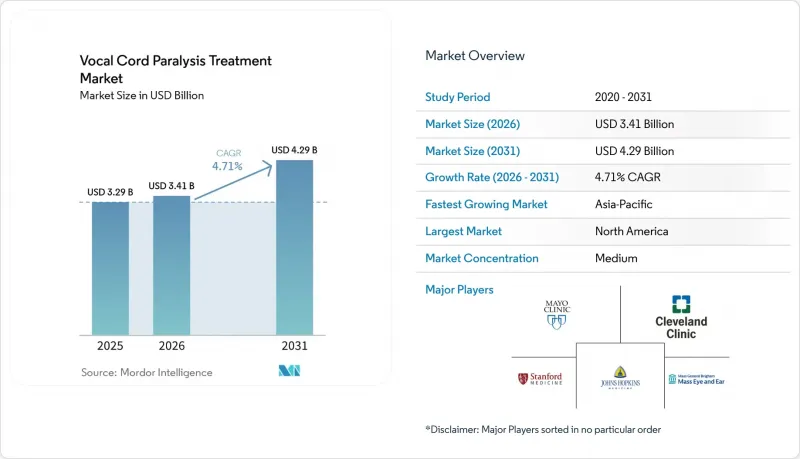
에 따르면 성대 마비 치료 시장 규모는 2025년에 32억 9,000만 달러로 평가되며, 2026년 34억 1,000만 달러에서 2031년까지 42억 9,000만 달러에 달할 것으로 예측되고 있으며, 예측 기간(2026-2031년)에 CAGR은 4.71%에 달할 전망입니다.
전 세계 성대 마비 치료 시장의 동향 및 인사이트
갑상선, 경추 및 심흉강 수술 건수 증가
갑상선, 부갑상선 및 경추 전방 수술 중 발생하는 의인성 손상은 여전히 성대 마비 치료 시장의 주요 유입 경로로 작용하고 있습니다. 갑상선 수술 후 후두신경 손상은 일시적 사례의 3%-8%, 영구적 사례의 1%-3%에서 발생하고 있습니다. 2025년에 실시된 무작위 임상시험에서는 개복 갑상선암 수술시 수술 중 신경 모니터링을 통해 일시적 마비 발생률이 10%에서 2%로 감소한 것으로 밝혀졌습니다. 또한 이 연구에서는 모니터링을 받은 환자의 목소리 회복이 약 11일 빨라진 것으로 나타났습니다. 모니터링 활용을 확대하는 것은 새로운 손상을 줄일 뿐만 아니라, 모니터링 장비, 근전도 대응 기관내 튜브 및 소프트웨어에 대한 수요도 촉진할 것입니다. 메드트로닉(Medtronic)사의 ‘Stealth AXiS’ 플랫폼을 포함한 로봇 수술 시스템 및 내비게이션 시스템과의 통합은 이러한 기술의 도입 장벽을 낮출 가능성이 있습니다.
증가하는 신경학적 및 악성 종양과 관련된 성대 기능 장애
성대 마비 치료 시장에서 신경학적 및 종양학 관련 사례는 외과적 외상으로 인한 사례보다 더 빠르게 증가하고 있습니다. 뇌졸중, 파킨슨병, 두경부 악성 종양은 후두회귀신경의 경로를 손상시키거나 압박할 가능성이 있습니다. 2024년에 3차 의료기관에서 실시한 연구에 따르면 사례의 32.9%에서 종양성 원인이, 8.2%에서 신경학적 요인이 확인되었습니다. 종양성 그룹에서 폐암이 가장 빈도가 높은 원발성 암이었습니다. 이러한 환자들은 수술 직후의 목소리 상실보다는 진행성 또는 변동성 증상을 보이는 경우가 많습니다. 진료 지연은 치료 부담을 가중시킬 수 있으므로, 신경내과 및 종양과 진료시 후두 선별 검사를 보다 면밀히 실시할 것을 권장합니다.
고액의 치료비와 보험 환급의 편차
보험 급여의 격차는 응급 기도 확보 처치가 가능한 경우에도 발성 치료에 대한 접근성에 큰 격차를 초래하고 있습니다. 2025년 연구에 따르면 발성 치료를 의뢰받은 환자의 거의 절반이 치료를 시작하지 않았습니다. 이 환자들이 꼽은 주요 이유는 보험이었습니다. 메디케이드 및 일부 민간 보험 플랜에서는 기능적 회복이 완료될 때까지의 세션 횟수가 제한될 수 있습니다. 또한 시설 중립형 지불 개혁으로 인해 병원에서 시행되는 내측 갑상연골 성형술에 대한 기존의 고액 보험 급여도 점차 축소되고 있습니다. CPT 31591 및 HCPCS L8607의 문서화 요건으로 인해 코딩 능력이 뛰어나고 진료 건수가 많은 진료소에 시술이 집중될 가능성이 있습니다.
부문 분석
2025년에는 일측 성대 마비가 이 유형 부문의 82.32%를 차지할 것으로 보이며, 2031년까지 연평균 성장률(CAGR) 5.12%로 확대될 것으로 예측됩니다. 성대 마비 치료 시장은 이 형태를 중심으로 전개되고 있으며, 그 이유는 사례 수가 가장 많고 여러 치료 경로가 존재하기 때문입니다. 이러한 치료법에는 일시적인 히알루론산 주입, 내측화 갑상연골 성형술, 후두 재신경화술이 포함되며, 각각 다른 의료기기나 재료가 사용됩니다. 5건의 연구에 걸쳐 967명의 환자를 대상으로 한 통합 분석에 따르면 일측성 사례는 양측성 사례보다 3배 더 높은 빈도로 발생하며, 그 주요 원인으로 의인성 수술 외상이 꼽히고 있습니다.
2025년, 성대 마비 치료 시장 규모의 68.32%를 외과적 치료가 차지했습니다. 여기에는 내측화 갑상연골 성형술, 주사를 통한 후두 성형술, 재신경화술, 성대 거근 내전술 및 기관절개술이 포함됩니다. 이러한 시술은 지속적인 기능 장애나 기도 확보가 어려운 경우에서 여전히 중요한 역할을 하고 있습니다. 2025년에 수행된 13건의 연구(환자 수 896명)를 대상으로 한 메타분석에서는 주사법을 이용한 후두 성형술과 내측화 갑상연골 성형술을 비교했습니다. 그 결과, 주요 발성 지표에서의 개선 정도는 동등한 것으로 나타났으나, 단기적인 지터(jitter) 개선에는 주사법을 이용한 후두 성형술이, 장기적인 시머(shimmer) 개선에는 갑상연골 성형술이 효과적인 것으로 밝혀졌습니다.
비수술적 치료는 2031년까지 연평균 성장률(CAGR) 5.82%로 확대될 것으로 예측됩니다. 디지털 및 원격 음성 치료는 성대 마비 치료 시장에서 전문 의료 센터의 범위를 넘어선 치료 제공을 가능하게 합니다. 2026년 연구에서는 Bridge2AI-Voice 데이터세트을 활용한 후두 병변 선별을 위한 고감도 AI 모델의 유효성이 검증되었습니다. 이 결과는 의료 서비스가 미치지 않는 지역에서의 원격의료 대응에 대한 평가를 지원합니다. 2026년 이비인후과 전문의 119명을 대상으로 실시된 조사에 따르면 한국과 대만에서는 주사를 이용한 후두 성형술이 선호되는 반면, 일본에서는 후두 골격 수술이 선호되는 것으로 나타났습니다.
지역별 분석
2025년, 북미는 지역별 매출의 40.32%를 차지했습니다. 이 지역의 성대 마비 치료 시장은 전문의 체계, 확립된 보험 환급 제도, 그리고 주입형 증량제의 보험 적용으로 인해 혜택을 받고 있습니다. 미국에는 많은 3차 의료 수준의 음성 센터가 존재하지만, 주요 대도시권 이외의 지역에서는 접근성에 편차가 있습니다. 병원 소개 지역의 63%에서 상근 이비인후과 전문의가 부재함에 따라 원격 음성 치료나 AI를 활용한 진료소에서의 진단이 지지를 받고 있습니다. 캐나다에서는 주요 학술 의료 센터에서 주요 시술이 이루어지고 있으며, 멕시코에서는 사립 병원이 이비인후과 수술 체계를 확충하고 있습니다.
유럽은 성대 마비 치료 시장에서 두 번째로 큰 규모를 자랑하는 지역이며, 독일, 프랑스, 영국, 이탈리아가 수요의 주축을 이루고 있습니다. 독일의 공식적인 음성 치료 체계는 진단 후 재활을 지원하고 있습니다. 아시아태평양은 2031년까지 연평균 성장률(CAGR) 6.45%로 성장할 것으로 예측되며, 성대 마비 치료 시장에서 가장 빠른 성장 속도를 보이는 지역입니다. 일본, 한국, 중국에서는 후두과 의사 커뮤니티가 확대되고 있으며, 치료법에 대한 인지도도 높아지고 있습니다. 2026년 조사에 따르면 일본에서는 후두 골격 수술이 선호되는 반면, 한국과 대만에서는 주사를 이용한 후두 성형술이 선호되는 것으로 나타났습니다.
기타 혜택:
- 엑셀 형식의 시장 예측(ME) 시트
- 3개월간의 애널리스트 지원
자주 묻는 질문
목차
제1장 서론
- 조사 전제조건과 시장 정의
- 조사 범위
제2장 조사 방법
제3장 개요
제4장 시장 구도
- 시장 개요
- 시장 성장 촉진요인
- 시장 성장 억제요인
- 밸류체인 분석
- 규제 상황
- 기술 전망
- Porter's Five Forces
제5장 시장 규모와 성장 예측
- 유형별
- 치료별
- 병인별
- 치료 제공자별
- 지역별
- 북미
- 미국
- 캐나다
- 멕시코
- 유럽
- 독일
- 영국
- 프랑스
- 이탈리아
- 스페인
- 기타 유럽 국가
- 아시아태평양
- 중국
- 인도
- 일본
- 호주
- 한국
- 기타 아시아태평양 국가
- 중동 및 아프리카
- GCC
- 남아프리카공화국
- 기타 중동 및 아프리카 국가
- 남미
- 브라질
- 아르헨티나
- 기타 남미 국가
- 북미
제6장 경쟁 구도
- 시장 집중도
- 시장 점유율 분석
- 기업 개요
- All India Institute of Medical Sciences
- Apollo Hospitals Enterprise Limited
- Charite-Universitatsmedizin Berlin
- Cleveland Clinic
- Johns Hopkins Medicine
- King Faisal Specialist Hospital and Research Centre
- Mass General Brigham
- Mayo Clinic
- Mount Sinai Health System
- NYU Langone Health
- Royal National Ear, Nose and Throat Hospital
- Sheba Medical Center
- Singapore General Hospital
- Stanford Health Care
- Toronto General Hospital
- UCSF Health
- University Hospital Heidelberg
- University Hospital Zurich
- University of Michigan Health
- University of Pittsburgh Medical Center
제7장 시장 기회와 향후 전망
KSA 26.10.23According to Mordor Intelligence, the vocal cord paralysis treatment market size was valued at USD 3.29 billion in 2025 and is estimated to grow from USD 3.41 billion in 2026 to reach USD 4.29 billion by 2031, at a CAGR of 4.71% during the forecast period (2026-2031).
Global Vocal Cord Paralysis Treatment Market Trends and Insights
Rising Volume of Thyroid, Cervical Spine and Cardiothoracic Surgery
Iatrogenic injury during thyroid, parathyroid, and anterior cervical spine procedures remains a major path into the vocal cord paralysis treatment market. Recurrent laryngeal nerve injury occurs in 3%-8% of temporary cases and 1%-3% of permanent cases after thyroid surgery.A 2025 randomized trial found that intraoperative neuromonitoring reduced temporary paralysis from 10% to 2% during open thyroid cancer surgery. The same study found that monitored patients recovered their voice nearly 11 days sooner. Wider monitoring use can reduce new injuries, but it also supports demand for monitoring hardware, electromyography endotracheal tubes, and software. Integration with robotic and navigation systems, including Medtronic's Stealth AXiS platform, may lower adoption barriers for these technologies.
Growing Neurological and Malignancy-Associated Vocal Fold Dysfunction
Neurological and oncology-related cases are expanding faster than surgical trauma cases in the vocal cord paralysis treatment market. Stroke, Parkinson's disease, and head and neck malignancies can impair or compress recurrent laryngeal nerve pathways. A 2024 tertiary-center study identified neoplastic causes in 32.9% of cases and neurological causes in 8.2% of cases. Lung cancer was the most frequent primary cancer within the neoplastic group. These patients often experience progressive or fluctuating symptoms rather than an immediate postsurgical loss of voice. Delayed presentation can increase treatment intensity and support closer laryngeal screening within neurology and oncology care.
High Procedure Costs and Reimbursement Variability
Reimbursement differences create major access gaps for voice therapy, even when emergency airway procedures remain available. A 2025 study found that nearly half of patients referred for voice therapy did not start treatment. Insurance was the primary reason cited by those patients. Medicaid and several commercial plans can limit the number of sessions before functional recovery is complete. Site-neutral payment reforms are also reducing the historic reimbursement premium for hospital-based medialization thyroplasty. Documentation requirements for CPT 31591 and HCPCS L8607 can concentrate procedures in high-volume practices with stronger coding capacity.
Other drivers and restraints analyzed in the detailed report include:
- Shift Toward Office-Based Injectable Laryngoplasty
- Earlier Intervention to Reduce Aspiration and Functional Loss
- Shortage of Laryngologists and Specialized Speech-Language Pathologists
For complete list of drivers and restraints, kindly check the Table Of Contents.
Segment Analysis
Unilateral vocal cord paralysis held 82.32% of the type segment in 2025 and is projected to expand at a 5.12% CAGR through 2031. The vocal cord paralysis treatment market centers on this form because it has the highest case frequency and several treatment routes. Those routes include temporary hyaluronic acid injection, medialization thyroplasty, and laryngeal reinnervation, each with different devices and materials. A pooled analysis of 967 patients across 5 studies found that unilateral cases occurred 3 times as often as bilateral cases, with iatrogenic surgical trauma as the leading cause.
Surgical treatment commanded 68.32% of the vocal cord paralysis treatment market size in 2025. It includes medialization thyroplasty, injection laryngoplasty, reinnervation, arytenoid adduction, and tracheotomy. These procedures remain important for persistent impairment or airway compromise. A 2025 meta-analysis of 896 patients across 13 studies compared injection laryngoplasty with medialization thyroplasty. It found comparable improvement in key voice measures, while injection laryngoplasty improved short-term jitter and thyroplasty improved long-term shimmer.
Non-surgical treatment is forecast to grow at a 5.82% CAGR through 2031. Digital and tele-speech therapy can extend care beyond specialist centers in the vocal cord paralysis treatment market. A 2026 study validated a high-sensitivity AI model for laryngeal lesion screening using the Bridge2AI-Voice dataset. The result supports telemedicine-ready assessment in underserved areas. A 2026 survey of 119 otorhinolaryngologists found that Korea and Taiwan favored injection laryngoplasty, while Japan favored laryngeal framework surgery.
Complete Report Scope:
- By Type
- Unilateral Vocal Cord Paralysis
- Left-Sided Unilateral Vocal Cord Paralysis
- Right-Sided Unilateral Vocal Cord Paralysis
- Bilateral Vocal Cord Paralysis
- Acute Bilateral Vocal Cord Paralysis
- Chronic Bilateral Vocal Cord Paralysis
- Unilateral Vocal Cord Paralysis
- By Treatment
- Surgical Treatment
- Medialization Thyroplasty
- Injection Laryngoplasty
- Laryngeal Reinnervation Surgery
- Arytenoid Adduction
- Tracheotomy
- Other Surgical Treatments
- Non-Surgical Treatment
- Voice Therapy
- Observation and Conservative Management
- Electromyography-Guided Treatment
- Digital and Tele-Speech Therapy
- Surgical Treatment
- By Etiology
- Surgical Trauma
- Neurological Disorders
- Malignancies
- Idiopathic and Post-Viral Conditions
- Trauma and Mechanical Injury
- Infections and Inflammatory Disorders
- Others
- By Treatment Provider
- Hospitals
- Ambulatory Surgical Centers
- Specialty ENT and Voice Clinics
- Rehabilitation Centers
- By Geography
- North America
- United States
- Canada
- Mexico
- Europe
- Germany
- United Kingdom
- France
- Italy
- Spain
- Rest of Europe
- Asia-Pacific
- China
- India
- Japan
- Australia
- South Korea
- Rest of Asia-Pacific
- Middle East and Africa
- GCC
- South Africa
- Rest of Middle East and Africa
- South America
- Brazil
- Argentina
- Rest of South America
- North America
Geography Analysis
North America held 40.32% of regional revenue in 2025. The vocal cord paralysis treatment market benefits in the region from specialist capacity, established reimbursement, and coverage for injectable bulking agents. The United States has many tertiary voice centers but uneven access beyond major metropolitan areas. The lack of an active primary laryngologist in 63% of hospital referral regions supports tele-speech therapy and AI-enabled office diagnostics. Canada covers core procedures at major academic centers, while Mexico's private hospitals are expanding ENT surgical capacity.
Europe is the second-largest regional area in the vocal cord paralysis treatment market, with Germany, France, the United Kingdom, and Italy anchoring demand. Germany's formal voice therapy framework supports rehabilitation after diagnosis. Asia-Pacific is projected to grow at a 6.45% CAGR through 2031, the fastest regional pace in the vocal cord paralysis treatment market. Japan, South Korea, and China have expanding laryngology communities and rising procedure awareness. A 2026 survey found that Japan preferred laryngeal framework surgery, while Korea and Taiwan preferred injection laryngoplasty.
- All India Institute of Medical Sciences
- Apollo Hospitals Enterprise Limited
- Charite - Universitatsmedizin Berlin
- Cleveland Clinic
- Johns Hopkins Medicine
- King Faisal Specialist Hospital and Research Centre
- Mass General Brigham
- Mayo Clinic
- Mount Sinai Health System
- NYU Langone Health
- Royal National Ear, Nose and Throat Hospital
- Sheba Medical Center
- Singapore General Hospital
- Stanford Health Care
- Toronto General Hospital
- UCSF Health
- University Hospital Heidelberg
- University Hospital Zurich
- University of Michigan Health
- University of Pittsburgh Medical Center
Additional Benefits:
- The market estimate (ME) sheet in Excel format
- 3 months of analyst support
TABLE OF CONTENTS
1 Introduction
- 1.1 Study Assumptions & Market Definition
- 1.2 Scope of the Study
2 Research Methodology
3 Executive Summary
4 Market Landscape
- 4.1 Market Overview
- 4.2 Market Drivers
- 4.2.1 Rising Volume of Thyroid, Cervical Spine and Cardiothoracic Surgery
- 4.2.2 Growing Neurological and Malignancy-Associated Vocal Fold Dysfunction
- 4.2.3 Shift Toward Office-Based Injectable Laryngoplasty
- 4.2.4 Earlier Intervention to Reduce Aspiration and Functional Loss
- 4.2.5 Continuous Recurrent Laryngeal Nerve Monitoring Adoption
- 4.2.6 AI-Assisted Laryngeal Imaging and Voice Assessment
- 4.3 Market Restraints
- 4.3.1 High Procedure Costs and Reimbursement Variability
- 4.3.2 Shortage of Laryngologists and Specialized Speech-Language Pathologists
- 4.3.3 Variable Recovery and Treatment Outcomes
- 4.3.4 Limited Interoperability of Voice, Imaging and Outcome Data
- 4.4 Value Chain Analysis
- 4.5 Regulatory Landscape
- 4.6 Technological Outlook
- 4.7 Porter's Five Forces
- 4.7.1 Threat of New Entrants
- 4.7.2 Bargaining Power of Suppliers
- 4.7.3 Bargaining Power of Buyers
- 4.7.4 Threat of Substitutes
- 4.7.5 Industry Rivalry
5 Market Size & Growth Forecasts (Value, USD)
- 5.1 By Type
- 5.1.1 Unilateral Vocal Cord Paralysis
- 5.1.1.1 Left-Sided Unilateral Vocal Cord Paralysis
- 5.1.1.2 Right-Sided Unilateral Vocal Cord Paralysis
- 5.1.2 Bilateral Vocal Cord Paralysis
- 5.1.2.1 Acute Bilateral Vocal Cord Paralysis
- 5.1.2.2 Chronic Bilateral Vocal Cord Paralysis
- 5.1.1 Unilateral Vocal Cord Paralysis
- 5.2 By Treatment
- 5.2.1 Surgical Treatment
- 5.2.1.1 Medialization Thyroplasty
- 5.2.1.2 Injection Laryngoplasty
- 5.2.1.3 Laryngeal Reinnervation Surgery
- 5.2.1.4 Arytenoid Adduction
- 5.2.1.5 Tracheotomy
- 5.2.1.6 Other Surgical Treatments
- 5.2.2 Non-Surgical Treatment
- 5.2.2.1 Voice Therapy
- 5.2.2.2 Observation and Conservative Management
- 5.2.2.3 Electromyography-Guided Treatment
- 5.2.2.4 Digital and Tele-Speech Therapy
- 5.2.1 Surgical Treatment
- 5.3 By Etiology
- 5.3.1 Surgical Trauma
- 5.3.2 Neurological Disorders
- 5.3.3 Malignancies
- 5.3.4 Idiopathic and Post-Viral Conditions
- 5.3.5 Trauma and Mechanical Injury
- 5.3.6 Infections and Inflammatory Disorders
- 5.3.7 Others
- 5.4 By Treatment Provider
- 5.4.1 Hospitals
- 5.4.2 Ambulatory Surgical Centers
- 5.4.3 Specialty ENT and Voice Clinics
- 5.4.4 Rehabilitation Centers
- 5.5 By Geography
- 5.5.1 North America
- 5.5.1.1 United States
- 5.5.1.2 Canada
- 5.5.1.3 Mexico
- 5.5.2 Europe
- 5.5.2.1 Germany
- 5.5.2.2 United Kingdom
- 5.5.2.3 France
- 5.5.2.4 Italy
- 5.5.2.5 Spain
- 5.5.2.6 Rest of Europe
- 5.5.3 Asia-Pacific
- 5.5.3.1 China
- 5.5.3.2 India
- 5.5.3.3 Japan
- 5.5.3.4 Australia
- 5.5.3.5 South Korea
- 5.5.3.6 Rest of Asia-Pacific
- 5.5.4 Middle East and Africa
- 5.5.4.1 GCC
- 5.5.4.2 South Africa
- 5.5.4.3 Rest of Middle East and Africa
- 5.5.5 South America
- 5.5.5.1 Brazil
- 5.5.5.2 Argentina
- 5.5.5.3 Rest of South America
- 5.5.1 North America
6 Competitive Landscape
- 6.1 Market Concentration
- 6.2 Market Share Analysis
- 6.3 Company Profiles (includes Global level Overview, Market level overview, Core Segments, Financials as available, Strategic Information, Market Rank/Share for key companies, Products & Services, and Recent Developments)
- 6.3.1 All India Institute of Medical Sciences
- 6.3.2 Apollo Hospitals Enterprise Limited
- 6.3.3 Charite - Universitatsmedizin Berlin
- 6.3.4 Cleveland Clinic
- 6.3.5 Johns Hopkins Medicine
- 6.3.6 King Faisal Specialist Hospital and Research Centre
- 6.3.7 Mass General Brigham
- 6.3.8 Mayo Clinic
- 6.3.9 Mount Sinai Health System
- 6.3.10 NYU Langone Health
- 6.3.11 Royal National Ear, Nose and Throat Hospital
- 6.3.12 Sheba Medical Center
- 6.3.13 Singapore General Hospital
- 6.3.14 Stanford Health Care
- 6.3.15 Toronto General Hospital
- 6.3.16 UCSF Health
- 6.3.17 University Hospital Heidelberg
- 6.3.18 University Hospital Zurich
- 6.3.19 University of Michigan Health
- 6.3.20 University of Pittsburgh Medical Center
7 Market Opportunities & Future Outlook
- 7.1 White-space & unmet-need assessment


