

|
시장보고서
상품코드
2154330
IVD 시약 : 시장 점유율 분석, 업계 동향과 통계, 성장 예측(2026-2031년)IVD Reagents - Market Share Analysis, Industry Trends & Statistics, Growth Forecasts (2026 - 2031) |
||||||
 Mordor Intelligence
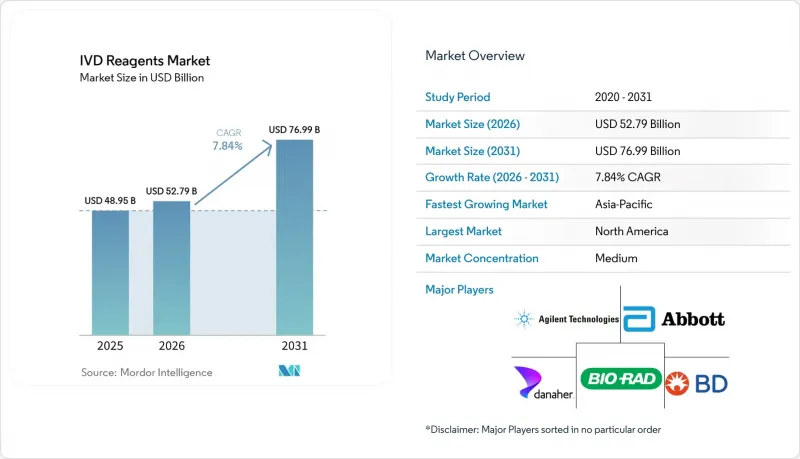
에 따르면 IVD 시약 시장 규모는 2025년 489억 5,000만 달러에서 2026년에는 527억 9,000만 달러로 확대하며, 2026-2031년에 CAGR 7.84%로 추이하며, 2031년까지 769억 9,000만 달러에 달할 것으로 예측됩니다.
전 세계 IVD 시약 시장의 동향 및 인사이트
고령화와 만성질환 검사 수요
IVD 시약 시장은 정기적인 선별 검사나 질환 모니터링이 필요한 고령 환자들로부터 안정적인 수요를 얻고 있습니다. 세계보건기구(WHO)의 예측에 따르면 2030년까지 전 세계 인구의 6명 중 1명이 60세 이상이 될 것으로 전망됩니다. 또한 80세 이상 인구는 2050년까지 4억 2,600만 명에 달해 2020년 대비 3배로 증가할 것으로 예측됩니다. 이러한 환자들은 당뇨병, 심혈관 질환, 암 진단을 위해 혈액 검사, 면역 분석, 바이오마커 검사를 반복적으로 받아야 합니다. 2025년 조사에 따르면 2021년 비감염성 질환으로 인한 고령자 사망자 수는 3,468만 명이었으며, 2050년까지 고령자의 비감염성 질환 유병률은 10만 명당 100,026건에 달할 것으로 예측됩니다. 일본, 한국, 서유럽에서는 고령 인구가 급속히 증가하고 있으며, 특히 강한 수요가 예상됩니다. 공급업체는 일차 진료 경로나 정기적인 질환 관리에 적합한 검사 패키지를 제공함으로써 이러한 수요에 대응할 수 있습니다.
분자 진단의 확대
분자 진단용 시약은 현재 호흡기 계통 검사에 그치지 않고, 종양 프로파일링, 패혈증 검출 및 항생제 내성 감시에도 활용되고 있습니다. 이에 따라 체외 진단용 시약(IVD) 시장은 팬데믹 기간 중 나타났던 일시적인 수요 패턴을 넘어 확대되고 있습니다. 미국 식품의약국(FDA)은 2024년, 실험실 개발 검사(LDT)로 제공되는 체외진단 검사를 의료기기로 취급하는 최종 규정을 공표했으며, 그 시행의 1단계는 2025년 5월부터 시작됩니다. 따라서 승인된 시판 키트를 사용하는 검사 기관은 병원내 조제에 의존하는 검사 기관에 비해 규정 준수 경로가 더 명확해질 가능성이 있습니다. 검사 기관이 검증된 키트를 채택하면 관련 기기 플랫폼을 표준화하는 경우가 많습니다. 이를 통해 도입된 기기의 수명 기간 중 시약의 지속적인 구매가 촉진됩니다. 따라서 IVD 시약 시장에서 확고한 임상적 근거와 규제 당국의 지지를 받는 분자진단 공급업체는 종양학 및 감염증 검사 프로그램을 대응하는 데 있으며, 더 유리한 입장에 있습니다.
IVDR, FDA 및 임상 검증의 부담
유럽 체외진단 의료기기 규정(IVDR)은 공급업체가 시중에 유통되는 대부분의 제품에 대해 과학적 타당성 및 분석 성능에 대한 증거를 제시할 것을 요구하고 있습니다. 규정 EU 2024/1860에 따라 일부 분류에 대해서는 이동 기간이 2027-2029년까지 연장되었으나, 기술 문서 및 인증 기관의 심사에 대해서는 여전히 엄격한 요건이 부과되고 있습니다. 스페인은 2025년 10월, 해당 규정을 국내에 적용하기 위해 지정 기관과의 연계, 시판 후 조사 및 등록 제도에 관한 규정을 포함한 왕령 제942/2025호를 공포했습니다. 또한 IVD 시약 시장은 미국의 FDA가 단계적으로 시행하는 ‘실험실 개발 검사(LDT) 규정’에도 대응해야 합니다. 중소규모 기업은 상품화에 이르기까지 개발 기간의 장기화나 비용 증가에 직면할 가능성이 있습니다. 현재 ISO 13485 및 ISO 15189의 운영은 많은 조달 및 검사실 현장에서 기본적인 요건으로 자리 잡고 있습니다. 이러한 요건은 이미 규제, 품질 및 임상 지원 체계를 갖추고 있는 공급업체에게 유리하게 작용할 가능성이 있습니다.
부문 분석
2025년, 항체는 IVD 시약 시장 점유율의 36.51%를 차지했습니다. 이들은 면역측정법, 래터럴 플로우 방식의 현장 진단(POCT), 그리고 면역조직화학적 동반 진단 패널에서 폭넓게 사용되고 있습니다. 표적 특이성이 높기 때문에 많은 검증된 워크플로우에서 대체하기 어렵습니다. 정제 단백질 및 펩티드는 임상화학 및 면역측정 절차를 위해 기준 물질, 교정 물질, 품질관리 물질, 기능성 시약을 제공합니다. 이러한 역할은 시설 간 일관된 측정을 요구하는 검사실에 의해 지원되고 있습니다. 항원은 감염병의 혈청학적 검사 및 자가면역 검사에서 여전히 중요한 역할을 수행하고 있습니다. 팬데믹 기간이 지난 후에도 병원체 감시 프로그램이 이러한 요구 사항을 지속적으로 지원하고 있습니다. 신뢰할 수 있는 일상적인 검사를 위해서는 엄격하게 관리된 분석 투입 물질이 필요하므로 IVD 시약 업계는 이러한 물질에 의존하고 있습니다.
올리고뉴클레오티드 및 핵산 프로브는 2031년까지 연평균 성장률(CAGR) 8.23%로 성장할 것으로 예측됩니다. 이들은 PCR 패널, 차세대 염기서열 분석용 라이브러리 준비, 그리고 새롭게 등장하는 CRISPR 기반 검출 시스템을 지원하고 있습니다. 이러한 수요는 감염병 검사, 암 프로파일링, 그리고 동반 진단의 개발과 밀접하게 연관되어 있습니다. 공급 안정성을 확보하기 위해 현지에서의 합성 및 Fill-finish 능력의 중요성이 점점 더 커지고 있습니다. 유럽 및 미국의 정책 논의에서는 핵산 합성이 중요한 의료용 원자재로 자리매김하고 있습니다. 이에 따라 지역적 생산 파트너십에 대한 관심이 높아지고 있습니다. 효소, 완충액, 그리고 독자적으로 배합된 시약 칵테일 또한 자동화된 고처리량 시스템을 지원하고 있습니다. 이러한 제품들은 항체나 프로브만큼 주목받지는 않지만, 많은 검사실에서 업무의 기반을 형성하고 있습니다.
2026년에는 면역측정 및 면역화학이 매출의 32.48%를 차지했습니다. 이 부문은 센트럴 랩 및 분산형 검사 환경에서 자가면역 질환, 호르몬, 심장 질환, 감염증 검사를 포괄합니다. 면역측정용 IVD 시약 시장의 규모는 반복적인 모니터링이 필요한 광범위한 질환들에 의해 지원되고 있습니다. 통합형 화학·면역측정 플랫폼은 여전히 실험실 설비 투자에서 중심적인 위치를 차지하고 있습니다. 로슈는 2026년 3월, cobas c703 및 cobas ISE neo 기기에 대해 FDA의 510(k) 승인을 획득했습니다. 로슈에 따르면 cobas ISE neo는 시간당 최대 1,800건의 검사를 처리할 수 있으며, 수작업과 시약 낭비를 줄이기 위한 자동 유지보수 기능을 갖추고 있다고 합니다. 혈액학 및 임상화학은 여전히 핵심 검사의 확고한 기반을 이루고 있습니다. 이러한 검사는 반복적으로 수행되므로 시약 대여 및 완전 자동화 계약에서 중요한 역할을 하고 있습니다.
분자 진단 시장은 2031년까지 연평균 성장률(CAGR) 8.91%로 성장할 것으로 예측됩니다. 종양 프로파일링, 증후군성 감염증 패널, 약리유전체 동반 진단 분석법은 각각 지속적인 수요 원천이 되고 있습니다. 이러한 사용 사례에는 전문적인 화학 기술과 지속적인 임상 검증이 모두 요구됩니다. 일부 종양 동반 진단제에 대한 미국의 분류 변경이 최종 확정되면, 특정 시판 전 승인 신청의 부담이 완화될 가능성이 있습니다. 이를 통해 소규모 분자 분석법 개발 기업에 대한 접근성이 확대될 수 있습니다. 유세포분석 및 응고 검사용 시약은 전문적인 혈액종양학 및 지혈 분야에서 여전히 중요한 역할을 하고 있습니다. 이러한 임상적 특이성은 가격 유지에 기여할 가능성이 있습니다. IVD 시약 시장은 높은 임상적 가치와 명확한 검사 워크플로우상 이점을 겸비한 기술로 전환되고 있습니다.
지역별 분석
2025년, 북미는 IVD 시약 시장 점유율의 38.15%를 차지했습니다. 이 지역의 IVD 시약 시장은 분자 검사 및 동반 진단 분야에서 탄탄한 기반을 갖추고 있습니다. FDA의 ‘실험실 개발 검사(LDT) 규정’에 따라 실험실은 기존에 자체 개발한 검사법을 사용하던 워크플로우에 대해 검증된 시판 제품을 평가하도록 권장받고 있습니다. 애보트 래버러토리스는 2026년 3월, 기업 가치 230억 달러에 엑사크트 사이언시스(Exact Sciences)의 인수를 완료했습니다. 로슈는 전립선 선암에서 PTEN 단백질의 소실을 확인하기 위한 ‘VENTANA PTEN SP218 RxDx’ 분석법에 대해 2026년 6월 FDA 승인을 획득했습니다.
유럽은 두 번째로 큰 지역 그룹이며, IVDR의 틀 아래에서 국가별로 차이가 나타납니다. 독일은 2025년에 23억 8,000만 유로의 IVD 매출을 기록했습니다. 이는 제시된 평균 환율을 적용해 환산하면 26억 달러에 해당하며, 그 중 82%를 시약 및 검사 키트가 차지했습니다. 이 나라의 매출은 규정 준수 비용과 환급 조건이 성장에 영향을 미친 탓에 전년 대비 0.8% 감소했습니다. 스페인은 2025년 10월에 국내 IVDR 규정을 채택했습니다. 유럽의 IVD 시약 시장은 바이오메륨(BioMerieux)사가 프랑스에 건설을 계획 중인 BIOFIRE PCR 시설로부터도 혜택을 받고 있으며, 이 프로젝트에는 2억 5,000만 유로가 넘는 투자가 이루어졌는데, 제시된 환율을 적용하면 2억 7,000만 미달러에 해당합니다.
아시아태평양은 2031년까지 연평균 성장률(CAGR) 10.57%로 성장할 것으로 예측됩니다. IVD 시약 시장은 수량 기준 조달, 검사실 네트워크 확대, 그리고 지역 전반에 걸친 디지털 헬스 이용 확대에 힘입어 성장하고 있습니다. 인도의 민간 검사 기관 체인과 정부 보건 프로그램은 표준화된 면역 분석법 및 분자 진단 제품에 대한 수요를 지원하고 있습니다. 서모피셔는 라틴아메리카 고객을 대상으로 분자 진단 시약 생산을 확대하기 위해 2026년 브라질 바루리에 제조 시설을 개설했습니다.
기타 혜택:
- 엑셀 형식의 시장 예측(ME) 시트
- 3개월간의 애널리스트 지원
목차
제1장 서론
- 조사 전제조건과 시장 정의
- 조사 범위
제2장 조사 방법
제3장 개요
제4장 시장 구도
- 시장 개요
- 시장 성장 촉진요인
- 시장 성장 억제요인
- 공급망 분석
- 규제 상황
- 기술 전망
- Porter's Five Forces 분석
제5장 시장 규모와 성장 예측
- 시약 유형별
- 기술별
- 용도별
- 최종사용자별
- 지역별
- 북미
- 미국
- 캐나다
- 멕시코
- 유럽
- 독일
- 영국
- 프랑스
- 이탈리아
- 스페인
- 기타 유럽 국가
- 아시아태평양
- 중국
- 인도
- 일본
- 호주
- 한국
- 기타 아시아태평양 국가
- 중동 및 아프리카
- GCC
- 남아프리카공화국
- 기타 중동 및 아프리카 국가
- 남미
- 브라질
- 아르헨티나
- 기타 남미 국가
- 북미
제6장 경쟁 구도
- 시장 집중도
- 시장 점유율 분석
- 기업 개요
- Abbott Laboratories
- Agilent Technologies, Inc.
- Becton, Dickinson and Company
- bioMerieux SA
- Bio-Rad Laboratories, Inc.
- Danaher Corporation
- DiaSorin S.p.A.
- DiaSys Diagnostic Systems GmbH
- F. Hoffmann-La Roche Ltd
- Grifols, S.A.
- Hologic, Inc.
- Illumina, Inc.
- QIAGEN N.V.
- QuidelOrtho Corporation
- Randox Laboratories Ltd
- Revvity, Inc.
- Siemens Healthineers AG
- Sysmex Corporation
- Thermo Fisher Scientific Inc.
- Werfen, S.A.
제7장 시장 기회와 향후 전망
KSAAccording to Mordor Intelligence, the IVD reagents market size is expected to grow from USD 48.95 billion in 2025 to USD 52.79 billion in 2026 and is forecast to reach USD 76.99 billion by 2031 at 7.84% CAGR over 2026-2031.
Global IVD Reagents Market Trends and Insights
Aging Population and Chronic Disease Testing Demand
The IVD reagents market draws steady volume from older patients who need regular screening and disease monitoring. The World Health Organization expects 1 in 6 people worldwide to be aged 60 years or older by 2030. It also expects the population aged 80 years and over to reach 426 million by 2050, or 3 times its 2020 level. These patients often require recurring hematology, immunoassay, and biomarker testing for diabetes, cardiovascular conditions, and cancer. A 2025 study reported 34.68 million deaths among older people from noncommunicable diseases in 2021 and projected elderly noncommunicable disease prevalence of 100,026 cases per 100,000 people by 2050. Japan, South Korea, and Western Europe face especially strong demand because their older populations are expanding quickly. Suppliers can respond with testing bundles that suit primary care pathways and recurring disease management.
Expansion of Molecular Diagnostics
Molecular diagnostic reagents now serve oncology profiling, sepsis detection, and antimicrobial resistance surveillance beyond respiratory testing. This broadens the IVD reagents market beyond the temporary demand pattern seen during the pandemic. The U.S. Food and Drug Administration issued a final rule in 2024 that treats in vitro diagnostic tests offered as laboratory-developed tests as devices, with the first stage of enforcement beginning in May 2025. Laboratories using cleared commercial kits may therefore face a clearer compliance path than laboratories relying on in-house formulations. Once a laboratory adopts a validated kit, it often standardizes the associated instrument platform. This can support repeat reagent purchases over the life of the installed base. Molecular suppliers in the IVD reagents market with strong clinical evidence and regulatory support are therefore better placed to serve oncology and infectious disease testing programs.
IVDR, FDA, and Clinical-Validation Burden
Europe's In Vitro Diagnostic Regulation requires suppliers to provide scientific validity and analytical performance evidence for most marketed products. Regulation EU 2024/1860 extended transition periods for some classes until 2027 to 2029, but technical documentation and notified body review remain demanding. Spain published Real Decreto 942/2025 in October 2025 to apply the regulation nationally, with provisions on notified body engagement, post-market surveillance, and registries. The IVD reagents market must also respond to the FDA's phased laboratory-developed test rule in the United States. Smaller companies can face longer development schedules and greater spending before commercialization. ISO 13485 and ISO 15189 practices now act as baseline expectations in many procurement and laboratory settings. These demands can favor suppliers that already maintain regulatory, quality, and clinical support capabilities.
Other drivers and restraints analyzed in the detailed report include:
- Decentralization of Testing Through Point-of-Care Platforms
- Core-Laboratory Automation and Network Consolidation
- Reimbursement and Tender-Driven Price Compression
For complete list of drivers and restraints, kindly check the Table Of Contents.
Segment Analysis
Antibodies held 36.51% of IVD reagents market share in 2025. They are used across immunoassays, lateral flow point-of-care tests, and immunohistochemistry companion diagnostic panels. Their target specificity makes substitution difficult in many validated workflows. Purified proteins and peptides provide reference materials, calibrators, quality controls, and functional reagents for clinical chemistry and immunoassay procedures. Their role is supported by laboratories seeking consistent measurement across sites. Antigens remain important in infectious disease serology and autoimmune testing. Pathogen surveillance programs continue to support this requirement after the pandemic period. The IVD reagents industry depends on these materials because reliable routine testing requires closely controlled assay inputs.
Oligonucleotides and nucleic acid probes are projected to grow at an 8.23% CAGR through 2031. They support PCR panels, next-generation sequencing library preparation, and emerging CRISPR-based detection systems. Their demand is closely linked to infectious disease testing, cancer profiling, and companion diagnostic development. Local synthesis and fill-finish capacity are becoming more important for supply security. European and U.S. policy discussions have identified nucleic acid synthesis as an important healthcare input. This supports interest in regional production partnerships. Enzymes, buffers, and proprietary reagent cocktails also support automated high-throughput systems. These products form the working basis for many laboratories even when they receive less attention than antibodies or probes.
Immunoassay and immunochemistry held 32.48% of revenue in 2026. The segment covers autoimmune, hormone, cardiac, and infectious disease testing in both central laboratories and decentralized settings. The IVD reagents market size for immunoassay is sustained by the wide range of conditions that require repeated monitoring. Integrated chemistry and immunoassay platforms remain central to laboratory capital spending. Roche received FDA 510(k) clearance in March 2026 for the cobas c703 and cobas ISE neo units. Roche stated that the cobas ISE neo can complete up to 1,800 tests per hour and includes automated maintenance functions intended to reduce hands-on work and reagent waste. Hematology and clinical chemistry remain established foundations of core laboratory testing. Their recurring use makes them important to reagent rental and total automation contracts.
Molecular diagnostics is forecast to grow at an 8.91% CAGR through 2031. Oncology profiling, syndromic infectious disease panels, and pharmacogenomic companion assays each add a durable source of demand. These use cases require both specialized chemistry and sustained clinical validation. A possible change in U.S. classification for some oncology companion diagnostics could reduce the burden of certain premarket submissions if finalized. That could widen access for smaller molecular assay developers. Flow cytometry and coagulation reagents remain important for specialized hematology-oncology and hemostasis work. Their clinical specificity can help sustain pricing. The IVD reagents market is moving toward technologies that combine high clinical value with clear laboratory workflow benefits.
Complete Report Scope:
- By Type of Reagent
- Antibodies
- Purified Proteins and Peptides
- Antigens
- Oligonucleotides and Nucleic Acid Probes
- Others
- By Technology
- Hematology
- Clinical Chemistry
- Molecular Diagnostics
- Immunoassay and Immunochemistry
- Others
- By Application
- Infectious Diseases
- Oncology
- Cardiology
- Endocrinology and Diabetes
- Autoimmune Diseases and Inflammation
- Others
- By End User
- Hospitals & Clinics
- Clinical Laboratories
- Blood Banks
- Home Care Settings
- Pharmaceutical & Biotechnology
- Others
- By Geography
- North America
- United States
- Canada
- Mexico
- Europe
- Germany
- United Kingdom
- France
- Italy
- Spain
- Rest of Europe
- Asia-Pacific
- China
- India
- Japan
- Australia
- South Korea
- Rest of Asia-Pacific
- Middle East and Africa
- GCC
- South Africa
- Rest of Middle East and Africa
- South America
- Brazil
- Argentina
- Rest of South America
- North America
Geography Analysis
North America held 38.15% of the IVD reagents market share in 2025. The IVD reagents market in the region has a strong base in molecular testing and companion diagnostics. The FDA laboratory developed test rule is encouraging laboratories to assess validated commercial products for workflows that have used in-house assays. Abbott Laboratories completed the Exact Sciences acquisition in March 2026 at an enterprise value of USD 23 billion. Roche received FDA approval in June 2026 for the VENTANA PTEN SP218 RxDx assay for identifying PTEN protein loss in prostate adenocarcinoma.
Europe is the second-largest regional grouping, with national differences operating under the IVDR framework. Germany recorded EUR 2.38 billion in IVD revenue in 2025, equal to USD 2.6 billion using the supplied average conversion, and reagents and test kits represented 82% of that value. The country's revenue declined 0.8% from the prior year as compliance costs and reimbursement conditions affected growth. Spain adopted its national IVDR rules in October 2025. The IVD reagents market in Europe also benefits from bioMerieux's planned BIOFIRE PCR facility in France, supported by an investment exceeding EUR 250 million, equal to USD 270 million, using the supplied conversion.
Asia-Pacific is forecast to grow at a 10.57% CAGR through 2031. The IVD reagents market is supported by volume-based procurement, expanding laboratory networks, and growing digital health use across the region. India's private laboratory chains and government health programs support demand for standardized immunoassay and molecular products. Thermo Fisher opened a Barueri manufacturing facility in Brazil in 2026 to expand molecular reagent production for Latin American customers.
- Abbott Laboratories
- Agilent Technologies
- Beckton Dickinson
- bioMerieux
- Bio-Rad Laboratories
- Danaher
- DiaSorin
- DiaSys Diagnostic Systems
- Roche
- Grifols
- Hologic
- Illumina
- QIAGEN
- QuidelOrtho
- Randox Laboratories
- Revvity, Inc.
- Siemens Healthineers
- Sysmex
- Thermo Fisher Scientific
- Werfen, S.A.
Additional Benefits:
- The market estimate (ME) sheet in Excel format
- 3 months of analyst support
TABLE OF CONTENTS
1 Introduction
- 1.1 Study Assumptions & Market Definition
- 1.2 Scope of the Study
2 Research Methodology
3 Executive Summary
4 Market Landscape
- 4.1 Market Overview
- 4.2 Market Drivers
- 4.2.1 Aging Population and Chronic Disease Testing Demand
- 4.2.2 Expansion of Molecular Diagnostics
- 4.2.3 Decentralization of Testing Through Point-of-Care Platforms
- 4.2.4 Core-Laboratory Automation and Network Consolidation
- 4.2.5 Personalized Medicine and Companion-Diagnostic Adoption
- 4.2.6 Ambient-Stable Reagents and Local Fill-Finish Capacity
- 4.3 Market Restraints
- 4.3.1 IVDR, FDA, and Clinical-Validation Burden
- 4.3.2 Reimbursement and Tender-Driven Price Compression
- 4.3.3 Lot-to-Lot Variability and Cold-Chain Dependence
- 4.3.4 Skilled Workforce and Assay-Interpretation Bottlenecks
- 4.4 Supply-Chain Analysis
- 4.5 Regulatory Landscape
- 4.6 Technological Outlook
- 4.7 Porter's Five Forces Analysis
- 4.7.1 Threat of New Entrants
- 4.7.2 Bargaining Power of Suppliers
- 4.7.3 Bargaining Power of Buyers
- 4.7.4 Threat of Substitutes
- 4.7.5 Competitive Rivalry
5 Market Size & Growth Forecasts (Value, USD)
- 5.1 By Type of Reagent
- 5.1.1 Antibodies
- 5.1.2 Purified Proteins and Peptides
- 5.1.3 Antigens
- 5.1.4 Oligonucleotides and Nucleic Acid Probes
- 5.1.5 Others
- 5.2 By Technology
- 5.2.1 Hematology
- 5.2.2 Clinical Chemistry
- 5.2.3 Molecular Diagnostics
- 5.2.4 Immunoassay and Immunochemistry
- 5.2.5 Others
- 5.3 By Application
- 5.3.1 Infectious Diseases
- 5.3.2 Oncology
- 5.3.3 Cardiology
- 5.3.4 Endocrinology and Diabetes
- 5.3.5 Autoimmune Diseases and Inflammation
- 5.3.6 Others
- 5.4 By End User
- 5.4.1 Hospitals & Clinics
- 5.4.2 Clinical Laboratories
- 5.4.3 Blood Banks
- 5.4.4 Home Care Settings
- 5.4.5 Pharmaceutical & Biotechnology
- 5.4.6 Others
- 5.5 By Geography
- 5.5.1 North America
- 5.5.1.1 United States
- 5.5.1.2 Canada
- 5.5.1.3 Mexico
- 5.5.2 Europe
- 5.5.2.1 Germany
- 5.5.2.2 United Kingdom
- 5.5.2.3 France
- 5.5.2.4 Italy
- 5.5.2.5 Spain
- 5.5.2.6 Rest of Europe
- 5.5.3 Asia-Pacific
- 5.5.3.1 China
- 5.5.3.2 India
- 5.5.3.3 Japan
- 5.5.3.4 Australia
- 5.5.3.5 South Korea
- 5.5.3.6 Rest of Asia-Pacific
- 5.5.4 Middle East and Africa
- 5.5.4.1 GCC
- 5.5.4.2 South Africa
- 5.5.4.3 Rest of Middle East and Africa
- 5.5.5 South America
- 5.5.5.1 Brazil
- 5.5.5.2 Argentina
- 5.5.5.3 Rest of South America
- 5.5.1 North America
6 Competitive Landscape
- 6.1 Market Concentration
- 6.2 Market Share Analysis
- 6.3 Company Profiles (includes Global Level Overview, Market Level Overview, Core Segments, Financials as Available, Strategic Information, Market Rank/Share, Products & Services, and Recent Developments)
- 6.3.1 Abbott Laboratories
- 6.3.2 Agilent Technologies, Inc.
- 6.3.3 Becton, Dickinson and Company
- 6.3.4 bioMerieux SA
- 6.3.5 Bio-Rad Laboratories, Inc.
- 6.3.6 Danaher Corporation
- 6.3.7 DiaSorin S.p.A.
- 6.3.8 DiaSys Diagnostic Systems GmbH
- 6.3.9 F. Hoffmann-La Roche Ltd
- 6.3.10 Grifols, S.A.
- 6.3.11 Hologic, Inc.
- 6.3.12 Illumina, Inc.
- 6.3.13 QIAGEN N.V.
- 6.3.14 QuidelOrtho Corporation
- 6.3.15 Randox Laboratories Ltd
- 6.3.16 Revvity, Inc.
- 6.3.17 Siemens Healthineers AG
- 6.3.18 Sysmex Corporation
- 6.3.19 Thermo Fisher Scientific Inc.
- 6.3.20 Werfen, S.A.
7 Market Opportunities & Future Outlook
- 7.1 White-space & Unmet-need Assessment


