

|
시장보고서
상품코드
2154341
소매 연료 저장 탱크 : 시장 점유율 분석, 업계 동향과 통계, 성장 예측(2026-2031년)Retail Fuel Storage Tanks - Market Share Analysis, Industry Trends & Statistics, Growth Forecasts (2026 - 2031) |
||||||
 Mordor Intelligence
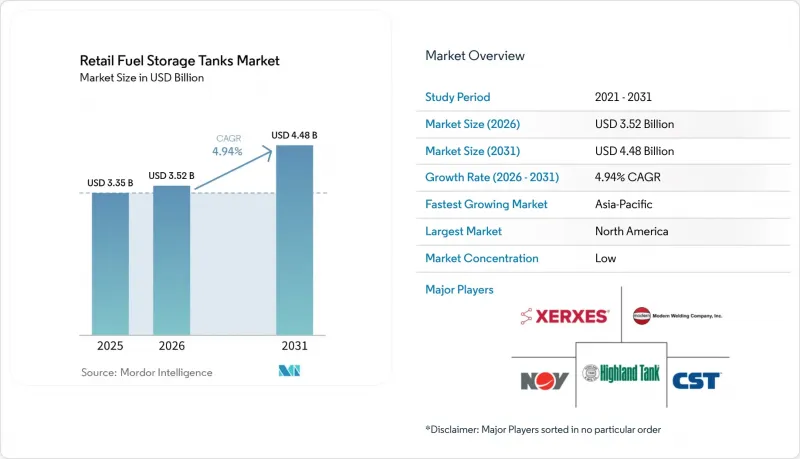
에 따르면 소매용 연료 저장 탱크 시장 규모는 2025년 33억 5,000만 달러에서 2026년에는 35억 2,000만 달러로 확대하며, 2026-2031년에 CAGR 4.94%로 추이하며, 2031년까지 44억 8,000만 달러에 달할 것으로 예측됩니다.
전 세계 소매용 연료 저장 탱크 시장의 동향 및 인사이트
노후된 단층식 지하 저장 탱크(UST)의 교체 의무가 단기적인 수요를 견인
단층식 지하 저장 탱크(UST)의 철거는 소매용 연료 저장 탱크 시장의 수요에 직접적인 요인으로 작용하고 있습니다. 캘리포니아주에서는 기준을 충족하지 않는 단층식 UST에 대해 2025년 12월 31일까지 영구적인 폐쇄를 의무화했습니다. 2026년 1월 1일 이후, 기준을 충족하지 못할 경우 탱크 1기당 하루 500-5,000달러의 벌금이 부과됩니다. 미국 환경보호청(EPA)은 2024년 12월, 최소 7개 주가 재정 지원과 개보수 또는 철거 요건을 결합한 인센티브 프로그램을 시행하고 있다고 보고했습니다. 동 청의 2025 회계연도 실적 보고서에서는 이중벽 시스템이 단일벽 구조에 비해 누출 발생 가능성이 낮은 것으로 밝혀졌습니다. 이러한 규제로 인해 특히 사업자가 정해진 폐쇄 기한을 준수해야 하는 경우, 구매 동향은 사전 설계된 이중벽 유닛으로 이동하고 있습니다.
다연료 소매업이 다구획 탱크 수요를 견인
소매업체들은 레귤러, 프리미엄, 미드등급, 에탄올 혼합 연료, 디젤 및 재생 가능 연료를 동일한 부지 내에서 보관해야 할 필요성이 점점 더 커지고 있습니다. 다구획 탱크는 하나의 구조물 내에 여러 제품을 저장할 수 있으므로 부지내 점유 면적과 설비의 복잡성을 줄일 수 있습니다. 따라서 여러 액체 연료 범주를 수용하도록 설계된 새로운 주유소가 건설됨에 따라 소매용 연료 저장 탱크 시장은 혜택을 보게 될 것입니다. Xerxes사에 따르면 이 회사의 유리섬유제 다구획 탱크는 표준 사양으로 이중벽 유리섬유 격벽을 채택하고 있습니다. 미국 규정에서는 에탄올 10% 이상 또는 바이오디젤 20% 이상을 함유한 규제 대상 물질로 전환하기 전에 사업자가 사전 통지를 해야 할 의무가 있습니다. 또한 사업자는 UST 시스템 전체가 새로운 물질과 호환된다는 것을 입증해야 하므로, 탱크의 구성은 연료 변경 결정에 있으며, 중요한 요소가 됩니다.
현장에 미치는 영향이 크고 굴착 비용이 높기 때문에 교체 속도가 둔화되고 있습니다.
굴착 및 부지 복구 비용은 탱크 본체보다 더 비쌀 수 있으며, 이로 인해 소규모 현장의 교체 작업이 지연되고 있습니다. 포트 세인트 루이스를 위해 작성된 2025년 2월의 비교 자료에 따르면 6,000갤런 지하 저장 탱크(UST) 교체에 소요되는 굴착 및 배수 비용은 19만 500달러로 추산됩니다. 동 자료에서는 주유소 운영에 미치는 광범위한 영향을 고려하기 전의 프로젝트 총 견적액을 62만 500달러로 산출하고 있습니다. 이러한 비용 구조로 인해 자본이 제한된 사업자나 공사 기간에 제약이 있는 사업자의 경우, 규제 준수를 위한 작업이 미뤄질 가능성이 있습니다. 또한 지역 규제에 따라 허용되는 장소에서는 지상 설치형 옵션이 더 매력적으로 보일 수도 있습니다. 토목 공사 비용을 더 대규모 네트워크 전체에 분산시킬 수 없는 경우, 소규모 독립 소매업체의 소매용 연료 저장 탱크 교체 프로젝트는 감소할 가능성이 있습니다. 대규모 체인점은 갱신 공사를 조정할 여지가 크기 때문에 연료 소매 업계의 통합을 촉진하는 한편, 독립 사업자의 고객 기반을 축소시키는 결과로 이어질 수도 있습니다.
부문 분석
2025년에는 이중벽 탱크가 65.1%의 점유율을 차지할 것으로 예상되며, 2031년까지 연평균 성장률(CAGR) 5.8%로 성장할 것으로 전망됩니다. 소매용 연료 저장 탱크 시장에서 이중벽 탱크가 차지하는 위상은 신규 설치 및 교체 프로젝트에서 2차 봉쇄를 권장하는 규제를 반영한 것입니다. 캘리포니아주의 단일벽 탱크 폐쇄 요건은 사업자들이 규정을 준수하는 교체 설비를 조달하는 직접적인 이유가 되었습니다. 캐나다 역시 2025년에 석유 저장 탱크 규제에 포함된 기술 기준을 개정했습니다. 이중벽 제품의 소매용 연료 저장 탱크 시장 규모는 규제에 따른 교체와 신규 시설 건설 모두에 의해 지원되고 있습니다.
3중벽 탱크는 지하수에 민감한 지역 및 더 엄격한 봉쇄 규제가 적용되는 관할 구역에 위치한 시설에서 여전히 특수한 선택지로 남아 있습니다. 구획형이나 재킷형 탱크는 제한된 부지 내에서 여러 유형의 연료를 취급하는 주유소에서 그 중요성이 커지고 있습니다. 유럽 집행위원회는 2026년 5월, 이동 결정 2026/989를 채택하여 고정형 액체 연료 탱크용 과충전 방지 장치에 관한 조화 표준 EN 13616-1:2025를 개정했습니다. 이 결정에 따라 회원국내 신규 설치 전반에 걸쳐 제품의 적합성을 문서화하는 것의 중요성이 재확인되었습니다. 따라서 공급업체는 인증, 설치 지원, 그리고 현장별 연료 및 봉쇄 요건을 충족하는 능력 면에서 경쟁해야 합니다.
2025년 재질별 점유율에서 강재가 55.3%를 차지했습니다. 소매용 연료 저장 탱크 시장에서 강재의 입지는 확립된 제조 능력, 익숙한 설치 기법, 그리고 다양한 연료와의 호환성에 의해 지원되고 있습니다. STI/SPFA에 따르면 인증된 강철 탱크는 E10에서 E100까지의 에탄올 혼합 연료 및 B2에서 B100까지의 바이오디젤 혼합 연료에 사용할 수 있습니다. 이로 인해 향후 연료 혼합 비율의 변화를 예상하는 사업자에게 강철은 실용적인 선택지가 됩니다. 또한 제품의 강도나 기존 제조 방법이 중시되는 대용량 및 지상 설치 용도에서도 강재는 여전히 중요한 선택지로 남아 있습니다.
유리섬유 강화 플라스틱(FRP)은 2031년까지의 예측 연평균 성장률(CAGR)이 6.3%로, 가장 빠르게 성장하고 있는 소재 카테고리입니다. 그 내식성은 부식성이 강한 토양 환경이나 긴 수명이 조달상의 우선순위가 되는 상황에서 중요합니다. Xerxes사는 다구획 구조와 이중벽 격벽을 갖춘 FRP 연료 탱크를 공급하고 있습니다. Mattr사는 6,000만 달러 규모의 성장 투자 계획의 일환으로, 2024년 7월 사우스캐롤라이나주 브라이스우드와 텍사스주 록월 소재의 새로운 복합재료 기술 시설에서 생산을 시작했습니다. 브라이스우드 시설은 2026년에 정상 생산 수준에 근접할 것으로 예상됩니다.
지역별 분석
2025년 기준, 북미는 31.4%의 점유율을 차지했습니다. 2026년 1월 1일부터 시행되는 캘리포니아주의 규제 조치로 인해 규정을 준수하는 이중벽식 지하 저장 탱크(UST) 및 지상 저장 탱크(AST)에 대한 단기 조달 수요가 증가하고 있습니다. 미국 환경보호청(EPA)은 재정 지원과 개조 또는 철거 요건을 결합한 주 정부 프로그램을 선정했습니다. 캐나다는 2025년 9월, 저장 탱크 시스템의 기술 기준을 갱신하는 개정안을 관보에 게재했습니다. 멕시코에서는 국경을 넘는 물류를 지원하기 위해 사업자가 다중 연료 대응 및 대용량 저장 설비를 도입하고 있는 고속도로변 주유소에서 수요가 증가하고 있습니다.
아시아태평양은 소매용 연료 저장 탱크 시장에서 가장 빠르게 성장하는 지역으로, 2031년까지 연평균 성장률(CAGR)이 6.7%에 달할 것으로 예측됩니다. 중국석유화학(Sinopec)은 2025-2026년에 푸젠성에서의 조달을 포함하여, 여러 크기의 SF 이중벽 탱크를 대상으로 한 입찰을 발표했습니다. 일본에서는 부식 위험이 높은 것으로 평가된 지하 탱크에 대해 내부 코팅, 음극 방식 또는 이중벽 구조 조치를 의무화하고 있습니다. 쉘은 2025년 5월, 인도네시아의 주유소 사업 및 그레식 연료 저장 터미널을 시타델 퍼시픽과 세파스의 합작 회사에 양도하기로 합의했습니다. 찬드라 아슬리 퍼시픽은 2025년 10월, 엑슨모빌의 싱가포르내 소매 주유소를 인수하기로 합의했습니다.
2025년, 유럽은 소매용 연료 저장 탱크 시장에서 여전히 중요한 위치를 유지하고 있으며, 독일, 프랑스, 폴란드 등이 활발한 설치 시장으로 꼽힙니다. 유럽연합 집행위원회는 2026년 결정을 통해 고정식 액체 연료 탱크용 과충전 방지 장치에 관한 조화 규격을 개정했습니다. 이에 따라 신제품 라인에 대한 최신 인증 서류의 필요성이 높아지고 있습니다. 중동 및 아프리카에서는 사우디아라비아와 아랍에미리트(UAE)가 소매 네트워크 확충을 추진하고 있으며, 장기적인 비즈니스 기회가 예상되지만, 남아프리카공화국에서는 환율 변동 및 자금 조달 제약으로 인해 프로젝트가 지연될 가능성이 있습니다.
기타 혜택:
- 엑셀 형식의 시장 예측(ME) 시트
- 3개월간 애널리스트 지원
자주 묻는 질문
목차
제1장 서론
- 조사 전제조건과 시장 정의
- 조사 범위
제2장 조사 방법
제3장 개요
제4장 시장 구도
- 시장 개요
- 시장 성장 촉진요인
- 시장 성장 억제요인
- 공급망 분석
- Porter's Five Forces 분석
- 기술 동향
- 규제 상황
- 투자 분석
제5장 시장 규모와 성장 예측
- 탱크 유형별
- 탱크 재질별
- 설치 유형별
- 탱크 용량별
- 지역별
- 북미
- 미국
- 캐나다
- 멕시코
- 유럽
- 독일
- 프랑스
- 이탈리아
- 스페인
- 영국
- 폴란드
- 러시아
- 기타 유럽 국가
- 아시아태평양
- 중국
- 인도
- 일본
- 한국
- 호주
- 인도네시아
- 베트남
- 태국
- 기타 아시아태평양 국가
- 남미
- 브라질
- 아르헨티나
- 칠레
- 기타 남미 국가
- 중동 및 아프리카
- 사우디아라비아
- 아랍에미리트
- 이집트
- 남아프리카공화국
- 모로코
- 기타 중동 및 아프리카 국가
- 북미
제6장 경쟁 구도
- 시장 집중도
- 전략적 동향
- 시장 점유율 분석
- 기업 개요
- Belco Manufacturing Company
- CST Industries, Inc.
- Eaton Sales & Service LLC
- Fiberglass Tank Solutions
- General Industries Co. Ltd.
- Granby Industries
- Highland Tank LLC
- KBK Industries
- Modern Welding Company, Inc.
- NOV Inc.
- Roben Manufacturing, Inc.
- Roth Industries GmbH & Co. KG
- Superior Tank Co., Inc.
- Tank Connection
- Tank Solutions Pty Ltd
- Western Global Limited
- Xerxes Corporation(Mattr)
제7장 시장 기회와 향후 전망
KSA 26.10.23According to Mordor Intelligence, the retail fuel storage tanks market size is expected to grow from USD 3.35 billion in 2025 to USD 3.52 billion in 2026 and is forecast to reach USD 4.48 billion by 2031 at 4.94% CAGR over 2026-2031.
Global Retail Fuel Storage Tanks Market Trends and Insights
Aging Single-Wall UST Replacement Mandates Fuel Near-Term Demand
The retirement of single-wall underground storage tanks is a direct source of demand for the retail fuel storage tanks market. California required the permanent closure of noncompliant single-wall USTs by December 31, 2025. Since January 1, 2026, noncompliance has carried penalties of USD 500 to USD 5,000 per tank each day. The US Environmental Protection Agency reported in December 2024 that at least 7 states had incentive programs that paired financial support with upgrade or removal requirements. The agency's fiscal year 2025 performance reporting also found that double-wall systems had a lower release tendency than single-wall configurations. These rules shift purchasing toward pre-engineered double-wall units, especially where operators need to meet a defined closure date.
Multi-Fuel Retailing Drives Multicompartment Tank Demand
Retailers increasingly need to store regular, premium, mid-grade, ethanol-blended fuel, diesel, and renewable fuels at the same site. A multicompartment tank keeps several products within one structure and can reduce site footprint and equipment complexity. The retail fuel storage tanks market, therefore, benefits when new stations are designed for more than one liquid fuel category. Xerxes states that its fiberglass multicompartment tank uses a double-wall fiberglass bulkhead as a standard feature. US regulations require operators to give notice before switching to regulated substances containing more than 10% ethanol or 20% biodiesel. Operators must also demonstrate that the complete UST system is compatible with the new substance, which makes tank configuration part of the fuel change decision.
High Site-Disruption and Excavation Costs Throttle Replacement Velocity
Excavation and site restoration can cost more than the tank itself, which slows replacement activity at smaller sites. A February 2025 comparison prepared for Port San Luis showed USD 190,500 in excavation and dewatering costs for a 6,000-gallon UST replacement. The same document placed the total project estimate at USD 620,500 before considering the wider effect on station operations. This cost profile can defer compliance work where operators have limited capital or a narrow construction window. It can also make aboveground options more attractive at sites where local rules permit them. The retail fuel storage tanks market may see fewer projects from small independent retailers when civil works costs cannot be spread across a larger network. Larger chains have greater scope to coordinate upgrades, which can support consolidation in fuel retailing while narrowing the independent customer base.
Other drivers and restraints analyzed in the detailed report include:
- Convenience-Store Network Expansion in Asia-Pacific Anchors the Long-Term Volume Story
- Mainstream Adoption of Ethanol and Biodiesel Blends Demands Infrastructure Reconfiguration
- Retail-Fuel Demand Uncertainty from Vehicle Electrification Introduces Long-Range Risk
For complete list of drivers and restraints, kindly check the Table Of Contents.
Segment Analysis
Double-wall tanks held 65.1% share in 2025 and are projected to grow at a 5.8% CAGR through 2031. Their position in the retail fuel storage tanks market reflects rules that favor secondary containment for new installations and replacement projects. California's single-wall closure requirement created an immediate reason for operators to procure compliant replacement equipment. Canada also updated the technical standards incorporated into its petroleum storage tank regulations in 2025. The retail fuel storage tanks market size for double-wall products is strengthened by both regulatory replacement and new-site construction.
Triple-wall tanks remain a specialized option for sites near sensitive groundwater or in jurisdictions with more demanding containment rules. Compartmented and jacketed variants become more relevant when stations offer several fuels from a constrained footprint. The European Commission adopted Implementing Decision 2026/989 in May 2026, updating the harmonized standard EN 13616-1:2025 for overfill-prevention devices on static liquid fuel tanks. The decision reinforces the importance of documented product compliance across new installations in member states. Suppliers must therefore compete on certification, installation support, and the ability to meet site-specific fuel and containment requirements.
Steel held 55.3% share by material in 2025. Its position in the retail fuel storage tanks market is supported by established manufacturing capacity, familiar installation practices, and broad fuel compatibility. STI/SPFA states that qualified steel tanks can be used with ethanol blends from E10 to E100 and biodiesel blends from B2 to B100. This makes steel a practical option for operators who expect future fuel blend changes. Steel also remains relevant in large capacity and aboveground applications where product strength and conventional fabrication are valued.
Fiberglass-reinforced plastic is the fastest-growing material category, with a forecast CAGR of 6.3% through 2031. Its corrosion resistance is important in aggressive soil environments and where long service life is a procurement priority. Xerxes offers fiberglass fuel tanks with multicompartment configurations and double-wall bulkheads. Mattr began production at new composite technology facilities in Blythewood, South Carolina, and Rockwall, Texas, in July 2024 under a USD 60 million growth investment. The Blythewood facility is expected to approach normalized production in 2026.
Complete Report Scope:
- By Tank Type
- Single-Wall Tanks
- Double-Wall Tanks
- Triple-Wall Tanks
- Other Tank Types
- By Tank Material
- Steel
- Fiberglass-Reinforced Plastic (FRP)
- Composite Materials
- Other Materials
- By Installation Type
- Underground Storage Tanks (USTs)
- Aboveground Storage Tanks (ASTs)
- By Tank Capacity
- Below 10,000 Gallons
- 10,000-20,000 Gallons
- 20,000-40,000 Gallons
- Above 40,000 Gallons
- By Geography
- North America
- United States
- Canada
- Mexico
- Europe
- Germany
- France
- Italy
- Spain
- United Kingdom
- Poland
- Russia
- Rest of Europe
- Asia-Pacific
- China
- India
- Japan
- South Korea
- Australia
- Indonesia
- Vietnam
- Thailand
- Rest of Asia-Pacific
- South America
- Brazil
- Argentina
- Chile
- Rest of South America
- Middle East and Africa
- Saudi Arabia
- United Arab Emirates
- Egypt
- South Africa
- Morocco
- Rest of Middle East and Africa
- North America
Geography Analysis
North America held 31.4% share in 2025. California's enforcement action from January 1, 2026, is driving near-term procurement of compliant double-wall USTs and ASTs. The EPA identified state programs that combine financial support with upgrade or removal requirements. Canada gazetted amendments in September 2025 that updated technical standards for storage tank systems. Mexico adds demand at highway corridor stations where operators are adopting multi-fuel and larger-capacity storage to support cross-border logistics.
Asia-Pacific is the fastest-growing area in the retail fuel storage tanks market, at a forecast 6.7% CAGR through 2031. Sinopec issued tenders covering SF double-wall tanks in several sizes, including a Fujian procurement for 2025-2026. Japan requires internal coating, cathodic protection, or double-shell measures for underground tanks assessed as having high corrosion risk. Shell agreed in May 2025 to transfer its Indonesia gas station business and Gresik fuel storage terminal to a Citadel Pacific and Sefas joint venture. Chandra Asri Pacific agreed in October 2025 to acquire ExxonMobil's retail fuel stations in Singapore.
Europe retained a meaningful position in the retail fuel storage tanks market in 2025, with Germany, France, and Poland among the active installation markets. The European Commission's 2026 decision updated the harmonized standard for overfill-prevention devices on static liquid fuel tanks. This increases the need for current certification documentation on new product lines. The Middle East and Africa offer a longer-term opportunity as Saudi Arabia and the UAE upgrade retail networks, while foreign exchange volatility and financing constraints in South Africa can delay projects.
- Belco Manufacturing Company
- CST Industries, Inc.
- Eaton Sales & Service LLC
- Fiberglass Tank Solutions
- General Industries Co. Ltd.
- Granby Industries
- Highland Tank LLC
- KBK Industries
- Modern Welding Company, Inc.
- NOV Inc.
- Roben Manufacturing, Inc.
- Roth Industries GmbH & Co. KG
- Superior Tank Co., Inc.
- Tank Connection
- Tank Solutions Pty Ltd
- Western Global Limited
- Xerxes Corporation (Mattr)
Additional Benefits:
- The market estimate (ME) sheet in Excel format
- 3 months of analyst support
TABLE OF CONTENTS
1 INTRODUCTION
- 1.1 Study Assumptions and Market Definition
- 1.2 Scope of the Study
2 RESEARCH METHODOLOGY
3 EXECUTIVE SUMMARY
4 MARKET LANDSCAPE
- 4.1 Market Overview
- 4.2 Market Drivers
- 4.2.1 Aging Single-Wall UST Replacement Mandates
- 4.2.2 Multi-Fuel Retailing Requires Multicompartment Tanks
- 4.2.3 Convenience-Store Network Expansion in Asia-Pacific
- 4.2.4 Mainstream Adoption of Ethanol and Biodiesel Blends
- 4.2.5 Digital Leak Detection and Remote Inventory Monitoring
- 4.2.6 California-Led Secondary-Containment Compliance Spillover
- 4.3 Market Restraints
- 4.3.1 High Site-Disruption and Excavation Costs
- 4.3.2 Permit and Contractor Bottlenecks for Tank Replacement
- 4.3.3 Corrosion and Compatibility Risk from New Fuel Blends
- 4.3.4 Retail-Fuel Demand Uncertainty from Vehicle Electrification
- 4.4 Supply-Chain Analysis
- 4.5 Porter's Five Forces Analysis
- 4.5.1 Bargaining Power of Suppliers
- 4.5.2 Bargaining Power of Buyers
- 4.5.3 Threat of New Entrants
- 4.5.4 Threat of Substitutes
- 4.5.5 Competitive Rivalry
- 4.6 Technology Outlook
- 4.7 Regulatory Landscape
- 4.8 Investment Analysis
5 MARKET SIZE AND GROWTH FORECASTS
- 5.1 By Tank Type
- 5.1.1 Single-Wall Tanks
- 5.1.2 Double-Wall Tanks
- 5.1.3 Triple-Wall Tanks
- 5.1.4 Other Tank Types
- 5.2 By Tank Material
- 5.2.1 Steel
- 5.2.2 Fiberglass-Reinforced Plastic (FRP)
- 5.2.3 Composite Materials
- 5.2.4 Other Materials
- 5.3 By Installation Type
- 5.3.1 Underground Storage Tanks (USTs)
- 5.3.2 Aboveground Storage Tanks (ASTs)
- 5.4 By Tank Capacity
- 5.4.1 Below 10,000 Gallons
- 5.4.2 10,000-20,000 Gallons
- 5.4.3 20,000-40,000 Gallons
- 5.4.4 Above 40,000 Gallons
- 5.5 By Geography
- 5.5.1 North America
- 5.5.1.1 United States
- 5.5.1.2 Canada
- 5.5.1.3 Mexico
- 5.5.2 Europe
- 5.5.2.1 Germany
- 5.5.2.2 France
- 5.5.2.3 Italy
- 5.5.2.4 Spain
- 5.5.2.5 United Kingdom
- 5.5.2.6 Poland
- 5.5.2.7 Russia
- 5.5.2.8 Rest of Europe
- 5.5.3 Asia-Pacific
- 5.5.3.1 China
- 5.5.3.2 India
- 5.5.3.3 Japan
- 5.5.3.4 South Korea
- 5.5.3.5 Australia
- 5.5.3.6 Indonesia
- 5.5.3.7 Vietnam
- 5.5.3.8 Thailand
- 5.5.3.9 Rest of Asia-Pacific
- 5.5.4 South America
- 5.5.4.1 Brazil
- 5.5.4.2 Argentina
- 5.5.4.3 Chile
- 5.5.4.4 Rest of South America
- 5.5.5 Middle East and Africa
- 5.5.5.1 Saudi Arabia
- 5.5.5.2 United Arab Emirates
- 5.5.5.3 Egypt
- 5.5.5.4 South Africa
- 5.5.5.5 Morocco
- 5.5.5.6 Rest of Middle East and Africa
- 5.5.1 North America
6 COMPETITIVE LANDSCAPE
- 6.1 Market Concentration
- 6.2 Strategic Moves
- 6.3 Market Share Analysis
- 6.4 Company Profiles (includes Global Level Overview, Market Level Overview, Core Segments, Financials as available, Strategic Information, Market Rank/Share, Products and Services, Recent Developments)
- 6.4.1 Belco Manufacturing Company
- 6.4.2 CST Industries, Inc.
- 6.4.3 Eaton Sales & Service LLC
- 6.4.4 Fiberglass Tank Solutions
- 6.4.5 General Industries Co. Ltd.
- 6.4.6 Granby Industries
- 6.4.7 Highland Tank LLC
- 6.4.8 KBK Industries
- 6.4.9 Modern Welding Company, Inc.
- 6.4.10 NOV Inc.
- 6.4.11 Roben Manufacturing, Inc.
- 6.4.12 Roth Industries GmbH & Co. KG
- 6.4.13 Superior Tank Co., Inc.
- 6.4.14 Tank Connection
- 6.4.15 Tank Solutions Pty Ltd
- 6.4.16 Western Global Limited
- 6.4.17 Xerxes Corporation (Mattr)
7 MARKET OPPORTUNITIES AND FUTURE OUTLOOK
- 7.1 White-Space and Unmet-Need Assessment


