

|
시장보고서
상품코드
2154349
치과용 베니어 : 시장 점유율 분석, 업계 동향과 통계, 성장 예측(2026-2031년)Dental Veneers - Market Share Analysis, Industry Trends & Statistics, Growth Forecasts (2026 - 2031) |
||||||
 Mordor Intelligence
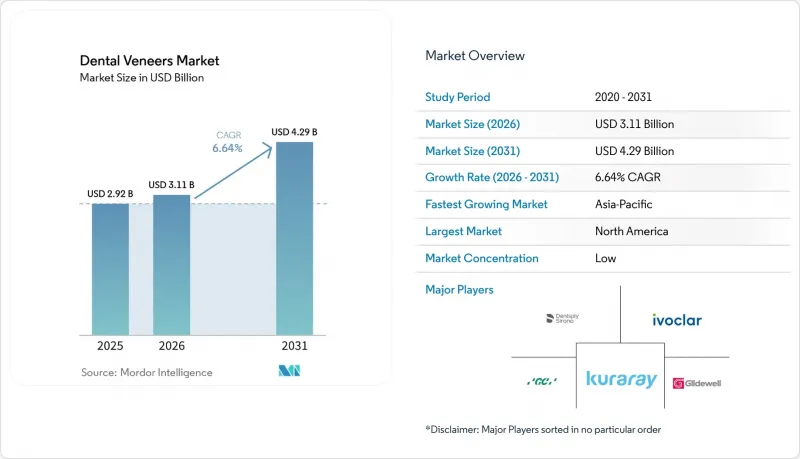
에 따르면 치과용 베니어 시장 규모는 2025년에 29억 2,000만 달러, 2026년에 31억 1,000만 달러에 달하며, 2031년까지 42억 9,000만 달러에 달할 것으로 예측되고 있으며, 2026-2031년에 CAGR 6.64%로 성장할 것으로 전망되고 있습니다.
세계 치과용 베니어 시장의 동향 및 인사이트
미소에 대한 심미적 요구 증가
미소의 심미성은 특히 화상 통화나 온라인 프로필이 직업적 인상에 영향을 미치는 상황에서 많은 근로 연령층 성인에게 일상적인 관심사가 되고 있습니다. 2024년 'Scientific Reports'지에 게재된 연구에 따르면 참가자의 29.37%가 심미 치과 치료를 받기로 결정하는 데 소셜미디어가 영향을 미쳤다고 응답했으며, 33.33%는 최신 시술에 대한 정보를 얻기 위해 소셜 플랫폼을 이용하고 있는 것으로 나타났습니다. 그 결과, 환자들은 시술 내용, 시각적 결과물, 그리고 치과의사가 설명해야 할 선택지에 대해 미리 이해한 상태에서 상담을 받으러 오는 경향이 강해지고 있습니다. 이러한 사전 준비를 통해 기본적인 치료 선택지에 대한 설명에 소요되는 시간을 단축할 수 있을 뿐만 아니라, 여러 치아에 걸친 증례의 수용을 촉진할 가능성이 있습니다. 동남아시아와 라틴아메리카의 2·3선 도시에서 진행 중인 도시화와 가처분 소득의 증가는 저비용 진료 환경에 대한 수요를 끌어올리고 있으며, 이러한 환경에서는 많은 환자 수가 평균 치료비의 낮음을 상쇄할 수 있습니다. 치과용 베니어 시장은 클리닉이 이러한 인식을 심미적 목표와 임상적 적합성을 모두 충족하는 현실적인 치료 계획으로 전환할 수 있을 때 혜택을 볼 수 있습니다.
저침습 베니어 시술에 대한 선호
노프레프(No-Prep) 및 초박형 시스템을 통해 치아의 비가역적인 변형을 우려하는 환자나 기존 시술에 활용할 수 있는 법랑질이 제한된 환자들에게도 베니어 치료의 적용 범위가 확대되고 있습니다. 2025년에 실시된 Prettau사의 노프레프 지르코니아 베니어에 대한 임상 평가에서는 파절률이 0.5%였으며, 96.0%의 수복물에서 색상 적합성이 ‘매우 양호’한 것으로 평가되었고, 평가 대상이었던 모든 수복물에서 해부학적 형태가 유지된 것으로 보고되었습니다. 이러한 결과는 치아 절삭이나 향후 유지 관리의 필요성에 대해 불안을 느껴 치료를 미루게 될 가능성이 있는 환자에게, 임상의가 보다 보존적인 선택지에 대해 논의할 수 있는 근거가 됩니다. 이러한 시스템은 영구적인 법랑질 변형에 대한 우려를 줄이고, 상담시 논의가 ‘돌이킬 수 없는 것’이라는 인상을 완화함으로써, 처음 치료를 받는 환자의 심리적 장벽을 낮출 수 있습니다. 또한 ISO 10477:2025는 폴리머 계열 크라운 및 베니어 재료에 관한 최신 기준을 규정하고 있으며, 치과 기공소 및 임상의에게 영구적인 베니어 재료를 평가하기 위한 공통된 틀을 제공합니다. 치과용 베니어 시장은 치아 질감 형성, 접착 강도, 장기적인 유지 관리 간의 균형이 잡힌 프로토콜의 보급으로 인해 혜택을 볼 것으로 예상됩니다.
높은 본인 부담 치료비와 제한된 보험 환급
자비 진료의 가격 책정으로 인해 인지도가 널리 퍼지고 온라인상의 치과 이미지를 통해 관심이 높아지고 있음에도 불구하고 많은 환자에게 베니어 치료는 손이 닿지 않는 것이 되고 있습니다. 이러한 영향은 선택적 심미 치료에 대한 보험 급여가 거의 또는 전혀 이루어지지 않아, 치료 접근성이 임상적 필요성뿐만 아니라 가계 예산에 의해 주로 결정되는 지역에서 가장 두드러집니다. 독일과 프랑스의 경우, 공적 보험의 적용 범위는 기능적 수복에 중점을 두고 있으며, 심미적인 베니어 치료 비용은 비급여 진료 범주에 속합니다. 그 결과 발생하는 관심과 구매력의 격차로 인해 환자는 치료를 미루거나, 직접 복합 레진 충전재를 선택하거나, 혹은 익숙한 지역 치과 의사의 진료를 받지 못한 채 해외에서 치료를 받게 될 수도 있습니다. 할인된 가격으로 진행되는 치료는 색상 재현성, 접착력 또는 치료 후 경과 관찰에 편차가 있을 경우, 추가적인 우려를 야기할 가능성이 있습니다. 치과 베니어 시장은 자금 조달 옵션이나 저비용 대안이 충분한 임상적 신뢰성, 확실한 색상 재현성, 그리고 환자에게 명확한 유지 관리 방안을 확립하지 않는 한, 가격에 민감한 환자층에서 계속해서 제약을 받게 될 것입니다.
부문 분석
2025년 기준, 도자기 및 세라믹 베니어는 치과용 베니어 시장 규모의 58.43%를 차지했습니다. 이러한 위상은 확립된 임상 사용 실적, 높은 투과성, 착색 저항성, 그리고 적절한 증례에서의 내구성에 대한 광범위한 증거에 기반을 두고 있습니다. 이보클라르의 IPS e.max 리튬 디실리케이트 제품군은 여전히 전치부 수복 분야에서 중요한 기준으로 자리 잡고 있습니다. 2025년 10월에 발표된 과학 보고서에는 20건 이상의 국제 연구가 정리되어 있으며, 생존율은 95%를 초과합니다. 세라믹 재료는 안정적인 외관과 내구성 있는 표면 특성을 중시하는 환자에게 적합하며, 특히 여러 전치에서 일관된 심미적 결과가 요구되는 경우에 적합합니다. 복합재 베니어는 단 한 번의 내원만으로 체어사이드에서 장착이 가능하며, 저비용 재료를 사용할 수 있으며, 특정 환자에게는 경제적인 선택지가 되므로, 비용을 중시하는 환경에서 여전히 중요한 위치를 차지하고 있습니다. 토쿠야마 덴탈의 ‘OMNICHROMA’는 단일 색상 복합레진 접근 방식을 통해 체어사이드 직접 시술 워크플로우를 지속적으로 지원하고 있지만, 재료 선택은 여전히 임상 사례에 따라 달라집니다.
초박형 및 노프레프(무절삭) 시스템은 가장 빠르게 성장하는 제품 카테고리이며, 이 부문의 치과 베니어 시장 규모는 2026-2031년까지 연평균 성장률(CAGR) 8.12%로 확대될 것으로 예측됩니다. 이 시스템의 매력은 더 많은 치아 조직을 보존할 수 있다는 점과, 기존의 절삭 처치를 꺼리는 환자들에게도 대응할 수 있다는 점에 있습니다. 쿠라레 노리타케 덴탈의 ‘CERABIEN MiLai’ 시스템은 지르코니아 및 리튬 디실리케이트 기판 위의 얇은 도자기 적층에 대응하며, 기공사가 보존적 수복에서 정교한 마무리를 실현하는 데 도움이 됩니다. 또한 프레타우의 임상 연구에서는 특정 증례에서 벽 두께 0.3-0.4 mm라도 임상적으로 허용 가능한 결과를 얻을 수 있음이 밝혀졌습니다. 구개측 및 교합면 베니어는 시장 규모 면에서는 여전히 작지만, 전악 재건에서 점차 받아들여지고 있습니다. 2025년 BMC Oral Health 저널의 연구에서는 버트 조인트 및 중공 챔퍼 형성 설계를 사용한 CAD/CAM 유리 세라믹 교합면 베니어에 대해 임상적으로 허용 가능한 치은 적합성과 파절 저항성이 확인되었습니다. 탈착식 심미용 베니어는 가역적이고 저비용의 심미 치료를 원하는 또 다른 비임상 환자군에게 계속해서 활용되고 있습니다.
지역별 분석
2025년, 북미는 치과 베니어 시장 규모의 41.57%를 차지했습니다. 이 지역은 높은 치과 의료비, 확립된 비급여 미용 치과 치료, 그리고 심미 치과에 특화된 광범위한 치과 네트워크를 모두 갖추고 있습니다. 미국에서는 환자의 자발적인 내원, 비급여 진료 상담, 그리고 눈에 띄는 심미 치과 서비스를 제공하는 치과에서 여러 치아에 포세린 베니어를 장착함으로써 지역 전체 수익의 상당 부분을 차지하고 있습니다. 디지털 스마일 디자인 플랫폼은 상담 논의를 지원하고, 평가부터 치료 동의에 이르기까지의 시간을 단축할 수 있습니다. 캐나다는 프리미엄 수요 특성을 지닌 성숙한 시장인 반면, 멕시코는 증가하는 국내 도시권 환자층과 미국에서 국경을 넘어 방문하는 환자 모두에게 서비스를 제공하고 있습니다.
유럽에서는 국가마다 보험 환급 정책과 심미 치과에 대한 관심이 달라 수요 패턴도 다양합니다. 독일, 영국, 프랑스, 이탈리아, 스페인은 모두 선택적 시술에 대한 자비 진료 동향이 각기 다릅니다. 독일에서는 심미 치료가 법정 보험 적용 대상에서 제외되어 있으므로 베니어 치료는 자비 진료 환자에게 집중되어 있습니다. 영국에서는 자비 치과 치료 미처리 건수가 증가하고 있으며, 심미 서비스에 대한 관심이 높아지고 있습니다. 남유럽 시장에서는 젊은 환자층 사이에서 외모를 중시하는 수요가 더욱 강하게 나타나고 있습니다. 또한 유럽은 재료 혁신 측면에서도 중요한 거점으로 자리 잡고 있으며, 각 제조사는 얇은 세라믹 치료를 위한 보다 신속하고 정밀한 마감 기법을 개발하고 있습니다.
아시아태평양은 2026-2031년까지 연평균 성장률(CAGR) 8.21%로 성장할 것으로 예측되며, 이는 치과 베니어 시장에서 지역별 가장 높은 성장률입니다. 중국과 인도는 중산층의 치과 의료비 지출 증가를 통해 시장에 기여하고 있는 반면, 한국에서는 심미 치과 문화가 이미 정착되어 있습니다. 태국은 계속해서 치과 관광의 지역 거점 역할을 하고 있으며, 호주는 치과 의료비가 높고 디지털 기술 도입이 활발한 프리미엄 시장입니다. 남미는 브라질과 콜롬비아를 필두로 한 성장의 중심지로 부상하고 있습니다. 국가 치과 데이터를 인용한 업계 보고서에 따르면 브라질은 2024년에 1억 3,600만 달러 상당의 치과 제품을 수출했으며, 이는 2023년 대비 11.7% 증가한 수치입니다. 또한 등록 치과의사 수는 44만 1,000명을 넘어섰습니다. 중동 및 아프리카도 사우디아라비아와 UAE를 포함한 GCC 국가들의 고급 심미 치과 인프라 확충을 통해 발전하고 있으며, 두바이와 아부다비로 환자를 유치하고 있습니다.
기타 혜택:
- 엑셀 형식의 시장 예측(ME) 시트
- 3개월간의 애널리스트 지원
자주 묻는 질문
목차
제1장 서론
- 조사 전제조건과 시장 정의
- 조사 범위
제2장 조사 방법
제3장 개요
제4장 시장 구도
- 시장 개요
- 시장 성장 촉진요인
- 시장 성장 억제요인
- 공급망 분석
- 규제 상황
- 기술 전망
- Porter's Five Forces 분석
제5장 시장 규모와 성장 예측
- 제품 유형별
- 용도별
- 최종사용자별
- 지역별
- 북미
- 미국
- 캐나다
- 멕시코
- 유럽
- 독일
- 영국
- 프랑스
- 이탈리아
- 스페인
- 기타 유럽 국가
- 아시아태평양
- 중국
- 일본
- 인도
- 호주
- 한국
- 기타 아시아태평양 국가
- 중동 및 아프리카
- GCC
- 남아프리카공화국
- 기타 중동 및 아프리카 국가
- 남미
- 브라질
- 아르헨티나
- 기타 남미 국가
- 북미
제6장 경쟁 구도
- 시장 집중도
- 시장 점유율 분석
- 기업 개요
- Amann Girrbach AG
- Apex Dental Laboratory Group
- BISCO, Inc.
- COLTENE Group
- Dentsply Sirona Inc.
- DMG Chemisch-Pharmazeutische Fabrik GmbH
- Envista Holdings Corporation
- GC Corporation
- Glidewell Laboratories
- Ivoclar AG
- Kulzer GmbH
- Kuraray Noritake Dental Inc.
- Modern Dental Group Limited
- National Dentex, LLC
- Planmeca Oy
- Shofu Dental Corporation
- Solventum Corporation
- Straumann Group
- Sun Dental Labs
- Tokuyama Dental Corporation
- Ultradent Products, Inc.
- VITA Zahnfabrik H. Rauter GmbH & Co. KG
- VOCO GmbH
- Zirkonzahn GmbH
제7장 시장 기회와 향후 전망
KSAAccording to Mordor Intelligence, the dental veneers market size is projected to be USD 2.92 billion in 2025, USD 3.11 billion in 2026, and reach USD 4.29 billion by 2031, growing at a CAGR of 6.64% from 2026 to 2031.
Global Dental Veneers Market Trends and Insights
Rising Demand for Smile Aesthetics
Smile aesthetics have become a routine consideration for many working-age adults, especially where video calls and online profiles affect professional visibility. A 2024 Scientific Reports study found that 29.37% of participants said social media influenced their decision to seek esthetic dental treatment, and 33.33% used social platforms to find information about their latest procedure. Patients are therefore more likely to reach a consultation with an initial understanding of the procedure, its visual outcome, and the choices that clinicians may need to explain. That preparation can reduce the time required to explain basic treatment choices and may support acceptance of multi-unit cases. Urbanization and higher disposable income in secondary and tertiary cities in Southeast Asia and Latin America are adding demand in lower-fee settings, where patient volumes can offset lower average treatment fees. The dental veneers market benefits when clinics can convert this awareness into realistic treatment plans that address both aesthetic goals and clinical suitability.
Preference for Minimally Invasive Veneer Procedures
No-prep and ultra-thin systems extend veneer treatment to patients who are concerned about irreversible tooth preparation or have limited enamel available for a conventional procedure. A 2025 clinical evaluation of Prettau no-prep zirconia veneers reported a 0.5% fracture rate, 96.0% of restorations rated very good for color match, and retention of anatomical form in all restorations assessed. These results give clinicians evidence to discuss a more conservative option with patients who might otherwise defer treatment because they remain unsure about preparation and future maintenance needs. The systems can lower the psychological barrier for first-time patients because they reduce concern around permanent enamel alteration and make consultation discussions feel less irreversible. ISO 10477:2025 also sets updated benchmarks for polymer-based crown and veneering materials, giving laboratories and clinicians a common frame for assessing permanent veneer materials. The dental veneers market is likely to gain from wider use of protocols that balance preparation, bond strength, and long-term maintenance.
High Out-of-Pocket Treatment Cost and Limited Reimbursement
Private-pay pricing limits veneer treatment for many patients, even where awareness is broad, and interest has been reinforced by online dental imagery. This effect is strongest where elective aesthetic procedures receive little or no reimbursement and household budgets remain the main determinant of access, rather than clinical need alone. In Germany and France, public coverage focuses on functional restoration, leaving cosmetic veneer expenditure in the private-pay category. The resulting gap between interest and purchasing power can lead patients to postpone care, choose direct composite work, or seek treatment abroad without access to a familiar local provider. Discounted care may create added concern when color replication, bonding, or post-treatment review is inconsistent. The dental veneers market will remain constrained in price-sensitive patient groups unless financing options and lower-cost alternatives develop sufficient clinical credibility, reliable color performance, and a clear maintenance pathway for patients.
Other drivers and restraints analyzed in the detailed report include:
- Digital Smile Design and Chairside CAD/CAM Adoption
- Dental Tourism and Cross-Border Cosmetic Care
- Enamel Removal and Long-Term Complication Concerns
For complete list of drivers and restraints, kindly check the Table Of Contents.
Segment Analysis
Porcelain and ceramic veneers accounted for 58.43% of the dental veneers market size in 2025. Their position reflects established clinical use, high translucency, stain resistance, and a broad evidence base for longevity in appropriate cases. Ivoclar's IPS e.max lithium disilicate portfolio remains an important reference point for anterior restorations, with an October 2025 scientific report summarizing more than 20 international studies and survival rates above 95%. Ceramic materials are suited to patients who place a premium on stable appearance and durable surface properties, especially when several anterior teeth require a consistent visual result. Composite veneers remain important in cost-sensitive settings because they can be placed chairside in a single visit, use lower-cost materials, and provide an accessible starting point for selected patients. Tokuyama Dental's OMNICHROMA has continued to support direct chairside workflows through its single-shade composite approach, although material selection still depends on the clinical case.
Ultra-thin and no-prep systems are the fastest-growing product category, with the dental veneers market size for this segment projected to grow at an 8.12% CAGR from 2026 to 2031. Their appeal comes from the ability to preserve more tooth structure and serve patients who are hesitant about conventional preparation. Kuraray Noritake Dental's CERABIEN MiLai system supports thin porcelain layering on zirconia and lithium disilicate substrates, which can help technicians achieve a refined finish in conservative restorations. The Prettau clinical study also indicated that wall thicknesses of 0.3-0.4 mm can produce clinically acceptable outcomes in selected cases. Palatal and occlusal veneers remain smaller by volume but are gaining acceptance in full-mouth rehabilitation. A 2025 BMC Oral Health study found clinically acceptable marginal fit and fracture resistance for CAD/CAM glass ceramic occlusal veneers using butt joint and hollow chamfer preparation designs. Removable cosmetic veneers continue to serve a separate nonclinical group seeking reversible, low-cost aesthetic options.
Complete Report Scope:
- By Product Type
- Porcelain/Ceramic Veneers
- Composite Veneers
- Ultra-Thin/No-Prep Veneer Systems
- Palatal and Occlusal Veneers
- Removable Cosmetic Veneers
- Other Product Types
- By Application
- Cosmetic Smile Enhancement
- Restorative and Functional Correction
- Other Applications
- By End User
- Dental Clinics
- Hospitals and Dental Hospitals
- Academic and Research Institutions
- Dental Laboratories
- By Geography
- North America
- United States
- Canada
- Mexico
- Europe
- Germany
- United Kingdom
- France
- Italy
- Spain
- Rest of Europe
- Asia-Pacific
- China
- Japan
- India
- Australia
- South Korea
- Rest of Asia-Pacific
- Middle East and Africa
- GCC
- South Africa
- Rest of Middle East and Africa
- South America
- Brazil
- Argentina
- Rest of South America
- North America
Geography Analysis
North America held 41.57% of the dental veneers market size in 2025. The region combines high dental spending, established private-pay cosmetic care, and a wide network of practices that focus on aesthetic dentistry. The United States supports much of the regional revenue through patient self-referral, private-pay consultation, and multi-unit porcelain veneer placement in practices that have developed visible esthetic service offerings. Digital smile design platforms support consultation discussions and can shorten the time from assessment to treatment acceptance. Canada is a mature market with premium demand characteristics, while Mexico serves both a growing domestic urban patient base and cross-border visitors from the United States.
Europe has varied demand patterns because reimbursement policies and interest in aesthetic dentistry differ by country. Germany, the United Kingdom, France, Italy, and Spain all have distinct private-pay dynamics for elective procedures. In Germany, the exclusion of cosmetic treatment from statutory insurance keeps veneer care concentrated among private-pay patients. In the United Kingdom, a growing private dental backlog has increased attention to aesthetic services. Southern European markets show stronger appearance-led demand among younger patients. Europe also remains an important center for material innovation, with providers developing faster and more controlled finishing methods for thin ceramic work.
Asia-Pacific is forecast to grow at an 8.21% CAGR from 2026 to 2031, the highest regional rate in the dental veneers market. China and India contribute through rising middle-class dental expenditure, while South Korea has an established aesthetic dentistry culture. Thailand remains a regional hub for dental tourism, and Australia is a premium market with high dental spending and strong digital adoption. South America is emerging as a growth corridor led by Brazil and Colombia. Brazil exported USD 136 million in dental products in 2024, 11.7% higher than in 2023, and had more than 441,000 registered dentists, according to industry reporting that cited national dental data. The Middle East and Africa are also developing through luxury cosmetic dentistry infrastructure in GCC countries, including Saudi Arabia and the UAE, which attracts patients to Dubai and Abu Dhabi.
- Amann Girrbach
- Apex Dental Laboratory Group
- BISCO, Inc.
- COLTENE Group
- Dentsply Sirona
- DMG Chemisch-Pharmazeutische Fabrik
- Envista
- GC Corporation
- Glidewell Laboratories
- Ivoclar AG
- Kulzer
- Kuraray Noritake Dental Inc.
- Modern Dental Group Limited
- National Dentex, LLC
- Planmeca
- Shofu Dental
- Solventum Corporation
- Straumann Group
- Sun Dental Labs
- Tokuyama Dental
- Ultradent Products, Inc.
- VITA Zahnfabrik H. Rauter GmbH & Co. KG
- VOCO
- Zirkonzahn GmbH
Additional Benefits:
- The market estimate (ME) sheet in Excel format
- 3 months of analyst support
TABLE OF CONTENTS
1 Introduction
- 1.1 Study Assumptions and Market Definition
- 1.2 Scope of the Study
2 Research Methodology
3 Executive Summary
4 Market Landscape
- 4.1 Market Overview
- 4.2 Market Drivers
- 4.2.1 Rising Demand for Smile Aesthetics
- 4.2.2 Preference for Minimally Invasive Veneer Procedures
- 4.2.3 Digital Smile Design and Chairside CAD/CAM Adoption
- 4.2.4 Dental Tourism and Cross-Border Cosmetic Care
- 4.2.5 Social-Media-Led Appearance Consciousness
- 4.2.6 Low-Cost Direct Composite Workflows Expanding Access
- 4.3 Market Restraints
- 4.3.1 High Out-of-Pocket Treatment Cost and Limited Reimbursement
- 4.3.2 Enamel Removal and Long-Term Complication Concerns
- 4.3.3 Shade-Matching and Replication Variability Across Digital Workflows
- 4.3.4 Imported Ceramic and Resin Input Cost Volatility
- 4.4 Supply Chain Analysis
- 4.5 Regulatory Landscape
- 4.6 Technological Outlook
- 4.7 Porter's Five Forces Analysis
- 4.7.1 Threat of New Entrants
- 4.7.2 Bargaining Power of Suppliers
- 4.7.3 Bargaining Power of Buyers
- 4.7.4 Threat of Substitutes
- 4.7.5 Competitive Rivalry
5 Market Size & Growth Forecasts (Value, USD)
- 5.1 By Product Type
- 5.1.1 Porcelain/Ceramic Veneers
- 5.1.2 Composite Veneers
- 5.1.3 Ultra-Thin/No-Prep Veneer Systems
- 5.1.4 Palatal and Occlusal Veneers
- 5.1.5 Removable Cosmetic Veneers
- 5.1.6 Other Product Types
- 5.2 By Application
- 5.2.1 Cosmetic Smile Enhancement
- 5.2.2 Restorative and Functional Correction
- 5.2.3 Other Applications
- 5.3 By End User
- 5.3.1 Dental Clinics
- 5.3.2 Hospitals and Dental Hospitals
- 5.3.3 Academic and Research Institutions
- 5.3.4 Dental Laboratories
- 5.4 By Geography
- 5.4.1 North America
- 5.4.1.1 United States
- 5.4.1.2 Canada
- 5.4.1.3 Mexico
- 5.4.2 Europe
- 5.4.2.1 Germany
- 5.4.2.2 United Kingdom
- 5.4.2.3 France
- 5.4.2.4 Italy
- 5.4.2.5 Spain
- 5.4.2.6 Rest of Europe
- 5.4.3 Asia-Pacific
- 5.4.3.1 China
- 5.4.3.2 Japan
- 5.4.3.3 India
- 5.4.3.4 Australia
- 5.4.3.5 South Korea
- 5.4.3.6 Rest of Asia-Pacific
- 5.4.4 Middle East and Africa
- 5.4.4.1 GCC
- 5.4.4.2 South Africa
- 5.4.4.3 Rest of Middle East and Africa
- 5.4.5 South America
- 5.4.5.1 Brazil
- 5.4.5.2 Argentina
- 5.4.5.3 Rest of South America
- 5.4.1 North America
6 Competitive Landscape
- 6.1 Market Concentration
- 6.2 Market Share Analysis
- 6.3 Company Profiles (includes Global Level Overview, Market Level Overview, Core Segments, Financials as available, Strategic Information, Market Rank/Share, Products and Services, Recent Developments)
- 6.3.1 Amann Girrbach AG
- 6.3.2 Apex Dental Laboratory Group
- 6.3.3 BISCO, Inc.
- 6.3.4 COLTENE Group
- 6.3.5 Dentsply Sirona Inc.
- 6.3.6 DMG Chemisch-Pharmazeutische Fabrik GmbH
- 6.3.7 Envista Holdings Corporation
- 6.3.8 GC Corporation
- 6.3.9 Glidewell Laboratories
- 6.3.10 Ivoclar AG
- 6.3.11 Kulzer GmbH
- 6.3.12 Kuraray Noritake Dental Inc.
- 6.3.13 Modern Dental Group Limited
- 6.3.14 National Dentex, LLC
- 6.3.15 Planmeca Oy
- 6.3.16 Shofu Dental Corporation
- 6.3.17 Solventum Corporation
- 6.3.18 Straumann Group
- 6.3.19 Sun Dental Labs
- 6.3.20 Tokuyama Dental Corporation
- 6.3.21 Ultradent Products, Inc.
- 6.3.22 VITA Zahnfabrik H. Rauter GmbH & Co. KG
- 6.3.23 VOCO GmbH
- 6.3.24 Zirkonzahn GmbH
7 Market Opportunities and Future Outlook
- 7.1 White-Space and Unmet-Need Assessment


