

|
시장보고서
상품코드
2154363
디옥시리보핵산(DNA) 백신 : 시장 점유율 분석, 업계 동향과 통계, 성장 예측(2026-2031년)Deoxyribonucleic Acid (DNA) Vaccines - Market Share Analysis, Industry Trends & Statistics, Growth Forecasts (2026 - 2031) |
||||||
 Mordor Intelligence
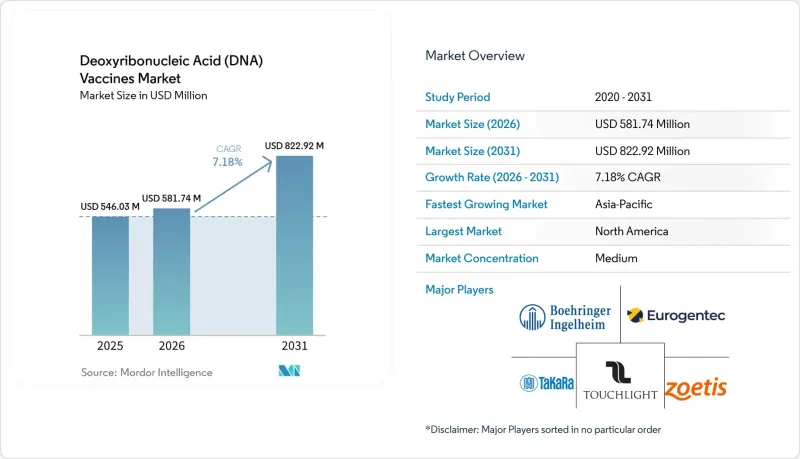
에 따르면 디옥시리보핵산(DNA) 백신 시장 규모는 2025년 5억 4,603만 달러에서 2026년에는 5억 8,174만 달러로 확대하며, 2026-2031년에 CAGR 7.18%로 추이하며, 2031년에는 8억 2,292만 달러에 달할 것으로 예측됩니다.
전 세계 데옥시리보핵산(DNA) 백신 시장의 동향 및 인사이트
신흥 및 재유행 병원체에 대한 신속한 대응
DNA 백신은 새로 선정된 항원 서열을 통합한 검증된 플라스미드 골격을 활용할 수 있으므로, 병원체의 유전적 특징이 확인된 후 초기 설계 단계를 단축할 수 있습니다. INOVIO사는 COVID-19 대응 과정에서 서열 선정부터 인간 대상 첫 투여까지 82일 만에 달성했습니다. 가나에서 성인 220명을 대상으로 실시된 INO-4500의 1b상 임상시험에서는 전기천공법을 이용한 피내 투여 후 측정 가능한 체액성 및 세포성 면역 반응이 보고되었습니다. 이 결과는 신속 대응 플랫폼이 라사바이러스와 같은 병원체에 대해 실질적인 가치를 가질 수 있음을 지원합니다. 또한 발병이 발생하여 광범위한 배포가 필요해지기 전에 대비 프로그램을 통해 재사용 가능한 제조 및 규제 관련 지식이 축적된다면, DNA 백신 시장에도 이점이 될 것입니다. 많은 mRNA 제품보다 온도 민감도가 낮다는 특성은 콜드 체인 인프라가 제한된 지역에서의 사용을 더욱 촉진할 것입니다.
확대되는 치료용 암 백신 및 맞춤형 백신 파이프라인
치료용 DNA 백신은 감염 예방이 아닌, 종양 특이적 돌연변이에 대한 면역 반응을 유도하기 위해 개발되고 있습니다. 2026년 교모세포종을 대상으로 한 1상 임상시험에서는 공간적으로 분산된 최대 40개의 네오항원을 표적으로 한 맞춤형 DNA 백신으로부터 백신 특이적 T세포 반응이 보고되었습니다. 네오항원 백신에 대한 연구에서는 지속적인 T세포 면역의 가능성도 제시되고 있지만, 임상적 유효성에 대해서는 각 프로그램별로 평가해야 합니다. Touchlight사는 2026년 7월, 자사의 무세포 dbDNA 플랫폼을 활용한 NEOVACC 1상 맞춤형 폐암 백신 임상시험에서 첫 번째 환자에 대한 투여를 시작했다고 보고했습니다. 제조 과정의 신속화로 인해 진행 속도가 빠른 종양에 대해 환자 특이적 제품이 보다 실용적인 선택지가 될 가능성이 있습니다. 이러한 움직임은 DNA 백신 시장내 종양학 분야의 연평균 성장률(CAGR)이 9.2%에 달할 것이라는 예측을 지원합니다.
기존의 주사 방식에서는 인간에서 면역원성이 낮습니다.
기존의 근육내 및 피하 주사 방식에서는 많은 인간용 DNA 백신 후보에서 면역 반응이 약해지는 경향이 있습니다. 공개된 임상 데이터에 따르면 측정 가능한 반응을 얻기 위해서는 2 mg의 DNA 투여량이 필요할 수 있는 반면, mRNA COVID-19 백신은 30-100μg의 투여량으로 충분합니다. DNA는 세포핵에 도달해야 하지만, 일반적인 주사 방식으로는 이 과정을 도울 수 없습니다. 전기천공법은 세포내 흡수를 개선할 수 있지만, 장비 및 투여와 관련된 추가 요건이 따릅니다. 2025년 전임상 연구에서는 LNP 제제를 이용한 H5N1 플라스미드 DNA 백신 투여 후, 생쥐에서 지속적인 방어 효과가 보고되었습니다. LNP 제제는 이러한 한계를 완화할 가능성이 있지만, 인간을 대상으로 한 프로그램에서는 여전히 임상적 검증과 확장 가능한 제조 공정이 필요합니다.
부문 분석
2025년, 인간용 DNA 백신은 매출의 61.83%를 차지했습니다. 이 비율은 HPV 관련 질환, 감염증 및 종양학 분야의 임상 활동을 반영합니다. 인간용 부문에는 MERS-CoV, 라사바이러스, 에볼라, 인플루엔자 및 암을 대상으로 한 프로그램이 포함됩니다. 나머지 매출은 동물용 백신이 차지하고 있으며, 이는 해당 플랫폼에서 완전히 상용화된 제품의 실적 원천으로 계속 자리 잡고 있습니다. 개 흑색종, 말 질환 및 연어 양식용 제품은 제조 및 규제 실무의 기준점이 되고 있습니다. 이러한 실적은 개발자들이 DNA 기반 제품을 어떻게 제조하고 투여할 수 있는지를 설명하는 데 도움이 되고 있습니다.
인간용 DNA 백신 시장 규모는 2026-2031년까지 연평균 성장률(CAGR) 8.51%로 확대될 것으로 예측됩니다. VGX-3100은 2026년 5월, 중국에서 진행된 3상 임상시험에서 긍정적인 톱라인 결과를 보고했습니다. 이 시험에는 22개 3차 병원의 207명의 피험자가 참여했으며, 주요 평가 지표를 달성했습니다. Fosun Wanbang사는 2026년 1월, 8억 위안(1억 1,300만 달러 상당) 규모의 계약을 통해 중화권내 상업화 권리를 확보했습니다. 이 계약에는 선급금 및 마일스톤 지급금, 그리고 두 자릿수 로열티가 포함되어 있습니다. 이러한 조건들은 아시아태평양의 인간용 DNA 백신 시장에 유익한 상업적 참고 사례가 될 것입니다. 동물용 프로그램은 더 짧은 개발 과정을 거쳐 진행될 수 있으며, 다른 증거 요건이 적용됩니다. 인간용 제품이 성숙기에 도달할 때까지 동물용 제품은 계속해서 중요한 단기 수입원이 될 전망입니다.
2025년에는 예방용 백신이 매출의 65.38%를 차지했습니다. 팬데믹 대비, 감염병 예방, 그리고 확립된 동물용 의약품 기반이 이러한 위상을 지원했습니다. 치료용 프로그램은 2031년까지 연평균 성장률(CAGR) 9.07%로 성장할 것으로 예측됩니다. 이러한 성장은 주로 네오항원에 대한 면역 반응을 유도하는 것을 목표로 하는 종양학 프로그램에서 비롯됩니다. 이 용도는 예방과 달리 환자마다 다른 구조체가 필요할 수 있습니다. 또한 제조 리드타임 및 임상 증거에 대해서도 서로 다른 요건이 발생합니다.
맞춤형 치료용 백신의 경우, 생검 재료에서 완성된 투여량에 이르기까지의 제조 과정을 4주 이내에 완료해야 하는 경우가 많습니다. NEOVACC 임상시험은 이러한 운영상의 요구에 대응하기 위해 무세포 생산이 어떻게 활용되고 있는지를 보여줍니다. 알레르기 및 자가면역 질환을 대상으로 한 치료 프로그램은 여전히 개발 초기 단계에 있습니다. 현재 이용 가능한 정보에 따르면 비소세포폐암의 경우 환자 선별이 중요한 과제로 꼽히고 있습니다. 따라서 치료용 백신이 널리 보급되기 전에는 동반 진단이 필요할 가능성이 있습니다. 암 치료 후보 약물이 유의미한 임상적 이점을 입증할 수 있다면, DNA 백신 업계에서는 더 높은 부가가치를 지닌 제품 구성이 예상됩니다. 이러한 기회는 여전히 반응 예측, 제조의 일관성, 그리고 보험사의 승인에 달려 있습니다.
2025년 시점에 플라스미드 DNA는 기술 플랫폼 부문의 72.16%를 차지했습니다. 이 점유율은 세균 발효에 기반한 전체 제조 네트워크에서 축적된 cGMP 경험을 반영합니다. 개발자들은 후기 임상 단계에 진입하는 플라스미드 제품에 대한 공정상의 요건을 잘 파악하고 있습니다. 또한 플라스미드 DNA는 2031년까지 연평균 성장률(CAGR) 9.18%로 성장할 것으로 예측됩니다. 이 성장률은 특히 종양학 및 감염증 분야의 임상 프로그램 규모를 반영한 것입니다. 그렇지만 전달 방법의 개선과 제조 공정의 간소화가 필요하다는 사실은 변함이 없습니다.
선형 DNA와 미니서클 DNA는 기존 플라스미드를 대체할 수 있는 대안으로 개발이 진행되고 있습니다. 이들은 항생제 내성 마커 및 세균 발효에 수반되는 불순물에 대한 우려를 해소할 수 있습니다. Touchlight사는 2025년 1월, 무세포 dbDNA 제조와 관련하여 MHRA의 GMP 승인을 획득했습니다. Applied DNA Sciences사는 2025년 1월, LineaDNA의 GMP 시설 건설을 완료했습니다. 이러한 플랫폼은 프로그램이 후기 임상 시험 단계로 진행됨에 따라 개발자들에게 더 많은 제조 옵션을 제공할 가능성이 있습니다. MIDGE 벡터와 DNA 오리гами 플랫폼은 여전히 전임상 단계에 있으며, 장기적인 기술적 선택지를 넓혀줄 것입니다.
지역별 분석
2025년, 북미는 전 세계 DNA 백신 시장의 38.12%를 차지했습니다. 이 지역에는 임상 개발 기업, 플라스미드 CDMO 및 전달 기술 공급업체가 집중되어 있습니다. 캐나다와 앨버타주는 2025년 Entos Pharmaceuticals사의 에드먼턴 제조 프로젝트에 1억 9,850만 달러를 지원했습니다. 계획 중인 시설은 연간 1,000만 회분의 백신 생산 능력을 목표로 하고 있습니다. 미국에서는 INOVIO사가 2026년 2분기 진행 상황 보고를 통해 INO-3107에 대한 승인 전 현장 조사가 완료되었다고 발표했습니다. 멕시코는 여전히 소규모 시장 참여국이며, 그 활동은 국내 제품 개발보다는 정부의 의료 조달에 중점을 두고 있습니다.
유럽은 지역별 기준으로 두 번째로 큰 시장입니다. 2025년 1월, MHRA는 Touchlight사의 햄프턴 시설에 대해 무세포 효소법을 이용한 DNA 제조와 관련된 최초의 GMP 인증을 부여했습니다. INO-3107은 EMA의 희귀질환 치료제 지정 및 ILAP 절차에 기반한 영국의 이노베이션 패스포트를 취득했습니다. 독일, 프랑스, 이탈리아에서는 생물제제 제조 체계가 확립되어 있습니다. NorthX Biologics는 2027년까지 예정된 Nimvec AM510의 첫 번째 인체 임상시험을 위해 준비를 진행 중인 Amarna Therapeutics를 지원하고 있습니다. 유럽의 개발 기업 및 학술 단체들도 해당 지역의 임상 및 제조 기반을 더욱 강화하고 있습니다.
아시아태평양은 2026-2031년까지 연평균 성장률(CAGR) 8.76%로 성장할 것으로 예측됩니다. 인도는 ‘국가 바이오파마 미션’의 일환으로, 세계 최초로 승인된 인간용 플라스미드 DNA 백신인 ZyCoV-D를 통해 중요한 선례를 확립했습니다. 중국은 VGX-3100의 3상 임상시험 결과와 푸솅완방(Fosun Wanbang)의 그레이터 차이나 지역내 상용화 계약을 통해 더욱 탄력을 받고 있습니다. 일본, 호주, 한국은 파이프라인 및 임상시험 활동에 기여하고 있습니다. 중동 및 아프리카, 남미는 여전히 소규모 시장에 머물러 있습니다. 공중보건 시스템의 확충에 따라 열안정성은 이들 지역에서 장기적인 기회를 지원할 가능성이 있습니다.
기타 혜택:
- 엑셀 형식의 시장 예측(ME) 시트
- 3개월간의 애널리스트 지원
자주 묻는 질문
목차
제1장 서론
- 조사 전제조건과 시장 정의
- 조사 범위
제2장 조사 방법
제3장 개요
제4장 시장 구도
- 시장 개요
- 시장 성장 촉진요인
- 시장 성장 억제요인
- 가치 및 공급망 분석
- 규제 상황
- 기술 전망
- Porter's Five Forces 분석
제5장 시장 규모와 성장 예측
- 유형별
- 백신의 용도별
- 기술 플랫폼별
- 제공 방법별
- 투여 경로별
- 적응증별
- 최종사용자별
- 지역별
- 북미
- 미국
- 캐나다
- 멕시코
- 유럽
- 독일
- 영국
- 프랑스
- 이탈리아
- 스페인
- 기타 유럽 국가
- 아시아태평양
- 중국
- 일본
- 인도
- 호주
- 한국
- 기타 아시아태평양 국가
- 중동 및 아프리카
- GCC
- 남아프리카공화국
- 기타 중동 및 아프리카 국가
- 남미
- 브라질
- 아르헨티나
- 기타 남미 국가
- 북미
제6장 경쟁 구도
- 시장 집중도
- 시장 점유율 분석
- 기업 개요
- Applied DNA Sciences, Inc.
- AnGes, Inc.
- AGC Biologics
- Aldevron LLC
- Boehringer Ingelheim Animal Health USA Inc.
- Eurogentec S.A.
- Enzene Biosciences Limited
- Entos Pharmaceuticals Inc.
- Genexine, Inc.
- GeneOne Life Science, Inc.
- INOVIO Pharmaceuticals, Inc.
- Ichor Medical Systems, Inc.
- LineaRx, Inc.
- NorthX Biologics AB
- PharmaJet, Inc.
- Takara Bio Inc.
- Touchlight Genetics Ltd.
- Takis Biotech S.r.l.
- VGXI, Inc.
- Waisman Biomanufacturing
- Zydus Lifesciences Limited
- Zoetis Inc.
제7장 시장 기회와 향후 전망
KSAAccording to Mordor Intelligence, the deoxyribonucleic acid vaccines market size is expected to grow from USD 546.03 million in 2025 to USD 581.74 million in 2026 and is forecast to reach USD 822.92 million by 2031 at 7.18% CAGR over 2026-2031.
Global Deoxyribonucleic Acid (DNA) Vaccines Market Trends and Insights
Faster Response to Emerging and Re-emerging Pathogens
DNA vaccines can use a validated plasmid backbone with a newly selected antigen sequence, which can shorten the early design stage after a pathogen is genetically characterized. INOVIO moved from sequence selection to a first human dose in 82 days during the COVID-19 response. The INO-4500 Phase 1b study in 220 adults in Ghana reported measurable humoral and cellular responses after intradermal administration with electroporation. This result supports continued development against pathogens such as the Lassa virus, where a rapid response platform may have practical value. The DNA vaccines market can also benefit when preparedness programs create reusable manufacturing and regulatory experience before an outbreak requires broad deployment. Lower temperature sensitivity than many mRNA products can further support use in areas with constrained cold-chain infrastructure.
Growing Therapeutic Oncology and Personalized Vaccine Pipelines
Therapeutic DNA vaccines are being developed to direct immune responses against tumor-specific mutations rather than to prevent an infection. A 2026 Phase 1 glioblastoma study reported vaccine-specific T-cell responses from a personalized DNA vaccine that targeted up to 40 spatially distributed neoantigens. Research on neoantigen vaccines has also described the potential for durable T-cell immunity, although clinical benefit must be assessed in each program. Touchlight reported first patient dosing in the NEOVACC Phase I personalized lung cancer vaccine trial in July 2026 using its cell-free dbDNA platform. Faster production may make patient-specific products more workable for tumors that progress quickly. This activity supports the 9.2% forecast CAGR for oncology within the DNA vaccines market.
Lower Human Immunogenicity With Conventional Injection
Conventional intramuscular and subcutaneous injection has produced weaker immune responses for many human DNA vaccine candidates. Published clinical data have indicated that measurable responses may require a 2 mg DNA dose, compared with 30 to 100 μg doses for mRNA COVID-19 vaccines. DNA must reach the cell nucleus, and ordinary injection does not assist this process. Electroporation can improve cellular uptake, but it adds equipment and administration requirements. A 2025 preclinical study reported durable protection in mice after an LNP-formulated H5N1 plasmid DNA vaccine. LNP formulation may reduce this limitation, but it still requires clinical validation and a scalable manufacturing process for human programs.
Other drivers and restraints analyzed in the detailed report include:
- Greater Demand for Stable, Scalable Vaccine Platforms
- Expansion of Veterinary and Zoonotic Disease Prevention
- Limited Human Commercial Validation and Reimbursement Precedent
For complete list of drivers and restraints, kindly check the Table Of Contents.
Segment Analysis
Human DNA vaccines accounted for 61.83% of revenue in 2025. This position reflects clinical activity in HPV-related disease, infectious diseases, and oncology. The human segment includes programs for MERS-CoV, Lassa virus, Ebola, influenza, and cancer. Animal vaccines supplied the remaining revenue and remain the source of fully commercialized product experience for the platform. Products for canine melanoma, equine disease, and salmon aquaculture have provided a reference point for manufacturing and regulatory practice. This history helps developers explain how DNA-based products can be made and administered.
Human DNA vaccines are forecast to grow at an 8.51% CAGR from 2026 to 2031. VGX-3100 reported positive topline results from its China Phase III study in May 2026, including 207 participants at 22 tertiary hospitals and achievement of the primary endpoint. Fosun Wanbang obtained Greater China commercialization rights in January 2026 under a deal valued at CNY 800 million, equivalent to USD 113 million, in upfront and milestone payments plus double-digit royalties. These terms provide a useful commercial reference for the human DNA vaccines market in Asia-Pacific. Animal programs can move through shorter development pathways and face different evidence requirements. They are likely to remain an important near-term contributor while human products mature.
Prophylactic vaccines accounted for 65.38% of revenue in 2025. Pandemic preparedness, infectious disease prevention, and the established animal health base supported that position. Therapeutic programs are forecast to grow at a 9.07% CAGR through 2031. Their growth is tied mainly to oncology programs that seek to stimulate responses against neoantigens. This use differs from prevention because each patient may need a distinct construct. It also creates different demands for manufacturing turnaround and clinical evidence.
Personalized therapeutic vaccines often require manufacturing from biopsy material to a finished dose in less than 4 weeks. The NEOVACC trial demonstrates how cell-free production is being used to address this operational need. Therapeutic programs for allergy and autoimmune disease remain early in development. The available input also identifies patient selection as a key issue for non-small cell lung cancer. Companion diagnostics could therefore be needed before therapeutic vaccines gain broad use. The DNA vaccines industry may see a higher-value product mix if oncology candidates establish meaningful clinical benefit. That opportunity still depends on response prediction, manufacturing consistency, and payer acceptance.
Plasmid DNA held 72.16% of the technology platform segment in 2025. Its share reflects established cGMP experience across bacterial fermentation-based manufacturing networks. Developers know the process expectations for plasmid products entering later clinical stages. Plasmid DNA is also forecast to grow at a 9.18% CAGR through 2031. The growth rate reflects the volume of clinical programs, especially in oncology and infectious diseases. It does not remove the need to improve delivery and simplify manufacturing.
Linear DNA and minicircle DNA are being developed as alternatives to conventional plasmids. They can address concerns related to antibiotic resistance markers and bacterial fermentation artifacts. Touchlight received an MHRA GMP license for cell-free dbDNA manufacturing in January 2025. Applied DNA Sciences completed its LineaDNA GMP facility buildout in January 2025. These platforms may give developers more manufacturing options as programs move into later studies. MIDGE vectors and DNA origami platforms remain preclinical and add to the longer-term technology range.
Complete Report Scope:
- By Type
- Human DNA Vaccines
- Animal DNA Vaccines
- By Vaccine Purpose
- Prophylactic DNA Vaccines
- Therapeutic DNA Vaccines
- By Technology Platform
- Plasmid DNA Vaccines Technology
- Linear DNA Vaccines Technology
- Minicircle DNA Vaccines Technology
- Other DNA Constructs
- By Delivery Method
- Electroporation
- Needle-Free Injection
- Suction-Based Delivery
- Lipid and Nanoparticle Delivery
- Liposome and Polymer Delivery
- Other Delivery Methods
- By Route of Administration
- Intradermal
- Intramuscular
- Subcutaneous
- Oral and Mucosal
- Other Routes of Administration
- By Indication
- Infectious Diseases
- Oncology
- Allergies and Autoimmune Conditions
- Other Human Indications
- Veterinary Diseases
- By End User
- Hospitals and Clinics
- Veterinary Hospitals and Clinics
- Government and Public-Health Suppliers
- Research Institutes and Academic Centers
- Pharmaceutical and Biotechnology Companies
- By Geography
- North America
- United States
- Canada
- Mexico
- Europe
- Germany
- United Kingdom
- France
- Italy
- Spain
- Rest of Europe
- Asia-Pacific
- China
- Japan
- India
- Australia
- South Korea
- Rest of Asia-Pacific
- Middle East & Africa
- GCC
- South Africa
- Rest of Middle East & Africa
- South America
- Brazil
- Argentina
- Rest of South America
- North America
Geography Analysis
North America held 38.12% of the global DNA vaccines market in 2025. The region has a high concentration of clinical developers, plasmid CDMOs, and delivery technology suppliers. Canada and Alberta committed USD 198.5 million to Entos Pharmaceuticals' Edmonton manufacturing project in 2025. The planned site targets a capacity of 10 million vaccine doses per year. In the United States, INOVIO reported that pre-licensure inspections for INO-3107 were complete in its second-quarter 2026 update. Mexico remains a smaller participant, with activity centered on government health procurement rather than domestic product development.
Europe is the second-largest regional market. The MHRA granted the first GMP license for cell-free enzymatic DNA production to Touchlight's Hampton facility in January 2025. INO-3107 has an EMA Orphan Drug designation and a UK Innovation Passport under the ILAP pathway. Germany, France, and Italy have established biologics manufacturing capabilities. NorthX Biologics is supporting Amarna Therapeutics as it prepares Nimvec AM510 for first-in-human studies expected by 2027. European developers and academic groups add to the region's clinical and manufacturing depth.
Asia-Pacific is forecast to grow at an 8.76% CAGR from 2026 to 2031. India established a key precedent through ZyCoV-D, the first approved human plasmid DNA vaccine, under the National Biopharma Mission. China adds momentum through VGX-3100 Phase III results and Fosun Wanbang's Greater China commercialization arrangement. Japan, Australia, and South Korea contribute to pipeline and clinical trial activity. The Middle East, Africa, and South America remain smaller markets. Thermal stability can support a longer-term opportunity in these locations as public-health systems expand.
- Applied DNA Sciences, Inc.
- AnGes, Inc.
- AGC Biologics
- Aldevron LLC
- Boehringer Ingelheim Animal Health USA Inc.
- Eurogentec S.A.
- Enzene Biosciences Limited
- Entos Pharmaceuticals Inc.
- Genexine, Inc.
- GeneOne Life Science, Inc.
- INOVIO Pharmaceuticals, Inc.
- Ichor Medical Systems, Inc.
- LineaRx, Inc.
- NorthX Biologics AB
- PharmaJet, Inc.
- Takara Bio
- Touchlight Genetics Ltd.
- Takis Biotech S.r.l.
- VGXI, Inc.
- Waisman Biomanufacturing
- Zydus Lifesciences Limited
- Zoetis
Additional Benefits:
- The market estimate (ME) sheet in Excel format
- 3 months of analyst support
TABLE OF CONTENTS
1 INTRODUCTION
- 1.1 Study Assumptions and Market Definition
- 1.2 Scope of the Study
2 RESEARCH METHODOLOGY
3 EXECUTIVE SUMMARY
4 MARKET LANDSCAPE
- 4.1 Market Overview
- 4.2 Market Drivers
- 4.2.1 Faster Response to Emerging and Re-emerging Pathogens
- 4.2.2 Growing Therapeutic Oncology and Personalized Vaccine Pipelines
- 4.2.3 Greater Demand for Stable, Scalable Vaccine Platforms
- 4.2.4 Expansion of Veterinary and Zoonotic Disease Prevention
- 4.2.5 Public-Private Funding for Pandemic Preparedness
- 4.2.6 Under-Reported: Antigen-Design Reuse Across Variant and Pathogen Programs
- 4.3 Market Restraints
- 4.3.1 Lower Human Immunogenicity With Conventional Injection
- 4.3.2 Electroporation-Associated Procedure Burden
- 4.3.3 Limited Human Commercial Validation and Reimbursement Precedent
- 4.3.4 Under-Reported: Device-Vaccine Combination-Product CMC Complexity
- 4.4 Value and Supply-Chain Analysis
- 4.5 Regulatory Landscape
- 4.6 Technological Outlook
- 4.7 Porter's Five Forces Analysis
5 MARKET SIZE AND GROWTH FORECASTS
- 5.1 By Type
- 5.1.1 Human DNA Vaccines
- 5.1.2 Animal DNA Vaccines
- 5.2 By Vaccine Purpose
- 5.2.1 Prophylactic DNA Vaccines
- 5.2.2 Therapeutic DNA Vaccines
- 5.3 By Technology Platform
- 5.3.1 Plasmid DNA Vaccines Technology
- 5.3.2 Linear DNA Vaccines Technology
- 5.3.3 Minicircle DNA Vaccines Technology
- 5.3.4 Other DNA Constructs
- 5.4 By Delivery Method
- 5.4.1 Electroporation
- 5.4.2 Needle-Free Injection
- 5.4.3 Suction-Based Delivery
- 5.4.4 Lipid and Nanoparticle Delivery
- 5.4.5 Liposome and Polymer Delivery
- 5.4.6 Other Delivery Methods
- 5.5 By Route of Administration
- 5.5.1 Intradermal
- 5.5.2 Intramuscular
- 5.5.3 Subcutaneous
- 5.5.4 Oral and Mucosal
- 5.5.5 Other Routes of Administration
- 5.6 By Indication
- 5.6.1 Infectious Diseases
- 5.6.2 Oncology
- 5.6.3 Allergies and Autoimmune Conditions
- 5.6.4 Other Human Indications
- 5.6.5 Veterinary Diseases
- 5.7 By End User
- 5.7.1 Hospitals and Clinics
- 5.7.2 Veterinary Hospitals and Clinics
- 5.7.3 Government and Public-Health Suppliers
- 5.7.4 Research Institutes and Academic Centers
- 5.7.5 Pharmaceutical and Biotechnology Companies
- 5.8 By Geography
- 5.8.1 North America
- 5.8.1.1 United States
- 5.8.1.2 Canada
- 5.8.1.3 Mexico
- 5.8.2 Europe
- 5.8.2.1 Germany
- 5.8.2.2 United Kingdom
- 5.8.2.3 France
- 5.8.2.4 Italy
- 5.8.2.5 Spain
- 5.8.2.6 Rest of Europe
- 5.8.3 Asia-Pacific
- 5.8.3.1 China
- 5.8.3.2 Japan
- 5.8.3.3 India
- 5.8.3.4 Australia
- 5.8.3.5 South Korea
- 5.8.3.6 Rest of Asia-Pacific
- 5.8.4 Middle East & Africa
- 5.8.4.1 GCC
- 5.8.4.2 South Africa
- 5.8.4.3 Rest of Middle East & Africa
- 5.8.5 South America
- 5.8.5.1 Brazil
- 5.8.5.2 Argentina
- 5.8.5.3 Rest of South America
- 5.8.1 North America
6 COMPETITIVE LANDSCAPE
- 6.1 Market Concentration
- 6.2 Market Share Analysis
- 6.3 Company Profiles (includes Global Level Overview, Market Level Overview, Core Segments, Financials as available, Strategic Information, Market Rank/Share, Products and Services, Recent Developments)
- 6.3.1 Applied DNA Sciences, Inc.
- 6.3.2 AnGes, Inc.
- 6.3.3 AGC Biologics
- 6.3.4 Aldevron LLC
- 6.3.5 Boehringer Ingelheim Animal Health USA Inc.
- 6.3.6 Eurogentec S.A.
- 6.3.7 Enzene Biosciences Limited
- 6.3.8 Entos Pharmaceuticals Inc.
- 6.3.9 Genexine, Inc.
- 6.3.10 GeneOne Life Science, Inc.
- 6.3.11 INOVIO Pharmaceuticals, Inc.
- 6.3.12 Ichor Medical Systems, Inc.
- 6.3.13 LineaRx, Inc.
- 6.3.14 NorthX Biologics AB
- 6.3.15 PharmaJet, Inc.
- 6.3.16 Takara Bio Inc.
- 6.3.17 Touchlight Genetics Ltd.
- 6.3.18 Takis Biotech S.r.l.
- 6.3.19 VGXI, Inc.
- 6.3.20 Waisman Biomanufacturing
- 6.3.21 Zydus Lifesciences Limited
- 6.3.22 Zoetis Inc.
7 MARKET OPPORTUNITIES AND FUTURE OUTLOOK
- 7.1 White-Space and Unmet-Need Assessment


