

|
시장보고서
상품코드
2154402
AI 기반 인증 워크플로우 툴 : 시장 점유율 분석, 업계 동향과 통계, 성장 예측(2026-2031년)AI-Based Certification Workflow Tools - Market Share Analysis, Industry Trends & Statistics, Growth Forecasts (2026 - 2031) |
||||||
 Mordor Intelligence
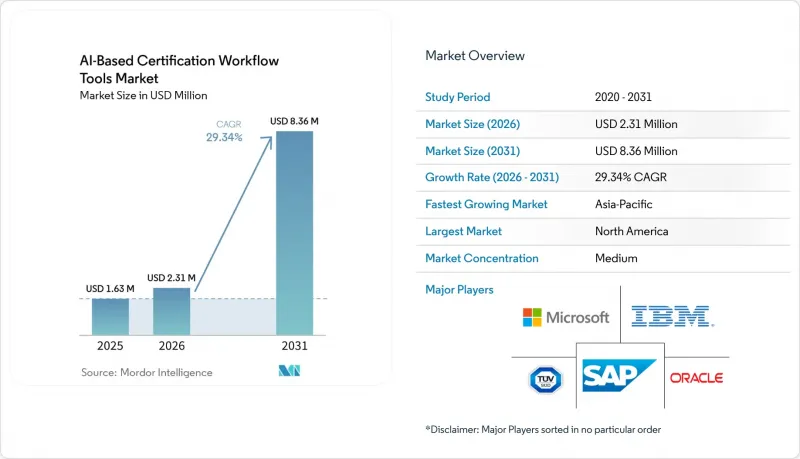
에 따르면 AI 기반 인증 워크플로우 툴 시장 규모는 2025년에 163만 달러, 2026년에 231만 달러로 평가되고 있으며, 2031년까지 836만 달러에 달할 것으로 예측됩니다.
2026-2031년까지 연평균 성장률(CAGR) 29.34%로 성장할 것으로 전망됩니다.
전 세계 AI 기반 인증 워크플로우 툴 시장의 동향 및 인사이트
AI 보증 및 적합성 평가에 관한 규제 확대
EU의 AI법은 고위험 AI 제공업체에 적합성 평가 의무를 부과함에 따라 AI 기반 인증 워크플로우 툴 시장에 대한 큰 수요 신호를 만들어 냈습니다. 해당 규정에서는 특정 위반 행위에 대해 최대 3,500만 유로(2025년 공시 평균 환율 기준 3,885만 달러에 해당) 또는 전 세계 연간 매출의 7%에 해당하는 벌금이 부과되도록 규정하고 있습니다. 독일 연방네트워크청(Bundesnetzagentur)은 2025년 8월 AI 적합성 평가 기관의 지정 통지 기관으로서 업무를 시작했습니다. 이러한 제도적 틀에 따라 인증 기관이 심사를 수행하기 위한 체계화된 증거 자료의 필요성이 높아지고 있습니다. 또한 ISO/IEC 42001은 인증 프로그램이 AI 거버넌스를 평가하는 데 활용할 수 있는 경영 시스템 프레임워크를 제공합니다. 이러한 요건 덕분에, 조직이 최신 신뢰할 수 있는 관리 증거를 유지해야 하는 규제 대상 분야에서 조달 관련 의사결정 기간이 단축되고 있습니다.
정기 감사에서 지속적인 규정 준수 모니터링으로의 전환
AI 기반 인증 워크플로우 툴 시장은 연간 평가에서 통제 및 증거에 대한 지속적인 모니터링으로의 전환에 힘입어 성장하고 있습니다. 연동된 시스템이 통제 주기 전반에 걸쳐 기록을 제공함으로써, 조직은 증거 준비에 필요한 수작업 부담을 줄일 수 있습니다. 이러한 접근 방식을 통해 감사 팀은 예정된 감사가 시작되기 전에 누락된 문서나 불완전한 통제를 쉽게 파악할 수 있습니다. 또한 증거 기록이 생성되므로 사용자는 시간이 지남에 따라 반복되는 문제를 되짚어 보는 데 도움이 됩니다. 실시간 증거 데이터 수집 및 자동 알림 기능을 갖춘 공급업체는 일괄 처리에 기반한 문서 요청 방식의 플랫폼보다 기업의 요구에 더 정확하게 대응할 수 있습니다. 증거 데이터의 축적 기간이 길수록 고객이 다른 시스템으로 전환하기가 어려워지므로, 이러한 변화는 기존 플랫폼에 유리하게 작용합니다.
감사인의 책임과 인적 감독 요건
AI 기반 인증 워크플로우 툴 시장은 적합성 판단에 대한 책임을 자격을 갖춘 감사인이 져야 한다는 요건으로 인해 여전히 제약을 받고 있습니다. EU AI법에는 고위험 AI 시스템에 대한 인적 감독 요건이 포함되어 있습니다. 인증 기관은 적합성 평가 기관의 AI 활용이 ISO/IEC 17021의 역량 요건과 어떻게 관련된지 현재 검토 중입니다. 이러한 불확실성으로 인해 검토 담당자의 점검 단계를 완전히 배제하는 툴의 적용 범위는 제한적입니다. 따라서 공급업체는 증거 수집, 부적합 사항 파악, 인증 결정의 각 단계에 승인 절차를 포함시켜야 합니다. 이러한 관리 조치로 인해 주요 고객을 대상으로 한 도입 및 판매 주기가 장기화될 가능성이 있습니다. 또한 증거 수집이 더욱 자동화되더라도 감사 워크플로우 내에는 어느 정도의 인건비가 남아 있게 됩니다.
부문 분석
소프트웨어 플랫폼은 2025년 AI 기반 인증 워크플로우 툴 시장 점유율의 80.78%를 차지하고 있으며, 2031년까지 연평균 성장률(CAGR) 31.07%로 성장할 것으로 예측됩니다. 이러한 우위는 지사, 표준, 감사 팀 전반에 걸쳐 감사 프로그램을 조정해야 할 필요성을 반영합니다. 통합된 플랫폼은 개별 문서 저장소나 이메일을 통한 증거 자료 요청을 대체할 수 있습니다. Certyze, Intact Systems, CertRoute, Zertic은 구성 가능한 워크플로우, 표준 지원 범위 및 기업 통합에 중점을 두고 있습니다. Qualtrax나 Jadian과 같은 GRC(거버넌스·리스크·컴플라이언스) 중심 공급업체들은 보다 광범위한 리스크 프로그램을 관리하는 고객의 관련 요구 사항을 충족하고 있습니다. Certyze사는 자사의 소프트웨어가 ISO/IEC 17021-1, ISO/IEC 17025 및 ISO/IEC 17065의 각 워크플로우에서 인증 기관 및 적합성 평가 기관을 지원한다고 밝혔습니다.
서비스 부문은 나머지 구성 요소 부문를 차지하며, 도입 컨설팅, 감사원 교육, 규정 준수 관리 서비스, 규제 변경 대응 지원, 그리고 사내에 심도 있는 인증 관련 전문 지식이 없는 조직에 대한 지원 등이 포함됩니다. 이러한 서비스의 역할이 가장 두드러지게 나타나는 단계는 온보딩 단계로, 고객은 기존의 문서 관리 업무를 미리 구성된 워크플로우로 전환하고, 책임 범위를 정의하며, 사용자를 교육하고, 각 필수 관리 조치를 이용 가능한 증거와 대조해야 합니다. Intact Systems는 2025년 4월, International Aerospace Quality Group과 공동으로 온라인 항공우주 공급업체 정보 시스템(OASIS)을 위한 ‘OASIS Insights’를 출시했습니다. 이 툴은 초기 감사, 재인증 감사 또는 감시 감사 후 인증된 항공우주 공급업체를 위한 성과 벤치마크 보고서를 생성하며, 완료된 감사 이벤트가 단순한 정적 기록에 그치지 않고 활용 가능한 품질 정보가 되는 방법을 보여줍니다. 이 모델은 소프트웨어 제공업체에게 정기적인 분석 기능으로 서비스를 보완할 수 있는 수단을 제공하는 동시에, 지속적인 운영 검토를 지원하는 플랫폼이 단순히 문서를 보관하기만 하는 레거시 시스템보다 더 높은 가치를 지닌 이유를 설명하는 데 도움이 됩니다.
2025년 기준, AI 기반 인증 워크플로우 툴 시장 규모의 73.59%를 클라우드 기반 솔루션이 차지하고 있으며, 2031년까지 연평균 성장률(CAGR) 32.02%로 성장할 것으로 예측됩니다. 일원화된 저장소를 통해 분산된 감사 담당자들은 정의된 사용자 권한 하에서 동일한 증거 자료에 접근할 수 있게 됩니다. 또한 클라우드 시스템은 인터페이스를 통해 ID 관리 및 품질관리 애플리케이션과 연동할 수도 있습니다. 이를 통해 정기적인 증거 자료 수집 및 일정에 따른 관리 항목 점검이 지원됩니다. 알림 기능을 통해 미비 사항이 감사 지적 사항이 되기 전에 관리 책임자에게 통지할 수 있습니다. Zertic사는 자사의 ISO 27001 인증을 획득한 시스템이 유럽, 북미, 남미의 인증 기관을 지원하고 있다고 밝혔습니다.
온프레미스 및 하이브리드 배포가 나머지 시장 점유율을 차지하고 있으며, GDPR에 따른 데이터 보호 의무, 각국의 데이터 현지화 규제 또는 사내 정책으로 인해 클라우드 상에서 증거 처리가 제한되는 경우에는 여전히 중요한 역할을 수행하고 있습니다. 하이브리드 설계를 통해 조직은 기밀성이 높은 저장소를 자사의 인프라에 유지하면서, 감사 일정 수립, 보고서 작성, 이해관계자와의 커뮤니케이션, 그리고 지사 간 조정을 위해 클라우드 서비스를 이용할 수 있습니다. 이러한 과도기적 아키텍처는 기존 시스템에서 마이그레이션하는 고객에게 미치는 영향을 완화하고, 기밀성이 높은 기록에 대한 현지 관리를 유지할 수 있게 해줍니다. 그러나 클라우드 기반 서비스는 요구 사항의 변화에 따라 업데이트가 가능하며, 여러 기준에 걸친 통합 감사를 지원하고, 각 사업장별로 개별적인 로컬 환경을 필요로 하지 않는 구독형 소프트웨어에 대한 광범위한 수요와 부합합니다. 따라서 온프레미스 시스템 제공업체는 신규 고객 유치 경쟁에 나설 때, 단순히 기존 아키텍처를 선호한다는 이유만으로는 부족하며, 명확한 데이터 거버넌스 근거를 제시해야 합니다.
지역별 분석
2025년, 북미는 AI 기반 인증 워크플로 툴 시장 점유율의 35.12%를 차지했습니다. 이 지역은 금융 서비스, 항공우주, 기술 분야의 성숙한 규정 준수 프로그램은 물론, 인증 기관이 밀집해 있다는 이점을 가지고 있습니다. 확립된 디지털 품질관리 관행은 고객에게 협업형 감사 툴을 활용할 수 있는 실용적인 기반을 제공합니다. SOX 관련 업무는 많은 미국 조직에 대규모의 지속적인 업무 부담을 야기하고 있습니다. PCAOB 및 SEC의 규제 지침은 AI를 활용한 감사 기법의 허용 가능한 사용 범위를 계속해서 규정하고 있습니다. 또한 캐나다와 멕시코도 북미 제조 네트워크와 관련된 공급망 요건을 통해 수요를 지원하고 있습니다.
유럽은 EU AI법에 기반한 적합성 평가 요건에 힘입어 2025년에는 지역별 2위 규모를 차지했습니다. 뷰로 베리타스는 AWS와의 제휴를 통해 2026년 4월 유럽 기업을 대상으로 한 독립적인 AI 시스템 감사 서비스를 시작했습니다. 이 서비스는 문서의 자동 분석 및 테스트를 통해 감사 주기를 단축하도록 설계되었습니다. 독일의 통지 기관은 AI 적합성 평가 기관에 대한 공식 인증 절차를 마련하고 있습니다. 이러한 규제, 인증 인프라 및 기업의 수요가 결합되어 해당 지역내 AI의 지속적인 도입을 지원하고 있습니다.
아시아태평양은 2031년까지 연평균 성장률(CAGR)이 34.04%에 달하며, 가장 빠르게 성장하는 지역이 될 것으로 예측됩니다. 중국에서 정비되고 있는 AI 거버넌스 프레임워크, 일본의 산업 표준 제정 노력, 그리고 싱가포르의 거버넌스 환경이 이 지역의 수요를 지원하고 있습니다. 인도의 자동차, 제약, IT 공급망 분야에서 ISO 인증을 취득한 수출 기업은 여러 규격 준수를 위한 효율적인 지원을 필요로 하고 있습니다. 한국과 호주 역시 거버넌스 관련 수요를 더욱 부추기고 있습니다. 브라질에서는 농업 및 산업 분야의 수출업체를 대상으로 한 기업 인증 프로그램을 통해 남미 지역에서의 조기 도입이 촉진되고 있습니다. 중동에서는 공공 부문의 디지털화 프로그램을 통해 시장이 발전하고 있는 반면, 아프리카는 여전히 시장 규모가 작지만 금융 서비스 및 통신 분야에서 조기 도입이 진행되고 있습니다.
기타 혜택:
- 엑셀 형식의 시장 예측(ME) 시트
- 3개월간의 애널리스트 지원
자주 묻는 질문
목차
제1장 서론
- 조사 전제조건과 시장 정의
- 조사 범위
제2장 조사 방법
제3장 개요
제4장 시장 구도
- 시장 개요
- 시장 성장 촉진요인
- 시장 성장 억제요인
- 업계 밸류체인 분석
- 규제 상황
- 기술 전망
- Porter's Five Forces 분석
제5장 시장 규모와 성장 예측
- 컴포넌트별
- 배포 모드별
- 최종사용자별
- 조직 규모별
- 산업 분야별
- 지역별
- 북미
- 미국
- 캐나다
- 멕시코
- 남미
- 브라질
- 아르헨티나
- 콜롬비아
- 기타 남미 국가
- 유럽
- 독일
- 영국
- 프랑스
- 이탈리아
- 스페인
- 러시아
- 기타 유럽 국가
- 아시아태평양
- 중국
- 일본
- 인도
- 한국
- 호주
- 싱가포르
- 기타 아시아태평양 국가
- 중동
- 아랍에미리트
- 사우디아라비아
- 이스라엘
- 튀르키예
- 기타 중동 국가
- 아프리카
- 남아프리카공화국
- 나이지리아
- 이집트
- 기타 아프리카 국가
- 북미
제6장 경쟁 구도
- 시장 집중도
- 전략적 동향
- 시장 점유율 분석
- 기업 개요
- Microsoft Corporation
- International Business Machines Corporation
- SAP SE
- Oracle Corporation
- TUV SUD AG
- Intact Systems
- Audit-AI
- AuditOne
- Certyze
- Zertic
- CertRoute
- Jadian
- Qualtrax
- VigiTrust
- Centrieva
- Dossier Solutions
- eLumen
- Liaison International
- Accredible, Inc.
- Parchment LLC
- Bureau Veritas SA
- SGS SA
제7장 시장 기회와 향후 전망
KSAAccording to Mordor Intelligence, the AI-based certification workflow tools market size was valued at USD 1.63 million in 2025 and USD 2.31million in 2026, and is projected to reach USD 8.36 million by 2031, growing at a CAGR of 29.34% during 2026-2031.
Global AI-Based Certification Workflow Tools Market Trends and Insights
Regulatory Expansion of AI Assurance and Conformity Assessment
The EU AI Act has created a significant demand signal for the AI-based certification workflow tools market because high-risk AI providers face conformity assessment obligations. The regulation allowed penalties of up to EUR 35 million, equivalent to USD 38.85 million at the stated 2025 average rate, or 7% of global annual revenue for certain infringements. Germany's Bundesnetzagentur became an operational notifying authority for AI conformity assessment bodies in August 2025. This institutional structure increases the need for well-organized evidence packages for certification bodies to review. ISO/IEC 42001 also provides a management system framework that certification programs can use to assess AI governance. These requirements are shortening procurement decision-making in regulated sectors where organizations must maintain current and reliable evidence of control.
Shift From Periodic Audits to Continuous Compliance Monitoring
The AI-based certification workflow tools market is driven by the shift from annual assessments to continuous monitoring of controls and evidence. Organizations can reduce the manual effort required to prepare evidence when connected systems provide records throughout the control cycle. This approach helps audit teams identify missing documents and incomplete controls before a scheduled audit begins. It also creates a record of evidence that helps users review recurring issues over time. Vendors with real-time evidence ingestion and automated reminders can better address enterprise needs than platforms built around batch document requests. The change favors established platforms because a longer history of evidence can make migrating to another system more difficult for customers.
Auditor Liability and Human Oversight Requirements
The AI-based certification workflow tools market remains limited by requirements that qualified auditors retain responsibility for conformity decisions. The EU AI Act includes human oversight requirements for high-risk AI systems. Accreditation bodies are still determining how the use of AI by conformity assessment organizations relates to competence requirements under ISO/IEC 17021. This uncertainty limits the scope for tools that remove reviewer checkpoints entirely. Vendors must therefore build approval stages into evidence collection, findings, and certificate decisions. Those controls can lengthen implementation and sales cycles for large customers. They also preserve a level of labor cost within audit workflows, even as evidence gathering becomes more automated.
Other drivers and restraints analyzed in the detailed report include:
- Demand for Machine-Readable and Cryptographically Verifiable Evidence
- Integration of Certification Workflows With Enterprise Systems
- Fragmented Standards and Limited Credential Interoperability
For complete list of drivers and restraints, kindly check the Table Of Contents.
Segment Analysis
Software platforms held 80.78% of the AI-based certification workflow tools market share in 2025 and are projected to grow at a CAGR of 31.07% through 2031. Their lead reflects the need to coordinate audit programs across sites, standards, and audit teams. A connected platform can replace separate document repositories and email-based evidence requests. Certyze, Intact Systems, CertRoute, and Zertic focus on configurable workflows, standards coverage, and enterprise integrations. GRC-oriented providers such as Qualtrax and Jadian address related requirements for customers managing wider risk programs. Certyze stated that its software supports certification bodies and conformity assessment bodies across ISO/IEC 17021-1, ISO/IEC 17025, and ISO/IEC 17065 workflows.
Services make up the remaining component segment and include implementation consulting, auditor training, managed compliance delivery, regulatory-change support, and assistance for organizations that do not have deep internal certification expertise. Their role is most visible during onboarding, when a customer must convert existing document routines into configured workflows, define responsibilities, train users, and map each required control to available evidence. Intact Systems launched OASIS Insights with the International Aerospace Quality Group in April 2025 for the Online Aerospace Supplier Information System. The tool generated performance benchmarking reports for certified aerospace suppliers after initial, recertification, or surveillance audits, showing how completed audit events can become usable quality information rather than remain static records. This model gives software providers a way to complement services with recurring analytics and helps explain why platforms that support continuing operational review can be more valuable than legacy systems that only store documents.
Cloud-based solutions accounted for 73.59% of the AI-based certification workflow tools market size in 2025 and are projected to grow at a CAGR of 32.02% through 2031. Centralized repositories enable distributed auditors to access the same evidence under defined user permissions. Cloud systems can also connect with identity and quality management applications through interfaces. This supports regular evidence collection and scheduled control checks. Alerts can notify control owners before gaps become audit findings. Zertic stated that its ISO 27001-certified system supports certification bodies in Europe, North America, and South America.
On-premises and hybrid deployments hold the remaining share and remain important when data-protection obligations under the GDPR, national data-localization rules, or internal policies limit cloud-hosted evidence processing. Hybrid designs allow organizations to retain sensitive repositories on their own infrastructure while using cloud services for audit scheduling, report production, stakeholder communication, and cross-site coordination. This transitional architecture can reduce disruption for customers moving from older systems and can preserve local control over high-sensitivity records. Cloud delivery nonetheless aligns with a wider preference for subscription software that can be updated as requirements change, can support combined audits across several standards, and does not require a separate local environment for every operating location. Providers of on-premises systems therefore need a clear data-governance case, rather than a simple preference for older architecture, when competing for new customer deployments.
Complete Report Scope:
- By Component
- Software Platforms
- Services
- By Deployment Mode
- Cloud-Based
- On-Premises
- Hybrid Deployment
- By End User
- Certification Bodies
- Accreditation and Scheme Owners
- Internal Audit and Compliance Departments
- Testing, Inspection, and Certification Providers
- Other End Users
- By Organization Size
- Large Enterprises
- Small and Medium-Sized Enterprises
- By Industry Vertical
- Information Technology and Telecommunications
- Manufacturing and Industrial
- Healthcare and Life Sciences
- Food and Agriculture
- Energy and Utilities
- Construction and Infrastructure
- Financial Services
- Transportation and Logistics
- Other Industry Verticals
- By Geography
- North America
- United States
- Canada
- Mexico
- South America
- Brazil
- Argentina
- Colombia
- Rest of South America
- Europe
- Germany
- United Kingdom
- France
- Italy
- Spain
- Russia
- Rest of Europe
- Asia-Pacific
- China
- Japan
- India
- South Korea
- Australia
- Singapore
- Rest of Asia-Pacific
- Middle East
- United Arab Emirates
- Saudi Arabia
- Israel
- Turkey
- Rest of Middle East
- Africa
- South Africa
- Nigeria
- Egypt
- Rest of Africa
- North America
Geography Analysis
North America held 35.12% of the AI-based certification workflow tools market share in 2025. The region benefits from mature compliance programs in financial services, aerospace, and technology, as well as a dense base of accredited certification bodies. Established digital quality management practices give customers a practical foundation for connected audit tools. SOX-related work creates a large and recurring workload for many U.S. organizations. Regulatory guidance from the PCAOB and SEC continues to shape the acceptable use of AI-assisted audit methods. Canada and Mexico also add demand through supply-chain requirements linked to North American manufacturing networks.
Europe represented the second-largest regional position in 2025, supported by EU AI Act conformity assessment requirements. Bureau Veritas launched an independent AI systems audit for European enterprises in April 2026 in partnership with AWS. The offering was designed to reduce audit cycles through automated document analysis and testing. Germany's notifying authority provides a formal route for AI conformity assessment bodies. This combination of regulation, certification infrastructure, and enterprise demand supports continued adoption in the region.
Asia-Pacific is projected to be the fastest-growing geography at a CAGR of 34.04% through 2031. China's developing AI governance framework, Japan's industrial standards work, and Singapore's governance environment support regional demand. India's ISO-certified exporters in automotive, pharmaceutical, and IT supply chains need efficient support for multi-standard compliance. South Korea and Australia add further governance-related demand. Brazil supports early adoption in South America through enterprise certification programs for agricultural and industrial exporters. The Middle East is developing through public-sector digital programs, while Africa remains smaller with early adoption in financial services and telecommunications.
- Microsoft Corporation
- International Business Machines Corporation
- SAP SE
- Oracle Corporation
- TUV SUD AG
- Intact Systems
- Audit-AI
- AuditOne
- Certyze
- Zertic
- CertRoute
- Jadian
- Qualtrax
- VigiTrust
- Centrieva
- Dossier Solutions
- eLumen
- Liaison International
- Accredible, Inc.
- Parchment LLC
- Bureau Veritas SA
- SGS SA
Additional Benefits:
- The market estimate (ME) sheet in Excel format
- 3 months of analyst support
TABLE OF CONTENTS
1 INTRODUCTION
- 1.1 Study Assumptions and Market Definition
- 1.2 Scope of the Study
2 RESEARCH METHODOLOGY
3 EXECUTIVE SUMMARY
4 MARKET LANDSCAPE
- 4.1 Market Overview
- 4.2 Market Drivers
- 4.2.1 Regulatory Expansion of AI Assurance and Conformity Assessment
- 4.2.2 Shift from Periodic Audits to Continuous Compliance Monitoring
- 4.2.3 Demand for Machine-Readable and Cryptographically Verifiable Evidence
- 4.2.4 Integration of Certification Workflows with Enterprise Systems
- 4.2.5 Expansion of Remote and Distributed Certification Operations
- 4.2.6 AI-Assisted Document Intelligence and Audit Decision Support
- 4.3 Market Restraints
- 4.3.1 Auditor Liability and Human Oversight Requirements
- 4.3.2 Fragmented Standards and Limited Credential Interoperability
- 4.3.3 Sensitive Client Data and Model-Governance Constraints
- 4.3.4 Inconsistent Training Data Across Standards, Languages, and Jurisdictions
- 4.4 Industry Value Chain Analysis
- 4.5 Regulatory Landscape
- 4.6 Technological Outlook
- 4.7 Porter's Five Forces Analysis
- 4.7.1 Bargaining Power of Suppliers
- 4.7.2 Bargaining Power of Buyers
- 4.7.3 Threat of New Entrants
- 4.7.4 Threat of Substitutes
- 4.7.5 Competitive Rivalry
5 MARKET SIZE AND GROWTH FORECASTS (VALUE)
- 5.1 By Component
- 5.1.1 Software Platforms
- 5.1.2 Services
- 5.2 By Deployment Mode
- 5.2.1 Cloud-Based
- 5.2.2 On-Premises
- 5.2.3 Hybrid Deployment
- 5.3 By End User
- 5.3.1 Certification Bodies
- 5.3.2 Accreditation and Scheme Owners
- 5.3.3 Internal Audit and Compliance Departments
- 5.3.4 Testing, Inspection, and Certification Providers
- 5.3.5 Other End Users
- 5.4 By Organization Size
- 5.4.1 Large Enterprises
- 5.4.2 Small and Medium-Sized Enterprises
- 5.5 By Industry Vertical
- 5.5.1 Information Technology and Telecommunications
- 5.5.2 Manufacturing and Industrial
- 5.5.3 Healthcare and Life Sciences
- 5.5.4 Food and Agriculture
- 5.5.5 Energy and Utilities
- 5.5.6 Construction and Infrastructure
- 5.5.7 Financial Services
- 5.5.8 Transportation and Logistics
- 5.5.9 Other Industry Verticals
- 5.6 By Geography
- 5.6.1 North America
- 5.6.1.1 United States
- 5.6.1.2 Canada
- 5.6.1.3 Mexico
- 5.6.2 South America
- 5.6.2.1 Brazil
- 5.6.2.2 Argentina
- 5.6.2.3 Colombia
- 5.6.2.4 Rest of South America
- 5.6.3 Europe
- 5.6.3.1 Germany
- 5.6.3.2 United Kingdom
- 5.6.3.3 France
- 5.6.3.4 Italy
- 5.6.3.5 Spain
- 5.6.3.6 Russia
- 5.6.3.7 Rest of Europe
- 5.6.4 Asia-Pacific
- 5.6.4.1 China
- 5.6.4.2 Japan
- 5.6.4.3 India
- 5.6.4.4 South Korea
- 5.6.4.5 Australia
- 5.6.4.6 Singapore
- 5.6.4.7 Rest of Asia-Pacific
- 5.6.5 Middle East
- 5.6.5.1 United Arab Emirates
- 5.6.5.2 Saudi Arabia
- 5.6.5.3 Israel
- 5.6.5.4 Turkey
- 5.6.5.5 Rest of Middle East
- 5.6.6 Africa
- 5.6.6.1 South Africa
- 5.6.6.2 Nigeria
- 5.6.6.3 Egypt
- 5.6.6.4 Rest of Africa
- 5.6.1 North America
6 COMPETITIVE LANDSCAPE
- 6.1 Market Concentration
- 6.2 Strategic Moves
- 6.3 Market Share Analysis
- 6.4 Company Profiles (includes Global Level Overview, Market Level Overview, Core Segments, Financials as available, Strategic Information, Market Rank/Share, Products and Services, Recent Developments)
- 6.4.1 Microsoft Corporation
- 6.4.2 International Business Machines Corporation
- 6.4.3 SAP SE
- 6.4.4 Oracle Corporation
- 6.4.5 TUV SUD AG
- 6.4.6 Intact Systems
- 6.4.7 Audit-AI
- 6.4.8 AuditOne
- 6.4.9 Certyze
- 6.4.10 Zertic
- 6.4.11 CertRoute
- 6.4.12 Jadian
- 6.4.13 Qualtrax
- 6.4.14 VigiTrust
- 6.4.15 Centrieva
- 6.4.16 Dossier Solutions
- 6.4.17 eLumen
- 6.4.18 Liaison International
- 6.4.19 Accredible, Inc.
- 6.4.20 Parchment LLC
- 6.4.21 Bureau Veritas SA
- 6.4.22 SGS SA
7 MARKET OPPORTUNITIES AND FUTURE OUTLOOK
- 7.1 White-Space and Unmet-Need Assessment


