

|
시장보고서
상품코드
2154407
감염증 치료 : 시장 점유율 분석, 업계 동향과 통계, 성장 예측(2026-2031년)Communicable Diseases Treatment - Market Share Analysis, Industry Trends & Statistics, Growth Forecasts (2026 - 2031) |
||||||
 Mordor Intelligence
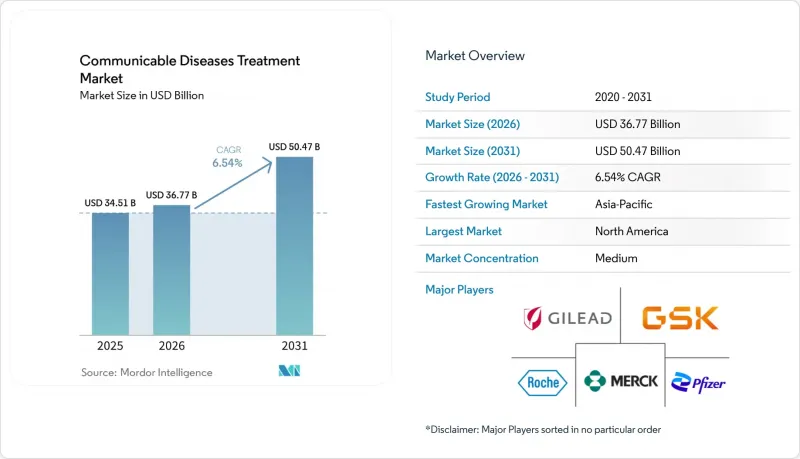
에 따르면 감염증 치료 시장 규모는 2025년 345억 1,000만 달러에서 2026년에는 367억 7,000만 달러로 확대하며, 2026-2031년에 CAGR 6.54%로 추이하며, 2031년에는 504억 7,000만 달러에 달할 것으로 예측됩니다.
전 세계 감염병 치료 시장의 동향 및 인사이트
바이러스성, 세균성, 진균성, 기생충성 감염병의 부담 증가
감염병의 규모와 광범위한 확산은 감염병 치료 시장에 안정적인 치료 기반을 제공하고 있습니다. UNAIDS 보고서에 따르면 2025년에는 3,210만 명이 항레트로바이러스 치료를 받게 되어 HIV 감염자의 78%가 치료를 받을 수 있게 되었습니다. 세계보건기구(WHO)는 2024년 간염 관련 사망자 수가 130만 명에 달했다고 기록했으며, B형 간염(HBV) 신규 감염자 수는 2015년 이후 고작 32%만 감소했다고 밝혔습니다. 이러한 진척 상황은 2030년까지 95%를 감축하겠다는 목표를 여전히 크게 밑돌고 있으며, 많은 의료 시스템에서 예방, 진단, 치료에 대한 수요가 지속되고 있습니다. 또한 바이러스성 질환은 약물 내성균 감염증과 동반될 수 있으며, 입원 환자의 치료는 더욱 복잡해지고 있습니다. 이러한 사례에서는 여러 약물을 투여하거나 장기 입원이 필요할 수 있으며, 이는 제네릭 의약품이 널리 사용되는 지역에서도 치료 수요를 지탱하는 요인이 되고 있습니다.
항생제 내성과 새로운 치료법에 대한 미충족 의료 수요
항균제 내성은 감염증 치료 시장에서 차별화된 항생제 및 항진균제에 대한 수요를 지원하고 있습니다. 세계보건기구(WHO)의 집계에 따르면 2025년 임상 개발 단계에 있는 항균제는 90종으로, 2023년의 97종에서 감소했습니다. 이러한 후보 약물 중 WHO의 혁신 기준을 충족한 것은 불과 15종에 불과했으며, WHO가 지정한 주요 병원체를 표적으로 한 것은 5종에 그쳤습니다. 세계보건총회는 ‘항균제 내성에 관한 글로벌 행동 계획 2026-2036’을 채택했습니다. 이는 항균제 개발을 위한 장기적인 정책 기반을 마련하기 위한 것입니다. 항균제 개발에 종사하는 기업의 90%는 직원 수가 50명 미만이기 때문에 많은 개발 기업의 자원은 제한적입니다. 이로 인해 개발 파이프라인은 자금 조달 여부에 좌우되기 쉬우며, 대기업에 의한 전문적인 항균제 자산 인수가 촉진되고 있습니다.
예비 항균제에 대한 임상 요건과 제한된 상업적 수익
임상적 증거 기준 및 시판 후 의무로 인해 감염증 치료제 개발 기업의 시장 진입 비용은 높아지고 있습니다. 신속 승인 제도는 미충족 의료 수요가 높은 분야의 치료제를 지원할 수 있지만, 개발 기업은 여전히 시판 후 확인 시험을 수행해야 합니다. 또한 규제 당국의 심사에서는 내성 문제와 관련된 항감염제에 대해 엄격한 약물감시 및 지속적인 위험-이익 평가가 요구됩니다. 이러한 요건은 항생제 파이프라인의 대부분을 차지하는 중소규모 개발 기업에 추가적인 압박을 가하고 있습니다. 적정 사용 프로그램으로 인해 예비 항생제의 일상적인 사용이 제한되고 있으며, 해당 약제가 높은 임상적 가치를 지녔다 하더라도 판매량이 감소할 가능성이 있습니다. 그 결과, 상용화까지의 과정이 길어지면서, 임상 및 규제 관련 비용을 더 광범위한 포트폴리오에 분산시킬 수 있는 대기업에게 유리한 상황이 조성되고 있습니다.
부문 분석
2025년, HIV/AIDS는 매출의 36.31%를 차지하며 감염병 치료 시장에서 여전히 가장 큰 질환 부문였습니다. 이 부문은 고부가가치 브랜드 치료제와 지속적인 치료 확대에 힘입어 성장하고 있습니다. UNAIDS 보고서에 따르면 2025년 말 기준으로 3,210만 명이 항레트로바이러스 요법을 받고 있었습니다. 지속형 주사용 항레트로바이러스 치료제는 매일 경구 투여를 지속하기 어려운 환자의 치료 성과를 개선할 수 있습니다. 2026년 2월에 발표된 LATITUDE 3상 임상시험의 최종 데이터에 따르면 복약 순응도에 어려움을 겪는 환자에서 장시간 작용형 카보테그라비르와 릴피비린의 병용 요법의 누적 치료 실패율은 22.8%였던 반면, 매일 경구 투여 요법에서는 41.2%였습니다. 이 결과는 지속적인 복약 순응에 어려움을 겪는 환자에게 주사제 치료 요법이 유용한 대안임을 지원합니다. 사하라 이남 아프리카가 HIV 감염자의 60% 이상을 차지하고 있으므로 국제적인 자금 조달에 대한 압박은 여전히 중요한 과제로 남아 있습니다. 기부자들의 지원 프로그램에 어떤 차질이 생기면, 해당 지역의 치료 접근성이나 환자 수 증가에 영향을 미칠 가능성이 있습니다.
A형, B형, C형, D형, E형 간염은 2031년까지의 예측 연평균 성장률(CAGR)이 7.58%로, 가장 빠르게 성장하고 있는 질환 분야입니다. 만성 B형 간염의 경우, 치료 대상이 확대되었음에도 불구하고 여전히 많은 수의 미치료 환자가 존재합니다. 세계보건기구(WHO)에 따르면 2024년에는 만성 B형 간염 환자의 5% 미만이 치료를 받았으나, 해당 기구의 2024년 치료 기준을 충족하는 환자는 50%에 육박했습니다. 3상 임상시험에서 베피로비르센은 만성 B형 간염 환자의 20%에서 치료 중단 후에도 지속적인 HBsAg 소실을 달성했습니다. 기능적 치유가 실현된다면, 치료는 ‘무기한 바이러스 억제’에서 ‘유한한 치료 과정’으로 전환될 것입니다. 결핵과 말라리아의 경우, 여전히 조달 가격이나 기부자로부터의 자금 지원 제약의 영향을 받고 있습니다. 다제내성균에는 첨단 치료와 고가의 치료가 필요하므로 병원내 감염은 임상적으로 중요한 과제로 남아 있습니다. 호흡기세포융합바이러스, 인플루엔자, 헤르페스 바이러스 감염증에 대해서는 확립된 항바이러스제의 사용이나 개발중인 항체 프로그램을 통해 안정적인 수요가 예상됩니다.
2025년, 항바이러스제는 감염병 치료 시장 규모의 40.24%를 차지했습니다. HIV 및 간염 제품 포트폴리오는 브랜드 제품과 높은 치료량을 통해 이러한 선도적 위치를 지원하고 있습니다. 길리어드 사이언스(Gilead Sciences)는 2025년 총매출이 294억 달러, HIV 관련 제품 매출이 207억 5,000만 달러였습니다고 보고했습니다. 이 회사의 HIV 관련 제품 매출은 2024년 대비 6% 증가했으며, 이는 예방 및 치료 분야의 수요를 반영한 것입니다. C형 간염용 직접 작용형 항바이러스제 역시 수요를 유지하고 있으며, 환자 1인당 60달러로 제네릭 완치 치료가 가능한 저소득 지역에서도 마찬가지입니다. 항균제 및 항진균제는 그 다음으로 큰 치료 분야를 형성하고 있습니다. 제네릭 의약품의 부상은 기존 제품에 영향을 미치고 있지만, 내성 감염증의 존재로 인해 차별화된 약물의 프리미엄 가격 책정이 지원되고 있습니다.
면역요법 및 모노클로널 항체는 2031년까지 연평균 성장률(CAGR) 8.22%를 기록할 것으로 예측됩니다. 현재 임상 개발은 HIV, RSV, 인플루엔자, 홍역, 분디부교바이러스 감염증에 이르고 있습니다. 제3상 임상시험에서는 HIV-1 감염으로 바이러스학적 억제 상태에 있는 성인을 대상으로, 테로파비맙 및 진릴비맙과 레나카파빌의 병용 요법과 카보테그라빌 및 릴피비린의 병용 요법을 비교 평가하고 있습니다. 개발 기반의 확대는 예방 및 치료 분야에서 항체의 역할 확대를 지원하고 있습니다. 또한 공공 조달을 통해 공급량을 확보할 수 있으므로 백신도 치료제 시장에서 그 위상을 높이고 있습니다. Gavi의 2026-2030년의 프로그램에는 뎅기열과 결핵 등이 지원 대상 질환에 포함되어 있습니다. 공공 자금을 통해 제약사에 더 명확한 수요 신호가 제공됨에 따라 감염병 치료 업계는 혜택을 받게 됩니다. 생물제제의 이용 확대에 따라 전문적인 제조, 유통 및 임상 투여에 대한 수요도 증가하고 있습니다.
지역별 분석
2025년, 북미는 매출의 36.61%를 차지하며 감염병 치료 시장에서 가장 큰 지역이 되었습니다. 이러한 위상을 지원하는 요인은 보험 환급 제도, HIV 및 간염 치료에 대한 막대한 지출, 그리고 신약군의 조기 도입입니다. 2025년 6월 미국에서 연 2회 투여하는 레나카파비르가 승인된 것은 이 지역이 새로운 HIV 예방 접근법을 채택할 수 있는 역량을 갖추고 있음을 보여줍니다. 또한 2026년 5월 HDV 감염 치료제 ‘헵쿨덱스’가 신속 승인을 받은 것은 새로운 치료법에 대한 접근성이 급속히 확대되고 있음을 보여줍니다. 캐나다와 멕시코에서는 국가 항레트로바이러스제 프로그램 및 공공 조달을 통해 치료 건수가 증가하고 있지만, 멕시코의 경우 특정 감염병 치료제 범주에서 본인 부담금이 높기 때문에 1인당 지출은 억제되고 있습니다. 화이자는 2025년 매출이 626억 달러에 달했다고 보고했으며, 백신 및 감염병 치료제는 이 회사의 주요 치료 분야 중 하나가 되었습니다. 이러한 규모는 북미 감염병 포트폴리오에서 이루어진 대규모 조직적 활동을 반영하고 있습니다.
유럽은 감염병 치료 시장에서 지역별 2위의 규모를 차지하고 있습니다. 보편적 의료 보장(UHC) 및 각국의 표준 처방집 덕분에 이 지역 대부분에서 항감염제 접근성이 보장되고 있습니다. 유럽의약품청(EMA)의 결정은 유럽연합(EU) 회원국 전체에서의 제품 출시로 이어질 가능성이 있습니다. EMA는 2026년 3월, 만성 B형 간염 치료제 베피로비르센의 판매 승인 신청을 GSK로부터 접수했습니다. 독일, 프랑스, 영국이 해당 지역의 지출 대부분을 차지하고 있습니다. 남유럽은 북유럽 국가들에 비해 결핵 및 HIV 감염 부담이 높아, 이로 인해 치료량이 증가하고 있습니다. 중동 및 아프리카는 GCC(걸프협력회의)의 의료 투자와 남아프리카공화국의 기부자 지원을 통한 HIV 대책 프로그램에 힘입고 있습니다. 기타 MEA 국가들은 항레트로바이러스 요법 및 백신에 대해 Gavi와 글로벌 펀드의 조달에 크게 의존하고 있습니다. 브라질과 아르헨티나를 필두로 한 남미는 광범위한 공중보건 서비스 범위와 비상 비축 물자의 혜택을 받고 있습니다.
아시아태평양은 2031년까지 연평균 성장률(CAGR) 8.25%로 성장할 것으로 예측되며, 이는 감염병 치료 시장에서 지역별 가장 빠른 성장 속도입니다. 인도와 중국은 결핵, 말라리아, 바이러스성 간염, HIV로 인한 막대한 부담에 직면해 있습니다. 또한 인도는 많은 저소득 국가의 의료 시스템에 저비용 의약품을 공급하고 있습니다. 중국에서는 중앙 정부의 협상에 기반한 조달 체계를 통해 가격이 인하되는 한편, 치료 규모도 확대되고 있습니다. 일본은 고가 항바이러스제와 백신에 대해 안정적인 수요를 제공하고 있습니다. 2025년 PNAS 연구에 따르면 21세기 중반까지 뎅기열 발생률이 49%에서 76%까지 증가할 것으로 예측되었으며, 발생률이 2배 이상 높아질 가능성이 있는 지역에는 2억 6,200만 명이 거주하고 있는 것으로 파악되었습니다. Gavi가 2026-2030년에 뎅기열 백신 자금 지원을 포함시킨 것은 동남아시아에서의 조달 가능성을 지원하고 있습니다.
기타 혜택:
- 엑셀 형식의 시장 예측(ME) 시트
- 3개월간의 애널리스트 지원
자주 묻는 질문
목차
제1장 서론
- 조사 전제조건과 시장 정의
- 조사 범위
제2장 조사 방법
제3장 개요
제4장 시장 구도
- 시장 개요
- 시장 성장 촉진요인
- 시장 성장 억제요인
- 공급망 분석
- 규제 상황
- Porter's Five Forces 분석
제5장 시장 규모와 성장 예측
- 질환별
- 치료 분류별
- 투여 경로별
- 유통 채널별
- 지역별
- 북미
- 미국
- 캐나다
- 멕시코
- 유럽
- 독일
- 영국
- 프랑스
- 이탈리아
- 스페인
- 기타 유럽 국가
- 아시아태평양
- 중국
- 일본
- 인도
- 호주
- 한국
- 기타 아시아태평양 국가
- 중동 및 아프리카
- GCC
- 남아프리카공화국
- 기타 중동 및 아프리카 국가
- 남미
- 브라질
- 아르헨티나
- 기타 남미 국가
- 북미
제6장 경쟁 구도
- 시장 집중도
- 시장 점유율 분석
- 기업 개요
- AbbVie Inc.
- AstraZeneca plc
- Bayer AG
- BioNTech SE
- Bristol-Myers Squibb Company
- Cipla Limited
- F. Hoffmann-La Roche Ltd
- Gilead Sciences, Inc.
- GSK plc
- Johnson & Johnson
- Lupin Limited
- Merck & Co., Inc.
- Moderna, Inc.
- Novartis AG
- Pfizer Inc.
- Sandoz Group AG
- Sanofi
- Sun Pharmaceutical Industries Limited
- Takeda Pharmaceutical Company Limited
- Viatris Inc.
제7장 시장 기회와 향후 전망
KSAAccording to Mordor Intelligence, the communicable diseases treatment market size is expected to grow from USD 34.51 billion in 2025 to USD 36.77 billion in 2026 and is forecast to reach USD 50.47 billion by 2031 at 6.54% CAGR over 2026-2031.
Global Communicable Diseases Treatment Market Trends and Insights
Rising Burden of Viral, Bacterial, Fungal, and Parasitic Infections
The scale and range of infections provide a stable treatment base for the communicable diseases treatment market. UNAIDS reported that 32.1 million people received antiretroviral therapy in 2025, while 78% of people living with HIV had access to treatment. The World Health Organization recorded 1.3 million hepatitis-related deaths in 2024 and stated that new HBV infections had declined only 32% since 2015. This progress remains well below the 95% reduction target for 2030, which keeps prevention, diagnosis, and treatment needs active in many health systems. Viral disease can also coexist with drug-resistant bacterial infection, increasing treatment complexity for hospitalized patients. These cases may require several medicines and longer admissions, supporting treatment demand even where generic products are widely used.
Antimicrobial Resistance and Unmet Need for Novel Therapies
Antimicrobial resistance supports demand for differentiated antibiotics and antifungals in the communicable diseases treatment market. The World Health Organization counted 90 antibacterial agents in clinical development in 2025, compared with 97 in 2023. Only 15 of these candidates met the organization's innovation criteria, and only 5 targeted WHO critical pathogens. The World Health Assembly adopted the Global Action Plan on Antimicrobial Resistance 2026-2036, which sets a longer-term policy basis for antimicrobial development. Many developers have limited resources, since 90% of companies active in antibacterial development employ fewer than 50 people. This leaves the pipeline sensitive to funding availability and supports acquisitions of specialized antimicrobial assets by larger companies.
Clinical Requirements and Limited Commercial Returns for Reserve Antibiotics
Clinical evidence standards and post-marketing obligations create high entry costs for infectious disease developers. Accelerated approval can support therapies for areas of high unmet need, but developers still need confirmatory post-marketing studies. Regulatory review also requires rigorous pharmacovigilance and continuing benefit-risk assessment for anti-infectives with resistance implications. These needs place greater pressure on small and mid-sized developers that make up much of the antibacterial pipeline. Stewardship programs restrict the routine use of reserve antibiotics, which can reduce sales volumes even where an agent has high clinical value. The result is a longer commercial path that favors established companies able to spread clinical and regulatory costs across broader portfolios.
Other drivers and restraints analyzed in the detailed report include:
- Public-Health Preparedness, Immunization Funding, and Vector-Borne Disease Exposure
- Molecular Diagnostics and Long-Acting Treatment Innovation
- Concentrated API Supply and Uneven Treatment Access
For complete list of drivers and restraints, kindly check the Table Of Contents.
Segment Analysis
HIV/AIDS held 36.31% of revenue in 2025 and remained the largest disease segment in the communicable diseases treatment market. The segment is supported by high-value branded therapy and continued treatment expansion. UNAIDS reported that 32.1 million people were on antiretroviral therapy at the end of 2025. Long-acting injectable antiretroviral treatment can improve outcomes for people who have difficulty maintaining daily oral therapy. Final LATITUDE Phase III data released in February 2026 showed cumulative regimen failure of 22.8% for long-acting cabotegravir plus rilpivirine, compared with 41.2% for daily oral therapy among people with adherence challenges. This result supports the use of injectable regimens as an alternative for patients with persistent adherence barriers. International funding pressure remains important because sub-Saharan Africa accounts for more than 60% of people living with HIV. Any interruption in donor-backed programs could affect access and volume growth in the region.
Hepatitis A, B, C, D, and E is the fastest-growing disease segment, with a forecast CAGR of 7.58% through 2031. Chronic HBV represents a large, untreated population, even though treatment eligibility has expanded. The World Health Organization stated that fewer than 5% of people living with chronic HBV were receiving treatment in 2024, despite nearly 50% meeting the organization's 2024 treatment criteria. Bepirovirsen achieved sustained HBsAg loss after treatment discontinuation in 20% of chronic HBV patients in Phase III trials. A functional cure would shift care from indefinite viral suppression toward finite treatment courses. Tuberculosis and malaria remain affected by procurement prices and donor funding constraints. Hospital-acquired infections retain clinical importance because multidrug-resistant organisms require high-acuity, premium-priced treatment. Respiratory syncytial virus, influenza, and herpesvirus infections provide stable demand through established antiviral use and developing antibody programs.
Antivirals accounted for 40.24% of the communicable disease treatment market size in 2025. HIV and hepatitis portfolios support this leadership through branded products and high treatment volumes. Gilead Sciences reported total 2025 revenue of USD 29.4 billion and HIV product sales of USD 20.75 billion. Its HIV product sales increased 6% from 2024, reflecting demand in prevention and treatment. Direct-acting antivirals for hepatitis C also sustain demand, including in lower-income settings where generic curative treatment is available at USD 60 per patient. Antibacterials and antifungals form the next major treatment block. Generic erosion affects established products, but resistant infections can support premium pricing for differentiated agents.
Immunotherapies and monoclonal antibodies are forecast to record an 8.22% CAGR through 2031. Clinical activity now extends across HIV, RSV, influenza, measles, and Bundibugyo virus disease. A Phase III study is evaluating teropavimab and zinlirvimab with lenacapavir against cabotegravir and rilpivirine for virologically suppressed adults with HIV-1. The broadening development base supports a larger role for antibodies in prevention and treatment. Vaccines also have a growing position in the treatment class landscape because public procurement can support volume. Gavi's 2026-2030 program includes dengue and tuberculosis among the diseases receiving support. The communicable diseases treatment industry benefits when public funding provides clearer demand signals for manufacturers. Greater biologic use also increases the need for specialized production, distribution, and clinical administration.
Complete Report Scope:
- By Disease
- HIV/AIDS
- Influenza
- Hepatitis A, B, C, D, and E
- Tuberculosis
- Malaria
- Respiratory Syncytial Virus
- Human Papillomavirus-Related Disease
- Dengue
- Herpesvirus Infections
- Fungal Infections
- Hospital-Acquired and Healthcare-Associated Infections
- Other Diseases
- By Treatment Class
- Antivirals
- Antibacterials
- Antifungals
- Antiparasitic Drugs
- Vaccines
- Immunotherapies and Monoclonal Antibodies
- Other Treatment Classes
- By Route of Administration
- Oral
- Injectables
- Inhalational and Intranasal
- Topical and Transdermal
- By Distribution Channel
- Hospital Pharmacies
- Retail and Chain Pharmacies
- Online Pharmacies
- Other Distribution Channels
- By Geography
- North America
- United States
- Canada
- Mexico
- Europe
- Germany
- United Kingdom
- France
- Italy
- Spain
- Rest of Europe
- Asia-Pacific
- China
- Japan
- India
- Australia
- South Korea
- Rest of Asia-Pacific
- Middle East and Africa
- GCC
- South Africa
- Rest of Middle East and Africa
- South America
- Brazil
- Argentina
- Rest of South America
- North America
Geography Analysis
North America held 36.61% of revenue in 2025, making it the largest regional part of the communicable diseases treatment market. Reimbursement capacity, high spending on HIV and hepatitis care, and early adoption of new drug classes support its position. The June 2025 U.S. approval of twice-yearly lenacapavir showed the region's ability to adopt a new HIV prevention approach. The accelerated approval of Hepcludex for HDV infection in May 2026 also illustrates the pace of product access for novel therapies. Canada and Mexico add treatment volumes through national antiretroviral programs and public procurement, Mexico's higher out-of-pocket payments in selected anti-infective categories moderate spending per person. Pfizer reported USD 62.6 billion in 2025 revenue, with vaccines and infectious diseases among its key therapeutic platforms. This scale reflects substantial institutional activity in North American communicable disease portfolios.
Europe holds the second-largest regional position in the communicable diseases treatment market. Universal health coverage and national formularies support access to anti-infectives across much of the region. European Medicines Agency decisions can provide a path to launches across European Union member states. The agency accepted GSK's marketing authorization application for bepirovirsen for chronic HBV in March 2026. Germany, France, and the United Kingdom account for much of the regional spending. Southern Europe has higher tuberculosis and HIV burdens than northern countries, which supports treatment volumes. The Middle East and Africa are supported by GCC health investment and South Africa's donor-backed HIV program. Other MEA countries rely more heavily on Gavi and the Global Fund procurement for antiretroviral therapy and vaccines. South America, led by Brazil and Argentina, benefits from wider public-health coverage and preparedness stockpiles.
Asia-Pacific is forecast to grow at an 8.25% CAGR through 2031, the fastest regional pace in the communicable diseases treatment market. India and China face substantial burdens from tuberculosis, malaria, viral hepatitis, and HIV. India also supplies lower-cost medicines to many lower-income health systems. China's centrally negotiated procurement frameworks have reduced prices while expanding treatment volumes. Japan provides a stable demand for antivirals and vaccines at premium price points. A 2025 PNAS study projected a 49% to 76% increase in dengue incidence by midcentury and identified 262 million people in areas where incidence could more than double. Gavi's inclusion of dengue vaccine funding for 2026-2030 supports procurement potential in Southeast Asia.
- Abbvie
- AstraZeneca
- Bayer
- BioNTech
- Bristol-Myers Squibb
- Cipla
- Roche
- Gilead Sciences
- GlaxoSmithKline
- Johnson & Johnson
- Lupin
- Merck
- Moderna
- Novartis
- Pfizer
- Sandoz Group AG
- Sanofi
- Sun Pharmaceuticals Industries
- Takeda Pharmaceuticals
- Viatris
Additional Benefits:
- The market estimate (ME) sheet in Excel format
- 3 months of analyst support
TABLE OF CONTENTS
1 Introduction
- 1.1 Study Assumptions and Market Definition
- 1.2 Scope of the Study
2 Research Methodology
3 Executive Summary
4 Market Landscape
- 4.1 Market Overview
- 4.2 Market Drivers
- 4.2.1 Rising Burden of Viral, Bacterial, Fungal, and Parasitic Infections
- 4.2.2 Antimicrobial Resistance and Unmet Need for Novel Therapies
- 4.2.3 Public-Health Preparedness and Expanded Immunization Funding
- 4.2.4 Molecular Diagnostics Enabling Earlier Treatment Selection
- 4.2.5 Small-Molecule, Biologic, and Long-Acting Therapy Innovation
- 4.2.6 Climate- and Mobility-Driven Expansion of Vector-Borne Disease Risk
- 4.3 Market Restraints
- 4.3.1 Stringent Clinical, Regulatory, and Pharmacovigilance Requirements
- 4.3.2 Stewardship and Low Commercial Return for Reserve Antibiotics
- 4.3.3 Concentrated Active-Pharmaceutical-Ingredient Supply
- 4.3.4 Treatment-Access Friction from Counterfeits, Stockouts, and Diagnostic Gaps
- 4.4 Supply-Chain Analysis
- 4.5 Regulatory Landscape
- 4.6 Porter's Five Forces Analysis
- 4.6.1 Bargaining Power of Suppliers
- 4.6.2 Bargaining Power of Buyers
- 4.6.3 Threat of New Entrants
- 4.6.4 Threat of Substitutes
- 4.6.5 Competitive Rivalry
5 Market Size & Growth Forecasts (Value, USD)
- 5.1 By Disease
- 5.1.1 HIV/AIDS
- 5.1.2 Influenza
- 5.1.3 Hepatitis A, B, C, D, and E
- 5.1.4 Tuberculosis
- 5.1.5 Malaria
- 5.1.6 Respiratory Syncytial Virus
- 5.1.7 Human Papillomavirus-Related Disease
- 5.1.8 Dengue
- 5.1.9 Herpesvirus Infections
- 5.1.10 Fungal Infections
- 5.1.11 Hospital-Acquired and Healthcare-Associated Infections
- 5.1.12 Other Diseases
- 5.2 By Treatment Class
- 5.2.1 Antivirals
- 5.2.2 Antibacterials
- 5.2.3 Antifungals
- 5.2.4 Antiparasitic Drugs
- 5.2.5 Vaccines
- 5.2.6 Immunotherapies and Monoclonal Antibodies
- 5.2.7 Other Treatment Classes
- 5.3 By Route of Administration
- 5.3.1 Oral
- 5.3.2 Injectables
- 5.3.3 Inhalational and Intranasal
- 5.3.4 Topical and Transdermal
- 5.4 By Distribution Channel
- 5.4.1 Hospital Pharmacies
- 5.4.2 Retail and Chain Pharmacies
- 5.4.3 Online Pharmacies
- 5.4.4 Other Distribution Channels
- 5.5 By Geography
- 5.5.1 North America
- 5.5.1.1 United States
- 5.5.1.2 Canada
- 5.5.1.3 Mexico
- 5.5.2 Europe
- 5.5.2.1 Germany
- 5.5.2.2 United Kingdom
- 5.5.2.3 France
- 5.5.2.4 Italy
- 5.5.2.5 Spain
- 5.5.2.6 Rest of Europe
- 5.5.3 Asia-Pacific
- 5.5.3.1 China
- 5.5.3.2 Japan
- 5.5.3.3 India
- 5.5.3.4 Australia
- 5.5.3.5 South Korea
- 5.5.3.6 Rest of Asia-Pacific
- 5.5.4 Middle East and Africa
- 5.5.4.1 GCC
- 5.5.4.2 South Africa
- 5.5.4.3 Rest of Middle East and Africa
- 5.5.5 South America
- 5.5.5.1 Brazil
- 5.5.5.2 Argentina
- 5.5.5.3 Rest of South America
- 5.5.1 North America
6 Competitive Landscape
- 6.1 Market Concentration
- 6.2 Market Share Analysis
- 6.3 Company Profiles (includes Global Level Overview, Market Level Overview, Core Segments, Financials as available, Strategic Information, Market Rank/Share, Products and Services, Recent Developments)
- 6.3.1 AbbVie Inc.
- 6.3.2 AstraZeneca plc
- 6.3.3 Bayer AG
- 6.3.4 BioNTech SE
- 6.3.5 Bristol-Myers Squibb Company
- 6.3.6 Cipla Limited
- 6.3.7 F. Hoffmann-La Roche Ltd
- 6.3.8 Gilead Sciences, Inc.
- 6.3.9 GSK plc
- 6.3.10 Johnson & Johnson
- 6.3.11 Lupin Limited
- 6.3.12 Merck & Co., Inc.
- 6.3.13 Moderna, Inc.
- 6.3.14 Novartis AG
- 6.3.15 Pfizer Inc.
- 6.3.16 Sandoz Group AG
- 6.3.17 Sanofi
- 6.3.18 Sun Pharmaceutical Industries Limited
- 6.3.19 Takeda Pharmaceutical Company Limited
- 6.3.20 Viatris Inc.
7 Market Opportunities and Future Outlook
- 7.1 White-Space and Unmet-Need Assessment


