

|
시장보고서
상품코드
2154411
스케일 제거제 : 시장 점유율 분석, 업계 동향과 통계, 성장 예측(2026-2031년)Descaling Chemicals - Market Share Analysis, Industry Trends & Statistics, Growth Forecasts (2026 - 2031) |
||||||
 Mordor Intelligence
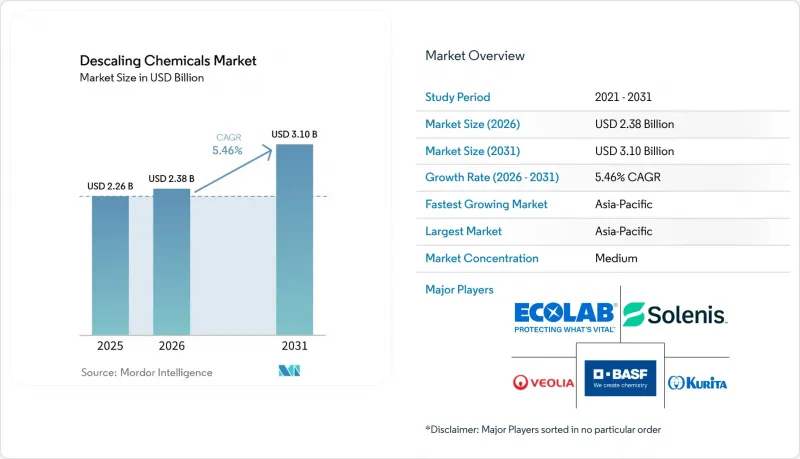
에 따르면 스케일 제거용 화학제품 시장 규모는 2025년에 22억 6,000만 달러로 추계되고 있으며, 예측 기간(2026-2031년)에 CAGR 5.46%로 확대하며, 2026년 23억 8,000만 달러에서 2031년에는 31억 달러에 달할 것으로 전망되고 있습니다.
전 세계 스케일 제거용 화학약품 시장의 동향 및 인사이트
산업용 에너지 효율 및 설비 수명에 관한 요건
스케일 부착은 보일러나 열교환기 표면의 열전달을 저해하므로 스케일 제거제 수요를 지속적으로 견인하는 요인이 되고 있습니다. 쿠리타 공업의 ‘DReeM Polymer’ 자료에 따르면 보일러 표면을 깨끗하게 유지함으로써 에너지 효율이 향상되고 이산화탄소 배출량을 줄일 수 있다고 합니다. 광물 침전물로 인해 열전달이 방해받으면, 소정의 증기 출력을 확보하기 위해 운영자는 더 많은 연료를 소비해야 합니다. 이러한 비용 부담으로 인해 세척 일정은 에너지 감사 및 설비 수명 계획에서 더욱 중요한 위치를 차지하게 되었습니다. 유지보수 팀이 화학 세정을 설비 고장이나 효율 저하에 대한 대응책이 아닌 계획적인 조치로 인식함에 따라 스케일 제거제 시장은 혜택을 볼 것입니다. 그 결과 발생하는 수요는 성능 목표, 유지보수 절차 및 규정 준수 요건과 연계되어 있으므로, 단기적인 생산 변동에 대한 의존도가 낮아집니다.
산업용 수처리 및 공정 세척 수요의 확대
산업용수 시스템은 가동 기간 내내 세척이 필요하며, 이로 인해 처리 및 유틸리티 용도에서 스케일 제거용 화학약품의 사용 범위가 확대되고 있습니다. 물 재이용 시스템에서는 재순환 유체 내에 미네랄이 농축될 가능성이 있으며, 막, 배관, 열교환기 및 정화 장치 내부에 침전물이 쌓일 위험이 높아집니다. 따라서 스케일 제거용 화학약품 시장은 취수량을 줄이는 시설뿐만 아니라 기존 수처리 시설을 확장하는 시설에게도 중요한 요소가 되고 있습니다. 새로운 제조, 광업, 발전 설비가 도입됨에 따라 정기 정지시 세척이 필요한 설비 기반이 확대되고 있습니다. 이러한 수요 양상은 경수와 폐쇄형 루프 시스템이 함께 사용되는 경우 특히 두드러집니다. 화학약품 공급업체는 각 현장의 설비, 수질, 침전물 유형, 가동 일정에 맞춰 맞춤형 세척 프로그램을 제공함으로써 이러한 요구에 대응할 수 있습니다.
유해 화학물질 취급 및 폐수 규제 준수에 따른 비용
산성 제제는 산업 사용자에게 취급, 보관, 근로자 보호 및 폐수 관리에 드는 비용을 증가시킬 가능성이 있습니다. 미국 환경보호청(EPA)은 OSHA(직업안전보건청)의 위험 정보 전달 관련 업데이트에 맞춰 2025년 11월에 유해 화학물질 인벤토리 보고 요건을 개정했습니다. 이러한 의무는 지정된 한도를 초과하는 양의 강산이나 규제 대상 킬레이트제를 사용하는 시설에 영향을 미칠 수 있습니다. 유럽의 REACH 규정 또한 화학 제제의 선정 및 사용에 영향을 미치고 있습니다. 이러한 상황으로 인해 스케일 제거제 시장에서 기존 산의 사용이 제한될 가능성이 있습니다. 특히 규정 준수 대응 자원이 제한적인 소규모 사용자나 공급업체의 경우 이러한 경향이 더욱 두드러질 것입니다. 또한 이러한 규제는 취급 부담이 적고 고부가가치 제품의 입지를 지원할 가능성이 있는 바이오 기반 제품 및 킬레이트제의 대체재를 촉진하는 역할을 합니다.
부문 분석
2025년, 산계 제품은 스케일 제거용 화학약품 시장 점유율의 47.34%를 차지했습니다. 이러한 위상은 보일러, 냉각탑, 열교환기에서 탄산칼슘, 산화철, 규산염 침전물을 제거하는 데 있으며, 그 효과가 입증되었음을 반영합니다. 광물 제거 속도가 유지보수 계획의 핵심이 되는 상황에서는 산계 제제가 여전히 널리 사용되고 있습니다. 'Discover Mechanical Engineering'지의 2026년 연구에서는 5 wt%에서 15 wt%의 염산 농도에서 탄산염 스케일의 급속한 용해가 보고된 반면, 부식 방지의 필요성도 지적되었습니다. 산과 억제제를 병용해야 할 필요성으로 인해 공급업체는 재료 보호, 투여량 지침, 그리고 현장에 맞춘 배합 설계를 통해 자사 제품의 차별화를 꾀할 여지가 생겼습니다. 또한 예방 처리만으로는 해결할 수 없는 심각한 침전물이 있는 기존 설비에서도 산계 제품은 여전히 중요한 역할을 하고 있습니다. 이러한 제품들은 유지보수 팀이 출입 제한 구역에 대한 접근을 재개할 수 있는 신뢰할 수 있는 방법이 필요한 설비 가동 중단 기간 중 특히 유용합니다. 시설에서 정기적인 연수 처리나 스케일 방지제 처리가 도입되어 있는 경우에도 이러한 제품들이 계속 사용되고 있다는 사실은 실질적인 복구 요구를 반영하고 있습니다.
바이오 기반 스케일 제거 제품은 2031년까지 연평균 성장률(CAGR) 7.08%로 성장할 것으로 예측되며, 화학 제품 카테고리 중 가장 빠르게 성장하는 분야가 될 전망입니다. 이러한 성장은 환경 부하가 낮은 배합에 대한 조달 수요 증가와 식물 유래 및 생분해성 성분의 개발을 반영하고 있습니다. Envirofluid사의 ‘Triple7 EnviroScale’은 바이오 기반 함유율 96%로 미국 농무부(USDA)의 ‘BioPreferred’ 인증을 획득했으며, 산업 및 기관 사용자에게 제3자 구매 지침으로 활용되고 있습니다. BASF는 2025년 4월, 재생 가능 탄소 함유율 56%이며 OECD 301D 기준에 따른 즉시 생분해성을 갖춘 GLDA 화학 기술을 적용한 ‘Trilon G’를 출시했습니다. 또한 'Scientific Reports' 저널에서는 산업용수 시스템에서 탄산칼슘 스케일 억제에 있으며, 바이오 유래 계면활성제의 성능에 대해서도 보고되었습니다. 이러한 사례들은 세정 성능과 화학 물질 취급에 대한 우려를 모두 줄이기를 원하는 운영자에게 바이오 기반 제품이 왜 점점 더 적합한 선택지가 되고 있는지를 보여줍니다. 이 제품의 도입이 특히 활발한 분야는 조달 규정, 폐수 처리 고려 사항, 그리고 민감한 장비의 존재로 인해 기존의 산성 세정 프로그램이 실용적이지 않게된 분야입니다. 이 범주에서는 여전히 다양한 침전물 유형와 운전 조건에 대한 적합성을 입증해야 합니다.
지역별 분석
아시아태평양은 2025년 스케일 제거용 화학약품 시장의 32.18%를 차지하고 있으며, 2031년까지 연평균 성장률(CAGR) 6.53%로 성장할 것으로 예측됩니다. 중국, 인도, 일본, 한국 및 아세안(ASEAN) 국가에서는 산업 생산 능력의 확대와 대규모 수처리 수요가 맞물려 수요가 증가하고 있습니다. 산업 생산에 따라 보일러, 열교환기, 냉각 시스템, 공정 장비 등이 증설되고 있으며, 이러한 설비에는 정기적인 세척이 필요합니다. 이 지역 일부에서는 광물 부하가 높아 산업용수 회로내 스케일 형성이 가속화되고 있습니다. 또한 이 지역에서는 물 재이용 및 처리 인프라가 확충되고 있으며, 이로 인해 재순환 시스템 내에서 광물 성분이 농축되고 있습니다. 이러한 상황으로 인해 아시아태평양은 스케일 제거용 화학약품 시장에서 가장 큰 지역 시장일 뿐만 아니라, 가장 빠르게 성장하고 있는 지역이기도 합니다. 수요는 대규모 산업 시설부터 외식 산업, 공공 사업, 공정 장비를 이용하는 소규모 사업자에 이르기까지 폭넓게 분포되어 있습니다. 현지 기술 지원을 제공하고 지역 수질에 적합한 배합을 제안할 수 있는 공급업체는 상업적 우위를 점하게 됩니다.
중국의 물 이용 효율화 투자와 광범위한 산업 기반은 전력, 화학, 제조 시설에서의 수요를 지원하고 있습니다. 인도에서도 유사한 경향이 나타나며, 경도가 높은 지하수와 산업 역량의 확장으로 인해 재순환 시스템에서의 세척 수요가 증가하고 있습니다. 아시아개발은행은 2025년에도 아시아태평양 전체에서 물 안보 격차와 인프라 제약이 여전히 존재할 것이라고 보고했습니다. 일본은 보다 성숙한 시장으로, 자동차, 전자, 식품 가공 분야의 사업자들은 특수 설비에 대응할 수 있는 저부식성 제품을 필요로 하고 있습니다. 이 지역의 구매자들은 세정 속도, 안전성, 그리고 재료 보호의 균형이 잘 잡힌 배합을 더욱 중요시하게 될 것으로 예상됩니다. 이러한 요구 사항은 성숙한 산업 시장과 급속히 확장되는 제조 거점 모두에 해당되며, 또한 사용자가 세정을 보다 일관되게 관리할 수 있도록 지원하는 모니터링 및 투여 서비스의 성장도 촉진하고 있습니다.
북미와 유럽은 공식적인 자산 관리 시스템과 정기적인 유지보수 절차가 잘 갖춰진, 여전히 고부가가치 시장입니다. 식품 가공, 발전, 산업 제조, 첨단 기술 시설이 두 지역 모두에서 확고한 수요를 지원하고 있습니다. 북미의 사업자들은 2026년 에코라보(Ecolab)가 ‘워터 네비게이터 IQ(Water Navigator IQ)’를 출시한 것에서도 알 수 있듯이, 공급업체가 제공하는 디지털 물 관리 툴을 도입하고 있습니다. 유럽의 구매자들은 환경 부하가 낮고 포스포네이트를 함유하지 않은 화학 제품을 점점 더 선호하는 경향을 보이고 있으며, 바이오 기반 대체품이 지지를 받고 있습니다. 남미, 중동 및 아프리카는 규모는 작은 시장이지만, 가공 산업, 해수 담수화 관련 시스템, 광업 및 경수 환경에서 스케일 관리가 필요하므로 전략적으로 중요한 위치를 계속 차지하고 있습니다. 브라질은 설탕·에탄올 가공 및 식품 제조를 통해 남미의 수요를 지원하고 있는 반면, 사우디아라비아, 걸프협력회의(GCC) 국가들, 남아프리카는 산업, 공공사업, 해수 담수화, 광업 활동을 통해 지역의 수요를 지원하고 있습니다. 이러한 시장에서는 현지 수질, 설비 상태, 운영 관행에 적합한 제품이 요구되는 경우가 많습니다. 시장 규모는 작을지라도, 지역 수요의 다양화를 목표로 하는 공급업체에게 있으며, 그 중요성은 결코 줄어들지 않습니다.
기타 혜택:
- 엑셀 형식의 시장 예측(ME) 시트
- 3개월간의 애널리스트 지원
자주 묻는 질문
목차
제1장 서론
- 조사 전제조건과 시장 정의
- 조사 범위
제2장 조사 방법
제3장 개요
제4장 시장 구도
- 시장 개요
- 시장 성장 촉진요인
- 시장 성장 억제요인
- 가치 및 공급망 분석
- Porter's Five Forces 분석
제5장 시장 규모와 성장 예측
- 화학별
- 용도별
- 최종사용자 산업별
- 지역별
- 아시아태평양
- 중국
- 인도
- 일본
- 한국
- ASEAN 국가
- 기타 아시아태평양 국가
- 북미
- 미국
- 캐나다
- 멕시코
- 유럽
- 독일
- 영국
- 프랑스
- 이탈리아
- 북유럽 국가
- 기타 유럽 국가
- 남미
- 브라질
- 아르헨티나
- 기타 남미 국가
- 중동 및 아프리카
- 사우디아라비아
- 남아프리카공화국
- 기타 중동 및 아프리카 국가
- 아시아태평양
제6장 경쟁 구도
- 시장 집중도
- 전략적 동향
- 시장 점유율·순위 분석
- 기업 개요
- A.W. Chesterton Company
- Accepta Water Treatment
- BASF
- Betco Corporation
- Diversey Holdings, Ltd.
- Ecolab Inc.
- Goodway Technologies Corp.
- Henkel AG & Co. KGaA
- Kemira Oyj
- Kurita Water Industries Ltd.
- Solenis
- Spartan Chemical Company, Inc.
- The Clorox Company
- Veolia
- Zep Inc.
제7장 시장 기회와 향후 전망
KSAAccording to Mordor Intelligence, the descaling chemicals market size was estimated at USD 2.26 billion in 2025 and is estimated to grow from USD 2.38 billion in 2026 to USD 3.10 billion by 2031, at a CAGR of 5.46% during the forecast period (2026-2031).
Global Descaling Chemicals Market Trends and Insights
Industrial Energy Efficiency and Equipment-Lifetime Requirements
Scale formation reduces heat transfer across boiler and heat-exchanger surfaces, making it a sustained driver of demand for descaling chemicals. According to Kurita's DReeM Polymer documentation, clean boiler surfaces can improve energy performance and reduce carbon dioxide emissions. When mineral deposits limit heat transfer, operators must consume more fuel to achieve a given steam output. This cost exposure has made cleaning schedules more relevant to energy audits and equipment-life planning. The descaling chemicals market benefits when maintenance teams treat chemical cleaning as a planned measure rather than a response to equipment failure or efficiency decline. The resulting demand is less dependent on short-term production changes because it is tied to performance targets, maintenance procedures, and compliance expectations.
Expansion of Industrial Water Treatment and Process-Cleaning Demand
Industrial water systems require cleaning throughout their operating life, which broadens the use of descaling chemicals across processing and utility applications. Water reuse systems can concentrate minerals in recirculating streams, increasing the risk of deposits inside membranes, piping, heat exchangers, and clarification equipment. This makes the descaling chemicals market relevant to facilities reducing water withdrawals, as well as to those expanding conventional water treatment. New manufacturing, mining, and electricity assets add to the installed equipment base that requires cleaning during scheduled outages. The demand relationship is particularly strong where hard water and closed-loop systems operate together. Chemical suppliers can address this need by offering cleaning programs tailored to the equipment, water quality, deposit type, and operating schedule at each site.
Hazardous-Chemical Handling and Wastewater Compliance Costs
Acid-based formulations can increase costs for handling, storage, worker protection, and wastewater management for industrial users. The U.S. Environmental Protection Agency amended hazardous chemical inventory reporting requirements in November 2025 to align with OSHA hazard communication updates. These obligations can affect facilities that use strong acids and regulated chelating agents at levels above specified limits. European REACH requirements also influence the selection and use of chemical formulations. These conditions can limit the use of conventional acids in the descaling chemicals market, particularly for smaller users and suppliers with limited compliance resources. They also favor bio-based and chelating alternatives that may carry lower handling burdens and support higher-value product positions.
Other drivers and restraints analyzed in the detailed report include:
- Growth of Preventive Maintenance and Clean-in-Place Programs
- Digital Scale Monitoring and Predictive Chemical Dosing
- Substitution by Water Softening, Antiscalants, and Mechanical Cleaning
For complete list of drivers and restraints, kindly check the Table Of Contents.
Segment Analysis
Acid-based products held 47.34% of the descaling chemicals market share in 2025. Their position reflects established effectiveness in removing calcium carbonate, iron oxide, and silicate deposits from boilers, cooling towers, and heat exchangers. Acid formulations remain widely used where the speed of mineral removal is central to the maintenance plan. A 2026 study in Discover Mechanical Engineering reported rapid carbonate-scale dissolution in hydrochloric acid concentrations from 5 wt% to 15 wt%, while also noting the need for corrosion protection. The need to pair acids with inhibitors gives suppliers room to differentiate through material protection, dosing guidance, and site-specific formulation design. Acid-based products also remain relevant for installed equipment with severe deposits that cannot be addressed through preventive treatment alone. They are especially useful during shutdowns, when maintenance teams need a dependable method to restore access to restricted surfaces. Their continued use reflects practical remediation needs, even where facilities have adopted routine softening or antiscalant treatment.
Bio-based descaling products are forecast to grow at a 7.08% CAGR through 2031, making them the fastest-growing chemistry category. Their growth reflects procurement preferences for lower-impact formulations and the development of plant-derived and biodegradable ingredients. Envirofluid's Triple7 EnviroScale received USDA BioPreferred certification with 96% biobased content, providing a third-party purchasing reference for industrial and institutional users. BASF introduced Trilon G in April 2025 using GLDA chemistry with 56% renewable carbon content and ready biodegradability under OECD 301D. Scientific Reports also documented the performance of bio-derived surfactants in controlling calcium carbonate scale in industrial water systems. These examples indicate why bio-based products are becoming more suitable for applications where operators require both cleaning performance and lower chemical-handling concerns. Their adoption is strongest where procurement rules, wastewater considerations, and sensitive equipment make conventional acid programs less practical. The category still needs to demonstrate fit across varying deposit types and operating conditions.
Complete Report Scope:
- By Chemistry
- Acid-Based Descaling Chemicals
- Non-Acid Descaling Chemicals
- Bio-Based Descaling Chemicals
- Others (Chelating Agent-Based Descaling Chemicals, Enzymatic Descaling Chemicals, Specialty Formulations)
- By Application
- Industrial Equipment
- Boilers
- Heat Exchangers
- Water Treatment Systems
- Others
- By End-User Industry
- Industrial Manufacturing
- Power Generation
- Food and Beverage
- Water and Wastewater Treatment
- Others
- By Geography
- Asia-Pacific
- China
- India
- Japan
- South Korea
- ASEAN Countries
- Rest of Asia-Pacific
- North America
- United States
- Canada
- Mexico
- Europe
- Germany
- United Kingdom
- France
- Italy
- NORDIC Countries
- Rest of Europe
- South America
- Brazil
- Argentina
- Rest of South America
- Middle-East and Africa
- Saudi Arabia
- South Africa
- Rest of Middle-East and Africa
- Asia-Pacific
Geography Analysis
Asia-Pacific held 32.18% of the descaling chemicals market share in 2025 and is projected to grow at a 6.53% CAGR through 2031. China, India, Japan, South Korea, and ASEAN countries combine the expansion of industrial capacity with significant water treatment requirements. Industrial production adds boilers, heat exchangers, cooling systems, and process equipment that require regular cleaning. High mineral loads in parts of the region accelerate scale formation within industrial water circuits. The region is also expanding its water reuse and treatment infrastructure, which concentrates minerals in recirculating systems. These conditions make Asia-Pacific both the largest regional market and the fastest-growing area for descaling chemicals. Demand is distributed across large industrial sites and smaller operators using foodservice, utility, and process equipment. Suppliers that can provide local technical support and formulations suited to regional water conditions hold a commercial advantage.
China's investment in water efficiency and its broad industrial base support demand across power, chemical, and manufacturing facilities. India presents a relevant profile, as hard groundwater and growing industrial capacity increase cleaning requirements in recirculation systems. The Asian Development Bank documented ongoing water security gaps and infrastructure constraints across the Asia-Pacific region in 2025. Japan is a more mature market where automotive, electronics, and food-processing operators require low-corrosivity products compatible with specialized equipment. Buyers across the region are expected to place greater value on formulations that balance cleaning speed, safety, and material protection. This requirement applies to both mature industrial markets and rapidly expanding manufacturing centers, and it also supports monitoring and dosing services that help users manage cleaning more consistently.
North America and Europe remain high-value markets with formal asset management systems and recurring maintenance protocols. Food processing, power generation, industrial manufacturing, and high-technology facilities support established demand in both regions. North American operators are also adopting suppliers' digital water management tools, as illustrated by Ecolab's Water Navigator IQ launch in 2026. European buyer preferences increasingly favor lower-impact, phosphonate-free chemistry, supporting bio-based alternatives. South America, the Middle-East, and Africa are smaller markets but remain strategically important, as processing industries, desalination-linked systems, mining operations, and hard-water conditions require scale management. Brazil supports South American demand through sugar-ethanol processing and food manufacturing, while Saudi Arabia, Gulf Cooperation Council (GCC) markets, and South Africa support regional demand through industrial, utility, desalination, and mining activity. These markets often require products adapted to local water composition, asset conditions, and operating practices. Their smaller scale does not reduce their relevance for suppliers seeking diversified regional demand.
- A.W. Chesterton Company
- Accepta Water Treatment
- BASF
- Betco Corporation
- Diversey Holdings, Ltd.
- Ecolab Inc.
- Goodway Technologies Corp.
- Henkel AG & Co. KGaA
- Kemira Oyj
- Kurita Water Industries Ltd.
- Solenis
- Spartan Chemical Company, Inc.
- The Clorox Company
- Veolia
- Zep Inc.
Additional Benefits:
- The market estimate (ME) sheet in Excel format
- 3 months of analyst support
TABLE OF CONTENTS
1 Introduction
- 1.1 Study Assumptions and Market Definition
- 1.2 Scope of the Study
2 Research Methodology
3 Executive Summary
4 Market Landscape
- 4.1 Market Overview
- 4.2 Market Drivers
- 4.2.1 Industrial Energy-Efficiency and Equipment-Lifetime Requirements
- 4.2.2 Expansion of Industrial Water Treatment and Process-Cleaning Demand
- 4.2.3 Growth of Preventive Maintenance and Clean-in-Place Programs
- 4.2.4 Digital Scale Monitoring and Predictive Chemical Dosing
- 4.2.5 Hard-Water Stress in Emerging Industrial and Foodservice Clusters
- 4.3 Market Restraints
- 4.3.1 Hazardous-Chemical Handling and Wastewater Compliance Costs
- 4.3.2 Substitution by Water Softening, Antiscalants and Mechanical Cleaning
- 4.3.3 Material-Compatibility Risk Across Mixed-Metallurgy Equipment
- 4.4 Value and Supply-Chain Analysis
- 4.5 Porter's Five Forces Analysis
- 4.5.1 Bargaining Power of Suppliers
- 4.5.2 Bargaining Power of Buyers
- 4.5.3 Threat of New Entrants
- 4.5.4 Threat of Substitutes
- 4.5.5 Competitive Rivalry
5 Market Size and Growth Forecasts (Value)
- 5.1 By Chemistry
- 5.1.1 Acid-Based Descaling Chemicals
- 5.1.2 Non-Acid Descaling Chemicals
- 5.1.3 Bio-Based Descaling Chemicals
- 5.1.4 Others (Chelating Agent-Based Descaling Chemicals, Enzymatic Descaling Chemicals, Specialty Formulations)
- 5.2 By Application
- 5.2.1 Industrial Equipment
- 5.2.2 Boilers
- 5.2.3 Heat Exchangers
- 5.2.4 Water Treatment Systems
- 5.2.5 Others
- 5.3 By End-User Industry
- 5.3.1 Industrial Manufacturing
- 5.3.2 Power Generation
- 5.3.3 Food and Beverage
- 5.3.4 Water and Wastewater Treatment
- 5.3.5 Others
- 5.4 By Geography
- 5.4.1 Asia-Pacific
- 5.4.1.1 China
- 5.4.1.2 India
- 5.4.1.3 Japan
- 5.4.1.4 South Korea
- 5.4.1.5 ASEAN Countries
- 5.4.1.6 Rest of Asia-Pacific
- 5.4.2 North America
- 5.4.2.1 United States
- 5.4.2.2 Canada
- 5.4.2.3 Mexico
- 5.4.3 Europe
- 5.4.3.1 Germany
- 5.4.3.2 United Kingdom
- 5.4.3.3 France
- 5.4.3.4 Italy
- 5.4.3.5 NORDIC Countries
- 5.4.3.6 Rest of Europe
- 5.4.4 South America
- 5.4.4.1 Brazil
- 5.4.4.2 Argentina
- 5.4.4.3 Rest of South America
- 5.4.5 Middle-East and Africa
- 5.4.5.1 Saudi Arabia
- 5.4.5.2 South Africa
- 5.4.5.3 Rest of Middle-East and Africa
- 5.4.1 Asia-Pacific
6 Competitive Landscape
- 6.1 Market Concentration
- 6.2 Strategic Moves
- 6.3 Market Share (%)/Ranking Analysis
- 6.4 Company Profiles (includes Global Overview, Market Overview, Core Segments, Financials as available, Strategic Information, Products and Services, and Recent Developments)
- 6.4.1 A.W. Chesterton Company
- 6.4.2 Accepta Water Treatment
- 6.4.3 BASF
- 6.4.4 Betco Corporation
- 6.4.5 Diversey Holdings, Ltd.
- 6.4.6 Ecolab Inc.
- 6.4.7 Goodway Technologies Corp.
- 6.4.8 Henkel AG & Co. KGaA
- 6.4.9 Kemira Oyj
- 6.4.10 Kurita Water Industries Ltd.
- 6.4.11 Solenis
- 6.4.12 Spartan Chemical Company, Inc.
- 6.4.13 The Clorox Company
- 6.4.14 Veolia
- 6.4.15 Zep Inc.
7 Market Opportunities and Future Outlook
- 7.1 White-Space and Unmet-Need Assessment


