

|
시장보고서
상품코드
2154414
자막 재료 : 시장 점유율 분석, 업계 동향과 통계, 성장 예측(2026-2031년)Zamak Material - Market Share Analysis, Industry Trends & Statistics, Growth Forecasts (2026 - 2031) |
||||||
 Mordor Intelligence
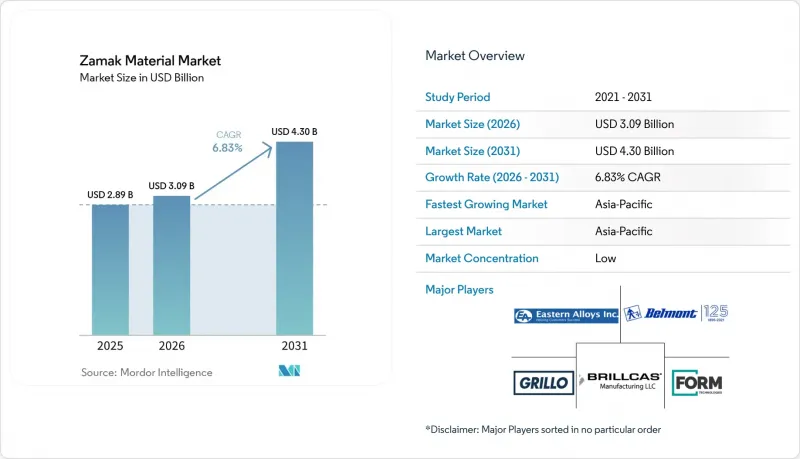
에 따르면 자막 재료 시장 규모는 2025년에 28억 9,000만 달러로 평가되며, 2026년 30억 9,000만 달러에서 2031년까지 43억 달러에 달할 것으로 예측되고 있으며, 예측 기간(2026-2031년)에 CAGR은 6.83%에 달할 전망입니다.
전 세계 자맥 소재 시장의 동향 및 인사이트
자동차 및 전기자동차(EV) 부품의 경량화
차량의 전동화에 따라 치수 안정성, 밀봉 성능 및 정확한 형상을 겸비한 소형 부품에 대한 수요가 증가하고 있습니다. 전기자동차용 배터리 커넥터, 첨단 운전자 보조 시스템(ADAS)용 센서 하우징, 제어 장치 케이스 등 이러한 특성이 요구되는 분야에서 자맥 소재 시장은 수혜를 입고 있습니다. 아연 다이캐스팅을 통해 알루미늄 콜드 챔버 주조로는 제조가 어려운 얇은 두께의 부품을 생산할 수 있습니다. 국제아연협회(International Zinc Association)는 향후 10년 동안 전기자동차의 케이블 연결부, 엔진 부품, 센서 하우징에서 아연 합금의 사용이 증가할 것으로 예측하고 있습니다. 동 기간 중 아연 다이캐스팅 수요의 지역별 성장률이 가장 높을 것으로 예상되는 곳은 인도와 동남아시아입니다. 또한 차량 1대당 ADAS 센서 수가 증가함에 따라 치수 정밀도가 안정된 소형 하우징에 대한 수요도 높아지고 있습니다.
전자 기기의 소형화와 EMI 차폐 수요
자맥(Zamak) 소재 시장은 콤팩트한 하우징과 EMI 차폐가 필요한 전자기기 용도에 의해 지원되고 있습니다. 아연 합금은 하나의 주조 부품으로 차폐 기능과 얇은 두께 성형을 동시에 실현할 수 있으며, 특정 설계에서 별도의 차폐층을 마련할 필요성을 줄여줍니다. 이는 5G 네트워크 관련 장비, 커넥티드 디바이스, 자동차용 전자기기 및 산업용 제어 장비와 관련이 있습니다. 전기·전자 분야는 하드웨어 수요 확대와 최종 제품내 전자 부품 증가를 반영하여 2031년까지 연평균 성장률(CAGR) 8.09%로 성장할 것으로 예측됩니다. 일체형 다이캐스팅 하우징은 개별 차폐 요소를 사용하는 설계에 비해 조립 공정의 수를 줄일 수 있습니다. 그 결과, 콤팩트하고 완성도 높은 금속 하우징이 필요한 OEM(Original Equipment Manufacturer)의 경우 제조 공정의 일관성을 향상시킬 수 있습니다.
아연 가격 및 1차 금속 공급의 변동
아연은 주요 합금 원료이므로, 아연 가격 변동은 자맥(Zamak) 소재 시장 전체의 이익률에 영향을 미칠 가능성이 있습니다. 국제 납·아연 연구 그룹(ILZSG)의 보고서에 따르면 2025년 정제 아연 시장에서는 3만 3,000메트릭톤의 공급 부족이 발생했습니다. 런던 금속 거래소(LME)의 창고 재고는 2025년 말 기준으로 7만 7,000메트릭톤 감소하여 73만 9,000메트릭톤이 되었습니다. 런던 금속 거래소(LME)의 현물 결제 가격은 2025년 4월 17일 2025년 최저치인 1메트릭톤당 2,521달러를 기록한 후, 2025년 12월 2일에는 1메트릭톤당 3,351달러에 도달했습니다. 현물 거래나 단기 계약을 통해 아연을 구매하는 생산자들은 급격한 원가 변동에 직면할 가능성이 있습니다. 소규모 다이캐스팅 제조업체들은 이러한 변동을 흡수하거나 자동차 및 전자기기 고객사에 전가할 수 있는 능력이 제한적일 수 있습니다.
부문별 분석
2025년 시점에 자맥 3은 자맥 소재 시장의 41.26%를 차지했으나, 자맥 7은 2031년까지 연평균 성장률(CAGR) 7.78%로 확대될 것으로 예측됩니다. 자맥 3은 기계적 성능, 치수 안정성, 주조성 및 표면 처리와의 적합성이 균형을 이루고 있으며, 계속해서 널리 사용되고 있습니다. 이 합금의 인장 강도는 283 메가파스칼(MPa)이며, 전기 도금이나 분체 도장을 통한 마감 처리가 가능합니다. 자동차 트림, 전자기기 케이스, 산업용 하드웨어 등에서 입증된 사용 실적이 북미 시장에서 이 합금의 입지를 지원하고 있습니다. 자맥 7은 유동성 및 표면 연마성 향상이 요구되는 얇은 외장 부품이나 전자기기 용도에 적합합니다. 웨어러블 기기 케이스, 5G 안테나 인클로저, 정밀 잠금 장치 등은 이러한 특성이 중요한 용도의 예입니다.
자맥 5는 구리 함량으로 인해 높은 강도가 요구되는 정밀 트림이나 기능성 브래킷에 적합합니다. 국제 아연 협회(International Zinc Association)의 보고에 따르면 자맥 5의 인장 강도는 331 MPa입니다. 자맥 2는 경도나 치수 팽창에 대한 내성이 중요한 고부하 기계 부품이나 기어에 사용됩니다. 그 밖의 합금 유형으로는 자맥 8, 아연·알루미늄 8(ZA-8), 그리고 고온 용도나 정밀 용도를 위한 특수 등급이 있습니다. 자맥 소재 업계에서는 재활용 함량 증명을 통해 합금 제품의 차별화도 추진하고 있습니다. 2025년 ecoInvent에 포함됨에 따라 구매자는 2차 자맥의 수명 주기 정보를 평가하기 위한 공인된 방법을 이용할 수 있게 되었습니다. 이를 통해 성능 중심의 특수 등급뿐만 아니라 인증된 재활용 합금 시장도 지원되고 있습니다.
지역별 분석
아시아태평양은 2025년 자맥 소재 시장의 43.34%를 차지하며, 2031년까지 연평균 성장률(CAGR) 7.85%로 확대될 것으로 예측됩니다. 중국은 국내 및 수출용 프로그램을 위해 아연 다이캐스팅 생산 능력을 집중하고 있습니다. 인도는 아연 다이캐스팅 분야에서 입지를 확대하고 있으며, 다각화된 OEM의 조달처로서 점점 더 중요한 존재가 되고 있습니다. 국제 아연 협회(International Zinc Association)는 향후 10년 동안 인도의 아연 다이캐스팅 수요가 49% 증가할 것으로 예측하고 있습니다. 또한 같은 기간 중 중국이 수요 증가의 11%를 추가로 기여할 것으로 전망하고 있습니다. 일본과 한국은 자동차용 정밀 부품 분야에서 여전히 중요한 역할을 수행하고 있습니다. 따라서 아시아태평양은 대규모 시장, 생산 능력 확대, 그리고 자동차 및 전자기기 제조 분야의 수요를 모두 갖추고 있습니다.
자동차 공급망과 지역내 정밀 주조 능력에 대한 수요가 북미 시장을 지원하고 있습니다. 유럽에서는 이탈리아, 독일, 벨기에에서 아연 합금 생산 및 다이캐스팅 사업이 확립되어 있습니다. 또한 유럽에는 재활용 소재를 사용한 제품을 제공하고, 지속가능성에 관한 문서화 체제가 갖춰진 공급업체도 존재합니다. 유럽화학물질청(ECHA)은 2025년 6월 현재 250종의 ‘극히 우려되는 물질(SVHC)’ 후보 리스트을 유지하고 있습니다. 이러한 규제 환경으로 인해 합금 조성 기록 및 공급망 정보 공개의 중요성이 높아지고 있습니다. 힌두스탄 아연(Hindustan Zinc)은 2025년 6월, 라자스탄 주에 13억 9,000만 달러 규모의 금속 복합 시설 건설을 승인했습니다. 이 프로젝트는 연간 25만 메트릭톤의 생산 능력을 증강하고 수입 의존도를 낮추는 것을 목표로 하고 있습니다. 공급 안정성, 에너지 비용 및 규정 준수 대응 능력이 이 지역들의 자맥(Zamak) 소재 시장을 형성하고 있습니다.
남미에서는 브라질의 자동차 생산과 아르헨티나의 건설 관련 철물 용도가 수요를 주도하고 있습니다. 이 지역의 많은 구매자들은 수입 자맥 합금에 의존하고 있으며, 이로 인해 아연 가격 변동에 대한 위험이 높아질 가능성이 있습니다. 국제 납·아연 연구 그룹(ILZS)은 2025년 내내 정제 아연 공급이 부족할 것이라고 보고하고 있습니다. 중동 및 아프리카에서는 사우디아라비아의 인프라 개발과 남아프리카공화국의 금속 자원 다각화가 향후 수요를 지원할 것으로 예상됩니다. 이 지역 중 일부에서는 현지 가공 능력이 여전히 발전 단계에 있습니다. 상류 공급업체들은 현지 2차 아연 생산 능력이 확대되기 전에 유통 파트너십 구축을 검토하고 있습니다. 자맥 소재 시장에는 이 지역에서 진입 여지가 있지만, 현지 생산 능력이 향상됨에 따라 그 여지는 점차 좁아질 가능성이 있습니다.
기타 혜택:
- 엑셀 형식의 시장 예측(ME) 시트
- 3개월간의 애널리스트 지원
자주 묻는 질문
목차
제1장 서론
- 조사 전제조건과 시장 정의
- 조사 범위
제2장 조사 방법
제3장 개요
제4장 시장 구도
- 시장 개요
- 시장 성장 촉진요인
- 시장 성장 억제요인
- 밸류체인 분석
- Porter's Five Forces 분석
제5장 시장 규모와 성장 예측
- 합금 유형별
- 제조 프로세스별
- 최종 용도 산업별
- 지역별
- 아시아태평양
- 중국
- 인도
- 일본
- 한국
- ASEAN 국가
- 기타 아시아태평양 국가
- 북미
- 미국
- 캐나다
- 멕시코
- 유럽
- 독일
- 영국
- 프랑스
- 이탈리아
- 북유럽 국가
- 기타 유럽 국가
- 남미
- 브라질
- 아르헨티나
- 기타 남미 국가
- 중동 및 아프리카
- 사우디아라비아
- 남아프리카공화국
- 기타 중동 및 아프리카 국가
- 아시아태평양
제6장 경쟁 구도
- 시장 집중도
- 전략적 동향
- 시장 점유율·순위 분석
- 기업 개요
- Belmont Metals
- BN Industries
- Brillcast Manufacturing LLC
- Bruschi Srl
- Chem Zinc Die Casting Alloys
- Eastern Alloys Inc.
- Form Technologies
- GRILLO-Werke AG
- Hindustan Zinc
- Ital Leghe S.r.l.
- KOREAZINC
- Nyrstar
- Phoenix Industries Ltd.
- Radiant Metals & Alloys Pvt. Ltd.
- REAZN S.A.
제7장 시장 기회와 향후 전망
KSAAccording to Mordor Intelligence, the zamak material market size was valued at USD 2.89 billion in 2025 and is estimated to grow from USD 3.09 billion in 2026 to reach USD 4.30 billion by 2031, at a CAGR of 6.83% during the forecast period (2026-2031).
Global Zamak Material Market Trends and Insights
Automotive and EV Component Lightweighting
Vehicle electrification increases the need for small components that combine dimensional stability, sealing performance, and accurate geometry. The Zamak material market benefits where EV battery connectors, advanced driver assistance system (ADAS) sensor housings, and control-unit enclosures need these characteristics. Zinc die casting can make thin-walled parts that are difficult to produce through aluminum cold-chamber casting. The International Zinc Association expects zinc alloy use in EV cable connections, engine parts, and sensor housings to increase during the next decade. India and Southeast Asia are expected to record the strongest regional gains in zinc die-casting demand over that period. A higher number of ADAS sensors per vehicle also increases the need for compact housings with repeatable dimensions.
Electronics Miniaturization and EMI Shielding Demand
The Zamak material market is supported by electronics applications that need compact enclosures and shielding against EMI. Zinc alloys can provide shielding and form thin walls in one cast part, reducing the need for separate shielding layers in certain designs. This is relevant to equipment associated with 5G networks, connected devices, automotive electronics, and industrial controls. Electrical and electronics are projected to advance at an 8.09% CAGR through 2031, reflecting greater hardware demand and more electronics within end products. One-piece die-cast enclosures can reduce the number of assembly stages compared with designs that use separate shielding elements. The resulting manufacturing approach can improve consistency for OEMs that require compact, finished metal housings.
Zinc Price and Primary-Metal Supply Volatility
Zinc price movements can affect margins across the Zamak material market because zinc is the principal alloy input. The International Lead and Zinc Study Group reported a 33,000 metric ton refined-zinc market deficit in 2025. London Metal Exchange warehouse stocks declined by 77,000 metric tons to 739,000 metric tons at the end of 2025. The London Metal Exchange cash settlement price reached USD 3,351 per metric ton on December 2, 2025, after reaching a 2025 low of USD 2,521 per metric ton on April 17. Producers who buy zinc on spot terms or short-term contracts can face abrupt cost changes. Smaller die casters may have less ability to absorb those changes or pass them through to automotive and electronics customers.
Other drivers and restraints analyzed in the detailed report include:
- Growth of Thin-Wall, High-Precision Die Casting
- Recycled Zinc and Lower-Carbon Alloy Availability
- Tightening Energy, Emissions, and Heavy-Metal Compliance Requirements
For complete list of drivers and restraints, kindly check the Table Of Contents.
Segment Analysis
Zamak 3 held 41.26% of the Zamak material market in 2025, while Zamak 7 is projected to advance at a 7.78% CAGR through 2031. Zamak 3 remained widely used because it balanced mechanical performance, dimensional stability, castability, and finishing compatibility. The alloy has a tensile strength of 283 megapascals (MPa) and supports electroplating and powder-coating finishes. Its established use across automotive trim, electronics housings, and industrial hardware supports its position in North America. Zamak 7 is suited to thin-wall cosmetic and electronics applications where improved fluidity and surface polishability matter. Wearable housings, 5G antenna enclosures, and precision locks are examples of applications where those properties are relevant.
Zamak 5 supports precision trim and functional brackets that need greater strength from its copper content. The International Zinc Association reports a tensile strength of 331 MPa for Zamak 5. Zamak 2 is used in heavy-duty mechanical parts and gears where hardness and resistance to dimensional growth are important. Other alloy types include Zamak 8, zinc-aluminum 8 (ZA-8), and specialty grades for elevated-temperature or precision applications. The Zamak material industry is also differentiating alloy offerings through recycled-content documentation. The 2025 ecoinvent inclusion gives purchasers a recognized method to assess secondary Zamak life cycle information. This supports a market for certified recycled alloy alongside performance-oriented specialty grades.
Complete Report Scope:
- By Alloy Type
- Zamak 3
- Zamak 5
- Zamak 2
- Zamak 7
- Other Alloy Types (Zamak 8/ZA-8, Specialty Zamak Alloys)
- By Manufacturing Process
- Hot-Chamber Die Casting
- Pressure Die Casting
- Multi-Slide Die Casting
- Other Manufacturing Processes
- By End-Use Industry
- Automotive
- Building and Construction
- Electrical and Electronics
- Other End-Use Industries (Consumer Goods and Appliances, Industrial Equipment, Healthcare, Aerospace and Defense)
- By Geography
- Asia-Pacific
- China
- India
- Japan
- South Korea
- ASEAN Countries
- Rest of Asia-Pacific
- North America
- United States
- Canada
- Mexico
- Europe
- Germany
- United Kingdom
- France
- Italy
- NORDIC Countries
- Rest of Europe
- South America
- Brazil
- Argentina
- Rest of South America
- Middle-East and Africa
- Saudi Arabia
- South Africa
- Rest of Middle-East and Africa
- Asia-Pacific
Geography Analysis
Asia-Pacific held 43.34% of the Zamak material market in 2025 and is projected to advance at a 7.85% CAGR through 2031. China has a large concentration of zinc die-casting capacity for domestic and export programs. India is expanding its position in zinc die casting and is becoming more relevant to diversified OEM sourcing. The International Zinc Association projects a 49% increase in zinc die-casting demand in India during the next decade. It expects China to contribute an additional 11% during the same period. Japan and South Korea remain important for precision automotive components. Asia-Pacific, therefore, combines scale, expanding capacity, and demand from automotive and electronics manufacturing.
Automotive supply chains and the need for regional precision-casting capacity support North America. Europe has established zinc-alloy production and die-casting activity in Italy, Germany, and Belgium. Europe also has suppliers with recycled-content offerings and established sustainability documentation. The European Chemicals Agency maintained a candidate list of 250 Substances of Very High Concern as of June 2025. This regulatory setting increases the importance of alloy composition records and supply-chain disclosures. Hindustan Zinc approved a USD 1.39 billion metals complex in Rajasthan in June 2025. The project is intended to add 250,000 metric tons per annum of operational capacity and reduce import dependence. Supply security, energy costs, and compliance capability shape the Zamak material market in these regions.
South America has demand led by Brazil's automotive production and by construction-linked hardware applications in Argentina. Many buyers in the region depend on imported Zamak alloy, which can increase exposure to zinc price movements. The International Lead and Zinc Study Group reported tight refined-zinc conditions during 2025. In the Middle-East and Africa, infrastructure development in Saudi Arabia and metals diversification in South Africa is expected to support future demand. Local fabrication capacity is still developing across parts of these regions. Upstream suppliers are considering distribution partnerships before local secondary-zinc capacity expands. The Zamak material market has an opening in these areas, but local capability could narrow it over time.
- Belmont Metals
- BN Industries
- Brillcast Manufacturing LLC
- Bruschi Srl
- Chem Zinc Die Casting Alloys
- Eastern Alloys Inc.
- Form Technologies
- GRILLO-Werke AG
- Hindustan Zinc
- Ital Leghe S.r.l.
- KOREAZINC
- Nyrstar
- Phoenix Industries Ltd.
- Radiant Metals & Alloys Pvt. Ltd.
- REAZN S.A.
Additional Benefits:
- The market estimate (ME) sheet in Excel format
- 3 months of analyst support
TABLE OF CONTENTS
1 Introduction
- 1.1 Study Assumptions and Market Definition
- 1.2 Scope of the Study
2 Research Methodology
3 Executive Summary
4 Market Landscape
- 4.1 Market Overview
- 4.2 Market Drivers
- 4.2.1 Automotive and EV Component Lightweighting
- 4.2.2 Electronics Miniaturization and EMI Shielding Demand
- 4.2.3 Growth of Thin-Wall, High-Precision Die Casting
- 4.2.4 Recycled Zinc and Lower-Carbon Alloy Availability
- 4.2.5 Nearshoring of Precision Component Supply Chains
- 4.3 Market Restraints
- 4.3.1 Zinc Price and Primary-Metal Supply Volatility
- 4.3.2 Substitution by Aluminum, Magnesium, and Engineering Plastics
- 4.3.3 Tightening Energy, Emissions, and Heavy-Metal Compliance Requirements
- 4.4 Value Chain Analysis
- 4.5 Porter's Five Forces Analysis
- 4.5.1 Threat of New Entrants
- 4.5.2 Bargaining Power of Suppliers
- 4.5.3 Bargaining Power of Buyers
- 4.5.4 Threat of Substitutes
- 4.5.5 Competitive Rivalry
5 Market Size and Growth Forecasts (Value)
- 5.1 By Alloy Type
- 5.1.1 Zamak 3
- 5.1.2 Zamak 5
- 5.1.3 Zamak 2
- 5.1.4 Zamak 7
- 5.1.5 Other Alloy Types (Zamak 8/ZA-8, Specialty Zamak Alloys)
- 5.2 By Manufacturing Process
- 5.2.1 Hot-Chamber Die Casting
- 5.2.2 Pressure Die Casting
- 5.2.3 Multi-Slide Die Casting
- 5.2.4 Other Manufacturing Processes
- 5.3 By End-Use Industry
- 5.3.1 Automotive
- 5.3.2 Building and Construction
- 5.3.3 Electrical and Electronics
- 5.3.4 Other End-Use Industries (Consumer Goods and Appliances, Industrial Equipment, Healthcare, Aerospace and Defense)
- 5.4 By Geography
- 5.4.1 Asia-Pacific
- 5.4.1.1 China
- 5.4.1.2 India
- 5.4.1.3 Japan
- 5.4.1.4 South Korea
- 5.4.1.5 ASEAN Countries
- 5.4.1.6 Rest of Asia-Pacific
- 5.4.2 North America
- 5.4.2.1 United States
- 5.4.2.2 Canada
- 5.4.2.3 Mexico
- 5.4.3 Europe
- 5.4.3.1 Germany
- 5.4.3.2 United Kingdom
- 5.4.3.3 France
- 5.4.3.4 Italy
- 5.4.3.5 NORDIC Countries
- 5.4.3.6 Rest of Europe
- 5.4.4 South America
- 5.4.4.1 Brazil
- 5.4.4.2 Argentina
- 5.4.4.3 Rest of South America
- 5.4.5 Middle-East and Africa
- 5.4.5.1 Saudi Arabia
- 5.4.5.2 South Africa
- 5.4.5.3 Rest of Middle-East and Africa
- 5.4.1 Asia-Pacific
6 Competitive Landscape
- 6.1 Market Concentration
- 6.2 Strategic Moves
- 6.3 Market Share (%)/Ranking Analysis
- 6.4 Company Profiles (includes Global Overview, Market Overview, Core Segments, Financials as available, Strategic Information, Products and Services, and Recent Developments)
- 6.4.1 Belmont Metals
- 6.4.2 BN Industries
- 6.4.3 Brillcast Manufacturing LLC
- 6.4.4 Bruschi Srl
- 6.4.5 Chem Zinc Die Casting Alloys
- 6.4.6 Eastern Alloys Inc.
- 6.4.7 Form Technologies
- 6.4.8 GRILLO-Werke AG
- 6.4.9 Hindustan Zinc
- 6.4.10 Ital Leghe S.r.l.
- 6.4.11 KOREAZINC
- 6.4.12 Nyrstar
- 6.4.13 Phoenix Industries Ltd.
- 6.4.14 Radiant Metals & Alloys Pvt. Ltd.
- 6.4.15 REAZN S.A.
7 Market Opportunities and Future Outlook
- 7.1 White-Space and Unmet-Need Assessment


