

|
시장보고서
상품코드
2154417
잉크 및 토너 카트리지 : 시장 점유율 분석, 업계 동향과 통계, 성장 예측(2026-2031년)Ink and Toner Cartridge - Market Share Analysis, Industry Trends & Statistics, Growth Forecasts (2026 - 2031) |
||||||
 Mordor Intelligence
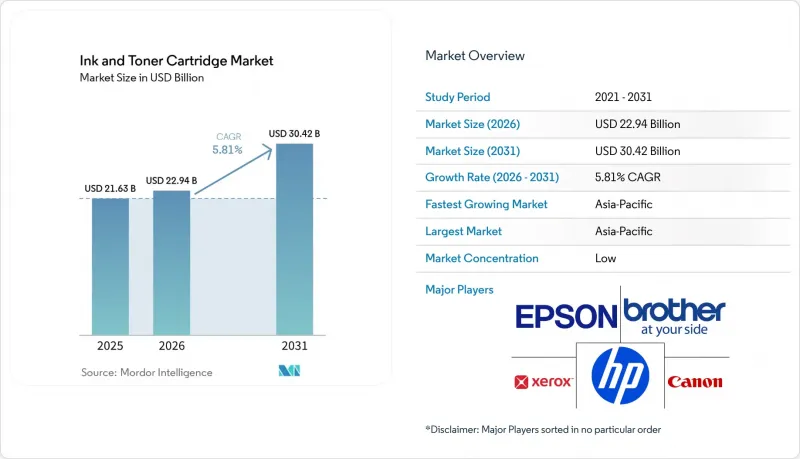
에 따르면 잉크 및 토너 카트리지 시장 규모는 2025년에 216억 3,000만 달러로 평가되며, 2026년 229억 4,000만 달러에서 2031년까지 304억 2,000만 달러에 달할 것으로 예측되고 있으며, 예측 기간(2026-2031년)에 CAGR은 5.81%에 달할 전망입니다.
전 세계 잉크 및 토너 카트리지 시장의 동향과 인사이트
관리형 인쇄 서비스 및 구독형 리필: 지속적인 수요 정착
매니지드 프린트 서비스 계약을 통해 잉크 및 토너 카트리지 시장의 수요는 일회성 구매에서 대기업의 프린터 군이나 소규모 분산형 업무 환경에서의 장기 공급 계약으로 전환되고 있습니다. 이 모델에서는 프린터의 소유권과 소모품 공급이 분리되므로, 조달 팀이 공급업체 선정에 있으며, 더 큰 역할을 하게 됩니다. 이러한 맥락에서 브랜드 인지도보다 ‘페이지당 비용’이라는 지표가 더 중요하게 여겨집니다. 이로 인해 계약에서 허용되는 경우, 호환 제품이나 재생 제품이 시장에 진입할 여지가 생기고 있습니다. HP는 2025년에 ‘All-In Plan’을 확충하여 대용량 ‘Smart Tank’ 티어와 ‘Instant Paper’ 옵션을 추가했습니다. 캐논 역시 소비자용 인쇄 소모품의 구독 서비스로 ‘PIXMA Print Plan’을 유지하고 있습니다.
E-Commerce와 디지털 카트리지 검색이 유통 채널의 경제 구조를 재편
온라인 판매는 고객이 카트리지를 찾아보고, 비교하며, 재주문하는 데 있으며, 더 큰 역할을 하고 있습니다. 특히 구매자가 전문 매장을 방문하지 않고도 특정 제품을 신속하게 필요로 하는 경우에 두드러집니다. 이러한 변화로 인해 가격 투명성이 높아지고, 기존 오프라인 유통에 대한 의존도가 낮아지고 있습니다. 또한 소규모 호환 브랜드라도 확립된 판매 대리점과의 관계가 없어도 고객에게 다가갈 수 있게 되었습니다. 알리바바와 JD.com은 중국에서 재구매 및 디지털 판매업체 발굴을 지원하는 광범위한 온라인 소매 및 조달 생태계를 운영하고 있습니다. 코스트코는 2025년 5월 매장에서 잉크 판매를 중단했는데, 이는 이 카테고리에서 오프라인 소매의 역할이 축소되고 있음을 반영합니다. 그 결과, 잉크 및 토너 카트리지 시장에서는 검색 가시성, 직접 배송, 그리고 간편한 재주문 절차가 더욱 중요시되고 있습니다.
종이 없는 업무 환경으로 인한 사무실 인쇄량 감소
많은 사내 파일을 종이 사본 없이도 열람, 서명, 배포, 보관할 수 있게 됨에 따라 디지털 문서 관리는 계속해서 일상적인 사무실 인쇄를 구조적으로 제한하고 있습니다. 일본에서는 2024년 1월부터 전자 기록에 관한 규정이 시행되어 디지털 보존으로의 전환이 가속화되고 있습니다. 이러한 추세는 전자적으로 열람, 승인, 보관이 가능한 일반적인 사무 문서에서 가장 두드러집니다. 계약서, 신분증, 포장 라벨, 마케팅 자료 및 일부 사무 업무에서는 여전히 종이 출력물이 필수적입니다. 그 결과, 상업 인쇄 및 전문 인쇄는 일반 사무 인쇄보다 회복력이 높은 상태를 유지하고 있습니다. 잉크 및 토너 카트리지 시장의 참여 기업은 인쇄된 문서가 업무 프로세스의 일부로 남아 있는 사용 사례에 집중함으로써 위험을 완화할 수 있습니다.
부문 분석
2025년, 잉크 카트리지는 잉크 및 토너 카트리지 시장 점유율의 51.56%를 차지했습니다. 이러한 위상은 가정 및 소규모 사업장에 잉크젯 기기가 널리 보급되어 있음을 반영하며, 이러한 사용자들은 문서, 양식, 라벨 및 가끔씩의 사진 출력을 위해 컬러 인쇄를 필요로 합니다. 잉크젯 프린터는 개인 문서, 컬러 출력 및 사진 인쇄 분야에서 여전히 널리 사용되고 있습니다. 잉크 탱크 방식 시스템도 잉크에 대한 지속적인 수요를 지원하고 있지만, 지출의 초점은 카트리지에서 리필용 병으로 이동하고 있습니다. 엡손은 2025년 8월, 미국에서 ‘ReadyPrint’를 도입했습니다. 이는 EcoTank 하드웨어에 무제한 컬러 인쇄 및 자동 잉크 보충 기능을 결합한 것입니다. 이러한 접근 방식을 통해 개별 카트리지 구매 대신 서비스 요금을 통해 소모품 수익을 확보하고 있습니다.
토너 카트리지는 가장 높은 성장이 예상되며, 이 부문의 잉크 및 토너 카트리지 시장 규모는 2031년까지 연평균 성장률(CAGR) 6.83%로 확대될 것으로 전망됩니다. 이러한 전망을 지원하는 것은 업무용 레이저 프린터의 도입입니다. 레이저 장비는 인쇄량이 늘어날수록 페이지당 비용이 낮아지기 때문에 청구서, 보고서, 기록, 고객용 자료 등을 정기적으로 인쇄하는 팀에게 중요한 요소가 됩니다. 기업의 조달 팀은 표준 인쇄 매수 테스트를 통해 이러한 주장을 검증할 수 있습니다. 또한 토너 사용은 기업의 다기능 프린터 및 전문적인 업무용 인쇄 업무에 의해서도 지원되고 있습니다. 제품 구성 비율은 잉크젯 수요의 폭넓은 기반을 훼손하지 않으면서, 더 대량인 인쇄 수요로 점차 이동하고 있습니다.
2025년, OEM 카트리지는 카테고리 총매출의 55.08%를 차지했습니다. 이러한 위상은 프린터 인증 시스템, 관리형 인쇄 계약, 그리고 인쇄 품질 보증, 예측 가능한 기술 지원, 사내 업무 문서에서 일관된 출력 품질을 중시하는 구매자들에 의해 지원되고 있습니다. 특정 프린터 모델의 경우, 전용 칩으로 인해 타사 소모품 사용이 제한될 수 있습니다. 또한 구독 플랜을 통해 OEM 제조사는 프린터 구매 후에도 사용자와 지속적인 관계를 구축할 수 있으며, 소비자가 교체용 카트리지를 구매할 때마다 적극적으로 비교 검토해야 할 필요성을 줄여주고 있습니다. OEM 공급업체는 품질과 서비스의 우위를 유지하면서 지속가능성 요건을 충족하기 위해 재활용 소재를 사용한 제품 라인도 전개하고 있습니다.
호환 카트리지는 2031년까지 연평균 성장률(CAGR) 7.01%로 성장할 것으로 예측되며, 이는 카트리지 유형 중 가장 높은 성장률입니다. 가격 민감도, 품질 향상, 그리고 온라인에서의 접근성이 동일한 구매 과정에서 여러 공급업체를 비교할 수 있는 일반 가정, 중소기업 및 조달 팀의 수요를 지원하고 있습니다. 재제조 및 리필 카트리지는 재사용과 비용 절감이라는 두 가지 요소를 결합하여 또 다른 요구를 충족시키고 있습니다. 다만, 카트리지의 설계상 분해나 칩 재설정이 어려운 경우, 그 보급 규모에는 한계가 있습니다. G&G사는 자사의 글로벌 재활용 프로그램을 통해 2025년에 1,792만 3,003개의 사용 후 카트리지를 회수 및 재활용했다고 발표했습니다. 호환 소모품 중 잉크 및 토너 카트리지 시장 규모는 기존 프린터를 교체하지 않고 소모품 비용을 절감하고자 하는 고객들에 의해 주도되고 있습니다.
지역별 분석
아시아태평양은 2025년에 해당 카테고리의 총매출의 42.04%를 차지할 것으로 예상되며, 2031년까지 연평균 성장률(CAGR) 6.28%로 성장할 것으로 전망됩니다. 이 지역에서는 확대되는 상업용 인쇄 시장 외에도 가정 및 소규모 사무실에서의 프린터 사용이 증가하면서, 보급형 프린터, 업무용 기기 및 호환 교체용 소모품에 대한 수요가 창출되고 있습니다. 중국은 주요 카트리지 생산 거점인 동시에 중요한 소비 시장이기도 합니다. 알리바바와 JD.com은 온라인 상품 검색 및 재구매를 지원하는 대규모 디지털 상거래 플랫폼을 운영하고 있습니다. 인도는 가처분 소득 증가, 중소기업 활동 확대, E-Commerce 접근성 확대의 혜택을 받고 있습니다. 일본에서는 전자 기록 관리 및 기업의 디지털화에 따른 압박이 커지고 있지만, 잉크 및 토너 카트리지 시장에서는 전문 인쇄, 법률 문서 및 상업 인쇄에 대한 수요가 유지되고 있습니다.
북미는 지역별 시장 규모에서 2위를 차지하고 있으며, 기업용 레이저 프린터의 견고한 보급 기반과 확립된 관리형 인쇄 서비스에 힘입고 있습니다. 이로 인해 공급업체는 계약에 기반한 예측 가능한 보충 수량을 확보하고 있습니다. 미국에서는 직접 판매, 구독, 온라인 보충 모델로의 전환이 더욱 진행되고 있습니다. 2025년 코스트코가 매장에서의 잉크 판매에서 철수한 것은 이 제품 카테고리에서 오프라인 소매의 역할이 줄어들고 있음을 반영합니다. 2026년 3월, HP는 아이다호주 보이시의 거점을 통합하고 2027 회계연도 말까지 철수할 계획을 발표했습니다. 캐나다에서는 매니지드 프린트 도입 현황이 미국과 대체로 유사하지만, 멕시코는 지역별 공급 전략에서 제조상 이점을 제공하고 있습니다. 제록스는 렉스마크 인수를 계기로 공급망 계획에 멕시코 제조 거점을 포함시켰습니다.
유럽에서는 인쇄 수요가 성숙 단계에 접어들었으며, 카트리지 공급망에 대해서는 세계에서 가장 엄격한 규정 준수 요건이 부과되어 제품 설계, 회수 체계, 화학 물질 정보, 재사용 증명 등에 영향을 미치고 있습니다. 유럽연합(EU)의 폐전기전자기기(WEEE) 지침, 순환형 경제 계획 및 화학 물질 표시 규정에 따라 검증된 재사용과 추적성의 가치가 높아지고 있습니다. 남미, 중동 및 아프리카는 잉크 및 토너 카트리지 시장 규모가 작지만 여전히 중요한 지역입니다. 브라질과 아르헨티나에서는 소매, 금융 서비스, 정부 문서 분야의 수요가 시장을 지탱하고 있습니다. 사우디아라비아와 남아프리카공화국은 중동 및 아프리카의 중요한 수요 기반을 형성하고 있습니다. 일부 공공 부문과 중소기업에서 디지털 전환이 더디게 진행되고 있는 점이, 이 지역 전반에 걸쳐 여전히 저렴한 가격의 카트리지가 사용되는 요인이 되고 있습니다.
기타 혜택:
- 엑셀 형식의 시장 예측(ME) 시트
- 3개월간의 애널리스트 지원
자주 묻는 질문
목차
제1장 서론
- 조사 전제조건과 시장 정의
- 조사 범위
제2장 조사 방법
제3장 개요
제4장 시장 구도
- 시장 개요
- 시장 성장 촉진요인
- 시장 성장 억제요인
- 밸류체인 분석
- Porter's Five Forces 분석
제5장 시장 규모와 성장 예측
- 제품 유형별
- 카트리지 유형별
- 프린터 기술별
- 잉크/토너 배합별
- 용도별
- 지역별
- 아시아태평양
- 중국
- 인도
- 일본
- 한국
- 기타 아시아태평양 국가
- 북미
- 미국
- 캐나다
- 멕시코
- 유럽
- 독일
- 영국
- 프랑스
- 이탈리아
- 기타 유럽 국가
- 남미
- 브라질
- 아르헨티나
- 기타 남미 국가
- 중동 및 아프리카
- 사우디아라비아
- 남아프리카공화국
- 기타 중동 및 아프리카 국가
- 아시아태평양
제6장 경쟁 구도
- 시장 집중도
- 전략적 동향
- 시장 점유율·순위 분석
- 기업 개요
- Brother Industries, Ltd.
- Canon Inc.
- Fujifilm Business Innovation Co., Ltd.
- HP Inc.
- Konica Minolta, Inc.
- Kyocera Corporation
- Lexmark International, Inc.
- Ninestar Corporation
- OKI Electric Industry Co., Ltd.
- Pantum International Limited
- Ricoh Company, Ltd.
- Seiko Epson Corporation
- Sharp Corporation
- Toshiba Tec Corporation
- Xerox Corporation
제7장 시장 기회와 향후 전망
KSA 26.10.23According to Mordor Intelligence, the ink and toner cartridge market size was valued at USD 21.63 billion in 2025 and estimated to grow from USD 22.94 billion in 2026 to reach USD 30.42 billion by 2031, at a CAGR of 5.81% during the forecast period (2026-2031).
Global Ink and Toner Cartridge Market Trends and Insights
Managed Print Services and Subscription Replenishment: Institutionalize Recurring Demand
Managed print service contracts have shifted demand in the ink and toner cartridge market from one-time purchases to longer supply arrangements across large enterprise fleets and smaller distributed work locations. This model separates printer ownership from consumable supply, giving procurement teams a greater role in supplier selection. Cost-per-page measurements carry more weight than brand familiarity in this context. This creates an opening for compatible and remanufactured options where contracts permit them. HP expanded its All-In Plan in 2025 to include high-capacity Smart Tank tiers and an Instant Paper option. Canon also maintained its PIXMA Print Plan as a subscription route for consumer printing supplies.
E-Commerce and Digital Cartridge Discovery Restructure Channel Economics
Online sales play a larger role in how customers identify, compare, and reorder cartridges, particularly when buyers need a specific product quickly without visiting a specialist retailer. This shift makes pricing more visible and reduces reliance on traditional store distribution. It also allows smaller compatible brands to reach customers without established distributor relationships. Alibaba and JD.com operate broad online retail and procurement ecosystems that support repeat purchases and the discovery of digital sellers in China. Costco ended in-store ink sales in May 2025, reflecting the reduced role of physical retail in this category. As a result, the ink and toner cartridge market places greater value on search visibility, direct fulfillment, and straightforward reorder processes.
Paperless Workflows Compress Office Print Volumes
Digital document management continues to structurally limit routine office printing, as many internal files can now be reviewed, signed, distributed, and retained without a physical copy. Electronic records rules in Japan have accelerated the shift toward digital storage since January 2024. This pressure is most visible in general office documents that can be reviewed, approved, or stored electronically. Physical output remains necessary for contracts, identity documents, packaging labels, marketing materials, and some administrative tasks. As a result, commercial and specialized printing remains more resilient than general office printing. Participants in the ink and toner cartridge market can reduce exposure by focusing on use cases where a printed document remains part of the operating process.
Other drivers and restraints analyzed in the detailed report include:
- Sustainability-Led Demand Elevates Remanufactured and Refillable Cartridges
- High-Yield Consumables Shift Commercial Printing Economics
- OEM Price Premiums, Aftermarket Competition, and Authentication Friction
For complete list of drivers and restraints, kindly check the Table Of Contents.
Segment Analysis
Ink cartridges accounted for 51.56% of the ink and toner cartridge market share in 2025. Their position reflects the large installed base of inkjet devices in homes and small businesses, where users require color printing for documents, forms, labels, and occasional photo output. Inkjet printers remain widely used for personal documents, color output, and photo printing. Ink-tank systems also support ongoing demand for ink, although they shift spending from cartridges toward refill bottles. Epson introduced ReadyPrint in the United States in August 2025, combining EcoTank hardware with unlimited color printing and automatic ink replacement. This approach retains consumables revenue through a service fee rather than a separate cartridge purchase.
Toner cartridges recorded the fastest growth outlook, with the ink and toner cartridge market size for this segment projected to expand at a CAGR of 6.83% through 2031. Commercial laser installations support this outcome because laser equipment offers a lower cost per page at higher print volumes, which matters for teams that regularly print invoices, reports, records, and customer materials. Enterprise procurement teams can assess those claims through standard yield testing. Toner use is also supported by corporate multifunction printers and specialized commercial print operations. The product split is shifting toward higher-quantity printing needs without displacing the broad base of inkjet demand.
OEM cartridges held 55.08% of total category revenue in 2025. Their position is supported by printer authentication systems, managed print contracts, and buyers who value print-quality assurances, predictable technical support, and consistent output for internal business documents. Proprietary chips can limit third-party access to supplies in certain printer models. Subscription plans also give OEMs a recurring relationship with users after the printer purchase, reducing the need for consumers to actively compare each replacement purchase. OEM suppliers are also using recycled-content product lines to address sustainability requirements while retaining their quality and service position.
Compatible cartridges are forecast to grow at a 7.01% CAGR through 2031, the fastest rate among cartridge types. Price sensitivity, improved quality, and online availability are supporting demand among households, small businesses, and procurement teams that can compare multiple suppliers during the same purchase process. Remanufactured and refilled cartridges serve a separate need by combining reuse with a cost alternative. Their scale is constrained when cartridge design makes disassembly or chip resetting difficult. G&G stated that its global recycling program collected and recycled 17,923,003 used cartridges in 2025. The ink and toner cartridge market size for compatible supplies is driven by customers seeking lower supply costs without changing their existing printers.
Complete Report Scope:
- By Product Type
- Ink Cartridges
- Toner Cartridges
- By Cartridge Type
- OEM Cartridges
- Compatible Cartridges
- Remanufactured and Refilled Cartridges
- Others (Refillable Ink-Tank Bottles, Specialty and Photo Cartridges)
- By Printer Technology
- Inkjet Printers
- Laser Printers
- By Ink/Toner Formulation
- Dye-Based Ink
- Pigment-Based Ink
- Toner
- Others (UV-Curable Ink, Solvent-Based Ink, Sublimation Ink, Specialty Toners)
- By Application
- Home and Personal Printing
- Office and Corporate Printing
- Commercial Printing
- Others (Industrial, Packaging and Label Printing, Education and Government Printing)
- By Geography
- Asia-Pacific
- China
- India
- Japan
- South Korea
- Rest of Asia-Pacific
- North America
- United States
- Canada
- Mexico
- Europe
- Germany
- United Kingdom
- France
- Italy
- Rest of Europe
- South America
- Brazil
- Argentina
- Rest of South America
- Middle-East and Africa
- Saudi Arabia
- South Africa
- Rest of Middle-East and Africa
- Asia-Pacific
Geography Analysis
Asia-Pacific held 42.04% of total category revenue in 2025 and is projected to grow at a CAGR of 6.28% through 2031. The region combines an expanding commercial printing base with growing printer use in homes and small offices, generating demand for entry-level printers, business equipment, and compatible replacement supplies. China serves as both a major cartridge production center and an important consumer market. Alibaba and JD.com operate large digital commerce platforms that support online discovery and repeat purchasing. India benefits from rising disposable incomes, expanding small-business activity, and wider access to e-commerce. Japan faces greater pressure from electronic recordkeeping and corporate digitization, though the ink and toner cartridge market retains demand for specialized, legal, and commercial printing needs.
North America is the second-largest regional market, supported by a substantial base of enterprise laser printers and established managed print services, which provide suppliers with predictable contracted replenishment quantities. The United States is shifting further toward direct, subscription, and online replenishment models. Costco's withdrawal from in-store ink sales in 2025 reflected the declining role of physical retail in this product category. In March 2026, HP announced the consolidation of its Boise, Idaho, site, with a planned exit by the end of fiscal year 2027. Canada broadly mirrors the United States in managed print adoption, while Mexico offers manufacturing advantages in regional supply strategies. Xerox identified its Mexico manufacturing facility in supply chain planning following its acquisition of Lexmark.
Europe has mature printing demand and some of the strictest compliance requirements for cartridge supply chains, affecting product design, collection arrangements, chemical information, and evidence of reuse. European Union Waste Electrical and Electronic Equipment (WEEE) policy, circular-economy planning, and chemical labeling rules increase the value of verified reuse and traceability. South America, the Middle-East, and Africa remain smaller but relevant geographies for the ink and toner cartridge market. Brazil and Argentina are supported by demand from retail, financial services, and government documentation. Saudi Arabia and South Africa represent important demand bases within the Middle-East and Africa. Lower digital substitution in several public-sector and small-business settings supports continued use of affordable cartridges across these regions.
- Brother Industries, Ltd.
- Canon Inc.
- Fujifilm Business Innovation Co., Ltd.
- HP Inc.
- Konica Minolta, Inc.
- Kyocera Corporation
- Lexmark International, Inc.
- Ninestar Corporation
- OKI Electric Industry Co., Ltd.
- Pantum International Limited
- Ricoh Company, Ltd.
- Seiko Epson Corporation
- Sharp Corporation
- Toshiba Tec Corporation
- Xerox Corporation
Additional Benefits:
- The market estimate (ME) sheet in Excel format
- 3 months of analyst support
TABLE OF CONTENTS
1 Introduction
- 1.1 Study Assumptions and Market Definition
- 1.2 Scope of the Study
2 Research Methodology
3 Executive Summary
4 Market Landscape
- 4.1 Market Overview
- 4.2 Market Drivers
- 4.2.1 Managed Print Services and Subscription Replenishment
- 4.2.2 E-Commerce and Digital Cartridge Discovery
- 4.2.3 Sustainability-Led Demand for Refillable and Remanufactured Supplies
- 4.2.4 High-Yield Consumables for Commercial and Specialized Printing
- 4.2.5 Verifiable Circular-Procurement Requirements
- 4.3 Market Restraints
- 4.3.1 Paperless Workflows and Declining Page Volumes
- 4.3.2 OEM Price Premiums and Aftermarket Price Competition
- 4.3.3 Firmware Authentication and Smart-Chip Lockouts
- 4.4 Value Chain Analysis
- 4.5 Porter's Five Forces Analysis
- 4.5.1 Threat of New Entrants
- 4.5.2 Bargaining Power of Suppliers
- 4.5.3 Bargaining Power of Buyers
- 4.5.4 Threat of Substitutes
- 4.5.5 Competitive Rivalry
5 Market Size and Growth Forecasts (Value)
- 5.1 By Product Type
- 5.1.1 Ink Cartridges
- 5.1.2 Toner Cartridges
- 5.2 By Cartridge Type
- 5.2.1 OEM Cartridges
- 5.2.2 Compatible Cartridges
- 5.2.3 Remanufactured and Refilled Cartridges
- 5.2.4 Others (Refillable Ink-Tank Bottles, Specialty and Photo Cartridges)
- 5.3 By Printer Technology
- 5.3.1 Inkjet Printers
- 5.3.2 Laser Printers
- 5.4 By Ink/Toner Formulation
- 5.4.1 Dye-Based Ink
- 5.4.2 Pigment-Based Ink
- 5.4.3 Toner
- 5.4.4 Others (UV-Curable Ink, Solvent-Based Ink, Sublimation Ink, Specialty Toners)
- 5.5 By Application
- 5.5.1 Home and Personal Printing
- 5.5.2 Office and Corporate Printing
- 5.5.3 Commercial Printing
- 5.5.4 Others (Industrial, Packaging and Label Printing, Education and Government Printing)
- 5.6 By Geography
- 5.6.1 Asia-Pacific
- 5.6.1.1 China
- 5.6.1.2 India
- 5.6.1.3 Japan
- 5.6.1.4 South Korea
- 5.6.1.5 Rest of Asia-Pacific
- 5.6.2 North America
- 5.6.2.1 United States
- 5.6.2.2 Canada
- 5.6.2.3 Mexico
- 5.6.3 Europe
- 5.6.3.1 Germany
- 5.6.3.2 United Kingdom
- 5.6.3.3 France
- 5.6.3.4 Italy
- 5.6.3.5 Rest of Europe
- 5.6.4 South America
- 5.6.4.1 Brazil
- 5.6.4.2 Argentina
- 5.6.4.3 Rest of South America
- 5.6.5 Middle-East and Africa
- 5.6.5.1 Saudi Arabia
- 5.6.5.2 South Africa
- 5.6.5.3 Rest of Middle-East and Africa
- 5.6.1 Asia-Pacific
6 Competitive Landscape
- 6.1 Market Concentration
- 6.2 Strategic Moves
- 6.3 Market Share (%)/Ranking Analysis
- 6.4 Company Profiles (includes Global Overview, Market Overview, Core Segments, Financials as available, Strategic Information, Products and Services, and Recent Developments)
- 6.4.1 Brother Industries, Ltd.
- 6.4.2 Canon Inc.
- 6.4.3 Fujifilm Business Innovation Co., Ltd.
- 6.4.4 HP Inc.
- 6.4.5 Konica Minolta, Inc.
- 6.4.6 Kyocera Corporation
- 6.4.7 Lexmark International, Inc.
- 6.4.8 Ninestar Corporation
- 6.4.9 OKI Electric Industry Co., Ltd.
- 6.4.10 Pantum International Limited
- 6.4.11 Ricoh Company, Ltd.
- 6.4.12 Seiko Epson Corporation
- 6.4.13 Sharp Corporation
- 6.4.14 Toshiba Tec Corporation
- 6.4.15 Xerox Corporation
7 Market Opportunities and Future Outlook
- 7.1 White-Space and Unmet-Need Assessment


