

|
시장보고서
상품코드
2154421
니켈 코발트 알루미늄(NCA) 산화물 : 시장 점유율 분석, 업계 동향과 통계, 성장 예측(2026-2031년)Nickel Cobalt Aluminum (NCA) Oxide - Market Share Analysis, Industry Trends & Statistics, Growth Forecasts (2026 - 2031) |
||||||
 Mordor Intelligence
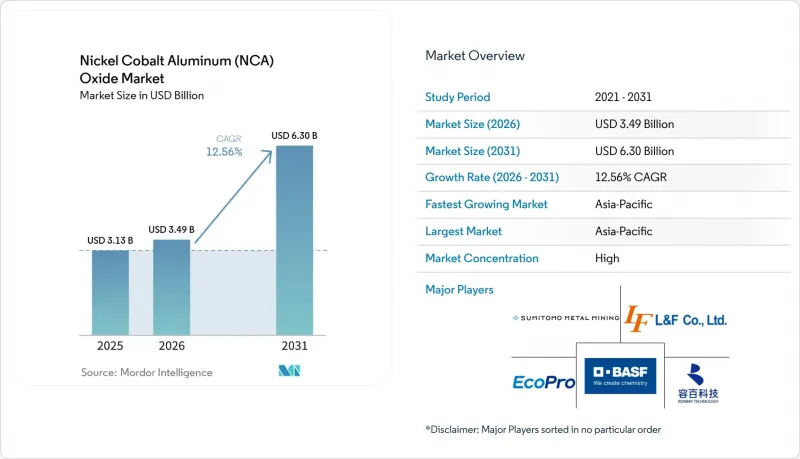
에 따르면 니켈·코발트·알루미늄(NCA) 산화물 시장 규모는 2025년에 31억 3,000만 달러로 평가되며, 2026년 34억 9,000만 달러에서 2031년까지 63억 달러에 달할 것으로 예측되고 있으며, 예측 기간(2026-2031년)에 CAGR은 12.56%에 달할 전망입니다.
전 세계 니켈·코발트·알루미늄(NCA) 산화물 시장의 동향 및 인사이트
고급 전기자동차의 주행 거리 요구 사항이 파워트레인 계층 내에서 NCA의 입지를 지원
주행 거리에 대한 우려는 여전히 전기자동차 보급 확대의 걸림돌로 남아 있으며, 프리미엄 고객층을 대상으로 하는 자동차 제조사들은 배터리 팩의 무게를 비례적으로 늘리지 않고도 주행 거리를 연장할 수 있으므로 에너지 밀도를 지속적으로 우선시하고 있습니다. 고니켈 NCA 양극재는 표준 니켈·코발트·망간 계열 화학 조성에 비해 20-30% 더 높은 에너지 밀도를 보여 주며, 적절한 용도에서 더 긴 주행 거리를 실현하고 있습니다. 니켈·코발트·알루미늄 산화물(NCA) 시장은 주행 거리 성능이 제품 제공의 핵심을 이루는 차량 프로그램, 특히 가격이 5만 달러를 초과하는 차량과 밀접한 관련이 있습니다. 2025년에는 NCA가 전 세계 전기자동차에 탑재된 코발트 함유 배터리 화학 조성의 15%를 차지할 것으로 예상되며, 그 역할은 중국 이외의 프리미엄 용도에 집중될 것입니다. 저가형 차량의 경우, 에너지 밀도가 낮은 화학 조성이나 더 크거나 다른 설계의 배터리 팩이 채택되는 경우가 많기 때문에 NCA가 모든 전기자동차 프로그램에 적합한 것은 아닙니다. 고급차 제조사는 패키징 및 성능 면에서 제약이 더 엄격하므로 일관되게 고품질의 고니켈 양극재를 공급할 수 있는 제조사에게는 수요 기반이 좁아지지만, 기술적으로 더 높은 수준의 요구 사항이 부과될 것입니다.
고성능 차량의 전동화가 NCA의 잠재 시장을 확대
전동화는 고출력 스포츠카, 고성능 SUV, 그리고 높은 비에너지와 지속적인 방전 능력이 중요한 기타 용도로 확대되고 있습니다. 이러한 용도에서는 차량 중량을 줄이면서도 성능을 지원하는 배터리 설계가 요구됩니다. BMW가 차세대 전기자동차에 46mm 원통형 셀을 채택하고 있는 것은 대형 원통형 아키텍처로의 이러한 전환을 반영합니다. 제조사들이 이러한 요건을 충족하는 양극재를 선택하고, 저비용 화학계 소재를 활용한 대안이 제한적인 경우, 니켈·코발트·알루미늄 산화물(NCA) 시장이 혜택을 볼 수 있습니다. 이러한 기회는 무게가 운용 능력에 직접적인 영향을 미치는 항공우주 관련 용도, 드론 및 전기 수직 이착륙(eVTOL) 플랫폼 등에도 확대되고 있습니다. 베이징 Easpring사는 에너지 밀도 목표가 400 Wh/kg을 초과하는 전고체 배터리용 양극재가 드론 및 eVTOL 플랫폼에서 이미 상용화되었다고 밝혔습니다. 이러한 특수 용도는 고부가가치 수요를 창출하지만, 철저한 소재 검증과 안전성 시험이 필요하므로 인증된 공급업체의 수는 제한적입니다.
LFP의 비용 및 규모 측면에서의 우위가 NCA의 잠재 시장을 제한
2025년 시점에 리튬인산철(LFP) 배터리 팩의 kWh당 가격은 니켈·망간·코발트계 배터리에 비해 40% 이상 저렴했으며, 전 세계 전기자동차용 배터리 도입량의 55% 이상을 리튬인산철이 차지했습니다. 이러한 가격 경쟁력과 중국내 확립된 생산 규모가 대중 시장용 전기자동차 부문에서 리튬인산철의 채택을 지원해 왔습니다. 니켈·코발트·알루미늄 산화물(NCA) 시장은 니켈과 코발트를 원료로 하며, 보다 엄격한 생산 관리가 필요하므로 이러한 비용 경쟁력을 쉽게 따라잡을 수 없습니다. NCA나 니켈·코발트·망간(NCM)을 포함한 삼원계 양극재는 2025년에 12% 성장에 그친 반면, 리튬철계 양극재는 58%의 성장을 기록하여 2025년 말까지 인산철리튬이 양극재 총 수요의 70% 이상을 차지하게 되었습니다. 그 결과, NCA는 컴팩트한 팩 크기, 높은 비에너지, 그리고 주행 거리 성능이 명확한 상업적 가치를 제공하는 프리미엄 용도에 계속 집중하고 있습니다. 이로 인해 보다 광범위한 전기자동차용 배터리 시장과 비교했을 때, 의미는 있지만 선택적인 기회가 생겨나고 있습니다. 생산자들은 단순히 비용 측면에서만 경쟁하는 것이 아니라, 성능 및 인증 측면에서의 우위를 유지해야 합니다.
부문 분석
니켈 함량이 98% 이상인 고순도 NCA는 2025년 니켈·코발트·알루미늄 산화물(NCA) 시장의 61.23%를 차지하고 있으며, 2031년까지 연평균 성장률(CAGR) 13.52%로 확대될 것으로 예측되어, 이는 사양 부문 중 가장 높은 성장률입니다. 니켈 함량의 증가는 비용량을 높이기 때문에 고순도 배합은 프리미엄 전기자동차에서 요구되는 주행 거리의 추가적인 향상을 가져옵니다. 니켈·코발트·알루미늄 산화물 산업은 성능, 배터리 팩 중량, 차량 주행 거리 간의 이러한 관계에 의존하고 있습니다. 자동차 제조사들은 검증된 소재 성능과 안정적인 제조 품질을 요구하므로 고순도 양극재는 프리미엄 가격을 책정할 수 있습니다.
이러한 인증 요건은 시장 진입 장벽이 되어 기존 공급업체 간의 가격 규율을 지원하고 있습니다. 2025년 POSCO Future M이 실시한 초고니켈 단결정 양극재에 관한 시범 사업은 니켈 함유율 98% 이상의 카테고리가 더욱 높은 니켈 배합으로 진화하고 있음을 보여줍니다. 98% 미만의 표준 순도 NCA 및 기타 등급은 비용 중심의 소비자 가전나 범용 전동 공구 등, 고순도 NCA의 전체 성능 범위가 반드시 필요하지 않은 분야를 포함하여 나머지 수요를 충족시키고 있습니다. 니켈·코발트·알루미늄 산화물(NCA) 시장은 여전히 고부가가치 자동차용 등급과 수요가 낮은 용도 사이에서 양분되어 있으며, 자동차용 인증에는 IEC 62133 및 IATF 16949 규격이 적용되고 있습니다.
지역별 분석
아시아태평양은 2025년에 전 세계 NCA 수요의 45.62%를 차지할 것으로 예상되며, 2031년까지 연평균 성장률(CAGR) 13.13%로 확대될 것으로 전망됩니다. 이 지역은 가장 크고 가장 빠르게 성장하는 지역 시장이며, 중국은 여전히 양극 전구체 생산 및 완제품 NCA 생산의 주요 거점입니다. EcoPro, POSCO Future M, LG Chem, L&F 등 한국 제조사들은 국내 생산 거점을 통해 전 세계 자동차 제조사(OEM)에 프리미엄 등급의 양극재를 공급하고 있습니다. 일본은 소재 제조사 및 기술 기반을 통해 NCA 시장에서 여전히 중요한 위치를 차지하고 있습니다. 스미토모 금속광산은 배터리 용도별 화학 조성 선호도의 차이를 반영하여, 중가대 제품을 대상으로 NCA에서 니켈·망간·코발트 산화물(NMC)로의 전환을 추진하고 있습니다.
인도, 아세안(ASEAN) 국가 및 기타 아시아태평양 시장에서는 국내 전기자동차(EV) 생산이 확대됨에 따라 중기적인 수요 잠재력이 기대되고 있습니다. 이들 국가는 양극재 생산 규모 면에서 아직 중국, 한국, 일본에 미치지 못하지만, 지역내 자동차 조립 및 배터리 공급망이 발전함에 따라 그 역할은 확대될 가능성이 있습니다. 아시아태평양의 NCA 시장은 집중된 배터리 제조 전문 지식과 전문적인 공급업체 네트워크의 혜택도 받고 있습니다. 이는 소재 개발, 생산 규모 확대, 고객 인증을 촉진하는 한편, 지역 생산자들은 중국의 수요 변화와 인산철리튬과의 경쟁에 직면하게 될 것입니다. 고품질의 고니켈 수요와 저비용 배터리 화학 조성에 대한 수요 간의 균형이 앞으로도 이 지역의 투자를 좌우할 것입니다.
북미와 유럽에서는 공급업체들이 미국 및 유럽의 조달 요건을 충족하기 위해 노력하고 있으며, 계획 생산량 단위당 투자액이 높게 나타나고 있습니다. LG화학이 테네시주에 건설 중인 양극재 공장은 연간 생산 능력 6만 톤으로 2026년 가동을 시작할 예정이며, 한편, 에코프로 BM은 연간 5만 4,000톤 규모의 데브레첸 공장에서 2026년 6월부터 유럽 자동차 OEM 제조사에 대한 출하를 시작했습니다. 남미는 아르헨티나에 위치한 포스코(POSCO)의 리튬 염수 자산과 필리핀에서의 니켈 조달을 통해 원자재 공급원으로서 전략적으로 중요한 위치를 차지하고 있습니다. 중동 및 아프리카는 여전히 소비의 초기 단계에 있는 지역이지만, 모로코에서는 배터리 소재 관련 활동이 관찰되고 있습니다. 이 지역들에서는 전기자동차의 보급이 틈새 산업용 및 상업용 용도로 한정되어 있으므로 NCA 시장의 현재 수요는 제한적입니다.
기타 혜택:
- 엑셀 형식의 시장 예측(ME) 시트
- 3개월간의 애널리스트 지원
목차
제1장 서론
- 조사 전제조건과 시장 정의
- 조사 범위
제2장 조사 방법
제3장 개요
제4장 시장 구도
- 시장 개요
- 시장 성장 촉진요인
- 시장 성장 억제요인
- 밸류체인 분석
- Porter's Five Forces 분석
제5장 시장 규모와 성장 예측
- 사양별
- 용도별
- 지역별
- 아시아태평양
- 중국
- 인도
- 일본
- 한국
- ASEAN 국가
- 기타 아시아태평양 국가
- 북미
- 미국
- 캐나다
- 멕시코
- 유럽
- 독일
- 영국
- 프랑스
- 이탈리아
- 북유럽 국가
- 기타 유럽 국가
- 남미
- 브라질
- 아르헨티나
- 기타 남미 국가
- 중동 및 아프리카
- 사우디아라비아
- 남아프리카공화국
- 기타 중동 및 아프리카 국가
- 아시아태평양
제6장 경쟁 구도
- 시장 집중도
- 전략적 동향
- 시장 점유율·순위 분석
- 기업 개요
- BASF
- Beijing Easpring Material Technology Co., Ltd.
- Changyuan Lico Co., Ltd.
- CNGR Advanced Material Co., Ltd.
- ECOPRO
- GEM Co., Ltd.
- L&F Co., Ltd.
- LG Chem
- Nihon Kagaku Sangyo Co., Ltd.
- Ningbo Ronbay New Energy Technology Co., Ltd.
- Ningbo Shanshan Co., Ltd.
- POSCO FUTURE M
- Redwood Materials, Inc.
- Sumitomo Metal Mining Co., Ltd.
- Tesla, Inc.
- Umicore
제7장 시장 기회와 향후 전망
KSAAccording to Mordor Intelligence, the nickel cobalt aluminum (NCA) oxide market size was valued at USD 3.13 billion in 2025 and is estimated to grow from USD 3.49 billion in 2026 to reach USD 6.30 billion by 2031, at a CAGR of 12.56% during the forecast period (2026-2031).
Global Nickel Cobalt Aluminum (NCA) Oxide Market Trends and Insights
Premium EV Range Requirements Sustain NCA's Position in the Powertrain Hierarchy
Range concerns remain a barrier to wider electric vehicle adoption, and automakers serving premium buyers continue to prioritize energy density as it can extend range without a proportionate increase in battery pack weight. High-nickel NCA cathodes have demonstrated 20-30% higher energy density than standard nickel-cobalt-manganese chemistries, supporting longer driving range in suitable applications. The Nickel Cobalt Aluminum Oxide market is tied to vehicle programs where range performance is a core part of the offering, including vehicles priced above USD 50,000. NCA accounted for 15% of cobalt-containing battery chemistry deployed in electric vehicles globally in 2025, with its role more concentrated in premium applications outside China. Lower-cost vehicles can often use lower-energy-density chemistries and larger or differently designed battery packs, making NCA unsuitable for every electric vehicle program. Premium manufacturers face tighter packaging and performance constraints, leaving a narrower yet more technically demanding demand base for producers capable of delivering consistent high-nickel cathode quality.
Electrification of High-Performance Vehicles Expands the NCA Addressable Market
Electrification is extending into high-power sports cars, performance sport utility vehicles, and other applications where high specific energy and sustained discharge capability are important. These applications require battery designs that support performance while limiting vehicle weight. BMW's use of 46 mm cylindrical cells for its next-generation electric vehicles reflects this shift toward large-format cylindrical architectures. The Nickel Cobalt Aluminum Oxide market can benefit when manufacturers select cathodes that meet these requirements and when lower-cost chemistries offer limited alternatives. The opportunity also extends to aerospace-related uses, drones, and electric vertical takeoff and landing platforms, where weight directly affects operating capability. Beijing Easpring stated that cathode materials for solid-state batteries with energy density targets exceeding 400 Wh/kg had been used commercially in drones and eVTOL platforms. These specialized applications create high-value demand but require extensive material validation and safety testing, which limits the number of qualified suppliers.
LFP's Cost and Scale Advantages Limit NCA's Addressable Market
Lithium iron phosphate battery packs were more than 40% cheaper per kWh than nickel-manganese-cobalt alternatives in 2025, and lithium iron phosphate accounted for more than 55% of global electric vehicle battery deployment. This price advantage and established Chinese production scale have supported the adoption of lithium iron phosphate in mass-market electric vehicle segments. The nickel cobalt aluminum oxide market cannot readily match that cost position, as it relies on nickel and cobalt inputs and more demanding production controls. Ternary cathodes, including NCA and nickel-cobalt-manganese (NCM), grew 12% in 2025, while lithium iron cathodes grew 58%, and lithium iron phosphate exceeded 70% of total cathode demand by the end of 2025. NCA consequently remains concentrated in premium applications where compact pack size, high specific energy, and range performance carry clear commercial value. This creates a meaningful but selective opportunity compared to the broader electric vehicle battery market, requiring producers to maintain their performance and qualification advantages rather than compete on cost alone.
Other drivers and restraints analyzed in the detailed report include:
- Regionalization of Battery Supply Chains Redirects Capital Toward Non-China NCA Production
- High-Nickel Energy Density Advantage Compounds Through Ongoing Cathode Innovation
- Nickel and Cobalt Price Volatility Introduces Margin Risk and Qualification Disruption
For complete list of drivers and restraints, kindly check the Table Of Contents.
Segment Analysis
High-purity NCA with a nickel content of at least 98% accounted for 61.23% of the Nickel Cobalt Aluminum Oxide market in 2025 and is projected to expand at a 13.52% CAGR through 2031, representing the fastest growth rate within the specification segment. Higher-purity formulations deliver the incremental range gains sought in premium electric vehicles, as increasing nickel content raises specific capacity. The Nickel Cobalt Aluminum Oxide industry relies on this relationship between performance, pack weight, and vehicle range. High-purity cathodes can command a qualification premium because automotive customers require proven material performance and stable manufacturing quality.
This qualification requirement creates a barrier to entry and supports pricing discipline among established suppliers. POSCO Future M's pilot work on ultra-high-nickel single-crystal cathodes in 2025 illustrates how the at-least-98% category is evolving toward even higher-nickel formulations. Standard-purity NCA below 98% and other grades meet the remaining demand, including cost-sensitive consumer electronics and commodity power tools, where the full performance range of high-purity NCA is not always necessary. The Nickel Cobalt Aluminum Oxide market remains divided between high-value automotive grades and lower-demand applications, with IEC 62133 and IATF 16949 standards governing automotive qualifications.
Complete Report Scope:
- By Specification
- High Purity (greater than or equal to 98%)
- Standard Purity (less-than 98%)
- Others
- By Application
- Electric Vehicles
- Energy Storage Systems
- Consumer Electronics
- Others (Power Tools, Medical Devices, Aerospace, and Defense)
- By Geography
- Asia-Pacific
- China
- India
- Japan
- South Korea
- ASEAN Countries
- Rest of Asia-Pacific
- North America
- United States
- Canada
- Mexico
- Europe
- Germany
- United Kingdom
- France
- Italy
- NORDIC Countries
- Rest of Europe
- South America
- Brazil
- Argentina
- Rest of South America
- Middle-East and Africa
- Saudi Arabia
- South Africa
- Rest of Middle-East and Africa
- Asia-Pacific
Geography Analysis
Asia-Pacific held 45.62% of global NCA demand in 2025 and is forecast to expand at a 13.13% CAGR through 2031. The region was both the largest and fastest-growing regional market, with China remaining a major location for cathode precursor production and finished NCA output. South Korean producers, including EcoPro, POSCO Future M, LG Chem, and L&F, supply premium-grade cathode materials to global original equipment manufacturers from domestic facilities. Japan remains important to the NCA market through its material producers and technology base. Sumitomo Metal Mining has been shifting from NCA toward Nickel Manganese Cobalt Oxide (NMC) for mid-market products, reflecting differing chemistry preferences across battery applications.
India, ASEAN countries, and other Asia-Pacific markets offer medium-term demand potential as domestic electric vehicle manufacturing expands. These countries do not yet match the scale of China, South Korea, or Japan in cathode production, but their roles may grow as regional vehicle assembly and battery supply chains develop. The NCA market in Asia-Pacific also benefits from concentrated battery manufacturing expertise and specialized supplier networks. This supports material development, production scaling, and customer qualification, while exposing regional producers to shifting Chinese demand and competition from lithium iron phosphate. The balance between premium high-nickel demand and lower-cost battery chemistry demand will continue to guide regional investment.
North America and Europe attract high investment per unit of planned output as suppliers work to meet U.S. and European sourcing requirements. LG Chem's Tennessee cathode plant is scheduled to begin operations in 2026 with an annual capacity of 60,000 tons, while EcoPro BM began shipments from its 54,000-ton-per-year Debrecen plant to European automotive original equipment manufacturers in June 2026. South America is strategically relevant as a raw material source through POSCO's lithium brine assets in Argentina and nickel procurement from the Philippines. The Middle-East and Africa remain early-stage consumption regions, with battery material activity present in Morocco. The NCA market has limited current demand in these regions, where electric vehicle adoption remains focused on niche industrial and commercial uses.
- BASF
- Beijing Easpring Material Technology Co., Ltd.
- Changyuan Lico Co., Ltd.
- CNGR Advanced Material Co., Ltd.
- ECOPRO
- GEM Co., Ltd.
- L&F Co., Ltd.
- LG Chem
- Nihon Kagaku Sangyo Co., Ltd.
- Ningbo Ronbay New Energy Technology Co., Ltd.
- Ningbo Shanshan Co., Ltd.
- POSCO FUTURE M
- Redwood Materials, Inc.
- Sumitomo Metal Mining Co., Ltd.
- Tesla, Inc.
- Umicore
Additional Benefits:
- The market estimate (ME) sheet in Excel format
- 3 months of analyst support
TABLE OF CONTENTS
1 Introduction
- 1.1 Study Assumptions and Market Definition
- 1.2 Scope of the Study
2 Research Methodology
3 Executive Summary
4 Market Landscape
- 4.1 Market Overview
- 4.2 Market Drivers
- 4.2.1 Premium EV Range Requirements
- 4.2.2 Electrification of High-Performance Vehicles
- 4.2.3 High-Nickel Energy Density Advantage
- 4.2.4 Regionalization of Battery Supply Chains
- 4.2.5 Closed-Loop Nickel and Cobalt Recovery
- 4.2.6 NCA Qualification for High-Power Cylindrical Cells
- 4.3 Market Restraints
- 4.3.1 LFP Cost and Availability Advantage
- 4.3.2 Nickel and Cobalt Price Volatility
- 4.3.3 High-Nickel Thermal-Runaway Exposure
- 4.3.4 Qualification and Process-Control Burden
- 4.4 Value Chain Analysis
- 4.5 Porter's Five Forces Analysis
- 4.5.1 Bargaining Power of Suppliers
- 4.5.2 Bargaining Power of Buyers
- 4.5.3 Threat of New Entrants
- 4.5.4 Threat of Substitutes
- 4.5.5 Competitive Rivalry
5 Market Size and Growth Forecasts (Value)
- 5.1 By Specification
- 5.1.1 High Purity (greater than or equal to 98%)
- 5.1.2 Standard Purity (less-than 98%)
- 5.1.3 Others
- 5.2 By Application
- 5.2.1 Electric Vehicles
- 5.2.2 Energy Storage Systems
- 5.2.3 Consumer Electronics
- 5.2.4 Others (Power Tools, Medical Devices, Aerospace, and Defense)
- 5.3 By Geography
- 5.3.1 Asia-Pacific
- 5.3.1.1 China
- 5.3.1.2 India
- 5.3.1.3 Japan
- 5.3.1.4 South Korea
- 5.3.1.5 ASEAN Countries
- 5.3.1.6 Rest of Asia-Pacific
- 5.3.2 North America
- 5.3.2.1 United States
- 5.3.2.2 Canada
- 5.3.2.3 Mexico
- 5.3.3 Europe
- 5.3.3.1 Germany
- 5.3.3.2 United Kingdom
- 5.3.3.3 France
- 5.3.3.4 Italy
- 5.3.3.5 NORDIC Countries
- 5.3.3.6 Rest of Europe
- 5.3.4 South America
- 5.3.4.1 Brazil
- 5.3.4.2 Argentina
- 5.3.4.3 Rest of South America
- 5.3.5 Middle-East and Africa
- 5.3.5.1 Saudi Arabia
- 5.3.5.2 South Africa
- 5.3.5.3 Rest of Middle-East and Africa
- 5.3.1 Asia-Pacific
6 Competitive Landscape
- 6.1 Market Concentration
- 6.2 Strategic Moves
- 6.3 Market Share (%)/Ranking Analysis
- 6.4 Company Profiles (includes Global Overview, Market Overview, Core Segments, Financials as available, Strategic Information, Products and Services, and Recent Developments)
- 6.4.1 BASF
- 6.4.2 Beijing Easpring Material Technology Co., Ltd.
- 6.4.3 Changyuan Lico Co., Ltd.
- 6.4.4 CNGR Advanced Material Co., Ltd.
- 6.4.5 ECOPRO
- 6.4.6 GEM Co., Ltd.
- 6.4.7 L&F Co., Ltd.
- 6.4.8 LG Chem
- 6.4.9 Nihon Kagaku Sangyo Co., Ltd.
- 6.4.10 Ningbo Ronbay New Energy Technology Co., Ltd.
- 6.4.11 Ningbo Shanshan Co., Ltd.
- 6.4.12 POSCO FUTURE M
- 6.4.13 Redwood Materials, Inc.
- 6.4.14 Sumitomo Metal Mining Co., Ltd.
- 6.4.15 Tesla, Inc.
- 6.4.16 Umicore
7 Market Opportunities and Future Outlook
- 7.1 White-Space and Unmet-Need Assessment


