

|
시장보고서
상품코드
2154424
제올라이트 콘크리트 : 시장 점유율 분석, 업계 동향과 통계, 성장 예측(2026-2031년)Zeolite Concrete - Market Share Analysis, Industry Trends & Statistics, Growth Forecasts (2026 - 2031) |
||||||
 Mordor Intelligence
에 따르면 제올라이트 콘크리트 시장 규모는 2025년에 4억 5,144만 달러로 추계되고 있으며, 예측 기간(2026-2031년)에 CAGR 5.12%로 확대하며, 2026년 4억 7,063만 달러에서 2031년에는 6억 409만 달러에 달할 것으로 전망되고 있습니다.
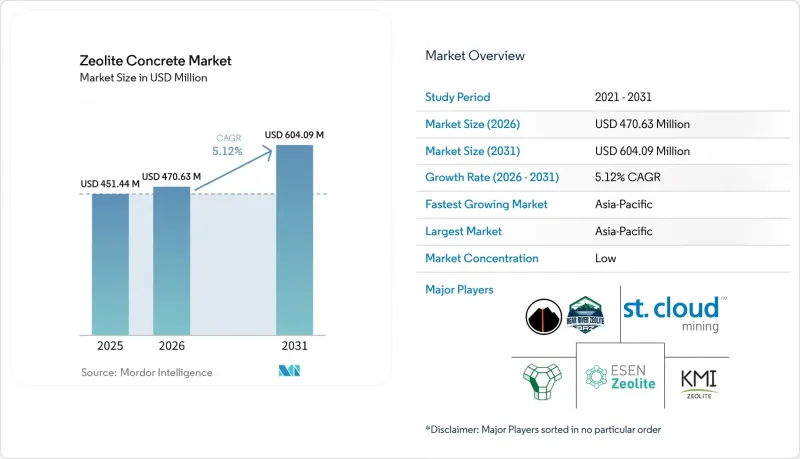
세계 제올라이트 콘크리트 시장의 동향 및 인사이트
저탄소 시멘트 대체가 핵심 가치 제안을 주도
제올라이트 콘크리트 시장은 포졸란성 시멘트 대체재로 광범위하게 전환되는 추세에 힘입어 성장하고 있습니다. 클리노프틸로라이트를 풍부하게 함유한 천연 제올라이트는 기계적 특성과 내구성을 유지하면서 시멘트 결합재의 일부를 대체할 수 있습니다. 2026년 연구에 따르면 천연 제올라이트를 15% 대체한 경우 56일 후의 압축 강도는 67.1 MPa에 달했으며, 이는 일반 포틀랜드 시멘트 대조군과 동등한 수치였습니다. 동일한 배합에서 급속 염화물 침투 전하량은 1,719 쿨롱으로 감소했고, 표면 전기 저항률은 15.08 Ω·cm로 상승했습니다. 2024년 연구에 따르면 제올라이트 분말을 30% 배합했을 때의 탄소발자국은 659.72 kg CO₂/m3인 것으로 보고되었습니다. 이러한 결과는 시멘트 사용량 감소와 운송에 따른 열화에 대한 내성 향상이 요구되는 프로젝트에서 제올라이트 사용을 지원하는 것입니다.
인프라와 경량 콘크리트에 대한 수요가 장기적인 판매량 성장을 지원
제올라이트 콘크리트 시장은 교통, 도시 개발 및 기타 콘크리트를 많이 사용하는 건설 프로젝트로부터 수요를 얻고 있습니다. 인도 표준국(BIS)의 IS 456에 기반한 인도의 철근 콘크리트 요건과 중국의 저탄소 조달 정책은 성능 시험을 거친 보충 시멘트계 재료 배합의 채택을 촉진하고 있습니다. 제올라이트계 경량 콘크리트는 밀도 500kg/m3-1,500kg/m3, 압축 강도 5 MPa-30 MPa를 실현합니다. 구조물의 무게가 줄어들어 고층 건축물의 기초와 기둥에 가해지는 하중이 경감되므로, 설계자가 경량화와 충분한 압축 성능을 모두 필요로 하는 상황에서 이 재료가 유용하게 사용됩니다. 수요는 장기적인 인프라 계획이 수립되어 있고 적절한 광상에 대한 현지 접근이 가능한 시장에서 여전히 가장 높은 관심을 받고 있습니다.
천연 광물의 조성 및 순도 편차가 규격 채택의 걸림돌이 되고 있습니다.
제올라이트 콘크리트 시장은 천연 광상에 따라 클리노프틸로라이트, 헤울란다이트, 나트로라이트 및 화산 유리의 함량이 다르기 때문에 일관성 확보라는 과제에 직면해 있습니다. 이러한 재료는 포졸란 반응성이 다르기 때문에 시험을 거치지 않고 광물 원료를 상호 호환 가능한 것으로 취급할 수 없습니다. 베어 리버 제올라이트 매장량 보고서에서는 양이온 교환 용량(CEC)의 기준치로 100 meq/100 g이 채택되었으나, 이 지표만으로는 혼합물의 성능 변동을 모두 파악할 수 없습니다. 2026년의 실험 문헌에서는 단일 제올라이트 혼합물이라 하더라도 염화물 급속 침투 값에 편차가 있다는 것이 보고되어 있으며, 성능 시험이 재료나 시험 조건에 쉽게 좌우된다는 사실이 밝혀졌습니다. 독립 기관에 의해 검증된 제품 데이터를 보유한 제조사는 콘크리트 사양 수립자에게 이러한 불확실성을 줄여줄 수 있습니다. 신뢰성 높은 제품 인증이 요구됨에 따라 기술 지원 체제가 잘 갖춰진 평판 좋은 광산이나 공급업체가 유리해질 가능성이 있습니다.
부문 분석
2025년, 천연 제올라이트는 전 세계 제올라이트 콘크리트 시장의 55.13%를 차지했습니다. 이러한 위상은 저렴한 비용과 지역적으로 광범위한 입수 가능성을 반영합니다. 천연 제올라이트의 광산 생산량은 연간 300만-400만 메트릭톤이며, 터키, 슬로바키아, 쿠바, 일본 및 미국 서부에 광상이 있습니다. 크리노프틸로라이트가 풍부하게 함유된 광상은 일반적으로 레디믹스 콘크리트 생산 지역 근처에 위치하여 운송 비용을 절감하고 현지 조달을 용이하게 합니다. 따라서 천연 등급은 신뢰할 수 있는 현지 자재를 확보할 수 있는 대규모 콘크리트 용도에 적합합니다.
합성 제올라이트는 2031년까지 연평균 성장률(CAGR) 5.67%로 성장할 것으로 예측됩니다. 합성 등급은 계약 사양에 따라 일관된 광물 조성이 요구되는 용도에서 우위를 발휘합니다. 고성능 콘크리트, 프리캐스트 패널, 자가충진 콘크리트 등이 그 용도의 예로 들 수 있습니다. 개질 제올라이트는 초고강도 콘크리트(UHPC)나 해양 방호용 배합에서 비교적 제한된 역할만 수행하고 있습니다. 열적 또는 화학적 활성화 처리를 통해 미처리 광물보다 반응성을 높일 수 있습니다. 쿠바의 조사에 따르면 200°C에서 2시간 동안 열 활성화 처리를 실시하면 20%의 치환율에서 일반 포틀랜드 시멘트와 조합했을 때 강도 활성 지수가 13% 향상되는 것으로 밝혀졌습니다.
2025년 시점에 레디믹스 콘크리트는 전 세계 제올라이트 콘크리트 시장의 44.06%를 차지했습니다. 이는 상업 시설, 주택, 인프라 공사에서 타설시 표준적인 공급 형태입니다. 제올라이트 대체는 막대한 설비 투자가 필요 없이 배치 플랜트에서 수행할 수 있으므로 기존의 레디믹스트 공급망 내에서 채택을 촉진하고 있습니다. 프리캐스트 콘크리트의 경우, 주로 장기 내구성과 기공 미세화를 목적으로 제올라이트가 사용되고 있으며, 이는 수명이 긴 구조물을 설계하는 데 있으며, 중요한 특성입니다.
자가충진 콘크리트는 2031년까지 연평균 성장률(CAGR) 5.79%로 확대될 것으로 예측됩니다. 이는 복잡한 형상, 철근이 고밀도로 배치된 부분 및 방음벽 패널에 사용됩니다. 도시 지역의 주택 건설과 데이터센터 건설이 이러한 용도에 대한 수요를 지원할 것으로 기대됩니다. 2024년에 실시된 제올라이트와 산화 그래핀을 배합한 자가충진 콘크리트에 관한 연구에 따르면 제올라이트 10% 및 산화 그래핀 0.02%를 함유한 혼합물이 양생 기간 중 압축 강도, 굽힘 강도 및 탄성 계수를 향상시키는 것으로 밝혀졌습니다. 또한 이 연구에서는 기존 콘크리트에 비해 탄소발자국이 낮다는 점도 보고되었습니다. 이러한 성능 요건으로 인해 레디믹스 콘크리트의 용도와 비교하여 보다 전문적인 역할이 기대됩니다.
지역별 분석
아시아태평양은 2025년에 전 세계 제올라이트 콘크리트 시장의 41.34%를 차지할 것으로 예상되며, 2031년까지 연평균 성장률(CAGR) 5.82%로 성장할 것으로 전망됩니다. 중국의 콘크리트 업계는 저탄소 조달로의 전환이 요구되고 있으며, 이에 따라 혼합 재료에 대한 관심이 높아지고 있으며, 국내산 클리노프틸로라이트와 터키 및 슬로바키아에서 수입되는 제올라이트의 사용이 촉진되고 있습니다. 인도의 건설 활동은 성능 시험을 거친 보충 시멘트질 재료를 사용할 수 있는 레디믹스 콘크리트 및 프리캐스트 콘크리트에 대한 수요를 지원하고 있습니다. 일본에서는 고로 슬래그 공급량이 감소하는 가운데, 국내산 포졸란 대체 재료에 대한 연구가 진행되고 있으며, 태평양 시멘트가 2025년 및 2026년에 실시한 천연 제올라이트의 수축 균열에 관한 연구는 이러한 수요를 반영한 것입니다.
북미 및 유럽은 제올라이트 콘크리트에 관한 규격이 엄격한 시장입니다. 미국에서는 제품별 환경성명서(EPD)를 통해 콘크리트용 클리노프틸로라이트에 대한 보다 공식적인 사양 제정이 촉진되고 있습니다. 캐나다에서는 캠룹스 인근의 퍼거슨 크릭 광구를 통해 현지 포졸란 공급 능력을 구축하고 있으며, 프로그레시브 플래닛(Progressive Planet)사에 따르면 이 광구는 반경 800km 범위 내에서 최소 30년 동안 자재를 공급할 수 있는 것으로 알려져 있습니다. 프랑스의 NF EN 206+A2/CN 규격에서는 저탄소 성분을 도입할 수 있는 성능 기반 콘크리트 배합이 허용되고 있습니다. 슬로바키아에는 지역 건설 수요를 충족시킬 수 있는 천연 제올라이트 자원이 있습니다. 이 지역에 진출한 기업은 적합성 데이터, 물류, 그리고 일관된 제품 성능을 놓고 경쟁하고 있습니다.
남미, 중동 및 아프리카는 제올라이트 콘크리트 시장에서 여전히 초기 단계에 있는 지역입니다. 안데스 화산대에는 칠레, 페루, 에콰도르에 크리노프틸라이트를 풍부하게 함유한 응회암이 존재하며, 이는 브라질의 건설 수요를 보완할 수 있습니다. 요르단의 WATAD 채석장은 하루 2,000톤 이상의 생산 능력을 갖추고 있으며, 수처리 및 수력 구조물용 제올라이트와 포졸란 재료를 공급하고 있습니다. 사우디아라비아와 아랍에미리트에서는 항만, 해수 담수화 플랜트, 도시 확장 계획에 따른 수요가 예상되며, 이러한 분야에서는 특히 황산염 내성 콘크리트가 중요합니다. 남아프리카의 건설 및 상수도 사업 부문도 지역내 광물 공급이 확대됨에 따라 단기적인 수요를 지원할 수 있습니다.
기타 혜택:
- 엑셀 형식의 시장 예측(ME) 시트
- 3개월간의 애널리스트 지원
자주 묻는 질문
목차
제1장 서론
- 조사 전제조건과 시장 정의
- 조사 범위
제2장 조사 방법
제3장 개요
제4장 시장 구도
- 시장 개요
- 시장 성장 촉진요인
- 시장 성장 억제요인
- 밸류체인 분석
- Porter's Five Forces 분석
제5장 시장 규모와 성장 예측
- 제올라이트 유형별
- 콘크리트 유형별
- 용도별
- 최종사용자 산업별
- 지역별
- 아시아태평양
- 중국
- 인도
- 일본
- 한국
- ASEAN 국가
- 기타 아시아태평양 국가
- 북미
- 미국
- 캐나다
- 멕시코
- 유럽
- 독일
- 영국
- 프랑스
- 이탈리아
- 북유럽 국가
- 기타 유럽 국가
- 남미
- 브라질
- 아르헨티나
- 기타 남미 국가
- 중동 및 아프리카
- 사우디아라비아
- 남아프리카공화국
- 기타 중동 및 아프리카 국가
- 아시아태평양
제6장 경쟁 구도
- 시장 집중도
- 전략적 동향
- 시장 점유율·순위 분석
- 기업 개요
- Bear River Zeolite Co.
- BENTOMINE
- Blue Pacific Minerals Ltd
- Esen Zeolite
- Gordes Zeolite
- International Zeolite Corp.
- KMI Zeolite Inc.
- Rota Mining Corporation
- St. Cloud Mining
- Teague Mineral Products
- Trassingeneering
- ZeoCat
- ZEOCEM s.r.o.
- Zeolite Australia
- Zeotech Corporation
제7장 시장 기회와 향후 전망
KSA 26.10.23According to Mordor Intelligence, the zeolite concrete market size was estimated at USD 451.44 million in 2025 and is estimated to grow from USD 470.63 million in 2026 to USD 604.09 million by 2031, at a CAGR of 5.12% during the forecast period (2026-2031).
Global Zeolite Concrete Market Trends and Insights
Low-Carbon Cement Substitution Driving the Core Value Proposition
The zeolite concrete market benefits from the broader shift toward pozzolanic supplementary cementitious materials. Clinoptilolite-rich natural zeolite can replace part of the cement binder while preserving mechanical and durability properties. A 2026 study found that 15% natural zeolite replacement achieved a 56-day compressive strength of 67.1 MPa, comparable with the ordinary Portland cement control. The same mix reduced the rapid chloride penetration charge to 1,719 coulombs and increased the electrical surface resistivity to 15.08 Ω*cm. A 2024 study reported a carbon footprint of 659.72 kg CO2/m3 for a 30% replacement with zeolite powder. These results support the use of zeolites in projects that require lower cement intensity and greater resistance to transport-related deterioration.
Infrastructure and Lightweight-Concrete Demand Anchoring Long-Run Volume Growth
The zeolite concrete market draws volume from transport, urban development, and other concrete-intensive construction programs. India's reinforced concrete requirements under Bureau of Indian Standards (BIS) IS 456 and China's lower-carbon procurement direction support the adoption of performance-tested supplementary cementitious material mixes. Zeolite-based lightweight concrete achieves densities from 500 kg/m3 to 1,500 kg/m3 and compressive strengths from 5 MPa to 30 MPa. Lower structural weight reduces loads on foundations and columns in high-rise construction, making the material relevant where designers need both weight reduction and adequate compressive performance. Demand remains most relevant in markets with long infrastructure pipelines and local access to suitable mineral deposits.
Natural Mineralogy and Purity Variability Constraining Specification Adoption
The zeolite concrete market faces a consistency challenge because natural deposits vary in their contents of clinoptilolite, heulandite, natrolite, and volcanic glass. These materials have different pozzolanic reactivity profiles, meaning mineral sources cannot be treated as interchangeable without testing. A cation exchange capacity threshold of 100 meq/100 g has been used in the Bear River Zeolite reserve report, but this measure does not capture all mix performance variation. Experimental literature from 2026 also reported different rapid chloride penetration values for a single zeolite mix, demonstrating the sensitivity of performance testing to material and test conditions. Producers with independently verified product data can reduce this uncertainty for concrete specifiers. The requirement for reliable product qualification may favor established deposits and suppliers with technical support.
Other drivers and restraints analyzed in the detailed report include:
- Durability Improvement in Aggressive Environments Expanding Marine and Industrial Segments
- Internal Curing and Shrinkage Control Opening Ultra-High-Performance Concrete Markets
- Reduced Workability and Higher Admixture Demand Raise the Total Cost of Adoption
For complete list of drivers and restraints, kindly check the Table Of Contents.
Segment Analysis
Natural zeolite held 55.13% of the global zeolite concrete market in 2025. Its position reflects lower cost and wide geographic availability. Natural zeolite mine production ranges from 3 to 4 million metric tons annually, with deposits in Turkey, Slovakia, Cuba, Japan, and the western United States. Clinoptilolite-rich deposits are commonly located near ready-mix concrete production regions, thereby reducing transport costs and simplifying local procurement. Natural grades are therefore suitable for large-scale concrete applications where dependable local material is available.
Synthetic zeolite is forecast to grow at a 5.67% CAGR through 2031. Synthetic grades benefit from applications requiring consistent mineralogy per contract specifications. High-performance concrete, precast panels, and self-compacting concrete are examples of such applications. Modified zeolite has a smaller role in UHPC and marine-protection formulations. Thermal or chemical activation can improve reactivity beyond that of untreated mineral. Cuban research found that thermal activation at 200°C for 2 hours increased the strength activity index with ordinary Portland cement by 13% at a 20% replacement level.
Ready-mix concrete represented 44.06% of the global zeolite concrete market in 2025. It is the standard delivery format for commercial, residential, and infrastructure pours. Zeolite substitution can be implemented at the batching plant without major capital investment, thereby supporting adoption within established ready-mix supply chains. Precast concrete uses zeolite primarily for long-term durability and pore refinement, properties that are important for elements designed for extended service life.
Self-compacting concrete is projected to expand at a 5.79% CAGR through 2031. It is used in complex forms, densely reinforced sections, and acoustic wall panels. Urban residential construction and data-center construction can support demand for these applications. A 2024 study of self-compacting concrete with zeolite and graphene oxide found that a mix containing 10% zeolite and 0.02% graphene oxide improved compressive strength, flexural strength, and elastic modulus across curing ages. The study also reported a lower carbon footprint than conventional concrete. These performance requirements support a more specialized role compared to ready-mix applications.
Complete Report Scope:
- By Zeolite Type
- Natural Zeolite
- Synthetic Zeolite
- Modified Zeolite
- Other Zeolite Types and Specialty Blends
- By Concrete Type
- Ready-Mix Concrete
- Precast Concrete
- Self-Compacting Concrete
- Lightweight Concrete
- Other Concrete Types
- By Application
- Structural Concrete
- Pavements and Road Construction
- Marine and Hydraulic Structures
- Repair and Rehabilitation
- Other Applications
- By End-User Industry
- Building and Construction
- Infrastructure
- Water and Wastewater
- Energy and Power
- Other Industries
- By Geography
- Asia-Pacific
- China
- India
- Japan
- South Korea
- ASEAN Countries
- Rest of Asia-Pacific
- North America
- United States
- Canada
- Mexico
- Europe
- Germany
- United Kingdom
- France
- Italy
- NORDIC Countries
- Rest of Europe
- South America
- Brazil
- Argentina
- Rest of South America
- Middle-East and Africa
- Saudi Arabia
- South Africa
- Rest of Middle-East and Africa
- Asia-Pacific
Geography Analysis
Asia-Pacific held 41.34% of the global zeolite concrete market in 2025 and is projected to grow at a 5.82% CAGR through 2031. China's concrete sector is under pressure to adopt lower-carbon procurement, increasing interest in blended materials and supporting the use of domestic clinoptilolite and imported zeolite from Turkey and Slovakia. India's construction activity supports demand for ready-mix and precast concrete that can use performance-tested supplementary cementitious materials. Japan is studying domestic pozzolanic alternatives as the availability of blast-furnace slag declines, with Taiheiyo Cement's 2025 and 2026 work on natural-zeolite shrinkage cracking reflecting this need.
North America and Europe are standards-intensive markets for zeolite concrete. In the United States, product-specific environmental declarations can support more formal specification of concrete-grade clinoptilolite. Canada is building local pozzolan supply capacity through the Ferguson Creek property near Kamloops, which Progressive Planet stated could supply material within an 800 km radius for at least 30 years. France's NF EN 206+A2/CN standard permits performance-based concrete formulation that can accommodate lower-carbon constituents. Slovakia has natural zeolite resources that can serve regional construction demand. Market participants in these regions compete on qualification data, logistics, and consistent product performance.
South America, the Middle-East, and Africa remain early-stage regions in the zeolite concrete market. The Andean volcanic arc contains clinoptilolite-rich tuffs in Chile, Peru, and Ecuador that can complement Brazil's construction demand. In Jordan, the WATAD quarry has a production capacity of over 2,000 tons per day and supplies zeolite and pozzolana materials for water treatment and hydraulic structures. Saudi Arabia and the United Arab Emirates offer demand from ports, desalination plants, and urban expansion programs, where sulfate-resistant concrete is particularly relevant. South Africa's construction and water utility sectors can also support near-term demand as regional mineral supply develops.
- Bear River Zeolite Co.
- BENTOMINE
- Blue Pacific Minerals Ltd
- Esen Zeolite
- Gordes Zeolite
- International Zeolite Corp.
- KMI Zeolite Inc.
- Rota Mining Corporation
- St. Cloud Mining
- Teague Mineral Products
- Trassingeneering
- ZeoCat
- ZEOCEM s.r.o.
- Zeolite Australia
- Zeotech Corporation
Additional Benefits:
- The market estimate (ME) sheet in Excel format
- 3 months of analyst support
TABLE OF CONTENTS
1 Introduction
- 1.1 Study Assumptions and Market Definition
- 1.2 Scope of the Study
2 Research Methodology
3 Executive Summary
4 Market Landscape
- 4.1 Market Overview
- 4.2 Market Drivers
- 4.2.1 Low-Carbon Cement Substitution
- 4.2.2 Infrastructure and Lightweight-Concrete Demand
- 4.2.3 Durability Improvement in Aggressive Environments
- 4.2.4 Internal Curing and Shrinkage Control
- 4.2.5 Source-Specific Zeolite Reactivity and Mix Optimization
- 4.2.6 Local Availability of Natural Pozzolan Deposits
- 4.3 Market Restraints
- 4.3.1 Natural Mineralogy and Purity Variability
- 4.3.2 Reduced Workability and Higher Admixture Demand
- 4.3.3 Early-Age Strength and Slow Pozzolanic Reaction
- 4.4 Value Chain Analysis
- 4.5 Porter's Five Forces Analysis
- 4.5.1 Bargaining Power of Suppliers
- 4.5.2 Bargaining Power of Buyers
- 4.5.3 Threat of New Entrants
- 4.5.4 Threat of Substitutes
- 4.5.5 Competitive Rivalry
5 Market Size and Growth Forecasts (Value)
- 5.1 By Zeolite Type
- 5.1.1 Natural Zeolite
- 5.1.2 Synthetic Zeolite
- 5.1.3 Modified Zeolite
- 5.1.4 Other Zeolite Types and Specialty Blends
- 5.2 By Concrete Type
- 5.2.1 Ready-Mix Concrete
- 5.2.2 Precast Concrete
- 5.2.3 Self-Compacting Concrete
- 5.2.4 Lightweight Concrete
- 5.2.5 Other Concrete Types
- 5.3 By Application
- 5.3.1 Structural Concrete
- 5.3.2 Pavements and Road Construction
- 5.3.3 Marine and Hydraulic Structures
- 5.3.4 Repair and Rehabilitation
- 5.3.5 Other Applications
- 5.4 By End-User Industry
- 5.4.1 Building and Construction
- 5.4.2 Infrastructure
- 5.4.3 Water and Wastewater
- 5.4.4 Energy and Power
- 5.4.5 Other Industries
- 5.5 By Geography
- 5.5.1 Asia-Pacific
- 5.5.1.1 China
- 5.5.1.2 India
- 5.5.1.3 Japan
- 5.5.1.4 South Korea
- 5.5.1.5 ASEAN Countries
- 5.5.1.6 Rest of Asia-Pacific
- 5.5.2 North America
- 5.5.2.1 United States
- 5.5.2.2 Canada
- 5.5.2.3 Mexico
- 5.5.3 Europe
- 5.5.3.1 Germany
- 5.5.3.2 United Kingdom
- 5.5.3.3 France
- 5.5.3.4 Italy
- 5.5.3.5 NORDIC Countries
- 5.5.3.6 Rest of Europe
- 5.5.4 South America
- 5.5.4.1 Brazil
- 5.5.4.2 Argentina
- 5.5.4.3 Rest of South America
- 5.5.5 Middle-East and Africa
- 5.5.5.1 Saudi Arabia
- 5.5.5.2 South Africa
- 5.5.5.3 Rest of Middle-East and Africa
- 5.5.1 Asia-Pacific
6 Competitive Landscape
- 6.1 Market Concentration
- 6.2 Strategic Moves
- 6.3 Market Share (%)/Ranking Analysis
- 6.4 Company Profiles (includes Global Overview, Market Overview, Core Segments, Financials as available, Strategic Information, Products and Services, and Recent Developments)
- 6.4.1 Bear River Zeolite Co.
- 6.4.2 BENTOMINE
- 6.4.3 Blue Pacific Minerals Ltd
- 6.4.4 Esen Zeolite
- 6.4.5 Gordes Zeolite
- 6.4.6 International Zeolite Corp.
- 6.4.7 KMI Zeolite Inc.
- 6.4.8 Rota Mining Corporation
- 6.4.9 St. Cloud Mining
- 6.4.10 Teague Mineral Products
- 6.4.11 Trassingeneering
- 6.4.12 ZeoCat
- 6.4.13 ZEOCEM s.r.o.
- 6.4.14 Zeolite Australia
- 6.4.15 Zeotech Corporation
7 Market Opportunities and Future Outlook
- 7.1 White-Space and Unmet-Need Assessment


