

|
시장보고서
상품코드
2154433
두개악안면 임플란트 : 시장 점유율 분석, 업계 동향과 통계, 성장 예측(2026-2031년)Craniomaxillofacial Implants - Market Share Analysis, Industry Trends & Statistics, Growth Forecasts (2026 - 2031) |
||||||
 Mordor Intelligence
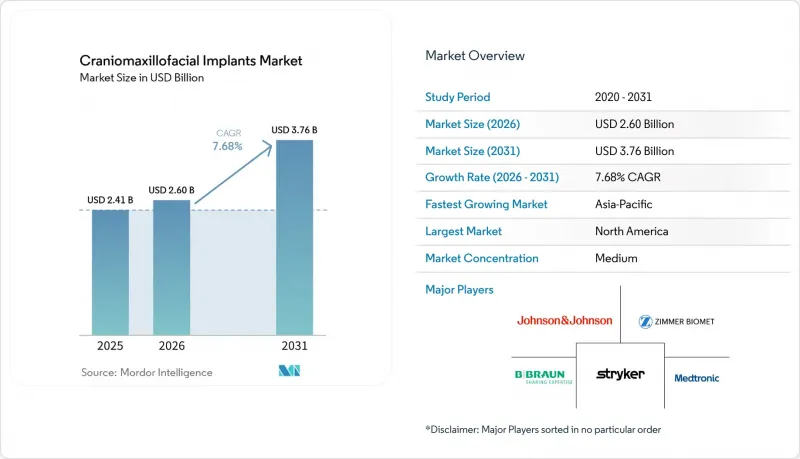
에 따르면 두개악안면 임플란트 시장 규모는 2025년에 24억 1,000만 달러, 2026년에 26억 달러에 달하며, 2031년까지 37억 6,000만 달러에 달할 것으로 예측되고 있으며, 2026-2031년에 CAGR 7.68%로 성장할 것으로 전망되고 있습니다.
전 세계 두개악안면 임플란트 시장의 동향 및 인사이트
두개안면 외상 및 재건 수술 건수의 증가가 단기적인 수요의 기반이 되고 있습니다.
두개안면 외상은 두개악안면 임플란트 시장에서 고정 시스템의 주요 수요 요인으로 계속 작용하고 있습니다. 2017-2024년 미국 국립 외상 데이터뱅크에 보고된 소아 두개악안면(CMF) 골절 중 자동차 사고로 인한 사례가 34.3%를 차지했습니다. 안전벨트 착용으로 인해 자동차 사고시 두개악안면 골절 위험은 42.8% 감소했으나, 중증 외상 사례에서는 여전히 플레이트, 나사, 메쉬 및 기타 고정 제품이 필요합니다. 중국에서는 2024년에 119만 4,145건의 신규 안면 골절 사례가 기록되었으며, 2010-2021년까지의 연령 조정 발생률은 17.74% 증가했습니다. 2020년, 중국의 3차 의료기관에서 발생한 외상 관련 비용은 55억 달러를 초과했습니다. 안와 및 중안면 손상에는 메쉬나 티타늄 고정 장치가 필요한 경우가 많으며, 또한 절제 후 두개골 결손에 대해서는 두개골 재건술에 대한 수요가 지속되고 있습니다. 이러한 외상 및 종양학에 기인한 적응증이 확립된 고정용 하드웨어에 대한 안정적인 수요를 지원하고 있습니다.
환자 맞춤형 치료 및 3D 프린팅 임플란트의 활용 확대가 가격 체계를 재편
환자 맞춤형 티타늄 두개골 임플란트는 미국의 확립된 규제 절차를 통해 더욱 쉽게 구할 수 있게 되었습니다. 2026년 7월, 월터 리드 국립 군사 의료 센터는 해당 센터의 ‘3D MAC 티타늄 두개골 플레이트 시스템’에 대해 FDA로부터 시판 전 승인(K253116)을 획득했습니다. 이번 승인은 임플란트 시스템과 관련하여 임상 현장의 의료 기관에 최초로 부여된 것으로, 특정 두개골 임플란트 사례에 대해 병원 내에서 제조할 수 있게 했습니다. 3D Systems사는 이 프로젝트에서 해당 센터의 ‘3D 의료 애플리케이션 센터’를 지원했습니다. 맞춤형 생산으로의 전환은 두개악안면 임플란트 시장의 상업적 구조를 변화시키고 있습니다. 환자 맞춤형 임플란트는 영상 진단, 설계, 제조 및 멸균 요건을 반영하여 표준 임플란트에 비해 3배에서 5배 높은 평균 판매 가격을 보이고 있습니다. Materialise와 Stryker는 임플란트 주문과 연계된 디지털 플랫폼의 혜택을 누리고 있지만, 기존 임플란트 공급업체들은 복잡한 재건 사례에서 경쟁 압박에 직면할 가능성이 있습니다.
임플란트, 계획 및 수술에 드는 높은 비용이 비용에 민감한 환경에서 보급을 저해
환자 맞춤형 티타늄 또는 PEEK 재질의 두개골 임플란트는 설계 서비스, 적층 제조, 멸균을 포함한 미국내 병원 조달 비용이 1건당 10,000-2만 달러를 초과할 수 있습니다. 외과 의사의 보수, 수술실 사용 시간, 가상 수술 계획 및 스프린트 제작비로 인해 턱 교정 수술 1건당 1,500-3,000달러가 추가로 발생할 수 있습니다. 진단 관련 그룹(DRG)에 기반한 환급으로는 이러한 비용을 완전히 충당하지 못할 수 있으며, 고정 수술 보수 모델 하에서는 도입이 제한되고 있습니다. 외과적 치료가 필요한 사고 관련 외상 중 전 세계 전체의 80-90%는 저·중소득 국가에서 발생하고 있습니다. 인프라 및 보상 범위의 부족으로 인해 의료 서비스 제공자는 두개악안면 골절에 대해 보존적 치료를 시행하거나 저가의 제네릭 티타늄 미니 플레이트를 사용할 수밖에 없는 경우가 많습니다. 모듈식 가격 책정을 통해 임플란트 비용과 계획 비용을 분리하는 것은 가능하지만, 공급망의 투명성 부족과 번들형 모델 변경에 대한 공급업체의 저항으로 인해 두개악안면 임플란트 시장에서 더 광범위한 도입이 제한되고 있습니다.
부문 분석
2025년, 플레이트와 스크류는 외상, 악교정 수술, 재건 수술에서의 사용에 힘입어 두개악안면 임플란트 시장 점유율의 45.76%를 차지했습니다. 티타늄 고정용 하드웨어는 CMF 수술 전반에 걸쳐 여전히 기본적인 요건으로 남아 있으며, 이 범주에 폭넓은 수술 기반을 제공하고 있습니다. 스트라이커(Striker)사의 ‘유니버설 셀렉트(Universal Select)’ 시스템은 가변 각도 잠금 장치와 AXS 스크류 형상을 결합한 반면, 듀피 신테시스(Depuy Synthes)사의 ‘TRUMATCH CMF’ 플랫폼은 3D 프린팅된 티타늄 플레이트와 디지털 수술 전 계획 기능을 통합하고 있습니다. 메쉬 시스템 및 두개골 피판 고정 시스템은 여전히 보완적인 범주에 속하는 반면, 견인 시스템 및 턱관절 치환 시스템은 더 제한적이긴 하지만 고부가가치의 적응증을 다루고 있습니다.
골 이식 대체재는 2026-2031년까지 연평균 성장률(CAGR) 8.51%로 성장할 것으로 예측됩니다. 합성 하이드록시아파타이트, β-트리칼슘인산염 및 탈회골기질는 자가 골 이식에 수반되는 기증 부위의 합병증을 완화하여 재건 수술에서의 사용을 촉진하고 있습니다. 몇 가지 생체활성 이식 재료가 FDA의 ‘획기적인 의료기기(Breakthrough Device)’로 지정됨에 따라 심사 기간이 단축되었고, 보험사에 대한 임상적 차별성이 입증되었습니다. 환자 맞춤형 임플란트는 여전히 매출 규모는 작지만 평균 판매 가격이 가장 높으며, 그 성장은 신뢰할 수 있는 계획 및 제조 워크플로우에 달려 있습니다.
티타늄 및 티타늄 합금은 생체 적합성, 내식성 및 피로 강도에 힘입어 2025년 매출의 61.65%를 차지했습니다. 이러한 특성 덕분에 티타늄은 대체 재료에 대한 규제상의 벤치마크로서의 입지를 확립했으며, 안와연 재건, 하악판 고정 및 두개안면 견인 시스템에서의 사용이 촉진되었습니다. 외과 의사들 사이에서 폭넓은 인지도와 확립된 승인 실적을 바탕으로, 외상 및 재건 수술에서의 도입 장벽은 지속적으로 낮아졌습니다. 따라서 두개악안면 임플란트 시장에서는 핵심적인 고정 요건에 있으며, 티타늄에 대한 의존도가 계속 유지되었습니다.
PEEK는 환자 맞춤형 임플란트 용도에서 신뢰할 수 있는 대체 소재로 부상했습니다. 2025년 연구에 따르면 PEEK의 ANA 심미적 만족도 점수 평균은 8.86이었던 반면, 티타늄, 실리콘, PMMA의 점수는 8.25 이했습니다. 합병증으로는 혈종이 보고되었으나, 거부 반응이나 감염 사례는 나타나지 않았습니다. 생체흡수성 폴리머는 2차 임플란트 제거를 피할 수 있으므로 2031년까지 연평균 성장률(CAGR) 10.89%로 성장할 것으로 예측됩니다. 2026년 총설에서는 골유착을 촉진하기 위한 플라즈마 처리, 하이드록시아파타이트 나노입자 코팅, 나노토포그래피 개질 등을 포함하여, CMF(두개·안면·구강) 및 턱관절 용도에서 PEEK의 활용이 더욱 광범위해지고 있다고 언급되어 있습니다. 세라믹과 스테인리스강은 여전히 성숙한 틈새 시장인 반면, 바이오소재와 복합 매트릭스는 계속해서 발전하고 있습니다.
지역별 분석
2025년, 북미는 매출의 39.56%를 차지했습니다. 미국에서는 안면 골절로 인한 응급실 내원 건수가 연간 40만 건을 넘었으며, 두개 봉합 조기 유합증의 교정 및 암 치료 후 두개 성형술에 대한 보험 급여가 전문적인 재건 수술을 지원했습니다. 광범위한 두개안면 치료 네트워크와 가상 수술 계획의 보급이 이 지역의 수요를 지원했습니다. 2026년 7월, 월터 리드는 3D Systems사의 ‘3D MAC 티타늄 두개골 플레이트 시스템’에 대한 승인을 획득하여, 미국이 맞춤형 임플란트 플랫폼 분야의 주요 규제 및 임상 시장으로서의 입지를 더욱 공고히 했습니다.
유럽은 독일, 영국, 프랑스, 이탈리아, 스페인이 주도하는 형태로 두개악안면 임플란트 시장에서 여전히 중요한 위치를 유지했습니다. 중앙 집중화된 병원 네트워크와 학술적인 두개악안면(CMF) 프로그램이 수술 건수를 지원하고 있었지만, 비용 및 물류상의 제약으로 인해 디지털 기술의 보다 광범위한 통합은 제한적이었습니다. 2025년 조사에 따르면 독일 구강악안면 외과 의사의 44.4%가 디지털과 기존 기법을 결합한 하이브리드 계획 기법을 채택하고 있는 것으로 나타났습니다. 2026년 2월, Materialise는 유럽의 외과 의사들을 위해 CMF 제품 포트폴리오에 맞춤형 PEEK 임플란트를 추가했습니다. 이 제품들은 EN ISO 13485를 준수하여 제조되었으며, 계획 승인 후 72시간 이내에 납품되었습니다. 한편, 유럽의 공급업체들은 흡수성 고정재 및 환자 맞춤형 설계 서비스 분야에서 여전히 확고한 입지를 유지하고 있었습니다.
아시아태평양은 두개악안면 임플란트 시장에서 가장 빠르게 성장하는 지역으로, 그 배경에는 중국의 수술 인프라 확충, 한국 및 일본의 첨단 재건·미용 시스템, 그리고 인도의 외상 및 선천성 질환 재건 수요가 있었습니다. 국내 및 글로벌 공급업체들은 중국의 고정 가격 대량 생산형 티타늄 하드웨어 수요를 공략했습니다. 남미에서는 브라질이 확립된 재건 수술 인프라를 바탕으로 판매량을 견인했습니다. 한편, 중동 및 아프리카에서는 시장이 여전히 신흥 단계에 있는 가운데, 걸프협력회의(GCC)의 의료 투자가 병원의 수용 능력과 외과 의사 연수를 지원했습니다.
기타 혜택:
- 엑셀 형식의 시장 예측(ME) 시트
- 3개월간의 애널리스트 지원
자주 묻는 질문
목차
제1장 서론
- 조사 전제조건과 시장 정의
- 조사 범위
제2장 조사 방법
제3장 개요
제4장 시장 구도
- 시장 개요
- 시장 성장 촉진요인
- 시장 성장 억제요인
- 밸류·공급망 분석
- 규제 상황
- 기술 전망
- Porter's Five Forces 분석
제5장 시장 규모와 성장 예측
- 제품과 기술별
- 소재별
- 용도별
- 최종사용자별
- 지역별
- 북미
- 미국
- 캐나다
- 멕시코
- 유럽
- 독일
- 영국
- 프랑스
- 이탈리아
- 스페인
- 기타 유럽 국가
- 아시아태평양
- 중국
- 인도
- 일본
- 호주
- 한국
- 기타 아시아태평양 국가
- 중동 및 아프리카
- GCC
- 남아프리카공화국
- 기타 중동 및 아프리카 국가
- 남미
- 브라질
- 아르헨티나
- 기타 남미 국가
- 북미
제6장 경쟁 구도
- 시장 집중도
- 시장 점유율 분석
- 기업 개요
- Acumed LLC
- Anatomics Pty Ltd
- B. Braun Melsungen AG
- Calavera Surgical Design
- CONMED Corporation
- Integra LifeSciences Holdings Corporation
- Jeil Medical Corporation
- Johnson & Johnson
- KLS Martin SE & Co. KG
- Materialise NV
- Matrix Surgical USA
- Medartis Holding AG
- Medtronic plc
- Orthofix Medical Inc.
- OsteoMed, L.P.
- Osteopore Limited
- Rebstock Instruments GmbH
- Renishaw plc
- Smith+Nephew plc
- Stryker Corporation
- Xilloc Medical B.V.
- Zimmer Biomet Holdings, Inc.
제7장 시장 기회와 향후 전망
KSA 26.10.23According to Mordor Intelligence, the craniomaxillofacial implants market size is projected to be USD 2.41 billion in 2025, USD 2.60 billion in 2026, and reach USD 3.76 billion by 2031, growing at a CAGR of 7.68% from 2026 to 2031.
Global Craniomaxillofacial Implants Market Trends and Insights
Rising Craniofacial Trauma and Reconstruction Volumes Anchor Near-Term Demand
Craniofacial trauma remains a key demand driver for fixation systems in the craniomaxillofacial implants market. Motor vehicle collisions accounted for 34.3% of pediatric CMF fractures reported in the U.S. National Trauma Data Bank between 2017 and 2024. Seat belt use reduced the risk of CMF fractures in motor vehicle collisions by 42.8%, yet severe trauma cases continue to require plates, screws, mesh, and other fixation products. China recorded 1,194,145 new facial fracture cases in 2024, while the age-standardized incidence increased by 17.74% between 2010 and 2021. Trauma-related costs at tertiary hospitals in China exceeded USD 5.5 billion in 2020. Orbital and midface injuries often require mesh and titanium fixation, while post-resection cranial defects sustain demand for cranioplasty procedures. These trauma and oncology-driven indications support consistent demand for established fixation hardware.
Growing Use of Patient-Specific and 3D-Printed Implants Reshapes Pricing Architecture
Patient-specific titanium cranial implants have become more accessible through established U.S. regulatory pathways. In July 2026, Walter Reed National Military Medical Center received FDA premarket clearance K253116 for its 3D MAC Titanium Cranial Plate System. The clearance was the first granted to a point-of-care institution for an implant system and supported hospital-site manufacturing for selected cranial implant cases. 3D Systems supported the center's 3D Medical Applications Center in this effort. The shift toward customized production is changing the commercial structure of the craniomaxillofacial implants market. Patient-specific implants command average selling prices that are three to five times higher than standard hardware, reflecting imaging, design, manufacturing, and sterilization requirements. Materialize and Stryker benefit from digital platforms linked to implant ordering, while conventional hardware suppliers may face competitive pressure in complex reconstruction cases.
High Implant, Planning, and Procedure Costs Constrain Penetration in Cost-Sensitive Settings
Patient-specific titanium or PEEK cranial implants can exceed USD 10,000-20,000 per case in U.S. hospital acquisition costs, including design services, additive manufacturing, and sterilization. Surgeon fees, operating room time, virtual surgical planning, and splint manufacturing can add USD 1,500-3,000 per orthognathic case. Diagnosis-related group reimbursement may not fully cover these costs, limiting adoption under fixed procedure payment models. Low- and middle-income countries account for 80-90% of global accident-related injuries requiring surgical treatment. Limited infrastructure and reimbursement coverage often lead providers to manage CMF fractures conservatively or use lower-cost generic titanium mini-plates. While modular pricing could separate implant and planning costs, limited supply chain transparency and supplier resistance to changing bundled models restrict wider adoption in the craniomaxillofacial implants market.
Other drivers and restraints analyzed in the detailed report include:
- Expansion of Orthognathic, Maxillofacial, and Aesthetic Surgery Broadens the Addressable Case Mix
- Increasing Use of Resorbable and Bioactive Implant Materials Shifts Long-Term Replacement Dynamics
- Shortage of Specialized Craniomaxillofacial Surgeons Creates Systemic Capacity Gaps
For complete list of drivers and restraints, kindly check the Table Of Contents.
Segment Analysis
Plates and screws held 45.76% of the craniomaxillofacial implants market share in 2025, supported by their use in trauma, orthognathic surgery, and reconstruction. Titanium fixation hardware remained a baseline requirement across CMF procedures, providing the category with a broad procedural base. Stryker's Universal Select system combines variable-angle locking with AXS screw geometry, while DePuy Synthes' TRUMATCH CMF platform integrates 3D-printed titanium plates with digital preoperative planning. Mesh systems and cranial flap fixation systems remain complementary categories, while distraction and temporomandibular joint replacement systems serve narrower, higher-value indications.
Bone graft substitutes are forecast to grow at a CAGR of 8.51% from 2026 to 2031. Synthetic hydroxyapatite, beta-tricalcium phosphate, and demineralized bone matrix reduce donor-site morbidity associated with autograft harvesting, supporting their use in reconstruction. FDA Breakthrough Device designations for several bioactive graft materials shortened review timelines and indicated clinical differentiation to payers. Patient-specific implants remain a smaller revenue category but have the highest average selling price, with growth dependent on reliable planning and manufacturing workflows.
Titanium and titanium alloys accounted for 61.65% of revenue in 2025, supported by their biocompatibility, corrosion resistance, and fatigue strength. These properties established titanium as a regulatory benchmark for alternative materials and supported its use in orbital rim reconstruction, mandibular plating, and craniofacial distraction systems. Broad surgeon familiarity and an established clearance history continued to reduce adoption barriers across trauma and reconstructive procedures. The craniomaxillofacial implants market, therefore, continued to rely on titanium for core fixation requirements.
PEEK emerged as a credible alternative for patient-specific implant applications. A 2025 study reported a mean ANA aesthetic satisfaction score of 8.86 for PEEK, compared with scores of 8.25 or lower for titanium, silicone, and PMMA; the complication profile included hematoma, with no rejection or infection events. Bioabsorbable polymers are projected to grow at a CAGR of 10.89% through 2031, as they can avoid secondary hardware removal. A 2026 review described broader PEEK use across CMF and temporomandibular joint applications, including plasma treatment, hydroxyapatite nanoparticle coating, and nanotopographic modification to improve osseointegration. Ceramics and stainless steel remain mature niches, while biomaterials and composite matrices continue to develop.
Complete Report Scope:
- By Product and Technique
- Plates and Screws
- Mesh Systems
- Bone Graft Substitutes
- Dural Repair Products
- Cranial Flap Fixation Systems
- Craniomaxillofacial Distraction Systems
- Temporomandibular Joint Replacement Systems
- Patient-Specific Implants
- By Material
- Titanium and Titanium Alloys
- Stainless Steel
- Polymers
- Bioabsorbable Polymers
- Ceramic
- Biomaterials
- PEEK
- Others
- By Application
- Trauma and Fracture Reconstruction
- Neurosurgery and Cranial Reconstruction
- Orthognathic and Dental Surgery
- Pediatric Craniosynostosis Repair
- Oncology and Post-Tumor Reconstruction
- Congenital Deformity Correction
- Temporomandibular Joint Reconstruction
- Plastic and Aesthetic Reconstruction
- Others
- By End User
- Hospitals
- Ambulatory Surgery Centers
- Specialty Clinics
- Academic and Teaching Hospitals
- Research and Development Institutions
- By Geography
- North America
- United States
- Canada
- Mexico
- Europe
- Germany
- United Kingdom
- France
- Italy
- Spain
- Rest of Europe
- Asia-Pacific
- China
- India
- Japan
- Australia
- South Korea
- Rest of Asia-Pacific
- Middle East and Africa
- GCC
- South Africa
- Rest of Middle East and Africa
- South America
- Brazil
- Argentina
- Rest of South America
- North America
Geography Analysis
North America held 39.56% of revenue in 2025. The United States recorded more than 400,000 annual emergency room visits for facial fractures, while reimbursement for craniosynostosis repair and post-oncological cranioplasty supported specialized reconstruction. Extensive craniofacial care networks and the high adoption of virtual surgical planning strengthened regional demand. In July 2026, Walter Reed received clearance for the 3D MAC Titanium Cranial Plate System from 3D Systems, reinforcing the United States' position as a key regulatory and clinical market for customized implant platforms.
Europe maintained a substantial position in the craniomaxillofacial implants market, led by Germany, the United Kingdom, France, Italy, and Spain. Centralized hospital networks and academic CMF programs supported procedure volumes, although cost and logistical constraints limited broader digital integration; a 2025 survey found that 44.4% of German oral and maxillofacial surgeons used hybrid digital and conventional planning methods. In February 2026, Materialize added custom-made PEEK implants to its CMF portfolio for European surgeons. The products were manufactured under EN ISO 13485, with a 72-hour turnaround following plan approval, while European suppliers retained strong positions in resorbable fixation and patient-specific design services.
Asia-Pacific was the fastest-growing region in the craniomaxillofacial implants market, supported by China's expanding surgical infrastructure, advanced reconstructive and aesthetic systems in South Korea and Japan, and trauma and congenital reconstruction needs in India. . Domestic and global suppliers targeted fixed-price, high-volume titanium hardware demand in China. Brazil led South American volumes through established reconstructive surgery infrastructure, while Gulf Cooperation Council healthcare investment supported hospital capacity and surgeon training in the Middle East and Africa, where markets remained emerging.
- Acumed
- Anatomics
- B. Braun
- Calavera Surgical Design
- Conmed
- Integra LifeSciences
- Jeil Medical
- Johnson & Johnson
- KLS Martin SE & Co. KG
- Materialise
- Matrix Surgical USA
- Medartis Holding AG
- Medtronic
- Orthofix
- OsteoMed, L.P.
- Osteopore Limited
- Rebstock Instruments GmbH
- Renishaw plc
- Smith+Nephew plc
- Stryker
- Xilloc Medical B.V.
- Zimmer Biomet
Additional Benefits:
- The market estimate (ME) sheet in Excel format
- 3 months of analyst support
TABLE OF CONTENTS
1 INTRODUCTION
- 1.1 Study Assumptions and Market Definition
- 1.2 Scope of the Study
2 RESEARCH METHODOLOGY
3 EXECUTIVE SUMMARY
4 MARKET LANDSCAPE
- 4.1 Market Overview
- 4.2 Market Drivers
- 4.2.1 Rising Craniofacial Trauma and Reconstruction Volumes
- 4.2.2 Growing Use of Patient-Specific and 3D-Printed Implants
- 4.2.3 Increasing Pediatric Craniosynostosis and Congenital Deformity Procedures
- 4.2.4 Expansion of Orthognathic, Maxillofacial and Aesthetic Surgery
- 4.2.5 Integration of Virtual Surgical Planning With Implant Workflows
- 4.2.6 Increasing Use of Resorbable and Bioactive Implant Materials
- 4.3 Market Restraints
- 4.3.1 High Implant, Planning and Procedure Costs
- 4.3.2 Shortage of Specialized Craniomaxillofacial Surgeons
- 4.3.3 Regulatory and Clinical Validation Complexity for Patient-Specific Devices
- 4.3.4 Limited Long-Term Evidence for Advanced PEEK, Magnesium and 4D-Printed Implants
- 4.4 Value/Supply-Chain Analysis
- 4.5 Regulatory Landscape
- 4.6 Technological Outlook
- 4.7 Porter's Five Forces Analysis
- 4.7.1 Bargaining Power of Suppliers
- 4.7.2 Bargaining Power of Buyers
- 4.7.3 Threat of New Entrants
- 4.7.4 Threat of Substitutes
- 4.7.5 Competitive Rivalry
5 MARKET SIZE AND GROWTH FORECASTS (VALUE, USD)
- 5.1 By Product and Technique
- 5.1.1 Plates and Screws
- 5.1.2 Mesh Systems
- 5.1.3 Bone Graft Substitutes
- 5.1.4 Dural Repair Products
- 5.1.5 Cranial Flap Fixation Systems
- 5.1.6 Craniomaxillofacial Distraction Systems
- 5.1.7 Temporomandibular Joint Replacement Systems
- 5.1.8 Patient-Specific Implants
- 5.2 By Material
- 5.2.1 Titanium and Titanium Alloys
- 5.2.2 Stainless Steel
- 5.2.3 Polymers
- 5.2.4 Bioabsorbable Polymers
- 5.2.5 Ceramic
- 5.2.6 Biomaterials
- 5.2.7 PEEK
- 5.2.8 Others
- 5.3 By Application
- 5.3.1 Trauma and Fracture Reconstruction
- 5.3.2 Neurosurgery and Cranial Reconstruction
- 5.3.3 Orthognathic and Dental Surgery
- 5.3.4 Pediatric Craniosynostosis Repair
- 5.3.5 Oncology and Post-Tumor Reconstruction
- 5.3.6 Congenital Deformity Correction
- 5.3.7 Temporomandibular Joint Reconstruction
- 5.3.8 Plastic and Aesthetic Reconstruction
- 5.3.9 Others
- 5.4 By End User
- 5.4.1 Hospitals
- 5.4.2 Ambulatory Surgery Centers
- 5.4.3 Specialty Clinics
- 5.4.4 Academic and Teaching Hospitals
- 5.4.5 Research and Development Institutions
- 5.5 By Geography
- 5.5.1 North America
- 5.5.1.1 United States
- 5.5.1.2 Canada
- 5.5.1.3 Mexico
- 5.5.2 Europe
- 5.5.2.1 Germany
- 5.5.2.2 United Kingdom
- 5.5.2.3 France
- 5.5.2.4 Italy
- 5.5.2.5 Spain
- 5.5.2.6 Rest of Europe
- 5.5.3 Asia-Pacific
- 5.5.3.1 China
- 5.5.3.2 India
- 5.5.3.3 Japan
- 5.5.3.4 Australia
- 5.5.3.5 South Korea
- 5.5.3.6 Rest of Asia-Pacific
- 5.5.4 Middle East and Africa
- 5.5.4.1 GCC
- 5.5.4.2 South Africa
- 5.5.4.3 Rest of Middle East and Africa
- 5.5.5 South America
- 5.5.5.1 Brazil
- 5.5.5.2 Argentina
- 5.5.5.3 Rest of South America
- 5.5.1 North America
6 COMPETITIVE LANDSCAPE
- 6.1 Market Concentration
- 6.2 Market Share Analysis
- 6.3 Company Profiles (includes Global Level Overview, Market Level Overview, Core Segments, Financials as available, Strategic Information, Market Rank/Share, Products and Services, Recent Developments)
- 6.3.1 Acumed LLC
- 6.3.2 Anatomics Pty Ltd
- 6.3.3 B. Braun Melsungen AG
- 6.3.4 Calavera Surgical Design
- 6.3.5 CONMED Corporation
- 6.3.6 Integra LifeSciences Holdings Corporation
- 6.3.7 Jeil Medical Corporation
- 6.3.8 Johnson & Johnson
- 6.3.9 KLS Martin SE & Co. KG
- 6.3.10 Materialise NV
- 6.3.11 Matrix Surgical USA
- 6.3.12 Medartis Holding AG
- 6.3.13 Medtronic plc
- 6.3.14 Orthofix Medical Inc.
- 6.3.15 OsteoMed, L.P.
- 6.3.16 Osteopore Limited
- 6.3.17 Rebstock Instruments GmbH
- 6.3.18 Renishaw plc
- 6.3.19 Smith+Nephew plc
- 6.3.20 Stryker Corporation
- 6.3.21 Xilloc Medical B.V.
- 6.3.22 Zimmer Biomet Holdings, Inc.
7 MARKET OPPORTUNITIES AND FUTURE OUTLOOK
- 7.1 White-Space and Unmet-Need Assessment


