

|
시장보고서
상품코드
2154439
베트남의 섬유 제조업 : 시장 점유율 분석, 업계 동향과 통계, 성장 예측(2026-2031년)Vietnam Textile Manufacturing - Market Share Analysis, Industry Trends & Statistics, Growth Forecasts (2026 - 2031) |
||||||
 Mordor Intelligence
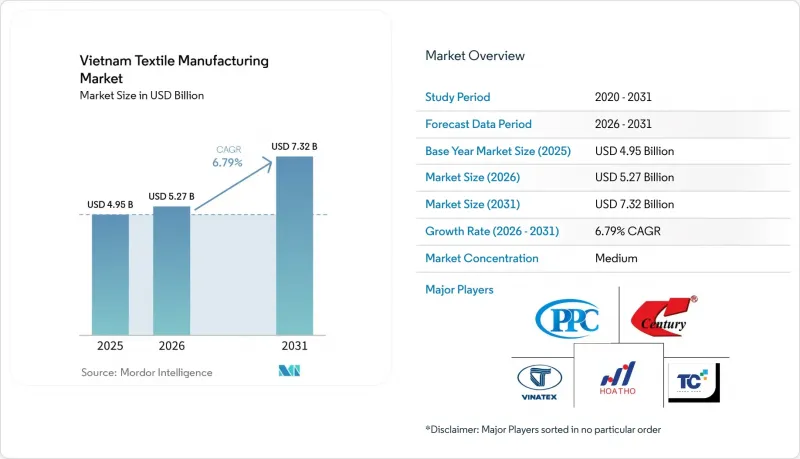
에 따르면 베트남의 섬유 제조 시장 규모는 2025년 49억 5,000만 달러에서 2026년에는 52억 7,000만 달러로 확대하며, 2031년까지 73억 2,000만 달러에 달할 것으로 예상되고 있으며, 2026-2031년에 CAGR 6.79%로 성장할 것으로 전망되고 있습니다.
베트남 섬유 제조 시장의 동향 및 인사이트
중국 중심의 조달에서 벗어나 공급망 다각화
관세 관련 긴장과 이전의 공급 차질로 인해 중국 중심의 공급망 리스크가 드러난 것을 계기로, 전 세계 의류 및 홈텍스타일 바이어들은 베트남에서의 조달 활동을 지속적으로 확대하고 있습니다. 미국 의류 수입에서 베트남이 차지하는 비중은 2024년 18.9%에서 2025년 21.1%로 상승한 반면, 중국 공급업체들은 미국 및 일본 수입 구성에서 점유율이 하락했습니다. 각 바이어 기업은 제품 개발, 품질 감사, 공급업체 관리 업무를 베트남 생산 거점 근처로 이전하고 있습니다. 이에 따라 베트남 섬유 제조 시장의 제조업체에 대한 기대가 높아지고 있습니다. 이는 관계가 단순한 ‘재단·봉제·마감’ 수주에 그치지 않기 때문입니다. 중동 수출액은 2024년에 10억 달러를 기록한 후, 2025년 첫 7개월 동안 7억 달러에 달했습니다. 수주량 증가는 방적 및 편직 공장의 가동률을 지원하고 있지만, 원산지 규정을 준수하는 원단에 필요한 염색 및 후가공 생산 능력에는 추가적인 부담이 가해지고 있습니다.
차세대 자유무역협정에 따른 시장 접근
베트남은 17개의 자유무역협정을 체결하여 60개 이상의 수출 시장에 차별화된 관세 접근을 제공하고 있습니다. EVFTA(유럽-베트남 자유무역협정)에 따라 베트남산 또는 EVFTA 원산지 원단을 사용한 요건을 충족하는 직물 및 니트 제품은 관세 없이 유럽연합(EU)으로 수입할 수 있습니다. 이 규정은 봉제에 비해 여전히 미발달된 직물, 니트 및 습식 가공 분야에 대한 투자를 촉진하는 것입니다. CPTPP의 ‘얀 포워드(Yarn Forward)’ 요건은 방적 및 회원국 경제권 내의 섬유, 원단, 의류 간의 연계성을 더욱 중시하고 있습니다. 2025년 첫 9개월 동안, 유럽 및 미국 지역으로의 섬유·의류 수출은 전년 동기 대비 10.8% 증가한 반면, 동 지역으로의 섬유 원료 및 실 수출은 13.3% 증가했습니다. 생산자가 현지산 또는 요건을 충족하는 원자재를 사용하여 이러한 원산지 요건을 충족할 수 있다면, 베트남의 섬유 제조 시장이 가장 큰 혜택을 누리게 될 것입니다.
수입 원단, 면, 섬유, 화학약품, 염료에 대한 의존도
수입 원자재에 대한 의존은 여전히 국내 부가가치 창출에 있으며, 가장 뿌리 깊은 제약 요인으로 남아 있습니다. 베트남은 면화를 100% 수입하고 있으며, 국내 공급량이 3,000톤 미만인 반면 연간 40만 톤을 소비하고 있습니다. 또한 합성섬유의 최대 95%를 수입에 의존하고 있습니다. 국내 원단 생산은 시장 수요의 불과 25%에서 30%만을 충당하고 있으며, 제조업체들은 수입 원자재와 부자재에 의존할 수밖에 없는 상황입니다. 2025년, 베트남은 171만 톤의 면화(28억 8,000만 달러 상당)를 수입했으며, 그 수입량의 45.6%를 미국이 공급했습니다. 2024년에는 수입 원단 규모가 110억 달러에 달했으며, 원자재 및 부자재 조달에서 중국이 59%를 차지했습니다. 이러한 의존 관계로 인해 투입 자재가 ‘얀 포워드(Yarn Forward)’ 규칙에 해당하지 않는 경우, 베트남 섬유 제조 시장이 CPTPP의 특혜 조치를 활용할 수 있는 능력은 제한됩니다.
부문별 분석
2025년에는 대중용 의류 및 기능성 의류의 수출 수요에 힘입어 범용 합성섬유가 시장 가치의 49.5%를 차지했습니다. 이 카테고리의 주요 소재는 폴리에스터, 나일론, 폴리프로필렌, 아크릴, 엘라스탄입니다. 폴리에스터 단섬유와 폴리에스터 필라멘트사는 여전히 국내 생산 기지에서 가장 대량으로 사용되는 원자재입니다. 수입 누출을 줄이고 베트남 국내에서 상류 공정의 부가가치를 더 많이 확보하기 위해서는 합성섬유의 통합이 우선 과제라고 지적되고 있습니다. 비스코스, 리오셀, 모달, 아세테이트 등의 인공 셀룰로오스 섬유는 기존 합성 섬유를 대체할 생분해성 소재를 찾는 바이어들로부터 관심을 받고 있습니다. 천연 면을 원료로 하는 섬유도 추적 가능성이 확보되고, UFLPA를 준수한 조달을 입증할 수 있는 공급업체에게는 선택지가 됩니다.
특수 섬유 및 고성능 섬유는 2031년까지 연평균 성장률(CAGR) 8.2%를 기록할 것으로 예측되며, 가장 빠르게 성장하는 원자재 부문이 될 전망입니다. 수요는 운송, 보호구, 의료기기, 건설, 지오텍스타일 등의 용도에서 발생하고 있습니다. 이에 따라 베트남 섬유 제조 업계에 진출하는 공급업체에게 기술 기준과 관리된 가공 공정의 중요성이 높아지고 있습니다. 도레이의 베트남내 폴리에스터 및 나일론 특수 직물 사업은 외국인 직접 투자(FDI) 주도로 구축된 보다 고도화된 원자재 기반을 보여줍니다. ISO 9001에 기반한 공정 관리 및 국제 품질 시스템 준수는 특수 섬유 조달에서 점점 더 중요해지고 있습니다. 이러한 요건으로 인해 소규모 가공업체보다 인증을 획득한 대규모 제조업체가 유리한 입장에 서게 됩니다. 이 부문은 고부가가치 제품 생산의 길을 열어주지만, 그 발전은 일관된 품질과 고객의 인정을 전제로 합니다.
2025년, 베트남 섬유 제조 시장 규모의 43.5%를 차지한 원단 제조는 여전히 주요 공정 부문으로 자리매김했습니다. 2025년 기준, 베트남에는 면사를 포함한 방적 공장이 121곳 가동 중이며, 그 방적기 수는 1,040만 대에 달했습니다. 이 방적 기반은 베트남의 의류 수출 시스템을 지원하는 원단 생산에 원료를 공급하고 있습니다. 실 및 재봉실의 생산량은 여전히 높은 수준을 유지하고 있지만, 2025년 한 해 동안 수출량이 8% 증가했음에도 불구하고 세계 가격 하락에 따라 면사의 수출 단가는 5% 하락했습니다. 전처리, 표백, 염색, 프린팅 등의 후가공 공정은 유럽의 환경 규제로 인해 가장 엄격한 감시를 받고 있습니다. 디지털 텍스타일 프린팅은 이러한 공정에서 물과 화학약품의 사용량을 줄일 수 있으므로 그 중요성이 커지고 있습니다.
부직포 및 펠트 생산은 2031년까지 연평균 성장률(CAGR) 9.8%로 성장할 것으로 예상되며, 이는 제조 공정 분야 중 가장 높은 성장률입니다. 의료 위생, 산업용 여과, 지오텍스타일, 자동차 내장재가 이러한 수요를 지원하고 있습니다. 팬데믹 이후의 수요로 인해 위생 및 의료 용도의 상업적 가능성이 입증됨에 따라 스펀본드 및 멜트블로우 생산 라인에 대한 투자가 증가하고 있습니다. YKK는 2026년 1월, 동나이성 논차크 공장에서 3단계 사업을 시작하며, 8,360만 달러를 투자해 액세서리 생산 확대와 첨단 제품 개발에 주력하고 있습니다. 이 프로젝트는 의류 생산을 둘러싼 부품 및 액세서리 생태계를 지원하는 것입니다. 또한 테크니컬 패브릭 및 부직포의 용도를 지원하는 보다 광범위한 미드스트림 기반에 대한 자신감도 반영하고 있습니다. 이 분야의 확장을 위해서는 신뢰성 높은 설비, 품질관리, 그리고 전문 바이어와의 연계가 필수적입니다.
기타 혜택:
- 엑셀 형식의 시장 예측(ME) 시트
- 3개월간의 애널리스트 지원
자주 묻는 질문
목차
제1장 서론
- 조사 전제조건과 시장 정의
- 조사 범위
제2장 조사 방법
제3장 개요
제4장 시장 구도
- 시장 개요
- 시장 성장 촉진요인
- 시장 성장 억제요인
- 밸류·공급망 분석
- 규제 상황
- 기술 전망
- ASEAN의 섬유 생산·소비·무역에 관한 분석과 인사이트
- 주요 섬유 생산국에서 제조 비용 경쟁력에 관한 분석
- 베트남의 공급망 다각화에 관한 분석
- 원재료 공급 상황과 섬유 가격의 동향에 관한 분석
- 투자, 생산능력의 확대 및 제조 기반 이전 동향
- 지속가능 및 순환형 섬유 제조에 관한 인사이트
- 무역정책 및 지정학적 이벤트가 시장에 미치는 영향 평가
제5장 시장 규모와 성장 예측
- 원재료별
- 제조 프로세스와 제품 유형별
- 최종 용도 산업별
- 기업 규모별
제6장 경쟁 구도
- 시장 집중도
- 전략적 동향
- 시장 점유율 분석
- 기업 개요
- Vietnam National Textile and Garment Group(Vinatex)
- Thanh Cong
- Century Synthetic Fiber Corporation
- Phong Phu Corporation
- Hoa Tho Textile
- Viet Thang Corporation
- Nam Dinh Textile Garment Corporation
- Phu Bai Spinning Mill Joint Stock Company
- Duc Quan Investment and Development Joint Stock Company
- Nha Trang Textile & Garment Joint Stock Company
- Dong Phuong Knitting Company Limited
- Sagotex Textile Joint Stock Company
- Viet Phat Import Export Trading Investment Joint Stock Company
- Tien Phong Textile Joint Stock Company
- Duy Tan Textile and Garment Joint Stock Company
- Maxport Limited Vietnam
- Luen Thai Holdings Limited
- Texhong Vietnam
- Hyosung Vietnam Co., Ltd.
- Toray Industries Vietnam Co., Ltd.
- Far Eastern Polytex(Vietnam) Ltd.
제7장 시장 기회와 향후 전망
KSAAccording to Mordor Intelligence, the Vietnam textile manufacturing market size is expected to increase from USD 4.95 billion in 2025 to USD 5.27 billion in 2026 and reach USD 7.32 billion by 2031, growing at a CAGR of 6.79% over 2026-2031.
Vietnam Textile Manufacturing Market Trends and Insights
Supply-Chain Diversification Away from China-Centric Sourcing
Global apparel and home-textile buyers have continued to place more sourcing activity in Vietnam after tariff tensions and earlier supply disruptions exposed the risk of China-centered supply chains. Vietnam's share of United States garment imports rose to 21.1% in 2025 from 18.9% in 2024, while Chinese suppliers lost share in United States and Japanese import baskets. Buyers are moving product development, quality auditing, and supplier-management work closer to Vietnamese production facilities. This raises expectations for manufacturers in the Vietnam textile manufacturing market because the relationship extends beyond basic cut-make-trim orders. Exports to the Middle East reached USD 700 million in the first 7 months of 2025 after generating USD 1 billion in 2024. Higher order flows support spinning and knitting utilization, but they also place added pressure on dyeing and finishing capacity needed for origin-compliant fabric.
New-Generation Free Trade Agreement Access
Vietnam has 17 free trade agreements that provide differentiated tariff access to more than 60 export markets. The EVFTA allows qualifying woven and knitted products made from Vietnam-originating or EVFTA-originating fabric to enter the European Union tariff-free. This rule favors investment in weaving, knitting, and wet processing, which are still underdeveloped relative to garment assembly. CPTPP yarn-forward requirements place more emphasis on spinning and on links between fiber, fabric, and garments within member economies. Textile and garment exports to the Europe-America region increased 10.8% year over year in the first 9 months of 2025, while textile fiber and yarn exports to that corridor increased 13.3%. The Vietnam textile manufacturing market benefits most when producers can meet these origin requirements with local or qualifying inputs.
Imported Fabric, Cotton, Fiber, Chemicals, and Dyes Dependence
Dependence on imported raw materials remains the most persistent constraint on domestic value addition. Vietnam imported 100% of its cotton, consuming 400,000 tons annually against a domestic supply of less than 3,000 tons, and imported up to 95% of its synthetic fibers. Domestic fabric production covered only 25% to 30% of market needs, leaving manufacturers dependent on imported materials and accessories. Vietnam imported 1.71 million tons of cotton valued at USD 2.88 billion in 2025, and the United States supplied 45.6% of the import volume. Imported fabric had reached USD 11 billion in 2024, while China accounted for 59% of raw material and accessory sourcing. These dependencies limit the Vietnam textile manufacturing market's ability to use CPTPP preferences when input materials do not qualify under yarn-forward rules.
Other drivers and restraints analyzed in the detailed report include:
- Green and Traceable Textile Procurement by Global Buyers
- Rising FDI Inflows and Industrial Zone Expansion
- Tariff, Rules of Origin, and Geopolitical Exposure
For complete list of drivers and restraints, kindly check the Table Of Contents.
Segment Analysis
Commodity synthetics held 49.5% market value in 2025, supported by demand from mass-market apparel and performance-wear exports. Polyester, nylon, polypropylene, acrylic, and elastane are the principal materials in this category. Polyester staple fiber and polyester filament yarn remain the highest-volume inputs for the domestic production base. identified synthetic-fiber integration as a priority for reducing import leakage and retaining more upstream value in Vietnam. Artificial cellulosic fibers such as viscose, lyocell, modal, and acetate are gaining interest from buyers seeking biodegradable alternatives to conventional synthetics. Natural cotton-based fibers also provide an option for suppliers that can demonstrate traceable, UFLPA-compliant sourcing.
Specialty and high-performance fibers are forecast to record an 8.2% CAGR through 2031, making them the fastest-growing raw-material category. Demand comes from transportation, protective equipment, medical devices, construction, and geotextile applications. This raises the importance of technical standards and controlled processing for suppliers entering the Vietnam textile manufacturing industry. Toray's Vietnam operations in polyester and nylon specialty fabrics show the FDI-led development of a more advanced raw-material base. ISO 9001 process management and international quality-system compliance are increasingly relevant to specialty-fiber procurement. These requirements favor larger certified manufacturers over fragmented processors. The category offers a path to higher-value output, but its development depends on consistent quality and customer qualification.
Fabric manufacturing held 43.5% of the Vietnam textile manufacturing market size in 2025 and remained the leading process segment. The country had 121 operating cotton-yarn-containing spinning mills with 10.4 million spindle-equivalents in calendar year 2025. This spinning base supplies fabric production that feeds the country's garment export system. Yarn and thread manufacturing remains high volume, but cotton-yarn export unit values declined 5% in calendar year 2025 as global prices softened, even though export volumes rose 8%. Finishing activities such as pretreatment, bleaching, dyeing, and printing face the closest scrutiny from European environmental requirements. Digital textile printing is gaining relevance because it can lower water and chemical use in these activities.
Nonwoven and felt manufacturing is projected to grow at a 9.8% CAGR through 2031, the highest rate among process categories. Medical hygiene, industrial filtration, geotextiles, and automotive interiors support this demand. Investment in spunbond and meltblown lines has increased after post-pandemic demand confirmed the commercial depth of hygiene and medical applications. YKK began Phase 3 of its Nhon Trach facility in Dong Nai in January 2026, committing USD 83.6 million to expand accessories production and advanced product development. The project supports the components and accessories ecosystem around apparel production. It also reflects confidence in the broader mid-stream base that supports technical fabrics and nonwoven applications. Expansion in this category depends on reliable equipment, quality control, and access to specialized buyers.
Complete Report Scope:
- By Raw Material
- Natural Fibers
- Plant-Based Fibers
- Cotton
- Others (jute, flax, hemp, ramie, coir)
- Animal-Based Fibers (wool, silk and other animal fibers)
- Plant-Based Fibers
- Man-Made Cellulosic Fibers (viscose/rayon, lyocell, modal and acetate)
- Commodity Synthetics (polyester, nylon/polyamide, polypropylene, acrylic and elastane)
- Specialty and High-Performance Fibers (aramid, UHMWPE, etc.)
- Natural Fibers
- By Manufacturing Process and Product Type
- Yarn and Thread Manufacturing
- Fabric Manufacturing
- Weaving
- Knitting and Crocheting
- Nonwoven and Felt Manufacturing
- Other Fabric-Formation Processes
- Textile Finishing and Surface Treatment (Pretreatment, Bleaching, Dyeing, Printing, etc.)
- By End Use Industry
- Apparel and Fashion
- Home and Household Textiles
- Technical and Industrial Textiles
- Transportation and Mobility
- Medical and Hygiene
- Industrial Processing and Filtration
- Construction and Geotextiles
- Protective and Safety
- Packaging
- Other Technical Applications - Agriculture, etc.
- By Enterprise Scale
- Large Organized Manufacturers
- Micro, Small, and Medium Enterprises (MSMEs) and the unorganized sector
List of Companies Covered in this Report:
- Vietnam National Textile and Garment Group (Vinatex)
- Thanh Cong
- Century Synthetic Fiber Corporation
- Phong Phu Corporation
- Hoa Tho Textile
- Viet Thang Corporation
- Nam Dinh Textile Garment Corporation
- Phu Bai Spinning Mill Joint Stock Company
- Duc Quan Investment and Development Joint Stock Company
- Nha Trang Textile & Garment Joint Stock Company
- Dong Phuong Knitting Company Limited
- Sagotex Textile Joint Stock Company
- Viet Phat Import Export Trading Investment Joint Stock Company
- Tien Phong Textile Joint Stock Company
- Duy Tan Textile and Garment Joint Stock Company
- Maxport Limited Vietnam
- Luen Thai Holdings Limited
- Texhong Vietnam
- Hyosung Vietnam Co., Ltd.
- Toray Industries Vietnam Co., Ltd.
- Far Eastern Polytex (Vietnam) Ltd.
Additional Benefits:
- The market estimate (ME) sheet in Excel format
- 3 months of analyst support
TABLE OF CONTENTS
1 Introduction
- 1.1 Study Assumptions and Market Definition
- 1.2 Scope of the Study
2 Research Methodology
3 Executive Summary
4 Market Landscape
- 4.1 Market Overview
- 4.1.1 Vietnam Primary Textile Manufacturing Ecosystem
- 4.1.2 Manufacturing Footprint and Industrial Clusters
- 4.1.3 Local Value Addition and Import Dependence
- 4.1.4 Market Maturity and Industry Life Cycle
- 4.2 Market Drivers
- 4.2.1 New-Generation Free Trade Agreement Access
- 4.2.2 Supply-Chain Diversification Away From China-Centric Sourcing
- 4.2.3 Green and Traceable Textile Procurement by Global Buyers
- 4.2.4 Recycled Fiber and Circular Processing Capacity Expansion
- 4.2.5 Industrial Digitalization and Process Automation
- 4.3 Market Restraints
- 4.3.1 Imported Fabric, Cotton, Fiber, Chemicals and Dyes Dependence
- 4.3.2 High Compliance Cost for Wet Processing and Carbon Reduction
- 4.3.3 Skilled-Labor Shortage and Workforce Volatility
- 4.3.4 Tariff, Rules-of-Origin and Geopolitical Exposure
- 4.4 Value / Supply-Chain Analysis
- 4.5 Regulatory Landscape
- 4.6 Technological Outlook
- 4.6.1 Analysis of Smart Manufacturing, Automation, and AI Adoption
- 4.6.2 Digital Textile Printing
- 4.6.3 AI-Enabled Demand and Production Planning
- 4.6.4 Fiber-to-Fiber Recycling
- 4.7 Insights on ASEAN Textile Production, Consumption, and Trade Analysis
- 4.8 Insights on Manufacturing Cost Competitiveness Across Major Textile-Producing Countries
- 4.9 Analysis of Vietnam Supply Chain Diversification
- 4.10 Insights on Raw Material Availability and Fiber Price Trends
- 4.11 Investments, Capacity Expansion, and Manufacturing Relocation Activities
- 4.12 Insights on Sustainable and Circular Textile Manufacturing
- 4.13 Impact Assessment of Trade Policies and Geopolitical Events on the Market
5 Market Size & Growth Forecasts
- 5.1 By Raw Material
- 5.1.1 Natural Fibers
- 5.1.1.1 Plant-Based Fibers
- 5.1.1.1.1 Cotton
- 5.1.1.1.2 Others (jute, flax, hemp, ramie, coir)
- 5.1.1.2 Animal-Based Fibers (wool, silk and other animal fibers)
- 5.1.1.1 Plant-Based Fibers
- 5.1.2 Man-Made Cellulosic Fibers (viscose/rayon, lyocell, modal and acetate)
- 5.1.3 Commodity Synthetics (polyester, nylon/polyamide, polypropylene, acrylic and elastane)
- 5.1.4 Specialty and High-Performance Fibers (aramid, UHMWPE, etc.)
- 5.1.1 Natural Fibers
- 5.2 By Manufacturing Process and Product Type
- 5.2.1 Yarn and Thread Manufacturing
- 5.2.2 Fabric Manufacturing
- 5.2.2.1 Weaving
- 5.2.2.2 Knitting and Crocheting
- 5.2.2.3 Nonwoven and Felt Manufacturing
- 5.2.2.4 Other Fabric-Formation Processes
- 5.2.3 Textile Finishing and Surface Treatment (Pretreatment, Bleaching, Dyeing, Printing, etc.)
- 5.3 By End Use Industry
- 5.3.1 Apparel and Fashion
- 5.3.2 Home and Household Textiles
- 5.3.3 Technical and Industrial Textiles
- 5.3.3.1 Transportation and Mobility
- 5.3.3.2 Medical and Hygiene
- 5.3.3.3 Industrial Processing and Filtration
- 5.3.3.4 Construction and Geotextiles
- 5.3.3.5 Protective and Safety
- 5.3.3.6 Packaging
- 5.3.3.7 Other Technical Applications - Agriculture, etc.
- 5.4 By Enterprise Scale
- 5.4.1 Large Organized Manufacturers
- 5.4.2 Micro, Small, and Medium Enterprises (MSMEs) and the unorganized sector
6 Competitive Landscape
- 6.1 Market Concentration
- 6.2 Strategic Moves
- 6.3 Market Share Analysis
- 6.4 Company Profiles (includes Global Level Overview, Market Level Overview, Core Segments, Financials as available, Strategic Information, Products and Services, Recent Developments)
- 6.4.1 Vietnam National Textile and Garment Group (Vinatex)
- 6.4.2 Thanh Cong
- 6.4.3 Century Synthetic Fiber Corporation
- 6.4.4 Phong Phu Corporation
- 6.4.5 Hoa Tho Textile
- 6.4.6 Viet Thang Corporation
- 6.4.7 Nam Dinh Textile Garment Corporation
- 6.4.8 Phu Bai Spinning Mill Joint Stock Company
- 6.4.9 Duc Quan Investment and Development Joint Stock Company
- 6.4.10 Nha Trang Textile & Garment Joint Stock Company
- 6.4.11 Dong Phuong Knitting Company Limited
- 6.4.12 Sagotex Textile Joint Stock Company
- 6.4.13 Viet Phat Import Export Trading Investment Joint Stock Company
- 6.4.14 Tien Phong Textile Joint Stock Company
- 6.4.15 Duy Tan Textile and Garment Joint Stock Company
- 6.4.16 Maxport Limited Vietnam
- 6.4.17 Luen Thai Holdings Limited
- 6.4.18 Texhong Vietnam
- 6.4.19 Hyosung Vietnam Co., Ltd.
- 6.4.20 Toray Industries Vietnam Co., Ltd.
- 6.4.21 Far Eastern Polytex (Vietnam) Ltd.
7 Market Opportunities & Future Outlook
- 7.1 White-Space and Unmet-Need Assessment


