

|
시장보고서
상품코드
2154441
AI 감사 플랫폼 : 시장 점유율 분석, 업계 동향과 통계, 성장 예측(2026-2031년)AI Audit Platforms - Market Share Analysis, Industry Trends & Statistics, Growth Forecasts (2026 - 2031) |
||||||
 Mordor Intelligence
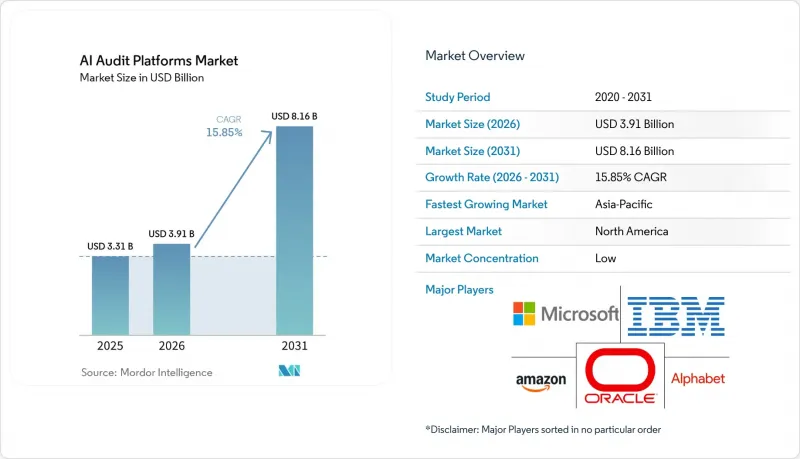
에 따르면 AI 감사 플랫폼 시장 규모는 2025년 33억 1,000만 달러에서 2026년에는 39억 1,000만 달러로 확대하며, 2026-2031년에 CAGR 15.85%로 추이하며, 2031년까지 81억 6,000만 달러에 달할 것으로 예측됩니다.
전 세계 AI 감사 플랫폼 시장의 동향 및 인사이트
단계적인 AI 규제와 감사 증거의 의무화
AI 감사 플랫폼 시장은 고위험 시스템에 대한 문서화된 통제를 의무화하는 규제에 힘입어 성장하고 있습니다. EU의 AI법은 2026년 8월부터 고위험 AI 시스템에 대한 완전 시행 단계에 접어들었으며, 위험 관리, 기술 문서 및 시판 후 모니터링이 의무화되었습니다. 연방준비제도이사회(FRB), 통화감독청(OCC), 연방예금보험공사(FDIC)는 2026년 4월 SR 26-2를 발표하여 미국 은행을 위한 모델 리스크 지침을 업데이트하고, 생성형 AI 및 에이전트형 AI를 포함하도록 했습니다. 한국의 ‘AI 기본법’도 2026년 1월에 시행되어 고위험 시스템에 대한 위험 기반 의무 및 평가 요건이 규정되었습니다. 이러한 동시 진행되는 요건으로 인해 여러 규제 프레임워크에 걸쳐 작동하는 재사용 가능한 통제 기능을 갖춘 플랫폼이 유리해집니다. 컴플라이언스 팀은 모델이나 에이전트가 운영 환경에 도입된 후에도 활용 가능한 증거를 필요로 하므로 AI 감사 플랫폼 시장이 혜택을 보고 있습니다.
생성형 AI 및 에이전트형 AI의 도입 확대
에이전트형 시스템은 작업 계획, 외부 툴 사용, 각 단계별 확인 없이도 행동을 수행할 수 있습니다. 해당 시스템의 컨텍스트, 메모리, 툴 상태에 따라 의사결정 경로가 달라지기 때문에 중요한 조치에 대해서는 사후 검토만으로는 불완전할 수 있습니다. IBM은 에이전트형 AI가 제대로 기능하기 위해서는 정기적인 검토 프로세스가 아닌, 지속적인 기능으로 운영될 수 있도록 하는 AI 어슈어런스가 필요하다고 밝혔습니다. 싱가포르의 ‘에이전트형 AI를 위한 모델 AI 거버넌스 프레임워크’에서는 위험이 높고 되돌릴 수 없는 행동에 대해 인간의 승인 체크포인트가 규정되어 있습니다. 이러한 아키텍처로 인해 워크플로우내 각 조치에 걸친 로그 기록, 정책 점검 및 추적 가능성에 대한 수요가 발생합니다. 따라서 AI 감사 플랫폼 시장은 변화하는 에이전트의 행동에 대응하는 모니터링 시스템을 필요로 하는 조직으로부터 혜택을 받고 있습니다.
AI 제공업체와 도입 기업 간의 책임 분산
AI 워크플로우에서는 클라우드 인프라, 기반 모델, 비즈니스 애플리케이션 및 하류 사용자 행동이 결합되는 경우가 많습니다. 이러한 구조로 인해 단일하고 완전한 감사 추적을 확립하거나 통제 실패에 대한 책임을 할당하기가 어려워집니다. 금융안정위원회(FSB)는 제3자 AI에 대한 의존이나 서비스 제공업체의 집중을 책임 있는 AI 도입에 있으며, 중대한 취약점으로 지목했습니다. 조직은 자사의 내부 툴에서 활용 가능한 형식으로 훈련 데이터, 계보 또는 성능 증거를 수령할 계약상 권리가 없을 수 있습니다. 이 문제는 각각 별도의 로깅 및 책임 규정을 가진 5개 이상의 서비스를 연결하는 다중 에이전트 워크플로우에서 더욱 두드러집니다. AI 감사 플랫폼 시장은 상호 운용 가능한 증거 형식을 채택하고, 제공자와 도입자 간의 통제 경계를 명확히 함으로써 이러한 제약을 해결해야 합니다.
부문 분석
2025년, AI 감사 플랫폼 시장에서 소프트웨어 플랫폼이 64.23%의 점유율을 차지했습니다. 이는 추론 속도로 작동하며 모델, 에이전트, 비즈니스 용도를 아우르는 공통 기록을 제공하는 정책 기반 툴에 대한 기업의 수요를 반영한 것입니다. 이러한 시스템은 MLOps 파이프라인, 에이전트 오케스트레이션 툴, 배포 레지스트리에서 운영 데이터를 수집하며, 일단 핵심 워크플로우로 연결되면 전환하는 데 막대한 노력이 필요하므로 그 입지가 더욱 공고해질 가능성이 있습니다. 플랫폼은 요구 사항의 변화에 따라 정책 라이브러리를 업데이트할 수 있으므로, 법무, 리스크, 기술, 감사 팀 간의 중복 작업을 줄일 수 있습니다. 구매자가 수동 보고서가 아닌 재현 가능한 증거를 필요로 하는 경우, 이 부문은 혜택을 받게 되며, 벤더들은 통합 기능, 제어 범위 및 증거 기록의 사용 편의성을 바탕으로 경쟁하고 있습니다. 따라서 AI 감사 플랫폼 시장에서 광범위한 AI 포트폴리오를 보유한 조직에게 소프트웨어는 여전히 주요 조달 옵션으로 남아 있습니다.
전문 서비스 및 관리형 서비스는 조직이 여러 규제 당국에 걸친 적합성 평가, 편향 테스트 설계 및 문서화에 대한 지원을 필요로 하므로 2031년까지 연평균 성장률(CAGR) 17.24%로 성장할 것으로 예측됩니다. 딜로이트, KPMG, 액센츄어, PwC는 많은 경우 전문 소프트웨어와 함께 EU AI법 대응, SR 26-2 준수, 에이전트형 AI의 위험 평가와 관련된 업무를 수행하고 있습니다. ModelOp이 2025년 8월 Angularis.ai와 체결한 제휴를 통해 수명주기관리와 ‘거버넌스-어즈-어-서비스(Governance-as-a-Service)’ 제공이 통합되었습니다. 이 모델은 거버넌스 전문가 부족 문제에 대응하기 위한 것으로, 플랫폼의 전면 도입부터 정기적인 감사 패키지에 이르기까지 다양한 형태로 제공될 수 있습니다. AI 감사 플랫폼 시장에서는 구매자들이 실질적인 역량을 요구함에 따라 구독 서비스와 관리형 지원 간의 연계가 더욱 긴밀해질 전망입니다.
규제 당국과 내부 리스크 관리 팀이 체계적인 문서화를 요구함에 따라 2025년에는 규정 준수 증거 및 보고가 매출의 38.71%를 차지하며 가장 큰 감사 기능으로 부상했습니다. 이 기능에서는 정책, 승인, 통제 및 고위험 시스템이 전체 수명 주기 동안 적절하게 관리되었음을 입증하는 증거가 기록됩니다. AI 감사 플랫폼 시장에서는 보고 기능을 처음 구매하는 고객을 유치하는 진입점으로, 또한 경영진을 위한 공통 기록으로 활용하고 있습니다. 강력한 보고 기능을 통해 법무, 리스크, 기술 팀 간의 중복 업무를 줄이면서, 전체 사용 사례에 걸쳐 기록의 일관성을 유지할 수 있습니다. 2025년 시장 점유율 1위를 차지한 것은 구매자들이 체계화된 규정 준수 증거를 중요하게 여긴다는 점을 반영합니다.
편향, 공정성, 설명 가능성에 관한 감사는 2031년까지 연평균 성장률(CAGR) 17.68%로 성장할 것으로 예측되며, 모델 및 데이터 계보, 실행시 의사결정 로그 기록도 확대되고 있습니다. ISO/IEC TS 6254:2025는 설명 가능성 및 해석 가능성에 대한 실무 지침을 제공합니다. OWASP의 ‘에이전트형 애플리케이션 위험 분류법’으로 인해 툴의 오용 및 메모리 포이즌링에 대한 관심이 높아지고 있습니다. AI 감사 플랫폼 시장은 추론, 툴 호출 및 정책 결정을 단일 증거 기록로 연결함으로써 이러한 기능을 지원하고 있는 반면, 순수한 AI 감사에 특화된 벤더들은 기술적 강점을 유지하고 있습니다. 수요는 기본적인 보고서 작성에서 무슨 일이 일어났는지와 그 이유를 설명하는 기록으로 전환되고 있습니다.
지역별 분석
2025년, 북미는 지역별 매출의 42.87%를 차지했습니다. 이는 AI 도입의 광범위한 기반과 확립된 모델 리스크 대응 관행에 힘입은 결과입니다. 연방준비제도이사회(FRB), 통화감독청(OCC), 연방예금보험공사(FDIC)는 2026년 4월 SR 26-2를 발표하여 금융기관에 거버넌스 프로그램의 미비점을 평가할 것을 촉구했습니다. 또한 FDA도 2026년 4월, 임상 시험에서의 AI 거버넌스 실천을 NIST의 AI 위험 관리 프레임워크와 연계하는 시범 프로그램을 시작했습니다. 이러한 움직임은 금융 및 의료 분야의 전반적인 애플리케이션 전반에 걸쳐 감사 가능한 거버넌스 인프라에 대한 구매자들의 관심을 높이고 있습니다.
2025년, 유럽은 지역별 규모에서 2위를 차지했습니다. 2026년 8월 EU AI법의 시행에 따라 고위험 AI 시스템은 문서화 및 모니터링 의무를 이동해야 합니다. 독일, 영국, 프랑스에는 활발히 활동하는 AI 거버넌스 기관과 산업별 고유 요건이 존재하며, 이러한 요소들이 해당 지역의 수요를 견인하고 있습니다. 유럽 AI 사무국은 EU AI법에 따라 기술 문서 제출을 요구하거나 제재를 가할 수 있습니다. 남미는 브라질의 데이터 보호 규정 준수 문화와 초기 단계에 있는 국가 차원의 AI 거버넌스 프레임워크를 견인력으로 삼아 성장 기회가 확대되고 있습니다.
아시아태평양은 2031년까지 연평균 성장률(CAGR) 16.91%로 성장할 것으로 예측되며, AI 감사 플랫폼 시장에서 지역별 가장 높은 성장률을 보이고 있습니다. 한국의 ‘AI 기본법’은 2026년 1월에 시행되어, 위험 단계에 따른 의무와 도입 전 평가가 도입되었습니다. 싱가포르의 자율형 AI 거버넌스 프레임워크와 금융 부문의 AI 리스크 관리 노력은 이 지역의 또 다른 참고 사례가 되고 있습니다. 일본의 ‘AI 추진법’은 2025년 9월에 전면 시행되었으며, 내각은 2026년 6월에 개정판 ‘AI 기본계획’안을 공표했습니다. 인도는 2025년 11월에 발표된 국가 지침에 따라 2026년 4월에 ‘AI 거버넌스·경제 그룹’을 설립했습니다. 아랍에미리트와 사우디아라비아의 국가 AI 전략이 공공 AI 프로그램에 거버넌스 요건을 부과하고 있으며, 중동 및 아프리카의 수요도 증가하고 있습니다.
기타 혜택:
- 엑셀 형식의 시장 예측(ME) 시트
- 3개월간의 애널리스트 지원
자주 묻는 질문
목차
제1장 서론
- 조사 전제조건과 시장 정의
- 조사 범위
제2장 조사 방법
제3장 개요
제4장 시장 구도
- 시장 개요
- 시장 성장 촉진요인
- 시장 성장 억제요인
- 거시경제 요인이 시장에 미치는 영향
- 업계 밸류체인 분석
- 기술 동향
- 규제 상황
- Porter's Five Forces 분석
제5장 시장 규모와 성장 예측
- 컴포넌트별
- 감사 기능별
- 배포별
- 조직 규모별
- 최종사용자 산업별
- 지역별
- 북미
- 미국
- 캐나다
- 멕시코
- 남미
- 브라질
- 아르헨티나
- 칠레
- 기타 남미 국가
- 유럽
- 독일
- 영국
- 프랑스
- 이탈리아
- 스페인
- 기타 유럽 국가
- 아시아태평양
- 중국
- 일본
- 인도
- 한국
- 호주
- 기타 아시아태평양 국가
- 중동
- 아랍에미리트
- 사우디아라비아
- 카타르
- 기타 중동 국가
- 아프리카
- 남아프리카공화국
- 이집트
- 나이지리아
- 기타 아프리카 국가
- 북미
제6장 경쟁 구도
- 시장 집중도
- 전략적 동향
- 시장 점유율 분석
- 기업 개요
- International Business Machines Corporation
- Microsoft Corporation
- Alphabet Inc.
- Amazon.com, Inc.
- Oracle Corporation
- Salesforce, Inc.
- SAP SE
- SAS Institute Inc.
- FICO
- Accenture plc
- Deloitte Touche Tohmatsu Limited
- PricewaterhouseCoopers International Limited
- Ernst & Young Global Limited
- KPMG International Cooperative
- Credo AI, Inc.
- Holistic AI, Inc.
- Fiddler Labs, Inc.
- ModelOp, Inc.
- Monitaur, Inc.
- FairNow, Inc.
- Saidot Oy
- DataRobot, Inc.
- Arize AI, Inc.
- Arthur AI, Inc.
- H2O.ai, Inc.
제7장 시장 기회와 향후 전망
KSAAccording to Mordor Intelligence, the AI audit platforms market size is expected to grow from USD 3.31 billion in 2025 to USD 3.91 billion in 2026, and is forecast to reach USD 8.16 billion by 2031, at a 15.85% CAGR over 2026-2031.
Global AI Audit Platforms Market Trends and Insights
Phased AI Regulation and Mandatory Audit Evidence
The AI Audit Platforms Market is supported by regulations requiring documented controls for high-risk systems. The EU AI Act entered its full enforcement stage for high-risk AI systems in August 2026, requiring risk management, technical documentation, and post-market monitoring. The Federal Reserve, the OCC, and the FDIC issued SR 26-2 in April 2026, updating United States bank model risk guidance to cover generative and agentic AI. South Korea's Basic AI Act also took effect in January 2026 with risk-based duties and assessment requirements for high-risk systems. These concurrent requirements favor platforms with reusable controls that work across regulatory frameworks. The AI Audit Platforms Market benefits because compliance teams need evidence that remains available after a model or agent enters production.
Expansion of Generative AI and Agentic AI Deployments
Agentic systems can plan tasks, use external tools, and act without confirmation at each step. Their context, memory, and tool state can change the decision path, making retrospective review incomplete for important actions. IBM states that agentic AI requires AI assurance to operate as a continuous capability rather than a periodic review process. Singapore's Model AI Governance Framework for Agentic AI outlines human approval checkpoints for high-stakes, irreversible actions. This architecture creates demand for logging, policy checks, and traceability across each action in a workflow. The AI Audit Platforms Market, therefore, gains from organizations that need oversight systems designed for changing agent behavior.
Fragmented Accountability Across AI Providers and Deployers
AI workflows often combine cloud infrastructure, foundation models, business applications, and downstream user actions. This structure makes it difficult to establish a single complete audit trail or to allocate responsibility for control failures. The Financial Stability Board identified third-party AI dependencies and service-provider concentration as material vulnerabilities in responsible AI adoption. Organizations may not have contractual rights to receive training data, lineage, or performance evidence in formats their internal tools can use. The problem is more pronounced in multi-agent workflows that connect 5 or more services, each with separate logging and liability rules. The AI Audit Platforms Market must address this constraint by adopting interoperable evidence formats and clarifying provider-deployer control boundaries.
Other drivers and restraints analyzed in the detailed report include:
- Shift From Sample-Based Testing to Continuous Full-Population Monitoring
- Demand for Explainability, Fairness, and Model Accountability
- Shortage of AI Governance and Conformity-Assessment Specialists
For complete list of drivers and restraints, kindly check the Table Of Contents.
Segment Analysis
Software platforms held 64.23% of the AI Audit Platforms Market share in 2025, reflecting enterprise demand for policy-based tools that operate at inference speed and provide a common record across models, agents, and business uses. These systems collect operational data from MLOps pipelines, agent orchestration tools, and deployment registries, and high switching effort can reinforce their position once connected to core workflows. Platforms can update policy libraries as requirements change, reducing duplicated work across legal, risk, technical, and audit teams. The segment benefits when buyers need repeatable evidence rather than manual reports, with vendors competing on integrations, control coverage, and the usability of their evidence records. Software, therefore, remains the central procurement choice for organizations with broad AI portfolios in the AI Audit Platforms Market.
Professional and managed services are forecast to grow at 17.24% CAGR through 2031 because organizations need support for conformity assessment, bias-testing design, and documentation across multiple regulators. Deloitte, KPMG, Accenture, and PwC are building work around EU AI Act readiness, SR 26-2 compliance, and agentic AI risk assessment, often alongside specialized software. ModelOp's August 2025 partnership with Angularis.ai combined lifecycle management with governance-as-a-service delivery. This model responds to the shortage of governance specialists and can range from full platform deployment to recurring audit packages. The AI Audit Platforms Market is likely to see closer links between subscriptions and managed support as buyers seek practical capacity.
Compliance evidence and reporting accounted for 38.71% of revenue in 2025, making it the largest audit function, as regulators and internal risk teams require structured documentation. This function records policies, approvals, controls, and evidence demonstrating whether high-risk systems were governed throughout their lifecycle. The AI Audit Platforms Market uses reporting as an entry point for first-time buyers and a common record for senior management. Strong reporting capabilities can reduce duplicated work between legal, risk, and technical teams while keeping records consistent across use cases. Its leading 2025 share reflects the priority that buyers place on organized compliance evidence.
Bias, fairness, and explainability auditing is forecast to grow at 17.68% CAGR through 2031, while model and data lineage and runtime decision logging are also expanding. ISO/IEC TS 6254:2025 provides a common reference for explainability and interpretability practices. OWASP's agentic application risk taxonomy has increased attention on tool misuse and memory poisoning. The AI Audit Platforms Market supports these functions by linking an inference, a tool call, and a policy decision into a single evidence record, while pure-play vendors retain technical strength. Demand is shifting from basic reporting to records that explain what happened and why.
Complete Report Scope:
- By Component
- Software Platforms
- Professional and Managed Services
- By Audit Function
- Compliance Evidence and Reporting
- Model and Data Lineage
- Runtime Decision Logging
- Bias, Fairness, and Explainability Auditing
- Other Audit Functions
- By Deployment
- Cloud-Based
- Hybrid
- On-Premises
- By Organization Size
- Large Enterprises
- Small and Medium-Sized Enterprises
- By End-User Industry
- Banking, Financial Services, and Insurance
- Healthcare and Life Sciences
- Information Technology and Telecommunications
- Government and Public Sector
- Retail and E-Commerce
- Manufacturing and Automotive
- Other End-User Industries
- By Geography
- North America
- United States
- Canada
- Mexico
- South America
- Brazil
- Argentina
- Chile
- Rest of South America
- Europe
- Germany
- United Kingdom
- France
- Italy
- Spain
- Rest of Europe
- Asia-Pacific
- China
- Japan
- India
- South Korea
- Australia
- Rest of Asia-Pacific
- Middle East
- United Arab Emirates
- Saudi Arabia
- Qatar
- Rest of Middle East
- Africa
- South Africa
- Egypt
- Nigeria
- Rest of Africa
- North America
Geography Analysis
North America accounted for 42.87% of regional revenue in 2025, supported by a large base of AI deployments and established model risk practices. The Federal Reserve, OCC, and the FDIC issued SR 26-2 in April 2026, prompting financial institutions to assess gaps in their governance programs. The FDA also started a pilot program in April 2026 that connects AI governance practices in clinical trials with the NIST AI Risk Management Framework. These actions support buyer interest in auditable governance infrastructure across financial and health applications.
Europe held the second-largest regional position in 2025. The EU AI Act's August 2026 enforcement milestone requires high-risk AI systems to meet documentation and monitoring duties. Germany, the United Kingdom, and France have active AI governance bodies and sector-specific requirements that add to regional demand. The European AI Office can request technical documentation and impose penalties under the EU AI Act. South America is a growing opportunity, led by Brazil's data-protection compliance culture and early-stage national AI governance frameworks.
Asia-Pacific is forecast to grow at 16.91% CAGR through 2031, the highest regional rate in the AI Audit Platforms Market. South Korea's Basic AI Act took effect in January 2026 and introduced risk-tiered obligations and pre-deployment assessments. Singapore's agentic AI governance framework and financial-sector AI risk management work provide additional regional reference points. Japan's AI Promotion Act came fully into force in September 2025, while its Cabinet published a revised draft AI Basic Plan in June 2026. India established the AI Governance and Economic Group in April 2026, following the national guidelines that were issued in November 2025. Demand in the Middle East and Africa is increasing as national AI strategies in the United Arab Emirates and Saudi Arabia impose governance requirements on public AI programs.
- International Business Machines Corporation
- Microsoft Corporation
- Alphabet Inc.
- Amazon.com, Inc.
- Oracle Corporation
- Salesforce, Inc.
- SAP SE
- SAS Institute Inc.
- FICO
- Accenture plc
- Deloitte Touche Tohmatsu Limited
- PricewaterhouseCoopers International Limited
- Ernst & Young Global Limited
- KPMG International Cooperative
- Credo AI, Inc.
- Holistic AI, Inc.
- Fiddler Labs, Inc.
- ModelOp, Inc.
- Monitaur, Inc.
- FairNow, Inc.
- Saidot Oy
- DataRobot, Inc.
- Arize AI, Inc.
- Arthur AI, Inc.
- H2O.ai, Inc.
Additional Benefits:
- The market estimate (ME) sheet in Excel format
- 3 months of analyst support
TABLE OF CONTENTS
1 INTRODUCTION
- 1.1 Study Assumptions and Market Definition
- 1.2 Scope of the Study
2 RESEARCH METHODOLOGY
3 EXECUTIVE SUMMARY
4 MARKET LANDSCAPE
- 4.1 Market Overview
- 4.2 Market Drivers
- 4.2.1 Phased AI Regulation and Mandatory Audit Evidence
- 4.2.2 Expansion of Generative AI and Agentic AI Deployments
- 4.2.3 Shift From Sample-Based Testing to Continuous Full-Population Monitoring
- 4.2.4 Demand for Explainability, Fairness, and Model Accountability
- 4.2.5 Integration of AI Audit Controls Into Enterprise Procurement
- 4.2.6 Machine-Readable Regulatory Control Mapping
- 4.3 Market Restraints
- 4.3.1 Fragmented Accountability Across AI Providers and Deployers
- 4.3.2 Shortage of AI Governance and Conformity-Assessment Specialists
- 4.3.3 Integration Friction Across Shadow AI and Legacy MLOps Estates
- 4.3.4 Privacy and Data-Residency Restrictions on Audit Telemetry
- 4.4 Impact of Macroeconomic Factors on the Market
- 4.5 Industry Value-Chain Analysis
- 4.6 Technology Outlook
- 4.7 Regulatory Landscape
- 4.8 Porter's Five Forces Analysis
- 4.8.1 Threat of New Entrants
- 4.8.2 Bargaining Power of Suppliers
- 4.8.3 Bargaining Power of Buyers
- 4.8.4 Threat of Substitutes
- 4.8.5 Intensity of Competitive Rivalry
5 MARKET SIZE AND GROWTH FORECASTS (VALUE)
- 5.1 By Component
- 5.1.1 Software Platforms
- 5.1.2 Professional and Managed Services
- 5.2 By Audit Function
- 5.2.1 Compliance Evidence and Reporting
- 5.2.2 Model and Data Lineage
- 5.2.3 Runtime Decision Logging
- 5.2.4 Bias, Fairness, and Explainability Auditing
- 5.2.5 Other Audit Functions
- 5.3 By Deployment
- 5.3.1 Cloud-Based
- 5.3.2 Hybrid
- 5.3.3 On-Premises
- 5.4 By Organization Size
- 5.4.1 Large Enterprises
- 5.4.2 Small and Medium-Sized Enterprises
- 5.5 By End-User Industry
- 5.5.1 Banking, Financial Services, and Insurance
- 5.5.2 Healthcare and Life Sciences
- 5.5.3 Information Technology and Telecommunications
- 5.5.4 Government and Public Sector
- 5.5.5 Retail and E-Commerce
- 5.5.6 Manufacturing and Automotive
- 5.5.7 Other End-User Industries
- 5.6 By Geography
- 5.6.1 North America
- 5.6.1.1 United States
- 5.6.1.2 Canada
- 5.6.1.3 Mexico
- 5.6.2 South America
- 5.6.2.1 Brazil
- 5.6.2.2 Argentina
- 5.6.2.3 Chile
- 5.6.2.4 Rest of South America
- 5.6.3 Europe
- 5.6.3.1 Germany
- 5.6.3.2 United Kingdom
- 5.6.3.3 France
- 5.6.3.4 Italy
- 5.6.3.5 Spain
- 5.6.3.6 Rest of Europe
- 5.6.4 Asia-Pacific
- 5.6.4.1 China
- 5.6.4.2 Japan
- 5.6.4.3 India
- 5.6.4.4 South Korea
- 5.6.4.5 Australia
- 5.6.4.6 Rest of Asia-Pacific
- 5.6.5 Middle East
- 5.6.5.1 United Arab Emirates
- 5.6.5.2 Saudi Arabia
- 5.6.5.3 Qatar
- 5.6.5.4 Rest of Middle East
- 5.6.6 Africa
- 5.6.6.1 South Africa
- 5.6.6.2 Egypt
- 5.6.6.3 Nigeria
- 5.6.6.4 Rest of Africa
- 5.6.1 North America
6 COMPETITIVE LANDSCAPE
- 6.1 Market Concentration
- 6.2 Strategic Moves
- 6.3 Market Share Analysis
- 6.4 Company Profiles (includes Global Level Overview, Market Level Overview, Core Segments, Financials as available, Strategic Information, Market Rank/Share, Products and Services, Recent Developments)
- 6.4.1 International Business Machines Corporation
- 6.4.2 Microsoft Corporation
- 6.4.3 Alphabet Inc.
- 6.4.4 Amazon.com, Inc.
- 6.4.5 Oracle Corporation
- 6.4.6 Salesforce, Inc.
- 6.4.7 SAP SE
- 6.4.8 SAS Institute Inc.
- 6.4.9 FICO
- 6.4.10 Accenture plc
- 6.4.11 Deloitte Touche Tohmatsu Limited
- 6.4.12 PricewaterhouseCoopers International Limited
- 6.4.13 Ernst & Young Global Limited
- 6.4.14 KPMG International Cooperative
- 6.4.15 Credo AI, Inc.
- 6.4.16 Holistic AI, Inc.
- 6.4.17 Fiddler Labs, Inc.
- 6.4.18 ModelOp, Inc.
- 6.4.19 Monitaur, Inc.
- 6.4.20 FairNow, Inc.
- 6.4.21 Saidot Oy
- 6.4.22 DataRobot, Inc.
- 6.4.23 Arize AI, Inc.
- 6.4.24 Arthur AI, Inc.
- 6.4.25 H2O.ai, Inc.
7 MARKET OPPORTUNITIES AND FUTURE OUTLOOK
- 7.1 White-Space and Unmet-Need Assessment


