

|
시장보고서
상품코드
2154462
비주얼 품질 검사 플랫폼 : 시장 점유율 분석, 업계 동향과 통계, 성장 예측(2026-2031년)Visual Quality Inspection Platforms - Market Share Analysis, Industry Trends & Statistics, Growth Forecasts (2026 - 2031) |
||||||
 Mordor Intelligence
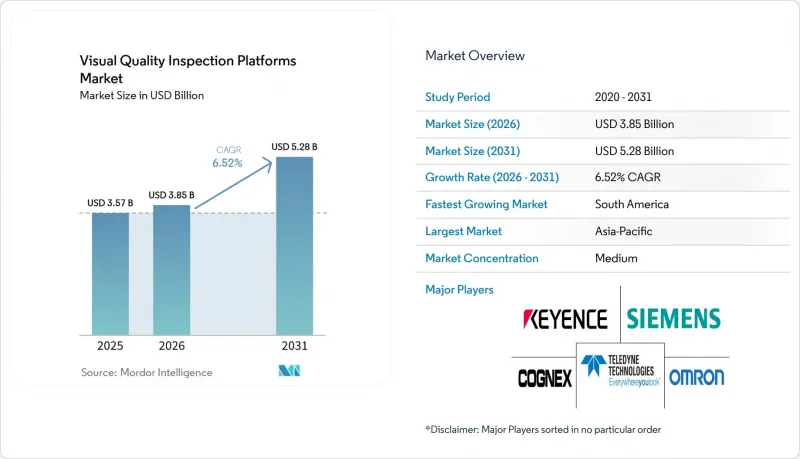
에 따르면 시각적 품질 검사 플랫폼 시장 규모는 2025년 35억 7,000만 달러, 2026년 38억 5,000만 달러에서 2031년까지 52억 8,000만 달러로 확대할 것으로 예측되고 있으며, 2026-2031년까지 연평균 성장률(CAGR)은 6.52%에 달할 전망입니다.
전 세계 시각적 품질 검사 플랫폼 시장의 동향 및 인사이트
AI를 활용한 결함 탐지 및 분류
딥러닝을 활용한 이미지 인식 모델은 여러 유형의 재료에서 100마이크로미터 미만의 허용 오차 범위 내에서 표면 결함을 분류할 수 있습니다. 규칙 기반 시스템의 경우, 제품, 재료 또는 조명 조건이 변경되면 수동으로 재조정해야 하는 경우가 많습니다. 2026년 'Scientific Reports'지에 게재된 연구에 따르면 다중 스케일 컨텍스트 감지 아키텍처는 산업용 결함 벤치마크에서 mAP50 점수 95% 이상을 달성하는 동시에 초당 100프레임 이상을 처리할 수 있는 것으로 밝혀졌습니다. 이러한 성능 덕분에 지연 허용도가 제한적인 공장 라인에서 실시간 활용이 가능해집니다. 제조업체는 라벨링 변경 주기를 최소화하면서 기존 검사 시스템을 새로운 SKU(재고 관리 단위)로 확장할 수 있으므로, 시각적 품질 검사 플랫폼 시장이 그 혜택을 누리고 있습니다. 2025년 CLIP-MDC 아키텍처에 관한 연구에서는 MVTec AD 데이터세트에서 99.9%의 AUROC와 평균 추론 속도 6.6밀리초가 보고되었으며, 이는 추론 속도와 정확도의 향상이 빈번한 제품 전환을 어떻게 지원할 수 있는지를 보여줍니다.
전기자동차(EV) 및 배터리 제조 분야의 품질 요구 사항
배터리 제조에서는 접합, 밀봉, 조립 및 열 조건을 엄격하게 관리해야 합니다. 이는 결함이 있는 부품이 완성된 팩에 혼입될 경우 심각한 안전 문제를 야기할 수 있기 때문입니다. 셀 커넥터의 결함은 일반적인 파워트레인 결함과 동일하게 취급할 수 없으며, 감지되지 않은 문제는 열 폭주, 리콜 및 법적 책임의 위험을 높일 수 있습니다. 아틀라스코프코의 ‘VisionTools’ 솔루션은 배터리 생산 라인의 접합, 밀봉, 조립 공정에서 AI 기반 검증을 수행하며, 이상 감지 기능을 통해 생산 중 시정 조치를 지원합니다. 또한 V60 소프트웨어가 탑재된 ‘Advanced Verification’은 셀 모듈의 열 프로파일링도 지원합니다. 리튬이온 파우치 셀의 레이저 용접에 관한 조사 결과, 합성 데이터로 학습시킨 AI 분류기가 정확도 0.94, 재현율 0.98을 달성한 것으로 밝혀졌습니다. 배터리 제조사가 대량 생산 과정에서 추적 가능한 검사 기록을 필요로 하고 있으므로 이러한 용도에서 2D, 3D 및 열화상 검사를 결합한 검사의 중요성은 더욱 높아지고 있습니다.
훈련 데이터 및 모델 검증 비용
생산 수준의 AI 검사 모델에는 관련 결함 클래스별로 라벨이 지정된 이미지가 필요하지만, 체계적인 이미지 아카이브를 보유하지 않은 기업의 경우 이를 확보하기 어려울 수 있습니다. 2025년에 실시된 산업용 결함 탐지 분야의 능동 학습에 관한 연구에 따르면 하이브리드 샘플링 기법을 채택한 경우에도 경쟁력 있는 F1 점수를 얻기 위해서는 결함 클래스 전체에 걸쳐 2,400건 이상의 라벨이 지정된 샘플이 필요한 것으로 밝혀졌습니다. 이 양의 데이터를 수집하고 라벨을 붙이려면 검증 단계에 들어가기까지 수주가 소요될 수 있습니다. 또한 생산 라인 변경, 조명 조건의 변화, 혹은 자재 공급업체 변경이 발생한 경우 모델 검증을 반복적으로 수행해야 합니다. 이러한 요건으로 인해 다품종 생산을 수행하는 시설에서는 개념 증명(PoC) 프로젝트의 비용이나 도입 일정이 당초 예정보다 초과될 가능성이 있습니다. 합성 데이터는 유효한 수단이지만, 시뮬레이션 이미지와 실제 생산 이미지 간에 차이가 발생하기 쉬운 미묘한 표면 텍스처에 대해서는 신뢰성이 떨어집니다.
부문 분석
2025년에는 통합형 AI 비전 시스템이 매출의 41.83%를 차지하며 상용 폼팩터 시장에서 주도적인 위치를 확립했습니다. 생산 라인에서 장기간에 걸친 설정 작업이나 책임 소재가 불분명한 상황을 용납할 수 없는 경우, 구매자는 전용으로 설계된 하드웨어와 소프트웨어의 조합을 선호합니다. 단일 공급업체가 카메라, 광학 시스템, 조명, 컨트롤러, 소프트웨어 및 기술 지원을 제공할 수 있습니다. 이러한 구조를 통해 제조업체는 처리량이 높은 생산 라인에서 도입 위험을 줄일 수 있습니다. 기존 하드웨어 고객은 대부분의 경우 설치 설비, 배선, 조명을 교체하지 않고도 AI 지원 시스템으로 업그레이드할 수 있습니다. 이러한 업그레이드 경로는 기존 장비 공급업체의 계약 갱신을 촉진합니다. 또한 소프트웨어만 제공하는 벤더가 단일 구매 주기로 이미 도입된 시스템을 대체하기 어렵게 만듭니다. 고객이 개별적으로 조립된 솔루션이 아닌, 미리 정의된 검사 시스템을 원할 경우 통합형 제품은 여전히 중요합니다. 이러한 추세로 인해 시각적 품질 검사 플랫폼 시장은 구성 요소 수준의 선택지보다 도입의 확실성을 우선시하는 구매자에게 실용적인 진입 경로를 제공하고 있습니다.
기존 카메라 인프라를 활용할 수 있는 제조업체의 경우, 독립형 AI 소프트웨어가 여전히 유용합니다. 이러한 구매자는 정상적으로 작동하는 산업용 카메라나 관련 장비를 교체하지 않고도 추론 기능을 추가할 수 있습니다. AI 검사 서비스에는 모델 훈련, 도입 지원, 최적화 및 운영 관리가 포함됩니다. 이러한 서비스는 사내 팀이 기계학습 운영 역량을 갖추지 못했을 가능성이 있는 제약, 식품 안전 및 규제 대상 전자기기 분야에서 유용합니다. 다수 거점에서 사업을 운영하는 제조업체들이 모델 거버넌스의 일원화를 요구하는 가운데, AI 비전 플랫폼 및 API 시장은 2031년까지 연평균 성장률(CAGR) 8.27%로 확대될 것으로 예측됩니다. 코그넥스(Cognex)는 100개 이상의 고객을 대상으로 한 베타 테스트를 거쳐 2026년 5월 ‘OneVision’의 일반 제공을 시작했습니다. 이 회사에 따르면 에시티(Essity)는 1일도 채 걸리지 않아 실 검사 애플리케이션을 구축했으나, 기존 프로세스에서는 1년 이상의 반복 작업이 필요했습니다. 한편, 슈나이더 일렉트릭은 통합 도입 후 수율이 2배로 증가했다고 보고했습니다. 이러한 사례들은 검사 프로그램이 여러 공장으로 확대됨에 따라 플랫폼의 중요성이 점점 더 커지고 있는 이유를 보여줍니다.
2025년에는 엣지 AI 또는 임베디드 AI가 매출의 56.92%를 차지했습니다. 고속 생산 라인에서는 50밀리초 이내에 합격 여부를 판정해야 하는 경우가 많습니다. 또한 로컬 처리를 통해 공장 가동 시간 요건을 충족하지 못할 가능성이 있는 끊김 없는 인터넷 연결에 대한 의존을 피할 수 있습니다. 아시아태평양 및 유럽의 데이터 처리 규정에 따라 생산 이미지를 외부 클라우드 인프라로 전송하는 것이 제한될 수 있습니다. 이러한 상황은 카메라 상에서 또는 생산 라인 근처에서 추론을 수행하는 시스템에 유리하게 작용합니다. 엣지 도입을 통해 기밀성이 높은 제품 이미지를 시설 내에 보관하는 것도 가능합니다. 이 접근 방식은 응답 속도와 로컬 데이터 관리 모두가 필수적인 용도에 특히 적합합니다. 이것이 바로 클라우드 툴의 보급에도 불구하고 임베디드 시스템이 여전히 널리 사용되는 이유를 설명해 줍니다. 고객이 로컬 제어와 중앙 집중식 관리를 비교 검토함에 따라 이러한 요구 사항은 시각적 품질 검사 플랫폼 시장을 계속해서 형성하고 있습니다.
온프레미스 서버와 워크스테이션은 반도체 웨이퍼 검사 및 항공우주 분야의 표면 분석에서 계속해서 활용되고 있습니다. 이러한 사용 사례에서는 임베디드 컨트롤러가 제공할 수 있는 처리 능력을 초과하는 처리 능력이 필요한 반면, 기밀성이 높은 이미지의 로컬 관리도 여전히 요구됩니다. 클라우드 및 SaaS는 주로 모델 훈련, 이미지 주석 달기, 버전 관리, 그리고 모든 장비를 대상으로 한 업데이트를 목적으로 2031년까지 연평균 성장률(CAGR) 9.12%로 확대될 것으로 예측됩니다. 파나소닉 홀딩스는 2026년 3월부터 AI 플랫폼 ‘AI Platform for Visual Inspection’의 글로벌 라이선싱을 시작하여 온프레미스, 클라우드 및 하이브리드 구성을 제공하고 있습니다. 이 플랫폼에는 블록체인 기반의 데이터 무결성 관리 기능이 포함되어 있으며, 모니터링을 통한 모델 개발을 지원합니다. 국제로봇연맹(IFR)의 보고서에 따르면 2024년 전 세계 산업용 로봇 도입 대수는 54만 2,000대에 달하며, 관리된 모델 업데이트의 대상이 될 수 있는 엔드포인트의 도입 기반이 확대되고 있습니다. 따라서 클라우드 툴은 모든 애플리케이션에 대해 클라우드 기반의 런타임 검사를 필요로 하지 않으면서도 수명주기관리를 지원할 수 있습니다.
지역별 분석
2025년, 아시아태평양은 시각적 품질 검사 플랫폼 시장의 39.12% 점유율을 차지했습니다. 이 지역은 주요 전자기기 및 반도체 공급망은 물론, 전기자동차(EV)용 배터리 생산 능력과 확립된 공장 자동화 시스템을 모두 갖추고 있습니다. 중국, 한국, 일본은 제조 부문이 대량 생산 및 품질에 민감한 생산 라인을 운영하고 있으며, 수요의 중심이 되고 있습니다. 2026년 1월, 중국 공업정보화부와 7개 관련 부처는 ‘AI+제조 실행 계획’을 발표했습니다. 이 계획에는 500개의 벤치마크 AI 검사 적용 시나리오와 1,000개의 고성능 산업용 AI 에이전트라는 목표가 포함되어 있습니다. 일본의 경우, 다이하츠와 VRAIN Solution의 공동 개발 및 도입 사례가 보여주듯이, 맞춤형 시스템과 지적재산권 보유가 중시되고 있습니다. 한국의 디스플레이 및 반도체 산업 기반, 인도의 전자기기 생산 연계형 인센티브 프로그램, 그리고 호주의 정밀 제조 활동 덕분에 이 지역의 수요는 주요 시장을 넘어 확대되고 있습니다. 이러한 조건들이 맞물리면서, 공급업체들이 대량 생산 및 품질에 민감한 제조를 위한 시스템을 개발하는 가운데, 아시아태평양은 시각적 품질 검사 플랫폼 시장에서 중심적인 위치를 계속 차지하고 있습니다.
북미와 유럽은 매출 규모 기준으로 2위와 3위를 차지하는 지역 시장입니다. 북미에서는 항공우주 및 방위 관련 제조업체들이 관리 대상 정보를 정의된 IT 경계 내에 보관하는 감사 가능한 시스템을 더욱 중시하고 있습니다. 미국 국방부는 2025년 11월, ‘국방 연방 조달 규칙 보충 규정(DFARS)’에서 CMMC 2.0을 공식적으로 제정했으며, 2026년 11월에는 제3자 평가 의무화가 한 단계 더 진전될 예정입니다. 이러한 요건들은 방위 산업 공급망내 온프레미스형 검사 아키텍처에 대한 수요를 지원할 가능성이 있습니다. 유럽에서는 첨단 자동차, 정밀 기계, 제약 제조에 더해 커넥티드 산업 기기에 대한 사이버 보안 요건이 결합되어 있습니다. 폭스바겐 그룹은 2025년에 ‘디지털 생산 플랫폼’ 제휴를 확대했으며, 한편 아우디의 IRIS 검사 시스템은 2026년에 폭스바겐 그룹의 10개 거점으로 도입이 진행되었습니다. 이번 도입은 VDA QMC 5 Part 3에 따른 인증을 거쳐, 조립, 배터리 생산, 물류, 프레스 공장의 업무를 포괄하고 있습니다.
남미는 도입 규모는 작지만, 2031년까지 8.06%라는 지역별 최고 연평균 성장률(CAGR)을 기록할 것으로 예측됩니다. 브라질의 자동차 조립 활동, 전자 분야 투자, 그리고 니어쇼어링 동향이 수요의 주요 원동력이 되고 있습니다. 전 세계 OEM과 제휴하는 공급업체들은 북미 및 유럽 프로그램에서 채택된 검사 기준을 충족해야 할 필요성이 점점 더 커지고 있습니다. 중동 및 아프리카에서는 도입이 여전히 초기 단계에 있습니다. 사우디아라비아의 ‘비전 2030’ 프로그램은 표면 검사 및 용접 검사가 유용한 석유화학 및 공정 분야에 대한 산업 투자를 촉진하고 있습니다. UAE의 AI 중심 산업 전략은 전자 및 제약 제조 클러스터에서의 검사 자동화를 지원하고 있습니다. 아프리카에서는 수요가 남아프리카공화국의 자동차 클러스터에 집중되어 있으며, 공급업체 감사에서 지속적인 프로그램 참여를 위해서는 육안 검사 능력이 중요한 경우가 있습니다.
기타 혜택:
- 엑셀 형식의 시장 예측(ME) 시트
- 3개월간의 애널리스트 지원
자주 묻는 질문
목차
제1장 서론
- 조사 전제조건과 시장 정의
- 조사 범위
제2장 조사 방법
제3장 개요
제4장 시장 구도
- 시장 개요
- 시장 성장 촉진요인
- 시장 성장 억제요인
- 업계 밸류체인 분석
- 규제 상황
- 기술 전망
- Porter's Five Forces 분석
제5장 시장 규모와 성장 예측
- 상용 폼팩터별
- 도입 아키텍처별
- 검사 방법별
- 제공별
- 최종사용자 산업별
- 지역별
- 북미
- 미국
- 캐나다
- 멕시코
- 남미
- 브라질
- 기타 남미 국가
- 유럽
- 독일
- 영국
- 프랑스
- 이탈리아
- 러시아
- 기타 유럽 국가
- 아시아태평양
- 중국
- 일본
- 한국
- 인도
- 호주
- 기타 아시아태평양 국가
- 중동
- 사우디아라비아
- 아랍에미리트
- 튀르키예
- 기타 중동 국가
- 아프리카
- 남아프리카공화국
- 기타 아프리카 국가
- 북미
제6장 경쟁 구도
- 시장 집중도
- 전략적 동향
- 시장 점유율 분석
- 기업 개요
- Cognex Corporation
- Keyence Corporation
- Teledyne Technologies Incorporated
- OMRON Corporation
- Siemens AG
- Basler AG
- SICK AG
- Datalogic S.p.A.
- Zebra Technologies Corporation
- MVTec Software GmbH
- Landing AI, Inc.
- Instrumental, Inc.
- Robovision NV
- Qualitas Technologies Pvt Ltd
- Nanotronics Imaging, Inc.
- ISRA VISION GmbH
- LMI Technologies Inc.
- Allied Vision Technologies GmbH
- Baumer Holding AG
- Pleora Technologies Inc.
- Visionary.ai Ltd.
제7장 시장 기회와 향후 전망
KSA 26.10.23According to Mordor Intelligence, the visual quality inspection platforms market size is projected to expand from USD 3.57 billion in 2025 and USD 3.85 billion in 2026 to USD 5.28 billion by 2031, registering a CAGR of 6.52% between 2026 and 2031.
Global Visual Quality Inspection Platforms Market Trends and Insights
AI-Based Defect Detection and Classification
Deep-learning vision models can classify surface defects at sub-100-micrometer tolerances across several material types. Rule-based systems often need manual recalibration when products, materials, or lighting conditions change. A 2026 Scientific Reports study found that multi-scale contextual detection architectures achieved mAP50 scores above 95% on industrial defect benchmarks while processing more than 100 frames per second. This performance supports real-time use on factory lines with limited latency tolerance. The visual quality inspection platforms market benefits because manufacturers can extend an existing inspection setup to new stock-keeping units with fewer relabeling cycles. A 2025 study of the CLIP-MDC architecture reported 99.9% AUROC on the MVTec AD dataset and an average inference speed of 6.6 milliseconds, showing how faster inference and improved accuracy can support high-frequency product changeovers.
EV and Battery Manufacturing Quality Requirements
Battery manufacturing requires close control of joining, sealing, assembly, and thermal conditions because a defective component can reach a finished pack with serious safety consequences. A faulty cell connector cannot be treated like an ordinary powertrain defect, and an undetected issue can raise the risk of thermal runaway, recall activity, and liability. Atlas Copco's VisionTools offering uses AI-based verification for battery-line joining, sealing, and assembly steps, with anomaly detection supporting corrective action during production. Its Advanced Verification with V60 software also supports thermal profiling of cell modules. Research on lithium-ion pouch-cell laser welds found that an AI classifier trained with synthetic data achieved precision of 0.94 and recall of 0.98. These uses make combined 2D, 3D, and thermal inspection more relevant as battery manufacturers require traceable inspection records for high-volume production.
Training-Data and Model-Validation Costs
Production-grade AI inspection models need labeled images for each relevant defect class, which can be difficult for companies without systematic image archives. A 2025 study on active learning for industrial defect detection found that competitive F1 scores required more than 2,400 labeled samples across defect classes, even when hybrid sampling methods were used. Collecting and labeling this volume can take weeks before validation begins. Model validation must also be repeated after a line change, different lighting, or a material supplier change. These requirements can leave high-mix facilities with proof-of-concept projects that exceed their original budget or deployment schedule. Synthetic data can help, but it is less dependable for subtle surface textures where simulated images differ from actual production images.
Other drivers and restraints analyzed in the detailed report include:
- Falling Edge AI Compute Costs
- Labor Shortages in Quality Operations
- Legacy Automation and MES Integration Complexity
For complete list of drivers and restraints, kindly check the Table Of Contents.
Segment Analysis
Integrated AI vision systems held 41.83% of revenue in 2025, giving them the leading commercial form-factor position. Buyers favor purpose-built hardware-and-software combinations when a production line cannot tolerate prolonged configuration work or unclear accountability. A single supplier can provide the camera, optics, lighting, controller, software, and technical support. This structure helps manufacturers reduce deployment risk on high-throughput lines. Existing hardware customers can often upgrade to AI-capable systems without replacing mounting equipment, cabling, or lighting. That upgrade path supports renewals for established equipment suppliers. It also makes it harder for software-only vendors to replace an installed system in a single purchasing cycle. Integrated products remain important where the customer wants a defined inspection system rather than a separately assembled solution. This preference gives the visual quality inspection platforms market a practical entry route for buyers that prioritize deployment certainty over component-level choice.
Standalone AI software remains relevant for manufacturers with serviceable camera infrastructure. These buyers can add inference capability without replacing working industrial cameras and related equipment. AI inspection services include model training, deployment support, optimization, and managed operations. These services are useful in pharmaceutical, food safety, and regulated electronics settings where internal teams may not have machine-learning operations capability. AI vision platforms and APIs are projected to expand at an 8.27% CAGR through 2031 as multi-site manufacturers seek centralized model governance. Cognex made OneVision generally available in May 2026 after beta testing with more than 100 customers. The company reported that Essity built a sealing inspection application in less than 1 day, compared with an earlier process that took more than 1 year of iteration, while Schneider Electric reported a doubling of yield after a centralized deployment. These cases show why platforms are becoming increasingly important as inspection programs expand across multiple plants.
Edge or embedded AI accounted for 56.92% of revenue in 2025. Fast production lines often require pass-or-fail decisions in less than 50 milliseconds. Local processing also avoids dependence on uninterrupted internet connectivity, which may not meet factory uptime requirements. Data-handling rules in Asia-Pacific and Europe can limit the transfer of production images to outside cloud infrastructure. These conditions favor systems that execute inference at the camera or near the line. Edge installations can also keep sensitive product images inside the facility. This approach is particularly suitable for applications where response speed and local data control are both essential. It explains why embedded systems remain common despite the growth of cloud tools. This requirement continues to shape the visual quality inspection platforms market as customers compare local control with centralized management.
On-premise servers and workstations continue to serve semiconductor wafer inspection and aerospace surface analysis. These use cases may need more processing capacity than an embedded controller can provide, while still requiring local control of sensitive images. Cloud or SaaS is projected to expand at a 9.12% CAGR through 2031, mainly for model training, image annotation, version control, and fleet-wide updates. Panasonic Holdings began global licensing of its AI Platform for Visual Inspection in March 2026, offering on-premises, cloud, and hybrid configurations. The platform includes blockchain-based data integrity management and supports model development through monitoring. The International Federation of Robotics reported 542,000 industrial robot installations worldwide in 2024, creating a growing installed base of potential endpoints for managed model updates. Cloud tools can therefore support lifecycle management without requiring cloud-based runtime inspection for every application.
Complete Report Scope:
- By Commercial Form Factor
- Integrated AI Vision Systems
- Standalone AI Software
- AI Vision Platform and API
- AI Inspection Services
- By Deployment Architecture
- Edge or Embedded AI
- On-Premise Server or Workstation
- Cloud or SaaS
- By Inspection Modality
- 2D Imaging Inspection
- 3D Imaging Inspection
- Multispectral and Hyperspectral Inspection
- Thermal and Specialty Imaging Inspection
- By Offering
- Hardware
- Software
- Services
- By End-user Industry
- Electronics and Semiconductor
- EV and Battery Manufacturing
- Pharmaceutical and Medical Devices
- Food and Beverage
- Automotive
- Aerospace and Defense
- Metals and Machinery
- Other End-user Industries
- By Geography
- North America
- United States
- Canada
- Mexico
- South America
- Brazil
- Rest of South America
- Europe
- Germany
- United Kingdom
- France
- Italy
- Russia
- Rest of Europe
- Asia-Pacific
- China
- Japan
- South Korea
- India
- Australia
- Rest of Asia-Pacific
- Middle East
- Saudi Arabia
- United Arab Emirates
- Turkey
- Rest of Middle East
- Africa
- South Africa
- Rest of Africa
- North America
Geography Analysis
Asia-Pacific held 39.12% of the visual quality inspection platforms market share in 2025. The region combines major electronics and semiconductor supply chains with EV battery capacity and established factory automation. China, South Korea, and Japan are central sources of demand because their manufacturing sectors operate high-volume, quality-sensitive production lines. In January 2026, China's Ministry of Industry and Information Technology and 7 co-ministries issued the AI Plus Manufacturing Action Plan. The plan includes targets for 500 benchmark AI inspection application scenarios and 1,000 high-performance industrial AI agents. Japan's pattern emphasizes customized systems and intellectual-property ownership, as shown by Daihatsu's jointly developed deployment with VRAIN Solution. South Korea's display and semiconductor base, India's electronics production-linked incentive program, and Australia's precision manufacturing activity extend the region's demand beyond its largest markets. Together, these conditions keep Asia-Pacific central to the visual quality inspection platforms market as suppliers develop systems for high-volume and quality-sensitive manufacturing.
North America and Europe are the second- and third-largest regional revenue pools. In North America, aerospace and defense manufacturers are placing greater emphasis on auditable systems that keep controlled information within defined IT boundaries. The U.S. Department of Defense formalized CMMC 2.0 in the Defense Federal Acquisition Regulation Supplement in November 2025, with mandatory third-party assessment requirements entering a further phase in November 2026. These requirements can support demand for on-premise inspection architectures in defense supply chains. Europe combines advanced automotive, precision machinery, and pharmaceutical manufacturing with cybersecurity requirements for connected industrial equipment. Volkswagen Group extended its Digital Production Platform collaboration in 2025, while Audi's IRIS inspection system was being rolled out to 10 Volkswagen Group locations in 2026. The rollout covers assembly, battery production, logistics, and press shop operations following qualification under VDA QMC 5 Part 3.
South America is projected to record the fastest regional CAGR of 8.06% through 2031, although it starts from a smaller installed base. Brazil's automotive assembly activity, electronics investment, and nearshoring trends are the main drivers of demand. Suppliers working with global OEMs increasingly need to meet the inspection standards used in North American and European programs. The Middle East and Africa remain at earlier stages of adoption. Saudi Arabia's Vision 2030 program is directing industrial investment toward petrochemical and process applications where surface and weld inspection can be useful. The UAE's AI-focused industrial strategy is supporting the automation of inspections in electronics and pharmaceutical manufacturing clusters. In Africa, demand is concentrated in South Africa's automotive cluster, where supplier audits can make visual inspection capabilities important for ongoing program participation.
- Cognex Corporation
- Keyence Corporation
- Teledyne Technologies Incorporated
- OMRON Corporation
- Siemens AG
- Basler AG
- SICK AG
- Datalogic S.p.A.
- Zebra Technologies Corporation
- MVTec Software GmbH
- Landing AI, Inc.
- Instrumental, Inc.
- Robovision NV
- Qualitas Technologies Pvt Ltd
- Nanotronics Imaging, Inc.
- ISRA VISION GmbH
- LMI Technologies Inc.
- Allied Vision Technologies GmbH
- Baumer Holding AG
- Pleora Technologies Inc.
- Visionary.ai Ltd.
Additional Benefits:
- The market estimate (ME) sheet in Excel format
- 3 months of analyst support
TABLE OF CONTENTS
1 INTRODUCTION
- 1.1 Study Assumptions and Market Definition
- 1.2 Scope of the Study
2 RESEARCH METHODOLOGY
3 EXECUTIVE SUMMARY
4 MARKET LANDSCAPE
- 4.1 Market Overview
- 4.2 Market Drivers
- 4.2.1 AI-Based Defect Detection and Classification
- 4.2.2 EV and Battery Manufacturing Quality Requirements
- 4.2.3 Falling Edge AI Compute Costs
- 4.2.4 Labor Shortages in Quality Operations
- 4.2.5 Factory Digitalization and Industry 4.0 Investment
- 4.2.6 Regulatory Traceability and Validation Requirements
- 4.3 Market Restraints
- 4.3.1 Training-Data and Model-Validation Costs
- 4.3.2 Legacy Automation and MES Integration Complexity
- 4.3.3 Cloud Data Sovereignty and Industrial Cybersecurity Exposure
- 4.3.4 Model Drift in High-Mix, Low-Volume Production
- 4.4 Industry Value-Chain Analysis
- 4.5 Regulatory Landscape
- 4.6 Technological Outlook
- 4.7 Porter's Five Forces Analysis
- 4.7.1 Bargaining Power of Suppliers
- 4.7.2 Bargaining Power of Buyers
- 4.7.3 Threat of New Entrants
- 4.7.4 Threat of Substitutes
- 4.7.5 Intensity of Competitive Rivalry
5 MARKET SIZE AND GROWTH FORECASTS (VALUE)
- 5.1 By Commercial Form Factor
- 5.1.1 Integrated AI Vision Systems
- 5.1.2 Standalone AI Software
- 5.1.3 AI Vision Platform and API
- 5.1.4 AI Inspection Services
- 5.2 By Deployment Architecture
- 5.2.1 Edge or Embedded AI
- 5.2.2 On-Premise Server or Workstation
- 5.2.3 Cloud or SaaS
- 5.3 By Inspection Modality
- 5.3.1 2D Imaging Inspection
- 5.3.2 3D Imaging Inspection
- 5.3.3 Multispectral and Hyperspectral Inspection
- 5.3.4 Thermal and Specialty Imaging Inspection
- 5.4 By Offering
- 5.4.1 Hardware
- 5.4.2 Software
- 5.4.3 Services
- 5.5 By End-user Industry
- 5.5.1 Electronics and Semiconductor
- 5.5.2 EV and Battery Manufacturing
- 5.5.3 Pharmaceutical and Medical Devices
- 5.5.4 Food and Beverage
- 5.5.5 Automotive
- 5.5.6 Aerospace and Defense
- 5.5.7 Metals and Machinery
- 5.5.8 Other End-user Industries
- 5.6 By Geography
- 5.6.1 North America
- 5.6.1.1 United States
- 5.6.1.2 Canada
- 5.6.1.3 Mexico
- 5.6.2 South America
- 5.6.2.1 Brazil
- 5.6.2.2 Rest of South America
- 5.6.3 Europe
- 5.6.3.1 Germany
- 5.6.3.2 United Kingdom
- 5.6.3.3 France
- 5.6.3.4 Italy
- 5.6.3.5 Russia
- 5.6.3.6 Rest of Europe
- 5.6.4 Asia-Pacific
- 5.6.4.1 China
- 5.6.4.2 Japan
- 5.6.4.3 South Korea
- 5.6.4.4 India
- 5.6.4.5 Australia
- 5.6.4.6 Rest of Asia-Pacific
- 5.6.5 Middle East
- 5.6.5.1 Saudi Arabia
- 5.6.5.2 United Arab Emirates
- 5.6.5.3 Turkey
- 5.6.5.4 Rest of Middle East
- 5.6.6 Africa
- 5.6.6.1 South Africa
- 5.6.6.2 Rest of Africa
- 5.6.1 North America
6 COMPETITIVE LANDSCAPE
- 6.1 Market Concentration
- 6.2 Strategic Moves
- 6.3 Market Share Analysis
- 6.4 Company Profiles (includes Global Level Overview, Market Level Overview, Core Segments, Financials as available, Strategic Information, Market Rank/Share, Products and Services, Recent Developments)
- 6.4.1 Cognex Corporation
- 6.4.2 Keyence Corporation
- 6.4.3 Teledyne Technologies Incorporated
- 6.4.4 OMRON Corporation
- 6.4.5 Siemens AG
- 6.4.6 Basler AG
- 6.4.7 SICK AG
- 6.4.8 Datalogic S.p.A.
- 6.4.9 Zebra Technologies Corporation
- 6.4.10 MVTec Software GmbH
- 6.4.11 Landing AI, Inc.
- 6.4.12 Instrumental, Inc.
- 6.4.13 Robovision NV
- 6.4.14 Qualitas Technologies Pvt Ltd
- 6.4.15 Nanotronics Imaging, Inc.
- 6.4.16 ISRA VISION GmbH
- 6.4.17 LMI Technologies Inc.
- 6.4.18 Allied Vision Technologies GmbH
- 6.4.19 Baumer Holding AG
- 6.4.20 Pleora Technologies Inc.
- 6.4.21 Visionary.ai Ltd.
7 MARKET OPPORTUNITIES AND FUTURE OUTLOOK
- 7.1 White-Space and Unmet-Need Assessment


