

|
시장보고서
상품코드
2154471
건축용 PTFE 막 재료 : 시장 점유율 분석, 업계 동향과 통계, 성장 예측(2026-2031년)Architectural PTFE Membrane Materials - Market Share Analysis, Industry Trends & Statistics, Growth Forecasts (2026 - 2031) |
||||||
 Mordor Intelligence
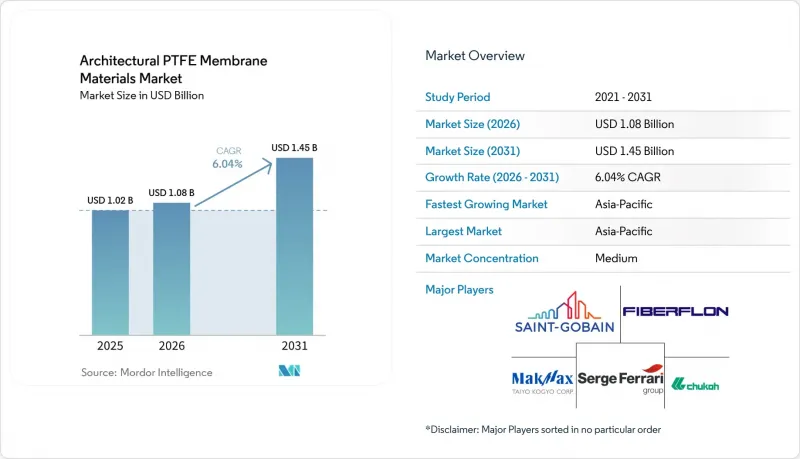
에 따르면 건축용 PTFE 막 재료 시장 규모는 2025년에 10억 2,000만 달러로 평가되며, 2026년 10억 8,000만 달러에서 2031년까지 14억 5,000만 달러에 달할 것으로 예측되고 있으며, 예측 기간(2026-2031년)에 CAGR은 6.04%에 달할 전망입니다.
전 세계 건축용 PTFE 막 재료 시장의 동향 및 인사이트
지속가능한 건축 및 친환경 인증에 대한 수요
‘에너지 및 환경 설계 리더십(LEED)’, ‘건축연구기구 환경평가법(BREEAM)’, 그리고 독일의 ‘지속가능한 건축 협회(DGNB)’ 등 각 평가 체계는 많은 대규모 공공 프로젝트에서 조달 요건으로 적용되고 있습니다. 이러한 프레임워크에서는 채광, 열 성능 및 재료의 내구성이 평가되므로 지붕 자재 사양에 대한 심사가 엄격해지고 있습니다. PTFE 코팅 유리섬유는 15%-25%의 확산 투과율과 70%±10%의 태양 반사율을 제공하여 건축 외피의 에너지 성능 요건을 충족합니다. 공공 부문 구매자들이 초기 비용 비교뿐만 아니라 문서화된 수명 주기 성능을 요구하게 되면, 건축용 PTFE 막재 시장은 그 혜택을 누리게 될 것입니다. 중흥화학공업 주식회사는 2025년 4월 EPD Hub로부터 FGT-600, FGT-800, FGT-1000을 포함한 FGT 시리즈에 대한 환경 제품 선언(EPD)을 취득했습니다. 이를 통해 수명 주기에 관한 문서가 요구되는 입찰 자격 심사에 대응할 수 있게 되었습니다. EPD를 활용할 수 있게 됨에 따라 기본 설계 단계에서 동등한 문서를 갖추지 못한 자재를 후보에서 제외할 수 있게 됩니다.
인프라 현대화 및 대형 시설 건설
교통 기관 및 스포츠 단체는 영구적인 대스팬 구조물에 대해 PTFE 코팅된 유리섬유를 지정하고 있습니다. 이러한 프로젝트에서는 인증된 자재가 필요하며, 납기 기간이 수년에 달하므로 건축용 PTFE 막 자재 시장의 수요를 지원하는 요인이 되고 있습니다. 타이요 공업 주식회사의 미국 자회사인 Birdair Inc.는 2026년 국제축구연맹(FIFA) 월드컵 개최지 중 하나인 휴스턴의 NRG 스타디움에서 PTFE 막 지붕 교체 공사에 관한 계약을 2025년 5월에 수주했습니다. 당초 지붕 막은 20년 전에 설치된 것이었으나, 현미경을 이용한 비교 검사 결과 구조적인 열화는 확인되지 않았습니다. 또한 타이요 공업 주식회사는 2025년 1월, 오사카 메트로의 유메지마역에도 PTFE 막 지붕을 설치했습니다. 행사 개최 일정이 확정되어 있으므로 행사장 운영 개시 전에 교체 공사를 완료해야 하며, 이로 인해 조달 과정이 가속화될 가능성이 있습니다.
초기 자재비 및 시공비의 고가
PTFE 코팅 유리섬유 막은 폴리염화비닐(PVC) 코팅 폴리에스테르에 비해 자재비가 30%에서 50% 더 비쌉니다. 불소화 에틸렌 프로필렌(FEP) 용접, 정밀한 장력 조정, 맞춤형 강철 커넥터가 포함되면 그 차이는 더욱 커집니다. 이 비용은 남아시아 및 동남아시아의 예산이 제한적인 지자체 프로젝트에 있으며, 큰 장벽이 될 수 있습니다. 설계 담당자는 수명 주기 비용 검토가 이루어지기 전의 개념 설계 단계에서 PVC를 선택하는 경우가 있습니다. 또한 현지에서 PTFE 시공 능력이 제한적이라는 점도 이러한 프로젝트에 필요한 전문 인력에 대한 투자를 저해하는 요인이 되고 있습니다. 그 결과, 건축용 PTFE 막재 시장은 수명 주기 비용 요건이 부과되는 공항, 교통 기관의 역, 그리고 상설 스포츠 시설에 집중된 상태가 지속되고 있습니다.
부문 분석
2025년, 건축용 PTFE 막재 시장에서 인장 막 구조가 45.23%의 점유율을 차지했습니다. 이러한 위상은 하중을 표면 전체에 분산시키고 30미터 이상의 기둥 없는 스팬을 가능하게 하는 이축 인장 특성을 반영한 것입니다. 이러한 구조적 접근 방식을 통해 동등한 강성을 가진 구조물에 비해 자재 중량을 줄이면서도 긴 스팬을 실현할 수 있습니다. 인장 시스템은 공항, 교통 시설, 경기장 및 영구적인 공공 공간에 적합합니다. 구조물의 내구성과 낮은 유지보수성이 요구되는 점이 인장 막 구조용 건축용 PTFE 막 재료 시장의 규모를 지원하고 있습니다. 또한 프로젝트 소유주들은 수명이 긴 공공 자산에 적합한 20-30년의 내구 연한을 높이 평가하고 있습니다.
공압식 및 공기 지지식 막 구조는 2031년까지 연평균 성장률(CAGR) 7.12%로 확대될 것으로 예측됩니다. 이러한 성장은 물류 창고에서의 에어돔 활용, 중국 북부 및 중앙아시아의 실내 스포츠 시설, 그리고 연중 내내 공조 관리가 필요한 걸프협력회의(GCC) 회원국의 편의 시설 공간에서의 활용과 관련이 있습니다. 타이요 공업 주식회사는 2025년 11월, 일본건축센터(BCJ)의 인증을 받은 격자형 도리식 막 지붕 시스템 ‘TensoDiaRoof’를 출시했습니다. 이 시스템은 강재 사용량을 10% 절감하며, 비계가 필요하지 않습니다. 이 시스템은 대규모 시설의 건설 계약에 그치지 않고, 기존 건물의 개보수 공사도 대상으로 하고 있습니다. 또한 다른 구조 유형에서도 오염된 장소에서 미관을 유지하는 데 도움이 되는 광촉매 PTFE 표면의 이점을 누리고 있습니다. 아울러, 설계부터 제조에 이르는 디지털 워크플로우의 보급으로 인해 복잡한 구조물에 대한 기술적 요구 사항도 높아지고 있습니다.
지역별 분석
아시아태평양은 2025년 건축용 PTFE 막재 시장의 38.57% 점유율을 차지하고 있으며, 2031년까지 연평균 성장률(CAGR) 6.95%로 확대될 것으로 예측됩니다. 중국의 도시화 계획에 따라 양쯔강 삼각주와 주강 삼각주 지역의 지하철역 및 복합 교통 터미널에서 PTFE 지붕재의 채택이 촉진되고 있습니다. 2025년 9월, 절강 후이펑 홀딩스 그룹은 베트남 전시 센터에 막재를 공급함으로써, 중국의 PTFE 제품이 대표적인 공공 건축물에 채택되는 등 해외 시장에서 큰 성과를 거두었습니다. 타이요 공업 주식회사가 유메지마역 및 미쓰이 아울렛 파크 키사라즈에서 시공한 사례는 일본의 교통 기관 및 상업 시설에서 지속적인 활동을 보여주고 있습니다. 인도 및 동남아시아 국가연합(ASEAN) 국가들에서는 공항 확장 및 대중교통 시스템 확장을 통해 비즈니스 기회가 창출되고 있습니다.
북미의 수요는 경기장 개보수에 집중되어 있으며, 트로피카나 필드와 NRG 스타디움에서는 기후 변화와 관련된 보수 공사와 스포츠 행사 개최 기한이 겹치고 있습니다. 유럽에서는 ‘유럽 그린딜’과 EN 15804의 수명 주기 요건이 영향을 미치고 있습니다. 드레스덴 중앙역(Dresden Hauptbahnhof) 개보수 공사에서는 2022-2025년에 완료된 3단계 공사에서 3만 3,000제곱미터의 세르주 페라리(Serge Ferrari) 사의 GF-7000 PTFE 막이 사용되었습니다. 북유럽 국가들에서는 독일의 ‘Zukunft Bau’ 프로그램을 통해 시험된 적응형 막 파사드 모듈이 채택되고 있습니다. 독일과 네덜란드에서는 공공 조달 분야에서 EPD(환경 제품 선언)가 작성된 자재에 대한 수요가 증가하고 있습니다.
남미, 중동 및 아프리카에서는 수요 상황이 다릅니다. 걸프협력회의(GCC)는 아시아태평양 이외의 고부가가치 비즈니스 기회로 부상하고 있습니다. 이는 사우디아라비아와 아랍에미리트가 건축용 PTFE 멤브레인 재료 시장에서 내구성이 뛰어난 장스팬 피복재가 필요한 경기장, 교통 허브, 공공 공간 개발을 추진하고 있기 때문입니다. 사막 환경에서는 PTFE의 자외선 저항성이 중요합니다. 브라질과 아르헨티나에서는 경기장 현대화 및 물류용 에어돔 건설을 통해 남미 지역의 수요를 지원하고 있습니다. 멕시코가 2026년 FIFA 월드컵 공동 개최국이된 것은 단기 프로젝트의 추진력이 되었습니다. 아프리카의 경우 시공 능력의 제약으로 인해 광범위한 도입이 제한되고 있으며, 여전히 정부 프로젝트에 중점을 두고 있습니다.
기타 혜택:
- 엑셀 형식의 시장 예측(ME) 시트
- 3개월간의 애널리스트 지원
자주 묻는 질문
목차
제1장 서론
- 조사 전제조건과 시장 정의
- 조사 범위
제2장 조사 방법
제3장 개요
제4장 시장 구도
- 시장 개요
- 시장 성장 촉진요인
- 시장 성장 억제요인
- 밸류체인 분석
- Porter's Five Forces 분석
제5장 시장 규모와 성장 예측
- 구조 유형별
- 용도별
- 최종 사용 분야별
- 지역별
- 아시아태평양
- 중국
- 인도
- 일본
- 한국
- ASEAN 국가
- 기타 아시아태평양 국가
- 북미
- 미국
- 캐나다
- 멕시코
- 유럽
- 독일
- 영국
- 프랑스
- 이탈리아
- 스페인
- 북유럽 국가
- 기타 유럽 국가
- 남미
- 브라질
- 아르헨티나
- 기타 남미 국가
- 중동 및 아프리카
- 사우디아라비아
- 아랍에미리트
- 남아프리카공화국
- 기타 중동 및 아프리카 국가
- 아시아태평양
제6장 경쟁 구도
- 시장 집중도
- 전략적 동향
- 시장 점유율·순위 분석
- 기업 개요
- CHUKOH CHEMICAL INDUSTRIES, LTD.
- FIBERFLON
- Haining Duletai New Material Co., Ltd.
- HIRAOKA & Co., Ltd.
- Jiangsu VEIK Technology & Materials Co., Ltd.
- Keli New Materials Co., Ltd.
- NINGBO WELLFLON NEW MATERIALS TECHNOLOGY CO., LTD.
- Saint-Gobain
- Serge Ferrari
- TACONIC
- TAIYO KOGYO CORPORATION
- Zhejiang Huifeng Holding Group Co., Ltd.
- Zhejiang Kaiao New Material Co., Ltd.
제7장 시장 기회와 향후 전망
KSAAccording to Mordor Intelligence, the architectural PTFE membrane materials market size was valued at USD 1.02 billion in 2025 and is estimated to grow from USD 1.08 billion in 2026 to reach USD 1.45 billion by 2031, at a CAGR of 6.04% during the forecast period (2026-2031).
Global Architectural PTFE Membrane Materials Market Trends and Insights
Sustainable Building and Green Certification Demand
Leadership in Energy and Environmental Design (LEED), Building Research Establishment Environmental Assessment Method (BREEAM), and Germany's Deutsche Gesellschaft fur Nachhaltiges Bauen (DGNB) frameworks have become procurement requirements in many large public projects. These frameworks assess daylighting, thermal performance, and material durability, which increases scrutiny of roof material specifications. PTFE-coated fiberglass provides 15% to 25% diffuse transmittance and 70% +- 10% solar reflectance, supporting envelope energy-performance requirements. The architectural PTFE membrane materials market benefits when public buyers require documented lifecycle performance rather than initial-cost comparisons alone. CHUKOH CHEMICAL INDUSTRIES, LTD. received an Environmental Product Declaration (EPD) from EPD Hub in April 2025 for its FGT series, including FGT-600, FGT-800, and FGT-1000, which supports tender qualification where lifecycle documentation is required. EPD availability can remove materials without comparable documentation at the schematic design stage.
Infrastructure Modernization and Mega-Venue Construction
Transit authorities and sporting bodies are specifying PTFE-coated fiberglass for permanent, large-span structures. This supports demand in the architectural PTFE membrane materials market because such projects require qualified materials and involve multi-year delivery schedules. TAIYO KOGYO CORPORATION's U.S. subsidiary, Birdair Inc., received a May 2025 contract to replace the PTFE membrane roof at NRG Stadium in Houston, a 2026 Federation Internationale de Football Association (FIFA) World Cup venue. The original roof membrane had been installed 20 years earlier, and micrographic comparisons found no structural degradation. TAIYO KOGYO CORPORATION also installed the PTFE membrane roof at Yumeshima Station on the Osaka Metro in January 2025. Fixed event schedules can accelerate procurement because replacement work must be completed before venue operations begin.
High Upfront Material and Installation Cost
PTFE-coated fiberglass membranes carry a 30% to 50% material-cost premium over polyvinyl chloride (PVC)-coated polyester. The difference grows when fluorinated ethylene propylene (FEP) welding, precision tensioning, and custom steel connectors are included. This cost can be a significant barrier for budget-constrained municipal projects in South and Southeast Asia. Specifiers can select PVC during concept design before lifecycle-cost considerations are evaluated. Limited local PTFE installation capacity also discourages investment in the specialized workforce required for these projects. The architectural PTFE membrane materials market, therefore, remains concentrated in airports, transit stations, and permanent sports venues with lifecycle-cost mandates.
Other drivers and restraints analyzed in the detailed report include:
- Daylighting and Energy Performance
- BIM-to-Fabrication Precision and Parametric Design
- PTFE-ETFE Substitution in Daylight-First Designs
For complete list of drivers and restraints, kindly check the Table Of Contents.
Segment Analysis
Tensile membrane structures held 45.23% of the architectural PTFE membrane materials market in 2025. Their position reflects biaxial tension, which distributes loads across the surface and allows column-free spans of 30 meters or more. This structural approach can achieve long spans at a lower material weight than comparable rigid structures. Tensile systems are suited to airports, transit facilities, stadiums, and permanent public spaces. Requirements for structural permanence and lower maintenance support the architectural PTFE membrane materials market size for tensile membrane structures. Project owners also value the material's 20- to 30-year service-life fit for long-lived public assets.
Pneumatic and air-supported membrane structures are projected to advance at a 7.12% CAGR through 2031. Their growth is linked to air-dome use in logistics warehouses, indoor sports facilities in northern China and Central Asia, and Gulf Cooperation Council amenity spaces requiring year-round climate control. TAIYO KOGYO CORPORATION launched TensoDiaRoof in November 2025, a Building Center of Japan (BCJ)-rated lattice-purlin membrane roof system that uses 10% less steel and requires no scaffolding. The system targets retrofit applications beyond large venue contracts. Other structure types benefit from photocatalytic PTFE surfaces that help retain aesthetic performance in polluted locations. Digital design-to-fabrication workflows also raise the technical requirements for complex structures.
Complete Report Scope:
- By Structure Type
- Tensile Membrane Structures
- Pneumatic and Air-Supported Membrane Structures
- Other Structure Types
- By Application
- Stadiums and Sports Venues
- Airport Terminals and Transportation Hubs
- Exhibition and Convention Centers
- Commercial Facades and Retail Structures
- Educational and Institutional Buildings
- Other Applications
- By End-Use Sector
- Commercial
- Industrial and Institutional
- Infrastructure
- Residential
- By Geography
- Asia-Pacific
- China
- India
- Japan
- South Korea
- ASEAN Countries
- Rest of Asia-Pacific
- North America
- United States
- Canada
- Mexico
- Europe
- Germany
- United Kingdom
- France
- Italy
- Spain
- NORDIC Countries
- Rest of Europe
- South America
- Brazil
- Argentina
- Rest of South America
- Middle-East and Africa
- Saudi Arabia
- United Arab Emirates
- South Africa
- Rest of Middle-East and Africa
- Asia-Pacific
Geography Analysis
Asia-Pacific held 38.57% of the architectural PTFE membrane materials market share in 2025 and is projected to advance at a 6.95% CAGR through 2031. China's urbanization program is supporting PTFE roofing at metro stations and intermodal terminals in the Yangtze River Delta and Pearl River Delta. Zhejiang Huifeng Holding Group Co., Ltd. supplied membrane material for the Vietnam Exhibition Center in September 2025, marking a major overseas deployment of a Chinese PTFE product in a flagship public building. TAIYO KOGYO CORPORATION's work at Yumeshima Station and Mitsui Outlet Park Kisarazu showed continued activity in Japanese transit and commercial sites. India and the Association of Southeast Asian Nations (ASEAN) countries offer opportunities through airport expansions and mass-transit extensions.
North American demand centers on stadium refurbishment, where Tropicana Field and NRG Stadium combine climate-related repairs with sporting deadlines. Europe is influenced by the European Green Deal and EN 15804 lifecycle requirements. The Dresden Hauptbahnhof renovation used 33,000 square meters of Serge Ferrari GF-7000 PTFE membrane over 3 phases completed between 2022 and 2025. Nordic countries are adopting adaptive membrane facade modules tested through Germany's Zukunft Bau program. Germany and the Netherlands have a strong demand for EPD-documented materials in public procurement.
South America, and Middle-East and Africa show different demand conditions. The Gulf Cooperation Council is a high-value opportunity outside Asia-Pacific because Saudi Arabia and the United Arab Emirates are developing stadiums, transport hubs, and public spaces that require durable long-span coverings in the architectural PTFE membrane materials market. PTFE's ultraviolet stability is important for desert conditions. Brazil and Argentina are supporting South American demand through stadium modernization and logistics air domes. Mexico's co-host role for the 2026 FIFA World Cup provided a near-term project catalyst. African procurement remains focused on government projects because installation capability constraints limit broader adoption.
- CHUKOH CHEMICAL INDUSTRIES, LTD.
- FIBERFLON
- Haining Duletai New Material Co., Ltd.
- HIRAOKA & Co., Ltd.
- Jiangsu VEIK Technology & Materials Co., Ltd.
- Keli New Materials Co., Ltd.
- NINGBO WELLFLON NEW MATERIALS TECHNOLOGY CO., LTD.
- Saint-Gobain
- Serge Ferrari
- TACONIC
- TAIYO KOGYO CORPORATION
- Zhejiang Huifeng Holding Group Co., Ltd.
- Zhejiang Kaiao New Material Co., Ltd.
Additional Benefits:
- The market estimate (ME) sheet in Excel format
- 3 months of analyst support
TABLE OF CONTENTS
1 Introduction
- 1.1 Study Assumptions and Market Definition
- 1.2 Scope of the Study
2 Research Methodology
3 Executive Summary
4 Market Landscape
- 4.1 Market Overview
- 4.2 Market Drivers
- 4.2.1 Sustainable Building and Green Certification Demand
- 4.2.2 Infrastructure Modernization and Mega-Venue Construction
- 4.2.3 Long Service Life and Low Maintenance
- 4.2.4 Daylighting and Energy Performance
- 4.2.5 BIM-to-Fabrication Precision and Parametric Design
- 4.2.6 Retrofit Replacement of Aging Textile Roofs
- 4.3 Market Restraints
- 4.3.1 High Upfront Material and Installation Cost
- 4.3.2 Specialized Engineering and Installation Capability
- 4.3.3 PTFE-ETFE Substitution in Daylight-First Designs
- 4.3.4 End-of-Life Recycling and Embodied-Carbon Scrutiny
- 4.4 Value Chain Analysis
- 4.5 Porter's Five Forces Analysis
- 4.5.1 Threat of New Entrants
- 4.5.2 Bargaining Power of Suppliers
- 4.5.3 Bargaining Power of Buyers
- 4.5.4 Threat of Substitutes
- 4.5.5 Competitive Rivalry
5 Market Size and Growth Forecasts (Value)
- 5.1 By Structure Type
- 5.1.1 Tensile Membrane Structures
- 5.1.2 Pneumatic and Air-Supported Membrane Structures
- 5.1.3 Other Structure Types
- 5.2 By Application
- 5.2.1 Stadiums and Sports Venues
- 5.2.2 Airport Terminals and Transportation Hubs
- 5.2.3 Exhibition and Convention Centers
- 5.2.4 Commercial Facades and Retail Structures
- 5.2.5 Educational and Institutional Buildings
- 5.2.6 Other Applications
- 5.3 By End-Use Sector
- 5.3.1 Commercial
- 5.3.2 Industrial and Institutional
- 5.3.3 Infrastructure
- 5.3.4 Residential
- 5.4 By Geography
- 5.4.1 Asia-Pacific
- 5.4.1.1 China
- 5.4.1.2 India
- 5.4.1.3 Japan
- 5.4.1.4 South Korea
- 5.4.1.5 ASEAN Countries
- 5.4.1.6 Rest of Asia-Pacific
- 5.4.2 North America
- 5.4.2.1 United States
- 5.4.2.2 Canada
- 5.4.2.3 Mexico
- 5.4.3 Europe
- 5.4.3.1 Germany
- 5.4.3.2 United Kingdom
- 5.4.3.3 France
- 5.4.3.4 Italy
- 5.4.3.5 Spain
- 5.4.3.6 NORDIC Countries
- 5.4.3.7 Rest of Europe
- 5.4.4 South America
- 5.4.4.1 Brazil
- 5.4.4.2 Argentina
- 5.4.4.3 Rest of South America
- 5.4.5 Middle-East and Africa
- 5.4.5.1 Saudi Arabia
- 5.4.5.2 United Arab Emirates
- 5.4.5.3 South Africa
- 5.4.5.4 Rest of Middle-East and Africa
- 5.4.1 Asia-Pacific
6 Competitive Landscape
- 6.1 Market Concentration
- 6.2 Strategic Moves
- 6.3 Market Share (%)/Ranking Analysis
- 6.4 Company Profiles (includes Global Overview, Market Overview, Core Segments, Financials as available, Strategic Information, Products and Services, and Recent Developments)
- 6.4.1 CHUKOH CHEMICAL INDUSTRIES, LTD.
- 6.4.2 FIBERFLON
- 6.4.3 Haining Duletai New Material Co., Ltd.
- 6.4.4 HIRAOKA & Co., Ltd.
- 6.4.5 Jiangsu VEIK Technology & Materials Co., Ltd.
- 6.4.6 Keli New Materials Co., Ltd.
- 6.4.7 NINGBO WELLFLON NEW MATERIALS TECHNOLOGY CO., LTD.
- 6.4.8 Saint-Gobain
- 6.4.9 Serge Ferrari
- 6.4.10 TACONIC
- 6.4.11 TAIYO KOGYO CORPORATION
- 6.4.12 Zhejiang Huifeng Holding Group Co., Ltd.
- 6.4.13 Zhejiang Kaiao New Material Co., Ltd.
7 Market Opportunities and Future Outlook
- 7.1 White-Space and Unmet-Need Assessment


