

|
시장보고서
상품코드
2154508
멀티 도메인 네트워크 오케스트레이션 소프트웨어 : 시장 점유율 분석, 업계 동향과 통계, 성장 예측(2026-2031년)Multi-Domain Network Orchestration Software - Market Share Analysis, Industry Trends & Statistics, Growth Forecasts (2026 - 2031) |
||||||
 Mordor Intelligence
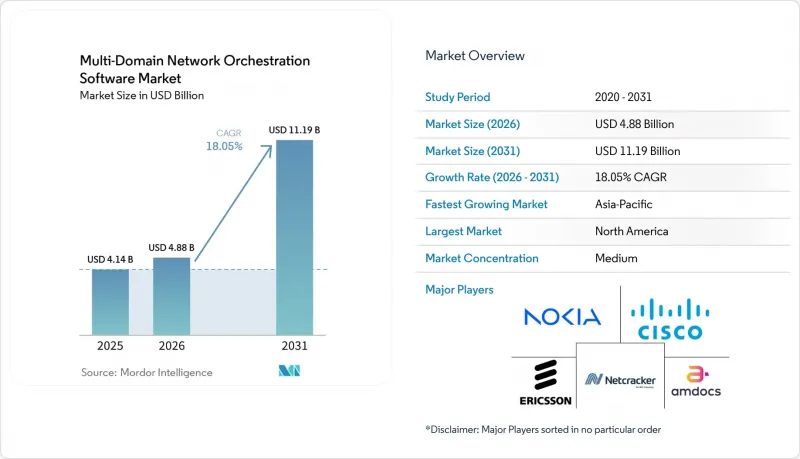
에 따르면 멀티 도메인 네트워크 오케스트레이션 소프트웨어 시장 규모는 2025년에 41억 4,000만 달러로 평가되며, 2026년부터 2031년까지 예측 기간 동안 CAGR 18.05%로 확대되어, 2031년까지 111억 9,000만 달러에 달할 것으로 추정됩니다.
세계 멀티도메인 네트워크 오케스트레이션 소프트웨어 시장의 동향 및 인사이트
5G 독립형(SA) 및 네트워크 슬라이싱을 통한 수익 창출
5G 독립형 네트워크를 통해 네트워크 슬라이싱이 단순한 계획상의 개념이 아닌 상용 서비스로 자리 잡음에 따라, 멀티도메인 네트워크 오케스트레이션 소프트웨어 시장은 그 혜택을 누리고 있습니다. 에릭슨(Ericsson)의 보고서에 따르면, 2026년 2분기에는 5G 독립형 네트워크 슬라이싱을 기반으로 한 84건의 상용 차별화 연결 서비스가 제공되고 있으며, 이는 2025년 11월의 65건에서 증가한 수치입니다. 각 서비스를 제공하려면 무선, 전송, 코어 도메인에 걸친 서비스 활성화, 보증 및 서비스 수준 계약(SLA) 이행의 협력이 필요합니다. 여러 개의 가동중인 슬라이스를 관리하는 통신 사업자는 포인트-투-포인트 프로비저닝에 비해 더 빈번한 상태 확인을 경험하고 있습니다. 차이나모바일, 도이체 텔레콤, OTE 그룹은 기업 및 소비자 환경에서 슬라이스 기반 서비스를 수익화하고 있으며, OTE의 ‘Priority Pass’는 대역폭 보장을 고객을 위해 어떻게 패키징할 수 있는지를 보여줍니다. 벤더 간 협업에 관한 표준화 활동으로 인해, 상호 운용성은 멀티 도메인 네트워크 오케스트레이션 소프트웨어 시장에서 더욱 중요한 구매 기준이 되고 있습니다. 이는 통신 사업자가 기반이 되는 네트워크 구성요소가 변경되더라도 계속 작동하는 서비스 워크플로우를 필요로 하기 때문입니다.
AI를 활용한 폐쇄 루프형 네트워크 운영
다중 도메인 네트워크 오케스트레이션 소프트웨어 시장은 서비스 활성화에 그치지 않고, 지속적인 모니터링 및 자동화된 유지보수까지 그 범위를 넓히고 있습니다. NTT 도코모는 2026년 2월, 100만 대 이상의 기기에 걸친 네트워크 유지보수를 실시간으로 지원하는 에이전틱 AI 시스템을 상용화했습니다. 이 플랫폼은 경보 및 트래픽 데이터를 분석하여 이상이나 장애 지점을 특정하고, 엔지니어에게 유지보수 권장 사항을 제공합니다. 노키아는 2026년 6월, IP, 유선 통신, 광통신, 무선 액세스 네트워크에 걸친 단계적 자동화를 실현하기 위한 ‘Autonomous Networks Agent Library’를 도입했습니다. 이러한 기능을 활용하기 위해서는 도메인을 초월한 일관된 인벤토리, 온톨로지 및 네트워크 상태 데이터가 필수적입니다. ETSI는 계층적 멀티도메인 네트워크에서 신뢰성 높은 폐쇄 루프형 의도 실현을 가능하게 하는 기반으로 정확한 디지털 트윈을 제시하고 있습니다.
레거시 자산 정보의 부정확성과 데이터의 일관성
레거시 자산 정보의 부정확성은 여전히 멀티도메인 네트워크 오케스트레이션 소프트웨어 시장을 제약하고 있습니다. 데이터베이스가 동일한 물리적 자산을 서로 다른 형식으로 기술하고 있는 경우, 자동화된 워크플로우로 인해 잘못된 프로비저닝이나 복구 결정이 발생할 수 있습니다. TM Forum의 Catalyst C26.0.916은 하이브리드 네트워크의 대조 시간을 60% 단축하고, 불일치 예측 정확도를 85% 향상시키며, 서비스 수준 계약(SLA) 위반 및 주문 손실을 40% 줄이는 것을 목표로 하고 있습니다. 재무상의 기업 기록과 운영상의 OSS 인벤토리 간의 차이는, 특히 폐기된 장비가 기록에 남아 있거나 새로운 자산이 공식적으로 가동을 시작하지 않은 경우, 이 문제를 더욱 복잡하게 만듭니다. 네트워크는 매일 변화하기 때문에 정기적인 현장 조사만으로는 이 과제를 완전히 해결할 수 없습니다. 통신 사업자는 AI를 활용한 자동화를 대규모로 전개하기 전에 신뢰할 수 있는 실시간 네트워크 상태 데이터가 필요합니다. 이러한 요구 사항으로 인해 멀티도메인 네트워크 오케스트레이션 소프트웨어 시장에서 계획된 많은 기능의 도입에 앞서 데이터 수정 작업이 우선시되고 있습니다.
부문 분석
2025년에는 멀티도메인 네트워크 오케스트레이션 소프트웨어 시장의 총 매출의 62.54%를 솔루션이 차지할 것으로 예상됩니다. 이 부문에는 멀티도메인 서비스 오케스트레이션 플랫폼, 도메인 오케스트레이션 및 컨트롤러 연동 도구, 그리고 인벤토리, 디스커버리 및 리콘실리에이션 레이어가 포함됩니다. 멀티도메인 서비스 오케스트레이션 플랫폼은 서비스 설계, 크로스도메인 분해 및 실시간 활성화를 지원합니다. 컨트롤러 연동 도구는 상위 수준의 서비스 의도를 사업자가 다양한 네트워크 도메인에서 활용할 수 있는 구성으로 변환합니다. 사업자가 기계가 읽을 수 있는 서비스 정의가 필요한 ‘NaaS(Network-as-a-Service)’ 제품을 도입함에 따라, 서비스 카탈로그 및 분해 도구가 주목받고 있습니다.
통신 사업자들이 복잡한 현대화 프로그램의 지원을 요구하는 가운데, 서비스 시장은 2031년까지 연평균 성장률(CAGR) 20.11%로 확대될 것으로 예측됩니다. 컨설팅 및 자문 서비스, 통합·구축, 그리고 관리형 운영·지원은 설계 결정부터 일상적인 운영 지원에 이르기까지 제공 프로세스의 다양한 단계를 포괄합니다. 통신 사업자들이 통합 위험을 벤더에게 이전하고 서비스 연속성에 대한 명확한 책임 소재를 요구함에 따라, 운영 관리 및 지원의 중요성은 더욱 커지고 있습니다. 멀티 도메인 네트워크 오케스트레이션 소프트웨어 업계에서는 도입 후 일상적인 운영을 지원할 수 있는 제공업체가 더 높이 평가되는 반면, 해당 시장에서는 도입 프로세스 전반에 걸쳐 명확한 운영 책임을 문서화할 수 있는 벤더가 높이 평가받고 있습니다. ETSI는 통일된 추상화가 부족하여 클라우드 네이티브 라이프사이클 관리의 모든 부담이 OSS 및 BSS 팀에 전가되고 있다고 지적하고 있습니다.
다중 도메인 네트워크 오케스트레이션 소프트웨어 시장에서 클라우드 배포는 2025년에 68.11%의 점유율을 차지할 것으로 예상되며, 2031년까지 연평균 성장률(CAGR) 19.67%로 확대될 전망입니다. 클라우드 플랫폼은 온프레미스 환경의 일부 자본 투자 주기를 단축하고, 인력을 비례적으로 늘리지 않고도 추가 네트워크 슬라이스에 따라 확장할 수 있습니다. 노키아는 2025년 6월에 ‘Autonomous Network Fabric’을 출시할 예정이며, Google Cloud 상의 SaaS 배포, Google Distributed Cloud를 통한 온프레미스 배포, 그리고 하이브리드 옵션이 제공될 것입니다. 다중 도메인 네트워크 오케스트레이션 소프트웨어 시장에서는 구독형 구매 및 변동하는 오케스트레이션 워크로드를 지원하기 위해 클라우드 기반 제공이 활용되고 있습니다. 데이터 상주 요건 및 합법적 감청 준수 등 각국의 규제로 인해 인도 등의 시장에서는 여전히 하이브리드 배포가 중요하게 여겨지고 있습니다.
중요한 국가 인프라를 관리하는 Tier 1 통신 사업자에게 있어 온프레미스 구축은 여전히 중요합니다. 하이브리드 구성은 비클라우드 그룹 내에서 가장 빠르게 확대되고 있는 선택지입니다. 이는 사업자가 정책상 중요한 워크로드를 온프레미스에 유지하면서, 그 외의 오케스트레이션 작업에는 클라우드 용량을 활용할 수 있기 때문입니다. 브로드밴드 포럼의 MR-530-1.0.0에서는 클라우드 환경 또는 온프레미스 환경에서 작동하며, 엔드투엔드 서비스 오케스트레이터를 지원할 수 있는 도메인 오케스트레이터 모델이 정의되어 있습니다. 통신 사업자들은 유럽의 케이블망 현대화 프로젝트와 남미의 인터넷 서비스 제공업체(ISP) 프로그램에서 이 모델을 검토하고 있습니다. 따라서 멀티 도메인 네트워크 오케스트레이션 소프트웨어 업계는 단일 운영 모델이 아닌 도입의 유연성을 지원해야 하며, 시장에서는 서비스 워크플로우를 분할하지 않고도 이러한 선택권을 유지할 수 있는 플랫폼이 지지를 받을 가능성이 높다고 볼 수 있습니다.
지역별 분석
2025년에는 북미가 멀티도메인 네트워크 오케스트레이션 소프트웨어 시장에서 28.77%의 점유율을 차지할 것으로 예상됩니다. 미국 주요 통신 사업자들의 OSS 및 BSS에 대한 지속적인 현대화와 더불어, 클라우드 기반 도매 및 엔터프라이즈 서비스가 멀티 도메인 네트워크 오케스트레이션 소프트웨어 시장에 안정적인 수요 기반을 창출할 것으로 예상됩니다. 2026년 1월 T-Mobile이 Netcracker와 공동으로 계획하고 있는 클라우드 플랫폼 확장은, 통신 사업자들이 오케스트레이션을 활용하여 파트너 및 모바일 가상 네트워크 사업자(MVNO)를 위한 도매 서비스를 도입하고 적용해 나갈 것으로 예상된다는 점을 여실히 보여줍니다. 캐나다와 멕시코에서는 기업용 자동화 프로그램을 통해 수요가 확대되고 있는 반면, StratoWeave는 독점적인 오케스트레이션 플랫폼을 대체할 오픈 소스 대안으로서 통신 사업자들의 참여를 이끌어내고 있습니다.
아시아태평양은 2031년까지 연평균 성장률(CAGR) 20.06%로 성장할 것으로 예측되며, 이는 각 지역 중 가장 높은 수치입니다. 차이나모바일, 차이나유니콤, 차이나텔레콤은 5G 독립형(SA) 구축 및 네트워크 슬라이싱 이니셔티브를 통해 오케스트레이션에 대한 막대한 수요를 창출하고 있습니다. 차이나모바일은 화웨이, GSMA 및 기타 파트너와 공동으로 MWC 상하이 2026에서 OpenAN을 출시할 예정이며, 레벨 4 자율 네트워크 이니셔티브를 위해 LF Networking에 초기 구성요소를 제공할 계획입니다. 인도에서는 국내 데이터 상주 요건을 충족하기 위해 클라우드 네이티브 5G 코어의 도입이 진행되고 있으며, 이는 멀티 벤더 통합에 대한 수요를 창출하고 있습니다. 말레이시아에서는 Tune Talk사의 클라우드 네이티브 전환이 동남아시아 전역의 계획에 영향을 미치고 있습니다. 일본에서는 NTT 도코모가 2026년 6월에 노키아의 ‘MantaRay AutoPilot’을 도입하여, 수동으로 매개변수를 입력할 필요 없이 15분 이내에 인텐트 기반 무선 액세스 네트워크 최적화 주기를 완료할 전망입니다.
유럽은 3위 지역 시장으로, 분산된 통신 사업자 환경, 멀티 벤더 네트워크, 그리고 체계화된 Open RAN 프로그램이 특징입니다. 유럽의 통신 사업자들은 무선 도메인 내에서 5개 이상의 벤더의 하드웨어 및 소프트웨어를 관리하는 경우가 많기 때문에 에릭슨과 노키아의 마켓플레이스 내 협업은 특히 중요합니다. Telenet과 BICS는 2025년부터 2026년까지 Netcracker의 OSS 프로그램을 추진할 전망입니다. 한편, 중동 및 아프리카에서는 stc Group, Huawei, Cassava Technologies가 주도하는 프로젝트를 통해 관련 노력이 가속화되고 있습니다. 카사바는 엔비디아(NVIDIA)의 AI 인프라를 활용하여 아프리카의 다세대 네트워크를 지원하는 자율형 네트워크 플랫폼을 2026년 3월에 출시할 예정입니다. 남미는 하이브리드 광섬유 및 모바일 오케스트레이션 수요가 집중되는 지역으로 부상하고 있습니다.
기타 혜택:
- 엑셀 형식의 시장 예측(ME) 시트
- 3개월간의 애널리스트 지원
자주 묻는 질문
목차
제1장 소개
- 조사 가정과 시장 정의
- 조사 범위
제2장 조사 방법
제3장 주요 요약
제4장 시장 구도
- 시장 개요
- 시장 성장 촉진요인
- 시장 성장 억제요인
- 거시경제 요인이 시장에 미치는 영향
- 업계 밸류체인 분석
- 규제 상황
- 기술 전망
- Porter's Five Forces 분석
제5장 시장 규모와 성장 예측
- 구성요소별
- 전개별
- 용도별
- 최종사용자별
- 지역별
- 북미
- 미국
- 캐나다
- 멕시코
- 기타 북미 국가
- 남미
- 브라질
- 아르헨티나
- 기타 남미 국가
- 유럽
- 독일
- 영국
- 프랑스
- 이탈리아
- 러시아
- 기타 유럽 국가
- 아시아태평양
- 중국
- 일본
- 인도
- 한국
- 호주
- 기타 아시아태평양 국가
- 중동
- 사우디아라비아
- 아랍에미리트
- 튀르키예
- 기타 중동 국가
- 아프리카
- 남아프리카공화국
- 나이지리아
- 이집트
- 기타 아프리카 국가
- 북미
제6장 경쟁 구도
- 시장 집중도
- 전략적 동향
- 시장 점유율 분석
- 기업 개요
- Amdocs Limited
- Ciena Corporation
- Cisco Systems, Inc.
- Telefonaktiebolaget LM Ericsson
- Huawei Technologies Co., Ltd.
- Nokia Corporation
- ZTE Corporation
- Netcracker Technology Corporation
- IBM Corporation
- Hewlett Packard Enterprise Company
- Juniper Networks, Inc.
- Oracle Corporation
- NEC Corporation
- Fujitsu Limited
- Rakuten Group, Inc.
- Itential, Inc.
- Inmanta NV
- Whale Cloud Technology Co., Ltd.
- Comarch S.A.
- Mavenir Systems, Inc.
- Anuta Networks, Inc.
- Red Hat, Inc.
- Broadcom Inc.
제7장 시장 기회와 향후 전망
KSM 26.10.29According to Mordor Intelligence, the multi-domain network orchestration software market size was valued at USD 4.14 billion in 2025 and estimated to expand to USD 11.19 billion by 2031, at a CAGR of 18.05% during the forecast period 2026-2031.
Global Multi-Domain Network Orchestration Software Market Trends and Insights
5G Standalone and Network Slicing Monetization
The multi-domain network orchestration software market is benefiting as 5G standalone networks make network slicing a commercial service rather than a planning concept. Ericsson reported 84 commercial differentiated-connectivity offerings based on 5G standalone network slicing in Q2 2026, compared with 65 in November 2025. Each offering needs coordinated service activation, assurance, and service-level agreement enforcement across radio, transport, and core domains. Operators managing multiple live slices experience more frequent state reconciliation than with point-to-point provisioning. China Mobile, Deutsche Telekom, and OTE Group are monetizing slice-based services in enterprise and consumer settings, while OTE's Priority Pass shows how bandwidth assurance can be packaged for customers. Standards activity around cross-vendor coordination is making interoperability a more important purchase criterion for the multi-domain network orchestration software market, since operators need service workflows that can remain functional as underlying network components change.
AI-Enabled Closed-Loop Network Operations
The multi-domain network orchestration software market is broadening beyond service activation to include continuous monitoring and automated maintenance. NTT DOCOMO commercially deployed an agentic AI system in February 2026 that supports network maintenance across more than 1 million devices in real time. The platform analyzes alarm and traffic data, identifies anomalies and failure points, and provides maintenance recommendations to engineers. Nokia introduced an Autonomous Networks Agent Library in June 2026 for staged automation across IP, fixed, optical, and radio access networks. These uses depend on consistent inventory, ontology, and network-state data across domains. ETSI identifies accurate digital twins as an enabling layer for dependable closed-loop intent fulfillment in hierarchical, multi-domain networks.
Legacy Inventory Inaccuracy and Data Reconciliation
Legacy inventory inaccuracies continue to constrain the multi-domain network orchestration software market. When databases describe the same physical assets in different formats, automated workflows may trigger incorrect provisioning or remediation decisions. TM Forum's Catalyst C26.0.916 targets a 60% reduction in hybrid-network reconciliation time, an 85% improvement in discrepancy prediction accuracy, and a 40% reduction in service-level agreement breaches and order fallout. Differences between financial enterprise records and operational OSS inventories further complicate the issue, particularly when retired equipment remains recorded or new assets are not formally commissioned. Periodic site surveys cannot fully resolve this challenge because networks change daily. Operators need reliable, real-time network state data before they can deploy AI-driven automation at scale. This requirement places data correction work ahead of many planned feature deployments in the multi-domain network orchestration software market.
Other drivers and restraints analyzed in the detailed report include:
- Cloud-Native and Hybrid Network Expansion
- Multi-Vendor Network Complexity
- High Integration and Migration Risk
For complete list of drivers and restraints, kindly check the Table Of Contents.
Segment Analysis
Solutions are expected to account for 62.54% of total revenue in the multi-domain network orchestration software market in 2025. This segment includes multi-domain service orchestration platforms, domain orchestration and controller coordination tools, and inventory, discovery, and reconciliation layers. Multi-domain service orchestration platforms support service design, cross-domain decomposition, and real-time activation. Controller coordination tools translate high-level service intent into configurations that operators can use across diverse network domains. Service catalog and decomposition tools are gaining attention as operators introduce network-as-a-service products that require machine-readable service definitions.
Services are projected to expand at a 20.11% CAGR through 2031, as operators seek support for complex modernization programs. Consulting and advisory services, integration and implementation, and managed operations and support address different stages of the delivery process, from design decisions to daily operational support. Managed operations and support are becoming more important as operators transfer integration risk to vendors and seek clear accountability for service continuity. The multi-domain network orchestration software industry is placing greater value on providers that can support daily operations after implementation, while the multi-domain network orchestration software market rewards vendors that can document clear operating responsibilities throughout a deployment. ETSI notes that the lack of unified abstraction shifts the full burden of cloud-native lifecycle management to OSS and BSS teams.
Cloud deployment is expected to hold a 68.11% share in 2025 and expand at a 19.67% CAGR through 2031 in the multi-domain network orchestration software market. Cloud platforms reduce some on-premises capital expenditure cycles and can scale with additional network slices without requiring proportional growth in headcount. Nokia is expected to launch Autonomous Network Fabric in June 2025 with SaaS deployment on Google Cloud, on-premises deployment through Google Distributed Cloud, and hybrid options. The multi-domain network orchestration software market is using cloud delivery to support subscription-based purchasing and variable orchestration workloads. National requirements for data residency and lawful-interception compliance keep hybrid deployment relevant in markets such as India.
On-premises deployment remains important for Tier-1 operators that manage critical national infrastructure. Hybrid configurations are the fastest-expanding option within the non-cloud group because they allow operators to retain policy-sensitive workloads on-site while using cloud capacity for other orchestration tasks. Broadband Forum's MR-530-1.0.0 defines a domain-orchestrator model that can operate in cloud or on-premises environments and support an end-to-end service orchestrator. Operators are considering this model in European cable modernization and South American internet service provider programs. Therefore, the multi-domain network orchestration software industry must support deployment flexibility rather than a single operating model, and the market is likely to favor platforms that preserve this choice without splitting service workflows.
Complete Report Scope:
- By Component
- Solutions
- Multi-Domain Service Orchestration Platforms
- Domain Orchestration and Controller Coordination
- Service Catalog and Decomposition
- Inventory, Discovery, and Reconciliation
- Other Solutions
- Services
- Consulting and Advisory
- Integration and Implementation
- Managed Operations and Support
- Solutions
- By Deployment
- Cloud
- On-Premises
- Hybrid
- By Application
- Service Fulfillment and Zero-Touch Provisioning
- Service Assurance and SLA Management
- Network Slicing and Slice Lifecycle Management
- Network Optimization and Traffic Engineering
- Fault Management and Automated Remediation
- Other Applications
- By End User
- Mobile Network Operators
- Fixed Network Operators
- Internet Service Providers
- Cloud Service Providers
- Cable Network Operators
- Other End Users
- By Geography
- North America
- United States
- Canada
- Mexico
- Rest of North America
- South America
- Brazil
- Argentina
- Rest of South America
- Europe
- Germany
- United Kingdom
- France
- Italy
- Russia
- Rest of Europe
- Asia-Pacific
- China
- Japan
- India
- South Korea
- Australia
- Rest of Asia-Pacific
- Middle East
- Saudi Arabia
- United Arab Emirates
- Turkey
- Rest of Middle East
- Africa
- South Africa
- Nigeria
- Egypt
- Rest of Africa
- North America
Geography Analysis
North America is expected to hold a 28.77% share in 2025 in the multi-domain network orchestration software market. Ongoing OSS and BSS modernization by major United States carriers, along with cloud-based wholesale and enterprise services, is expected to create a steady base of demand for the multi-domain network orchestration software market. T-Mobile's planned cloud-platform expansion with Netcracker in January 2026 highlights how operators are expected to use orchestration to introduce and adapt wholesale offerings for partners and mobile virtual network operators. Canada and Mexico are adding demand through enterprise automation programs, while StratoWeave is attracting operator participation as an open-source alternative to proprietary orchestration platforms.
Asia-Pacific is projected to expand at a CAGR of 20.06% through 2031, the highest among regions. China Mobile, China Unicom, and China Telecom are creating substantial orchestration requirements through 5G standalone deployments and network slicing activities. China Mobile is expected to join Huawei, GSMA, and other partners in launching OpenAN at MWC Shanghai 2026, contributing initial components to LF Networking for Level 4 autonomous network work. India is increasing cloud-native 5G core deployments to meet domestic data-residency requirements, generating multi-vendor integration work. In Malaysia, Tune Talk's cloud-native transition is influencing planning across Southeast Asia. In Japan, NTT DOCOMO is expected to use Nokia's MantaRay AutoPilot in June 2026 to complete an intent-based radio access network optimization cycle in less than 15 minutes without manual parameter input.
Europe is the third-largest regional market, shaped by a fragmented carrier landscape, multi-vendor networks, and structured Open RAN programs. The Ericsson-Nokia marketplace collaboration is particularly relevant because European operators often manage hardware and software from five or more vendors within a radio domain. Telenet and BICS are expected to advance Netcracker OSS programs during 2025 and 2026. Meanwhile, the Middle East and Africa are accelerating through projects from stc Group, Huawei, and Cassava Technologies. Cassava is expected to launch an autonomous network platform in March 2026, using NVIDIA AI infrastructure to support multi-generation networks in Africa. South America is emerging as a demand pocket for hybrid fiber and mobile orchestration.
- Amdocs Limited
- Ciena Corporation
- Cisco Systems, Inc.
- Telefonaktiebolaget LM Ericsson
- Huawei Technologies Co., Ltd.
- Nokia Corporation
- ZTE Corporation
- Netcracker Technology Corporation
- IBM Corporation
- Hewlett Packard Enterprise Company
- Juniper Networks, Inc.
- Oracle Corporation
- NEC Corporation
- Fujitsu Limited
- Rakuten Group, Inc.
- Itential, Inc.
- Inmanta NV
- Whale Cloud Technology Co., Ltd.
- Comarch S.A.
- Mavenir Systems, Inc.
- Anuta Networks, Inc.
- Red Hat, Inc.
- Broadcom Inc.
Additional Benefits:
- The market estimate (ME) sheet in Excel format
- 3 months of analyst support
TABLE OF CONTENTS
1 INTRODUCTION
- 1.1 Study Assumptions and Market Definition
- 1.2 Scope of the Study
2 RESEARCH METHODOLOGY
3 EXECUTIVE SUMMARY
4 MARKET LANDSCAPE
- 4.1 Market Overview
- 4.2 Market Drivers
- 4.2.1 5G Standalone and Network Slicing Monetization
- 4.2.2 Cloud-Native and Hybrid Network Expansion
- 4.2.3 Multi-Vendor Network Complexity
- 4.2.4 AI-Enabled Closed-Loop Network Operations
- 4.2.5 Federated Inventory and Cross-Domain Data Normalization
- 4.2.6 Intent-Based Service Lifecycle Automation
- 4.3 Market Restraints
- 4.3.1 Legacy Inventory Inaccuracy and Data Reconciliation
- 4.3.2 High Integration and Migration Risk
- 4.3.3 Autonomous-Action Governance in Production Networks
- 4.3.4 Proprietary Adapters and Vendor Lock-In
- 4.4 Impact of Macroeconomic Factors on the Market
- 4.5 Industry Value Chain Analysis
- 4.6 Regulatory Landscape
- 4.7 Technological Outlook
- 4.8 Porter's Five Forces Analysis
- 4.8.1 Threat of New Entrants
- 4.8.2 Bargaining Power of Suppliers
- 4.8.3 Bargaining Power of Buyers
- 4.8.4 Threat of Substitutes
- 4.8.5 Intensity of Competitive Rivalry
5 MARKET SIZE AND GROWTH FORECASTS (VALUE)
- 5.1 By Component
- 5.1.1 Solutions
- 5.1.1.1 Multi-Domain Service Orchestration Platforms
- 5.1.1.2 Domain Orchestration and Controller Coordination
- 5.1.1.3 Service Catalog and Decomposition
- 5.1.1.4 Inventory, Discovery, and Reconciliation
- 5.1.1.5 Other Solutions
- 5.1.2 Services
- 5.1.2.1 Consulting and Advisory
- 5.1.2.2 Integration and Implementation
- 5.1.2.3 Managed Operations and Support
- 5.1.1 Solutions
- 5.2 By Deployment
- 5.2.1 Cloud
- 5.2.2 On-Premises
- 5.2.3 Hybrid
- 5.3 By Application
- 5.3.1 Service Fulfillment and Zero-Touch Provisioning
- 5.3.2 Service Assurance and SLA Management
- 5.3.3 Network Slicing and Slice Lifecycle Management
- 5.3.4 Network Optimization and Traffic Engineering
- 5.3.5 Fault Management and Automated Remediation
- 5.3.6 Other Applications
- 5.4 By End User
- 5.4.1 Mobile Network Operators
- 5.4.2 Fixed Network Operators
- 5.4.3 Internet Service Providers
- 5.4.4 Cloud Service Providers
- 5.4.5 Cable Network Operators
- 5.4.6 Other End Users
- 5.5 By Geography
- 5.5.1 North America
- 5.5.1.1 United States
- 5.5.1.2 Canada
- 5.5.1.3 Mexico
- 5.5.1.4 Rest of North America
- 5.5.2 South America
- 5.5.2.1 Brazil
- 5.5.2.2 Argentina
- 5.5.2.3 Rest of South America
- 5.5.3 Europe
- 5.5.3.1 Germany
- 5.5.3.2 United Kingdom
- 5.5.3.3 France
- 5.5.3.4 Italy
- 5.5.3.5 Russia
- 5.5.3.6 Rest of Europe
- 5.5.4 Asia-Pacific
- 5.5.4.1 China
- 5.5.4.2 Japan
- 5.5.4.3 India
- 5.5.4.4 South Korea
- 5.5.4.5 Australia
- 5.5.4.6 Rest of Asia-Pacific
- 5.5.5 Middle East
- 5.5.5.1 Saudi Arabia
- 5.5.5.2 United Arab Emirates
- 5.5.5.3 Turkey
- 5.5.5.4 Rest of Middle East
- 5.5.6 Africa
- 5.5.6.1 South Africa
- 5.5.6.2 Nigeria
- 5.5.6.3 Egypt
- 5.5.6.4 Rest of Africa
- 5.5.1 North America
6 COMPETITIVE LANDSCAPE
- 6.1 Market Concentration
- 6.2 Strategic Moves
- 6.3 Market Share Analysis
- 6.4 Company Profiles (includes Global Level Overview, Market Level Overview, Core Segments, Financials as available, Strategic Information, Market Rank/Share, Products and Services, Recent Developments)
- 6.4.1 Amdocs Limited
- 6.4.2 Ciena Corporation
- 6.4.3 Cisco Systems, Inc.
- 6.4.4 Telefonaktiebolaget LM Ericsson
- 6.4.5 Huawei Technologies Co., Ltd.
- 6.4.6 Nokia Corporation
- 6.4.7 ZTE Corporation
- 6.4.8 Netcracker Technology Corporation
- 6.4.9 IBM Corporation
- 6.4.10 Hewlett Packard Enterprise Company
- 6.4.11 Juniper Networks, Inc.
- 6.4.12 Oracle Corporation
- 6.4.13 NEC Corporation
- 6.4.14 Fujitsu Limited
- 6.4.15 Rakuten Group, Inc.
- 6.4.16 Itential, Inc.
- 6.4.17 Inmanta NV
- 6.4.18 Whale Cloud Technology Co., Ltd.
- 6.4.19 Comarch S.A.
- 6.4.20 Mavenir Systems, Inc.
- 6.4.21 Anuta Networks, Inc.
- 6.4.22 Red Hat, Inc.
- 6.4.23 Broadcom Inc.
7 MARKET OPPORTUNITIES AND FUTURE OUTLOOK
- 7.1 White-Space and Unmet-Need Assessment


