

|
시장보고서
상품코드
2154514
인공삽입물 : 시장 점유율 분석, 업계 동향과 통계, 성장 예측(2026-2031년)Endoprosthesis - Market Share Analysis, Industry Trends & Statistics, Growth Forecasts (2026 - 2031) |
||||||
 Mordor Intelligence
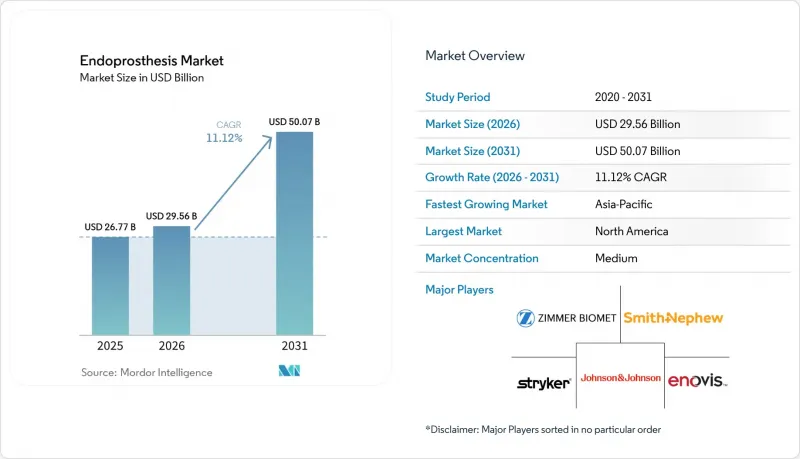
에 따르면 인공삽입물 시장은 2025년 267억 7,000만 달러에서 2026년에는 295억 6,000만 달러로 확대되어, 2031년까지 500억 7,000만 달러에 달할 것으로 예측되며, 2026년부터 2031년까지 CAGR 11.12%로 성장할 것으로 전망됩니다.
전 세계 인공삽입물 시장의 동향 및 인사이트
고령화와 퇴행성 관절염의 부담 증가
인공관절 시장은 고령화와 퇴행성 관절염의 부담 증가에 힘입어 성장하고 있습니다. 2025년 연구에 따르면, 2050년까지 퇴행성 관절염의 유병률과 장애가 지속적으로 증가할 것으로 예측되며, 특히 여성과 55세 이상 인구에서 그 부담이 커질 것으로 보입니다. 고관절 및 슬관절 치환술은 이동 능력이나 장애에 미치는 영향에도 불구하고, 의료 계획에서 여전히 충분한 고려를 받지 못하고 있습니다. 일본, 한국, 중국, 인도에서는 규모가 크고 고령화된 인구가 정형외과 의료 서비스를 이용할 수 있게 됨에 따라 수요가 더욱 지속될 것으로 전망됩니다.
비만, 스포츠 부상, 외상 후 관절 질환의 유병률 증가
외상성 관절 질환은 인공관절 시장에 더 젊고 신체적 부하가 높은 환자층을 유입시키고 있습니다. 교통사고로 인한 부상은 전 세계적으로 매년 119만 명의 사망자를 발생시키고 있으며, 생존자들은 정형외과적 외상을 입어 나중에 재건 수술이 필요할 수 있습니다. 이러한 위험은 부상 부담이 크고 외상 치료 체계가 여전히 불균형한 인도, 동남아시아, 라틴아메리카에서 특히 중요합니다. 스포츠 참여가 증가함에 따라 30대 및 40대 환자에서 인대 및 연골 손상도 증가하고 있습니다. 2025년에 수행된 공학 연구에 따르면, 신장성 대퇴골 스템을 설계함으로써 모델링된 인공 고관절 치환술 환경에서 스트레스 실드 현상이 52.3% 감소하는 것으로 밝혀졌습니다. 이러한 환자층은 시멘트리스 고정, 골 보존형 설계, 그리고 긴 수명을 목표로 한 소재에 대한 수요를 높일 가능성이 있습니다.
임플란트, 수술실, 재활 치료의 높은 비용
높은 비용은 특히 공적 보험의 적용 범위가 제한된 지역에서 인공관절 시장의 발전을 저해하는 요인이 되고 있습니다. 인공관절 전치환술에는 임플란트, 수술실 사용료, 마취, 영상 진단, 재활 치료 비용이 포함됩니다. 세계보건기구(WHO)는 관절 성형술이 장애 치료에 중요한 역할을 하고 있음에도 불구하고, 전 세계 보건 계획에 여전히 충분히 반영되지 않은 ‘필수 수술’이라고 밝히고 있습니다. 맞춤형, 재치환 및 종양 재건용 임플란트는 단가가 높으며, 진단 관련 지불 제도 하에서는 전액이 보장되지 않을 수 있습니다. 사하라 이남 아프리카나 동남아시아의 농촌 지역에서는 환자 본인 부담금이 임상적으로 적절한 치료를 받는 데 장애가 될 수 있습니다. 제조사들은 치료 수준을 저하시키지 않으면서 접근성을 확대하기 위해 저비용 제품 라인, 정부와의 협력, 그리고 지불 방식을 마련해야 합니다.
부문 분석
2025년, 무릎 인공관절은 인공관절 시장 점유율의 38.26%를 차지했습니다. 이 범주에는 전체 치환, 부분 치환, 재치환 및 종양 재건 옵션이 포함되어 있어 광범위한 임상 용도를 지원합니다. 2019년 전 세계적으로 3억 6,500만 명이 슬관절염을 앓고 있었으며, 이는 이 부문에 있어 거대한 수술 기반을 형성하고 있습니다. 수요는 시간이 지남에 따라 진행되는 경우가 많으며, 비수술적 치료가 더 이상 효과를 보이지 않을 때 치환술이 필요한 병태와 밀접하게 관련되어 있습니다. 또한, 이 부문은 외과의를 대상으로 한 광범위한 교육 및 잘 정비된 치료 경로로부터도 혜택을 받고 있습니다. 그 규모가 크기 때문에 병원, 정형외과 클리닉 및 외래 수술 센터에서의 구매 결정에 있어 핵심적인 역할을 수행하고 있습니다.
고관절 인공관절 시장은 2031년까지 연평균 성장률(CAGR) 12.15%로 성장할 것으로 예측됩니다. 이러한 성장은 뼈 상태의 악화와 환자의 평균 수명 연장에 대응하는 시멘트리스 고정법 및 베어링 표면 기술 개발과 관련이 있습니다. 또한, 로봇 플랫폼이 상지 수술로 확대됨에 따라 어깨 관절 치환술도 주목을 받고 있습니다. 스트라이커(Stryker)사는 2026년 3월, ‘Mako Shoulder’를 본격적으로 시판하기 시작했습니다. 이는 계획용 소프트웨어, 로봇 기술, 그리고 호환 가능한 리버스형 어깨 관절 임플란트를 결합한 제품입니다. 소관절은 여전히 판매량이 적은 카테고리이지만, 그 복잡성으로 인해 더 높은 단가나 더 전문적인 임상 요건이 요구되는 경우가 있습니다.
2025년 기준으로 전체 치환술은 인공관절 시장 전체의 40.16%를 차지했습니다. 임상 실무, 외과의사 연수, 그리고 보험 환급 제도가 충분히 확립되어 있기 때문에 진행된 고관절 및 슬관절의 퇴행성 관절염에 대한 일반적인 선택지로 계속 자리 잡고 있습니다. 이 수술에는 폭넓은 임플란트 라인업이 있으며, 경험이 풍부한 외과의사에 의한 풍부한 시술 실적이 있습니다. 재치환술은 수술 건수는 적지만, 더 복잡한 임플란트와 고도의 수술 기술이 요구됩니다. 이러한 증례는 앞으로도 대학병원이나 전문병원에 집중되는 경향이 있을 것으로 보입니다.
부분 치환술은 2031년까지 연평균 성장률(CAGR) 12.64%로 확대될 것으로 예측됩니다. 이러한 성장은 향후 재치환술이 필요할 가능성이 있는 특정 환자에 대해 뼈 보존 접근법에 대한 신뢰가 높아지고 있음을 반영합니다. 이러한 데이터는 외과의사 및 조달 팀에게 각 기기 간의 재치환 위험을 비교할 수 있는 보다 명확한 근거가 됩니다. 표면 치환술은 레지스트리 조사 결과, 금속 대 금속 베어링에 수반되는 조직의 유해 반응에 대한 우려가 제기되고 있어 여전히 적용 범위가 제한적입니다. 구제 수술이나 종양 재건 사례에서는 표준 임플란트가 환자의 해부학적 구조에 맞지 않을 경우, 맞춤형 성형 기술의 활용이 증가하고 있습니다.
지역별 분석
2025년, 북미는 인공관절 시장 점유율의 47.34%를 차지했습니다. 이 지역은 높은 수술 건수, 프리미엄 임플란트의 광범위한 채택, 그리고 로봇 시스템의 조기 도입에 힘입고 있습니다. 2024년에는 미국 내 초회 전체 슬관절 치환술 중 외래 수술이 54%에 달했으며, 이는 진료 장소 선택이 구매 요건을 얼마나 크게 변화시키고 있는지를 보여줍니다. 지역별로는 미국이 여전히 가장 큰 시장 규모를 차지하고 있지만, 캐나다에서는 더 엄격한 가격 조건이 적용되는 주 정부의 의료 제도를 통해 예측 가능한 수요가 확보되고 있습니다. 멕시코에서는 대도시의 민간 병원 네트워크를 통해 정형외과 수용 능력을 확대하고 있습니다. 이러한 차이로 인해 제조사들은 해당 지역 전체의 가격 책정 및 보험 환급 현실을 고려하면서, 첨단 기술 제공과의 균형을 맞춰야 합니다.
유럽은 독일, 영국, 프랑스, 이탈리아, 스페인이 성숙한 정형외과 의료 시스템을 갖추고 있어 인공관절의 주요 시장으로 자리 잡고 있습니다. 각국의 관절 등록 제도는 임플란트 선정과 생존율에 관한 근거를 연계함으로써 조달에 큰 영향을 미치고 있습니다. 유럽 의료기기 규정(MDR)의 요건에 따라, 클래스 III 정형외과용 임플란트에 대한 시판 후 임상 추적 조사의 중요성이 높아지고 있습니다. 또한 영국에서는 브렉시트 이후 독자적인 요건이 마련되어, 공급업체의 규제 대응 부담이 증가하고 있습니다. 이러한 제도는 장기간의 추적 기간을 통해 일관된 근거를 제공할 수 있는 제조사를 평가하는 것입니다.
아시아태평양은 2031년까지 연평균 성장률(CAGR) 14.21%로 성장할 것으로 예측되며, 이는 지역별 부문 중 가장 높은 성장률입니다. 중국, 일본, 인도, 한국, 호주는 공공 조달에서 프리미엄 레지스트리 주도형 선정에 이르기까지 각각 다른 수요 조건을 보이고 있습니다. 중국의 중앙집권적 조달 정책으로 인해 인공 슬관절의 평균 가격은 82% 하락했으며, 판매량 측면에서 국내 관절 공급업체들의 입지가 강화되었습니다. 한편, 일본, 한국, 호주에서는 고령화가 진행되고 확립된 임상 기준이 첨단 임플란트 채택을 촉진하고 있어, 다른 비즈니스 기회가 창출되고 있습니다. 중동 및 아프리카, 남미는 여전히 소규모 시장이지만, 민간 병원의 확대, 정부의 의료 투자, 교통사고로 인한 부상 위험이 높고, 경쟁이 포화 상태에 이르지 않았기 때문에 가격 책정을 신중하게 진행한다면 진입의 여지가 있습니다.
기타 혜택:
- 엑셀 형식의 시장 예측(ME) 시트
- 3개월간 애널리스트 지원
자주 묻는 질문
목차
제1장 소개
- 조사 가정과 시장 정의
- 조사 범위
제2장 조사 방법
제3장 주요 요약
제4장 시장 구도
- 시장 개요
- 시장 성장 촉진요인
- 시장 성장 억제요인
- 공급/밸류체인 분석
- 규제 상황
- 기술 전망
- Porter's Five Forces 분석
제5장 시장 규모와 성장 예측
- 제품 유형별
- 시술별
- 적응증별
- 최종사용자별
- 지역별
- 북미
- 미국
- 캐나다
- 멕시코
- 유럽
- 독일
- 영국
- 프랑스
- 이탈리아
- 스페인
- 기타 유럽 국가
- 아시아태평양
- 중국
- 일본
- 인도
- 호주
- 한국
- 기타 아시아태평양 국가
- 중동 및 아프리카
- GCC
- 남아프리카공화국
- 기타 중동 및 아프리카 국가
- 남미
- 브라질
- 아르헨티나
- 기타 남미 국가
- 북미
제6장 경쟁 구도
- 시장 집중도
- 시장 점유율 분석
- 기업 개요
- Acumed LLC
- Aesculap AG
- Arthrex, Inc.
- B. Braun Melsungen AG
- Conformis, Inc.
- Corin Group
- DJO, LLC
- Enovis Corporation
- Enovis'DJO Surgical
- Exactech, Inc.
- Globus Medical, Inc.
- Johnson & Johnson Services, Inc.
- LimaCorporate S.p.A.
- Medacta International SA
- MicroPort Scientific Corporation
- Orthofix Medical Inc.
- Shoulder Innovations, Inc.
- Smith+Nephew plc
- Stryker Corporation
- Zimmer Biomet Holdings, Inc.
제7장 시장 기회와 향후 전망
KSM 26.10.29According to Mordor Intelligence, the endoprosthesis market is expected to grow from USD 26.77 billion in 2025 to USD 29.56 billion in 2026, and is forecasted to reach USD 50.07 billion by 2031, growing at a CAGR of 11.12% from 2026 to 2031.
Global Endoprosthesis Market Trends and Insights
Aging Populations and Rising Osteoarthritis Burden
The endoprosthesis market is supported by an aging population and a growing burden of osteoarthritis. A 2025 study projected continued growth in osteoarthritis prevalence and disability through 2050, with a heavier burden among women and people aged 55 years or older. Hip and knee arthroplasty remains underrepresented in health planning despite its effect on mobility and disability. Demand is likely to become more durable in Japan, South Korea, China, and India as larger, older populations gain access to orthopedic services.
Rising Obesity, Sports Injury, and Post-Traumatic Joint Disease Prevalence
Post-traumatic joint disease adds a younger and more physically demanding patient group to the endoprosthesis market. Road traffic injuries caused 1.19 million deaths each year worldwide, and survivors may experience orthopedic trauma that creates later reconstructive needs. This exposure is important in India, Southeast Asia, and Latin America, where injury burdens are high, and trauma care capacity remains uneven. Greater sports participation also increases ligament and cartilage injuries among patients in their 30s and 40s. A 2025 engineering study found that an auxetic femoral stem design reduced stress shielding by 52.3% in a modeled hip replacement setting. These patients can increase demand for cementless fixation, bone-conserving designs, and materials intended for long service life.
High Implant, Operating Room, and Rehabilitation Costs
High costs remain a restraint on the endoprosthesis market, especially where public insurance coverage is limited. Total joint replacement includes the implant, operating room time, anesthesia, imaging, and rehabilitation. The World Health Organization has described arthroplasty as an essential surgery that remains insufficiently included in global health planning despite its role in treating disability. Custom, revision, and tumor reconstruction implants carry greater unit costs and may not be fully covered under diagnosis-related payment systems. Out-of-pocket costs in Sub-Saharan Africa and rural Southeast Asia can prevent clinically appropriate treatment. Manufacturers need lower-cost lines, government partnerships, and payment approaches that expand access without reducing standards of care.
Other drivers and restraints analyzed in the detailed report include:
- Expansion of Robotic-Assisted and Minimally Invasive Arthroplasty
- Growth of Ambulatory Surgical Center and Same-Day Joint Replacement Pathways
- Reimbursement Pressure, Hospital Procurement Consolidation, and Price Compression
For complete list of drivers and restraints, kindly check the Table Of Contents.
Segment Analysis
Knee endoprostheses held 38.26% of the endoprosthesis market share in 2025. The category includes total, partial, revision, and tumor reconstruction options, which support its broad clinical use. Knee osteoarthritis affected 365 million people globally in 2019 and provides a large procedure base for the category. Demand is tied to a condition that often advances over time and can require replacement when nonoperative care is no longer effective. The category also benefits from extensive surgeon training and well-developed care pathways. Its scale makes it central to purchasing decisions at hospitals, orthopedic clinics, and ambulatory surgical centers.
Hip endoprostheses are forecasted to grow at 12.15% CAGR through 2031. Growth is linked to cementless fixation and bearing surface developments that address compromised bone and longer patient life expectancy. Shoulder replacement is also gaining attention as robotic platforms expand to upper-extremity procedures. Stryker placed Mako Shoulder into full commercial release in March 2026, combining planning software, robotic technology, and compatible reversed shoulder implants. Smaller joints remain lower-volume categories, but their complexity can support higher unit values and more specialized clinical requirements.
Total replacement procedures accounted for 40.16% of the endoprosthesis market in 2025. They remain the common choice for advanced hip and knee osteoarthritis because clinical practice, surgeon training, and reimbursement are well established. The procedure has a broad implant portfolio and a large installed base of experienced surgeons. Revision procedures account for less volume but require more complex implants and greater operating expertise. These cases are likely to remain concentrated in academic centers and specialized hospitals.
Partial replacement is forecasted to expand at 12.64% CAGR through 2031. Its growth reflects greater confidence in bone-conserving approaches for selected patients who may need future revision options. Such data gives surgeons and procurement teams a clearer basis for comparing revision risk across devices. Resurfacing remains more limited because registry findings have raised concerns about adverse tissue reactions associated with metal-on-metal bearings. Salvage and tumor reconstruction cases are increasingly using custom additive manufacturing when standard implants cannot match the patient's anatomy.
Complete Report Scope:
- By Product Type
- Knee Endoprostheses
- Hip Endoprostheses
- Shoulder Endoprostheses
- Ankle Endoprostheses
- Elbow Endoprostheses
- Other Product Types
- By Procedure
- Total Replacement
- Partial Replacement
- Revision Replacement
- Resurfacing
- Salvage and Tumor Reconstruction
- By Indication
- Osteoarthritis
- Rheumatoid and Inflammatory Arthritis
- Traumatic Arthritis and Fracture
- Post-Traumatic Bone Loss
- Congenital Deformity
- Other Indications
- By End-User
- Hospitals and Surgical Centers
- Ambulatory Surgical Centers
- Orthopedic Clinics
- Specialty and Rehabilitation Clinics
- By Geography
- North America
- United States
- Canada
- Mexico
- Europe
- Germany
- United Kingdom
- France
- Italy
- Spain
- Rest of Europe
- Asia-Pacific
- China
- Japan
- India
- Australia
- South Korea
- Rest of Asia-Pacific
- Middle East and Africa
- GCC
- South Africa
- Rest of Middle East and Africa
- South America
- Brazil
- Argentina
- Rest of South America
- North America
Geography Analysis
North America held 47.34% of the endoprosthesis market share in 2025. The region is supported by high procedure volumes, broad premium implant adoption, and early use of robotic systems. Outpatient primary total knee procedures reached 54% of U.S. procedures in 2024, which shows how strongly site-of-care choices are changing purchasing requirements. The United States remains the largest source of regional volume, while Canada provides predictable demand through provincial systems with stricter price conditions. Mexico is expanding orthopedic capacity through private hospital networks in large cities. These differences require manufacturers to balance premium technology offerings with pricing and reimbursement realities across the region.
Europe is a major endoprosthesis market because Germany, the United Kingdom, France, Italy, and Spain have mature orthopedic systems. National joint registries have a strong influence on purchasing by linking implant selection to survivorship evidence. European Medical Device Regulation requirements increase the importance of post-market clinical follow-up for Class III orthopedic implants. The United Kingdom also has separate post-Brexit requirements, which add regulatory work for suppliers. These systems reward manufacturers that can provide consistent evidence across long follow-up periods.
Asia-Pacific is projected to grow at a 14.21% CAGR through 2031, the fastest rate among geographic segments. China, Japan, India, South Korea, and Australia each contribute different demand conditions, from public procurement to premium registry-led selection. China's centralized procurement policy reduced average knee prosthesis prices by 82% and strengthened domestic joint suppliers by volume. Japan, South Korea, and Australia offer a different opportunity because older populations and established clinical standards support advanced implant adoption. The Middle East, Africa, and South America remain smaller segments, but private hospital expansion, government health investment, road injury exposure, and lower competitive saturation create room for carefully priced offerings.
- Acumed
- Aesculap
- Arthrex
- B. Braun
- Conformis, Inc.
- Corin Group
- DJO Global
- Enovis Corporation
- Enovis' DJO Surgical
- Exactech
- Globus Medical
- Johnson & Johnson
- LimaCorporate S.p.A.
- Medacta International SA
- MicroPort
- Orthofix
- Shoulder Innovations, Inc.
- Smith+Nephew plc
- Stryker
- Zimmer Biomet
Additional Benefits:
- The market estimate (ME) sheet in Excel format
- 3 months of analyst support
TABLE OF CONTENTS
1 Introduction
- 1.1 Study Assumptions and Market Definition
- 1.2 Scope of the Study
2 Research Methodology
3 Executive Summary
4 Market Landscape
- 4.1 Market Overview
- 4.2 Market Drivers
- 4.2.1 Aging Populations and Rising Osteoarthritis Burden
- 4.2.2 Rising Obesity, Sports Injury, and Post-Traumatic Joint Disease Prevalence
- 4.2.3 Expansion of Robotic-Assisted and Minimally Invasive Arthroplasty
- 4.2.4 Growth of Ambulatory Surgical Center and Same-Day Joint Replacement Pathways
- 4.2.5 Registry-Linked Evidence and Survivorship Transparency Increasing Implant Selection Confidence
- 4.2.6 Modular, Patient-Specific, and Additively Manufactured Implants Expanding Treatment Eligibility
- 4.3 Market Restraints
- 4.3.1 High Implant, Operating-Room, and Rehabilitation Costs
- 4.3.2 Implant Failure, Infection, Wear, and Revision Risk
- 4.3.3 Reimbursement Pressure, Hospital Procurement Consolidation, and Price Compression
- 4.3.4 Robotics Fleet Lock-In, Capital Utilization Risk, and Surgeon Learning Curves
- 4.4 Supply/Value Chain Analysis
- 4.5 Regulatory Landscape
- 4.6 Technological Outlook
- 4.7 Porter's Five Forces Analysis
- 4.7.1 Threat of New Entrants
- 4.7.2 Bargaining Power of Suppliers
- 4.7.3 Bargaining Power of Buyers
- 4.7.4 Threat of Substitutes
- 4.7.5 Competitive Rivalry
5 Market Size & Growth Forecasts (Value, USD)
- 5.1 By Product Type
- 5.1.1 Knee Endoprostheses
- 5.1.2 Hip Endoprostheses
- 5.1.3 Shoulder Endoprostheses
- 5.1.4 Ankle Endoprostheses
- 5.1.5 Elbow Endoprostheses
- 5.1.6 Other Product Types
- 5.2 By Procedure
- 5.2.1 Total Replacement
- 5.2.2 Partial Replacement
- 5.2.3 Revision Replacement
- 5.2.4 Resurfacing
- 5.2.5 Salvage and Tumor Reconstruction
- 5.3 By Indication
- 5.3.1 Osteoarthritis
- 5.3.2 Rheumatoid and Inflammatory Arthritis
- 5.3.3 Traumatic Arthritis and Fracture
- 5.3.4 Post-Traumatic Bone Loss
- 5.3.5 Congenital Deformity
- 5.3.6 Other Indications
- 5.4 By End-User
- 5.4.1 Hospitals and Surgical Centers
- 5.4.2 Ambulatory Surgical Centers
- 5.4.3 Orthopedic Clinics
- 5.4.4 Specialty and Rehabilitation Clinics
- 5.5 By Geography
- 5.5.1 North America
- 5.5.1.1 United States
- 5.5.1.2 Canada
- 5.5.1.3 Mexico
- 5.5.2 Europe
- 5.5.2.1 Germany
- 5.5.2.2 United Kingdom
- 5.5.2.3 France
- 5.5.2.4 Italy
- 5.5.2.5 Spain
- 5.5.2.6 Rest of Europe
- 5.5.3 Asia-Pacific
- 5.5.3.1 China
- 5.5.3.2 Japan
- 5.5.3.3 India
- 5.5.3.4 Australia
- 5.5.3.5 South Korea
- 5.5.3.6 Rest of Asia-Pacific
- 5.5.4 Middle East and Africa
- 5.5.4.1 GCC
- 5.5.4.2 South Africa
- 5.5.4.3 Rest of Middle East and Africa
- 5.5.5 South America
- 5.5.5.1 Brazil
- 5.5.5.2 Argentina
- 5.5.5.3 Rest of South America
- 5.5.1 North America
6 Competitive Landscape
- 6.1 Market Concentration
- 6.2 Market Share Analysis
- 6.3 Company Profiles (includes Global level Overview, Market level overview, Core Segments, Financials as available, Strategic Information, Market Rank/Share for key companies, Products & Services, Recent Developments)
- 6.3.1 Acumed LLC
- 6.3.2 Aesculap AG
- 6.3.3 Arthrex, Inc.
- 6.3.4 B. Braun Melsungen AG
- 6.3.5 Conformis, Inc.
- 6.3.6 Corin Group
- 6.3.7 DJO, LLC
- 6.3.8 Enovis Corporation
- 6.3.9 Enovis' DJO Surgical
- 6.3.10 Exactech, Inc.
- 6.3.11 Globus Medical, Inc.
- 6.3.12 Johnson & Johnson Services, Inc.
- 6.3.13 LimaCorporate S.p.A.
- 6.3.14 Medacta International SA
- 6.3.15 MicroPort Scientific Corporation
- 6.3.16 Orthofix Medical Inc.
- 6.3.17 Shoulder Innovations, Inc.
- 6.3.18 Smith+Nephew plc
- 6.3.19 Stryker Corporation
- 6.3.20 Zimmer Biomet Holdings, Inc.
7 Market Opportunities & Future Outlook
- 7.1 White-space & Unmet-need Assessment


