

|
시장보고서
상품코드
2154731
AI 자율형 소프트웨어 엔지니어 플랫폼 : 시장 점유율 분석, 업계 동향과 통계, 성장 예측(2026-2031년)AI Autonomous Software Engineer Platform - Market Share Analysis, Industry Trends & Statistics, Growth Forecasts (2026 - 2031) |
||||||
 Mordor Intelligence
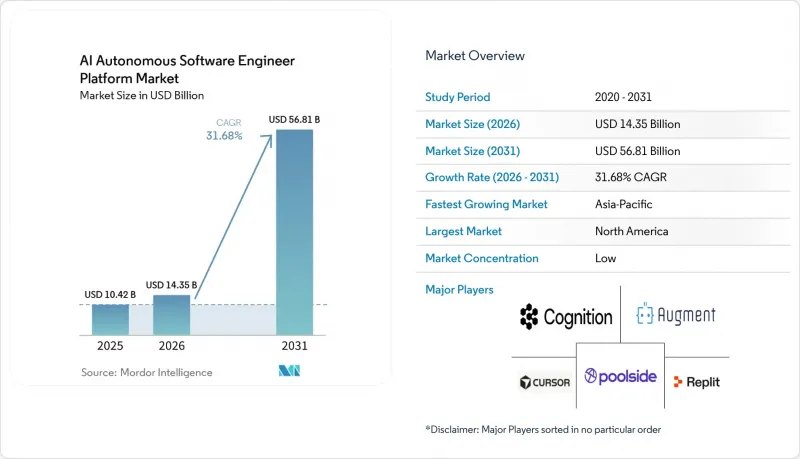
에 따르면 AI 자율형 소프트웨어 엔지니어 플랫폼 시장 규모는 2025년 104억 2,000만 달러에서 2026년에는 143억 5,000만 달러로 확대되어, 2026년부터 2031년까지 CAGR 31.68%를 기록하며 2031년까지 568억 1,000만 달러에 달할 것으로 예측됩니다.
전 세계 AI 자율형 소프트웨어 엔지니어 플랫폼 시장의 동향 및 인사이트
기반 모델의 추론 및 도구 활용 개선
기반 모델의 추론 기능은 플랫폼이 보다 장기적이고 상호 연관성이 높은 엔지니어링 작업에 대응할 수 있도록 함으로써, AI 자율형 소프트웨어 엔지니어 플랫폼 시장을 뒷받침하고 있습니다. Anthropic사는 Claude Opus 5가 기존 테스트 스위트를 수용 기준으로 활용하여 수십만 줄에 달하는 코드베이스 규모의 마이그레이션을 지원할 수 있다고 밝혔습니다. 이 기능을 통해 자율형 도구는 단편적인 코드 제안의 범위를 넘어, 계획, 구현, 테스트, 수정 전반에 걸친 작업으로 진화하고 있습니다. 또한, 여러 벤더가 고성능 모델에 접근할 수 있게 됨에 따라, 단독 코드 생성 기능의 가치는 떨어지고 있습니다. 구매자들은 플랫폼이 어떻게 작업을 할당하고, 컨텍스트를 관리하며, 제어를 적용하고, 각 동작을 기록하는지에 더 큰 비중을 두게 되었습니다. 그 결과, AI 자율형 소프트웨어 엔지니어 플랫폼 시장에서는 모델의 능력을 신뢰할 수 있는 개발 워크플로로 전환할 수 있는 벤더가 우위를 점하고 있습니다.
만성적인 개발자 부족과 엔지니어링 역량 격차
만성적인 기술 격차로 인해 대기업과 서비스 제공업체 모두 AI 자율형 소프트웨어 엔지니어 플랫폼 시장에 대한 관심이 높아지고 있습니다. 맨파워그룹은 2026년 보고서에서 고용주의 20%가 AI 모델 및 애플리케이션 개발을 ‘확보하기 어려운 기술’로 꼽은 반면, 엔지니어링 기술은 19%에 그쳤다고 보고했습니다. 동 조사에 따르면, 채용 난이도는 독일에서 83%, 프랑스에서 74%, 영국에서 73%였습니다. 이러한 격차는 프로그래밍 영역에만 국한되지 않는데, 조직이 AI 시스템과 관련된 보안, 모니터링, 품질 관리를 담당할 수 있는 인력도 필요로 하기 때문입니다. 자율형 플랫폼은 기존 팀의 생산성을 향상시킬 수 있지만, 검토나 책임 있는 감독의 필요성을 배제하는 것은 아닙니다. 따라서 수요는 자동화와 승인 절차, 정책 적용, 감사 기록을 결합한 제품에 집중되고 있습니다.
보안, 신뢰성 및 부정 조작의 위험
보안 및 신뢰성에 대한 우려는, 특히 규제 대상 조직에서, AI 자율형 소프트웨어 엔지니어 플랫폼 시장에 여전히 중대한 제약요인으로 작용하고 있습니다. 마이크로소프트는 2026년 6월, Claude Code GitHub Action이 신뢰할 수 없는 GitHub 콘텐츠를 처리할 때 CI/CD 워크플로우의 기밀 정보를 유출할 가능성이 있음을 밝혔습니다. 이 사례는 엄격한 관리 없이 리포지토리, 기밀 정보 또는 배포 도구에 대한 접근 권한을 부여받은 에이전트가 어떻게 보안 위험을 초래할 수 있는지를 보여줍니다. 이에 기업 측은 인간 승인 단계 설정, 권한 제한, 프롬프트 격리, 에이전트 활동 기록 의무화 등을 통해 대응하고 있습니다. 이러한 요구 사항은 특히 금융, 의료, 정부 기관에서 조달 및 도입 주기를 길게 만들 가능성이 있습니다. 또한 이는 선택적 추가 기능이 아닌, 제품에 내장된 강력한 보안 조치를 제공하는 벤더에게 좋은 기회가 될 것입니다. 자율형 에이전트가 소프트웨어 수명주기 전반에 걸쳐 더 광범위한 권한을 부여받게 됨에 따라, 신뢰할 수 있는 제어는 앞으로도 필수적일 것입니다.
부문 분석
2025년, ‘코드 생성 및 기능 구현’은 매출의 37.12%를 차지하며 계속해서 가장 큰 기능 부문으로 자리매김했습니다. 이 분야가 조기에 채택된 배경에는 제품과 완료된 기능 요청이나 코드 변경과 같은 가시적인 개발 성과 사이에 직접적인 연관성이 있었기 때문입니다. ‘코드 완성 및 인라인 편집’은 익숙한 프로그래밍 작업을 코드 편집기 내에서 수행할 수 있기 때문에 여전히 일반적인 도입 포인트로 자리 잡고 있습니다. ‘자동 테스트 생성 및 유지보수’는 비중은 작지만, 자율형 코드의 양이 증가함에 따라 그 중요성이 커지고 있습니다.
코드 리뷰와 디버깅은 2031년까지 연평균 성장률(CAGR)이 32.68%에 달해 가장 빠르게 성장할 기능으로 예상됩니다. 이는 코드 생성 속도가 빨라짐에 따라 팀이 테스트, 검증, 승인해야 하는 변경량이 증가한다는 제약에 대응하기 위한 것입니다. 리뷰 도구는 결함을 식별하고, 변경 내용을 설명하며, 인간의 판단이 필요한 결정 사항에 주의를 집중시킬 수 있습니다. AI 자율형 소프트웨어 엔지니어 플랫폼 업계는 생성, 테스트, 검증이 단일 워크플로의 일부가 되는 통합 시스템으로 전환되고 있습니다.
2025년에는 IDE 통합형 플랫폼이 매출의 46.81%를 차지하며, 계속해서 주요 도입 환경으로서의 지위를 유지했습니다. 개발자들이 이러한 제품을 선호하는 이유는 소프트웨어 작성, 편집, 리뷰에 사용하는 도구에 AI 기능이 내장되어 있기 때문입니다. 또한 IDE를 통한 도입을 통해 팀은 더 광범위한 작업을 할당하기 전에 단계적으로 자율성을 도입할 수 있게 됩니다. Cursor사는 2026년 4월, 개발자 작업 공간에서 개별 제안에서 에이전트 간 협업으로의 전환을 반영하여, 병렬 에이전트를 핵심으로 한 제품 재설계를 단행했습니다.
클라우드 CI/CD 파이프라인 플랫폼은 32.48%라는 가장 높은 연평균 성장률(CAGR)이 예상되며, 2031년까지 도입 환경이 확대될 것으로 전망됩니다. 이러한 플랫폼에서는 에이전트가 소프트웨어를 빌드, 테스트, 릴리스하는 것과 동일한 워크플로를 통해 작업을 비동기적으로 실행할 수 있습니다. 이 모델은 개발자의 반복 작업을 줄일 수 있지만, 권한 관리 및 모니터링의 중요성을 높입니다. 데이터 상주 요건이나 감사 요건이 있는 구매자에게는 프라이빗 클라우드 및 온프레미스 구성의 중요성이 점점 더 커지고 있습니다. 벤더가 별도의 운영 프로세스를 추가하지 않고 통합을 실현함으로써 AI 자율형 소프트웨어 엔지니어 플랫폼 시장이 뒷받침되고 있습니다.
지역별 분석
북미는 2025년 매출의 41.19%를 차지하며 계속해서 최대 지역 시장으로 자리매김했습니다. 이 지역에는 AI 네이티브 벤더, 확립된 클라우드 인프라, 그리고 대기업의 풍부한 기술 예산이 융합되어 있습니다. CSET 조지타운에 따르면, 2026년 3월 기준 미국에는 51만 9,000명의 AI 개발자가 있었습니다. 캐나다와 멕시코는 소프트웨어 생태계와 국경을 초월한 조달 활동을 더욱 강화하고 있습니다. 북미의 AI 자율형 소프트웨어 엔지니어 플랫폼 시장 규모는 기업들이 라이선스 수 기반 가격 책정에서 사용량 기반 계약으로 전환하고 있는 점도 뒷받침하고 있습니다.
유럽은 데이터 주권, 개인정보 보호, 규정 준수가 도입 선택에 영향을 미친다는 점에서 독특합니다. EU AI법과 GDPR의 시행으로 인해 프라이빗 클라우드, 하이브리드, 온프레미스 구성에 대한 수요가 증가하고 있습니다. 독일, 프랑스, 영국에서는 인재 확보가 극히 어려운 상황이며, 이는 엔지니어링 역량을 확장할 수 있는 도구에 대한 수요를 뒷받침하고 있습니다. 영국은 벤더의 연구개발 활동을 유치하고 있는 반면, 독일, 네덜란드, 프랑스에서는 데이터 거주 요건이 더 엄격합니다. 남미, 중동 및 아프리카는 여전히 초기 단계의 시장이지만, 브라질의 아웃소싱 부문과 아랍에미리트 및 사우디아라비아의 디지털 프로그램이 도입을 뒷받침하고 있습니다.
아시아태평양은 2031년까지 연평균 성장률(CAGR)이 32.73%에 달해 가장 빠른 성장이 예상되는 지역입니다. 중국에는 데이터 현지화 규제와 국산 소프트웨어 조달 우선 정책에 의해 형성된 국내 생태계가 존재합니다. Qoder의 조사에 따르면, 2025년 시점에서 알리바바는 중국 AI 코딩 시장의 47.6%를 차지했습니다. 일본은 시스템 통합업체를 통해 도구를 도입하고 있는 반면, 인도는 풍부한 개발자 기반을 활용하여 국내 및 세계에서의 활용을 촉진하고 있습니다. 남아프리카공화국, 나이지리아, 이집트는 도입 단계가 아직 초기이지만, 기술 분야 및 스타트업 생태계 전반에서 활동이 활발해지고 있습니다.
기타 혜택:
- 엑셀 형식의 시장 예측(ME) 시트
- 3개월간의 애널리스트 지원
자주 묻는 질문
목차
제1장 소개
- 조사 가정과 시장 정의
- 조사 범위
제2장 조사 방법
제3장 주요 요약
제4장 시장 구도
- 시장 개요
- 시장 성장 촉진요인
- 시장 성장 억제요인
- 거시경제 요인이 시장에 미치는 영향
- 업계 밸류체인 분석
- 규제 상황
- 기술 전망
- Porter's Five Forces 분석
제5장 시장 규모와 성장 예측
- 에이전트 기능별
- 도입 환경별
- 조직 규모별
- 최종사용자별
- 지역별
- 북미
- 미국
- 캐나다
- 멕시코
- 남미
- 브라질
- 아르헨티나
- 콜롬비아
- 칠레
- 기타 남미 국가
- 유럽
- 영국
- 독일
- 프랑스
- 네덜란드
- 기타 유럽 국가
- 아시아태평양
- 중국
- 인도
- 일본
- 한국
- 기타 아시아태평양 국가
- 중동
- 아랍에미리트
- 사우디아라비아
- 튀르키예
- 기타 중동 국가
- 아프리카
- 남아프리카공화국
- 나이지리아
- 이집트
- 기타 아프리카 국가
- 북미
제6장 경쟁 구도
- 시장 집중도
- 전략적 동향
- 시장 점유율 분석
- 기업 개요
- Cognition AI, Inc.
- Anysphere, Inc.
- Replit, Inc.
- Poolside SAS AI
- Augment Computing, Inc.
- Sourcegraph, Inc.
- Tabnine Ltd.
- Qodo Ltd.
- Magic AI, Inc.
- Factory AI, Inc.
- Lovable Technologies AB
- StackBlitz, Inc.
- CodeRabbit, Inc.
- Cosine AI, Inc.
- All Hands AI, Inc.
- Pythagora, Inc.
- Mutable, Inc.
- Refact AI, Inc.
- BLACKBOX AI, Inc.
- Bito Technologies, Inc.
제7장 시장 기회와 향후 전망
KSM 26.10.29According to Mordor Intelligence, the AI autonomous software engineer platform market size is expected to grow from USD 10.42 billion in 2025 to USD 14.35 billion in 2026, and is forecast to reach USD 56.81 billion by 2031, at a 31.68% CAGR over 2026-2031.
Global AI Autonomous Software Engineer Platform Market Trends and Insights
Foundation-Model Reasoning and Tool-Use Improvements
Foundation-model reasoning is supporting the AI autonomous software engineer platform market by enabling platforms to address longer, more connected engineering tasks. Anthropic stated that Claude Opus 5 could support codebase-scale migrations across hundreds of thousands of lines of code, using existing test suites as an acceptance measure. This capability moves autonomous tools beyond isolated code suggestions and toward work that spans planning, implementation, testing, and revision. It also reduces the value of standalone code-generation features when several vendors can access capable models. Buyers are placing more weight on how a platform assigns tasks, manages context, applies controls, and records each action. The AI autonomous software engineer platform market consequently favors vendors that can turn model capability into reliable development workflows.
Persistent Developer Shortages and Engineering Capacity Gaps
Persistent skill gaps are increasing interest in the AI autonomous software engineer platform market across both large organizations and service providers. ManpowerGroup reported in 2026 that AI model and application development was cited by 20% of employers as a hard-to-find skill, while engineering skills were cited by 19%. The same survey reported hiring difficulty rates of 83% in Germany, 74% in France, and 73% in the United Kingdom. The gap extends beyond programming because organizations also need people who can manage security, monitoring, and quality controls around AI systems. Autonomous platforms can increase the output of existing teams, but they do not remove the need for review and accountable oversight. Demand therefore favors products that combine automation with approval gates, policy enforcement, and audit records.
Security, Reliability, and Unauthorized-Action Risk
Security and reliability concerns remain a material restraint for the AI autonomous software engineer platform market, especially in regulated organizations. Microsoft disclosed in June 2026 that the Claude Code GitHub Action could expose CI/CD workflow secrets when it processed untrusted GitHub content. The case shows how an agent can create exposure when it receives access to repositories, secrets, or deployment tools without tight controls. Enterprises are responding by requiring human approval points, restricted permissions, prompt isolation, and records of agent actions. These requirements can lengthen procurement and implementation cycles, particularly in finance, healthcare, and government. They also create an opening for vendors that offer strong security practices built into the product rather than as an optional add-on. Reliable controls will remain necessary as autonomous agents receive broader authority across the software lifecycle.
Other drivers and restraints analyzed in the detailed report include:
- Enterprise Demand for End-to-End SDLC Productivity
- Cloud-Native and CI/CD Modernization
- Unpredictable Inference Economics and Agent-Usage Costs
For complete list of drivers and restraints, kindly check the Table Of Contents.
Segment Analysis
Code Generation and Feature Implementation held 37.12% of revenue in 2025 and remained the largest capability segment. Its early adoption reflected a direct connection between the product and visible development output, including completed feature requests and code changes. Code Completion and Inline Editing remained common entry points because they fit familiar programming work into the code editor. Automated Test Generation and Maintenance accounted for a smaller share of the mix but gained importance as autonomous code volumes increased.
Code Review and debugging are expected to be the fastest-expanding capabilities with a CAGR of 32.68% through 2031. It addresses a constraint because faster code generation can increase the volume of changes that teams must test, validate, and approve. Review tools can identify defects, explain changes, and direct attention toward decisions that need human judgment. The AI autonomous software engineering platform industry is moving toward combined systems in which generation, testing, and validation are part of a single workflow.
IDE-Integrated Platforms accounted for 46.81% of revenue in 2025 and remained the leading deployment environment. Developers prefer these products because they bring AI functions into the tools used for writing, editing, and reviewing software. IDE deployment also lets teams gradually introduce autonomy before assigning broader tasks. Cursor redesigned its product around parallel agents in April 2026, reflecting a move from individual suggestions to coordinated agent work in the developer workspace.
Cloud CI/CD Pipeline Platforms are expected to have the fastest CAGR, at 32.48%, expanding the deployment environment through 2031. They allow agents to execute tasks asynchronously through the same workflows that build, test, and release software. The model can reduce repetitive developer work, but it raises the importance of permissions and monitoring. Private cloud and on-premises configurations are becoming more relevant for buyers with data residency or audit requirements. The AI autonomous software engineer platform market is supported when vendors deliver integration without adding separate operational processes.
Complete Report Scope:
- By Agent Capability
- Code Generation and Feature Implementation
- Code Completion and Inline Editing
- Code Review and Debugging
- Automated Test Generation and Maintenance
- Other Agent Capabilities
- By Deployment Environment
- IDE-Integrated Platforms
- Cloud CI/CD Pipeline Platforms
- Standalone Web Platforms
- Other Deployment Environments
- By Organization Size
- Large Enterprises
- Small and Medium-Sized Enterprises
- By End User
- Enterprise Software Teams
- Independent Software Vendors
- System Integrators and Technology-Service Providers
- Open-Source Development Communities
- Other End Users
- By Geography
- North America
- United States
- Canada
- Mexico
- South America
- Brazil
- Argentina
- Colombia
- Chile
- Rest of South America
- Europe
- United Kingdom
- Germany
- France
- Netherlands
- Rest of Europe
- Asia-Pacific
- China
- India
- Japan
- South Korea
- Rest of Asia-Pacific
- Middle East
- United Arab Emirates
- Saudi Arabia
- Turkey
- Rest of Middle East
- Africa
- South Africa
- Nigeria
- Egypt
- Rest of Africa
- North America
Geography Analysis
North America held 41.19% of revenue in 2025 and remained the largest regional market. The region combines AI-native vendors, established cloud infrastructure, and large enterprise technology budgets. The United States had 519,000 AI development workers as of March 2026, according to CSET Georgetown. Canada and Mexico add software ecosystems and cross-border procurement activity. The AI autonomous software engineer platform market size in North America is also supported by companies moving from seat-based pricing toward usage-based arrangements.
Europe is distinct because data sovereignty, privacy, and compliance influence deployment choices. The EU AI Act and GDPR enforcement are strengthening demand for private-cloud, hybrid, and on-premises configurations. Germany, France, and the United Kingdom face high hiring difficulty, which supports demand for tools that can extend engineering capacity. The United Kingdom has attracted vendor research and development activity, whereas Germany, the Netherlands, and France have stronger data residency requirements. South America, the Middle East, and Africa remain earlier-stage markets, with Brazil's outsourcing sector and digital programs in the United Arab Emirates and Saudi Arabia supporting adoption.
Asia-Pacific is expected to be the fastest-growing region, with a CAGR of 32.73% through 2031. China has a domestic ecosystem shaped by data-localization rules and procurement preferences for local software. Alibaba held 47.6% of China's AI coding market in 2025, according to Qoder. Japan is adopting tools through systems integrators, while India supports domestic and global use through its large developer base. South Africa, Nigeria, and Egypt are earlier in adoption but are seeing increased activity across technology sectors and startup ecosystems.
- Cognition AI, Inc.
- Anysphere, Inc.
- Replit, Inc.
- Poolside SAS AI
- Augment Computing, Inc.
- Sourcegraph, Inc.
- Tabnine Ltd.
- Qodo Ltd.
- Magic AI, Inc.
- Factory AI, Inc.
- Lovable Technologies AB
- StackBlitz, Inc.
- CodeRabbit, Inc.
- Cosine AI, Inc.
- All Hands AI, Inc.
- Pythagora, Inc.
- Mutable, Inc.
- Refact AI, Inc.
- BLACKBOX AI, Inc.
- Bito Technologies, Inc.
Additional Benefits:
- The market estimate (ME) sheet in Excel format
- 3 months of analyst support
TABLE OF CONTENTS
1 INTRODUCTION
- 1.1 Study Assumptions and Market Definition
- 1.2 Scope of the Study
2 RESEARCH METHODOLOGY
3 EXECUTIVE SUMMARY
4 MARKET LANDSCAPE
- 4.1 Market Overview
- 4.2 Market Drivers
- 4.2.1 Foundation-Model Reasoning and Tool-Use Improvements
- 4.2.2 Persistent Developer Shortages and Engineering Capacity Gaps
- 4.2.3 Enterprise Demand for End-to-End SDLC Productivity
- 4.2.4 Cloud-Native and CI/CD Modernization
- 4.2.5 Rising Demand for Private and Governed AI Development
- 4.2.6 Standardization of Agent Interoperability Protocols
- 4.3 Market Restraints
- 4.3.1 Unpredictable Inference Economics and Agent-Usage Costs
- 4.3.2 Security, Reliability, and Unauthorized-Action Risk
- 4.3.3 Intellectual-Property and Code-Provenance Uncertainty
- 4.3.4 Legacy-System Integration and Weak Enterprise ROI Visibility
- 4.4 Impact of Macroeconomic Factors on the Market
- 4.5 Industry Value Chain Analysis
- 4.6 Regulatory Landscape
- 4.7 Technological Outlook
- 4.8 Porter's Five Forces Analysis
- 4.8.1 Threat of New Entrants
- 4.8.2 Bargaining Power of Suppliers
- 4.8.3 Bargaining Power of Buyers
- 4.8.4 Threat of Substitutes
- 4.8.5 Intensity of Competitive Rivalry
5 MARKET SIZE AND GROWTH FORECASTS (VALUE)
- 5.1 By Agent Capability
- 5.1.1 Code Generation and Feature Implementation
- 5.1.2 Code Completion and Inline Editing
- 5.1.3 Code Review and Debugging
- 5.1.4 Automated Test Generation and Maintenance
- 5.1.5 Other Agent Capabilities
- 5.2 By Deployment Environment
- 5.2.1 IDE-Integrated Platforms
- 5.2.2 Cloud CI/CD Pipeline Platforms
- 5.2.3 Standalone Web Platforms
- 5.2.4 Other Deployment Environments
- 5.3 By Organization Size
- 5.3.1 Large Enterprises
- 5.3.2 Small and Medium-Sized Enterprises
- 5.4 By End User
- 5.4.1 Enterprise Software Teams
- 5.4.2 Independent Software Vendors
- 5.4.3 System Integrators and Technology-Service Providers
- 5.4.4 Open-Source Development Communities
- 5.4.5 Other End Users
- 5.5 By Geography
- 5.5.1 North America
- 5.5.1.1 United States
- 5.5.1.2 Canada
- 5.5.1.3 Mexico
- 5.5.2 South America
- 5.5.2.1 Brazil
- 5.5.2.2 Argentina
- 5.5.2.3 Colombia
- 5.5.2.4 Chile
- 5.5.2.5 Rest of South America
- 5.5.3 Europe
- 5.5.3.1 United Kingdom
- 5.5.3.2 Germany
- 5.5.3.3 France
- 5.5.3.4 Netherlands
- 5.5.3.5 Rest of Europe
- 5.5.4 Asia-Pacific
- 5.5.4.1 China
- 5.5.4.2 India
- 5.5.4.3 Japan
- 5.5.4.4 South Korea
- 5.5.4.5 Rest of Asia-Pacific
- 5.5.5 Middle East
- 5.5.5.1 United Arab Emirates
- 5.5.5.2 Saudi Arabia
- 5.5.5.3 Turkey
- 5.5.5.4 Rest of Middle East
- 5.5.6 Africa
- 5.5.6.1 South Africa
- 5.5.6.2 Nigeria
- 5.5.6.3 Egypt
- 5.5.6.4 Rest of Africa
- 5.5.1 North America
6 COMPETITIVE LANDSCAPE
- 6.1 Market Concentration
- 6.2 Strategic Moves
- 6.3 Market Share Analysis
- 6.4 Company Profiles (includes Global Level Overview, Market Level Overview, Core Segments, Financials as available, Strategic Information, Market Rank/Share, Products and Services, Recent Developments)
- 6.4.1 Cognition AI, Inc.
- 6.4.2 Anysphere, Inc.
- 6.4.3 Replit, Inc.
- 6.4.4 Poolside SAS AI
- 6.4.5 Augment Computing, Inc.
- 6.4.6 Sourcegraph, Inc.
- 6.4.7 Tabnine Ltd.
- 6.4.8 Qodo Ltd.
- 6.4.9 Magic AI, Inc.
- 6.4.10 Factory AI, Inc.
- 6.4.11 Lovable Technologies AB
- 6.4.12 StackBlitz, Inc.
- 6.4.13 CodeRabbit, Inc.
- 6.4.14 Cosine AI, Inc.
- 6.4.15 All Hands AI, Inc.
- 6.4.16 Pythagora, Inc.
- 6.4.17 Mutable, Inc.
- 6.4.18 Refact AI, Inc.
- 6.4.19 BLACKBOX AI, Inc.
- 6.4.20 Bito Technologies, Inc.
7 MARKET OPPORTUNITIES AND FUTURE OUTLOOK
- 7.1 White-Space and Unmet-Need Assessment


