

|
시장보고서
상품코드
2154733
머신 아이덴티티 관리 플랫폼 : 시장 점유율 분석, 업계 동향과 통계, 성장 예측(2026-2031년)Machine Identity Management Platform - Market Share Analysis, Industry Trends & Statistics, Growth Forecasts (2026 - 2031) |
||||||
 Mordor Intelligence
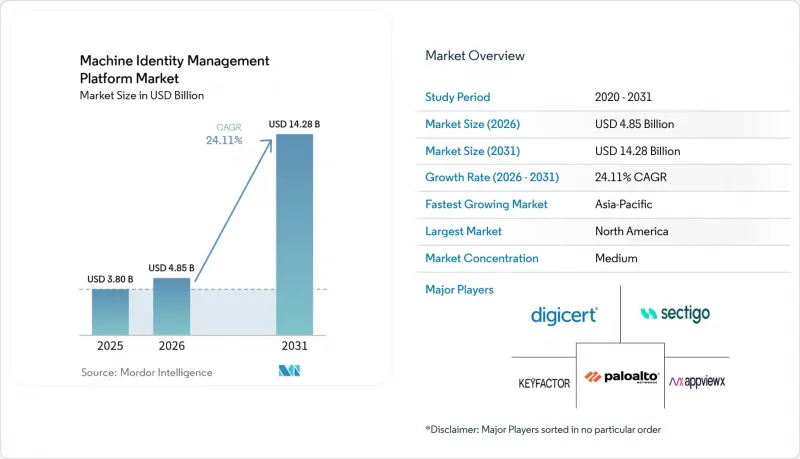
에 따르면 머신 아이덴티티 관리 플랫폼 시장 규모는 2025년 38억 달러, 2026년 48억 5,000만 달러에서 2031년까지 142억 8,000만 달러로 확대될 것으로 예측되며, 2026년부터 2031년까지 연평균 성장률(CAGR)은 24.11%가 될 전망입니다.
전 세계 머신 아이덴티티 관리 플랫폼 시장의 동향 및 인사이트
클라우드 네이티브 워크로드와 API의 확대가 인증 정보 수요를 견인
클라우드 네이티브 설계에서는 기존 데이터센터 시스템에 비해 훨씬 빠른 속도로 머신 아이덴티티가 생성됩니다. 각 마이크로서비스, 컨테이너, 서버리스 함수 및 API 엔드포인트에는 인증된 통신을 수행하기 위해 고유한 암호화 ID가 필요합니다. 멀티 클라우드 환경에서는 각 환경마다 서로 다른 도구와 정책이 사용될 가능성이 있으므로, 이러한 요구 사항은 더욱 커집니다. IBM은 2026년, ID 및 액세스 관리 포트폴리오 내의 전문 분야로 머신 아이덴티티 관리를 도입하여 자동화된 탐지, 발급, 갱신 및 만료에 중점을 두고 있습니다. 또한, 개발 팀이 자체적으로 API 키나 OAuth 토큰을 생성하는 경우, API의 무분별한 증가로 인해 이러한 키와 토큰이 보안 팀의 모니터링 범위 밖으로 빠져나갈 가능성이 있습니다. 따라서 머신 아이덴티티 관리 시장은 인증 정보의 양이 증가하고 있다는 점과, 그로 인해 발생하는 가시성 격차를 메워야 할 필요성이라는 두 가지 요인 모두로부터 혜택을 받고 있습니다.
제로 트러스트 도입이 머신 간 인증을 재정의합니다.
제로 트러스트에서는 연결이 어디서 시작되었는지와 관계없이 모든 연결에 대해 검증이 요구됩니다. 이 원칙은 기업 네트워크 내 활동의 상당 부분을 뒷받침하는 머신 간 트래픽에 직접 적용됩니다. 클라우드 네이티브 컴퓨팅 재단(CNCF)이 관리하는 SPIFFE 및 SPIRE 표준은 단기 유효한 암호화 SVID와 컨테이너 및 가상 머신에 대한 지속적인 인증을 통해 워크로드의 신원을 지원합니다. Corsha는 2025년, 중요한 운영 시스템 간의 제로 트러스트 연결과 관련하여 미국 국방물류국(DLA)으로부터 5,000만 달러 규모의 단독 조달 IDIQ 계약을 수주했습니다. 이러한 움직임은 기존에 네트워크 세분화에 크게 의존해 왔던 국방, 공공 서비스, 제조업 분야에서도 머신 인증이 중요해지고 있음을 보여주며, 머신 아이덴티티 관리 시장을 기존의 엔터프라이즈 PKI 프로젝트의 범위를 넘어 확장시키고 있습니다.
분산된 레거시 PKI와 비밀 관리 도구가 플랫폼 도입을 지연시키고 있습니다.
팔로알토 네트웍스가 인용한 2026년 포네몬 연구소의 조사에 따르면, 3분의 1 이상의 조직이 레거시 PKI의 비용과 위험을 기기 인증 정보를 보호하는 데 있어 주요 장애물로 꼽고 있습니다. 대규모 조직에서는 Microsoft Active Directory Certificate Services, HashiCorp Vault, 클라우드 시크릿 스토어 및 서로 다른 벤더의 하드웨어 보안 모듈(HSM)을 병용하는 경우가 많습니다. 자동화된 정책 적용을 일관되게 작동시키려면 이러한 도구를 공통의 거버넌스 계층에 연결해야 합니다. Ponemon-Sullivan의 조사에 따르면, 53%의 조직이 여전히 PKI의 건전성을 평가하기 위해 수동적이거나 임시방편적인 방법을 사용하고 있는 것으로 나타났습니다. NIST는 2024년 8월에 FIPS 203, FIPS 204 및 FIPS 205를 최종 확정했으며, PKI 운영의 현대화에 이미 필요했던 작업에 포스트 양자 전환이 추가되었습니다. 머신 아이덴티티 관리 시장의 보급 속도는 여전히 완만한 수준에 머물러 있습니다. 이는 조직이 안정적인 일상적인 인증서 운영을 유지하면서 레거시 인프라를 재설계해야 하기 때문입니다.
부문 분석
2025년 기준으로 솔루션은 머신 아이덴티티 관리 시장의 57.31% 점유율을 차지했습니다. 이 범주에는 인증서 수명주기 관리 플랫폼, 시크릿 관리 볼트, PKI-as-a-Service(PKI-as-a-Service) 서비스, 그리고 머신 아이덴티티 거버넌스 프로그램의 핵심 기술 계층을 제공하는 워크로드 ID 관리 도구가 포함됩니다. 서비스 부문은 2026년부터 2031년까지 연평균 성장률(CAGR) 24.51%로 확대될 것으로 예측됩니다. 플랫폼 도입 시, 조직이 일관된 성과를 달성할 수 있게 되기까지는 구현, 통합 및 운영 관리에 대한 지원이 필요한 경우가 많습니다. 이러한 경향은 많은 기업 보안 팀에서 PKI 인력이 부족한 현실을 반영하고 있습니다.
전문 서비스에 대한 수요는 포스트 양자 암호화로의 전환에 필요한 작업도 반영하고 있습니다. 'Computers'지의 2025년 조사에 따르면, 중견 기업의 경우 8-12년, 대기업의 경우 12-15년 이상 소요될 것으로 추정됩니다. 이러한 긴 기간은 암호화 기술에 대한 전문 지식을 갖춘 벤더에게 지속적인 컨설팅 및 자문 업무의 기회가 될 것입니다. 매니지드 서비스는 사내에 PKI 담당자가 없는 조직에 제공되며, 같은 2026년 Ponemon-Sullivan 조사에 따르면 63%의 조직이 기본적인 PKI 운영을 외부에 위탁하고 있는 것으로 나타났습니다. 관리형 인증서 수명주기 관리와 포스트 양자 암호화 대응 평가를 결합한 벤더는 운영 측면과 계획 측면의 요구 사항을 모두 충족할 수 있습니다.
2025년, 애플리케이션 및 서비스 ID는 머신 아이덴티티 관리 시장의 28.53%를 차지했습니다. 이 점유율은 인증된 API 통신을 위해 서비스 계정, 클라이언트 인증서, OAuth 토큰을 사용하는 애플리케이션 및 마이크로서비스의 기반이 확립되었음을 반영합니다. AI 에이전트 ID는 2026년부터 2031년까지 연평균 성장률(CAGR) 25.51%로 확대될 것으로 예측됩니다. 이러한 성장은 정적인 서비스 계정의 인증 정보가 아닌, 지속적인 ID 증명의 필요성을 반영합니다. IETF의 에이전트 ID 프레임워크 초안에서는 ID, 권한 부여, 증명, 증거 및 신뢰에 관한 각 계층이 개략적으로 설명되어 있습니다.
워크로드 및 컨테이너의 신원은 SSH 키나 암호화 키와 함께 DevSecOps 파이프라인에서 여전히 필수적입니다. 인증서의 유효 기간이 단축됨에 따라 이러한 자동화의 가능성은 높아지고 있습니다. 시크릿, 비밀번호, 액세스 토큰, API 키, OAuth 토큰과 같은 신원 정보 또한 대규모 배포 기반을 형성하고 있으며, 여기에서는 ‘섀도우 자격 증명’의 존재가 거버넌스상의 과제를 야기하고 있습니다. 단일 에이전트형 워크플로우에서 API 키 사용, 상호 TLS를 통한 서비스 호출, 시크릿에 대한 액세스가 하나의 트랜잭션 내에서 이루어지는 경우가 있으며, 이로 인해 신원 범주 간에 의존성이 발생합니다. 따라서 머신 신원 관리 업계에서는 개별적으로 작동하는 도구가 아닌, 신원 유형을 아우르며 라이프사이클을 관리하는 플랫폼이 요구되고 있습니다.
지역별 분석
2025년, 북미는 머신 아이덴티티 관리 시장 규모의 43.77%를 차지했습니다. 이 지역은 클라우드 규모의 기술 구매자 집중, 확립된 제로 트러스트 프로그램, 그리고 CyberArk, Keyfactor, AppViewX, DigiCert와 같은 주요 벤더의 존재라는 이점을 누리고 있습니다. 미국 연방정부 관리예산국(OMB)의 M-22-09 지침에 기반한 제로 트러스트 정책은 민간 기관 및 연방정부 계약업체에 대한 요구 사항을 지속적으로 확대하고 있습니다. 이로 인해 최대 규모의 민간 기업을 넘어선 수요가 창출되어, 머신 아이덴티티 관리 시장이 정부 공급업체 및 정부 기관으로까지 확대되는 데 기여하고 있습니다. 캐나다와 멕시코는 금융 서비스 및 국경을 초월한 기술 사업을 통해 시장 규모를 확대하고 있는 반면, 마이크로소프트는 2026년 8월, 15개의 제어 그룹과 91개의 과제를 포함하는 ‘제로 트러스트 워크숍’에 DevSecOps를 핵심 요소로 추가하여 AI를 위한 제로 트러스트 전략을 강화했습니다.
2025년, 유럽은 지역별 점유율에서 2위를 차지했습니다. 독일, 영국, 프랑스가 주요 수요 기반을 형성하고 있으며, 2025년 1월에는 금융 기관 및 해당 ICT 서비스 제공업체를 대상으로 한 DORA가 시행되었습니다. 독일의 BSI와 프랑스의 ANSSI는 포스트 양자 암호화로의 전환에 관한 지침을 발표했으며, 2025년 11월 Trusted Computing Group의 조사에 따르면 독일 보안 전문가의 70%가 2026년까지 최소 1개의 PQC 알고리즘이 실제 운영 단계에 진입할 것으로 예상했습니다. 영국은 사이버 복원력에 관한 지침을 통해 인증서 수명주기의 자동화를 추진하고 있습니다. 한편, 남미는 여전히 신흥 지역이며, 브라질에서는 금융 서비스의 디지털화와 브라질 중앙은행(Banco Central do Brasil)의 요구 사항이 이를 뒷받침하고 있습니다.
아시아태평양은 2026년부터 2031년까지 연평균 성장률(CAGR) 25.09%로 확대될 것으로 예측되며, 지역 내 ID 시스템이 현대화됨에 따라 머신 아이덴티티 관리 시장의 중요성이 높아지고 있습니다. 2026년, 팔로알토 네트웍스는 해당 지역의 기업 환경에서 머신 아이덴티티 수가 인간 직원 수를 111대 1의 비율로 앞질렀다고 보고했습니다. 인도에서는 핀테크의 확대, 디지털 결제 인프라, 그리고 대규모 개발자 기반에 힘입은 수요가 나타나고 있으며, API를 많이 사용하는 업무로 인해 방대한 인증 정보 재고가 생성되고 있습니다. 일본과 한국은 머신 인증에 있어 제로 트러스트 원칙을 중시하는 사이버 보안 프로그램을 추진하고 있습니다. 한편, 2026년 호주, 싱가포르, 일본을 대상으로 실시된 옥타(Okta)의 조사에 따르면, 응답자의 10% 미만이 자사의 ID 시스템이 비인간 ID를 관리하는 데 충분히 갖춰져 있다고 생각하지 않는 것으로 나타났습니다. 중국에서는 클라우드 인프라와 국가 주도의 AI 개발을 통해 머신 아이덴티티의 양이 확대되고 있으며, 데이터의 현지화가 벤더에 대한 접근을 좌우하고 있습니다. 반면 중동 및 아프리카에서는 금융 부문의 규제와 정부의 디지털 프로그램에 힘입고 있음에도 불구하고, 도입은 여전히 초기 단계에 머물러 있습니다.
기타 혜택:
- 엑셀 형식의 시장 전망(ME) 시트
- 3개월간의 애널리스트 지원
자주 묻는 질문
목차
제1장 소개
- 조사 가정과 시장 정의
- 조사 범위
제2장 조사 방법
제3장 주요 요약
제4장 시장 구도
- 시장 개요
- 거시경제 요인이 시장에 미치는 영향
- 시장 성장 촉진요인
- 시장 성장 억제요인
- 업계 밸류체인 분석
- 규제 상황
- 기술 전망
- Porter's Five Forces 분석
제5장 시장 규모와 성장 예측
- 구성요소별
- ID 유형별
- 전개 방식별
- 조직 규모별
- 최종 이용 산업별
- 지역별
- 북미
- 미국
- 캐나다
- 멕시코
- 남미
- 브라질
- 아르헨티나
- 기타 남미 국가
- 유럽
- 독일
- 영국
- 프랑스
- 이탈리아
- 스페인
- 러시아
- 기타 유럽 국가
- 아시아태평양
- 중국
- 인도
- 일본
- 한국
- 호주
- 기타 아시아태평양 국가
- 중동
- 사우디아라비아
- 아랍에미리트
- 튀르키예
- 기타 중동 국가
- 아프리카
- 남아프리카공화국
- 나이지리아
- 기타 아프리카 국가
- 북미
제6장 경쟁 구도
- 시장 집중도
- 전략적 동향
- 시장 점유율 분석
- 기업 개요
- Palo Alto Networks
- Keyfactor, Inc.
- AppViewX, Inc.
- DigiCert, Inc.
- Sectigo Limited
- Entrust Corporation
- GlobalSign, Inc.
- SSH Communications Security Corporation
- Akeyless Security Ltd.
- Aembit, Inc.
- Astrix Security, Inc.
- Clutch Security, Inc.
- GitGuardian SAS
- P0 Security, Inc.
- Oasis Security Ltd.
- Token Security Ltd.
- SPIRL, Inc.
- Smallstep Labs, Inc.
- Teleport, Inc.
- Corsha, Inc.
- Delinea, Inc.
- BeyondTrust Corporation
- Fortanix, Inc.
- One Identity LLC
제7장 시장 기회와 향후 전망
KSM 26.10.29According to Mordor Intelligence, the machine identity management platform market size is projected to expand from USD 3.80 billion in 2025 and USD 4.85 billion in 2026 to USD 14.28 billion by 2031, registering a CAGR of 24.11% between 2026 and 2031.
Global Machine Identity Management Platform Market Trends and Insights
Expansion of Cloud-Native Workloads and APIs Fuels Credential Demand
Cloud-native designs create machine identities at a much faster rate than traditional data center systems. Each microservice, container, serverless function, and API endpoint needs a distinct cryptographic identity for authenticated communication. Multi-cloud environments increase this requirement because each environment may use different tools and policies. IBM introduced machine identity management as a dedicated discipline within its identity and access management portfolio in 2026, with a focus on automated discovery, issuance, renewal, and revocation. API sprawl can also leave API keys and OAuth tokens outside the security team's visibility when development teams create them independently. The machine identity management market, therefore, benefits both from a higher credential volume and from the need to close the resulting visibility gap.
Zero-Trust Adoption Redefines Machine-to-Machine Authentication
Zero trust requires verification for every connection, regardless of where that connection begins. This principle applies directly to machine-to-machine traffic, which supports much of the activity in enterprise networks. The SPIFFE and SPIRE standard maintained by the Cloud Native Computing Foundation, support workload identities through short-lived cryptographic SVIDs and continuous attestation for containers and virtual machines. Corsha received a USD 50 million sole-source IDIQ contract from the US Defense Logistics Agency in 2025 for zero-trust connectivity across critical operational systems. This activity shows that machine authentication is becoming relevant in defense, utilities, and manufacturing settings that historically relied more heavily on network segmentation, extending the machine identity management market beyond traditional enterprise PKI projects.
Fragmented Legacy PKI and Secrets Tooling Delays Platform Adoption
More than one-third of organizations identified legacy PKI cost and risk as a primary barrier to securing machine credentials in a 2026 Ponemon study cited by Palo Alto Networks. Large organizations often operate Microsoft Active Directory Certificate Services, HashiCorp Vault, cloud secret stores, and hardware security modules from different vendors. These tools must be connected to a common governance layer before automated policy enforcement can work consistently. The Ponemon-Sullivan study found that 53% of organizations still used manual or ad hoc methods to assess PKI health. NIST finalized FIPS 203, FIPS 204, and FIPS 205 in August 2024, adding post-quantum migration to the work already required to modernize PKI operations. The machine identity management market is experiencing slower adoption, as organizations must redesign legacy infrastructure while maintaining stable daily certificate operations.
Other drivers and restraints analyzed in the detailed report include:
- Certificate Lifespan Compression Creates an Automation Imperative
- AI Agent and Autonomous Workflow Proliferation Opens an Ungoverned Identity Surface
- Shortage of Machine Identity Specialists Limits Program Scale
For complete list of drivers and restraints, kindly check the Table Of Contents.
Segment Analysis
Solutions held 57.31% of the machine identity management market share in 2025. This category includes certificate lifecycle management platforms, secrets management vaults, PKI-as-a-service offerings, and workload identity tools that provide the core technology layer for machine identity governance programs. Services are projected to expand at a 24.51% CAGR from 2026 to 2031. Platform deployments often require implementation, integration, and managed operations support before organizations can achieve consistent outcomes. The component pattern reflects the shortage of PKI talent across many enterprise security teams.
Professional services demand also reflects the work required to migrate to post-quantum cryptography. A 2025 study in Computers estimated migration timelines of 8 to 12 years for medium-sized enterprises and 12 to 15+ years for large enterprises. This duration supports ongoing consulting and advisory opportunities for vendors with cryptographic expertise. Managed services are serving organizations that lack internal PKI staffing, and the same 2026 Ponemon-Sullivan study found that 63% of organizations outsourced basic PKI operations. Vendors that combine managed certificate lifecycle management with post-quantum readiness assessments can address both operational and planning needs.
Application and service identities held 28.53% of the machine identity management market share in 2025. Their position reflects the established base of applications and microservices that use service accounts, client certificates, and OAuth tokens for authenticated API communication. AI agent identities are projected to expand at a 25.51% CAGR from 2026 to 2031. This growth reflects the need for continuous identity attestation rather than static service account credentials. The IETF Agent Identity Framework draft outlines layers for identity, authorization, attestation, evidence, and trust.
Workload and container identities, together with SSH keys and cryptographic keys, remain essential to DevSecOps pipelines. Their automation potential increases as the validity periods of certificates shorten. Secrets, passwords, access tokens, API keys, and OAuth token identities also represent large installed bases where shadow credentials create governance needs. A single agentic workflow may use API keys, invoke services via mutual TLS, and access secrets in a single transaction, creating dependencies across identity categories. The machine identity management industry, therefore, needs platforms that manage lifecycles across identity types rather than tools that operate in isolation.
Complete Report Scope:
- By Component
- Solutions
- Services
- By Identity Type
- Application and Service Identities
- API Keys and OAuth Token Identities
- Workload and Container Identities
- Machine Certificates
- Secrets, Passwords, and Access Tokens
- SSH Keys and Cryptographic Keys
- AI Agent Identities
- Other Identity Types
- By Deployment Mode
- Cloud-Based
- On-Premises
- Hybrid
- By Organization Size
- Large Enterprises
- Small and Medium-Sized Enterprises
- By End-User Industry
- BFSI
- Information Technology and Telecommunications
- Healthcare and Life Sciences
- Government and Public Sector
- Manufacturing and Industrial
- Retail and E-Commerce
- Energy and Utilities
- Transportation and Logistics
- By Geography
- North America
- United States
- Canada
- Mexico
- South America
- Brazil
- Argentina
- Rest of South America
- Europe
- Germany
- United Kingdom
- France
- Italy
- Spain
- Russia
- Rest of Europe
- Asia-Pacific
- China
- India
- Japan
- South Korea
- Australia
- Rest of Asia-Pacific
- Middle East
- Saudi Arabia
- United Arab Emirates
- Turkey
- Rest of Middle East
- Africa
- South Africa
- Nigeria
- Rest of Africa
- North America
Geography Analysis
North America accounted for 43.77% of the machine identity management market size in 2025. The region benefits from the concentration of cloud-scale technology buyers, established zero-trust programs, and leading vendors such as CyberArk, Keyfactor, AppViewX, and DigiCert. US federal zero-trust direction under the Office of Management and Budget memorandum M-22-09 continues to extend requirements across civilian agencies and federal contractors. This creates demand beyond the largest private enterprises and helps the machine identity management market reach government suppliers and agencies. Canada and Mexico add volume through financial services and cross-border technology operations, while Microsoft expanded its Zero Trust for AI strategy in August 2026 with a DevSecOps pillar in its Zero Trust Workshop that includes 15 control groups and 91 tasks.
Europe held the second-largest regional share in 2025. Germany, the United Kingdom, and France form the principal demand base, and DORA entered into force in January 2025 for financial entities and their ICT service providers. Germany's BSI and France's ANSSI have issued post-quantum cryptography transition guidance, while 70% of German security professionals expected at least 1 PQC algorithm to be in production by 2026, according to a November 2025 Trusted Computing Group survey. The United Kingdom promotes certificate lifecycle automation in its cyber resilience guidance, while South America remains an emerging region, with Brazil supported by financial services digitalization and the requirements of the Banco Central do Brasil.
Asia-Pacific is projected to expand at a 25.09% CAGR from 2026 to 2031, and the machine identity management market is gaining relevance as regional identity systems are modernized. In 2026, Palo Alto Networks reported that machine identities outnumbered human workers by 111 to 1 across enterprise environments in the region. India is seeing demand driven by fintech expansion, digital payment infrastructure, and a large developer base, where API-dense work creates large credential inventories. Japan and South Korea are advancing cybersecurity programs that emphasize zero-trust principles for machine authentication, while an Okta survey in 2026 across Australia, Singapore, and Japan found that fewer than 10% of respondents considered their identity systems fully equipped to manage non-human identities. China generates machine identity volumes through cloud infrastructure and state-led AI development, with data localization shaping vendor access, while the Middle East and Africa remain at earlier stages of adoption, supported by financial-sector rules and government digital programs.
- Palo Alto Networks
- Keyfactor, Inc.
- AppViewX, Inc.
- DigiCert, Inc.
- Sectigo Limited
- Entrust Corporation
- GlobalSign, Inc.
- SSH Communications Security Corporation
- Akeyless Security Ltd.
- Aembit, Inc.
- Astrix Security, Inc.
- Clutch Security, Inc.
- GitGuardian SAS
- P0 Security, Inc.
- Oasis Security Ltd.
- Token Security Ltd.
- SPIRL, Inc.
- Smallstep Labs, Inc.
- Teleport, Inc.
- Corsha, Inc.
- Delinea, Inc.
- BeyondTrust Corporation
- Fortanix, Inc.
- One Identity LLC
Additional Benefits:
- The market estimate (ME) sheet in Excel format
- 3 months of analyst support
TABLE OF CONTENTS
1 INTRODUCTION
- 1.1 Study Assumptions and Market Definition
- 1.2 Scope of the Study
2 RESEARCH METHODOLOGY
3 EXECUTIVE SUMMARY
4 MARKET LANDSCAPE
- 4.1 Market Overview
- 4.2 Impact of Macroeconomic Factors on the Market
- 4.3 Market Drivers
- 4.3.1 Expansion of Cloud-Native Workloads and APIs
- 4.3.2 Zero-Trust Adoption for Machine-to-Machine Access
- 4.3.3 Shortening Certificate Lifespans and Automated Renewal Requirements
- 4.3.4 AI Agent and Autonomous Workflow Proliferation
- 4.3.5 Machine Identity Governance for Software Supply Chains
- 4.3.6 Post-Quantum Cryptography Readiness and Crypto-Agility Programs
- 4.4 Market Restraints
- 4.4.1 Fragmented Legacy PKI and Secrets Tooling
- 4.4.2 Shortage of PKI and Machine Identity Specialists
- 4.4.3 Ownership Ambiguity Across Platform Engineering and Security Teams
- 4.4.4 False Positives from Ephemeral and Shadow Machine Identities
- 4.5 Industry Value Chain Analysis
- 4.6 Regulatory Landscape
- 4.7 Technological Outlook
- 4.8 Porter's Five Forces Analysis
- 4.8.1 Bargaining Power of Suppliers
- 4.8.2 Bargaining Power of Buyers
- 4.8.3 Threat of New Entrants
- 4.8.4 Threat of Substitutes
- 4.8.5 Intensity of Competitive Rivalry
5 MARKET SIZE AND GROWTH FORECASTS (VALUE)
- 5.1 By Component
- 5.1.1 Solutions
- 5.1.2 Services
- 5.2 By Identity Type
- 5.2.1 Application and Service Identities
- 5.2.2 API Keys and OAuth Token Identities
- 5.2.3 Workload and Container Identities
- 5.2.4 Machine Certificates
- 5.2.5 Secrets, Passwords, and Access Tokens
- 5.2.6 SSH Keys and Cryptographic Keys
- 5.2.7 AI Agent Identities
- 5.2.8 Other Identity Types
- 5.3 By Deployment Mode
- 5.3.1 Cloud-Based
- 5.3.2 On-Premises
- 5.3.3 Hybrid
- 5.4 By Organization Size
- 5.4.1 Large Enterprises
- 5.4.2 Small and Medium-Sized Enterprises
- 5.5 By End-User Industry
- 5.5.1 BFSI
- 5.5.2 Information Technology and Telecommunications
- 5.5.3 Healthcare and Life Sciences
- 5.5.4 Government and Public Sector
- 5.5.5 Manufacturing and Industrial
- 5.5.6 Retail and E-Commerce
- 5.5.7 Energy and Utilities
- 5.5.8 Transportation and Logistics
- 5.6 By Geography
- 5.6.1 North America
- 5.6.1.1 United States
- 5.6.1.2 Canada
- 5.6.1.3 Mexico
- 5.6.2 South America
- 5.6.2.1 Brazil
- 5.6.2.2 Argentina
- 5.6.2.3 Rest of South America
- 5.6.3 Europe
- 5.6.3.1 Germany
- 5.6.3.2 United Kingdom
- 5.6.3.3 France
- 5.6.3.4 Italy
- 5.6.3.5 Spain
- 5.6.3.6 Russia
- 5.6.3.7 Rest of Europe
- 5.6.4 Asia-Pacific
- 5.6.4.1 China
- 5.6.4.2 India
- 5.6.4.3 Japan
- 5.6.4.4 South Korea
- 5.6.4.5 Australia
- 5.6.4.6 Rest of Asia-Pacific
- 5.6.5 Middle East
- 5.6.5.1 Saudi Arabia
- 5.6.5.2 United Arab Emirates
- 5.6.5.3 Turkey
- 5.6.5.4 Rest of Middle East
- 5.6.6 Africa
- 5.6.6.1 South Africa
- 5.6.6.2 Nigeria
- 5.6.6.3 Rest of Africa
- 5.6.1 North America
6 COMPETITIVE LANDSCAPE
- 6.1 Market Concentration
- 6.2 Strategic Moves
- 6.3 Market Share Analysis
- 6.4 Company Profiles (includes Global Level Overview, Market Level Overview, Core Segments, Financials as available, Strategic Information, Market Rank/Share, Products and Services, Recent Developments)
- 6.4.1 Palo Alto Networks
- 6.4.2 Keyfactor, Inc.
- 6.4.3 AppViewX, Inc.
- 6.4.4 DigiCert, Inc.
- 6.4.5 Sectigo Limited
- 6.4.6 Entrust Corporation
- 6.4.7 GlobalSign, Inc.
- 6.4.8 SSH Communications Security Corporation
- 6.4.9 Akeyless Security Ltd.
- 6.4.10 Aembit, Inc.
- 6.4.11 Astrix Security, Inc.
- 6.4.12 Clutch Security, Inc.
- 6.4.13 GitGuardian SAS
- 6.4.14 P0 Security, Inc.
- 6.4.15 Oasis Security Ltd.
- 6.4.16 Token Security Ltd.
- 6.4.17 SPIRL, Inc.
- 6.4.18 Smallstep Labs, Inc.
- 6.4.19 Teleport, Inc.
- 6.4.20 Corsha, Inc.
- 6.4.21 Delinea, Inc.
- 6.4.22 BeyondTrust Corporation
- 6.4.23 Fortanix, Inc.
- 6.4.24 One Identity LLC
7 MARKET OPPORTUNITIES AND FUTURE OUTLOOK
- 7.1 White-Space and Unmet-Need Assessment


