

|
시장보고서
상품코드
2154755
방열 재료 : 시장 점유율 분석, 업계 동향과 통계, 성장 예측(2026-2031년)Heat Dissipation Materials - Market Share Analysis, Industry Trends & Statistics, Growth Forecasts (2026 - 2031) |
||||||
 Mordor Intelligence
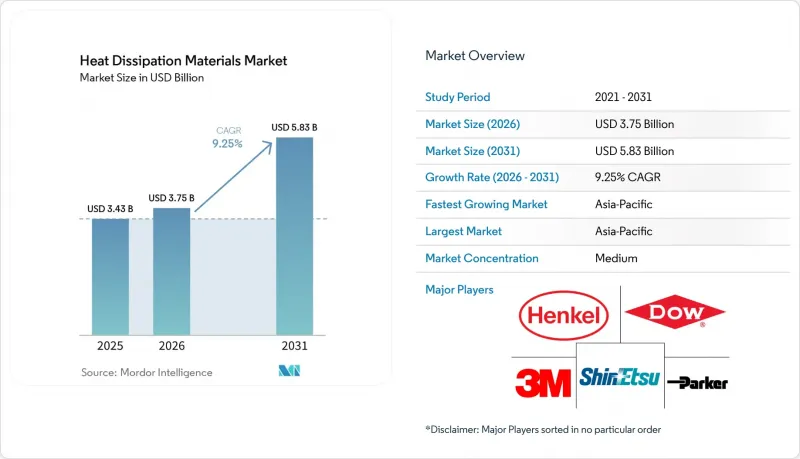
에 따르면 방열 재료 시장 규모는 2025년에 34억 3,000만 달러로 평가되며, 2026년 37억 5,000만 달러에서 2031년까지 58억 3,000만 달러에 달할 것으로 예측되며, 예측 기간(2026-2031년) 동안 CAGR은 9.25%가 될 전망입니다.
전 세계 방열 재료 시장의 동향 및 인사이트
AI 및 고성능 컴퓨팅의 전력 밀도
인공지능(AI) 워크로드의 증가로 인해, 열 인터페이스 재료의 선정은 서버 개발에서 시스템 수준의 설계 요건이 되었습니다. NVIDIA의 Blackwell 그래픽 처리 장치(GPU) 모듈은 그래픽 총 소비 전력이 575W를 초과하여, 패키지 설계에서 지속적인 방열이 최우선 과제가 되고 있습니다. 미래의 킬로와트급 가속기는 액체 냉각을 전제로 설계되어 있어, 다이, 리드, 콜드 플레이트 및 냉각 루프 간의 신뢰성 높은 인터페이스에 대한 수요가 높아지고 있습니다. 솔더 기반 열 인터페이스 재료는 50μm 미만의 본딩 라인에서 0.02 K·cm2/W에서 0.08 K·cm2/W의 총 열 저항을 달성한 반면, 갈륨 기반 액체 금속은 0.05 K·cm2/W 미만의 인터페이스 저항을 달성했습니다. 대형 그래픽 처리 장치(GPU) 패키지의 경우, 100μm에서 300μm의 뒤틀림이 발생할 수 있으며, 이는 재료의 공칭 두께를 초과할 가능성이 있으므로 본딩 라인의 일관된 관리가 필수적입니다. 금속 및 액체 금속의 배합이 성능이 낮은 여러 폴리머계 계면재를 대체함으로써, 방열 재료 시장에서 랙당 가치는 향상될 것입니다.
전기자동차 배터리 및 전력 전자 장치의 전동화
전기자동차 플랫폼의 전동화는 방열 재료에 대한 수요 양상을 단순한 단위 수량 증가 이상의 것으로 변화시키고 있습니다. 셀-투-팩(cell-to-pack) 및 셀-투-섀시(cell-to-chassis) 설계에서는 갭 필러나 상변화 재료를 교체 가능한 서비스 부품으로 사용하는 대신, 셀 사이에 직접 배치합니다. 배터리 시스템이 인증을 통과하고 생산 단계에 접어들면, 소재 선택은 구조 설계상의 결정 사항이 됩니다. 알토 대학교의 연구에 따르면, 1mm에서 3mm 두께의 상변화 소재 배리어를 설치함으로써 리튬이온 배터리 모듈 내 셀 간 열 폭주의 전파를 억제할 수 있는 것으로 밝혀졌습니다. 헨켈 AG & Co. KGaA는 2026년 5월, 이러한 구조를 위해 실리콘이 함유되지 않은 갭 필러 ‘Bergquist TGF 2030APS’ 및 열전도성 접착제 ‘Loctite TLB 9270APS’를 출시했습니다. 인버터, 차량용 충전기, 직류-직류 변환기에서도 스위칭 주파수 및 급속 충전에 따른 열 부하 증가로 인해 전도성 포팅 재료가 필요합니다. 인증된 갭 필러가 배터리 플랫폼의 생산 수명 기간 내내 지속적으로 적용됨에 따라, 방열 재료 시장의 수요는 더욱 예측 가능해집니다.
필러 및 특수 금속의 원가 변동
특수 필러 및 금속의 가격 변동은 방열 재료 제조업체에게 여전히 시급한 수익성 제약요인으로 작용하고 있습니다. 질화붕소 필러는 전기 절연성과 높은 전도성을 갖추고 있지만, 합성이 복잡하기 때문에 표준 알루미나 대체재에 비해 가격이 상당히 비쌉니다. 이러한 비용 구조로 인해 중급 사양 제품의 이익률이 하락하고, 범용 배합에서 질화붕소의 배합량이 제한되고 있습니다. 중국의 갈륨 수출 규제로 인해 2025년에는 중국 내 갈륨 가격이 킬로그램당 420달러까지 치솟을 전망이며, 금속 배합 제품은 정책에 기인한 공급 차질 위험에 노출되어 있습니다. 인듐과 은의 비용도 솔더용 열 인터페이스 재료의 가격과 성능의 균형에 영향을 미칩니다. 특히, 공급업체가 열 사이클 시험을 통해 피복성과 뒤틀림 성능을 유지해야 하는 경우 그 영향이 두드러집니다. 중복되는 수출 규제로 인해 조달, 헤지, 계약 협상, 재고 전략이 복잡해지고 있습니다. 지속적인 원가 압박은 중소 규모의 특수 합금 제조업체의 연구개발 능력을 제한하고, 매출총이익률의 회복력을 약화시킬 가능성이 있습니다.
부문 분석
2025년, 열 인터페이스 재료는 수요의 36.67%를 차지하고 있으며, 이는 여러 전자기기 용도에서 실리콘 디바이스와 방열판 사이의 접점으로서 사용되고 있음을 반영합니다. 이 부문은 소비자용 전자기기, 데이터센터 및 자동차용 전력 전자 장치를 다루며, 각 조립 과정에서 접촉면의 열전달 제어가 필요했습니다. 헨켈 AG & Co. KGaA는 2025년 10월, 800G 및 1.6T 광 트랜시버용 ‘Loctite TCF 14001’을 상용화했습니다. 이 제품은 열전도율 14.5 W/(m·K)를 갖추고 있으며, 실리콘계 휘발성 가스 방출량은 100 ppm 미만입니다. 서버 랙이나 소비자용 기기에서도 방열판에 대한 수요는 유지되었지만, 일부 하이퍼스케일 데이터센터에서는 액체 콜드 플레이트의 도입으로 인해 랙당 방열판 수요가 감소하고 있습니다. 열전도 테이프는 기계적 고정이 적합하지 않은 소비자용 전자기기 조립에 활용되고 있으며, 한편 실리콘이 함유되지 않고 광학적으로 깨끗한 테이프는 능동형 광케이블 용도에서 보다 전문적인 사용 사례를 개척했습니다.
상변화 소재는 2031년까지 연평균 성장률(CAGR) 9.89%로 확대될 것으로 예측됩니다. 이러한 성장은 배터리 어셈블리 내에 열 소재를 통합하여, 영구적인 온도 상승을 초래하지 않으면서 과도적인 열을 관리해야 하는 전기자동차 아키텍처와 밀접한 관련이 있습니다. 알토 대학교의 보고서에 따르면, 파라핀 팽창 흑연 복합 상변화 소재는 열 성능 향상과 확장 가능한 배터리 모듈 사용 간의 균형을 맞출 수 있으며, 1mm에서 3mm 두께의 배리어 층이 열 폭주의 전파를 억제할 수 있다고 합니다. 그 밖의 재료로는 구조적 접착과 열 제어가 동시에 요구되는 파워 모듈, 인버터, 모터 드라이브용 열전도성 접착제, 포팅 컴파운드, 밀봉재 등이 있습니다. 방열 재료 업계에서는 구조적, 광학적, 유전적 및 열적 성능을 하나의 배합에 통합하는 경향이 강해지고 있으며, 이로 인해 인증된 설계를 변경하는 데 드는 비용이 증가하고 있습니다.
지역별 분석
아시아태평양은 2025년에 시장 수요의 42.18%를 차지할 것으로 예상되며, 전자기기 제조, 반도체 조립, 전기자동차 생산에 힘입어 2031년까지 연평균 성장률(CAGR) 9.93%로 확대될 것으로 전망됩니다. 중국에서는 배터리 셀 제조와 스마트폰 및 노트북 공급망에서의 방열 재료 소비가 맞물려 있으며, 국내 전기자동차 제조사들은 급속 충전 시 열 완충을 위해 고밀도 방열층을 사용한 ‘셀-투-팩(Cell-to-Pack)’ 설계를 채택했습니다. 일본과 한국은 디바이스 스택의 여러 부분에서 고사양 열 관리 소재가 필요한 첨단 반도체 패키징, 디스플레이 패널 제조 및 자동차용 전자기기를 공급했습니다. 인도의 ‘생산 연계형 인센티브(PLI)’ 제도는 인도 내에서 부상하고 있는 반도체 및 전자기기 제조 생태계를 지원했으며, 국제적인 혼합 제조업체들이 현지에서 엔지니어링 및 유통 역량을 구축하도록 장려했습니다. 베트남, 태국, 말레이시아에서는 OEM 제조업체들이 공급망을 다각화함에 따라 전자기기 조립이 확대되어 방열 재료 시장의 지역적 기반이 넓어졌습니다.
북미에서는 미국의 인공지능(AI) 데이터센터와 고사양 자동차 용도를 중심으로 서로 다른 수요 동향이 나타났습니다. ‘CHIPS 법’에 힘입은 반도체 제조 투자로 인해 국내 첨단 패키징 생산능력이 확대되고 있으며, 시설이 양산 규모에 도달함에 따라 현지 열 관리 소재의 소비량도 증가할 것으로 예상됩니다. 또한, 정부 및 국방 관련 조달 프로그램도 주요 전자기기 공급망에서 사용되는 국내 인증 소재에 대한 수요를 뒷받침했습니다. 유럽에서는 다른 지역의 요건과는 달리 지속가능성 및 화학제품 규제 준수를 우선시하는 방침에 따라, 실리콘 무함유, 할로겐 저감, 그리고 재활용 가능성이 입증된 방열 재료가 선호되었습니다. 독일의 자동차 전자기기 산업, 북유럽 국가들의 데이터센터 밀집도, 그리고 영국과 프랑스의 방위·항공우주 용도가 고온 안정성이 뛰어난 배합 소재에 대한 수요를 뒷받침했습니다.
남미, 중동 및 아프리카는 비교적 소규모의 수요 지역이었습니다. 브라질에서는 자동차 조립 및 전기자동차 보급 프로그램을 통해 수요가 뒷받침되었으며, 일부 현지 조달 요건이 국내 유통 네트워크 구축을 촉진했습니다. 사우디아라비아의 ‘비전 2030’과 관련된 데이터센터 및 디지털 인프라에 대한 투자는 기업의 열 관리 관련 조달 수요를 뒷받침하고 있으며, 이 나라를 지역 내 수요 거점으로 자리매김하고 있습니다. 남아프리카는 확립된 자동차 제조 거점을 통해 기여하고 있는 한편, 세계 전자 브랜드들의 다지역 조달로 인해 주요 생산 거점 이외의 지역에서도 관련 기회가 창출되고 있습니다. 이러한 상황으로 인해 방열 재료 시장의 수요는 주요 제조 거점인 아시아태평양을 넘어 확대되고 있습니다.
기타 혜택:
- 엑셀 형식의 시장 예측(ME) 시트
- 3개월간의 애널리스트 지원
자주 묻는 질문
목차
제1장 소개
- 조사 가정과 시장 정의
- 조사 범위
제2장 조사 방법
제3장 주요 요약
제4장 시장 구도
- 시장 개요
- 시장 성장 촉진요인
- 시장 성장 억제요인
- 밸류체인 분석
- Porter's Five Forces 분석
제5장 시장 규모와 성장 예측
- 소재 유형별
- 용도별
- 지역별
- 아시아태평양
- 중국
- 인도
- 일본
- 한국
- ASEAN 국가
- 기타 아시아태평양 국가
- 북미
- 미국
- 캐나다
- 멕시코
- 유럽
- 독일
- 영국
- 프랑스
- 이탈리아
- 북유럽 국가
- 러시아
- 기타 유럽 국가
- 남미
- 브라질
- 아르헨티나
- 기타 남미 국가
- 중동 및 아프리카
- 사우디아라비아
- 남아프리카공화국
- 기타 중동 및 아프리카 국가
- 아시아태평양
제6장 경쟁 구도
- 시장 집중도
- 전략적 동향
- 시장 점유율·순위 분석
- 기업 개요
- 3M
- Boyd
- Dow
- DuPont
- Electrolube
- Fujipoly America, Inc.
- Henkel AG & Co. KGaA
- Honeywell International Inc.
- Indium Corporation
- Momentive
- PARKER HANNIFIN CORP
- Shin-Etsu Chemical Co., Ltd.
- Wacker Chemie AG
- Wakefield Thermal, Inc.
제7장 시장 기회와 향후 전망
KSM 26.10.29According to Mordor Intelligence, the heat dissipation materials market size was valued at USD 3.43 billion in 2025 and is estimated to grow from USD 3.75 billion in 2026 to reach USD 5.83 billion by 2031, at a CAGR of 9.25% during the forecast period (2026-2031).
Global Heat Dissipation Materials Market Trends and Insights
AI and High-Performance Computing Power Density
Artificial intelligence workloads have made thermal interface material selection a system-level design requirement in server development. NVIDIA Blackwell graphics processing unit modules exceeded 575 W of total graphics power, placing sustained heat removal at the center of package design. Future kilowatt-class accelerators are designed for liquid cooling, which increases the need for reliable interfaces between the die, lid, cold plate, and cooling loop. Solder thermal interface materials achieved total thermal resistance from 0.02 K*cm2/W to 0.08 K*cm2/W below 50 µm bond lines, while gallium-based liquid metals achieved interface resistance below 0.05 K*cm2/W. Large graphics processing unit packages can experience 100 µm to 300 µm warpage, which can exceed nominal material thickness and make consistent bond-line control essential. The heat dissipation materials market gains value per rack when metal and liquid-metal formulations replace several lower-performance polymer interface solutions.
Electric Vehicle Battery and Power-Electronics Electrification
Electric vehicle platform electrification is changing the demand profile for heat dissipation materials beyond a simple rise in unit volumes. Cell-to-pack and cell-to-chassis designs place gap fillers and phase change materials directly between cells, rather than using them as replaceable service components. Material choice becomes a structural design commitment once a battery system has passed qualification and entered production. A review from Aalto University found that 1 mm to 3 mm phase change material barriers can limit cell-to-cell thermal-runaway propagation in lithium-ion battery modules. Henkel AG & Co. KGaA introduced the Bergquist TGF 2030APS silicone-free gap filler and Loctite TLB 9270APS thermally conductive adhesive for these architectures in May 2026. Inverters, on-board chargers, and direct current-to-direct current converters also need conductive potting materials as switching frequencies and fast-charging thermal loads increase. The heat dissipation materials market gains more predictable demand when qualified gap fillers remain embedded within a battery platform for its production life.
Filler and Specialty-Metal Cost Volatility
Specialty filler and metal price changes remain an immediate profitability constraint for heat dissipation materials manufacturers. Boron nitride fillers support electrical insulation and high conductivity, but their complex synthesis makes them materially more expensive than standard alumina alternatives. This cost structure reduces margins for mid-specification products and limits boron nitride loading in commodity formulations. China's gallium export controls pushed domestic Chinese gallium prices to USD 420 per kilogram in 2025, exposing metal formulations to policy-driven supply disruptions. Indium and silver costs also change the price-performance balance of solder thermal interface materials, especially when suppliers must maintain coverage and warpage performance through thermal cycling. Overlapping export-control rules complicate purchasing, hedging, contract negotiations, and inventory strategies. Sustained cost pressure can limit research and development capacity and weaken gross-margin resilience for smaller specialty formulators.
Other drivers and restraints analyzed in the detailed report include:
- Advanced Semiconductor Packaging and Chiplet Architectures
- 5G, 6G, and Optical-Module Deployment
- Qualification Cycles and Narrow Process Windows
For complete list of drivers and restraints, kindly check the Table Of Contents.
Segment Analysis
Thermal interface materials held 36.67% of demand in 2025, reflecting their use between silicon devices and heat sinks across several electronics applications. The segment served consumer electronics, data centers, and automotive power electronics, where each assembly needed controlled heat transfer at a contact surface. Henkel AG & Co. KGaA commercialized Loctite TCF 14001 in October 2025 for 800G and 1.6T optical transceivers, with 14.5 W/(m*K) thermal conductivity and less than 100 ppm silicone volatile outgassing. Heat sinks also retained demand in server racks and consumer devices, although liquid cold plates are reducing heat-sink demand per rack in some hyperscale data centers. Thermal tapes served consumer-electronics assembly, where mechanical fastening was unsuitable, while silicone-free and optically clean tape created a more specialized use case in active optical cable applications.
Phase change materials are projected to advance at a 9.89% CAGR through 2031. Their growth is tied to electric vehicle architectures that embed thermal materials within battery assemblies and require them to manage transient heat without permanent temperature elevation. Aalto University reported that paraffin-expanded graphite composite phase change materials can balance thermal enhancement with scalable battery-module use, and 1 mm to 3 mm barriers can limit thermal-runaway propagation. Other materials include thermally conductive adhesives, potting compounds, and encapsulants for power modules, inverters, and motor drives where structural bonding and heat control are required together. The heat dissipation materials industry is increasingly combining structural, optical, dielectric, and thermal performance in one formulation, which raises switching costs for qualified designs.
Complete Report Scope:
- By Material Type
- Thermal Interface Materials
- Heat Sinks
- Thermal Tapes
- Phase Change Materials
- Other Material Types
- By Application
- Consumer Electronics
- Automotive
- Telecommunications
- Healthcare
- Other Applications
- By Geography
- Asia-Pacific
- China
- India
- Japan
- South Korea
- ASEAN Countries
- Rest of Asia-Pacific
- North America
- United States
- Canada
- Mexico
- Europe
- Germany
- United Kingdom
- France
- Italy
- NORDIC Countries
- Russia
- Rest of Europe
- South America
- Brazil
- Argentina
- Rest of South America
- Middle-East and Africa
- Saudi Arabia
- South Africa
- Rest of Middle-East and Africa
- Asia-Pacific
Geography Analysis
Asia-Pacific held 42.18% of the market demand in 2025 and is projected to advance at a 9.93% CAGR through 2031, supported by electronics manufacturing, semiconductor assembly, and electric vehicle production. China combined battery-cell manufacturing with thermal-material consumption from smartphone and laptop supply chains, while domestic electric vehicle producers adopted cell-to-pack designs that used dense thermal layers for fast-charging thermal buffering. Japan and South Korea supplied advanced semiconductor packaging, display-panel manufacturing, and automotive electronics that required high-specification thermal-management materials at several points in the device stack. India's Production-Linked Incentive (PLI) scheme supported its emerging semiconductor and electronics manufacturing ecosystem and encouraged international formulators to develop local engineering and distribution capabilities. Vietnam, Thailand, and Malaysia expanded electronics assembly as original equipment manufacturers diversified supply chains, broadening the regional base of the heat dissipation materials market.
North America had a different demand profile centered on artificial intelligence data centers in the United States and high-specification automotive applications. Semiconductor fabrication investments supported by the CHIPS Act are expanding domestic advanced-packaging capacity and are expected to increase local thermal-material consumption as facilities reach production scale. Government and defense procurement programs also supported demand for domestically qualified materials used in critical electronics supply chains. Europe favored silicone-free, halogen-reduced, and recyclability-documented thermal materials under sustainability and chemical-compliance priorities that differed from regional requirements elsewhere. Germany's automotive electronics base, Nordic data-center density, and defense and aerospace applications in the United Kingdom and France supported demand for high-temperature stable formulations.
South America, and Middle-East and Africa represented smaller demand areas. Brazil supported demand through automotive assembly and electric vehicle adoption programs, while some local-content requirements encouraged development of domestic distribution networks. Saudi Arabia's Vision 2030-related data-center and digital-infrastructure investments are supporting enterprise thermal-management procurement and positioning the Kingdom as a regional demand center. South Africa contributes through its established automotive manufacturing base, while multi-region sourcing by global electronics brands creates related opportunities beyond core production locations. These conditions broaden demand in the heat dissipation materials market beyond the dominant Asia-Pacific manufacturing base.
- 3M
- Boyd
- Dow
- DuPont
- Electrolube
- Fujipoly America, Inc.
- Henkel AG & Co. KGaA
- Honeywell International Inc.
- Indium Corporation
- Momentive
- PARKER HANNIFIN CORP
- Shin-Etsu Chemical Co., Ltd.
- Wacker Chemie AG
- Wakefield Thermal, Inc.
Additional Benefits:
- The market estimate (ME) sheet in Excel format
- 3 months of analyst support
TABLE OF CONTENTS
1 Introduction
- 1.1 Study Assumptions and Market Definition
- 1.2 Scope of the Study
2 Research Methodology
3 Executive Summary
4 Market Landscape
- 4.1 Market Overview
- 4.2 Market Drivers
- 4.2.1 AI and High-Performance Computing Power Density
- 4.2.2 Electric Vehicle Battery and Power-Electronics Electrification
- 4.2.3 Advanced Semiconductor Packaging and Chiplet Architectures
- 4.2.4 5G, 6G, and Optical-Module Deployment
- 4.2.5 Thermal-EMI Co-Design in High-Frequency Electronics
- 4.3 Market Restraints
- 4.3.1 Filler and Specialty-Metal Cost Volatility
- 4.3.2 Qualification Cycles and Narrow Process Windows
- 4.3.3 Reliability Trade-Offs at Thinner Bond Lines
- 4.4 Value Chain Analysis
- 4.5 Porter's Five Forces Analysis
- 4.5.1 Bargaining Power of Suppliers
- 4.5.2 Bargaining Power of Buyers
- 4.5.3 Threat of New Entrants
- 4.5.4 Threat of Substitutes
- 4.5.5 Competitive Rivalry
5 Market Size and Growth Forecasts (Value)
- 5.1 By Material Type
- 5.1.1 Thermal Interface Materials
- 5.1.2 Heat Sinks
- 5.1.3 Thermal Tapes
- 5.1.4 Phase Change Materials
- 5.1.5 Other Material Types
- 5.2 By Application
- 5.2.1 Consumer Electronics
- 5.2.2 Automotive
- 5.2.3 Telecommunications
- 5.2.4 Healthcare
- 5.2.5 Other Applications
- 5.3 By Geography
- 5.3.1 Asia-Pacific
- 5.3.1.1 China
- 5.3.1.2 India
- 5.3.1.3 Japan
- 5.3.1.4 South Korea
- 5.3.1.5 ASEAN Countries
- 5.3.1.6 Rest of Asia-Pacific
- 5.3.2 North America
- 5.3.2.1 United States
- 5.3.2.2 Canada
- 5.3.2.3 Mexico
- 5.3.3 Europe
- 5.3.3.1 Germany
- 5.3.3.2 United Kingdom
- 5.3.3.3 France
- 5.3.3.4 Italy
- 5.3.3.5 NORDIC Countries
- 5.3.3.6 Russia
- 5.3.3.7 Rest of Europe
- 5.3.4 South America
- 5.3.4.1 Brazil
- 5.3.4.2 Argentina
- 5.3.4.3 Rest of South America
- 5.3.5 Middle-East and Africa
- 5.3.5.1 Saudi Arabia
- 5.3.5.2 South Africa
- 5.3.5.3 Rest of Middle-East and Africa
- 5.3.1 Asia-Pacific
6 Competitive Landscape
- 6.1 Market Concentration
- 6.2 Strategic Moves
- 6.3 Market Share (%)/Ranking Analysis
- 6.4 Company Profiles (includes Global Overview, Market Overview, Core Segments, Financials as available, Strategic Information, Products and Services, and Recent Developments)
- 6.4.1 3M
- 6.4.2 Boyd
- 6.4.3 Dow
- 6.4.4 DuPont
- 6.4.5 Electrolube
- 6.4.6 Fujipoly America, Inc.
- 6.4.7 Henkel AG & Co. KGaA
- 6.4.8 Honeywell International Inc.
- 6.4.9 Indium Corporation
- 6.4.10 Momentive
- 6.4.11 PARKER HANNIFIN CORP
- 6.4.12 Shin-Etsu Chemical Co., Ltd.
- 6.4.13 Wacker Chemie AG
- 6.4.14 Wakefield Thermal, Inc.
7 Market Opportunities and Future Outlook
- 7.1 White-Space and Unmet-Need Assessment


