

|
시장보고서
상품코드
2154759
열 간극 충전재 : 시장 점유율 분석, 업계 동향과 통계, 성장 예측(2026-2031년)Thermal Gap Fillers - Market Share Analysis, Industry Trends & Statistics, Growth Forecasts (2026 - 2031) |
||||||
 Mordor Intelligence
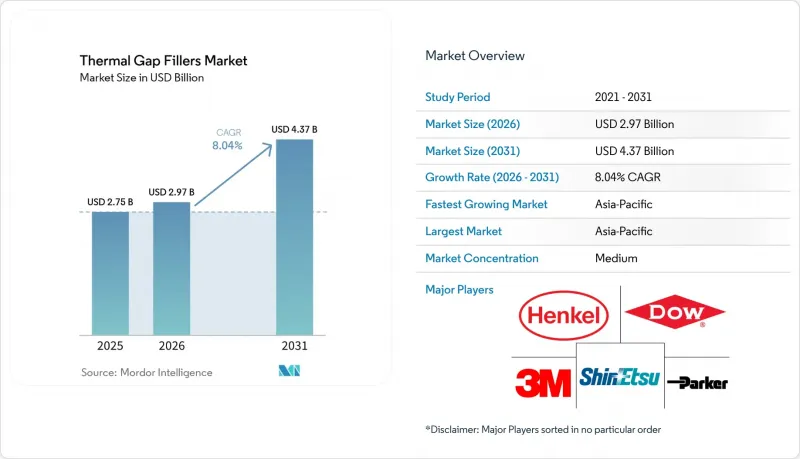
에 따르면 열 간극 충전재 시장 규모는 2025년에 27억 5,000만 달러로 평가되며, 2026년 29억 7,000만 달러에서 2031년까지 43억 7,000만 달러에 달할 것으로 예측되며, 예측 기간(2026-2031년) 동안 CAGR은 8.04%가 될 전망입니다.
세계 열 간극 충전재 시장의 동향 및 인사이트
EV 배터리 및 전력 전자 장치의 열 부하 증가
열 간극 충전재 시장은 모듈식 전기자동차 배터리 팩에서 셀-투-팩(Cell-to-Pack) 및 셀-투-섀시(Cell-to-Chassis) 설계로의 전환으로 인해 혜택을 보고 있습니다. 모듈식 배터리 팩의 경우, 이 소재는 셀 그룹과 모듈 수준의 냉각판 사이의 틈을 메워 여러 개의 작은 계면(interface)을 형성합니다. 반면, 셀-투-팩 설계에서는 셀 어레이를 섀시의 냉각 구조에 직접 연결하기 때문에 더 많은 도포량과 복잡한 표면 전체에 걸쳐 더 균일한 접합 라인이 필요합니다. 또한, 이 레이아웃에서는 계면 불균일성이 배터리 팩 전체에 국부적인 온도 차이를 유발할 가능성이 있으므로, 코팅 불량에 대한 허용 범위가 좁아집니다. 또한, 배터리 하우징에는 열을 전달하고 열 폭주를 억제하는 데 도움이 되는 재료가 필요하기 때문에 이는 표준 갭 필러의 화학 성분을 뛰어 넘는 배합 요건을 요구합니다. 2026년 5월, 헨켈 AG & Co. KGaA는 셀-투-팩(Cell-to-Pack)형 배터리 조립을 위해 열전도율 1.7 W/(m·K), 도포 속도 40 cm³/s를 초과하는 실리콘 프리 2액형 갭 필러 ‘Bergquist TGF 2030APS’를 출시했습니다. 또한, 실리콘 카바이드(SiC) 및 갈륨 나이트라이드(GaN) 소자를 사용한 인버터, 차량용 충전기, 직류-직류(DC-DC) 컨버터에서도 연속 부하 사이클 중 정격 출력을 유지하고 과도한 접합부 온도 상승을 방지하기 위해 4-6+ W/(m·K)의 열전도율을 가진 재료가 요구됩니다.
AI 데이터센터 및 고성능 컴퓨팅의 전력 밀도
열 간극 충전재 시장은 기존의 인증 주기만으로는 대응하기 어려울 정도로 전력 밀도가 급속히 높아지고 있는 인공지능 서버 랙의 영향을 받고 있습니다. 이러한 상황은 높은 열전도율, 재현성 있는 디스펜싱 특성, 그리고 빈번한 열 사이클 중 펌프 아웃에 대한 내성을 갖춘 사전 인증된 배합을 보유한 공급업체에게 유리하게 작용합니다. NVIDIA는 냉각액의 작동 온도가 최대 45°C에 달하는 AI 팩토리용 액체 냉각을 도입하여, 중요한 계면을 칩과 콜드 플레이트의 접촉부로 이동시켰습니다. AI 가속기의 핫스팟은 주변 패키지 온도보다 10-30°C 높은 온도에서 작동할 가능성이 있으며, 향후 프로세서에서는 다이 수준의 열유속이 1-2 W/mm2, 국부적인 핫스팟이 2-3 W/mm2를 초과할 가능성이 있습니다. 이러한 조건으로 인해 프로세서, 콜드 플레이트, 광학 모듈 및 관련 지원 하드웨어 주변에서 사용되는 재료에 대한 열 저항 허용 범위는 더욱 좁아지고 있습니다. 2025년 10월, 헨켈 AG & Co. KGaA는 인공지능 데이터센터 인프라용 800G 및 1.6T 광 트랜시버를 위해 열전도율 14.5 W/(m·K)를 가진 2액형 실리콘 액체 갭 필러 ‘Loctite TCF 14001’을 상용화했습니다. 다이렉트 투 칩(DTC) 액체 냉각 기술의 도입으로, 수요는 엄격하게 제어되는 칩과 콜드 플레이트의 계면으로 이동하고 있습니다. 이 계면에서 결함이 발생하면 지속적인 연산 성능이 제한될 뿐만 아니라, 인증 시험 불합격으로 인한 비용 증가를 초래할 우려가 있습니다.
고열전도율 필러와 특수 폴리머의 원가 변동
열 간극 충전재 시장은 4-10+W/(m·K)의 열전도율을 가진 프리미엄 제품에 고순도의 육방정계 질화붕소, 질화알루미늄 및 합성 흑연이 사용되고 있어 비용 면에서 압박을 받고 있습니다. 이러한 필러는 표준 제품에 사용되는 기존의 알루미나나 실리카 필러에 비해 5배에서 10배의 비용이 듭니다. 셀-투-팩 방식의 배터리 설계에서는 차량 플랫폼 1대당 2-3 m²에 걸쳐 갭 필러를 충전해야 하는 경우가 있어, 이로 인해 배터리 제조사의 비용 부담이 증가하고, 전도율이 낮은 대체재 검토를 강요받는 압박이 커지고 있습니다. 이러한 영향은 부품표(BOM) 관리가 중요한 경영 지표가 되는 자동차 프로그램에서 특히 두드러집니다. 불소계 및 폴리우레탄계 캐리어 시스템은 그 원료가 에너지 비용과 아시아 및 중동에 집중된 공급망에 영향을 미치는 무역 정책에 좌우되기 때문에 가격 변동 위험을 더욱 높이고 있습니다. 영국 왕립화학학회(Royal Society of Chemistry)가 발표한 조사에 따르면, 계면활성제를 이용한 육방정계 질화붕소 나노시트의 액체 박리법에서는 89%의 수율을 얻을 수 있었으며, 실리콘 오일 매트릭스에서 최대 73%의 열전도율 향상이 확인되었습니다. 이러한 비용 요인으로 인해, 6 W/(m·K)를 초과하는 열전도율을 가진 소재의 사용은 주로 자동차 OEM 제조사, 데이터센터 운영사, 그리고 열적 고장으로 인한 비용이 소재의 높은 가격을 상회하는 방위용 전자기기 프로그램으로 제한되고 있습니다.
부문별 분석
2025년, 실리콘 타입은 전 세계 매출의 58.47%를 차지했습니다. 실리콘 타입 열 간극 충전재의 시장 규모는 자동차, 산업 및 컴퓨팅 분야의 용도에 의해 뒷받침되었습니다. 이는 다년간의 열 사이클 시험 실적, OEM(순정 부품 제조업체)의 승인 및 공정 검증 기록이 있어 다른 제품으로 전환하기 어렵기 때문입니다. -40°C에서 150°C에 이르는 작동 온도 범위, 40 cm³/s를 초과하는 로봇 디스펜싱과의 호환성, 그리고 다양한 기판에 대한 접착력이 지속적인 사용을 뒷받침하고 있습니다. 2026년 7월, 헨켈 AG & Co. KGaA는 첨단 운전자 보조 시스템(ADAS), 전자 제어 장치(ECU), 및 차량용 충전기의 조립 라인을 위해 열전도율 6.5 W/(m·K)의 저휘발성 실리콘 제품 ‘Bergquist Gap Filler TGF 6500LVO’를 출시했습니다. 이 배합에는 D4, D5, D6 실록산이 포함되어 있지 않습니다.
비실리콘 타입은 2031년까지 연평균 성장률(CAGR) 9.23%로 확대될 것으로 예측됩니다. 이 유형은 자율주행차의 카메라, 첨단 운전자 보조 시스템(ADAS), 레이더, 정밀 의료기기 및 광전자기기에 사용되고 있으며, 이러한 분야에서는 시록산의 이주가 접착 접합부, 렌즈 및 고주파 회로 접합부에 악영향을 미칠 가능성이 있습니다. 2025년 3월, 헨켈 AG & Co. KGaA는 열전도율 6.5 W/(m·K)를 가진 1액형 실리콘 프리 경화성 젤 ‘Bergquist Liqui Form TLF 6500 CGel-SF’를 출시했습니다. 유럽연합(EU)의 화학제품 등록, 평가, 승인 및 제한(REACH) 체계에 따른 D4, D5 및 D6 환상 실록산에 대한 규제로 인해, 유럽용 프로그램의 배합 재검토가 가속화되고 있습니다. 상변화 물질 및 흑연계 패드를 포함한 기타 소재들은 수동적 열 완충이 중요한 에너지 저장 시스템을 뒷받침하고 있습니다.
지역별 분석
아시아태평양은 2025년에 전 세계 매출의 42.19%를 차지할 것으로 예상되며, 2031년까지 연평균 성장률(CAGR) 9.08%로 확대될 것으로 전망됩니다. 아시아태평양의 열 간극 충전재 시장 점유율은 중국의 전기자동차 파워트레인 생산 및 전자기기 조립 활동에 힘입어 성장했습니다. 한국에서는 반도체 패키징 및 고대역폭 메모리 생산을 통해 수요가 확대되고 있으며, 스택 레벨 인터페이스를 통해 1mm 미만의 새로운 응용 분야가 탄생하고 있습니다. 일본의 특수 실리콘 공급망은 국내 자동차 제조업체와 지역 수출 시장에 공급하고 있습니다. 인도 및 동남아시아국가연합(ASEAN) 국가들에서는 전자기기 및 전기자동차 조립이 비용이 높은 생산 거점에서 이전됨에 따라 수요가 증가하고 있습니다.
또한, 아시아태평양의 열 간극 충전재 시장은 소재 공급업체들이 조립 거점 근처에 생산 거점을 두는 것에서도 혜택을 보고 있습니다. 특정 셀-투-팩형 배터리 플랫폼에 대한 제품 인증을 획득하면 3-5개 차종 라인에 걸쳐 생산량을 확대할 수 있으므로, 현지에서 기술 지원을 제공하려는 동기가 됩니다. 북미에서는 하이퍼스케일 인공지능(AI) 데이터센터 프로젝트가 집중되어 있어 수요가 주도되고 있습니다. 또한, 제조업체들이 국내 조달 요건을 충족하기 위해 공급망을 현지화함에 따라 전기자동차 인증 활동도 탄력을 받고 있습니다. 이 지역의 소재 개발 및 인증 역량은 전기자동차, 방위 산업, 그리고 첨단 컴퓨팅 프로그램에 동시에 기여하고 있습니다.
유럽에서는 독일, 프랑스, 영국, 이탈리아 및 북유럽 국가들이 주요 수요 거점으로 자리 잡고 있습니다. 이 지역의 자동차 제조사와 1차 공급업체들은 열 사이클 시험, 오일 블리드 및 휘발성 실록산 분석과 관련하여 엄격한 문서화 요건을 유지하고 있습니다. 유럽연합(EU)의 D4, D5, D6 고리형 실록산에 대한 규제로 인해, 저휘발성이며 규정을 준수하는 배합 변경이 요구되고 있습니다. 남미는 여전히 발전 중인 지역으로, 브라질과 아르헨티나에서의 전기자동차 보급 및 전자기기 제조와 수요가 연동되어 있습니다. 중동 및 아프리카의 수요는 5세대 네트워크 구축과 국가 주도의 AI 프로그램을 위한 데이터센터 건설에 힘입어 증가하고 있습니다. 이 지역들은 아직 수요 기반이 작지만, 2031년까지 성장세가 가속화될 것으로 예상됩니다.
기타 혜택:
- 엑셀 형식의 시장 예측(ME) 시트
- 3개월간의 애널리스트 지원
자주 묻는 질문
목차
제1장 소개
- 조사 가정과 시장 정의
- 조사 범위
제2장 조사 방법
제3장 주요 요약
제4장 시장 구도
- 시장 개요
- 시장 성장 촉진요인
- 시장 성장 억제요인
- 밸류체인 분석
- Porter's Five Forces 분석
제5장 시장 규모와 성장 예측
- 소재 유형별
- 최종 이용 산업별
- 지역별
- 아시아태평양
- 중국
- 인도
- 일본
- 한국
- ASEAN 국가
- 기타 아시아태평양 국가
- 북미
- 미국
- 캐나다
- 멕시코
- 유럽
- 독일
- 영국
- 프랑스
- 이탈리아
- 북유럽 국가
- 기타 유럽 국가
- 남미
- 브라질
- 아르헨티나
- 기타 남미 국가
- 중동 및 아프리카
- 사우디아라비아
- 남아프리카공화국
- 기타 중동 및 아프리카 국가
- 아시아태평양
제6장 경쟁 구도
- 시장 집중도
- 전략적 동향
- 시장 점유율·순위 분석
- 기업 개요
- 3M
- Boyd
- Dow
- DuPont
- Electrolube
- Elkem ASA
- Fuji Polymer Industries Co., Ltd.
- Henkel AG & Co. KGaA
- Honeywell International Inc.
- KCC Corporation
- Momentive
- PARKER HANNIFIN CORP
- Rogers Corporation
- Saint-Gobain
- Shin-Etsu Chemical Co., Ltd.
- Wacker Chemie AG
제7장 시장 기회와 향후 전망
KSM 26.10.29According to Mordor Intelligence, the thermal gap fillers market size was valued at USD 2.75 billion in 2025 and is estimated to grow from USD 2.97 billion in 2026 to reach USD 4.37 billion by 2031, at a CAGR of 8.04% during the forecast period (2026-2031).
Global Thermal Gap Fillers Market Trends and Insights
EV Battery and Power-Electronics Thermal Load Growth
The thermal gap fillers market gains from the move from modular electric vehicle battery packs to cell-to-pack and cell-to-chassis designs. In a modular battery pack, the material fills gaps between cell groups and a module-level cooling plate, creating several smaller interfaces. In cell-to-pack designs, it bridges the cell array directly to the chassis cooling structure, which requires greater dispensing volumes and more uniform bondlines across complex surfaces. This layout also reduces the tolerance for weak coverage because uneven interfaces can produce localized temperature differences across the battery pack. Battery enclosures also need materials that transfer heat and help contain thermal runaway, which raises formulation requirements beyond standard gap filler chemistry. In May 2026, Henkel AG & Co. KGaA launched Bergquist TGF 2030APS, a silicone-free two-component gap filler with 1.7 W/(m*K) conductivity and dispensing rates above 40 cm3/s for cell-to-pack battery assembly. Inverters, on-board chargers, and direct-current-to-direct-current converters using silicon carbide and gallium nitride devices also require materials rated at 4-6+ W/(m*K) to sustain rated power during continuous load cycles and avoid excessive junction temperatures.
AI Data Centers and High-Performance Computing Power Density
The thermal gap fillers market is affected by artificial intelligence server racks increasing in power density faster than conventional qualification cycles can accommodate. This favors suppliers with prequalified formulations that offer high thermal conductivity, repeatable dispensing behavior, and resistance to pump-out during frequent thermal cycling. NVIDIA introduced liquid cooling for artificial intelligence factories, with coolant operating at up to 45 °C, shifting the critical interface toward the chip-to-cold-plate contact. Artificial intelligence accelerator hotspots can operate 10-30 °C above nearby package temperatures, while future processors can have die-level heat flux from 1-2 W/mm2 and local hotspots above 2-3 W/mm2. These conditions create narrower thermal resistance budgets for materials used around processors, cold plates, optical modules, and related supporting hardware. In October 2025, Henkel AG & Co. KGaA commercialized Loctite TCF 14001, a two-part silicone liquid gap filler with 14.5 W/(m*K) thermal conductivity for 800G and 1.6T optical transceivers in artificial intelligence data center infrastructure. Direct-to-chip liquid cooling redirects demand toward tightly controlled chip-to-cold-plate interfaces, where defects can limit sustained computing performance and increase the cost of qualification failures.
High-Conductivity Filler and Specialty-Polymer Cost Volatility
The thermal gap fillers market faces cost pressure because premium products with 4-10+ W/(m*K) conductivity use high-purity hexagonal boron nitride, aluminum nitride, and synthetic graphite. These fillers cost 5x-10x more than conventional alumina or silica fillers used in standard products. Cell-to-pack battery designs can require gap filler coverage across 2-3 m2 per vehicle platform, which increases cost exposure for battery manufacturers and creates pressure to consider lower-conductivity alternatives. The effect is especially material in automotive programs, where bill-of-material discipline is a central operating measure. Fluorinated and polyurethane carrier systems add another layer of volatility because their feedstocks respond to energy costs and trade policy affecting concentrated Asian and Middle Eastern supply chains. Research published by the Royal Society of Chemistry reported an 89% yield for surfactant-assisted liquid exfoliation of hexagonal boron nitride nanosheets and thermal conductivity gains of up to 73% in silicone oil matrices. These costs limit the use of conductivity above 6 W/(m*K) mainly to automotive original equipment manufacturers, data center operators, and defense electronics programs where the cost of thermal failure is greater than the material premium.
Other drivers and restraints analyzed in the detailed report include:
- 5G Radio and Telecom Infrastructure Heat Dissipation
- Electronics Miniaturization and High Component Density
- Qualification Cycles and Process-Window Risk
For complete list of drivers and restraints, kindly check the Table Of Contents.
Segment Analysis
Silicone type held 58.47% of global revenue in 2025. The thermal gap fillers market size for silicone type was supported by automotive, industrial, and computing uses because of long thermal-cycling histories, original equipment manufacturer approvals, and process validation records, making switching difficult. Its operating range from -40 °C to 150 °C, compatibility with robotic dispensing above 40 cm3/s, and broad substrate adhesion support its continued use. In July 2026, Henkel AG & Co. KGaA launched Bergquist Gap Filler TGF 6500LVO, a low-volatile silicone product with 6.5 W/(m*K) conductivity for advanced driver-assistance systems, electronic control units, and on-board charger assembly lines. The formulation does not contain D4, D5, or D6 siloxanes.
Non-silicone type is projected to advance at a 9.23% CAGR through 2031. It is used in autonomous vehicle cameras, advanced driver-assistance systems, radar, precision medical instruments, and optical electronics, where siloxane migration can affect adhesive bonds, lenses, and radio-frequency circuit junctions. In March 2025, Henkel AG & Co. KGaA launched Bergquist Liqui Form TLF 6500 CGel-SF, a one-part silicone-free curable gel with 6.5 W/(m*K) conductivity. Restrictions under the European Union Registration, Evaluation, Authorization and Restriction of Chemicals (REACH) framework for D4, D5, and D6 cyclic siloxanes are accelerating reformulation for European programs. Other material types, including phase-change materials and graphite-based pads, support energy-storage systems where passive thermal buffering is important.
Complete Report Scope:
- By Material Type
- Silicone Type
- Non-Silicone Type
- Other Material Types
- By End-User Industry
- Electronics
- Automotive
- Telecommunications
- Industrial
- Healthcare
- Other End-User Industries
- By Geography
- Asia-Pacific
- China
- India
- Japan
- South Korea
- ASEAN Countries
- Rest of Asia-Pacific
- North America
- United States
- Canada
- Mexico
- Europe
- Germany
- United Kingdom
- France
- Italy
- NORDIC Countries
- Rest of Europe
- South America
- Brazil
- Argentina
- Rest of South America
- Middle-East and Africa
- Saudi Arabia
- South Africa
- Rest of Middle-East and Africa
- Asia-Pacific
Geography Analysis
Asia-Pacific held 42.19% of global revenue in 2025 and is projected to advance at a 9.08% CAGR through 2031. The thermal gap fillers market share in Asia-Pacific was supported by China's electric vehicle powertrain output and electronics assembly activity. South Korea added demand through semiconductor packaging and high-bandwidth memory production, where stack-level interfaces create new application points below 1 mm. Japan's specialty silicone supply chain serves domestic automotive manufacturers and regional export markets. India and the Association of Southeast Asian Nations countries are gaining demand as electronics and electric vehicle assembly shift from higher-cost production locations.
The thermal gap fillers market in Asia-Pacific also benefits when material suppliers locate production near assembly hubs. Qualifying a product for one cell-to-pack battery platform can extend volumes across 3-5 vehicle model lines, which creates an incentive for local technical support. North America drives demand through the concentration of hyperscale artificial intelligence data center projects. It also supports electric vehicle qualification activity as manufacturers localize supply chains for domestic-content requirements. Regional material development and qualification capabilities serve electric vehicle, defense, and advanced computing programs at the same time.
Europe includes Germany, France, the United Kingdom, Italy, and the Nordic Countries as primary demand centers. Automotive manufacturers and Tier 1 suppliers in the region maintain demanding documentation requirements for thermal cycling, oil bleed, and volatile siloxane analysis. European Union restrictions on D4, D5, and D6 cyclic siloxanes favor low-volatile and compliant reformulations. South America remain a developing area, with demand linked to electric vehicle adoption and electronics manufacturing in Brazil and Argentina. The Middle-East and Africa demand is supported by fifth-generation network deployment and data center construction for sovereign artificial intelligence programs. These areas have a smaller base but are expected to gain momentum through 2031.
- 3M
- Boyd
- Dow
- DuPont
- Electrolube
- Elkem ASA
- Fuji Polymer Industries Co., Ltd.
- Henkel AG & Co. KGaA
- Honeywell International Inc.
- KCC Corporation
- Momentive
- PARKER HANNIFIN CORP
- Rogers Corporation
- Saint-Gobain
- Shin-Etsu Chemical Co., Ltd.
- Wacker Chemie AG
Additional Benefits:
- The market estimate (ME) sheet in Excel format
- 3 months of analyst support
TABLE OF CONTENTS
1 Introduction
- 1.1 Study Assumptions and Market Definition
- 1.2 Scope of the Study
2 Research Methodology
3 Executive Summary
4 Market Landscape
- 4.1 Market Overview
- 4.2 Market Drivers
- 4.2.1 EV Battery and Power-Electronics Thermal Load Growth
- 4.2.2 AI Data Centers and High-Performance Computing Power Density
- 4.2.3 5G Radio and Telecom Infrastructure Heat Dissipation
- 4.2.4 Electronics Miniaturization and High Component Density
- 4.2.5 Automated Dispensing and Cure-in-Place Assembly Adoption
- 4.3 Market Restraints
- 4.3.1 High-Conductivity Filler and Specialty-Polymer Cost Volatility
- 4.3.2 Qualification Cycles and Process-Window Risk
- 4.3.3 Silicone Outgassing, Oil Bleed, and Contamination Concerns
- 4.4 Value Chain Analysis
- 4.5 Porter's Five Forces Analysis
- 4.5.1 Bargaining Power of Suppliers
- 4.5.2 Bargaining Power of Buyers
- 4.5.3 Threat of New Entrants
- 4.5.4 Threat of Substitutes
- 4.5.5 Competitive Rivalry
5 Market Size and Growth Forecasts (Value)
- 5.1 By Material Type
- 5.1.1 Silicone Type
- 5.1.2 Non-Silicone Type
- 5.1.3 Other Material Types
- 5.2 By End-User Industry
- 5.2.1 Electronics
- 5.2.2 Automotive
- 5.2.3 Telecommunications
- 5.2.4 Industrial
- 5.2.5 Healthcare
- 5.2.6 Other End-User Industries
- 5.3 By Geography
- 5.3.1 Asia-Pacific
- 5.3.1.1 China
- 5.3.1.2 India
- 5.3.1.3 Japan
- 5.3.1.4 South Korea
- 5.3.1.5 ASEAN Countries
- 5.3.1.6 Rest of Asia-Pacific
- 5.3.2 North America
- 5.3.2.1 United States
- 5.3.2.2 Canada
- 5.3.2.3 Mexico
- 5.3.3 Europe
- 5.3.3.1 Germany
- 5.3.3.2 United Kingdom
- 5.3.3.3 France
- 5.3.3.4 Italy
- 5.3.3.5 NORDIC Countries
- 5.3.3.6 Rest of Europe
- 5.3.4 South America
- 5.3.4.1 Brazil
- 5.3.4.2 Argentina
- 5.3.4.3 Rest of South America
- 5.3.5 Middle-East and Africa
- 5.3.5.1 Saudi Arabia
- 5.3.5.2 South Africa
- 5.3.5.3 Rest of Middle-East and Africa
- 5.3.1 Asia-Pacific
6 Competitive Landscape
- 6.1 Market Concentration
- 6.2 Strategic Moves
- 6.3 Market Share (%)/Ranking Analysis
- 6.4 Company Profiles (includes Global Overview, Market Overview, Core Segments, Financials as available, Strategic Information, Products and Services, and Recent Developments)
- 6.4.1 3M
- 6.4.2 Boyd
- 6.4.3 Dow
- 6.4.4 DuPont
- 6.4.5 Electrolube
- 6.4.6 Elkem ASA
- 6.4.7 Fuji Polymer Industries Co., Ltd.
- 6.4.8 Henkel AG & Co. KGaA
- 6.4.9 Honeywell International Inc.
- 6.4.10 KCC Corporation
- 6.4.11 Momentive
- 6.4.12 PARKER HANNIFIN CORP
- 6.4.13 Rogers Corporation
- 6.4.14 Saint-Gobain
- 6.4.15 Shin-Etsu Chemical Co., Ltd.
- 6.4.16 Wacker Chemie AG
7 Market Opportunities and Future Outlook
- 7.1 White-Space and Unmet-Need Assessment


