

|
시장보고서
상품코드
2154798
남미의 플라스틱 포장 필름 : 시장 점유율 분석, 업계 동향과 통계, 성장 예측(2026-2031년)South America Plastic Packaging Films - Market Share Analysis, Industry Trends & Statistics, Growth Forecasts (2026 - 2031) |
||||||
 Mordor Intelligence
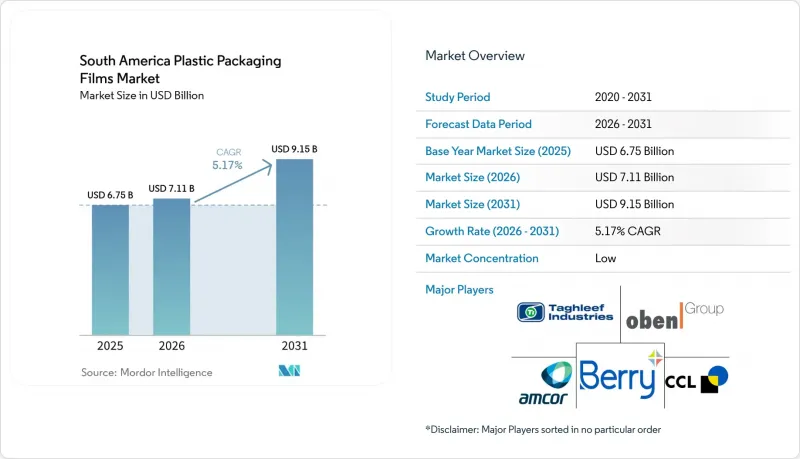
에 따르면 남미의 플라스틱 포장 필름 시장 규모는 2025년에 67억 5,000만 달러로 평가되며, 2026년 71억 1,000만 달러에서 2031년까지 91억 5,000만 달러에 달할 것으로 예측되며, 예측 기간(2026-2031년) 동안 CAGR은 5.17%가 될 전망입니다.
남미 플라스틱 포장 필름 시장의 동향 및 인사이트
포장 식품 및 음료 가공의 성장
남미의 플라스틱 포장 필름 시장은 포장 식품 및 음료에 대한 수요 증가의 혜택을 받고 있습니다. 포장 식품 부문은 2031년까지 연평균 성장률(CAGR) 5.03%로 성장할 것으로 예측됩니다. 브라질의 도시화와 노동력 참여율 향상으로 인해 간편한 식사 옵션에 대한 수요가 증가하고 있습니다. 현대 소매업계에서는 특히 냉장 제품, 상온 제품, 즉석 식품의 경우 비공식 식품 유통 경로보다 표준화된 포장이 요구되고 있습니다. 이러한 제품들은 보관 및 유통 과정에서 습기와 산소로부터 보호되어야 합니다. 이에 따라 기존 브랜드나 자체 브랜드 제품, 나아가 광범위한 식품 카테고리 전반에 걸쳐 연포장 구조가 선호되고 있습니다.
E-Commerce와 부피 중량 최적화
E-Commerce의 부상으로 소포 배송 분야에서 더욱 콤팩트하고 가벼운 포장재에 대한 수요가 증가하고 있습니다. 브라질의 결제 시스템 ‘Pix’는 2025년에 온라인 주문의 42%를 처리했습니다. 소포 배송업체들은 부피 중량제 요금 체계를 채택하고 있어, 많은 경질 포장재에 비해 가볍고 유연한 솔루션이 유리합니다. ‘Mercado Libre’ 및 유사한 플랫폼은 E-Commerce 거래량의 90% 이상을 사내에서 처리하고 있어, 사양 결정 권한이 집중되어 있습니다. ‘Mercado Libre’의 8개 풀필먼트 센터에 도입된 쉴드 에어(Shield Air)사의 설비를 통해 소포 1개당 포장 비용을 18%, 빈 공간 충전재 사용량을 35% 절감했습니다. 이러한 운영상의 이점으로 인해, 처리 속도, 완충성 및 소포의 밀도를 중시하여 설계된 필름이 선호되고 있습니다.
변동이 심한 폴리올레핀 및 에너지 투입 비용
폴리올레핀 가격 변동은 여전히 컨버터의 이익률에 대한 즉각적인 압박 요인으로 작용하고 있습니다. 수지 생산은 브라질에 집중되어 있으며, 전 세계 원유 및 납사 가격 주기의 영향을 받습니다. 남미의 플라스틱 포장 필름 시장에서는 이러한 비용을 헤지할 수 있는 지역적 여력이 제한적입니다. 컨버터는 특히 아르헨티나에서 가격에 민감한 소비재 제조업체 고객들에게 수지 가격 상승분을 즉시 전가하지 못하는 경우가 많습니다. 2025년, 브라질과 아르헨티나의 전기 요금 제도 개혁으로 인해 산업용 에너지 비용이 상승했습니다. 이러한 상황은 조달, 에너지 효율, 생산 분야에서 폭넓은 역량을 갖춘 대기업에 유리하게 작용합니다.
부문별 분석
2025년, PE는 남미 플라스틱 포장 필름 시장에서 38.24%의 점유율을 차지했습니다. 이러한 위상은 블로우 필름 및 캐스트 필름 생산 라인에서의 광범위한 사용을 반영합니다. PE는 식품, 퍼스널케어 및 산업용 포장에서 열 밀봉에 적합합니다. 많은 컨버터들은 이미 PE 등급 수지에 맞춰 설계된 설비를 가동하고 있습니다. 이러한 도입된 설비는 재활용이 가능한 단일 소재 설계도 지원합니다.
PP는 과자, 유제품, 라벨용 BOPP 분야에서 여전히 중요한 위치를 차지하고 있습니다. BOPET은 투명성과 차단 성능이 요구되는 고급 용도에 사용되고 있습니다. OPS 및 기타 소재는 트위스트 랩 및 산업용 오버랩 용도에서 여전히 비교적 작은 비중을 차지하고 있습니다. 바이오플라스틱은 2031년까지 연평균 성장률(CAGR) 6.42%로 성장할 것으로 예측됩니다. 이러한 성장은 비용, 가공 성능, 브랜드의 노력, 그리고 사용 후 처리 인프라에 따라 좌우될 것입니다.
2025년 기준, 포장 형태별로 보면 남미의 플라스틱 포장 필름 시장 규모의 42.18%를 파우치가 차지했습니다. 이 형태는 2031년까지 연평균 성장률(CAGR) 6.83%로 성장할 것으로 예상됩니다. 스탠드업형이나 주입구가 있는 디자인은 커피, 반려동물 사료, 유제품, 가정용품에 사용되고 있습니다. 경량이기 때문에 E-Commerce 및 소매 유통의 효율화에 기여합니다. 또한 파우치는 매장 진열 및 분량 관리 측면에서도 장점이 있습니다.
백과 라이닝은 농업 자재, 밀가루, 벌크 식품의 포장에 사용됩니다. 랩과 오버랩은 단백질 제품 수출이나 연어 출하 시 2차 포장재로 기능합니다. 고차단성 파우치는 헬스케어 및 의약품 분야에서의 용도에서 그 중요성이 커지고 있습니다. 이러한 용도에서는 출하량보다 빠른 속도로 부가가치를 높일 수 있습니다. 재활용 가능한 구조라 하더라도 산소나 습기로부터의 보호 기능을 유지해야 합니다.
기타 장점:
- 엑셀 형식의 시장 예측(ME) 시트
- 3개월간의 애널리스트 지원
목차
제1장 소개
- 조사 가정과 시장 정의
- 조사 범위
제2장 조사 방법
제3장 주요 요약
제4장 시장 구도
- 시장 개요
- 시장 성장 촉진요인
- 시장 성장 억제요인
- 거시경제 요인이 시장에 미치는 영향
- 업계 공급망 분석
- 기술 동향
- 규제 상황
- Porter's Five Forces 분석
제5장 시장 규모와 성장 예측
- 수지 유형별
- 포장 형태별
- 필름 기능별
- 최종 이용 산업별
- 지역별
- 브라질
- 아르헨티나
- 콜롬비아
- 칠레
- 기타 남미 국가
제6장 경쟁 구도
- 시장 집중도
- 전략적 동향
- 시장 점유율 분석
- 기업 개요
- Amcor plc
- Berry Global, Inc.
- Taghleef Latin America S.A.
- Oben Holding Group S.A.C.
- Innovia Films Limited
- FLEX AMERICAS S.A. de C.V.
- Poly Rafia, S.A. de C.V.
- CCL Industries Inc.
- Cosmo Films Limited
- Jindal Poly Films Limited
- Polibak Plastik Film Sanayi ve Ticaret A.S.
- Coveris Management GmbH
- Constantia Flexibles Group GmbH
- ProAmpac Holdings, Inc.
- Sealed Air Corporation
- Mondi plc
- Sonoco Products Company
- Petropack S.A.
- Isma S.A.
- Plafilm S.A.
제7장 시장 기회와 향후 전망
KSMAccording to Mordor Intelligence, the South America plastic packaging films market size was valued at USD 6.75 billion in 2025 and estimated to grow from USD 7.11 billion in 2026 to reach USD 9.15 billion by 2031, at a CAGR of 5.17% during the forecast period (2026-2031).
South America Plastic Packaging Films Market Trends and Insights
Growth in Packaged Food and Beverage Processing
The South America Plastic Packaging Films Market benefits from a growing need for packaged food and beverages. The packaged-food sector is forecast to grow at a 5.03% CAGR through 2031. Urbanization in Brazil and greater workforce participation have increased demand for convenient meal options. Modern retail requires more standardized packaging than informal food channels, especially for chilled, ambient, and ready-to-eat products. These products need moisture and oxygen protection during storage and distribution. This supports flexible structures for established brands, private-label products, and a wider range of food categories.
E-Commerce and Volumetric-Weight Optimization
E-commerce is increasing demand for packaging that occupies less space and weighs less in parcel delivery. Brazil's Pix payment system handled 42% of online orders in 2025. Parcel carriers use dimensional-weight pricing, which favors lighter, flexible solutions over many rigid alternatives. Mercado Libre and similar platforms process more than 90% of e-commerce volumes internally, concentrating specification decisions. Sealed Air equipment at 8 Mercado Libre fulfillment centers reduced packaging cost per parcel by 18% and void fill by 35%. These operating gains favor films designed for speed, cushioning, and parcel density.
Volatile Polyolefin and Energy Input Costs
Polyolefin price changes remain an immediate pressure on converter margins. Resin production is concentrated in Brazil and follows global crude oil and naphtha cycles. The South America Plastic Packaging Films Market has limited regional capacity to hedge those costs. Converters often cannot immediately pass higher resin prices to price-sensitive consumer-goods customers, especially in Argentina. Electricity tariff reforms in Brazil and Argentina increased industrial energy costs in 2025. These conditions favor larger companies with broader capabilities in procurement, energy efficiency, and production.
Other drivers and restraints analyzed in the detailed report include:
- Lightweighting and Downgauging of Film Structures
- Rising Adoption of Mono-Material Recyclable Films
- Extended Producer Responsibility Compliance Costs
For complete list of drivers and restraints, kindly check the Table Of Contents.
Segment Analysis
PE held 38.24% of the South America plastic packaging films market share in 2025. Its position reflects broad use on blown-film and cast-film lines. PE supports heat sealing in food, personal care, and industrial packaging. Many converters already operate equipment designed around PE-grade resins. This installed base also supports recyclable mono-material designs.
PP remains important in BOPP applications for confectionery, dairy, and labels. BOPET serves premium applications that need clarity and barrier performance. OPS and other materials retain smaller roles in twist-wrap and industrial overwrap uses. Bioplastics are forecast to grow at a 6.42% CAGR through 2031. Growth depends on cost, processing performance, brand commitments, and end-of-life infrastructure.
Pouches accounted for 42.18% of the South America Plastic Packaging Films Market size by packaging format in 2025. The format is expected to grow at a 6.83% CAGR through 2031. Stand-up and spouted designs are used for coffee, pet food, dairy, and household products. Their lower weight can improve e-commerce and retail distribution. Pouches also offer shelf-display and portion-control benefits.
Bags and linings are used for packaging agricultural inputs, flour, and bulk food. Wraps and overwraps serve as secondary packaging for protein exports and salmon shipments. High-barrier pouches are gaining importance in healthcare and pharmaceutical uses. These applications can increase value faster than shipment volumes. Recyclable structures must still preserve oxygen and moisture protection.
Complete Report Scope:
- By Resin Type
- Polypropylene (PP)
- Polyethylene (PE)
- Polyethylene-terephthalate (BOPET)
- Polystyrene (OPS)
- Bioplastics
- Other Material Types
- By Packaging Format
- Wraps and Overwraps
- Bags and Linings
- Pouches
- Other Packging Formats
- By Film Functionality
- Low-Barrier Mono-material Films
- Medium-Barrier Metallised Films
- High-Barrier Multilayer Films
- Specialty Active and Antimicrobial Films
- By End-use Industry
- Food
- Candy and Confectionery
- Frozen Foods
- Fresh Produce
- Dairy Products
- Meat, Poultry and Seafood
- Pet Food
- Other Food Products
- Beverages
- Healthcare and Pharmaceutical
- Personal Care and Home Care
- Industrial Packaging
- Other End-use Industries
- Food
- By Geography
- Brazil
- Argentina
- Colombia
- Chile
- Rest of South America
List of Companies Covered in this Report:
- Amcor plc
- Berry Global, Inc.
- Taghleef Latin America S.A.
- Oben Holding Group S.A.C.
- Innovia Films Limited
- FLEX AMERICAS S.A. de C.V.
- Poly Rafia, S.A. de C.V.
- CCL Industries Inc.
- Cosmo Films Limited
- Jindal Poly Films Limited
- Polibak Plastik Film Sanayi ve Ticaret A.S.
- Coveris Management GmbH
- Constantia Flexibles Group GmbH
- ProAmpac Holdings, Inc.
- Sealed Air Corporation
- Mondi plc
- Sonoco Products Company
- Petropack S.A.
- Isma S.A.
- Plafilm S.A.
Additional Benefits:
- The market estimate (ME) sheet in Excel format
- 3 months of analyst support
TABLE OF CONTENTS
1 INTRODUCTION
- 1.1 Study Assumptions and Market Definition
- 1.2 Scope of the Study
2 RESEARCH METHODOLOGY
3 EXECUTIVE SUMMARY
4 MARKET LANDSCAPE
- 4.1 Market Overview
- 4.2 Market Drivers
- 4.2.1 Growth in Packaged Food and Beverage Processing
- 4.2.2 E-Commerce and Volumetric-Weight Optimization
- 4.2.3 Lightweighting and Downgauging of Film Structures
- 4.2.4 Rising Adoption of Mono-Material Recyclable Films
- 4.2.5 Recycled-Content Mandates and Reverse-Logistics Credits
- 4.2.6 Export-Oriented Agrifood and Cold-Chain Expansion
- 4.3 Market Restraints
- 4.3.1 Volatile Polyolefin and Energy Input Costs
- 4.3.2 Extended Producer Responsibility Compliance Costs
- 4.3.3 Limited Post-Consumer Film Collection and Sorting Infrastructure
- 4.3.4 Converter Qualification Risk for High-Barrier Recyclable Films
- 4.4 Impact of Macroeconomic Factors on the Market
- 4.5 Industry Supply-Chain Analysis
- 4.6 Technology Outlook
- 4.7 Regulatory Landscape
- 4.8 Porter's Five Forces Analysis
- 4.8.1 Threat of New Entrants
- 4.8.2 Bargaining Power of Suppliers
- 4.8.3 Bargaining Power of Buyers
- 4.8.4 Threat of Substitutes
- 4.8.5 Intensity of Competitive Rivalry
5 MARKET SIZE AND GROWTH FORECASTS (VALUE)
- 5.1 By Resin Type
- 5.1.1 Polypropylene (PP)
- 5.1.2 Polyethylene (PE)
- 5.1.3 Polyethylene-terephthalate (BOPET)
- 5.1.4 Polystyrene (OPS)
- 5.1.5 Bioplastics
- 5.1.6 Other Material Types
- 5.2 By Packaging Format
- 5.2.1 Wraps and Overwraps
- 5.2.2 Bags and Linings
- 5.2.3 Pouches
- 5.2.4 Other Packging Formats
- 5.3 By Film Functionality
- 5.3.1 Low-Barrier Mono-material Films
- 5.3.2 Medium-Barrier Metallised Films
- 5.3.3 High-Barrier Multilayer Films
- 5.3.4 Specialty Active and Antimicrobial Films
- 5.4 By End-use Industry
- 5.4.1 Food
- 5.4.1.1 Candy and Confectionery
- 5.4.1.2 Frozen Foods
- 5.4.1.3 Fresh Produce
- 5.4.1.4 Dairy Products
- 5.4.1.5 Meat, Poultry and Seafood
- 5.4.1.6 Pet Food
- 5.4.1.7 Other Food Products
- 5.4.2 Beverages
- 5.4.3 Healthcare and Pharmaceutical
- 5.4.4 Personal Care and Home Care
- 5.4.5 Industrial Packaging
- 5.4.6 Other End-use Industries
- 5.4.1 Food
- 5.5 By Geography
- 5.5.1 Brazil
- 5.5.2 Argentina
- 5.5.3 Colombia
- 5.5.4 Chile
- 5.5.5 Rest of South America
6 COMPETITIVE LANDSCAPE
- 6.1 Market Concentration
- 6.2 Strategic Moves
- 6.3 Market Share Analysis
- 6.4 Company Profiles (includes Global Level Overview, Market Level Overview, Core Segments, Financials as available, Strategic Information, Market Rank/Share, Products and Services, Recent Developments)
- 6.4.1 Amcor plc
- 6.4.2 Berry Global, Inc.
- 6.4.3 Taghleef Latin America S.A.
- 6.4.4 Oben Holding Group S.A.C.
- 6.4.5 Innovia Films Limited
- 6.4.6 FLEX AMERICAS S.A. de C.V.
- 6.4.7 Poly Rafia, S.A. de C.V.
- 6.4.8 CCL Industries Inc.
- 6.4.9 Cosmo Films Limited
- 6.4.10 Jindal Poly Films Limited
- 6.4.11 Polibak Plastik Film Sanayi ve Ticaret A.S.
- 6.4.12 Coveris Management GmbH
- 6.4.13 Constantia Flexibles Group GmbH
- 6.4.14 ProAmpac Holdings, Inc.
- 6.4.15 Sealed Air Corporation
- 6.4.16 Mondi plc
- 6.4.17 Sonoco Products Company
- 6.4.18 Petropack S.A.
- 6.4.19 Isma S.A.
- 6.4.20 Plafilm S.A.
7 MARKET OPPORTUNITIES AND FUTURE OUTLOOK
- 7.1 White-Space and Unmet-Need Assessment


