

|
시장보고서
상품코드
2154832
이사토산 무수물 : 시장 점유율 분석, 업계 동향과 통계, 성장 예측(2026-2031년)Isatoic Acid Anhydride - Market Share Analysis, Industry Trends & Statistics, Growth Forecasts (2026 - 2031) |
||||||
 Mordor Intelligence
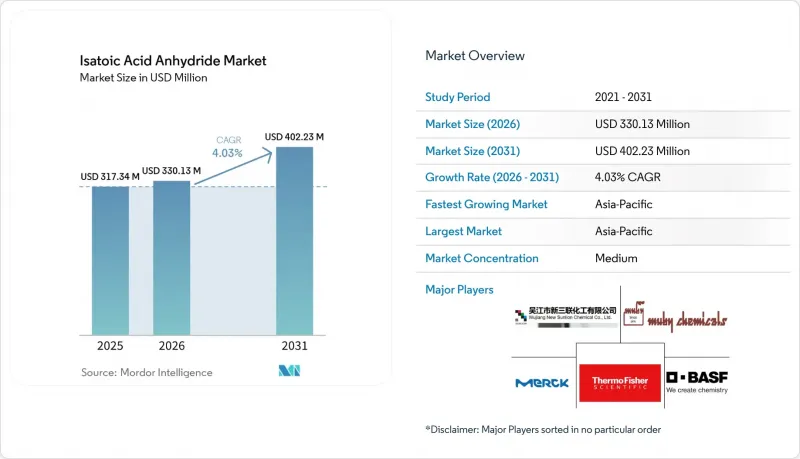
에 따르면 이사토산 무수물 시장 규모는 2025년에 3억 1,734만 달러로 평가되며, 2026년 3억 3,013만 달러에서 2031년까지 4억 223만 달러에 달할 것으로 예측되고 있으며, 예측 기간에 CAGR은 4.03%입니다(2026-2031년).
전 세계 이사토산 무수물 시장의 동향 및 인사이트
의약품 중간체의 수요 증가
이사토산 무수물은 벤조디아제핀 및 키나졸리논 합성 경로에 포함되어 있으며, 이에 따라 이사토산 무수물 시장은 여러 의약품 개발 프로그램과 연계되어 있습니다. 벤조디아제핀 활성 성분(API) 부문은 2025년에 7억 1,790만 달러에 달할 것으로 예상되며, 관련 고순도 중간체의 수요를 지원하고 있습니다. 2026년 연구에서는 전이 금속을 사용하지 않고 중간체 분리 공정을 줄인 2-벤조디아제핀의 연속 제조 경로가 보고되었습니다. 이러한 경로에서는 원료의 품질을 엄격하게 관리해야 하므로, 규정된 품질을 일관되게 유지하는 이사토산 무수물 배치에 대한 수요가 지원되고 있습니다. 유럽 송진화학 그룹은 API 합성 체인에 중간체가 하나 추가될 때마다 품질관리 및 변경 관리 요건이 증가한다고 밝혔습니다. 따라서 우수 제조 기준(GMP) 인증을 획득한 공급업체와의 장기 공급 계약은, 특히 여러 제조 단계에 걸쳐 생산 일정, 적합성 평가 기록 및 제품 출시 일정을 조율해야 하는 경우, 제약 업계 고객에게 조달 위험 및 규제 위험을 완화할 수 있습니다.
농약 합성의 확대
제초제 벤타존의 제조에는 이사토산 무수물이 합성 중간체로 사용되고 있으며, 이로 인해 이사토산 무수물 시장은 벼와 대두의 작물 보호 밸류체인과 연결되어 있습니다. 농약 제제에서의 수요는 생산자들에게 규제가 엄격한 의약품 생산 이외의 판로를 제공하고 있습니다. 아시아의 생산자들은 제초제 및 기타 작물 보호용 화학물질의 제조 능력을 확대하고 있습니다. 일부 생산자들은 시판 공급에 대한 의존도를 낮추기 위해 자사 전용 이사토산 무수물의 생산 능력을 구축하고 있습니다. 이로 인해 공급망 전체의 소비량이 증가하더라도 판매 대리점을 통해 거래되는 물량이 제한될 가능성이 있습니다. 독립 제제 제조업체에 공급하는 공급업체는 고객이 유연한 공급량이나 일관된 원료 사양을 필요로 하는 경우 여전히 중요한 역할을 수행하고 있습니다. 이는 현지 제제 일정이 파종 주기, 작물 생육 상황 및 고객의 재고 수요에 따라 변동될 수 있기 때문입니다.
전구체의 가격 및 공급 상황 변동
안트라닐산은 이사토산 무수물의 주요 전구체이며, 석유화학 밸류체인 내에서 프탈산 무수물과 암모니아로부터 제조됩니다. 이 때문에 이사토산 무수물 시장은 원유 가격 변동이나 방향족 원료의 공급 상황 변화에 민감하게 영향을 받습니다. 상류 투입 비용의 상승이 의약품 및 산업용 중간체 구매자에게 완전히 전가되지 않을 가능성이 있습니다. 원료 헤지나 후방 통합을 실시하지 않는 소규모 생산자는 이러한 변동의 영향을 더 크게 받습니다. 통합형 생산자는 원자재 공급을 더 엄격하게 관리할 수 있으므로 조달상의 혼란을 더 적절하게 관리할 수 있습니다. 이러한 이점으로 인해 보다 안정적인 납품과 가격 책정을 제공하는 대형 공급업체로부터의 구매가 촉진되는 반면, 소규모 기업은 자사의 이익률에 영향을 주지 않으면서 급격한 원자재 비용 변동을 흡수할 수 있는 능력이 제한될 수밖에 없습니다.
부문 분석
2025년, 의약품 등급은 이사토산 무수물의 시장 점유율 65.45%를 차지했습니다. 이러한 선도적 지위는 GMP 관리 하의 API 합성에서 이사토산 무수물이 수행하는 역할을 반영하며, 제조업체는 불순물 프로파일링, 규격 검증 및 문서화된 변경 관리를 수행해야 합니다. 제약 업계의 고객은 규제 대상 제품을 제조할 때 산업용 원료를 쉽게 대체할 수 없습니다. 유럽 송진화학 그룹은 API 제조 공정에 중간체가 추가됨에 따라 품질관리 및 품질 보증 요건이 더욱 엄격해진다고 지적하고 있습니다. 이러한 요건은 검증된 고순도 이사토산 무수물의 공급에 대한 수요를 지원하고 있으며, 상세한 기술 문서는 구매 결정의 실질적인 요소가 되고 있습니다. 또한 이로 인해 제약 용도와 산업 용도의 조달에 명확한 구분이 생기고 있습니다.
중국과 인도의 염료 및 농약 제조업체들의 생산 확대에 따라 산업용 등급 시장은 2031년까지 연평균 성장률(CAGR) 4.78%로 성장할 것으로 예측됩니다. 산업용 사용자는 일반적으로 비용, 가용성 및 자사의 특정 제형 공정에 대한 요건을 더 중요하게 여깁니다. 장쑤성의 중국 제조업체들은 높은 처리량의 배치 합성을 통해 이러한 수요의 상당 부분을 충족시키고 있습니다. REACH 등록 및 GMP 인증을 취득한 인도의 공급업체들은 규제 시장내 의약품 조달에서 더욱 중요한 역할을 수행하고 있습니다. BASF는 2026년, 루트비히스하펜의 베르분트 사업장에서 클로로포메이트 및 산 클로라이드의 생산을 확대하여 관련 특수 포스겐 화학 분야의 역량을 강화했습니다. 의약품 등급의 이사토산 무수물에 대한 공급업체 인증에는 감사 및 분석적 검증에 12-18개월이 소요될 수 있습니다. 이러한 요건으로 인해 의약품 분야의 고객에게는 전환 비용이 발생합니다.
2025년 시점에 이사토산 무수물의 시장 점유율 중 55.24%를 분말이 차지했습니다. 또한 2031년까지 연평균 성장률(CAGR) 5.89%로 확대될 것으로 예측되며, 이는 제어되고 재현 가능한 원료 첨가가 필요한 용도에서 분말의 중요성을 반영합니다. 입자 크기가 제어된 분말은 의약품 합성시 정확한 투여를 가능하게 합니다. 또한 더 큰 고체 원료로 인한 취급의 복잡성을 줄일 수 있습니다. 유동 공정에서도 안정적이고 재현성 있는 속도로 투입할 수 있는 재료가 요구됩니다. 이러한 요구 사항은 특히 생산 팀이 신뢰할 수 있는 첨가, 이송 및 배치 간 취급 성능을 필요로 하는 상황에서 이사토산 무수물 시장에서 분말이 차지하는 핵심적인 역할을 더욱 공고히 하고 있습니다.
2026년에 실시된 알부테롤 황산염의 연속 제조에 관한 연구에서는 유량 매개변수를 제어함으로써 99.3%의 용액 수율을 달성할 수 있음이 입증되었습니다. 이 연구 결과는 제조업체가 연속 공정 환경에서 일관된 분말 취급 능력을 중시하는 이유를 여실히 보여줍니다. 고체 형태는 운송 중의 보관 안정성이 즉각적인 투여 정확도보다 더 중요하게 여겨지는 상황에서 여전히 유용합니다. 이 형태는 사내에서 정평이 나 있는 용해법이 확립된 산업용 염료 및 폴리머 용도에 사용됩니다. 따라서 이사토산 무수물 시장은 제약, 산업 및 연구 용도에 걸친 각기 다른 취급 요구 사항을 반영하고 있습니다.
지역별 분석
2025년, 아시아태평양은 이사토산 무수물의 시장 점유율 34.84%를 차지했습니다. 이 지역은 2031년까지 연평균 성장률(CAGR) 4.74%로 확대될 것으로 예측됩니다. 중국은 안트라닐산 생산 및 하류 공정인 이사토산 무수물의 고리화 반응을 지원하는 장쑤성과 산둥성에서의 제조 활동을 통해 생산의 핵심을 담당하고 있습니다. 인도 구자라트주의 제약 벨트 지역에는 규제 대상 수출 시장을 충족하는 GMP 인증을 받은 최종 가공 시설이 있습니다. 일본, 한국 및 아세안(ASEAN) 국가들은 연구용 등급 및 특수 용도 분야의 수요를 주도하고 있습니다. 지역 전체의 공급 기반에서 품질 및 환경 규정 준수의 중요성이 점점 더 커지고 있으며, 신뢰할 수 있는 기록을 제공하고 일관된 제조 관행을 유지할 수 있는 공급업체의 중요성이 날로 높아지고 있습니다.
북미의 이사토산 무수물 시장은 수입 및 추적성, 품질 문서와 관련된 조달 요건에 의해 형성되고 있습니다. 제약 제조사 및 위탁 개발·제조 기관(CDMO)은 중요한 중간체에 대해 일반적으로 장기적인 인증 공급업체 계약을 활용하고 있습니다. 미국 환경보호청(EPA)의 2026년 3월 개정안에 따라 유해 대기 오염 물질을 취급하는 화학 제조 시설에 대한 규정 준수 요건이 강화되었습니다. 유럽에서도 사양이 검증되고 REACH 규정을 준수하는 조달에 의존하고 있습니다. 독일, 프랑스, 영국은 주요 의약품 소비 거점입니다. BASF는 루트비히스하펜에 특수 포스겐 화학물질의 생산 능력을 유지하고 있으며, 규제 대상 고객에 대한 문서화된 공급 기반을 지원하고 있습니다.
남미, 중동 및 아프리카는 이사토산 무수물 시장의 규모가 비교적 작고 수입에 의존하고 있는 지역입니다. 브라질의 대두 및 옥수수 생산은 제초제 벤타존 제조와 관련된 농약 등급의 수요를 지원하고 있습니다. 사우디아라비아의 ‘비전 2030’ 구상은 특수 화학품 사업 활동을 지원하고 있습니다. 남아프리카의 제네릭 의약품 부문은 추가적인 수요를 창출하고 있지만, 그 규모는 제한적입니다. 이 지역에서의 비즈니스 기회는 주로 수입 공급, 현지 제형화, 그리고 의약품 및 농약 생산 능력 확장과 관련되어 있습니다.
기타 혜택:
- 엑셀 형식의 시장 예측(ME) 시트
- 3개월간의 애널리스트 지원
자주 묻는 질문
목차
제1장 서론
- 조사 전제조건과 시장 정의
- 조사 범위
제2장 조사 방법
제3장 개요
제4장 시장 구도
- 시장 개요
- 시장 성장 촉진요인
- 시장 성장 억제요인
- 밸류체인 분석
- Porter's Five Forces 분석
제5장 시장 규모와 성장 예측
- 제품 등급별
- 폼별
- 용도별
- 최종 용도 산업별
- 지역별
- 아시아태평양
- 중국
- 인도
- 일본
- 한국
- ASEAN 국가
- 기타 아시아태평양 국가
- 북미
- 미국
- 캐나다
- 멕시코
- 유럽
- 독일
- 영국
- 프랑스
- 이탈리아
- 북유럽 국가
- 기타 유럽 국가
- 남미
- 브라질
- 아르헨티나
- 기타 남미 국가
- 중동 및 아프리카
- 사우디아라비아
- 남아프리카공화국
- 기타 중동 및 아프리카 국가
- 아시아태평양
제6장 경쟁 구도
- 시장 집중도
- 전략적 동향
- 시장 점유율·순위 분석
- 기업 개요
- Anmol Chemicals
- Anshul Specialty Molecules Private Limited
- BASF
- Changzhou Waston Chemical Technology Co., Ltd.
- Hebei Chuanghai Biotechnology Co., Ltd.
- Hefei Lbao Physical & Chemical Science Co., Ltd.
- Hefei TNJ Chemical Industry Co., Ltd.
- Jiangsu Juming Chemical Process Technology Co., Ltd.
- Jinan Finer Chemical Co., Ltd.
- Merck KGaA
- Muby Chem Private Limited
- Thermo Fisher Scientific Inc.
- Tokyo Chemical Industry Co., Ltd.(TCI)
- Wujiang New Sunlion Chemical Co., Ltd.
제7장 시장 기회와 향후 전망
KSA 26.10.28According to Mordor Intelligence, the isatoic acid anhydride market size was valued at USD 317.34 million in 2025 and is estimated to grow from USD 330.13 million in 2026 to reach USD 402.23 million by 2031, at a CAGR of 4.03% during the forecast period (2026-2031).
Global Isatoic Acid Anhydride Market Trends and Insights
Rising Pharmaceutical Intermediate Demand
Isatoic acid anhydride sits within benzodiazepine and quinazolinone synthesis routes, which link the isatoic acid anhydride market to several drug development programs. The benzodiazepine active pharmaceutical ingredients (APIs) segment reached USD 717.90 million in 2025, supporting demand for related high-purity intermediates. A 2026 study described a continuous manufacturing route to 2-benzodiazepines that avoided transition metals and reduced intermediate isolation steps. These routes require carefully controlled material quality, which supports demand for consistently specified isatoic acid anhydride batches. The European Fine Chemicals Group stated that each added intermediate in an API synthesis chain increases quality-control and change-control requirements. Long-term supply agreements with Good Manufacturing Practice (GMP)-certified suppliers can therefore reduce procurement and regulatory risks for pharmaceutical customers, especially when production schedules, qualification records, and product-release expectations must remain aligned across several manufacturing stages.
Expanding Agrochemical Synthesis
Bentazone herbicide production uses isatoic acid anhydride as a synthetic intermediate, linking the isatoic acid anhydride market to rice and soybean crop-protection value chains. Demand from agrochemical formulations gives producers an outlet outside regulated pharmaceutical production. Asian producers are expanding their manufacturing capabilities for herbicides and other crop-protection chemicals. Some producers are also developing captive isatoic acid anhydride capacity to reduce their reliance on merchant supply. This can limit volumes traded through distributors even when consumption across the supply chain increases. Suppliers serving independent formulators remain relevant where customers require flexible volumes or consistent material specifications, because local formulation schedules can change with planting cycles, crop conditions, and customer inventory needs.
Precursor Price and Availability Volatility
Anthranilic acid is the primary isatoic acid anhydride precursor and is produced from phthalic anhydride and ammonia within the petrochemical value chain. This makes the isatoic acid anhydride market exposed to crude oil cycles and changes in aromatic feedstock availability. Cost increases in upstream inputs may not be fully passed through to buyers of pharmaceutical or industrial intermediates. Smaller producers without feedstock hedging or backward integration are more exposed to those movements. Integrated producers can better manage procurement disruptions because they have closer control over raw material supply. This advantage can shift purchasing toward larger suppliers that offer more stable deliveries and pricing, while limiting the ability of smaller businesses to absorb abrupt raw-material cost changes without affecting their own margins.
Other drivers and restraints analyzed in the detailed report include:
- Growth in Specialty Dyes, Pigments and Polymer Additives
- Asia-Pacific Manufacturing Localization and Generic API Outsourcing
- Phosgene-Related EHS and Compliance Costs
For complete list of drivers and restraints, kindly check the Table Of Contents.
Segment Analysis
Pharmaceutical grade held 65.45% of the isatoic acid anhydride market share in 2025. Its leading position reflects the role of isatoic acid anhydride in GMP-controlled API synthesis, where manufacturers require impurity profiling, specification verification, and documented change control. Pharmaceutical customers cannot readily substitute industrial material when manufacturing regulated products. The European Fine Chemicals Group noted that additional intermediates in an API chain create added quality-control and quality-assurance requirements. This requirement supports demand for validated, high-purity isatoic acid anhydride supply and makes detailed technical documentation a practical part of the purchasing decision. It also creates a clear distinction between procurement for pharmaceutical and industrial uses.
Industrial grade is projected to advance at a 4.78% CAGR through 2031 as dye and agrochemical producers expand output in China and India. Industrial users generally place more emphasis on cost, availability, and the requirements of their specific formulation processes. Chinese producers in Jiangsu serve much of this demand through high-throughput batch synthesis. Indian suppliers with REACH registration and GMP certifications are more relevant to pharmaceutical procurement in regulated markets. BASF expanded chloroformate and acid chloride production at its Ludwigshafen Verbund site in 2026, strengthening its related specialty phosgene-chemistry capabilities. Supplier qualification for pharmaceutical grade isatoic acid anhydride can take 12 to 18 months of audit and analytical validation. These requirements create switching costs for customers in the pharmaceutical tier.
Powder held 55.24% of the isatoic acid anhydride market share in 2025. It is also projected to advance at a 5.89% CAGR through 2031, reflecting its importance in applications that require controlled, repeatable material addition. Particle-size-controlled powder supports accurate dosing in pharmaceutical synthesis. It can reduce handling complications associated with larger solid materials. Flow processes also rely on materials that can be introduced at stable and reproducible rates. These needs reinforce powder's central role in the isatoic acid anhydride market, particularly where production teams need dependable addition, transfer, and batch-to-batch handling performance.
A 2026 study on continuous albuterol sulfate manufacturing demonstrated that controlled flow-rate parameters can support a 99.3% solution yield. The finding illustrates why manufacturers value consistent powder handling in continuous process settings. Solid form remains useful where storage stability during transport is more important than immediate dosing precision. This form is used in industrial dye and polymer applications that have established in-house dissolution methods. The isatoic acid anhydride market, therefore, reflects differing handling needs across pharmaceutical, industrial, and research applications.
Complete Report Scope:
- By Product Grade
- Pharmaceutical Grade
- Industrial Grade
- Other Product Grades
- By Form
- Solid
- Powder
- Other Forms
- By Application
- Dyes and Pigments
- Pesticides
- Herbicides
- Saccharin
- Flavors and Fragrances
- Other Applications
- By End-Use Industry
- Pharmaceuticals
- Agrochemicals
- Perfume and Fragrance
- Food and Beverages
- Other End-Use Industries
- By Geography
- Asia-Pacific
- China
- India
- Japan
- South Korea
- ASEAN Countries
- Rest of Asia-Pacific
- North America
- United States
- Canada
- Mexico
- Europe
- Germany
- United Kingdom
- France
- Italy
- NORDIC Countries
- Rest of Europe
- South America
- Brazil
- Argentina
- Rest of South America
- Middle East and Africa
- Saudi Arabia
- South Africa
- Rest of Middle East and Africa
- Asia-Pacific
Geography Analysis
Asia-Pacific held 34.84% of the isatoic acid anhydride market share in 2025. The region is projected to advance at a 4.74% CAGR through 2031. China anchors production through manufacturing activity in Jiangsu and Shandong, which support anthranilic acid production and downstream isatoic acid anhydride cyclization. India's Gujarat pharmaceutical belt includes GMP-certified finishing facilities that serve regulated export markets. Japan, South Korea, and the Association of Southeast Asian Nations (ASEAN) countries add demand from research grade and specialized applications. Quality and environmental compliance are becoming more important across the regional supply base, increasing the relevance of suppliers that can provide reliable records and maintain consistent production practices.
The isatoic acid anhydride market in North America is shaped by imports and procurement requirements for traceability and quality documentation. Pharmaceutical manufacturers and contract development and manufacturing organizations (CDMOs) commonly use long-term qualified-supplier arrangements for critical intermediates. The EPA's March 2026 amendments raised compliance requirements for chemical manufacturing area sources that handle hazardous air pollutants. Europe also depends on specification-verified and REACH-compliant procurement. Germany, France, and the United Kingdom are important pharmaceutical consumption centers. BASF maintains specialty phosgene-chemistry production capabilities at Ludwigshafen that support a documented supply base for regulated customers.
South America and Middle East and Africa are smaller and import-dependent areas of the isatoic acid anhydride market. Brazil's soy and corn production supports agrochemical grade demand linked to bentazone herbicide manufacturing. Saudi Arabia's Vision 2030 initiatives support specialty chemical activity. South Africa's generic pharmaceutical sector creates additional but limited demand. Their opportunities are primarily tied to import supply, local formulation, and the development of pharmaceutical and agrochemical capacity.
- Anmol Chemicals
- Anshul Specialty Molecules Private Limited
- BASF
- Changzhou Waston Chemical Technology Co., Ltd.
- Hebei Chuanghai Biotechnology Co., Ltd.
- Hefei Lbao Physical & Chemical Science Co., Ltd.
- Hefei TNJ Chemical Industry Co., Ltd.
- Jiangsu Juming Chemical Process Technology Co., Ltd.
- Jinan Finer Chemical Co., Ltd.
- Merck KGaA
- Muby Chem Private Limited
- Thermo Fisher Scientific Inc.
- Tokyo Chemical Industry Co., Ltd. (TCI)
- Wujiang New Sunlion Chemical Co., Ltd.
Additional Benefits:
- The market estimate (ME) sheet in Excel format
- 3 months of analyst support
TABLE OF CONTENTS
1 Introduction
- 1.1 Study Assumptions and Market Definition
- 1.2 Scope of the Study
2 Research Methodology
3 Executive Summary
4 Market Landscape
- 4.1 Market Overview
- 4.2 Market Drivers
- 4.2.1 Rising Pharmaceutical Intermediate Demand
- 4.2.2 Expanding Agrochemical Synthesis
- 4.2.3 Growth in Specialty Dyes, Pigments and Polymer Additives
- 4.2.4 Asia-Pacific Manufacturing Localization and Generic API Outsourcing
- 4.2.5 Continuous-Flow and Low-Waste Synthesis Adoption
- 4.3 Market Restraints
- 4.3.1 Precursor Price and Availability Volatility
- 4.3.2 Phosgene-Related EHS and Compliance Costs
- 4.3.3 Analytical Release Testing and Change-Control Burden
- 4.4 Value Chain Analysis
- 4.5 Porter's Five Forces Analysis
- 4.5.1 Bargaining Power of Suppliers
- 4.5.2 Bargaining Power of Buyers
- 4.5.3 Threat of New Entrants
- 4.5.4 Threat of Substitutes
- 4.5.5 Competitive Rivalry
5 Market Size and Growth Forecasts (Value)
- 5.1 By Product Grade
- 5.1.1 Pharmaceutical Grade
- 5.1.2 Industrial Grade
- 5.1.3 Other Product Grades
- 5.2 By Form
- 5.2.1 Solid
- 5.2.2 Powder
- 5.2.3 Other Forms
- 5.3 By Application
- 5.3.1 Dyes and Pigments
- 5.3.2 Pesticides
- 5.3.3 Herbicides
- 5.3.4 Saccharin
- 5.3.5 Flavors and Fragrances
- 5.3.6 Other Applications
- 5.4 By End-Use Industry
- 5.4.1 Pharmaceuticals
- 5.4.2 Agrochemicals
- 5.4.3 Perfume and Fragrance
- 5.4.4 Food and Beverages
- 5.4.5 Other End-Use Industries
- 5.5 By Geography
- 5.5.1 Asia-Pacific
- 5.5.1.1 China
- 5.5.1.2 India
- 5.5.1.3 Japan
- 5.5.1.4 South Korea
- 5.5.1.5 ASEAN Countries
- 5.5.1.6 Rest of Asia-Pacific
- 5.5.2 North America
- 5.5.2.1 United States
- 5.5.2.2 Canada
- 5.5.2.3 Mexico
- 5.5.3 Europe
- 5.5.3.1 Germany
- 5.5.3.2 United Kingdom
- 5.5.3.3 France
- 5.5.3.4 Italy
- 5.5.3.5 NORDIC Countries
- 5.5.3.6 Rest of Europe
- 5.5.4 South America
- 5.5.4.1 Brazil
- 5.5.4.2 Argentina
- 5.5.4.3 Rest of South America
- 5.5.5 Middle East and Africa
- 5.5.5.1 Saudi Arabia
- 5.5.5.2 South Africa
- 5.5.5.3 Rest of Middle East and Africa
- 5.5.1 Asia-Pacific
6 Competitive Landscape
- 6.1 Market Concentration
- 6.2 Strategic Moves
- 6.3 Market Share (%)/Ranking Analysis
- 6.4 Company Profiles (includes Global Overview, Market Overview, Core Segments, Financials as available, Strategic Information, Products and Services, and Recent Developments)
- 6.4.1 Anmol Chemicals
- 6.4.2 Anshul Specialty Molecules Private Limited
- 6.4.3 BASF
- 6.4.4 Changzhou Waston Chemical Technology Co., Ltd.
- 6.4.5 Hebei Chuanghai Biotechnology Co., Ltd.
- 6.4.6 Hefei Lbao Physical & Chemical Science Co., Ltd.
- 6.4.7 Hefei TNJ Chemical Industry Co., Ltd.
- 6.4.8 Jiangsu Juming Chemical Process Technology Co., Ltd.
- 6.4.9 Jinan Finer Chemical Co., Ltd.
- 6.4.10 Merck KGaA
- 6.4.11 Muby Chem Private Limited
- 6.4.12 Thermo Fisher Scientific Inc.
- 6.4.13 Tokyo Chemical Industry Co., Ltd. (TCI)
- 6.4.14 Wujiang New Sunlion Chemical Co., Ltd.
7 Market Opportunities and Future Outlook
- 7.1 White-Space and Unmet-Need Assessment


