

|
시장보고서
상품코드
2154890
ASEAN의 섬유 제조업 : 시장 점유율 분석, 업계 동향과 통계, 성장 예측(2026-2031년)ASEAN Textile Manufacturing - Market Share Analysis, Industry Trends & Statistics, Growth Forecasts (2026 - 2031) |
||||||
 Mordor Intelligence
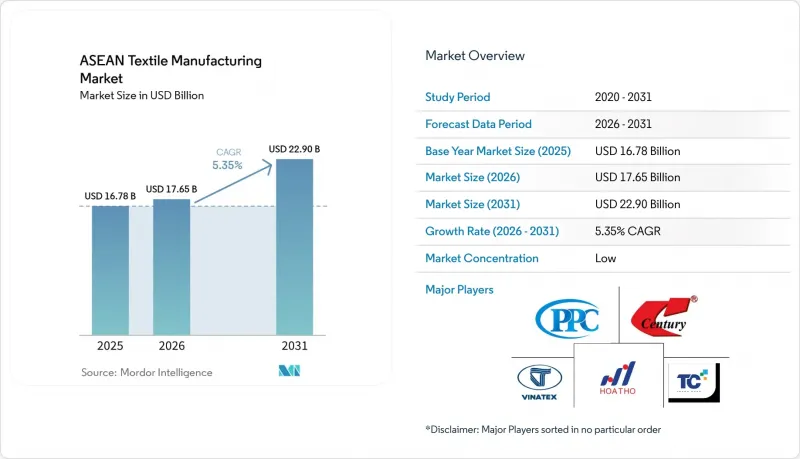
에 따르면 ASEAN의 섬유 제조 시장 규모는 2025년에 167억 8,000만 달러로 평가되며, 2026년 176억 5,000만 달러에서 2031년까지 229억 달러에 달할 것으로 예측되고 있으며, 예측 기간(2026-2031년)에 CAGR은 5.35%에 달할 전망입니다.
아세안 섬유 제조 시장의 동향 및 인사이트
수출·조달처의 다각화와 니어쇼어링
2024년 이후, 전 세계 의류 및 섬유 제품 바이어들은 조달 계획을 변경하고 있으며, 그 결과 아세안(ASEAN) 섬유 제조 시장은 생산의 주요 거점으로 부상하고 있습니다. 미국으로의 의류 수입에서 베트남의 점유율은 2024년 18.9%에서 2025년 21.1%로 상승했습니다. 캄보디아의 섬유, 의류, 신발, 여행용품 수출은 2025년 첫 9개월 동안 전년 동기 대비 16.6% 증가했습니다. 베트남, 태국, 캄보디아의 제조업체들은 그동안 중국에 남아 있던 생산 물량을 더 많이 확보하기 위해 방적, 직조, 염색 능력을 강화하고 있습니다. 장기적인 우위는 인증된 원산지 규정을 준수하는 거점 내에서 섬유, 실, 원단을 공급할 수 있는 생산자에게 유리하게 작용할 가능성이 높습니다. 미얀마는 여전히 인건비가 낮은 편이지만, 정세 불안으로 인해 인증을 중시하는 바이어들이 요구하는 공식적인 생산 능력 확대가 제한되고 있습니다. 베트남의 산업생산지수는 2025년에 9.2% 상승했으며, 수주 증가가 제조업 생산액 및 미결제 수주를 지원하고 있는 것으로 나타났습니다.
FTA 원산지 규정, 지역내 조달 및 디지털 생산
ATIGA, RCEP 및 양자 협정에 기반한 원산지 규정은 아세안(ASEAN) 섬유 제조 시장의 투자 결정 및 무역 서류 작성에 영향을 미칩니다. ATIGA의 섬유 관련 규정에서는 특혜 관세를 적용받기 위해 ‘원사 포워드(yarn-forward)’ 기준 중 하나 또는 40%의 지역 부가가치가 요구됩니다. 2025년 ATIGA 개정을 통해 458개 관세 품목에 대한 특혜 접근이 확대되었으며, 전자식 Form D 원산지 증명서가 도입되었습니다. RCEP에서는 제조업체가 15개 참가 경제권 전체에서 적격 투입재를 누적할 수 있으므로, 적격 생산자가 활용할 수 있는 조달 기반이 확대됩니다. 이러한 체계는 베트남과 말레이시아의 새로운 방적·직물 프로젝트를 촉진하고 있습니다. 이는 인증된 상류 공정 생산 능력이 있다면, 중계 모델로는 제공할 수 없는 관세 혜택을 확보할 수 있기 때문입니다. 디지털 프린팅이나 소량 생산 시스템은 유연성을 높여주지만, 그 이점은 사업자, 자금 조달, 고객의 수요에 따라 달라집니다. 따라서 아세안(ASEAN)의 섬유 제조 시장에서는 현지 원자재 조달, 전자 규정 준수 시스템, 그리고 신속한 생산 일정 관리를 결합한 공장이 우위를 점하고 있습니다.
면화 수입에 대한 의존도와 섬유 가격 변동
아세안 섬유 제조 시장은 국내 면화 생산량이 제한적이기 때문에 여전히 세계 면화 및 섬유 가격 변동의 영향을 받기 쉬운 상황에 놓여 있습니다. 베트남은 2025/26 마케팅 연도에 760만 베일(1베일=480파운드)의 면화를 수입했는데, 2025년 8월부터 2026년 2월까지의 기간 중 그 수입량의 86%를 미국, 브라질, 호주가 공급했습니다. 면화 가격 하락은 투입 비용 절감으로 이어지지만, 원사 마진이 좁아지면 방적업체의 이익률도 압박받을 가능성이 있습니다. Vinatex는 면화 수입 의존도가 100%, 섬유 수입 의존도가 90%에서 95%에 달한다는 점을 주요 취약점으로 지적하고 있습니다. 인도네시아의 면화 소비량은 구매력 저하로 인해 수입이 억제될 것으로 예상되어, 2025/26 마케팅 연도에는 5% 감소한 185만 베일에 달할 것으로 전망됩니다. 또한 새로운 재생 섬유 프로젝트가 진행되고 있음에도 불구하고 섬유 폐기물 회수 체계가 미흡하여 신뢰할 수 있는 순환형 원료 확보에도 제약이 따르고 있습니다. 인도네시아의 면사 수입에 대한 세이프가드 조치는 방적업체를 보호하는 한편, 하류 직물·니트 업체에게는 비용 상승 요인이 됩니다.
부문별 분석
2025년, 아세안(ASEAN) 섬유 제조 시장 매출 중 범용 합성섬유가 49.5%를 차지했습니다. 폴리에스테르, 나일론, 폴리프로필렌, 아크릴, 엘라스탄은 이 지역에 확립된 폴리머, 방적, 텍스처링 운영 체제에 적합하므로 대량 생산을 지원하고 있습니다. 합성섬유는 전 세계 섬유 생산량의 67.4%를 차지하며, 그중 폴리에스테르가 57.2%를 차지합니다. 천연섬유도 여전히 중요하지만, 면은 수입에 의존하고 있으며, 비단이나 양모와 같은 동물성 섬유는 태국이나 베트남에서 보다 전문적인 용도로 사용되고 있습니다. 비스코스, 리요셀, 모달, 아세테이트 등의 인공 셀룰로오스 섬유는 브랜드들에게 버진 폴리에스터나 기존 방식으로 재배된 면을 대체할 수 있는 선택지가 되고 있습니다.
아세안(ASEAN) 섬유 제조 시장에서 특수 섬유 및 고성능 섬유는 2026-2031년까지 연평균 성장률(CAGR) 8.2%로 성장할 것으로 예측됩니다. 아라미드, 초고분자량 폴리에틸렌(UHMWPE), 산업용 필라멘트 및 탄소섬유 강화 소재는 운송, 국방, 보호 및 산업 용도로 사용되고 있습니다. 이 부문은 기술 사양, 일관된 성능, 그리고 산업용 구매자와의 긴밀한 협력에 의존하고 있습니다. 인드라마 벤처스(Indrama Ventures)가 2025년에 추진한 재생 PET 합작 투자는 지역 섬유 제조업체들이 회수된 섬유 제품에서 어떻게 가치를 창출하려 하고 있는지를 보여줍니다. 유럽에 공급되는 폴리에스터 제품에 대한 재생 소재 함유율 요건이 강화될 전망이므로, 버진 수지만을 사용한 생산보다 인증받은 재생 공정이 우선시될 가능성이 있습니다. 이러한 변화로 인해 원자재의 출처와 제조 품질을 검증할 수 있는 공급업체를 통한 조달 결정이 촉진될 것입니다.
2025년, 아세안(ASEAN) 섬유 제조 시장 규모 중 직물 제조가 43.5%를 차지했습니다. 직물, 니트, 부직포 생산은 베트남, 인도네시아, 태국, 말레이시아에서 확고히 자리 잡고 있습니다. 2025년, 베트남에는 121개의 방적 공장이 있으며, 추정 1,040만 스핀들에 상당하는 생산 능력을 보유하고 있었습니다. 여기에는 외국계 공장 46곳과 국내 공장 75곳이 포함됩니다. 직물 생산은 베트남 북부 및 중부·서자바 지역에 집중되어 있는 반면, 말레이시아와 태국은 고성능 니트 원단의 생산 능력을 보유하고 있습니다. 부직포는 의료용 섬유, 지오텍스타일, 여과재, 개인 보호 장비(PPE)를 지원하고 있지만, 막대한 설비 투자가 필요합니다.
아세안(ASEAN) 섬유 제조 시장에서 섬유 마감 및 표면 처리는 2031년까지 연평균 성장률(CAGR) 7.7%로 성장할 것으로 예측됩니다. 전처리, 표백, 염색, 프린팅, 코팅 및 기타 마감 공정은 원단이 고객의 화학 물질, 물, 탄소 관련 요건을 충족하는지 여부를 결정하는 데 있으며, 점점 더 중요한 역할을 하고 있습니다. 엡손과 IDC가 제공한 자료에 따르면 디지털 프린팅은 기존 스크린 프린팅에 비해 물 사용량을 90% 줄일 수 있습니다. 이 공정은 수요가 불안정한 경우에도 소량 주문이나 신속한 디자인 변경에 대응할 수 있습니다. 인도네시아의 개정된 폐수 배출 기준에 따라 주요 습식 가공 시설은 2027년 말까지 기준 준수를 위한 투자를 수행해야 합니다. 이 부문의 성장은 인증된 마감 소재에 대한 수요 증가를 반영하고 있지만, 환경 규제가 강화됨에 따라 자본 수요도 증가할 전망입니다.
기타 혜택:
- 엑셀 형식의 시장 예측(ME) 시트
- 3개월간의 애널리스트 지원
자주 묻는 질문
목차
제1장 서론
- 조사 전제조건과 시장 정의
- 조사 범위
제2장 조사 방법
제3장 개요
제4장 시장 구도
- 시장 개요
- 시장 성장 촉진요인
- 시장 성장 억제요인
- 밸류·공급망 분석
- 규제 상황
- 기술 전망
- ASEAN의 섬유 생산·소비·무역에 관한 분석과 인사이트
- 주요 섬유 생산국에서 제조 비용 경쟁력에 관한 분석
- ASEAN에서 공급망의 다양화에 관한 분석
- 원재료 공급 상황과 섬유 가격의 동향에 관한 분석
- 투자, 생산능력의 확대 및 제조 기반 이전 동향
- 지속가능 및 순환형 섬유 제조에 관한 인사이트
- 무역정책 및 지정학적 이벤트가 시장에 미치는 영향 평가
제5장 시장 규모와 성장 예측
- 원재료별
- 제조 프로세스와 제품 유형별
- 최종 용도 산업별
- 기업 규모별
- 지역별
- 베트남
- 인도네시아
- 태국
- 말레이시아
- 캄보디아
- 미얀마
- 필리핀
- 기타 ASEAN 국가 - 싱가포르, 라오스 인민민주공화국, 브루나이
제6장 경쟁 구도
- 시장 집중도
- 전략적 동향
- 시장 점유율 분석
- 기업 개요
- Vietnam National Textile and Garment Group
- Thanh Cong Textile Garment Investment Trading Joint Stock Company
- Phong Phu Corporation JSC
- Hoa Tho Textile-Garment Joint Stock Corporation
- Century Synthetic Fiber Corporation
- PT Asia Pacific Fibers Tbk
- PT Sri Rejeki Isman Tbk
- PT Indo-Rama Synthetics Tbk
- Duniatex
- PT Tifico Fiber Indonesia Tbk
- PT Elegant Textile Industry
- PT Indo Liberty Textiles
- PT Sunrise Bumi Textiles
- Ramatex Textiles Industrial Sdn Bhd
- Penfabric Sdn Berhad
- Toray Industries Malaysia Sdn Bhd
- Aditya Birla Yarns
- Indo Thai Synthetics Co. Ltd
- Jong Stit Group
- Innotech Textile(M) Sdn. Bhd.
제7장 시장 기회와 향후 전망
KSA 26.10.28According to Mordor Intelligence, the ASEAN textile manufacturing market size was valued at USD 16.78 billion in 2025 and is estimated to grow from USD 17.65 billion in 2026 to reach USD 22.90 billion by 2031, at a CAGR of 5.35% during the forecast period (2026-2031).
ASEAN Textile Manufacturing Market Trends and Insights
Export-Sourcing Diversification and Nearshoring
Global apparel and textile buyers have changed their sourcing plans since 2024, and the ASEAN textile manufacturing market has become a major destination for the resulting production. Vietnam's share of United States apparel imports rose to 21.1% in 2025 from 18.9% in 2024. Cambodia's textile, garment, footwear, and travel goods exports rose 16.6% year over year in the first 9 months of 2025. Manufacturers in Vietnam, Thailand, and Cambodia are adding spinning, weaving, and dyeing capacity to retain more production that had previously remained in China. The lasting advantage is likely to favor producers that can supply fiber, yarn, and fabric within a certified, rules-of-origin-compliant location. Myanmar retains low labor costs, but political instability limits the formal capacity expansion certification-focused buyers seek. Vietnam's industrial production index rose 9.2% in 2025, showing that order growth has supported manufacturing output as well as bookings.
FTA Rules of Origin, Regional Localization, and Digital Production
Rules of origin under ATIGA, RCEP, and bilateral agreements affect investment decisions and trade documentation in the ASEAN textile manufacturing market. ATIGA textile rules require either a yarn-forward standard or 40% regional value content for preferential tariff eligibility. The 2025 ATIGA revision expanded preferential access across 458 tariff lines and introduced electronic Form D origin certification. RCEP lets manufacturers cumulate qualifying inputs across 15 participating economies, which broadens the sourcing base available to an eligible producer. This framework encourages new spinning and weaving projects in Vietnam and Malaysia because certified upstream capacity can support tariff access that a transshipment model cannot offer. Digital printing and small-batch systems add flexibility, although their benefits depend on operators, funding, and customer demand. The ASEAN textile manufacturing market therefore rewards plants that combine local input sourcing, electronic compliance systems, and responsive production scheduling.
Cotton Import Dependence and Fiber-Price Volatility
The ASEAN textile manufacturing market remains exposed to global cotton and fiber-price movements because domestic cotton production is limited. Vietnam imported 7.6 million 480-pound bales of cotton in marketing year 2025/26, and the United States, Brazil, and Australia supplied 86% of the volume between August 2025 and February 2026. Lower cotton prices can reduce input costs, but narrow yarn spreads can also compress spinner margins. Vinatex has identified 100% cotton import dependence and 90% to 95% fiber import dependence as key vulnerabilities. Indonesia's cotton consumption is forecast to decline 5% to 1.85 million bales in marketing year 2025/26 as weaker purchasing power constrains imports. Weak textile-waste collection also restricts reliable circular feedstock, despite new recycled-fiber projects. Indonesia's safeguards on imported cotton yarn can protect spinners while raising costs for downstream weavers and knitters.
Other drivers and restraints analyzed in the detailed report include:
- Technical Textile Demand from Medical, Mobility, and Industrial Uses
- Brand Demand for Traceable and Lower-Impact Materials
- Energy, Water, and Compliance Cost Inflation
For complete list of drivers and restraints, kindly check the Table Of Contents.
Segment Analysis
Commodity synthetics accounted for 49.5% of the ASEAN textile manufacturing market revenue in 2025. Polyester, nylon, polypropylene, acrylic, and elastane support large-volume production because they fit established regional polymer, spinning, and texturing operations. Synthetic fibers accounted for 67.4% of global fiber production, and polyester represented 57.2% of global output. Natural fibers remain important, but cotton is imported, and animal fibers such as silk and wool serve more specialized activities in Thailand and Vietnam. Artificial cellulosic fibers such as viscose, lyocell, modal, and acetate offer brands an alternative to virgin polyester and conventionally grown cotton.
Specialty and high-performance fibers are forecast to grow at an 8.2% CAGR from 2026 to 2031 within the ASEAN textile manufacturing market. Aramid, UHMWPE, technical filaments, and carbon-fiber-reinforced materials are used in transport, defense, protection, and industrial applications. The segment relies on technical specifications, consistent performance, and close engagement with industrial buyers. Indorama Ventures' 2025 recycled PET joint venture shows how a regional fiber producer is pursuing value from recovered textiles. Expected recycled-content requirements for polyester products supplied to Europe may favor certified recycled processing over virgin-resin-only production. This change can move purchasing decisions toward suppliers that can verify material origin and process quality.
Fabric manufacturing accounted for 43.5% of the ASEAN textile manufacturing market size in 2025. Weaving, knitting, and nonwoven production are established across Vietnam, Indonesia, Thailand, and Malaysia. Vietnam had an estimated 10.4 million spindle equivalents across 121 spinning mills in 2025, including 46 foreign-invested mills and 75 domestic mills. Weaving is concentrated in northern Vietnam and the Central and West Java belt, while Malaysia and Thailand have capabilities in knit performance fabrics. Nonwovens support medical textiles, geotextiles, filtration, and personal protective equipment, but they require substantial capital investment.
Textile finishing and surface treatment are forecast to grow at a 7.7% CAGR through 2031 in the ASEAN textile manufacturing market. Pretreatment, bleaching, dyeing, printing, coating, and other finishing steps increasingly determine whether fabric meets customer chemical, water, and carbon requirements. Digital printing can use 90% less water than conventional screen printing, according to the supplied Epson and IDC material. This process also supports smaller orders and faster design changes when demand is uneven. Indonesia's updated wastewater standards will require major wet-processing facilities to invest in compliance by late 2027. The segment's growth reflects higher demand for certified finished inputs, although the added environmental controls will raise capital needs.
Complete Report Scope:
- By Raw Material
- Natural Fibers
- Plant-Based Fibers
- Cotton
- Others (Jute, Flax, Hemp, Ramie, Coir)
- Animal-Based Fibers (Wool, Silk, and Other Animal Fibers)
- Plant-Based Fibers
- Man-Made Cellulosic Fibers (Viscose/Rayon, Lyocell, Modal, and Acetate)
- Commodity Synthetics (Polyester, Nylon/Polyamide, Polypropylene, Acrylic, and Elastane)
- Specialty and High-Performance Fibers (Aramid, UHMWPE, etc.)
- Natural Fibers
- By Manufacturing Process and Product Type
- Yarn and Thread Manufacturing
- Fabric Manufacturing
- Weaving
- Knitting and Crocheting
- Nonwoven and Felt Manufacturing
- Other Fabric-Formation Processes
- Textile Finishing and Surface Treatment (Pretreatment, Bleaching, Dyeing, Printing, etc.)
- By End Use Industry
- Apparel and Fashion
- Home and Household Textiles
- Technical and Industrial Textiles
- Transportation and Mobility
- Medical and Hygiene
- Industrial Processing and Filtration
- Construction and Geotextiles
- Protective and Safety
- Packaging
- Other Technical Applications - Agriculture, etc.
- By Enterprise Scale
- Large Organized Manufacturers
- Micro, Small, and Medium Enterprises (MSMEs) and the unorganized sector
- By Geography
- Vietnam
- Indonesia
- Thailand
- Malaysia
- Cambodia
- Myanmar
- Philippines
- Rest of ASEAN Countries - Singapore, Lao PDR and Brunei
List of Companies Covered in this Report:
- Vietnam National Textile and Garment Group
- Thanh Cong Textile Garment Investment Trading Joint Stock Company
- Phong Phu Corporation JSC
- Hoa Tho Textile - Garment Joint Stock Corporation
- Century Synthetic Fiber Corporation
- PT Asia Pacific Fibers Tbk
- PT Sri Rejeki Isman Tbk
- PT Indo-Rama Synthetics Tbk
- Duniatex
- PT Tifico Fiber Indonesia Tbk
- PT Elegant Textile Industry
- PT Indo Liberty Textiles
- PT Sunrise Bumi Textiles
- Ramatex Textiles Industrial Sdn Bhd
- Penfabric Sdn Berhad
- Toray Industries Malaysia Sdn Bhd
- Aditya Birla Yarns
- Indo Thai Synthetics Co. Ltd
- Jong Stit Group
- Innotech Textile (M) Sdn. Bhd.
Additional Benefits:
- The market estimate (ME) sheet in Excel format
- 3 months of analyst support
TABLE OF CONTENTS
1 Introduction
- 1.1 Study Assumptions and Market Definition
- 1.2 Scope of the Study
2 Research Methodology
3 Executive Summary
4 Market Landscape
- 4.1 Market Overview
- 4.2 Market Drivers
- 4.2.1 Export-Sourcing Diversification and Nearshoring
- 4.2.2 FTA Rules of Origin and Regional Supply-Chain Localization
- 4.2.3 Technical Textile Demand from Medical, Mobility, and Industrial Uses
- 4.2.4 Brand Demand for Traceable and Lower-Impact Materials
- 4.2.5 Digital Production and Small-Batch Customization
- 4.2.6 Regenerated and Recycled Fiber Capacity Expansion
- 4.3 Market Restraints
- 4.3.1 Cotton Import Dependence and Fiber-Price Volatility
- 4.3.2 Energy, Water, and Compliance Cost Inflation
- 4.3.3 Uneven Automation Skills and SME Financing Constraints
- 4.3.4 Weak Textile-Waste Collection and Circular Feedstock Reliability
- 4.4 Value / Supply-Chain Analysis
- 4.5 Regulatory Landscape
- 4.6 Technological Outlook
- 4.6.1 Analysis of Smart Manufacturing, Automation, and AI Adoption
- 4.6.2 Digital Textile Printing
- 4.6.3 AI-Enabled Demand and Production Planning
- 4.6.4 Fiber-to-Fiber Recycling
- 4.7 Insights on ASEAN Textile Production, Consumption, and Trade Analysis
- 4.8 Insights on Manufacturing Cost Competitiveness Across Major Textile-Producing Countries
- 4.9 Analysis of ASEAN Supply Chain Diversification
- 4.10 Insights on Raw Material Availability and Fiber Price Trends
- 4.11 Investments, Capacity Expansion, and Manufacturing Relocation Activities
- 4.12 Insights on Sustainable and Circular Textile Manufacturing
- 4.13 Impact Assessment of Trade Policies and Geopolitical Events on the Market
5 Market Size and Growth Forecasts
- 5.1 By Raw Material
- 5.1.1 Natural Fibers
- 5.1.1.1 Plant-Based Fibers
- 5.1.1.1.1 Cotton
- 5.1.1.1.2 Others (Jute, Flax, Hemp, Ramie, Coir)
- 5.1.1.2 Animal-Based Fibers (Wool, Silk, and Other Animal Fibers)
- 5.1.1.1 Plant-Based Fibers
- 5.1.2 Man-Made Cellulosic Fibers (Viscose/Rayon, Lyocell, Modal, and Acetate)
- 5.1.3 Commodity Synthetics (Polyester, Nylon/Polyamide, Polypropylene, Acrylic, and Elastane)
- 5.1.4 Specialty and High-Performance Fibers (Aramid, UHMWPE, etc.)
- 5.1.1 Natural Fibers
- 5.2 By Manufacturing Process and Product Type
- 5.2.1 Yarn and Thread Manufacturing
- 5.2.2 Fabric Manufacturing
- 5.2.2.1 Weaving
- 5.2.2.2 Knitting and Crocheting
- 5.2.2.3 Nonwoven and Felt Manufacturing
- 5.2.2.4 Other Fabric-Formation Processes
- 5.2.3 Textile Finishing and Surface Treatment (Pretreatment, Bleaching, Dyeing, Printing, etc.)
- 5.3 By End Use Industry
- 5.3.1 Apparel and Fashion
- 5.3.2 Home and Household Textiles
- 5.3.3 Technical and Industrial Textiles
- 5.3.3.1 Transportation and Mobility
- 5.3.3.2 Medical and Hygiene
- 5.3.3.3 Industrial Processing and Filtration
- 5.3.3.4 Construction and Geotextiles
- 5.3.3.5 Protective and Safety
- 5.3.3.6 Packaging
- 5.3.3.7 Other Technical Applications - Agriculture, etc.
- 5.4 By Enterprise Scale
- 5.4.1 Large Organized Manufacturers
- 5.4.2 Micro, Small, and Medium Enterprises (MSMEs) and the unorganized sector
- 5.5 By Geography
- 5.5.1 Vietnam
- 5.5.2 Indonesia
- 5.5.3 Thailand
- 5.5.4 Malaysia
- 5.5.5 Cambodia
- 5.5.6 Myanmar
- 5.5.7 Philippines
- 5.5.8 Rest of ASEAN Countries - Singapore, Lao PDR and Brunei
6 Competitive Landscape
- 6.1 Market Concentration
- 6.2 Strategic Moves
- 6.3 Market Share Analysis
- 6.4 Company Profiles (Includes Global Level Overview, Market Level Overview, Core Segments, Financials as available, Strategic Information, Products and Services, Recent Developments)
- 6.4.1 Vietnam National Textile and Garment Group
- 6.4.2 Thanh Cong Textile Garment Investment Trading Joint Stock Company
- 6.4.3 Phong Phu Corporation JSC
- 6.4.4 Hoa Tho Textile - Garment Joint Stock Corporation
- 6.4.5 Century Synthetic Fiber Corporation
- 6.4.6 PT Asia Pacific Fibers Tbk
- 6.4.7 PT Sri Rejeki Isman Tbk
- 6.4.8 PT Indo-Rama Synthetics Tbk
- 6.4.9 Duniatex
- 6.4.10 PT Tifico Fiber Indonesia Tbk
- 6.4.11 PT Elegant Textile Industry
- 6.4.12 PT Indo Liberty Textiles
- 6.4.13 PT Sunrise Bumi Textiles
- 6.4.14 Ramatex Textiles Industrial Sdn Bhd
- 6.4.15 Penfabric Sdn Berhad
- 6.4.16 Toray Industries Malaysia Sdn Bhd
- 6.4.17 Aditya Birla Yarns
- 6.4.18 Indo Thai Synthetics Co. Ltd
- 6.4.19 Jong Stit Group
- 6.4.20 Innotech Textile (M) Sdn. Bhd.
7 Market Opportunities & Future Outlook
- 7.1 White-Space and Unmet-Need Assessment


