

|
시장보고서
상품코드
2154932
소규모 언어 모델(SLMs) : 시장 점유율 분석, 업계 동향과 통계, 성장 예측(2026-2031년)Small Language Models (SLMs) - Market Share Analysis, Industry Trends & Statistics, Growth Forecasts (2026 - 2031) |
||||||
 Mordor Intelligence
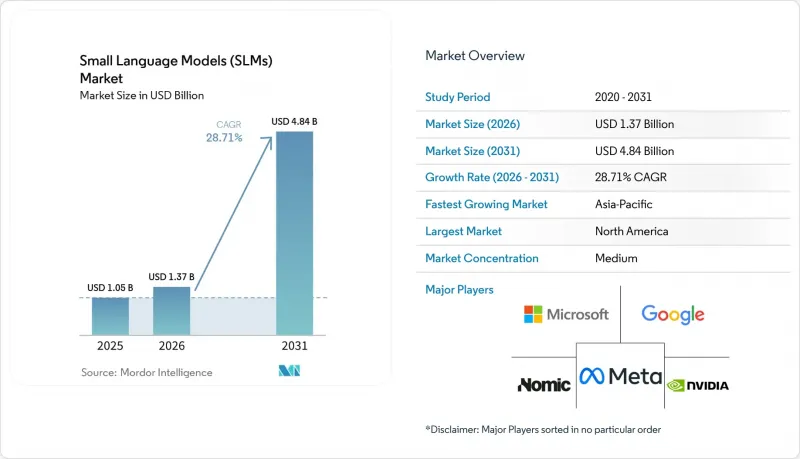
에 따르면 소형 언어 모델(SLM) 시장 규모는 2025년 10억 5,000만 달러, 2026년 13억 7,000만 달러에서 2031년까지 48억 4,000만 달러로 확대될 것으로 예측되고 있으며, 2026-2031년에 CAGR은 28.71%를 기록할 전망입니다.
전 세계 소형 언어 모델(SLM) 시장의 동향 및 인사이트
저지연 온디바이스 AI에 대한 수요 증가
저지연 추론은 소형 언어 모델 시장에서 단순한 기술적 선호에서 상업적 요건으로 전환되고 있습니다. 기업은 현재 소프트웨어 및 기기에 내장된 AI 기능에 대해 더 빠른 응답 시간, 낮은 전력 소비, 그리고 네트워크 의존도 감소를 기대하고 있습니다. 마이크로소프트는 2025년 5월, 스냅드래곤이 탑재된 Copilot+PC에서 ‘Phi-4-mini-reasoning’의 사용을 가능하게 하여, 추론 워크로드가 CPU 부하가 높은 실행에 의존하지 않고 NPU로 오프로드하여 실행될 수 있음을 입증했습니다. 또한 애플도 WWDC 2025에서 15개 언어에 걸친 다국어 성능을 유지하면서도 KV 캐시 메모리 사용량을 37.5% 줄인 온디바이스 기초 모델을 출시하여, 완전 오프라인 추론의 실용성을 한층 더 입증했습니다. 구글은 2026년 4월, 구글 클라우드에서 ‘Gemma 4’를 발표하며 이러한 흐름을 더욱 가속화했습니다. Gemma 4는 140개 이상의 언어를 지원하며, 모바일 및 디바이스 배포를 위해 구축된 엣지 지향형 변형도 포함되어 있었습니다. 그 결과, 소형 언어 모델 시장은 로컬 AI 기능을 선택적 확장 기능이 아닌 표준 기능으로 취급하게된 하드웨어 및 소프트웨어 각 분야에 의해 주도되고 있습니다.
비용 압박 대 최첨단 모델의 추론 경제성
추론 비용은 기업이 프로덕션 환경 아키텍처를 비교하는 방식을 변화시키기 때문에 소형 언어 모델 시장에서 가장 명확한 도입 촉진요인 중 하나가 되고 있습니다. 구매자들은 더 이상 기능 벤치마크만을 바탕으로 모델을 선택하지 않습니다. 대량 처리 워크플로우에서는 지속적인 API 비용이 성능상 이점을 금세 상쇄할 가능성이 있기 때문입니다. 따라서 소형 언어 모델 시장이 탄력을 받고 있는 이유는 소형 모델이 현재 더 저렴할 뿐만 아니라, 그 경제성이 최첨단 모델 제공업체들조차 더 작고 효율적인 대체 모델을 출시하도록 부추기고 있기 때문이기도 합니다.
제한된 컨텍스트 깊이 대 대규모 기반 모델
컨텍스트 깊이는 복잡한 분석 작업에서 소형 언어 모델 시장이 어디까지 발전할 수 있는지에 있으며, 여전히 가장 명확한 기술적 한계로 남아 있습니다. 많은 소형 모델은 범위가 제한된 워크플로우에서는 양호한 성능을 발휘하지만, 장문 리뷰, 확장된 에이전트 메모리, 계층적 추론에 있어서는 여전히 대규모 시스템과의 격차가 드러나고 있습니다. 애플은 자사의 온디바이스 기반 모델이 4,000 토큰의 컨텍스트 윈도우를 지원하는 반면, Private Cloud Compute 경로에서는 32,000 토큰을 지원한다고 밝혔으며, 이는 프라이버시를 최우선으로 하는 배포와 더 광범위한 컨텍스트 용량 사이의 상충 관계를 부각시키고 있습니다. Mistral은 2026년 7월, Magistral Small 2507을 발표하며 그 격차 일부를 해소했습니다. 이 모델은 Apache 2.0 라이선스 하에서 128,000 토큰의 컨텍스트 윈도우를 지원하면서도 온프레미스 배포가 가능합니다. 이러한 진전에도 불구하고 소형 언어 모델 시장은 여전히 엣지 환경에서의 효율성과 가장 까다로운 기업 사용 사례에 필요한 광범위한 컨텍스트 메모리 사이의 설계적 상충 관계에 직면해 있습니다.
부문 분석
2025년에는 프레임워크가 매출의 68.45%를 차지하며, 기업이 아직 도입 접근 방식의 표준화를 진행 중이던 이 시기에 소형 언어 모델 시장의 중심을 차지했습니다. 이러한 위상은 비즈니스 애플리케이션이 프로덕션 환경으로 전환되기 전에 추론 런타임, 오케스트레이션 계층, 미세 조정 파이프라인 및 하드웨어 지원 백엔드가 필요했음을 반영한 것입니다. 기업은 일반적으로 이 계층을 장기적인 인프라 옵션으로 간주했습니다. 이는 프레임워크가 일단 사내 워크플로우에 통합되면 이후 출시되는 수많은 모델을 지원할 수 있는 경향이 있기 때문입니다. 따라서 소형 언어 모델 시장에서는 제한적인 포인트 솔루션보다 재사용 가능한 모델 기반에 대한 초기 투자가 더 활발했습니다. 이러한 경향은 또한 구매자들이 단일한 고정 알고리즘에 집착하기보다는 잇달아 등장하는 독자적인 모델이나 오픈 웨이트 모델을 호스팅할 수 있는 환경을 구축하려 하고 있음을 시사했습니다.
2025년 5월부터 이용 가능해질 스냅드래곤 탑재 NPU용 마이크로소프트의 ONNX 기반 Phi 최적화와 WWDC26에서 발표된 애플의 Core AI 프레임워크는 모두 벤더들이 컴파일부터 실행시 관리에 이르는 ‘모델에서 하드웨어로의 경로’를 장악하려 하고 있음을 보여줍니다. 이 전략이 중요한 이유는 오픈 웨이트 모델의 출시로 인해 소형 언어 모델 시장 전체에서 기본 프레임워크에 대한 접근 권한이 지닌 희소 가치가 점차 낮아지고 있기 때문입니다. 2025년 1월의 ‘Mistral Small 3’와 2026년 3월의 ‘Mistral Small 4’는 모두 Apache 2.0 라이선스 하에 출시되어, 독자적인 프레임워크를 통한 차별화에만 의존하는 벤더들에 대한 압박이 강화되었습니다. 서비스 시장은 2031년까지 연평균 성장률(CAGR) 26.34%로 성장할 것으로 예측되며, 이러한 변화는 베이스 스택이 구축된 후 기업이 관리형 미세 조정, 도메인 적응 및 모니터링을 요구하는 보다 후단의 수익화 계층으로의 전환을 시사합니다. 이러한 의미에서 소형 언어 모델 업계는 프레임워크 선택에서 운영 지원으로 전환되고 있으며, 프레임워크 자체에 대한 접근보다 서비스의 깊이가 더 지속가능한 수입원이 되고 있습니다.
2025년에는 클라우드가 매출의 57.38%를 차지하며, 기업의 도입이 시작된 초기 단계에서 소형 언어 모델 시장에서 가장 큰 점유율을 차지했습니다. 많은 조직이 ‘클라우드 우선’을 선택한 이유는 초기 하드웨어 투자를 줄일 수 있고, 기존 ID 시스템과 통합할 수 있으며, 대규모 인프라 결정을 내리기 전에 사용량 기반의 테스트가 가능했기 때문입니다. 그러나 이러한 초기 우위는 클라우드가 모든 워크로드에 대한 장기적인 해결책임을 의미하지는 않았습니다. 규제가 엄격한 산업에서는 데이터의 이동 경로나 추론 처리 방식에 대해 여전히 더 강력한 관리가 필요했기 때문입니다. 온프레미스 배포는 기밀성이 높은 작업을 타사 클라우드 환경을 통해 처리하기 어렵게 만드는 의료, BFSI(은행·금융·보험) 및 기타 거버넌스 요구 사항이 엄격한 사용자층을 대상으로 계속해서 제공되고 있습니다. 따라서 소형 언어 모델 시장은 비용, 속도, 규정 준수 요구 사항의 다양한 조합에 각각 대응하는 광범위한 배포 구조를 유지하고 있습니다.
엣지 디바이스는 2031년까지 연평균 성장률(CAGR) 28.98%로 확대될 것으로 예측되며, 소형 언어 모델 시장에서 가장 빠르게 성장하는 도입 방식으로 자리 잡고 있습니다. 이러한 성장은 소프트웨어 공급보다는 하드웨어 수요에 기인한 것입니다. 이는 기업이 현재 로컬 추론을 실험실에서의 시도가 아닌, 실용적인 프로덕션 환경의 선택지로 인식하기 시작했기 때문입니다. 스냅드래곤이 탑재된 Copilot+PC를 위해 마이크로소프트가 출시한 ‘Phi’와, 기기 상의 추론에 관한 애플의 개발자용 툴은 모두 컴팩트한 로컬 실행을 보다 표준화된 방향으로 이끄는 데 기여했습니다. 스프링거 네이처(Springer Nature)는 2026년 6월, NPU가 작동 범위 내에서 엣지 추론시 GPU보다 40-60배 높은 에너지 효율을 실현할 수 있다고 보고했으며, 이로 인해 분산형 AI 도입의 경제성이 변화하고 있습니다. 또한 선전시의 ‘AI+첨단 제조 2026-2027’ 실행 계획 역시 생산 라인 도입을 위한 프루닝, 양자화, 디스티레이션을 지원하고 있으며, 공공 정책이 소형 언어 모델 시장에서 기기 측의 수요를 촉진하고 있음을 시사합니다.
지역별 분석
2025년, 북미는 전 세계 매출의 37.89%를 차지하며 소형 언어 모델 시장에서 가장 큰 지역이 되었습니다. 이 지역의 우위는 조기 도입 기업의 집중, 성숙한 클라우드 인프라, 그리고 마이크로소프트, 구글 LLC, 아마존 웹 서비스, 애플과 같은 주요 플랫폼 기업의 존재에 힘입은 것이었습니다. 또한 규제 대상 기업이 실제 운영에서 검증된 소수의 플랫폼으로 조달을 집중하는 경향이 있었기 때문에 이 지역은 프레임워크 통합 측면에서 가장 두드러진 중심지로서의 위치를 유지했습니다. 뉴욕주가 2026년에 발표한 AI 관련 사이버 보안 위험에 대한 금융 부문 지침은, 규정 준수가 중시되는 환경에서 감사 가능하고 현지에서 관리되는 도입의 필요성을 강조함으로써 이러한 추세를 더욱 지원했습니다. 그 결과, 북미의 소규모 언어 모델 시장은 기업이 도입 아키텍처에 대한 감시를 강화하는 가운데 계속해서 견고한 수요에 힘입어 성장세를 이어갔습니다.
아시아태평양은 2031년까지 연평균 성장률(CAGR) 29.76%로 확대될 것으로 예측되며, 소형 언어 모델 시장에서 가장 빠르게 성장하는 지역 시장이 될 전망입니다. 이러한 성장을 주도하는 요인은 일본과 한국의 제조 분야 엣지 AI 수요, 중국에서 활발하게 전개되고 있는 국내 모델 생태계, 그리고 인도 전역의 비용 중심 도입 수요입니다. 미쓰비시 전기는 2025년 6월, 엣지 환경용 제조 분야 언어 모델을 발표했으며, 2026년도 중에 산업용 기기 및 로봇에 제품을 적용하는 것을 목표로 하고 있습니다. 도쿄 일렉트론 디바이스는 2026년 6월, 제조업체가 엣지 환경에서 소형 모델을 평가하고 제품화할 수 있도록 지원하는 ‘Try it! SLM on Edge’ 지원 프로그램을 시작하여, 제조업체가 엣지 환경에서 소형 모델을 평가하고 제품화할 수 있도록 지원하고 있습니다. 이러한 동향은 아시아태평양의 소형 언어 모델 시장이 실험 단계에서 실제 운용으로의 통합으로 전환되고 있음을 보여주며, 특히 로컬 추론이 운용상의 요구와 부합하는 산업 분야에서 그 경향이 두드러집니다.
유럽은 여전히 3위 지역 시장이며, 그 도입 양상은 소형 언어 모델 시장에서 ‘규제 우선’이라는 전개 방침으로 특징지어졌습니다. EU AI법 제50조에 따른 투명성 의무는 2026년 8월 2일부터 적용될 예정이며, 이에 따라 고객용 AI 시스템에서의 정보 공개, 라벨링 및 문서화의 중요성이 높아졌습니다. 이 지역의 기업 조달에서는 독일과 영국이 주도적인 역할을 수행하고 있는 반면, 북유럽 국가들은 주권형 AI 아키텍처 설계 거점으로서 존재감을 높여가고 있습니다. 남미는 여전히 성장의 초기 단계에 있으며, 은행, E-Commerce, 미디어 분야의 현지화가 초기 도입을 지원하고 있었습니다. 한편, 중동 시장과 아프리카 일부 지역에서는 주권형 AI 인프라와 현지 언어로 제공되는 서비스 수요를 중심으로 시장이 발전하고 있었습니다.
기타 혜택:
- 엑셀 형식의 시장 예측(ME) 시트
- 3개월간의 애널리스트 지원
자주 묻는 질문
목차
제1장 서론
- 조사 전제조건과 시장 정의
- 조사 범위
제2장 조사 방법
제3장 개요
제4장 시장 구도
- 시장 개요
- 시장 성장 촉진요인
- 시장 성장 억제요인
- 업계 밸류체인 분석
- 규제 상황
- 기술 전망
- Porter's Five Forces 분석
- 거시경제 요인이 시장에 미치는 영향
제5장 시장 규모와 성장 예측
- 제공별
- 배포 모드별
- 용도별
- 최종사용자별
- 지역별
- 북미
- 미국
- 캐나다
- 남미
- 브라질
- 기타 남미 국가
- 유럽
- 독일
- 영국
- 프랑스
- 이탈리아
- 스페인
- 북유럽
- 기타 유럽 국가
- 아시아태평양
- 중국
- 인도
- 일본
- 한국
- 호주
- 동남아시아
- 기타 아시아태평양 국가
- 중동
- 튀르키예
- 사우디아라비아
- 아랍에미리트
- 기타 중동 국가
- 아프리카
- 남아프리카공화국
- 기타 아프리카 국가
- 북미
제6장 경쟁 구도
- 시장 집중도
- 전략적 동향
- 시장 점유율 분석
- 기업 개요
- Microsoft Corporation
- Google LLC
- Meta Platforms, Inc.
- Nomic AI, Inc.
- NVIDIA Corporation
- Amazon Web Services, Inc.
- IBM Corporation
- Liquid AI, Inc.
- Cohere Inc.
- Mistral AI SAS
- AI21 Labs Ltd.
- 01.AI
- Hugging Face, Inc.
- Databricks, Inc.
- Salesforce, Inc.
- DeepSeek Artificial Intelligence Co., Ltd.
- Qualcomm Incorporated
- Apple Inc.
- Ollama, Inc.
- Alibaba Cloud(Alibaba Group Holding Limited)
- Cerebras Systems, Inc.
- Groq, Inc.
- H2O.ai, Inc.
- Upstage AI, Inc.
제7장 시장 기회와 향후 전망
KSA 26.10.28According to Mordor Intelligence, the small language models (SLMs) market size is projected to expand from USD 1.05 billion in 2025 and USD 1.37 billion in 2026 to USD 4.84 billion by 2031, registering a CAGR of 28.71% from 2026 to 2031.
Global Small Language Models (SLMs) Market Trends and Insights
Rising Demand For Low-Latency On-Device AI
Low-latency inference has moved from a technical preference to a commercial requirement across the small-language-models market. Enterprises now expect AI functions to deliver faster response times, lower power consumption, and fewer network dependencies when embedded in software and devices. Microsoft made Phi-4-mini-reasoning available on Snapdragon-powered Copilot+ PCs in May 2025, demonstrating that reasoning workloads could run with NPU offload rather than relying on CPU-heavy execution. Apple also released an on-device foundation model at WWDC 2025 that reduced KV cache memory use by 37.5% while maintaining multilingual performance across 15 languages, reinforcing the practicality of fully offline inference. Google extended that direction in April 2026 with Gemma 4 on Google Cloud, which supported more than 140 languages and included edge-oriented variants built for mobile and device deployment. As a result, the small language models market is being pulled forward by hardware and software categories that now treat local AI capability as a baseline feature rather than an optional enhancement.
Cost Pressure Versus Frontier Model Inference Economics
Inference cost has become one of the clearest adoption drivers in the small language models market because it changes how enterprises compare production architectures. Buyers are no longer choosing models only on capability benchmarks, because recurring API costs can quickly outweigh any performance advantage in high-volume workflows. The small language models market is therefore gaining traction not only because compact models are cheaper today, but also because their economics are pushing even frontier model providers to release smaller, more efficient alternatives.
Limited Context Depth Versus Larger Foundation Models
Context depth remains the clearest technical limit on how far the small language model market can go in complex analytical tasks. Many compact models perform well in bounded workflows, but long-document review, extended agent memory, and layered reasoning still expose the gap with larger systems. Apple stated that its on-device foundation model supports a 4,000-token context window, while its Private Cloud Compute pathway supports 32,000 tokens, highlighting the trade-off between privacy-first deployment and broader contextual capacity. Mistral addressed part of that gap in July 2026 with Magistral Small 2507, which supported a 128,000-token context window under an Apache 2.0 license while remaining deployable on-premises. Even with that progress, the small-language-models market still faces a design trade-off between edge efficiency and the broader contextual memory needed for the most demanding enterprise use cases.
Other drivers and restraints analyzed in the detailed report include:
- Data Privacy, Residency, and Sovereign AI Requirements
- Edge-Optimized Enterprise Automation Use Cases
- Benchmark Fragmentation and Weak Cross-Model Comparability
For complete list of drivers and restraints, kindly check the Table Of Contents.
Segment Analysis
Frameworks captured 68.45% of revenue in 2025, placing them at the center of the small language models market during a period when enterprises were still standardizing their deployment approach. That position reflected the need for inference runtimes, orchestration layers, fine-tuning pipelines, and hardware-aware backends before a business application could move into production. Enterprises generally treated this layer as a long-term infrastructure choice because once a framework is embedded in internal workflows, it tends to support many subsequent model releases. The small language models market, therefore, showed stronger early spending on reusable model plumbing than on narrow point solutions. This pattern also suggested that buyers were building environments that could host successive proprietary and open-weight models rather than committing to one fixed algorithm.
Microsoft's ONNX-based Phi optimizations for Snapdragon-powered NPUs, available from May 2025, and Apple's Core AI framework introduced at WWDC26 both showed how platform vendors are trying to own the model-to-hardware path from compilation to runtime management. That strategy matters because open-weight model releases are lowering the scarcity value of access to basic frameworks across the small language model market. Mistral Small 3 in January 2025 and Mistral Small 4 in March 2026 were both released under the Apache 2.0 license, which increased pressure on vendors that rely solely on proprietary framework differentiation. Services are projected to grow at a 26.34% CAGR through 2031, and that shift points to a later monetization layer where enterprises want managed fine-tuning, domain adaptation, and monitoring after the base stack is in place. In that sense, the small language models industry is moving from framework selection toward operational support, where service depth becomes a more durable source of revenue than access to the framework itself.
Cloud held 57.38% of revenue in 2025, giving it the largest share of the small language models market at the start of enterprise adoption. Many organizations chose cloud-first because it reduced upfront hardware commitments, integrated with existing identity systems, and enabled usage-based testing before larger infrastructure decisions were made. That early dominance did not mean cloud was the long-term answer for every workload, because regulated sectors still needed stronger control over where data moved and how inference was handled. On-premises deployments continued to serve healthcare, BFSI, and other governance-heavy users that could not easily route sensitive tasks through third-party cloud environments. The small language models market has therefore kept a multi-path deployment structure, with each mode matching a different combination of cost, speed, and compliance needs.
Edge devices are projected to expand at a 28.98% CAGR through 2031, which makes them the fastest-growing deployment mode in the small language models market. That growth reflects hardware pull more than software supply, because enterprises are now seeing local inference as a practical production option rather than a lab exercise. Microsoft's Phi releases for Snapdragon-powered Copilot+ PCs and Apple's developer tooling around on-device inference both helped turn compact local execution into a more standardized path. Springer Nature reported in June 2026 that NPUs can deliver 40 to 60 times the energy efficiency of GPUs for edge inference within their operating range, thereby changing the economics of distributed AI deployment. Shenzhen's "AI + Advanced Manufacturing 2026-2027" action plan also backed pruning, quantization, and distillation for production-line deployment, indicating that public policy was reinforcing device-side demand in the small language models market.
Complete Report Scope:
- By Offering
- Frameworks
- Services
- By Deployment Mode
- Cloud
- On-Premises
- Edge Devices
- By Application
- Content Generation
- Sentiment Analysis
- Semantic Search and Information Retrieval
- Conversational AI
- Other Applications (Translation and Localization, Data Extraction and Document Analysis, etc.)
- By End-User
- BFSI
- Healthcare and Life Sciences
- Retail and E-Commerce
- Technology and Software Providers
- Media and Entertainment
- Telecommunications
- Other End-Users
- By Geography
- North America
- United States
- Canada
- South America
- Brazil
- Rest of South America
- Europe
- Germany
- United Kingdom
- France
- Italy
- Spain
- Nordics
- Rest of Europe
- Asia-Pacific
- China
- India
- Japan
- South Korea
- Australia
- Southeast Asia
- Rest of Asia-Pacific
- Middle East
- Turkey
- Saudi Arabia
- United Arab Emirates
- Rest of Middle East
- Africa
- South Africa
- Rest of Africa
- North America
Geography Analysis
North America accounted for 37.89% of global revenue in 2025, making it the largest region in the small language models market. The region's lead rested on the concentration of early-adopting enterprises, mature cloud infrastructure, and the presence of major platform companies such as Microsoft, Google LLC, Amazon Web Services, and Apple. It also remained the clearest center for framework consolidation, because regulated enterprises tended to narrow procurement around a smaller set of production-validated platforms. New York's 2026 financial sector guidance on AI-related cybersecurity risk added to that pattern by reinforcing the need for auditable and locally governed deployments in compliance-sensitive environments. As a result, the small language models market in North America continued to face strong demand amid tighter enterprise scrutiny of deployment architecture.
Asia-Pacific is projected to expand at a 29.76% CAGR through 2031, making it the fastest-growing regional market for small language models. Growth is being driven by manufacturing-edge AI demand in Japan and South Korea, a highly active domestic model ecosystem in China, and cost-sensitive deployment demand across India. Mitsubishi Electric announced a manufacturing-domain language model for edge deployment in June 2025, and the company targeted product application in industrial equipment and robots within FY2026. Tokyo Electron Device launched its "Try it! SLM on Edge" support program in June 2026 to help manufacturers evaluate and productize compact models in edge environments. These developments showed that the small language models market in Asia-Pacific was moving from experimentation toward production integration, especially in industrial settings where local inference aligns with operational needs.
Europe remained the third-largest regional market, and its adoption pattern was defined by regulatory-first deployment choices in the small language models market. The EU AI Act transparency obligations under Article 50 were set to apply from August 2, 2026, which increased the importance of disclosure, labeling, and documentation in customer-facing AI systems. Germany and the United Kingdom led enterprise procurement in the region, while the Nordics were gaining relevance as design centers for sovereign AI architectures. South America was still in an early growth phase with banking, e-commerce, and media localization supporting initial adoption, while Middle East markets and parts of Africa were developing around sovereign AI infrastructure and local-language service demand.
- Microsoft Corporation
- Google LLC
- Meta Platforms, Inc.
- Nomic AI, Inc.
- NVIDIA Corporation
- Amazon Web Services, Inc.
- IBM Corporation
- Liquid AI, Inc.
- Cohere Inc.
- Mistral AI SAS
- AI21 Labs Ltd.
- 01.AI
- Hugging Face, Inc.
- Databricks, Inc.
- Salesforce, Inc.
- DeepSeek Artificial Intelligence Co., Ltd.
- Qualcomm Incorporated
- Apple Inc.
- Ollama, Inc.
- Alibaba Cloud (Alibaba Group Holding Limited)
- Cerebras Systems, Inc.
- Groq, Inc.
- H2O.ai, Inc.
- Upstage AI, Inc.
Additional Benefits:
- The market estimate (ME) sheet in Excel format
- 3 months of analyst support
TABLE OF CONTENTS
1 INTRODUCTION
- 1.1 Study Assumptions and Market Definition
- 1.2 Scope of the Study
2 RESEARCH METHODOLOGY
3 EXECUTIVE SUMMARY
4 MARKET LANDSCAPE
- 4.1 Market Overview
- 4.2 Market Drivers
- 4.2.1 Rising Demand for Low-Latency On-Device AI
- 4.2.2 Cost Pressure Versus Frontier Model Inference Economics
- 4.2.3 Data Privacy, Residency, and Sovereign AI Requirements
- 4.2.4 Edge-Optimized Enterprise Automation Use Cases
- 4.2.5 Open-Source Model Ecosystems and Fast Fine-Tuning Cycles
- 4.2.6 Hardware Efficiency Gains in NPUs, GPUs, and AI Accelerators
- 4.3 Market Restraints
- 4.3.1 Limited Context Depth Versus Larger Foundation Models
- 4.3.2 Benchmark Fragmentation and Weak Cross-Model Comparability
- 4.3.3 Integration Complexity Across Legacy Enterprise Stacks
- 4.3.4 Hardware Supply Chain Constraints and Accelerator Cost Sensitivity
- 4.4 Industry Value Chain Analysis
- 4.5 Regulatory Landscape
- 4.6 Technological Outlook
- 4.7 Porter's Five Forces Analysis
- 4.7.1 Threat of New Entrants
- 4.7.2 Bargaining Power of Suppliers
- 4.7.3 Bargaining Power of Buyers
- 4.7.4 Threat of Substitutes
- 4.7.5 Competitive Rivalry
- 4.8 Impact of Macroeconomic Factors on the Market
5 MARKET SIZE AND GROWTH FORECASTS (VALUE)
- 5.1 By Offering
- 5.1.1 Frameworks
- 5.1.2 Services
- 5.2 By Deployment Mode
- 5.2.1 Cloud
- 5.2.2 On-Premises
- 5.2.3 Edge Devices
- 5.3 By Application
- 5.3.1 Content Generation
- 5.3.2 Sentiment Analysis
- 5.3.3 Semantic Search and Information Retrieval
- 5.3.4 Conversational AI
- 5.3.5 Other Applications (Translation and Localization, Data Extraction and Document Analysis, etc.)
- 5.4 By End-User
- 5.4.1 BFSI
- 5.4.2 Healthcare and Life Sciences
- 5.4.3 Retail and E-Commerce
- 5.4.4 Technology and Software Providers
- 5.4.5 Media and Entertainment
- 5.4.6 Telecommunications
- 5.4.7 Other End-Users
- 5.5 By Geography
- 5.5.1 North America
- 5.5.1.1 United States
- 5.5.1.2 Canada
- 5.5.2 South America
- 5.5.2.1 Brazil
- 5.5.2.2 Rest of South America
- 5.5.3 Europe
- 5.5.3.1 Germany
- 5.5.3.2 United Kingdom
- 5.5.3.3 France
- 5.5.3.4 Italy
- 5.5.3.5 Spain
- 5.5.3.6 Nordics
- 5.5.3.7 Rest of Europe
- 5.5.4 Asia-Pacific
- 5.5.4.1 China
- 5.5.4.2 India
- 5.5.4.3 Japan
- 5.5.4.4 South Korea
- 5.5.4.5 Australia
- 5.5.4.6 Southeast Asia
- 5.5.4.7 Rest of Asia-Pacific
- 5.5.5 Middle East
- 5.5.5.1 Turkey
- 5.5.5.2 Saudi Arabia
- 5.5.5.3 United Arab Emirates
- 5.5.5.4 Rest of Middle East
- 5.5.6 Africa
- 5.5.6.1 South Africa
- 5.5.6.2 Rest of Africa
- 5.5.1 North America
6 COMPETITIVE LANDSCAPE
- 6.1 Market Concentration
- 6.2 Strategic Moves
- 6.3 Market Share Analysis
- 6.4 Company Profiles (includes Global Level Overview, Market Level Overview, Core Segments, Financials as available, Strategic Information, Market Rank/Share, Products and Services, Recent Developments)
- 6.4.1 Microsoft Corporation
- 6.4.2 Google LLC
- 6.4.3 Meta Platforms, Inc.
- 6.4.4 Nomic AI, Inc.
- 6.4.5 NVIDIA Corporation
- 6.4.6 Amazon Web Services, Inc.
- 6.4.7 IBM Corporation
- 6.4.8 Liquid AI, Inc.
- 6.4.9 Cohere Inc.
- 6.4.10 Mistral AI SAS
- 6.4.11 AI21 Labs Ltd.
- 6.4.12 01.AI
- 6.4.13 Hugging Face, Inc.
- 6.4.14 Databricks, Inc.
- 6.4.15 Salesforce, Inc.
- 6.4.16 DeepSeek Artificial Intelligence Co., Ltd.
- 6.4.17 Qualcomm Incorporated
- 6.4.18 Apple Inc.
- 6.4.19 Ollama, Inc.
- 6.4.20 Alibaba Cloud (Alibaba Group Holding Limited)
- 6.4.21 Cerebras Systems, Inc.
- 6.4.22 Groq, Inc.
- 6.4.23 H2O.ai, Inc.
- 6.4.24 Upstage AI, Inc.
7 MARKET OPPORTUNITIES AND FUTURE OUTLOOK
- 7.1 White-Space and Unmet Need Assessment

(주말 및 공휴일 제외)


