

|
시장보고서
상품코드
2154944
리 증후군 : 시장 점유율 분석, 업계 동향과 통계, 성장 예측(2026-2031년)Leigh Syndrome - Market Share Analysis, Industry Trends & Statistics, Growth Forecasts (2026 - 2031) |
||||||
 Mordor Intelligence
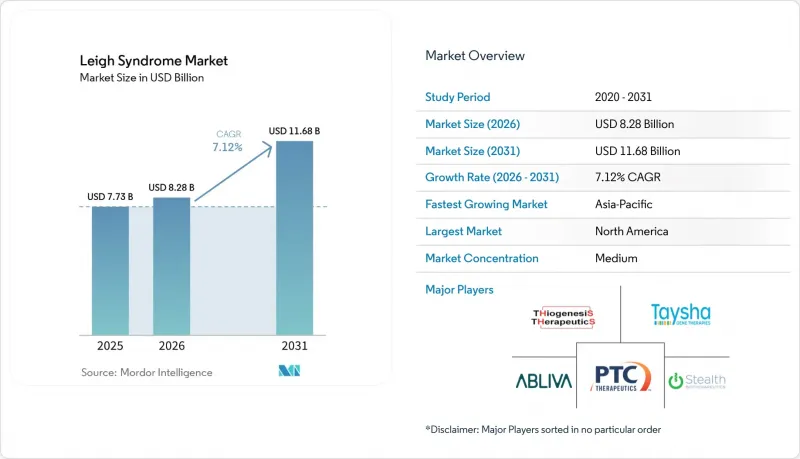
에 따르면 리 증후군 시장 규모는 2025년에 77억 3,000만 달러, 2026년에 82억 8,000만 달러에 달하며, 2031년까지 116억 8,000만 달러에 달할 것으로 예측되고 있으며, 2026-2031년에 CAGR 7.12%로 성장할 것으로 전망되고 있습니다.
전 세계 리 증후군 시장의 동향 및 인사이트
유전자 검사 증가 및 조기 진단
조기 유전자 검사는 환자가 전문 의료 서비스를 받을 수 있는 시기를 앞당기기 때문에 리 증후군 시장의 단기적인 주요 요인으로 작용하고 있습니다. 2025년 7월 기준, NCBI 유전자 검사 등록부에는 전 세계 32개 검사 기관이 리 증후군 스펙트럼을 대상으로 시행하는 271건의 시퀀싱 기반 검사가 등록되어 있었습니다. 글로벌 환자 등록부의 보고에 따르면 48개국에서 400명 이상의 참가자가 등록되어 있으며, 환자 식별을 위한 노력이 광범위하게 이루어지고 있음을 보여줍니다. 조기 확정 진단을 통해 임상시험 피험자 등록이 시작되기 전에 특정 변이를 가진 환자를 식별할 수 있게 됩니다. Thiogenesis사는 확정된 유전적 아형에 따라 2a상 임상시험 피험자 등록을 구성하고 있으며, 이는 이러한 환자 풀의 실용적 가치를 보여줍니다. NIH 희귀질환 임상연구 네트워크를 통해 지원을 받고 있는 NAMDC는 진단, 전문 의료, 연구 참여를 연결하는 전국적인 체계를 제공하고 있습니다. 확정 진단 사례가 늘어남에 따라 리 증후군 시장의 임상적 요구 사항이 치료 센터 및 프로그램 후원자들에게 더욱 명확해질 것으로 기대됩니다.
미토콘드리아 표적 치료 및 유전자 치료의 발전
미토콘드리아 표적 치료 및 유전자 치료는 리 증후군 시장의 개발 전망을 변화시키고 있습니다. 2026년 'Nature Biotechnology'지에 게재된 연구에서는 공학적으로 설계된 염기 편집기를 사용하여 쥐의 수정란에서 질환 관련 미토콘드리아 변이를 교정함으로써, 야생형 대립유전자의 평균 53.00%가 회복된 것으로 보고되었습니다. 또한 2025년 'Brain'지에 게재된 연구에서는 집속 초음파를 보조 수단으로 활용한 AAV9 전달을 통해 Ndufs4 녹아웃 마우스에서 혈액-뇌 장벽을 통과하여 생존율, 심장 기능 및 뇌 기능이 개선된 것으로 밝혀졌습니다. 이러한 연구 결과는 중추신경계에 도달하는 것을 목표로 하는 치료법에서 주요 전달 장벽을 해결하는 것입니다. Taysha사의 TSHA-104 프로그램은 SURF1 관련 리 증후군에 대한 돌연변이 특이적 접근법을 제시하며, ‘희귀 소아 질환’ 및 ‘오펀드럭’으로 지정받았습니다. 2025년에 보고된 개선형 AAV9 벡터 설계는 쥐 모델에서 효능을 유지하면서 세포 독성을 감소시켰으며, 이는 향후 재신청을 위한 안전성 계획 강화로 이어질 가능성이 있습니다.
유전적 및 표현형적 이질성
유전적 및 표현형적 이질성으로 인해 리 증후군 시장에서 단일 프로그램이 커버할 수 있는 범위는 제한적입니다. 리 증후군은 미토콘드리아 게놈과 핵 게놈에 걸쳐 있는 100개 이상의 유전자에 기인할 수 있습니다. 동일한 MT-ATP6 m.9176T>C 돌연변이라도, 이형접합성 부하에 따라 중증 리 증후군 또는 더 경미한 NARP 표현형을 유발할 가능성이 있습니다. SURF1 관련 질환에 초점을 맞춘 프로그램은 환자의 불과 10.00%에서 15.00%에만 도달할 수 있지만, MT-ATP6 관련 프로그램은 또 다른 환자 집단을 대상으로 합니다. SIMPATHIC 임상시험은 MT-ATP6 관련 질환으로 한정되어 있으며, 유전적 선별을 통해 각 연구 대상 집단이 어떻게 좁혀지는지를 보여줍니다. 이러한 구분은 임상시험 피험자 모집을 복잡하게 만들고, 특정 돌연변이에 대한 승인에 따른 수입원을 축소시킵니다.
부문 분석
2025년 기준, 유전적 원인에 따른 리 증후군 시장 규모 중 핵 DNA 관련 리 증후군이 58.24%를 차지했습니다. SURF1, NDUFAF6, PDHA1을 포함한 핵 돌연변이는 확진 사례에서 높은 빈도로 관찰되며, 보다 명확한 분자 표적을 가지고 있습니다. 글로벌 환자 등록부에 따르면 등록 참가자의 64.00%가 핵 DNA 변이를 가지고 있었습니다. 해당 등록부의 핵 DNA 변이 코호트 중 72.00%를 SURF1이 차지했습니다. 미토콘드리아 DNA 관련 리 증후군은 두 번째로 큰 범주이며, 주로 MT-ATP6 및 MT-ND 서브유닛의 돌연변이와 관련이 있습니다.
코엔자임 Q10 결핍증 시장 규모는 2031년까지 연평균 성장률(CAGR) 11.42%로 확대될 것으로 예측됩니다. 시퀀싱 기술의 발전으로 생합성 경로의 변이를 더 높은 정확도로 식별할 수 있게 되었습니다. CoQ10 보충 및 차세대 유사체는 이 아형에 대해 임상적으로 효과적인 치료법이 될 것입니다. 등록된 약물 전용 연구에서는 iPS 세포 유래 신경 세포 모델을 사용하여, 핵 DNA 및 미토콘드리아 DNA 관련 각 아형을 대상으로 FDA 및 EMA 승인을 받은 화합물에 대한 스크리닝이 진행되고 있습니다. PDH 결핍증은 대사 관리, 케톤 식이요법 및 티아민 보충이 필요한, 정의는 되어 있으나 충분한 치료가 이루어지지 않고 있는 환자군으로 남아 있습니다.
2025년 시점에 리 증후군 시장의 46.37%를 지지요법 및 대증 요법이 차지했습니다. 이 범주는 집중 치료, 인공 호흡, 발작 관리, 영양 지원의 지속적인 이용을 반영합니다. 승인된 질병 수정 요법을 이용할 수 없기 때문에 이러한 서비스는 여전히 필수적입니다. 비타민 및 보조 인자 보충, 그리고 항산화 요법은 현재 두 번째로 큰 지출 항목을 차지하고 있습니다. 리보플라빈, 코엔자임 Q10, 티아민, 그리고 α-리포산은 수년 동안 임상 관리에 사용되어 왔습니다.
유전자 및 RNA 기반 치료법은 2031년까지 연평균 성장률(CAGR) 24.86%로 성장할 것으로 예측됩니다. AAV9를 이용한 전달 프로그램, 미토콘드리아 기반 편집, 그리고 mitoTALEN을 이용한 교정 툴이 이러한 예측을 지원하고 있습니다. 벡터 설계의 개선은 전임상 모델에서 효능을 유지하면서 세포 독성을 감소시키는 것을 목표로 합니다. 미토콘드리아 치환 요법 및 첨단 치료법은 여전히 상업적 개발의 초기 단계에 있습니다. 이러한 임상적 진전은 충분한 안전성 증거 확보와 전문 소아 의료 서비스 내에서 치료를 시행할 수 있는 능력에 달려 있습니다.
지역별 분석
2025년 기준, 북미는 리 증후군 시장의 41.28%를 차지했습니다. 이 지역은 희귀질환 대응 지원 체계, 전문 센터 및 체계적인 연구 네트워크의 혜택을 받고 있습니다. NAMDC는 NIH 희귀질환 임상 연구 네트워크를 통해 진단받은 환자, 임상 연구 거점 및 전문 의료 서비스 간의 협력을 지원하고 있습니다. 캐나다에서는 Thiogenesis사를 통해 개발 활동이 지원되고 있으며, 멕시코에서는 초기 단계의 전문적인 신경학적 치료에 대한 접근성이 보장되고 있습니다. 이러한 특징 덕분에 북미의 리 증후군 시장은 다른 많은 지역에 비해 보다 확립된 임상 인프라를 갖추고 있습니다.
유럽은 리 증후군 시장에서 두 번째로 큰 지역적 존재감을 보이고 있습니다. Khondrion사는 2026년 4월, 주요 3상 임상시험인 ‘KHENERFIN’에서 첫 번째 환자에 대한 투여를 시작했습니다. EMA는 2025년 7월, 유전성 미토콘드리아 산화인산화 장애에 대한 손리크로마놀에 희귀질환 치료제 지정을 부여했습니다. 영국, 프랑스, 이탈리아, 스페인에서는 전문 미토콘드리아 및 희귀 대사 질환 센터를 통해 연계된 의뢰 체계가 구축되어 있습니다.
아시아태평양은 2031년까지 연평균 성장률(CAGR) 15.38%로 성장할 것으로 예측됩니다. 일본에서는 SPP-004의 3상 임상시험이 완료되었으며, 등록 환자의 50.00%에서 중추신경계 증상이 안정화되거나 개선된 것으로 나타났습니다. 중국에서는 2025년 다기관 공동 코호트 연구에서 유전학적으로 확인된 소아 미토콘드리아 질환 사례의 28.00%를 리 증후군이 차지하고 있으며, 진단에 있으며, 큰 기회가 기대됩니다. 동 연구에 따르면 핵 DNA 아형의 발병 연령 중앙값은 1.15세, 미토콘드리아 DNA 아형은 5.42세로 보고되었습니다. 인도, 한국, 호주에서는 희귀질환 연구 체계와 게놈 분석 연구소 네트워크를 구축하고 있습니다.
기타 혜택:
- 엑셀 형식의 시장 예측(ME) 시트
- 3개월간의 애널리스트 지원
목차
제1장 서론
- 조사 전제조건과 시장 정의
- 조사 범위
제2장 조사 방법
제3장 개요
제4장 시장 구도
- 시장 개요
- 시장 성장 촉진요인
- 시장 성장 억제요인
- 공급망 분석
- 규제 상황
- 기술 전망
- Porter's Five Forces 분석
제5장 시장 규모와 성장 예측
- 유전적 병인별
- 치료 유형별
- 투여 경로별
- 케어 환경별
- 지역별
- 북미
- 미국
- 캐나다
- 멕시코
- 유럽
- 독일
- 영국
- 프랑스
- 이탈리아
- 스페인
- 기타 유럽 국가
- 아시아태평양
- 중국
- 일본
- 인도
- 호주
- 한국
- 기타 아시아태평양 국가
- 중동 및 아프리카
- GCC
- 남아프리카공화국
- 기타 중동 및 아프리카 국가
- 남미
- 브라질
- 아르헨티나
- 기타 남미 국가
- 북미
제6장 경쟁 구도
- 시장 집중도
- 시장 점유율 분석
- 기업 개요
- Abliva AB
- Aclarion
- Biogen Inc.
- BridgeBio Pharma
- Daiichi Sankyo
- Dainippon Sumitomo Pharma Co., Ltd.
- Edison Pharmaceuticals, Inc.
- GenSight Biologics S.A.
- Ionis Pharmaceuticals, Inc.
- Khondrion B.V.
- Minovia Therapeutics, Inc.
- OMEICOS Therapeutics GmbH
- PTC Therapeutics, Inc.
- Sarepta Therapeutics, Inc.
- Stealth BioTherapeutics Corp.
- Takeda Pharmaceutical Company Limited
- Taysha Gene Therapies, Inc.
- Thiogenesis Therapeutics, Inc.
- VAKS Pharma
제7장 시장 기회와 향후 전망
KSAAccording to Mordor Intelligence, the leigh syndrome market size is projected to be USD 7.73 billion in 2025, USD 8.28 billion in 2026, and reach USD 11.68 billion by 2031, growing at a CAGR of 7.12% from 2026 to 2031.
Global Leigh Syndrome Market Trends and Insights
Increasing Genetic Testing and Earlier Diagnosis
Earlier genetic testing is a central near-term factor for the Leigh syndrome market because it changes the point at which patients can enter specialist care. The NCBI Genetic Test Registry listed 271 sequencing-based tests for Leigh syndrome spectrum from 32 laboratories worldwide in July 2025. The Global Patient Registry reported that it included more than 400 participants across 48 countries, showing the breadth of the patient identification effort. Earlier confirmation allows sponsors to identify people with defined mutations before trial enrollment begins. Thiogenesis structured its Phase 2a enrollment around confirmed genetic subtypes, which shows the practical value of these patient pools. The NAMDC, which is supported through the NIH Rare Diseases Clinical Research Network, provides a national structure that links diagnosis, specialist care, and research participation. More confirmed cases can also make the clinical needs of the Leigh syndrome market clearer to treatment centers and program sponsors.
Progress in Mitochondrial Targeted and Gene Therapies
Mitochondrial-targeted and gene therapies are changing the development outlook for the Leigh syndrome market. A 2026 Nature Biotechnology study corrected disease-associated mitochondrial variants in rat zygotes with engineered base editors and reported a 53.00% average restoration of wild-type alleles . A 2025 Brain study found that focused-ultrasound-assisted AAV9 delivery crossed the blood-brain barrier and improved survival, cardiac function, and brain function in Ndufs4 knockout mice. These findings address a major delivery barrier for therapies intended to reach the central nervous system. Taysha's TSHA-104 program illustrates the mutation-specific approach for SURF1-associated Leigh syndrome and has received Rare Pediatric Disease and Orphan Drug designations. A refined AAV9 vector design reported in 2025 maintained efficacy in rat models while reducing cytotoxicity, which may strengthen safety planning before a future resubmission.
Genetic and Phenotypic Heterogeneity
Genetic and phenotypic heterogeneity limit the scale available to any single program in the Leigh syndrome market. Leigh syndrome can arise from more than 100 genes across mitochondrial and nuclear genomes. The same MT-ATP6 m.9176T>C variant can produce severe Leigh syndrome or the milder NARP phenotype, depending on heteroplasmy load. A program focused on SURF1-related disease may reach only 10.00% to 15.00% of patients, while MT-ATP6 programs serve a separate group. The SIMPATHIC trial is restricted to MT-ATP6-related disease and shows how genetic selection narrows each study population. This division complicates trial recruitment and reduces the revenue pool attached to a mutation-specific approval.
Other drivers and restraints analyzed in the detailed report include:
- Growth of Patient Registries and Trial Ready Cohorts
- Expansion of Rare Mitochondrial Disease Research Funding
- High Cost of Rare Disease Drug Development
For complete list of drivers and restraints, kindly check the Table Of Contents.
Segment Analysis
Nuclear DNA-Associated Leigh Syndrome accounted for 58.24% of the Leigh syndrome market size by genetic etiology in 2025. Nuclear variants, including SURF1, NDUFAF6, and PDHA1, are prevalent in confirmed cases and have clearer molecular targets. The Global Patient Registry found that 64.00% of enrolled participants had nuclear DNA mutations. SURF1 represented 72.00% of the nuclear DNA mutation cohort in that registry. Mitochondrial DNA-Associated Leigh Syndrome is the second-largest category and is associated largely with MT-ATP6 and MT-ND subunit variants.
Coenzyme Q10 Deficiency is forecast to grow at an 11.42% CAGR through 2031. Improved sequencing can identify biosynthesis pathway mutations with greater precision. CoQ10 supplementation and next-generation analogs provide a clinically tractable route for this subtype. A registered drug-repurposing study is using iPSC-derived neuronal models to screen FDA- and EMA-approved compounds across nuclear and mitochondrial DNA-associated subtypes. PDH Deficiency remains a defined but underserved group that requires metabolic management, ketogenic diets, and thiamine supplementation.
Supportive & Symptomatic Therapy accounted for 46.37% of the Leigh syndrome market in 2025. This category reflects the continuing use of intensive care, mechanical ventilation, seizure management, and nutritional support. These services remain essential because approved disease-modifying therapies are not available. Vitamin and cofactor supplementation and antioxidant therapy form the second-largest current spending block. Riboflavin, CoQ10, thiamine, and alpha-lipoic acid have long been used in clinical management.
Gene & RNA-Based Therapies are forecast to grow at a 24.86% CAGR through 2031. AAV9 delivery programs, mitochondrial base editing, and mitoTALEN correction tools support this forecast. Improved vector design is intended to preserve efficacy while lowering cytotoxicity in preclinical models. Mitochondrial Replacement & Advanced Therapies remain early in commercial development. Their clinical progress will depend on adequate safety evidence and on the ability to administer treatment within specialist pediatric services.
Complete Report Scope:
- By Genetic Etiology
- Nuclear DNA (nDNA)-Associated Leigh Syndrome
- Mitochondrial DNA (mtDNA)-Associated Leigh Syndrome
- Pyruvate Dehydrogenase Complex (PDH) Deficiency
- Coenzyme Q10 Deficiency
- Other Genetic Subtypes
- By Treatment Type
- Supportive & Symptomatic Therapy
- Vitamin & Cofactor Supplementation
- Antioxidant Therapy
- Gene & RNA-Based Therapies
- Mitochondrial Replacement & Advanced Therapies
- Others
- By Route of Administration
- Oral
- Intravenous
- Subcutaneous
- Intracerebroventricular
- Enteral Administration
- By Care Setting
- Tertiary Hospitals
- Pediatric Neurology Centers
- Mitochondrial Disease Centers of Excellence
- Specialty Clinics
- Rehabilitation Centers
- Home Healthcare
- By Geography
- North America
- United States
- Canada
- Mexico
- Europe
- Germany
- United Kingdom
- France
- Italy
- Spain
- Rest of Europe
- Asia-Pacific
- China
- Japan
- India
- Australia
- South Korea
- Rest of Asia-Pacific
- Middle East and Africa
- GCC
- South Africa
- Rest of Middle East and Africa
- South America
- Brazil
- Argentina
- Rest of South America
- North America
Geography Analysis
North America held 41.28% of the Leigh syndrome market in 2025. The region benefits from rare-disease pathways, specialist centers, and structured research networks. The NAMDC supports connections between diagnosed patients, clinical research sites, and specialist services through the NIH Rare Diseases Clinical Research Network. Canada supports development activity through Thiogenesis, while Mexico has earlier-stage specialist neurological care access. These features give the North American Leigh syndrome market a more established clinical infrastructure than many other regions.
Europe is the second-largest regional presence in the Leigh syndrome market. Khondrion dosed the first patient in the pivotal KHENERFIN Phase 3 study in April 2026. The EMA granted orphan designation to sonlicromanol for inherited mitochondrial oxidative phosphorylation defects in July 2025. The United Kingdom, France, Italy, and Spain add coordinated referral capability through specialist mitochondrial and rare metabolic centers.
Asia-Pacific is forecast to grow at a 15.38% CAGR through 2031. Japan completed a Phase 3 trial of SPP-004, which showed stabilization or improvement in central nervous system symptoms in 50.00% of enrolled patients. China offers a substantial diagnostic opportunity, as Leigh syndrome represented 28.00% of genetically confirmed pediatric mitochondrial cases in a 2025 multicenter cohort. The same study reported a median onset of 1.15 years for nuclear DNA subtypes and 5.42 years for mitochondrial DNA subtypes. India, South Korea, and Australia are building rare-disease research capacity and genomics laboratory networks.
- Abliva AB
- Aclarion
- Biogen
- BridgeBio Pharma
- Daiichi Sankyo
- Dainippon Sumitomo Pharma Co., Ltd.
- Edison Pharmaceuticals, Inc.
- GenSight Biologics S.A.
- Ionis Pharmaceuticals
- Khondrion B.V.
- Minovia Therapeutics, Inc.
- OMEICOS Therapeutics GmbH
- PTC Therapeutics, Inc.
- Sarepta Therapeutics
- Stealth BioTherapeutics Corp.
- Takeda Pharmaceuticals
- Taysha Gene Therapies, Inc.
- Thiogenesis Therapeutics, Inc.
- VAKS Pharma
Additional Benefits:
- The market estimate (ME) sheet in Excel format
- 3 months of analyst support
TABLE OF CONTENTS
1 Introduction
- 1.1 Study Assumptions & Market Definition
- 1.2 Scope of the Study
2 Research Methodology
3 Executive Summary
4 Market Landscape
- 4.1 Market Overview
- 4.2 Market Drivers
- 4.2.1 Increasing Genetic Testing and Earlier Diagnosis
- 4.2.2 Expansion of Rare-Mitochondrial-Disease Research Funding
- 4.2.3 Progress in Mitochondrial-Targeted and Gene Therapies
- 4.2.4 Growth of Patient Registries and Trial-Ready Cohorts
- 4.2.5 Increasing Clinical Recognition of Leigh Syndrome
- 4.2.6 Mutation-Specific Drug Repurposing and Precision Screening
- 4.3 Market Restraints
- 4.3.1 Genetic and Phenotypic Heterogeneity
- 4.3.2 High Cost of Rare-Disease Drug Development
- 4.3.3 Delayed Diagnosis and Limited Specialist Access
- 4.3.4 Weak Commercial Incentives for Ultra-Rare Subgroups
- 4.4 Supply Chain Analysis
- 4.5 Regulatory Landscape
- 4.6 Technological Outlook
- 4.7 Porter's Five Forces Analysis
- 4.7.1 Threat of New Entrants
- 4.7.2 Bargaining Power of Suppliers
- 4.7.3 Bargaining Power of Buyers
- 4.7.4 Threat of Substitutes
- 4.7.5 Intensity of Competitive Rivalry
5 Market Size & Growth Forecasts (Value, USD)
- 5.1 By Genetic Etiology
- 5.1.1 Nuclear DNA (nDNA)-Associated Leigh Syndrome
- 5.1.2 Mitochondrial DNA (mtDNA)-Associated Leigh Syndrome
- 5.1.3 Pyruvate Dehydrogenase Complex (PDH) Deficiency
- 5.1.4 Coenzyme Q10 Deficiency
- 5.1.5 Other Genetic Subtypes
- 5.2 By Treatment Type
- 5.2.1 Supportive & Symptomatic Therapy
- 5.2.2 Vitamin & Cofactor Supplementation
- 5.2.3 Antioxidant Therapy
- 5.2.4 Gene & RNA-Based Therapies
- 5.2.5 Mitochondrial Replacement & Advanced Therapies
- 5.2.6 Others
- 5.3 By Route of Administration
- 5.3.1 Oral
- 5.3.2 Intravenous
- 5.3.3 Subcutaneous
- 5.3.4 Intracerebroventricular
- 5.3.5 Enteral Administration
- 5.4 By Care Setting
- 5.4.1 Tertiary Hospitals
- 5.4.2 Pediatric Neurology Centers
- 5.4.3 Mitochondrial Disease Centers of Excellence
- 5.4.4 Specialty Clinics
- 5.4.5 Rehabilitation Centers
- 5.4.6 Home Healthcare
- 5.5 By Geography
- 5.5.1 North America
- 5.5.1.1 United States
- 5.5.1.2 Canada
- 5.5.1.3 Mexico
- 5.5.2 Europe
- 5.5.2.1 Germany
- 5.5.2.2 United Kingdom
- 5.5.2.3 France
- 5.5.2.4 Italy
- 5.5.2.5 Spain
- 5.5.2.6 Rest of Europe
- 5.5.3 Asia-Pacific
- 5.5.3.1 China
- 5.5.3.2 Japan
- 5.5.3.3 India
- 5.5.3.4 Australia
- 5.5.3.5 South Korea
- 5.5.3.6 Rest of Asia-Pacific
- 5.5.4 Middle East and Africa
- 5.5.4.1 GCC
- 5.5.4.2 South Africa
- 5.5.4.3 Rest of Middle East and Africa
- 5.5.5 South America
- 5.5.5.1 Brazil
- 5.5.5.2 Argentina
- 5.5.5.3 Rest of South America
- 5.5.1 North America
6 Competitive Landscape
- 6.1 Market Concentration
- 6.2 Market Share Analysis
- 6.3 Company Profiles (includes Global Level Overview, Market Level Overview, Core Segments, Financials as available, Strategic Information, Market Rank/Share, Products and Services, Recent Developments)
- 6.3.1 Abliva AB
- 6.3.2 Aclarion
- 6.3.3 Biogen Inc.
- 6.3.4 BridgeBio Pharma
- 6.3.5 Daiichi Sankyo
- 6.3.6 Dainippon Sumitomo Pharma Co., Ltd.
- 6.3.7 Edison Pharmaceuticals, Inc.
- 6.3.8 GenSight Biologics S.A.
- 6.3.9 Ionis Pharmaceuticals, Inc.
- 6.3.10 Khondrion B.V.
- 6.3.11 Minovia Therapeutics, Inc.
- 6.3.12 OMEICOS Therapeutics GmbH
- 6.3.13 PTC Therapeutics, Inc.
- 6.3.14 Sarepta Therapeutics, Inc.
- 6.3.15 Stealth BioTherapeutics Corp.
- 6.3.16 Takeda Pharmaceutical Company Limited
- 6.3.17 Taysha Gene Therapies, Inc.
- 6.3.18 Thiogenesis Therapeutics, Inc.
- 6.3.19 VAKS Pharma
7 Market Opportunities & Future Outlook
- 7.1 White-Space and Unmet-Need Assessment


