

|
시장보고서
상품코드
2154951
남미의 위험 폐기물 처리 자동화 : 시장 점유율 분석, 업계 동향과 통계, 성장 예측(2026-2031년)South America Hazardous Waste Handling Automation - Market Share Analysis, Industry Trends & Statistics, Growth Forecasts (2026 - 2031) |
||||||
 Mordor Intelligence
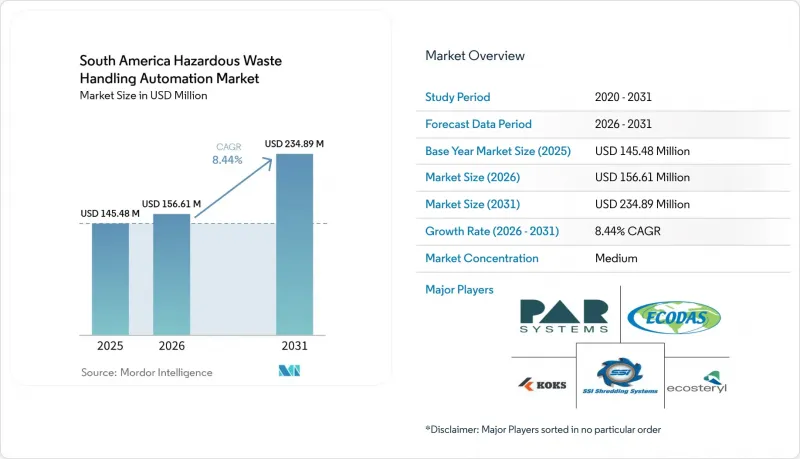
에 따르면 남미의 유해 폐기물 처리 자동화 시장 규모는 2025년에 1억 4,548만 달러로 평가되며, 2026년 1억 5,661만 달러에서 확대하며, 2031년까지 2억 3,489만 달러에 달할 것으로 예측됩니다.
2026-2031년까지의 예측 기간 중 연평균 성장률(CAGR)은 8.44%에 달할 것으로 전망됩니다.
남미 유해 폐기물 처리 자동화 시장의 동향 및 인사이트
브라질의 산업 유해 폐기물 발생량 증가
브라질에는 화학 제품 제조, 정유, 비철금속 가공이 집중되어 있으며, 이 지역에서 가장 광범위한 산업 유해 폐기물 발생원을 보유하고 있습니다. 상파울루-캄피나스 회랑 및 파라 주의 카라자스 광구는 해당 산업 활동으로 인해 격리, 운송, 분류, 처리가 필요한 물질이 생성되므로 중요한 거점으로 자리 잡고 있습니다. 이 폐기물 발생원은 일회성 프로젝트 수요에 그치지 않고, 처리 설비에 대한 지속적인 수요를 지원하고 있습니다. 사업자들은 통제된 조건 하에서 독성, 반응성, 가연성 및 오염 물질을 처리할 수 있는 시스템을 갖추어야 합니다. 남미의 유해 폐기물 처리 자동화 시장은 대규모 공장이 폐기물 처리 공정 개선을 위해 설비 투자를 앞당기면서 혜택을 보고 있습니다. 또한 디지털 기록 및 감사 가능한 폐기물 관리 계획이 일반적인 규정 준수 관행의 일부가 됨에 따라 소규모 지역 배출 사업자도 설비 구매자가 될 가능성이 있습니다.
의무화된 디지털 추적성 및 규정 준수 문서
2026년 7월 15일에 발령된 콜롬비아 정부령 제766호는 유해 폐기물 발생자, 운반업자 및 관리자의 책임을 재정의했습니다. 이 조치에서는 국가 폐기물 등록부와 국가 운송 등록부 간의 상호 운용 가능한 정보 흐름을 의무화하고 있습니다. 또한 유해 폐기물 처리 체인의 각 이동 지점에서 신뢰할 수 있는 기록을 더욱 중시하고 있습니다. 자동화 설비는 이송 이벤트, 센서, 격리 장치 및 운영 기록을 연동함으로써 이러한 요구 사항을 충족할 수 있습니다. 2024년에 실시된 콜롬비아의 RESPEL 체계에 대한 학술적 검토에서는 인가를 받은 관리 사업자의 적용 범위가 제한적이며 기술 투자에 대한 인센티브가 불충분하다는 점이 폐기물 관리 개선을 저해하는 제약 요인으로 지적되었습니다. 따라서 남미의 유해 폐기물 처리 자동화 시장에는 물리적 처리와 추적 기능을 결합한 시스템에 대한 수요가 있을 여지가 있습니다.
수입 장비 및 예비 부품의 높은 비용
첨단 매니퓰레이터 암, AI 탑재 선별 장치 및 산업용 분쇄 설비는 일반적으로 남미 지역 외부에서 공급됩니다. 구매자는 이러한 장비와 교체 부품을 달러로 결제하는 경우가 많아, 이로 인해 프로젝트는 현지 통화 변동 위험에 노출됩니다. 아르헨티나 페소 약세나 브라질 레알의 변동은 예산 주기 동안 프로젝트의 수익성을 변화시킬 가능성이 있습니다. 환율 상황이 악화될 경우, 사업자는 구매를 연기하거나 프로젝트 규모를 축소하거나 통합 기능이 적은 장비를 구매할 수 있습니다. 수입 규제, 라이선스 요건, 관세는 국경을 넘는 폐기물 처리와 관련된 시스템에 추가적인 비용 및 행정 업무 부담을 초래할 수 있습니다. 이러한 조건들은 장기적인 자본 설비의 수명 주기 동안 환율 위험을 관리할 수 없는 중규모 사업자에게 있으며, 도입을 가장 눈에 띄게 제한하는 요인이 됩니다.
부문별 분석
2025년, 남미 유해 폐기물 처리 자동화 시장에서 ‘특정 폐기물’은 38.47%의 점유율을 차지했습니다. 이러한 위상은 화학 제품 제조, 정유 및 비철금속 가공 과정에서 발생하는 독성, 반응성, 부식성 및 가연성 잔류물이 대량으로 발생하고 있음을 반영합니다. 이러한 물질은 수작업으로 취급할 경우 안전 및 환경상의 위험을 높일 수 있으므로, 통제된 격리가 필요합니다. 이 범주에는 운송, 처리 또는 처분 전에 문서화된 분류가 필요한 폐기물 흐름이 포함됩니다. 자동 이송, 밀폐 보관 및 선별 시스템은 시설이 이러한 폐기물 흐름의 취급을 표준화하는 데 도움이 됩니다. ‘지정 폐기물’ 및 ‘일반 폐기물’은 사용 후 배터리, 형광등, 농약 용기 및 이와 유사한 물질로부터 추가적인 수요를 창출하고 있습니다. 브라질과 콜롬비아의 확장된 생산자 책임(EPR) 프로그램은 이러한 폐기물 유형에 대한 체계적인 수거 및 처리의 필요성을 높이고 있습니다. 처리 시설에는 적재 및 하역시 추가적인 노출을 유발하지 않으면서 물질을 격리할 수 있는 설비가 필요합니다. 남미의 유해 폐기물 처리 자동화 시장은 여전히 산업 사업자들이 분류 및 취급 요건을 얼마나 일관되게 적용하고 있는지에 따라 좌우되고 있습니다. 이 부문은 강력한 격리 능력과 서비스 역량을 갖춘 공급업체들에게 계속해서 안정적인 기반을 제공하고 있습니다.
혼합 폐기물은 2031년까지 연평균 성장률(CAGR) 9.24%로 확대될 것으로 예측됩니다. 제약 폐수, 폐기물 에너지화 잔류물, 전자기기 및 특수 재료 시설에서 발생하는 혼합 화학 물질 흐름에는 대개 단일한 단순 공정으로는 처리할 수 없는 여러 유형의 물질이 포함되어 있습니다. 이로 인해 물질을 식별 및 분리하여 적절한 처리 경로로 유도하는 시스템의 가치가 높아지고 있습니다. 반입되는 물질의 구성이 변동하는 경우, 사업자는 센서, 이미지 처리 툴, 밀폐형 컨베이어 및 제어된 선별 스테이션을 활용할 수 있습니다. 2024년 페루 킬마나의 매립지에서 실시된 조사에서는 AI, IoT 및 블록체인을 기반으로 한 매립지 관리 시스템이 평가되었으며, 12개월 동안 매립지로 보내지는 잔류 폐기물이 35% 감소하고 메탄(CH4) 배출량이 40% 감소한 것으로 보고되었습니다. 이 연구는 모든 유해 폐기물 처리 용도에서의 성능을 입증하는 것은 아니지만, 폐기물 관리 현장에서의 디지털 분류 및 모니터링에 대한 지역적 사례를 보여줍니다. 공급업체는 이와 유사한 증거를 활용하여 자동화가 복잡한 자재 분류를 어떻게 지원할 수 있는지 설명할 수 있습니다. 혼합 유량을 처리하는 운영자는 적재물별 포장, 수분, 오염의 편차도 관리해야 합니다. 또한 혼합 유량은 시설이 단일 격리 설비가 아닌 통합 시스템을 고려하도록 유도합니다. 이러한 요건으로 인해 남미의 유해 폐기물 처리 자동화 시장에서 유연한 구성에 대한 수요가 증가할 가능성이 있습니다.
2025년에는 매니퓰레이터 암이 제품 매출의 36.19%를 차지했습니다. 이들은 드럼 이동, 컨테이너 선별, 글러브박스 작업, 작업자가 직접 만져서는 안 되는 물질의 이송 등 첨단 조작성을 요하는 작업에 사용됩니다. 이러한 확고한 입지는 가동 범위, 제어된 동작, 그리고 작업자와 유해 물질 간의 격리를 결합해야 할 필요성에서 비롯됩니다. 매니퓰레이터 암은 화학 플랜트, 연구소, 처리 시설 및 특정 광업 용도에서 사용할 수 있습니다. 또한 카메라, 원격 제어, 힘 감각 피드백 또는 밀폐형 셀과 통합할 수도 있습니다. 2026년 3월 RAICo와 Nuclear Restoration Services가 실시한 실증 실험에서는 잔해 선별 과정에서 3D 시각화와 힘 감각 피드백 제어를 결합한 햅틱 원격 조작 시스템이 선보였습니다. 이러한 시스템은 직접적인 가시성이나 물리적 접근이 제한되는 용도에서 유용한 작동 원리를 보여주고 있습니다. 또한 고객들은 현장의 대대적인 재설계가 필요 없이 제한된 공간에서 작동할 수 있는 암을 높이 평가하고 있습니다. 신축식 마스트, 크레인, 트러스는 섬세한 조작보다는 들어 올리는 능력과 도달 거리가 중시되는 탱크 팜, 대규모 폐기물 저장소, 공공 시설에서 여전히 중요한 역할을 수행하고 있습니다. 이러한 장비 옵션을 통해 남미의 유해 폐기물 처리 자동화 시장은 정밀 작업과 인프라 규모의 작업 모두를 처리할 수 있게 됩니다.
파쇄 시스템은 2031년까지 연평균 성장률(CAGR) 9.41%로 성장할 것으로 예상됩니다. 사업자는 재료의 크기, 모양 또는 포장이 후공정에서의 효율적인 처리를 방해하는 경우, 소각이나 안전한 매립 처리에 앞서 파쇄, 과립화, 전처리 장치를 사용합니다. 이러한 시스템은 일관된 전처리가 필요한 화학 고형물, 의약품 폐기물, 용기 및 기타 유해 물질에서 특히 중요합니다. 또한 이 설비는 부피가 큰 재료나 불규칙한 형태의 재료를 다루기 쉬운 형태로 처리함으로써 처리 작업의 예측 가능성을 높일 수 있습니다. 설계 시에는 격리, 세척, 유지보수 및 작업자의 안전을 충분히 고려해야 합니다. 수요를 주도하는 요인은 미처리 재료를 직접 매립지로 보내는 대신, 최종 처리 전에 폐기물을 적절히 전처리해야 할 필요성입니다. 공급업체는 내구성, 격리 성능 및 서비스 지원을 통해 자사 시스템을 차별화할 수 있습니다. 또한 고객은 시스템이 잦은 가동 중단이나 까다로운 세척 절차 없이 변동하는 원료에 대응할 수 있는지 여부도 평가합니다. 시설이 보관 부담을 줄이거나 처리 워크플로우를 간소화하려는 경우에도 이 제품 카테고리는 이점을 제공합니다. 그 성능은 남미 전역의 유해 폐기물 처리 자동화 시장에 있으며, 중요한데, 이는 원료의 부피 감소 처리가 그 이후의 모든 처리 단계에 영향을 미치기 때문입니다.
기타 혜택:
- 엑셀 형식의 시장 예측(ME) 시트
- 3개월간의 애널리스트 지원
자주 묻는 질문
목차
제1장 서론
- 조사 전제조건과 시장 정의
- 조사 범위
제2장 조사 방법
제3장 개요
제4장 시장 구도
- 시장 개요
- 시장 성장 촉진요인
- 시장 성장 억제요인
- 거시경제 요인이 시장에 미치는 영향
- 업계 밸류체인 분석
- 규제 상황
- 기술 전망
- Porter's Five Forces 분석
제5장 시장 규모와 성장 예측
- 폐기물 유형별
- 제품 유형별
- 자동화 아키텍처별
- 최종사용자 산업별
- 지역별
- 브라질
- 아르헨티나
- 콜롬비아
- 기타 남미 국가
제6장 경쟁 구도
- 시장 집중도
- 전략적 동향
- 시장 점유율 분석
- 기업 개요
- PaR Systems, Inc.
- KOKS Group B.V.
- ECODAS S.A.S.
- Ecosteryl S.A.
- Tesalys S.A.S.
- Celitron Medical Technologies B.V.
- SSI Shredding Systems, Inc.
- Granutech-Saturn Systems Corporation
- International Waste Industries, Inc.
- Pallmann Maschinenfabrik GmbH & Co. KG
- Cleanrobotics
- Fortive Corporation
- Sutco Contracting GmbH
- STADLER Anlagenbau GmbH
- Vecoplan AG
- BHS-Sonthofen GmbH
- ZenRobotics Oy
- Recycleye Ltd.
- Waste Robotics Inc.
- Danu Robotics Ltd.
제7장 시장 기회와 향후 전망
KSA 26.10.28According to Mordor Intelligence, the South America hazardous waste handling automation market size was valued at USD 145.48 million in 2025 and is estimated to expand from USD 156.61 million in 2026 to reach USD 234.89 million by 2031, at a CAGR of 8.44% during the forecast period 2026-2031.
South America Hazardous Waste Handling Automation Market Trends and Insights
Expansion of Brazil's Industrial Hazardous Waste Base
Brazil's concentration of chemical production, oil refining, and base-metal processing gives it the region's broadest base of hazardous industrial waste. The Sao Paulo-Campinas corridor and Para's Carajas mineral province are important locations because their industrial operations create material that needs containment, transport, classification, and treatment. This waste base supports recurring demand for handling equipment rather than only occasional project demand. Operators need systems that can handle toxic, reactive, flammable, and contaminated material under controlled conditions. The South America hazardous waste handling automation market benefits when large plants move capital spending forward to improve their waste-handling processes. Smaller regional generators can also become equipment buyers when digital records and auditable waste plans become part of ordinary compliance practice.
Mandatory Digital Traceability and Compliance Documentation
Colombia's Decreto 766, issued on July 15, 2026, redefined responsibilities for hazardous waste generators, transporters, and managers. The measure requires interoperable information flows between the national waste registry and the national transport registry. It places more value on reliable records at each movement point in the hazardous-waste chain. Automated equipment can support this need by connecting transfer events, sensors, containment units, and operating records. A 2024 academic review of Colombia's RESPEL framework identified limited coverage by licensed managers and insufficient incentives for technology investment as constraints to better waste management. The South America hazardous waste handling automation market, therefore, has an opening for systems that combine physical handling with traceability functions.
High Imported Equipment and Spare-Parts Costs
Advanced manipulator arms, AI-enabled sorting equipment, and industrial shredding installations are commonly supplied from outside South America. Buyers often pay for this equipment and its replacement parts in USD, which exposes projects to local currency movements. Peso depreciation in Argentina and volatility in the Brazilian real can change a project's economics during a budget cycle. Operators may defer purchases, reduce the project scope, or buy less integrated equipment when exchange conditions worsen. Import controls, licensing requirements, and tariffs can add further cost and administrative work for systems linked to cross-border waste treatment. These conditions limit adoption most sharply among mid-sized operators that cannot manage foreign-exchange exposure over long capital-equipment cycles.
Other drivers and restraints analyzed in the detailed report include:
- Worker Exposure Reduction in High-Risk Industrial Operations
- Growth of Mining, Chemicals, Energy, and Healthcare Waste Streams
- Uneven Enforcement and Permitting Across South American Countries
For complete list of drivers and restraints, kindly check the Table Of Contents.
Segment Analysis
Characteristic Wastes held 38.47% of the South America hazardous waste handling automation market share in 2025. This position reflects the large volumes of toxic, reactive, corrosive, and flammable residues created by chemical production, oil refining, and base metals processing. These materials require controlled containment because manual handling can increase safety and environmental risks. The category includes waste streams that often need documented classification before transport, treatment, or disposal. Automated transfer, sealed storage, and sorting systems can help facilities standardize the handling of these streams. Listed Wastes and Universal Wastes provide additional demand from spent batteries, fluorescent lamps, pesticide containers, and similar materials. Extended producer responsibility programs in Brazil and Colombia add to the need for organized collection and treatment of these waste types. Treatment facilities need equipment that can isolate materials without creating additional exposure during loading or unloading. The South America hazardous waste handling automation market remains tied to how consistently industrial operators apply classification and handling requirements. This segment continues to provide a stable base for suppliers with strong containment and service capabilities.
Mixed Wastes are projected to expand at a 9.24% CAGR through 2031. Pharmaceutical effluents, energy-from-waste residues, and blended chemical streams from electronics and specialty-material facilities often contain multiple material types that a single, simple process cannot manage. This increases the value of systems that identify, separate, and direct material into the right treatment path. Operators may use sensors, vision tools, enclosed conveyors, and controlled sorting stations when the composition of incoming material varies. A 2024 study at a landfill in Quilmana, Peru, evaluated an AI-, IoT-, and blockchain-based system for landfill management and reported a 35% reduction in residual waste sent to the landfill and a 40% decline in CH4 emissions over 12 months. The study does not establish performance across all hazardous waste applications, but it provides a regional example of digital classification and monitoring in a waste-management setting. Vendors can use comparable evidence to explain how automation could support complex material segregation. Mixed-stream operators must also manage variation in packaging, moisture, and contamination between loads. Mixed streams also encourage facilities to consider integrated systems instead of standalone containment equipment. This requirement can increase demand for flexible configurations within the South America hazardous waste handling automation market.
Manipulator Arms accounted for 36.19% of product revenue in 2025. They are used in high-dexterity tasks such as drum movement, container sorting, glovebox work, and transferring materials that workers should not touch directly. Their established position comes from the need to combine reach, controlled motion, and separation between the operator and hazardous material. Arms can be used in chemical plants, laboratories, treatment facilities, and selected mining applications. They may also be integrated with cameras, remote controls, force feedback, or enclosed cells. The March 2026 RAICo and Nuclear Restoration Services demonstration showed a haptic teleoperation arrangement that combined 3D visualization with force-feedback control for debris sorting. Such systems demonstrate a useful operating principle for applications where direct visibility and direct physical access are limited. Customers also value arms that can operate in constrained spaces without requiring a major site redesign. Telescoping masts, cranes, and trusses remain relevant at tank farms, large waste pits, and utility sites where lifting capacity and reach matter more than fine manipulation. These equipment choices allow the South America hazardous waste handling automation market to serve both precision and infrastructure-scale tasks.
Size Reduction Systems are expected to advance at a 9.41% CAGR through 2031. Operators use shredding, granulation, and pre-treatment equipment before incineration or secure landfill when material size, shape, or packaging prevents efficient downstream processing. These systems are especially relevant for chemical solids, pharmaceutical waste, containers, and other hazardous materials that require consistent preparation. The equipment can also make handling more predictable by reducing bulky or irregular materials into a manageable form. It must be designed with containment, cleaning, maintenance, and worker safety in mind. Demand is driven by the need to prepare waste before final treatment, rather than sending unprocessed material directly for disposal. Equipment vendors can differentiate their systems through durability, containment performance, and service support. Customers also assess whether a system can manage variable feedstock without frequent stoppages or difficult cleaning procedures. The product category also benefits when facilities seek to reduce storage burdens and simplify their treatment workflow. Its performance is important to the broader South America hazardous waste handling automation market because reduction can shape every later treatment stage.
Complete Report Scope:
- By Waste Type
- Listed Wastes
- Characteristic Wastes
- Universal Wastes
- Mixed Wastes
- By Product Type
- Manipulator Arms
- Telescoping Masts
- Cranes
- Trusses
- Size Reduction Systems
- By Automation Architecture
- Semi-Automated Systems
- Fully Automated Systems
- AI-Enabled Autonomous Systems
- By End-User Industry
- Manufacturing
- Chemical and Petrochemical
- Energy and Utilities
- Mining and Metals
- Pharmaceutical and Research Institutions
- Government and Defense
- Waste Management Operators
- By Geography
- Brazil
- Argentina
- Colombia
- Rest of South America
List of Companies Covered in this Report:
- PaR Systems, Inc.
- KOKS Group B.V.
- ECODAS S.A.S.
- Ecosteryl S.A.
- Tesalys S.A.S.
- Celitron Medical Technologies B.V.
- SSI Shredding Systems, Inc.
- Granutech-Saturn Systems Corporation
- International Waste Industries, Inc.
- Pallmann Maschinenfabrik GmbH & Co. KG
- Cleanrobotics
- Fortive Corporation
- Sutco Contracting GmbH
- STADLER Anlagenbau GmbH
- Vecoplan AG
- BHS-Sonthofen GmbH
- ZenRobotics Oy
- Recycleye Ltd.
- Waste Robotics Inc.
- Danu Robotics Ltd.
Additional Benefits:
- The market estimate (ME) sheet in Excel format
- 3 months of analyst support
TABLE OF CONTENTS
1 INTRODUCTION
- 1.1 Study Assumptions and Market Definition
- 1.2 Scope of the Study
2 RESEARCH METHODOLOGY
3 EXECUTIVE SUMMARY
4 MARKET LANDSCAPE
- 4.1 Market Overview
- 4.2 Market Drivers
- 4.2.1 Expansion of Brazil's Industrial Hazardous Waste Base
- 4.2.2 Mandatory Digital Traceability and Compliance Documentation
- 4.2.3 Worker Exposure Reduction in High-Risk Industrial Operations
- 4.2.4 Growth of Mining, Chemicals, Energy, and Healthcare Waste Streams
- 4.2.5 Rising Demand for On-Site Medical Waste Treatment
- 4.2.6 Retrofit Demand from Aging Manual Handling Infrastructure
- 4.3 Market Restraints
- 4.3.1 High Imported Equipment and Spare-Parts Costs
- 4.3.2 Uneven Enforcement and Permitting Across South American Countries
- 4.3.3 Limited Local Automation-Service and Maintenance Capability
- 4.3.4 Fragmented Waste Volumes and Long Equipment Payback Periods
- 4.4 Impact of Macroeconomic Factors on the Market
- 4.5 Industry Value Chain Analysis
- 4.6 Regulatory Landscape
- 4.7 Technological Outlook
- 4.8 Porter's Five Forces Analysis
- 4.8.1 Bargaining Power of Suppliers
- 4.8.2 Bargaining Power of Buyers
- 4.8.3 Threat of New Entrants
- 4.8.4 Threat of Substitutes
- 4.8.5 Intensity of Competitive Rivalry
5 MARKET SIZE AND GROWTH FORECASTS (VALUE)
- 5.1 By Waste Type
- 5.1.1 Listed Wastes
- 5.1.2 Characteristic Wastes
- 5.1.3 Universal Wastes
- 5.1.4 Mixed Wastes
- 5.2 By Product Type
- 5.2.1 Manipulator Arms
- 5.2.2 Telescoping Masts
- 5.2.3 Cranes
- 5.2.4 Trusses
- 5.2.5 Size Reduction Systems
- 5.3 By Automation Architecture
- 5.3.1 Semi-Automated Systems
- 5.3.2 Fully Automated Systems
- 5.3.3 AI-Enabled Autonomous Systems
- 5.4 By End-User Industry
- 5.4.1 Manufacturing
- 5.4.2 Chemical and Petrochemical
- 5.4.3 Energy and Utilities
- 5.4.4 Mining and Metals
- 5.4.5 Pharmaceutical and Research Institutions
- 5.4.6 Government and Defense
- 5.4.7 Waste Management Operators
- 5.5 By Geography
- 5.5.1 Brazil
- 5.5.2 Argentina
- 5.5.3 Colombia
- 5.5.4 Rest of South America
6 COMPETITIVE LANDSCAPE
- 6.1 Market Concentration
- 6.2 Strategic Moves
- 6.3 Market Share Analysis
- 6.4 Company Profiles (includes Global Level Overview, Market Level Overview, Core Segments, Financials as available, Strategic Information, Market Rank/Share, Products and Services, Recent Developments)
- 6.4.1 PaR Systems, Inc.
- 6.4.2 KOKS Group B.V.
- 6.4.3 ECODAS S.A.S.
- 6.4.4 Ecosteryl S.A.
- 6.4.5 Tesalys S.A.S.
- 6.4.6 Celitron Medical Technologies B.V.
- 6.4.7 SSI Shredding Systems, Inc.
- 6.4.8 Granutech-Saturn Systems Corporation
- 6.4.9 International Waste Industries, Inc.
- 6.4.10 Pallmann Maschinenfabrik GmbH & Co. KG
- 6.4.11 Cleanrobotics
- 6.4.12 Fortive Corporation
- 6.4.13 Sutco Contracting GmbH
- 6.4.14 STADLER Anlagenbau GmbH
- 6.4.15 Vecoplan AG
- 6.4.16 BHS-Sonthofen GmbH
- 6.4.17 ZenRobotics Oy
- 6.4.18 Recycleye Ltd.
- 6.4.19 Waste Robotics Inc.
- 6.4.20 Danu Robotics Ltd.
7 MARKET OPPORTUNITIES AND FUTURE OUTLOOK
- 7.1 White-Space and Unmet-Need Assessment


