

|
시장보고서
상품코드
2154956
남미의 알코올 음료 포장 : 시장 점유율 분석, 업계 동향과 통계, 성장 예측(2026-2031년)South America Alcoholic Drinks Packaging - Market Share Analysis, Industry Trends & Statistics, Growth Forecasts (2026 - 2031) |
||||||
 Mordor Intelligence
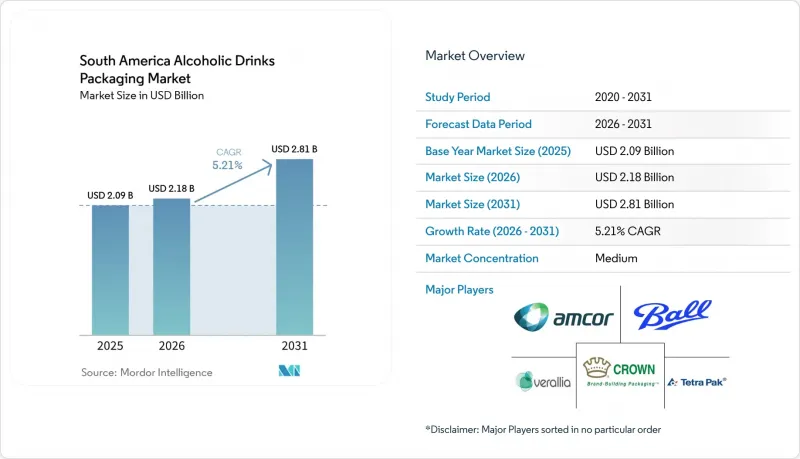
에 따르면 남미의 알코올 음료 패키지 시장 규모는 2025년에 20억 9,000만 달러로 평가되며, 2026년 21억 8,000만 달러에서 확대하며, 2031년까지 28억 1,000만 달러에 달할 것으로 예측됩니다.
2026-2031년까지의 예측 기간 중 연평균 성장률(CAGR)은 5.21%에 달할 것으로 전망됩니다.
남미 주류 포장 시장의 동향 및 인사이트
맥주, 증류주, 와인 패키지의 프리미엄화
프리미엄화의 진전에 따라 주류 브랜드가 제품을 어떻게 선보일지에 있으며, 1차 포장의 중요성이 더욱 커지고 있습니다. 특히 소비자가 제품을 시음하기 전에 병이나 캔 자체가 높은 품질을 전달해야 하는 경우, 이러한 경향이 두드러집니다. 특징적인 유리 형태, 엠보싱 가공, 엄선된 색상 사용, 그리고 소량 생산은 주류 제품과는 차별화된 시각적 차별화를 추구하는 크라프트 제품 및 프리미엄 제품을 지원하고 있습니다. 중후한 호박색 병은 럼, 카샤사, 위스키에서 여전히 중요한 역할을 하고 있습니다. 이는 제품을 보호하는 동시에, 내수 및 수출용 브랜드를 위해 매장에서 차별화된 존재감을 창출하기 위함입니다. 이러한 변화로 인해 디자인 지원, 일관된 제조 품질, 그리고 병과 캡의 성능에 관한 실질적인 지침을 제공할 수 있는 공급업체의 가치가 높아지고 있습니다. 또한 생산자들이 외관, 품질 보증, 그리고 정의된 디자인을 구현하는 능력을 점점 더 중요하게 여기게 되면서, 남미 주류 포장 시장에서 가격만을 통한 경쟁은 예전만큼 효과적이지 않게 되었습니다. 따라서 포장 공급업체는 용기를 브랜드의 일부로 인식하는 고객을 만족시키면서, 동시에 충전, 운송, 소매 진열, 반품 물류와 같은 운영상의 요구 사항도 충족시켜야 합니다.
즉석 음용(RTD) 칵테일 형태의 성장
2024년, 브라질의 RTD(Ready-to-Drink) 칵테일 판매량은 세계 8위를 기록했으며, 소비량은 1억 8,000만 리터에 육박했습니다. 또한 이 카테고리는 2023-2024년에 4% 이상 성장했습니다. 레디 투 드링크 칵테일에는 일반적으로 금속캔이 사용되며, 제품에 대한 수요는 용기 생산 요건 및 캔 충전 능력 확보와 직접적으로 연결되어 있습니다. 이 형태는 유리 용기가 실용적이지 않고, 1회 분량이 다루기 쉬운 야외나 사교 모임, 편의성을 중시하는 상황에서 휴대용 제품에 대한 수요를 충족시키고 있습니다. 브라질에서는 이 카테고리가 제한된 틈새 시장을 넘어, 이미 맥주, 증류주, 무알코올 음료 포트폴리오를 관리하고 있는 유서 깊은 음료 제조업체의 포장 관련 의사결정에도 영향을 미치고 있습니다. 또한 RTD 칵테일은 남미의 주류 포장 시장에서 더 폭넓은 포장 형태의 조합을 촉진하고 있습니다. 이는 브랜드 소유자가 동일한 카테고리 내에서 캔, 카톤, 라벨, 2차 포장을 병용할 수 있기 때문입니다. 이 카테고리에서 충전 및 용기 계약을 수주한 공급업체는 캡, 라벨, 인쇄된 캔, 멀티팩, 보호용 2차 포장 등 관련 수요 시장에도 진출할 수 있습니다.
알루미늄, 유리, 수지 및 에너지 비용의 변동
용기 비용은 음료 수요와 별개로 변동하는 원자재에 의존하므로 원자재 및 에너지 가격 변동은 남미 전역의 포장 제조업체들에게 여전히 구조적인 과제로 남아 있습니다. 아르헨티나의 통화 불안은 수입 알루미늄 시트 및 유리 제조용 원자재의 현지 비용을 상승시켜, 외화 표시 구매에 의존하는 제조업체에 특히 큰 압박을 가하고 있습니다. 유리 용해로는 다량의 에너지를 필요로 하므로 에너지 요금 변동은 용기 비용과 공급업체가 안정적인 가격을 유지하는 능력에 있으며, 중요한 요소가 됩니다. 이러한 압박은 고정 가격 계약을 복잡하게 만들고, 금형 결정이나 새로운 캔 형태 또는 충전 및 가공 설비 업그레이드에 관한 결정을 미루게 할 가능성이 있습니다. 소규모 가공업체나 지역 충전업체는 더 광범위한 조달 및 재무 자원을 보유한 다국적 제조업체에 비해 통화 및 에너지 리스크를 관리할 수단이 제한적입니다. 따라서 남미의 주류 포장 시장에서는 유연한 조달 체계, 투명한 가격 책정, 그리고 원자재 상황이 변화했을 때 제품 구성을 조정할 수 있는 운영 능력을 갖춘 공급업체가 우위를 점하게 됩니다.
부문 분석
2025년, 유리 용기는 남미 주류 포장 시장에서 42.78%의 점유율을 차지하며, 주요 생산 거점의 맥주 및 증류주 포장 시장에서 중심적인 위치를 유지했습니다. 브라질, 아르헨티나, 칠레에서는 맥주, 증류주, 와인을 병에 담는 전통이 유리 용기에 대한 수요를 지원하고 있으며, 이들 국가의 브랜드들은 소매 유통 및 음식점 제공에서 오랫동안 병을 사용해 왔습니다. 또한 유리는 경쟁이 치열한 소매 환경에서 병의 모양, 색상, 캡 디자인, 무게 등을 활용하여 제품을 차별화하는 프리미엄 카테고리의 브랜드 요구 사항도 충족시키고 있습니다. 식품 접촉 재료에 대한 기술적 적합성 요건은, 특히 용기, 캡, 라이너가 완전한 시스템으로 평가될 경우, 공급업체의 인증 기준을 높일 가능성이 있습니다. 제품 보호, 진열대에서의 외관, 재사용 체계, 그리고 확립된 충전 라인 등 음료 제조업체에게 중요한 모든 분야에서 유리는 여전히 중요한 소재로 남아 있습니다.
금속은 편의성과 휴대성을 중시하는 RTD(Ready-to-Drink) 칵테일, 캔에 담긴 카샤사, 저알코올 음료에 힘입어 2026-2031년까지 연평균 성장률(CAGR) 6.01%로 확대될 것으로 예측됩니다. 브라질의 금속 회수 시스템은 재활용 가능한 형태와 소비 후 명확한 회수 경로를 추구하는 음료 브랜드에게 그 중요성이 커지고 있습니다. 플라스틱은 비용을 중시하는 맥주 제품 및 일부 RTD(Ready-to-Drink) 제품에서 여전히 중요한 역할을 하고 있으며, 특히 경량성과 취급 위험이 낮다는 점이 포장재 선택에 영향을 미치는 상황에서 그 가치가 발휘됩니다. 그 밖의 소재로는 운송 효율성과 상온 보존성을 겸비한 카톤 형태가 있으며, 이는 브랜드 소유주에게 특정 RTD(Ready-to-Drink) 제품을 위한 새로운 선택지를 제공하고 있습니다. 따라서 남미의 주류 포장 시장은 단일 소재로 향하고 있는 것이 아니라, 제품 용도, 가격대, 소매 환경, 유통 요구에 따라 형성되는 다양한 소재의 조합으로 나아가고 있습니다.
2025년, 남미 주류 포장 시장에서 병은 63.82%의 점유율을 차지했습니다. 이는 충전 인프라가 잘 갖춰져 있고, 소비자에게 친숙하며, 음료 카테고리 전반에 걸쳐 널리 사용되고 있음을 반영합니다. 유리병과 PET병은 기존 운영 체제에 적합하고 폭넓은 제품 크기를 수용할 수 있으며, 양조장 및 증류소에서 여전히 보편적으로 사용되고 있습니다. 또한 병은 판매 현장에서 시각적 차별화를 중시하는 크라프트 맥주, 프리미엄 맥주, 증류주 브랜드에 확립된 전시 형식을 제공합니다. 기존의 병 충전 라인은 동일한 시설에서 다양한 포장 크기, 가격대, 유통 채널을 아우르는 생산자들에게 운영의 연속성을 보장합니다. 반환형 병 시스템은 회수 및 재충전을 지역 배송 시스템과 통합할 수 있는 특정 맥주 유통 채널에서 이 포장 유형을 더욱 지원하고 있습니다.
금속캔은 RTD(ready-to-drink) 제품이 기존 맥주나 와인의 소비 상황 외에도 새로운 소비 기회를 창출함에 따라 2026-2031년에 연평균 성장률(CAGR) 5.89%로 확대될 것으로 예상됩니다. 크라운(Crown)사는 2025년 5월, 폰타 그로사(Ponta Grossa) 공장에 세 번째 고속 생산 라인을 도입한다고 발표했습니다. 이를 통해 계획된 연간 생산 능력은 24억 캔에서 36억 캔으로 확대되며, 2026년 3분기 상업 생산 개시를 목표로 하고 있습니다. 파우치는 파손 위험 감소와 휴대 편의성이 장점인 휴대용 와인 및 향이 첨가된 증류주 용도에서 틈새 시장 역할을 유지하고 있습니다. 그 밖의 포장 형태로는 특히 소비자와 소매업체가 경제적인 형태를 선호할 때 멀티서브 와인에 사용되는 백인박스(Bag-in-Box) 형식이 있습니다. 이러한 포장 조합을 통해 남미 주류 포장 시장은 기존 소매 제품, 호스피탈리티 업계의 요구, 그리고 새로운 편의성을 중시하는 형태까지 모두 충족시킬 수 있게 되었습니다.
기타 장점:
- 엑셀 형식의 시장 예측(ME) 시트
- 3개월간의 애널리스트 지원
자주 묻는 질문
목차
제1장 서론
- 조사 전제조건과 시장 정의
- 조사 범위
제2장 조사 방법
제3장 개요
제4장 시장 구도
- 시장 개요
- 거시경제 요인이 시장에 미치는 영향
- 시장 성장 촉진요인
- 시장 성장 억제요인
- 업계 밸류체인 분석
- 규제 상황
- 기술 전망
- Porter's Five Forces 분석
제5장 시장 규모와 성장 예측
- 소재별
- 패키지 유형별
- 제품별
- 유통 채널별
- 지역별
- 브라질
- 아르헨티나
- 기타 남미 국가
제6장 경쟁 구도
- 시장 집중도
- 전략적 동향
- 시장 점유율 분석
- 기업 개요
- Amcor plc
- Ball Corporation
- Crown Holdings, Inc.
- Verallia S.A.
- Tetra Pak International S.A.
- Ardagh Group S.A.
- CANPACK S.A.
- Graham Packaging Company L.P.
- Plastipak Holdings, Inc.
- Owens-Illinois, Inc.
- Berry Global Group, Inc.
- Trivium Packaging B.V.
- Refresco Group N.V.
- SIG Group AG
- AptarGroup, Inc.
- CCL Industries Inc.
- Envases Universales de Mexico, S.A.P.I. de C.V.
- Ecolean AB
- Alpek, S.A.B. de C.V.
- Guala Closures S.p.A.
- Closure Systems International, Inc.
제7장 시장 기회와 향후 전망
KSA 26.10.28According to Mordor Intelligence, the South America alcoholic drinks packaging market size was valued at USD 2.09 billion in 2025 and is estimated to expand from USD 2.18 billion in 2026 to reach USD 2.81 billion by 2031, at a CAGR of 5.21% during the forecast period from 2026 to 2031.
South America Alcoholic Drinks Packaging Market Trends and Insights
Premiumization of Beer, Spirits, and Wine Packaging
Premium positioning is making the primary pack more important in how alcoholic beverage brands present their products, particularly when a bottle or can must signal quality before consumers try the product. Distinctive glass shapes, embossing, controlled color choices, and smaller production runs support craft and premium offerings that seek a visible difference from mainstream products. Heavier amber bottles remain relevant for rum, cachaca, and whisky because they protect products while creating a differentiated shelf presence for domestic and export-facing brands. This shift places greater value on suppliers that can provide design support, consistent manufacturing quality, and practical guidance on the performance of bottles and closures. It also makes price-only competition less effective for the South America alcoholic drinks packaging market, since producers increasingly evaluate presentation, quality assurance, and the ability to execute a defined design. Packaging suppliers must therefore serve customers who treat the container as part of the brand, while still meeting the operational needs of filling, transport, retail display, and return logistics.
Growth of Ready-to-Drink Cocktail Formats
Brazil ranked eighth worldwide for ready-to-drink volume in 2024, with consumption close to 180 million liters, and the category expanded by more than 4% between 2023 and 2024. Ready-to-drink cocktails generally use metal cans, directly linking product demand with container production requirements and the availability of can-filling capacity. The format meets the demand for portable products for outdoor, social, and convenience-led occasions, where glass is less practical and single servings are easier to manage. In Brazil, the category has moved beyond a limited niche and is influencing packaging decisions among established beverage producers that already manage beer, spirits, and non-alcoholic portfolios. Ready-to-drink cocktails also support a broader format mix in the South America alcoholic drinks packaging market, because brand owners may use cans, cartons, labels, and secondary packs for the same category. Suppliers that secure filling and container contracts in this category can participate in related demand for closures, labels, printed cans, multipacks, and protective secondary packaging.
Volatility in Aluminum, Glass, Resin, and Energy Costs
Material and energy price changes remain a structural challenge for packaging producers across South America, because containers depend on inputs whose cost can move independently of beverage demand. Argentina's currency instability can raise the local cost of imported aluminum sheet and glassmaking inputs, placing particular pressure on producers that rely on foreign-currency purchases. Glass furnaces require substantial energy, which makes changes in energy tariffs important to container costs and to suppliers' ability to maintain stable pricing. These pressures complicate fixed-price contracts and can postpone decisions on molds, new can formats, or upgrades to filling and conversion equipment. Smaller converters and regional fillers have fewer tools to manage currency and energy risk than multinational producers with broader procurement and financial resources. The South America alcoholic drinks packaging market, therefore, rewards suppliers with flexible sourcing, transparent pricing arrangements, and the operational ability to adjust product mixes when input conditions change.
Other drivers and restraints analyzed in the detailed report include:
- Expansion of Recyclable Metal Can Applications
- Rising Adoption of Returnable Glass Bottle Systems
- Uneven Collection and Recycling Infrastructure
For complete list of drivers and restraints, kindly check the Table Of Contents.
Segment Analysis
Glass held 42.78% of the South America alcoholic drinks packaging market share in 2025, retaining its central position in beer and spirits packaging across established production centers. Beer, spirits, and wine bottling traditions support demand for glass across Brazil, Argentina, and Chile, where brands have long used bottles for retail distribution and on-premise service. Glass also serves brand needs in premium categories that use bottle shape, color, closure design, and weight to distinguish products in crowded retail environments. Technical compliance requirements for food-contact materials can raise the qualification threshold for suppliers, especially where containers, closures, and liners are evaluated as a complete system. The material remains important where product protection, shelf appearance, reuse arrangements, and established filling lines all matter to beverage producers.
Metal is projected to expand at a 6.01% CAGR from 2026 to 2031, supported by ready-to-drink cocktails, canned cachaca, and lower-alcohol beverages that favor convenience and portability. The material's collection system in Brazil strengthens its relevance to beverage brands seeking recyclable formats and a clear recovery pathway after consumption. Plastic remains relevant for cost-sensitive beer products and selected ready-to-drink formats, particularly where low weight and lower handling risk affect package choice. Other materials include carton formats that offer transport efficiency and shelf-stable storage, giving brand owners another option for selected ready-to-drink products. The South America alcoholic drinks packaging market is therefore not moving toward a single material, but toward a mix shaped by product use, price point, retail setting, and distribution needs.
Bottles held 63.82% of the South America alcoholic drinks packaging market share in 2025, reflecting installed filling infrastructure, consumer familiarity, and their broad use across beverage categories. Glass and PET bottles remain common across breweries and distilleries because they fit existing operations and accommodate a range of product sizes. Bottles also provide an established presentation format for craft, premium, and spirits brands that rely on visual differentiation at the point of sale. Existing bottle lines provide operational continuity for producers serving multiple package sizes, price tiers, and distribution channels from the same facility. Returnable bottle systems further support the package type in selected beer channels, where collection and refilling can be integrated with local delivery systems.
Metal cans are expected to expand at a 5.89% CAGR from 2026 to 2031, as ready-to-drink products create additional consumption occasions outside traditional beer and wine settings. Crown announced a third high-speed line at Ponta Grossa in May 2025, raising planned annual capacity from 2.4 billion to 3.6 billion cans, with commercial production targeted for the third quarter of 2026. Pouches retain a niche role in portable wine and flavored spirits applications, where reduced breakage risk and easy carrying are useful. Other package types include bag-in-box formats used for multi-serve wine, particularly where consumers and retailers seek economical formats. This package mix allows the South America alcoholic drinks packaging market to serve established retail products, hospitality needs, and newer convenience-led formats.
Complete Report Scope:
- By Material
- Metal
- Glass
- Plastic
- Other Materials
- By Package Type
- Bottles
- Metal Cans
- Pouches
- Other Package Types
- By Product
- Beer
- Spirits
- Wine
- Ready-To-Drink Cocktails
- Other Products
- By Distribution Channel
- Off-Trade Retail
- On-Trade / HoReCa
- E-Commerce
- Duty Free
- By Geography
- Brazil
- Argentina
- Rest of South America
List of Companies Covered in this Report:
- Amcor plc
- Ball Corporation
- Crown Holdings, Inc.
- Verallia S.A.
- Tetra Pak International S.A.
- Ardagh Group S.A.
- CANPACK S.A.
- Graham Packaging Company L.P.
- Plastipak Holdings, Inc.
- Owens-Illinois, Inc.
- Berry Global Group, Inc.
- Trivium Packaging B.V.
- Refresco Group N.V.
- SIG Group AG
- AptarGroup, Inc.
- CCL Industries Inc.
- Envases Universales de Mexico, S.A.P.I. de C.V.
- Ecolean AB
- Alpek, S.A.B. de C.V.
- Guala Closures S.p.A.
- Closure Systems International, Inc.
Additional Benefits:
- The market estimate (ME) sheet in Excel format
- 3 months of analyst support
TABLE OF CONTENTS
1 INTRODUCTION
- 1.1 Study Assumptions and Market Definition
- 1.2 Scope of the Study
2 RESEARCH METHODOLOGY
3 EXECUTIVE SUMMARY
4 MARKET LANDSCAPE
- 4.1 Market Overview
- 4.2 Impact of Macroeconomic Factors on the Market
- 4.3 Market Drivers
- 4.3.1 Premiumization of Beer, Spirits, and Wine Packaging
- 4.3.2 Growth of Ready-to-Drink Cocktail Formats
- 4.3.3 Expansion of Recyclable Metal Can Applications
- 4.3.4 Rising Adoption of Returnable Glass Bottle Systems
- 4.3.5 E-Commerce and Small-Pack Demand
- 4.3.6 Expansion of Non-Alcoholic and Low-Alcohol Beverage Packaging
- 4.4 Market Restraints
- 4.4.1 Volatility in Aluminum, Glass, Resin, and Energy Costs
- 4.4.2 Uneven Collection and Recycling Infrastructure
- 4.4.3 Bulk Wine Exports Limiting Local Packaging Demand
- 4.4.4 Packaging Compliance Complexity Across National Markets
- 4.5 Industry Value Chain Analysis
- 4.6 Regulatory Landscape
- 4.7 Technological Outlook
- 4.8 Porter's Five Forces Analysis
- 4.8.1 Bargaining Power of Suppliers
- 4.8.2 Bargaining Power of Buyers
- 4.8.3 Threat of New Entrants
- 4.8.4 Threat of Substitutes
- 4.8.5 Intensity of Competitive Rivalry
5 MARKET SIZE AND GROWTH FORECASTS (VALUE)
- 5.1 By Material
- 5.1.1 Metal
- 5.1.2 Glass
- 5.1.3 Plastic
- 5.1.4 Other Materials
- 5.2 By Package Type
- 5.2.1 Bottles
- 5.2.2 Metal Cans
- 5.2.3 Pouches
- 5.2.4 Other Package Types
- 5.3 By Product
- 5.3.1 Beer
- 5.3.2 Spirits
- 5.3.3 Wine
- 5.3.4 Ready-To-Drink Cocktails
- 5.3.5 Other Products
- 5.4 By Distribution Channel
- 5.4.1 Off-Trade Retail
- 5.4.2 On-Trade / HoReCa
- 5.4.3 E-Commerce
- 5.4.4 Duty Free
- 5.5 By Geography
- 5.5.1 Brazil
- 5.5.2 Argentina
- 5.5.3 Rest of South America
6 COMPETITIVE LANDSCAPE
- 6.1 Market Concentration
- 6.2 Strategic Moves
- 6.3 Market Share Analysis
- 6.4 Company Profiles (includes Global Level Overview, Market Level Overview, Core Segments, Financials as available, Strategic Information, Market Rank/Share, Products and Services, Recent Developments)
- 6.4.1 Amcor plc
- 6.4.2 Ball Corporation
- 6.4.3 Crown Holdings, Inc.
- 6.4.4 Verallia S.A.
- 6.4.5 Tetra Pak International S.A.
- 6.4.6 Ardagh Group S.A.
- 6.4.7 CANPACK S.A.
- 6.4.8 Graham Packaging Company L.P.
- 6.4.9 Plastipak Holdings, Inc.
- 6.4.10 Owens-Illinois, Inc.
- 6.4.11 Berry Global Group, Inc.
- 6.4.12 Trivium Packaging B.V.
- 6.4.13 Refresco Group N.V.
- 6.4.14 SIG Group AG
- 6.4.15 AptarGroup, Inc.
- 6.4.16 CCL Industries Inc.
- 6.4.17 Envases Universales de Mexico, S.A.P.I. de C.V.
- 6.4.18 Ecolean AB
- 6.4.19 Alpek, S.A.B. de C.V.
- 6.4.20 Guala Closures S.p.A.
- 6.4.21 Closure Systems International, Inc.
7 MARKET OPPORTUNITIES AND FUTURE OUTLOOK
- 7.1 White-Space and Unmet-Need Assessment


