

|
시장보고서
상품코드
2154967
남미의 폭발 방지 장비 : 시장 점유율 분석, 업계 동향과 통계, 성장 예측(2026-2031년)South America Explosion Proof Equipment - Market Share Analysis, Industry Trends & Statistics, Growth Forecasts (2026 - 2031) |
||||||
 Mordor Intelligence
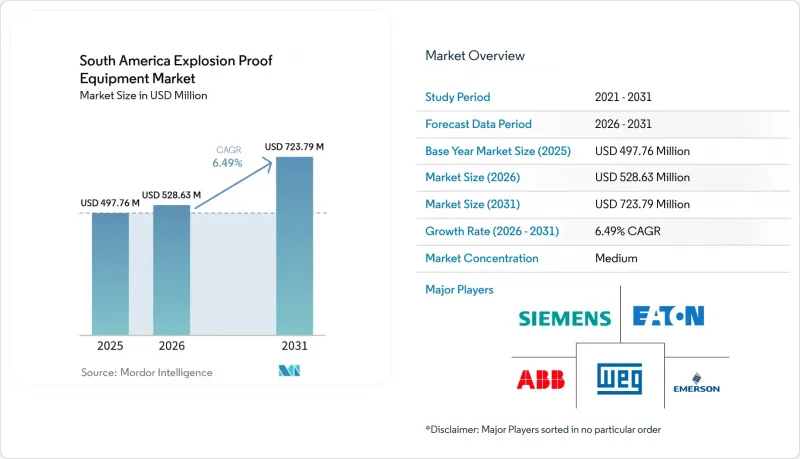
에 따르면 남미의 방폭 기기 시장은 2025년에 4억 9,780만 달러 규모이며, 예측 기간(2026-2031년)에 CAGR 6.5%로 확대하며, 2026년 5억 2,860만 달러에서 2031년에는 7억 2,380만 달러에 달할 것으로 추정되고 있습니다.
남미 방폭 장비 시장의 동향 및 인사이트
브라질의 해양 석유 및 가스 및 정제 인프라 확대
페트로브라스의 2026-2030년 사업 계획에는 탐사 및 생산에 692억 달러가 배정되어 있으며, 8개의 신규 생산 시스템, 11척의 부지오스형 FPSO, 정유소 확장 계획에 더해, 자본 계획의 중심에 해양 생산 및 관련 처리 자산을 두는 전략이 포함되어 있습니다. 이러한 개발에는 분류된 장소에서 인증을 받은 모터, 케이블 그랜드, 정션 박스, 조명, 자동화 장비, 현장 계측 장비 및 지원용 전기 인프라가 필요하며, 그 사양은 대부분의 경우 건설 시작 전에 설정됩니다. 2026년 5월 페트로브라스와 SBM 오프쇼어 간에 체결된 2척의 SEAP FPSO에 관한 계약은 600억 레알(119억 달러)이 넘는 투자를 수반하며, 장비 사양 수립 작업은 설계부터 시운전에 이르기까지 수년간 진행됩니다. 각 FPSO는 장비 공급, 설치, 검사, 교체 작업, 문서화 및 가동 개시 후 필요한 지속적인 유지보수 프로그램에 걸쳐 수요를 창출합니다. 기존의 해양 자산에 대해서도, 유전 확장이나 유지보수 프로그램 수행 중에 설비의 교체가 필요합니다. 특히 구성품이 지정된 위험구역의 분류에 적합한 상태를 유지해야 하는 경우에는 그 필요성이 두드러집니다. 이러한 신규 건설과 기존 설비 작업이 결합되면서 남미의 방폭 장비 시장의 조달 주기가 장기화되고 있으며, 인증 공급업체에게는 OEM(원본 장비) 및 애프터마켓 양 분야에서 비즈니스 기회가 제공되고 있습니다.
구리, 철광석, 리튬 및 금광의 확장
광산 현장에서는 파쇄, 이송, 굴착, 광물 처리, 펌프 송액 및 자재 이송 작업에 있으며, 가연성 분진이나 위험한 작업 조건에 적합한 기기가 필요합니다. 분진은 지하 작업 현장, 광석 처리 회로, 밀폐된 처리 구역 및 저장 장소에서 발생할 가능성이 있으므로, 위험구역용 장비의 사용 범위는 석유 및 가스 시설 이외의 분야로도 확대되고 있습니다. 따라서 남미의 방폭 장비 시장은 가혹한 현장 조건을 충족하는 신뢰성 높은 배전 설비, 모터, 조명, 감시 시스템, 케이블 연결 및 외장 케이스를 필요로 하는 광업 프로젝트의 영향을 받고 있습니다. 장비 선정은 구역 분류, 분진의 특성, 온도 요건, 설치 조건, 유지보수를 위한 접근성, 그리고 인력과 플랜트 자산을 보호해야 할 필요성에 따라 결정됩니다. 외딴 지역의 광산 운영에서는 장기간의 가동 중단이 중요한 처리 작업에 지장을 줄 수 있으므로, 내구성이 뛰어난 제품, 예비 부품의 확보 가능성, 그리고 현지 유지보수 지원이 더욱 중요하게 여겨집니다. 이러한 운영 조건으로 인해 인증 장비는 단순한 구매 품목이 아니라 현장 설계, 시운전, 유지보수 및 교체 과정에 필수적인 요소가 되었습니다.
인증 및 수명 주기 규정 준수에 드는 막대한 비용
장비 승인에는 시험, 공장 평가, 모니터링, 인증 갱신, 기술 기록, 그리고 제품 사양이 지속적으로 규정을 준수하고 있음을 입증하는 증거 제출 등이 포함될 수 있으므로, 인증 비용은 막대할 수 있습니다. 브라질의 규제 체계는 이미 IECEx 또는 ATEX 승인을 획득한 공급업체에게도 추가적인 업무를 부과할 가능성이 있습니다. ABENDI의 보고서에 따르면 2025년 12월 기준으로 280명 이상의 브라질 전문가가 IECEx 인증자 자격증을 보유하고 있었습니다. 위험구역 설비에 대한 교육, 검사, 설치 및 유지보수 수요에 비해, 이용 가능한 자격을 갖춘 인력은 여전히 제한적입니다. 소규모 사업자는 인증 및 교육 비용이 상승하거나 규정 준수가 다른 자본적 우선순위와 상충될 경우, 업그레이드를 미룰 수 있습니다. 이러한 비용은 남미의 방폭 장비 시장에서 잠재적 수요를 제한하는 요인이 될 수 있습니다. 특히 조달 예산이 제한적이고 전문적인 엔지니어링 자원에 대한 접근성도 제한적인 소규모 프로젝트의 경우 그 영향이 두드러집니다.
부문 분석
2025년 기준, 남미 방폭 장비 시장에서 ‘폭발 방지’가 42.9%의 점유율을 차지하고 있으며, 2031년까지 연평균 성장률(CAGR) 8%로 성장할 것으로 예상됩니다. 이 범주에는 보호 성능, 장비 중량, 유지보수 용이성, 설치 실용성 간의 적절한 균형을 추구할 때 사업자가 선택하는 안전성 향상, 비발화 및 밀폐 방식 등이 포함됩니다. 이는 장비 배치, 사용 가능한 공간, 설치 시스템의 무게가 프로젝트 설계 및 유지보수 계획에 영향을 미치는 해양 시설에서 특히 중요합니다. 이 방식에 대한 남미 방폭 장비 시장 규모는 보호 방식을 위험 유형, 장비 기능 및 운영 장소의 조건에 맞추어야 할 필요성도 반영하고 있습니다. ABENDI는 2025년까지 브라질의 폭발성 분위기에 관한 표준 및 유지보수 관행의 지속적인 개발이 진행 중임을 지적하며, 적절한 선정과 문서화된 점검의 중요성을 강조했습니다.
내화형 장비는 견고한 점화 봉쇄가 요구되는 석유 및 가스 유정 입구나 공정 구역에서 여전히 중요하지만, 본질안전형은 가스 위험구역의 계측 및 센서 회로에 널리 적용되고 있습니다. 가압 및 퍼지는 개별 구성 요소를 교체하는 것이 현실적이지 않거나, 설치된 시스템에 대폭적인 변경이 필요한 대형 제어 인클로저나 분석 장치에 적합합니다. 배리어나 방폭벽과 같은 물리적 분리 조치는 장비 배치나 분리가 위험 관리의 핵심이 되는 용도에 대응합니다. 단일한 방법이 모든 공정, 장소, 유지보수 체계 또는 위험 등급 분류에 적합한 것은 아니므로, 공급업체는 광범위한 보호 솔루션 포트폴리오를 유지해야 합니다. 이러한 요구 사항으로 인해 제품 선정은 현장 고유의 설계, 검사, 설치 및 유지보수 관행과 밀접하게 연결되어 있습니다.
2025년 기준, 존 1은 전체 시장의 37.8%를 차지했습니다. 이 존은 정상 가동 중 가연성 가스가 존재할 가능성이 있는 장소, 즉 해양 플랫폼, 정유소 설비, 수취 터미널 및 기타 탄화수소 처리 시설과 관련이 있습니다. 브라질의 해양 자산은 존 1 장비의 중요한 도입 기반을 형성하고 있습니다. 이는 상류 부문 운영에 대규모 전기, 계측, 감지, 통신 시스템이 필요하기 때문입니다. 노후화된 자산의 유지보수나 수명 연장 공사가 진행됨에 따라 장비 교체가 필요할 수 있습니다. 남미의 방폭 장비 시장은 모터, 조명, 인클로저, 접지, 제어 장비, 감지 장비를 통해 이러한 수요에 대응하고 있습니다. 페트로브라스(Petrobras)가 계획하고 있는 탐사, 생산, 정제 분야에 대한 투자를 통해 이러한 용도의 중요성은 계속 유지되고 있습니다.
존 20은 2031년까지 연평균 성장률(CAGR) 7.8%로 확대될 것으로 예측되며, 본 조사 추정치에서 가장 높은 성장률을 보이는 존 분류입니다. 이는 밀폐된 곡물, 설탕, 바이오연료, 광업 및 기타 자재 취급 공정 등 가연성 분진 구름이 지속적으로 존재하거나 장기간에 걸쳐 존재하는 장소에 적용됩니다. 존 2 및 22는 위험한 가스나 분진이 지속적으로 존재할 가능성이 낮은 광범위한 용도를 포괄하는 반면, 존 0 및 21은 지속적으로 존재하는 위험에 대한 보호가 필요한 보다 제한적인 용도에서 여전히 중요합니다. 이처럼 구역 분류가 다양하므로 공급업체는 운영 환경, 위험 프로필, 검사 체계 및 실제 설치 조건에 적합한 장비를 제공해야 합니다. 또한 이는 시설 전체에 단일 장비 설계를 채택하기보다는 여러 보호 솔루션이 필요할 수 있음을 의미합니다.
기타 혜택:
- 엑셀 형식의 시장 예측(ME) 시트
- 3개월간의 애널리스트 지원
자주 묻는 질문
목차
제1장 서론
- 조사 전제조건과 시장 정의
- 조사 범위
제2장 조사 방법
제3장 개요
제4장 시장 구도
- 시장 개요
- 시장 성장 촉진요인
- 시장 성장 억제요인
- 업계 밸류체인 분석
- 규제 상황
- 기술 전망
- 거시경제 요인이 시장에 미치는 영향
- Porter's Five Forces 분석
제5장 시장 규모와 성장 예측
- 보호 방법별
- 존별
- 최종사용자 산업별
- 시스템별
- 국가별
- 브라질
- 아르헨티나
- 칠레
- 콜롬비아
- 페루
- 기타 남미 국가
제6장 경쟁 구도
- 시장 집중도
- 전략적 동향
- 시장 점유율 분석
- 기업 개요
- WEG S.A.
- ABB Ltd.
- Siemens AG
- Eaton Corporation plc
- Emerson Electric Co.
- Pepperl+Fuchs SE
- R. STAHL AG
- BARTEC Top Holding GmbH
- Honeywell International Inc.
- Rockwell Automation, Inc.
- Schneider Electric SE
- Marechal Electric Group
- G.M. International SRL
- Warom Technology Incorporated Company
- Hawke International
- Kohlbach Motores e Equipamentos Eletricos Ltda.
제7장 시장 기회와 향후 전망
KSA 26.10.28According to Mordor Intelligence, the South America explosion proof equipment market was valued at USD 497.8 million in 2025 and is estimated to grow from USD 528.6 million in 2026 to USD 723.8 million by 2031, at a CAGR of 6.5% during the forecast period (2026-2031).
South America Explosion Proof Equipment Market Trends and Insights
Expansion of Brazil Offshore Oil and Gas and Refining Infrastructure
Petrobras's 2026-2030 business plan allocates USD 69.2 billion to exploration and production and includes 8 new production systems, 11 Buzios FPSOs, refinery expansion plans, and a strategy that keeps offshore production and related processing assets at the center of its capital program. These developments require certified motors, cable glands, junction boxes, lighting, automation equipment, field instrumentation, and supporting electrical infrastructure in classified locations, with specifications often set before construction begins. The May 2026 contracts between Petrobras and SBM Offshore for 2 SEAP FPSOs represent investments exceeding BRL 60 billion, or USD 11.9 billion, and extend equipment specification activities over several years, from engineering through commissioning. Each FPSO creates demand across equipment supply, installation, inspection, replacement work, documentation, and the ongoing maintenance programs required after it enters operation. Existing offshore assets also require equipment replacement during field extension and maintenance programs, particularly where components must remain suitable for the designated hazardous-area classification. This combination of new construction and installed-base work supports a longer procurement cycle for the South America explosion-proof equipment market and provides qualified suppliers opportunities across both original equipment and aftermarket activities.
Expansion of Copper, Iron Ore, Lithium, and Gold Mining
Mining sites require equipment suitable for combustible dust and hazardous operating conditions in crushing, conveying, drilling, mineral processing, pumping, and material transfer activities. Dust can occur in underground works, ore-handling circuits, enclosed processing areas, and storage points, thereby broadening the use of hazardous-area equipment beyond oil and gas facilities. The South America explosion-proof equipment market, therefore, has exposure to mining projects that require reliable electrical distribution, motors, lighting, monitoring systems, cable connections, and enclosures that meet demanding site conditions. Equipment selection depends on the zone classification, dust characteristics, temperature requirements, installation conditions, maintenance access, and the need to protect personnel and plant assets. Remote mining operations also place greater value on durable products, spare parts availability, and local maintenance support because extended downtime can disrupt essential processing tasks. These operating conditions make certified equipment an integral part of the site design, commissioning, maintenance, and replacement processes rather than a stand-alone purchase.
High Certification and Lifecycle Compliance Costs
Certification costs can be significant because equipment approval may involve testing, factory assessment, surveillance, certificate renewal, technical records, and ongoing evidence that product specifications remain compliant. Brazil's regulatory framework can create additional work for suppliers that already hold IECEx or ATEX approvals. ABENDI reported that more than 280 Brazilian professionals held IECEx Certified Persons competence certificates by December 2025. The available qualified workforce remains limited relative to the training, inspection, installation, and maintenance needs of hazardous-area installations. Smaller operators can delay upgrades when certification and training costs rise or when compliance work competes with other capital priorities. These costs can limit addressable demand in the South America explosion proof equipment market, particularly for smaller projects with limited procurement budgets and limited access to specialist engineering resources.
Other drivers and restraints analyzed in the detailed report include:
- Stricter Hazardous-Area Compliance and Certification Enforcement
- Industrial Automation and IIoT Retrofit Adoption
- High Upfront Cost for Certified Equipment and Engineering
For complete list of drivers and restraints, kindly check the Table Of Contents.
Segment Analysis
Explosion Prevention held 42.9% of the South America explosion proof equipment market share in 2025 and is expected to grow at a 8% CAGR through 2031. The category includes increased safety, non-sparking, and encapsulation approaches that operators select when they seek a suitable balance of protection, equipment weight, maintenance access, and installation practicality. It is relevant to offshore installations where equipment layout, available space, and the weight of installed systems affect project design and maintenance planning. The South America explosion proof equipment market size for this method also reflects the need to match the protection approach to the type of hazard, the equipment function, and the conditions at the operating location. ABENDI noted ongoing development of Brazilian explosive-atmosphere standards and maintenance practices during 2025, reinforcing the importance of appropriate selection and documented inspection.
Flameproof equipment remains important in oil and gas wellhead and process areas where robust ignition containment is required, while intrinsic safety is widely applicable to instrumentation and sensor circuits in gas-hazard locations. Pressurization and purging are suited to larger control enclosures and analyzers where replacing each individual component may not be practical or may require extensive changes to installed systems. Physical separation measures, such as barriers and blast walls, address applications where equipment layout and separation are central to risk control. Suppliers must maintain a broad protection portfolio because no single method fits every process, location, maintenance arrangement, or hazard classification. This requirement keeps product selection closely linked to site-specific engineering, inspection, installation, and maintenance practices.
Zone 1 represented 37.8% of regional value in 2025. This zone is associated with locations where flammable gas may be present during normal operations, including offshore platforms, refinery units, receiving terminals, and other hydrocarbon-processing assets. Brazil's offshore assets form a substantial installed base for Zone 1 equipment because upstream operations require extensive electrical, instrumentation, detection, and communications systems. Equipment replacement can remain necessary as mature assets undergo maintenance and life-extension work, and the South America explosion proof equipment market supports these needs through motors, lighting, enclosures, glands, controls, and detection equipment. Petrobras's planned exploration, production, and refining investments maintain the importance of these applications.
Zone 20 is forecast to advance at a 7.8% CAGR through 2031, making it the fastest-growing zone classification in the supplied estimates. It applies to locations where combustible dust clouds are continuously present or present for long periods, including enclosed grain, sugar, biofuels, mining, and other material-handling processes. Zones 2 and 22 cover a broad range of applications where hazardous gas or dust is less likely to be continuously present, while Zones 0 and 21 remain important for narrower applications that require protection against continuous-presence hazards. This spread of zone classifications requires suppliers to provide equipment that is appropriate for the operating environment, hazard profile, inspection regime, and practical installation conditions. It also means that a facility may require several protection solutions rather than a single equipment design across all areas.
Complete Report Scope:
- By Method of Protection
- Explosion Containment (Flame-Proof)
- Intrinsic Safety
- Pressurization / Purged
- Explosion Prevention
- Explosion Segregation
- By Zone
- Zone 0
- Zone 1
- Zone 2
- Zone 20
- Zone 21
- Zone 22
- By End-User Industry
- Oil and Gas
- Chemicals and Petrochemicals
- Mining and Metals
- Energy and Power
- Pharmaceuticals
- Food and Beverage Processing
- Wastewater Treatment
- Hydrogen Production and Fuel Cells
- Other End-User Industries
- By System
- Power Supply and Distribution
- Motors and Drives
- Automation and Control Systems
- Lighting Systems
- Material Handling Equipment
- Surveillance and Detection
- Heating and HVAC
- Other Systems
- By Country
- Brazil
- Argentina
- Chile
- Colombia
- Peru
- Rest of South America
List of Companies Covered in this Report:
- WEG S.A.
- ABB Ltd.
- Siemens AG
- Eaton Corporation plc
- Emerson Electric Co.
- Pepperl+Fuchs SE
- R. STAHL AG
- BARTEC Top Holding GmbH
- Honeywell International Inc.
- Rockwell Automation, Inc.
- Schneider Electric SE
- Marechal Electric Group
- G.M. International SRL
- Warom Technology Incorporated Company
- Hawke International
- Kohlbach Motores e Equipamentos Eletricos Ltda.
Additional Benefits:
- The market estimate (ME) sheet in Excel format
- 3 months of analyst support
TABLE OF CONTENTS
1 INTRODUCTION
- 1.1 Study Assumptions and Market Definition
- 1.2 Scope of the Study
2 RESEARCH METHODOLOGY
3 EXECUTIVE SUMMARY
4 MARKET LANDSCAPE
- 4.1 Market Overview
- 4.2 Market Drivers
- 4.2.1 Expansion of Brazil Offshore Oil and Gas and Refining Infrastructure
- 4.2.2 Expansion of Copper, Iron Ore, Lithium and Gold Mining
- 4.2.3 Stricter Hazardous-Area Compliance and Certification Enforcement
- 4.2.4 Industrial Automation and IIoT Retrofit Adoption
- 4.2.5 Aging Installed-Base Replacement Across Process Industries
- 4.2.6 Dust-Zone Safety Upgrades in Grain, Sugar and Biofuels Processing
- 4.3 Market Restraints
- 4.3.1 High Certification and Lifecycle Compliance Costs
- 4.3.2 High Upfront Cost for Certified Equipment and Engineering
- 4.3.3 Fragmented National Acceptance of Ex Standards
- 4.3.4 Currency Volatility, Import Delays and Specialist Shortages
- 4.4 Industry Value Chain Analysis
- 4.5 Regulatory Landscape
- 4.6 Technological Outlook
- 4.7 Impact of Macroeconomic Factors on the Market
- 4.8 Porter's Five Forces Analysis
- 4.8.1 Threat of New Entrants
- 4.8.2 Bargaining Power of Buyers
- 4.8.3 Bargaining Power of Suppliers
- 4.8.4 Threat of Substitutes
- 4.8.5 Intensity of Competitive Rivalry
5 MARKET SIZE AND GROWTH FORECASTS (VALUE)
- 5.1 By Method of Protection
- 5.1.1 Explosion Containment (Flame-Proof)
- 5.1.2 Intrinsic Safety
- 5.1.3 Pressurization / Purged
- 5.1.4 Explosion Prevention
- 5.1.5 Explosion Segregation
- 5.2 By Zone
- 5.2.1 Zone 0
- 5.2.2 Zone 1
- 5.2.3 Zone 2
- 5.2.4 Zone 20
- 5.2.5 Zone 21
- 5.2.6 Zone 22
- 5.3 By End-User Industry
- 5.3.1 Oil and Gas
- 5.3.2 Chemicals and Petrochemicals
- 5.3.3 Mining and Metals
- 5.3.4 Energy and Power
- 5.3.5 Pharmaceuticals
- 5.3.6 Food and Beverage Processing
- 5.3.7 Wastewater Treatment
- 5.3.8 Hydrogen Production and Fuel Cells
- 5.3.9 Other End-User Industries
- 5.4 By System
- 5.4.1 Power Supply and Distribution
- 5.4.2 Motors and Drives
- 5.4.3 Automation and Control Systems
- 5.4.4 Lighting Systems
- 5.4.5 Material Handling Equipment
- 5.4.6 Surveillance and Detection
- 5.4.7 Heating and HVAC
- 5.4.8 Other Systems
- 5.5 By Country
- 5.5.1 Brazil
- 5.5.2 Argentina
- 5.5.3 Chile
- 5.5.4 Colombia
- 5.5.5 Peru
- 5.5.6 Rest of South America
6 COMPETITIVE LANDSCAPE
- 6.1 Market Concentration
- 6.2 Strategic Moves
- 6.3 Market Share Analysis
- 6.4 Company Profiles (includes Global Level Overview, Market Level Overview, Core Segments, Financials as available, Strategic Information, Market Rank/Share, Products and Services, Recent Developments)
- 6.4.1 WEG S.A.
- 6.4.2 ABB Ltd.
- 6.4.3 Siemens AG
- 6.4.4 Eaton Corporation plc
- 6.4.5 Emerson Electric Co.
- 6.4.6 Pepperl+Fuchs SE
- 6.4.7 R. STAHL AG
- 6.4.8 BARTEC Top Holding GmbH
- 6.4.9 Honeywell International Inc.
- 6.4.10 Rockwell Automation, Inc.
- 6.4.11 Schneider Electric SE
- 6.4.12 Marechal Electric Group
- 6.4.13 G.M. International SRL
- 6.4.14 Warom Technology Incorporated Company
- 6.4.15 Hawke International
- 6.4.16 Kohlbach Motores e Equipamentos Eletricos Ltda.
7 MARKET OPPORTUNITIES AND FUTURE OUTLOOK
- 7.1 White-Space and Unmet-Need Assessment


