

|
시장보고서
상품코드
2154980
산업용 실 : 시장 점유율 분석, 업계 동향과 통계, 성장 예측(2026-2031년)Industrial Seals - Market Share Analysis, Industry Trends & Statistics, Growth Forecasts (2026 - 2031) |
||||||
 Mordor Intelligence
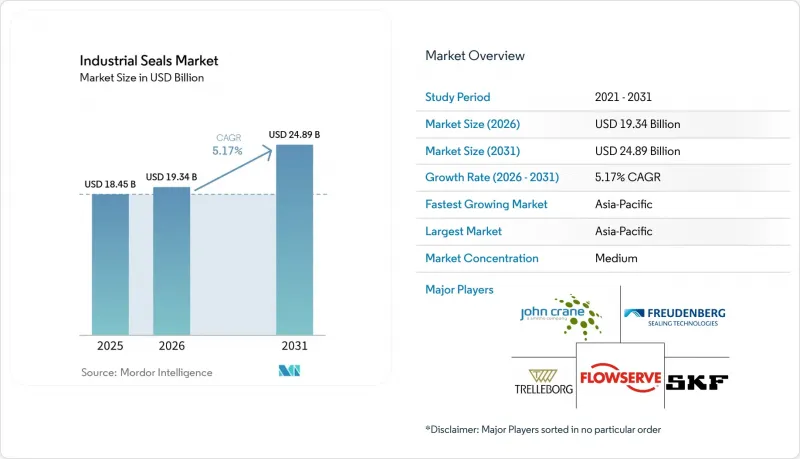
에 따르면 산업용 실 시장 규모는 2025년에 184억 5,000만 달러로 추계되고 있으며, 예측 기간(2026-2031년)에 CAGR 5.17%로 확대하며, 2026년 193억 4,000만 달러에서 2031년에는 248억 9,000만 달러에 달할 것으로 전망되고 있습니다.
전 세계 산업용 실 시장의 동향 및 인사이트
산업용 자동화 및 기존 플랜트의 신뢰성 향상
구형 공정 플랜트의 자동화 개조는 기존의 설비 투자 계획만으로는 충분히 파악하기 어려운 갱신 주기를 만들어내고 있습니다. 특히 자산이 지속적인 상태 모니터링이 아닌 정기 점검을 전제로 설계된 경우에는 이러한 경향이 두드러집니다. 신뢰성 향상 프로그램에서는 이미 장기간 가동 실적이 있으며 제조 연도가 서로 다른 기기가 포함될 가능성이 있는 회전 기기에 센서, 가변속 드라이브 및 상태 모니터링 시스템이 추가됩니다. 개조 후의 장비는 더욱 엄격하게 모니터링되는 조건 하에서 가동되며, 운영자는 예기치 못한 유지보수 사태를 줄이는 것을 목표로 하므로 이러한 프로그램에서는 단순한 동등품 교체 대신 성능 향상이 도모된 동적 실 부품의 채택이 요구되는 경우가 많습니다. 계측 장비의 고도화로 인해 기존의 유지보수 일정으로는 고장, 계획 정지, 혹은 생산 품질 문제가 발생하기 전까지는 감지할 수 없었던 열화를 특정할 수 있게 되었습니다. 프라운호퍼 디지실(Fraunhofer DigiSeal) 프로젝트는 AI와 운영 노하우를 기계식 실의 유지보수에 적용하여, 수명 연장과 예기치 못한 고장 감소를 명확한 목표로 삼고 있습니다. 초기 개조 사양을 통해 사업자는 부가가치가 더 높은 부품으로의 전환이나 그 후의 서비스 계약 체결로 이어지게 되며, 산업용 실 시장에서 이미 도입된 설비 전체에 걸쳐 용도 중심의 교체 패턴이 확립될 것입니다.
EV 배터리, 열 관리 및 e-파워트레인의 실
전기자동차 플랫폼에서는 내연 기관 파워트레인의 기존 요구 사항에만 의존하는 것이 아니라, 배터리 하우징, 냉각 회로, 전기 모터 샤프트 인터페이스 및 파워 일렉트로닉스 하우징용 실이 필요합니다. 각 부위에는 열팽창, 유전성 유체, 방습, 화학 물질 노출 및 반복되는 작동 주기에 걸친 긴 수명에 대해 각각 다른 요구 사항이 부과됩니다. 이러한 요구로 인해 기존 차량 레이아웃에서는 그다지 중요하게 여겨지지 않았던 특수한 실 부위가 생겨나고 있습니다. 반면, 구동계의 변화에 따라 기존의 오일 실 용도 중 일부는 감소할 가능성이 있습니다. 따라서 내연기관 차량이 방대한 기존 도입 기반을 바탕으로 교체 수요를 계속해서 견인하는 한편, 산업용 실 시장에는 새로운 사양 수립의 기회가 생겨나고 있습니다. 재료의 추적 가능성과 검증된 성능은 확립된 재료 라이브러리, 검증된 제조 공정, 그리고 설계부터 생산에 이르기까지 고객의 인증 작업을 지원할 수 있는 역량을 갖춘 공급업체에게 유리하게 작용합니다. 트렐보르그 실링 솔루션즈는 내화학성 및 가혹한 열 조건에 대응하도록 설계된 배터리 셀용 실 기술 ‘CellXPro’를 2025년에 도입했습니다. 이는 산업용 실 시장의 해당 부문에서 회사의 제품 전략을 반영한 것입니다.
실리스 펌프 및 접착제 접합식 EV 배터리 클로저
실리스 자기 구동 펌프는 특정 위험 유체 용도에서 기존의 기계식 실을 대체합니다. 특히 실 유지보수를 위한 접근성보다 봉쇄를 우선시하는 장비 설계에서 효과적입니다. 그 중요성은 봉쇄, 공정 안전 및 배출 제어가 설계상의 핵심 고려 사항이 되는 화학, 제약, 반도체 분야의 운영에서 가장 두드러집니다. 플로우서브(FlowServ)는 2025년 3월, 이중 기밀 봉쇄 구조를 갖춘 실리스 자기 구동 제품인 ‘INNOMAG TB-MAG 듀얼 드라이브 펌프’를 발표했습니다. 이 제품은 정평이 나 있는 실 공급업체들조차 특정 펌프 용도에서 기존의 실을 필요로 하지 않는 장비 설계에 참여하고 있으며, 그러한 설계를 단순한 외부 경쟁으로만 인식하고 있지 않음을 보여줍니다. 전기자동차의 경우, 특정 셀-투-팩(cell-to-pack) 설계에서 배터리의 밀폐부에 구조용 접착제가 사용되며, 일부 케이스 구성에서는 개별적인 주변 실 부품이 부분적으로 대체되고 있습니다. 이러한 접근 방식이 보편적인 것은 아니지만, 특정 설계에서 기존 실 사용량을 줄일 수 있는 반면, 남아 있는 실에는 온도, 화학 물질 노출 및 보호 성능 측면에서 더 엄격한 성능 요건이 부과됩니다.
부문 분석
2025년, 레이디얼 실은 전 세계 매출의 33.21%를 차지할 것으로 예상되며, 이는 펌프 샤프트, 모터 베어링, 기어박스 출력부 및 기타 회전 인터페이스에서의 사용을 반영한 것입니다. 이 실의 도입 실적은 자동차 제조, 공정 플랜트 및 일반 산업 기계 분야에서 정기적인 마모와 유체 유지가 여전히 주요 유지보수 우려 사항이기 때문에 반복적으로 발생하는 교체 수요를 지원하고 있습니다. 석유 및 가스, 발전, 그리고 기존 자동차 생산 분야는 모두 정해진 점검 주기에 따라 다수의 회전 기기를 가동하고 있으므로 여전히 중요한 수주 원천으로 남아 있습니다. 축방향 실은 스티어링 컬럼이나 축류 압축기 등, 샤프트를 따라 움직임이 발생하고 설계 요건이 방사형 배치와는 다른 추력 하중이 가해지는 용도에 사용됩니다. 카본 실은 열적 및 원심력 조건이 가혹해질 수 있는 특수 항공우주 분야나 고속 터보 기계 환경에서 사용되며, 그 결과 적용 범위는 좁아지지만 더 엄격한 요구 사항이 요구됩니다.
또 다른 범주에는 레이디얼 하중과 축방향 하중을 동시에 받는 eAxle용 하이브리드 형상이 포함됩니다. 이 그룹은 여전히 규모는 작지만, 전기 구동 시스템에서는 여러 하중 조건을 컴팩트한 패키지에 결합할 수 있고 맞춤형 설계의 여지가 생기기 때문에 개발 측면에서 주목을 받고 있습니다. 기계식 실은 가장 빠르게 성장하는 유형으로, 2026-2031년까지의 예측 연평균 성장률(CAGR)은 6.13%입니다. 반도체 및 수소 인프라 프로젝트에서는 설계된 실 면, 엄선된 소재, 검증된 제조 공정이 요구되는 가혹한 공정 환경에서의 사용이 촉진되고 있습니다. 2025년, 존 크레인(John Crane)사는 기존 구성에 비해 에너지 사용량을 90%-95% 절감하고, 교체에 따른 가동 중단 시간을 1일로 줄일 수 있는 코크스 내성 비접촉식 가스 윤활 실을 발표했습니다.
지역별 분석
아시아태평양은 2025년에 전 세계 매출의 38.43%를 차지할 것으로 예상되며, 2031년까지 연평균 성장률(CAGR) 5.86%로 성장할 것으로 전망됩니다. 중국은 화학 처리, 국내 반도체 개발, 자동차 생산을 통해 지역 수요를 지원하고 있으며, 이러한 요인들이 결합되어 표준 및 특수 실링 용도 모두에 걸쳐 수요를 창출하고 있습니다. 일본은 정밀 실링 재료 및 반도체 등급 불소 수지 분야에서 여전히 중요한 시장인 반면, 한국은 반도체 제조 거점 및 관련 장비 공급망을 통해 수요를 창출하고 있습니다. 이 지역에는 대규모 최종사용자 생산 거점과 첨단 소재 및 공정 장비 공급업체가 공존하며, 산업용 실링 시장의 다양한 수요 기반을 지원하고 있습니다. 인도는 제조 투자의 새로운 거점으로 부상하고 있으며, 2026년 4월에 발표된 벵갈루루의 트렐레보르그 실링 솔루션즈(Trelleborg Sealing Solutions) 캠퍼스도 그 한 예입니다. 이 캠퍼스에서는 PTFE 제품, 기계식 페이스 실, 회전축 실, 폴리우레탄 솔루션 및 조사·시험 활동이 진행될 예정입니다.
북미와 유럽은 산업용 실 시장에서 두 번째로 큰 수요 클러스터를 형성하고 있습니다. 두 지역 모두 노후화된 산업 자산과 규제 준수를 위한 갱신 프로그램이 프리미엄 제품에 대한 수요를 지원하는 한편, 기존 설비는 애프터마켓 서비스, 유지보수 지원, 그리고 사업자가 설비의 신뢰성을 관리하는 데 도움이 되는 솔루션에 대한 수요를 창출하고 있습니다. 북미에서는 EPA(미국 환경보호청)의 요건에 따라 정유 및 가스 중류 사업 분야에서 누출을 줄이는 구성에 대한 관심이 높아지고 있습니다. 캐나다와 멕시코에서는 오일샌드, 석유화학, 연안 공급 전략과 관련된 수요가 더해지고 있으며, 고객들은 신규 프로젝트와 기존 사업 모두에서 신뢰할 수 있는 공급을 요구하고 있습니다. 유럽에서는 수소 인프라 분야에서 가스의 급격한 감압이나 고압 운전에도 대응 가능한 시스템이 요구되고 있으며, 유럽 산업가스협회(EIGA)의 문서 261에서는 사용자 시설내 수소 배관에 대한 요건이 규정되어 있습니다.
남미, 중동 및 아프리카는 수익 규모는 작지만, 많은 경우 고부가가치 시스템이 요구됩니다. 브라질에서는 설탕·에탄올 사업 및 심해 석유 및 가스 개발을 통해 수요가 지원되고 있으며, 아르헨티나에서는 화학 처리 및 광업 분야의 수요가 있으며, 용도에 특화된 장비 지원이 필요한 경우가 있습니다. 사우디아라비아의 에너지 전환 프로그램과 탄소 포집에 대한 투자는 특수 패키지 제품에 대한 수요를 창출하고 있으며, 남아프리카의 광업 분야에서는 마모가 심한 가동 환경에서 슬러리에 내성이 있는 기계적 실이 요구되고 있습니다. 해상이나 외딴 지역으로 이어지는 긴 물류 경로에서는 예상치 못한 부품 교체가 어렵고 비용이 많이 들며, 플랜트 가동에 차질을 빚을 가능성이 있으므로 초기 비용이 가장 낮은 선택지보다는 내구성이 높고 사양이 뛰어난 부품이 선택되는 경향이 있습니다. 트렐보르그(Trelleborg)는 2026년 6월, 보잉(Boeing) 및 에어버스(Airbus)를 위한 폴리머 실과 엔진 부품을 제조하기 위해 카사블랑카에 항공우주 전용 시설을 개설했습니다.
기타 혜택:
- 엑셀 형식의 시장 예측(ME) 시트
- 3개월간의 애널리스트 지원
자주 묻는 질문
목차
제1장 서론
- 조사 전제조건과 시장 정의
- 조사 범위
제2장 조사 방법
제3장 개요
제4장 시장 구도
- 시장 개요
- 시장 성장 촉진요인
- 시장 성장 억제요인
- 밸류체인 분석
- Porter's Five Forces 분석
제5장 시장 규모와 성장 예측
- 유형별
- 소재별
- 최종 용도 산업별
- 지역별
- 아시아태평양
- 중국
- 인도
- 일본
- 한국
- ASEAN 국가
- 기타 아시아태평양 국가
- 북미
- 미국
- 캐나다
- 멕시코
- 유럽
- 독일
- 영국
- 프랑스
- 이탈리아
- 북유럽 국가
- 기타 유럽 국가
- 남미
- 브라질
- 아르헨티나
- 기타 남미 국가
- 중동 및 아프리카
- 사우디아라비아
- 남아프리카공화국
- 기타 중동 및 아프리카 국가
- 아시아태평양
제6장 경쟁 구도
- 시장 집중도
- 전략적 동향
- 시장 점유율·순위 분석
- 기업 개요
- A.W. Chesterton Company
- AESSEAL
- Dana Seals
- EagleBurgmann
- Enpro Inc.
- Flowserve Corporation
- Freudenberg Sealing Technologies
- Hutchinson SA
- James Walker
- John Crane
- NOK Corporation
- PARKER HANNIFIN CORP
- SKF
- The Timken Company
- Trelleborg AB
제7장 시장 기회와 향후 전망
KSA 26.10.28According to Mordor Intelligence, the industrial seals market size was estimated at USD 18.45 billion in 2025 and is estimated to grow from USD 19.34 billion in 2026 to USD 24.89 billion by 2031, at a CAGR of 5.17% during the forecast period (2026-2031).
Global Industrial Seals Market Trends and Insights
Industrial Automation and Brownfield Reliability Upgrades
Automation retrofits in older process plants are creating a replacement cycle that conventional capital expenditure plans may not fully capture, particularly where assets were designed around periodic inspections rather than continuous condition monitoring. Reliability programs add sensors, variable-speed drives, and condition-monitoring systems to rotating assets that already have many years of operating history and may include equipment of varying vintages. These programs often require upgraded dynamic sealing components rather than simple like-for-like replacements, because the revised equipment operates under more closely observed conditions and operators seek to reduce unplanned maintenance events. Better instrumentation identifies deterioration that earlier maintenance schedules may not have detected until a failure, a planned shutdown, or a production-quality issue occurs. The Fraunhofer DigiSeal project applies AI and operational knowledge to mechanical-seal maintenance, with the stated aim of extending service life and reducing unexpected failures. The initial retrofit specification can shift operators toward higher-value parts and later support service arrangements, giving the industrial seals market a more application-led replacement pattern across the installed base.
EV Battery, Thermal Management, and E-Powertrain Sealing
Electric vehicle platforms require seals for battery enclosures, cooling circuits, e-motor shaft interfaces, and power electronics housings, rather than relying solely on the established requirements of internal-combustion powertrains. Each location presents different requirements for thermal movement, dielectric fluids, moisture protection, chemical exposure, and long service life over repeated operating cycles. These needs introduce specialized sealing points that were less relevant in conventional vehicle layouts, even though several conventional oil-seal applications may decline as drivetrains change. The industrial seals market therefore gains new specification opportunities, while internal combustion vehicles continue to drive replacement demand from their large installed base. Material traceability and documented performance favor suppliers with established material libraries, validated production processes, and the ability to support customer qualification work from design through production. Trelleborg Sealing Solutions introduced CellXPro in 2025 as a battery-cell sealing technology designed for chemical resistance and demanding thermal conditions, reflecting the company's product focus in this segment of the industrial seals market.
Seal-Less Pumps and Adhesive-Bonded EV Battery Closures
Sealless magnetic-drive pumps can replace conventional mechanical seals in selected hazardous-fluid applications, particularly where equipment design prioritizes containment over access for seal maintenance. Their relevance is greatest in chemical, pharmaceutical, and semiconductor operations where containment, process safety, and emissions control are central design considerations. Flowserve introduced the INNOMAG TB-MAG Dual Drive Pump in March 2025 as a sealless magnetic-drive product with dual hermetic containment. This product demonstrates that established sealing suppliers also participate in equipment designs that eliminate the need for conventional seals in specific pump applications, rather than treating such designs solely as external competition. In electric vehicles, certain cell-to-pack designs use structural adhesives for battery closures and partially replace discrete perimeter-sealing components in selected enclosure configurations. These approaches are not universal, but they can reduce conventional seal content in selected designs while subjecting remaining seals to stricter performance requirements for temperature, chemical exposure, and protection.
Other drivers and restraints analyzed in the detailed report include:
- Semiconductor Fab Expansion, Hydrogen, LNG, and Green-Ammonia Infrastructure
- Fugitive-Emission and Zero-Leakage Compliance
- Specialty Material Volatility and Long Qualification Cycles
For complete list of drivers and restraints, kindly check the Table Of Contents.
Segment Analysis
Radial seals held 33.21% of global revenue in 2025, reflecting their use on pump shafts, motor bearings, gearbox outputs, and other rotating interfaces. Their installed base supports repeat replacement demand across automotive manufacturing, process plants, and general industrial machinery, where routine wear and fluid retention remain core maintenance concerns. Oil and gas, power generation, and conventional vehicle production remain important sources of orders, as each operates large populations of rotating assets with established service intervals. Axial seals serve thrust-loading applications, including steering columns and axial compressors, where movement occurs along the shaft and design requirements differ from those of radial arrangements. Carbon seals are used in specialized aerospace and high-speed turbomachinery settings where thermal and centrifugal conditions can be demanding, resulting in a narrower application scope but more exacting requirements.
The other category includes hybrid geometries for e-axles that experience radial and axial loads simultaneously. This group remains smaller but is receiving development attention because electric drive systems can combine several load conditions in compact packages, creating room for customized designs. Mechanical seals are the fastest-growing type, with a forecast CAGR of 6.13% from 2026 to 2031. Semiconductor and hydrogen infrastructure projects support their use in demanding process environments that favor engineered faces, carefully selected materials, and validated manufacturing processes. In 2025, John Crane introduced a coke-resistant non-contacting gas-lubricated seal that reduced energy use by 90%-95% compared with a legacy configuration and limited replacement downtime to one day.
Complete Report Scope:
- By Type
- Radial Seals
- Mechanical Seals
- Axial Seals
- Carbon Seals
- Others
- By Material
- Elastomer Seals
- Thermoplastic Seals
- Metal Seals
- Composite Seals
- Others
- By End-Use Industry
- Automotive
- Oil and Gas
- Chemicals and Petrochemicals
- Power Generation and Utilities
- Semiconductor
- Aerospace and Defense
- Food and Beverage
- Pharmaceuticals and Life Sciences
- Mining and Metals
- Others
- By Geography
- Asia-Pacific
- China
- India
- Japan
- South Korea
- ASEAN Countries
- Rest of Asia-Pacific
- North America
- United States
- Canada
- Mexico
- Europe
- Germany
- United Kingdom
- France
- Italy
- NORDIC Countries
- Rest of Europe
- South America
- Brazil
- Argentina
- Rest of South America
- Middle East and Africa
- Saudi Arabia
- South Africa
- Rest of Middle East and Africa
- Asia-Pacific
Geography Analysis
Asia-Pacific accounted for 38.43% of global revenue in 2025 and is forecast to grow at a 5.86% CAGR through 2031. China supports regional demand through chemical processing, domestic semiconductor development, and vehicle production, which together create requirements across both standard and specialty sealing applications. Japan remains important for precision sealing materials and semiconductor-grade fluoropolymers, while South Korea adds demand from its semiconductor manufacturing base and related equipment supply chain. The region combines large end-user production centers with suppliers of advanced materials and process equipment, supporting a varied demand base for the industrial seals market. India is a greenfield location for manufacturing investment, including a Trelleborg Sealing Solutions campus in Bengaluru, announced in April 2026, that will cover PTFE products, mechanical face seals, rotary shaft seals, polyurethane solutions, and research and testing activities.
North America and Europe form the second-largest demand cluster for the industrial seals market. Older industrial assets and compliance-driven replacement programs support demand for premium products in both regions, while the installed base generates demand for aftermarket service, maintenance support, and solutions that help operators manage equipment reliability. In North America, EPA requirements drive attention to lower-leakage configurations in refining and midstream gas operations. Canada and Mexico add demand linked to oil sands, petrochemicals, and nearshore supply strategies, with customers seeking dependable supply for both new projects and existing operations. In Europe, hydrogen infrastructure requires systems capable of handling rapid gas decompression and high-pressure service, while European Industrial Gases Association (EIGA) Document 261 sets out requirements for hydrogen piping at user locations.
South America, the Middle East, and Africa account for smaller revenue pools but often require higher-value systems. Brazil supports demand through sugar-ethanol operations and deepwater oil and gas activity, while Argentina contributes chemical processing and mining demand that may require application-specific equipment support. Saudi Arabian conversion programs and carbon-capture investment create demand for specialized packages, while South African mining requires slurry-resistant mechanical seals in high-wear operating environments. Long logistics routes to offshore and remote sites can favor durable, high-specification parts over the lowest initial-cost option, as unplanned replacement can be difficult, expensive, and disruptive to plant operations. Trelleborg opened a dedicated aerospace facility in Casablanca in June 2026 to manufacture polymer seals and engine components for Boeing and Airbus.
- A.W. Chesterton Company
- AESSEAL
- Dana Seals
- EagleBurgmann
- Enpro Inc.
- Flowserve Corporation
- Freudenberg Sealing Technologies
- Hutchinson SA
- James Walker
- John Crane
- NOK Corporation
- PARKER HANNIFIN CORP
- SKF
- The Timken Company
- Trelleborg AB
Additional Benefits:
- The market estimate (ME) sheet in Excel format
- 3 months of analyst support
TABLE OF CONTENTS
1 Introduction
- 1.1 Study Assumptions and Market Definition
- 1.2 Scope of the Study
2 Research Methodology
3 Executive Summary
4 Market Landscape
- 4.1 Market Overview
- 4.2 Market Drivers
- 4.2.1 Industrial Automation and Brownfield Reliability Upgrades
- 4.2.2 EV Battery, Thermal Management and E-Powertrain Sealing
- 4.2.3 Semiconductor Fab Expansion and Aggressive Process Conditions
- 4.2.4 Fugitive-Emission and Zero-Leakage Compliance
- 4.2.5 Hydrogen, LNG and Green-Ammonia Infrastructure
- 4.3 Market Restraints
- 4.3.1 Seal-Less Pumps and Adhesive-Bonded EV Battery Closures
- 4.3.2 Specialty Fluoropolymer and Silicon-Carbide Supply Volatility
- 4.3.3 Long Qualification Cycles for New Compounds and Designs
- 4.4 Value Chain Analysis
- 4.5 Porter's Five Forces Analysis
- 4.5.1 Bargaining Power of Suppliers
- 4.5.2 Bargaining Power of Buyers
- 4.5.3 Threat of New Entrants
- 4.5.4 Threat of Substitutes
- 4.5.5 Competitive Rivalry
5 Market Size and Growth Forecasts (Value)
- 5.1 By Type
- 5.1.1 Radial Seals
- 5.1.2 Mechanical Seals
- 5.1.3 Axial Seals
- 5.1.4 Carbon Seals
- 5.1.5 Others
- 5.2 By Material
- 5.2.1 Elastomer Seals
- 5.2.2 Thermoplastic Seals
- 5.2.3 Metal Seals
- 5.2.4 Composite Seals
- 5.2.5 Others
- 5.3 By End-Use Industry
- 5.3.1 Automotive
- 5.3.2 Oil and Gas
- 5.3.3 Chemicals and Petrochemicals
- 5.3.4 Power Generation and Utilities
- 5.3.5 Semiconductor
- 5.3.6 Aerospace and Defense
- 5.3.7 Food and Beverage
- 5.3.8 Pharmaceuticals and Life Sciences
- 5.3.9 Mining and Metals
- 5.3.10 Others
- 5.4 By Geography
- 5.4.1 Asia-Pacific
- 5.4.1.1 China
- 5.4.1.2 India
- 5.4.1.3 Japan
- 5.4.1.4 South Korea
- 5.4.1.5 ASEAN Countries
- 5.4.1.6 Rest of Asia-Pacific
- 5.4.2 North America
- 5.4.2.1 United States
- 5.4.2.2 Canada
- 5.4.2.3 Mexico
- 5.4.3 Europe
- 5.4.3.1 Germany
- 5.4.3.2 United Kingdom
- 5.4.3.3 France
- 5.4.3.4 Italy
- 5.4.3.5 NORDIC Countries
- 5.4.3.6 Rest of Europe
- 5.4.4 South America
- 5.4.4.1 Brazil
- 5.4.4.2 Argentina
- 5.4.4.3 Rest of South America
- 5.4.5 Middle East and Africa
- 5.4.5.1 Saudi Arabia
- 5.4.5.2 South Africa
- 5.4.5.3 Rest of Middle East and Africa
- 5.4.1 Asia-Pacific
6 Competitive Landscape
- 6.1 Market Concentration
- 6.2 Strategic Moves
- 6.3 Market Share (%)/Ranking Analysis
- 6.4 Company Profiles (includes Global Overview, Market Overview, Core Segments, Financials as available, Strategic Information, Products and Services, and Recent Developments)
- 6.4.1 A.W. Chesterton Company
- 6.4.2 AESSEAL
- 6.4.3 Dana Seals
- 6.4.4 EagleBurgmann
- 6.4.5 Enpro Inc.
- 6.4.6 Flowserve Corporation
- 6.4.7 Freudenberg Sealing Technologies
- 6.4.8 Hutchinson SA
- 6.4.9 James Walker
- 6.4.10 John Crane
- 6.4.11 NOK Corporation
- 6.4.12 PARKER HANNIFIN CORP
- 6.4.13 SKF
- 6.4.14 The Timken Company
- 6.4.15 Trelleborg AB
7 Market Opportunities and Future Outlook
- 7.1 White-Space and Unmet-Need Assessment


