

|
시장보고서
상품코드
2154987
주택용 배터리 에너지 저장 시스템 : 시장 점유율 분석, 업계 동향과 통계, 성장 예측(2026-2031년)Residential Battery Energy Storage Systems - Market Share Analysis, Industry Trends & Statistics, Growth Forecasts (2026 - 2031) |
||||||
 Mordor Intelligence
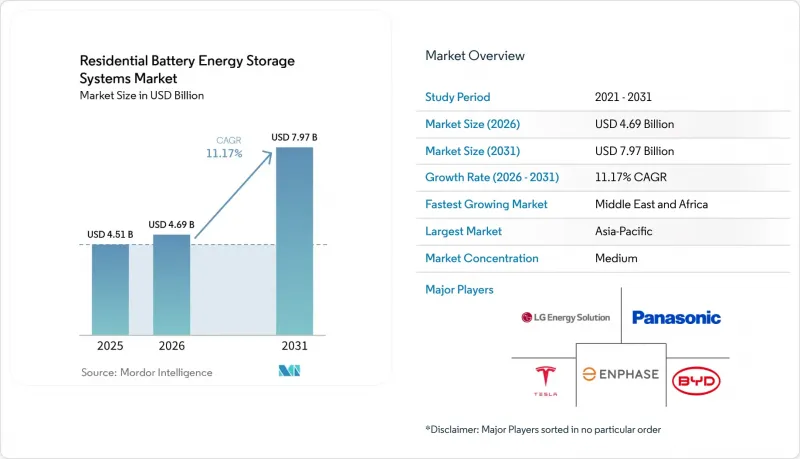
에 따르면 주택용 축전지 시스템 시장 규모는 2025년 45억 1,000만 달러, 2026년 46억 9,000만 달러에서 2031년까지 79억 7,000만 달러로 확대될 것으로 예측되고 있으며, 2026-2031년까지 연평균 성장률(CAGR)은 11.17%에 달할 전망입니다.
전 세계 주택용 배터리 에너지 저장 시스템 시장의 동향 및 인사이트
지붕형 태양광발전과 배터리 저장 시스템의 병행 설치 확대
지붕형 태양광발전의 도입은 꾸준한 수요를 견인하는 요인으로 작용하고 있습니다. 이는 전력 판매 보상금 삭감으로 인해 가정의 자가 소비 가치가 높아졌고, 판매 시점에 태양광발전과 축전 시스템의 조합이 더욱 밀접하게 연관되게 되었기 때문입니다. 캘리포니아주의 순계량제(net metering) 제도로 인해 주거용 태양광발전의 전력 판매 가치가 하락함에 따라 신규 태양광발전 시스템의 경제성 측면에서 축전지의 중요성이 더욱 높아졌습니다. Sunrun사의 보고에 따르면 2026년 2분기 배터리 도입률은 74%로, 2025년 2분기의 70%에서 상승했습니다. 호주의 판매 시점 보조금 제도는 활발한 설치 활동을 지원했을 뿐만 아니라, 가구의 세무 상황에 의존하지 않았기 때문에 세제 기반 프로그램이 안고 있는 행정적 제약을 피할 수 있었습니다. 이러한 접근 방식을 통해 세액 공제 프로그램의 혜택을 충분히 누리지 못할 가능성이 있는 가구에도 지원을 제공할 수 있으며, 에너지 저장 시스템에 대한 사회경제적 접근성을 개선하고 주거용 에너지 저장 장치 시장의 참여를 확대할 수 있습니다.
LFP 팩 및 시스템 비용의 하락
2025년에는 주거용 시스템 수준에서 LFP 팩의 비용이 1kWh당 130달러 미만으로 떨어졌습니다. 이로 인해 가정용 프로젝트의 투자 회수 기간이 단축되었으며, 선진국과 신흥 시장 모두에서 도입의 경제적 이점이 높아졌습니다. LFP 화학계는 6,000회 이상의 충방전 사이클 수를 자랑하며, 니켈·망간·코발트(NMC) 화학계의 3,000-4,000회와 비교하여 셀 가격을 추가로 낮출 필요 없이 수명 주기 전반에 걸쳐 에너지 저장 비용을 절감하고 있습니다. BYD는 2025년 12월까지 전 세계에 150만 대 이상의 가정용 BatteryBox 시스템을 설치했다고 발표했습니다. 엔페이즈(Enphase)는 2025년 7월, 이전 모델보다 에너지 밀도가 34% 향상된 ‘IQ Battery 10C’를 발표했습니다. 이로 인해 동등한 용량을 설치하는 데 필요한 공간이 줄어들어 설치 인건비 부담이 완화되었습니다. 따라서 제조 규모, 셀 선정, 모듈식 설계는 셀 가격뿐만 아니라 가정용 축전지 시장 전체 프로젝트의 경제성에도 영향을 미치고 있습니다.
높은 초기 설치 비용과 자금 조달의 격차
배터리 팩 가격 하락에도 불구하고 인버터, 전기 공사, 인건비, 인허가 및 자금 조달 비용은 여전히 남아 있으며, 이 모든 요소가 합쳐져 가정용 설치에 있으며, 중요한 요소가 되고 있습니다. 미국 연방 세법 제25D조에 따른 주택용 청정 에너지 세액 공제(Residential Clean Energy Credit)의 종료로 인해 직접 구매 시스템의 경제성이 변화하면서, 리스 및 기타 제3자 소유 형태에 대한 관심이 높아지고 있습니다. 이러한 모델은 가정이 부담하는 초기 비용을 줄이고, 고객의 자금 조달 여력이 제한적인 경우에도 설치를 지원하며, 시스템 비용의 더 많은 부분을 주택 소유자가 아닌 공급자가 부담하는 형태로 만들 수 있습니다. 남미, 사하라 사막 이남의 아프리카, 동남아시아에서는 우대 대출이나 판매 시점 리베이트가 없다면 비상용 전원에 대한 관심이 실제 설치로 이어지지 않을 가능성이 있습니다. 서비스 모델로의 전환은 보급을 확대하는 한편, 장기적인 수익 및 운영 관리권을 에너지 서비스 제공업체에 더 많이 위임하는 결과를 초래할 수도 있습니다.
부문 분석
2025년 기준으로 리튬이온 배터리는 가정용 에너지 저장 시스템 시장 규모의 82.9%를 차지하고 있으며, 화학 성분의 선택이 현재 시스템 설계의 주요 결정 요인이 되고 있습니다. LFP는 긴 사이클 수명과 열적 특성이 가정에서의 일상적인 에너지 저장 이용 및 옥상 태양광발전으로부터의 정기적인 충방전에 적합하므로 리튬이온 배터리 중 주류를 이루고 있습니다. 이 배터리의 사이클 수명은 6,000회 이상으로, NMC 계열 배터리의 3,000-4,000회에 비해 우수하여 시스템의 수명 주기 경제성이 향상되고, 장기 운영시 잔여 용량 저하 문제가 발생할 가능성이 낮아집니다. Enphase사의 2025년 모델 ‘IQ Battery 10C’는 에너지 용량뿐만 아니라 에너지 밀도와 설치 편의성이 중요시되고 있음을 보여줍니다. 유럽연합(EU)의 배터리 규정에 따르면 향후 몇 년 내에 관련 배터리 소재에 대해 재활용 함유율의 최저 기준이 의무화될 예정이며, 이는 가정용 배터리 에너지 저장 시스템 시장의 소재 조달, 제품 문서화 및 조달 계획에 영향을 미칠 것입니다.
납축전지는 오프그리드나 가격에 민감한 용도에서 제한적인 역할을 유지하고 있습니다. 이러한 용도에서는 리튬이온 축전 시스템의 도입이 여전히 어렵고, 가정용 축전 시스템 시장에서 초기 투자 비용이 주요 구매 기준이 되고 있습니다. LFP(인산철리튬)의 비용 절감이 지속됨에 따라 그 격차는 점차 좁혀지고 있습니다. 특히 태양광발전 시스템과 축전지를 결합하여 매일의 충방전 사이클에서 LFP의 긴 수명을 활용할 수 있는 경우, 이러한 경향이 두드러집니다. 다른 기술 부문에서는 나트륨 이온 배터리 및 레독스 플로우 배터리 제품이 여전히 상용화의 초기 단계에 있습니다. 나트륨 이온 배터리는 리튬 및 코발트 밸류체인에 대한 의존도를 낮출 수 있지만, 현재의 에너지 밀도 한계로 인해 벽면 공간이나 장비 설치 면적이 중요한 주택 시장에서 단기적인 역할은 제한적입니다. 중국의 공급업체들은 셀의 일괄 생산 체제를 채택하고 있으며, 그 공급 범위를 인버터 및 에너지 관리 플랫폼으로 확대하고 있습니다. 이를 통해 주거용 축전지 업계에서 셀 비용 절감과 고부가가치 시스템 서비스가 결합되고 있습니다.
지역별 분석
2025년, 아시아태평양은 주거용 배터리 시장의 50.2% 점유율을 차지했습니다. 중국은 LFP(인산철리튬) 제조 거점, 수직 통합된 공급망, 그리고 셀 및 배터리 장비 수출을 통해 국내 수요와 세계 가격 형성을 모두 지원하고 있습니다. 호주의 ‘커뮤니티 홈 배터리 프로그램(Community Home Battery Program)’은 2026년 5월까지 40만 건 이상의 가정용 배터리 설치와 누적 11.2GWh의 주택용 용량 달성을 지원했습니다. 이 판매 시점 보조금 제도는 활발한 도입 활동을 촉진하고, 세액 공제 제도 외의 대안을 제공함과 동시에, 직접적인 리베이트가 주거용 배터리 에너지 저장 시스템 시장의 보급을 얼마나 가속화할 수 있는지를 보여주었습니다. 또한 일본 가정의 회복탄력성(복구력)에 관한 요건 역시 전력망 공급이 중단되었을 때 가동 가능한 신뢰성 높은 백업 전원 시스템에 대한 수요를 지원하고 있습니다.
유럽에서는 2025년에 9.8 GWh 규모의 가정용 에너지 저장 시스템이 도입되어 전년 대비 6% 감소했으나, 이탈리아를 제외한 지역에서는 18% 증가했습니다. 독일에서는 2025년 말까지 가정용 에너지 저장 시스템 설치 대수가 240만 대를 넘어섰으며, 도입 용량은 25GWh에 달했습니다. 네덜란드에서는 2027년에 예정된 넷 미터링 종료에 앞서 도입이 확대되었습니다. 한편, 영국에서는 동적 요금제의 중요성이 높아짐에 따라 2025년 상반기 도입 대수가 2배 이상 증가했습니다. 유럽 대륙에서는 주택의 계통 연계에 3상 전력이 널리 사용되고 있으므로 3상 대응 백업 기능이 중요해집니다. 또한 폴란드에서는 전력 가격의 급등과 새로운 지붕 설치형 태양광발전 시스템의 보급으로 인해 주택용 축전지 시장의 경제성이 향상되어 시장 기회가 확대되고 있습니다.
미국에서는 2026년 1분기에 1.3GWh 규모의 주택용 에너지 저장 시스템이 도입되어 전년 동기 대비 86% 증가했습니다. 세액 공제 변경으로 인해 직접 구매 수요는 감소할 가능성이 있지만, 리스나 구독 모델의 경우 고액의 초기 비용을 정기적인 지불로 대체함으로써 그 영향을 억제할 수 있습니다. 중동 및 아프리카는 2031년까지의 가정용 배터리 에너지 저장 시스템 시장에서 12.7%라는 가장 높은 예측 연평균 성장률(CAGR)을 보이고 있습니다. 남아프리카공화국에서는 2025년에 2.1 GWh 규모의 가정용 에너지 저장 시스템이 도입되어 전년 대비 110% 증가했습니다. 이는 계획 정전으로 인해 백업 전원이 단순한 전기 요금 관리 수단이 아닌 실질적인 필요성이 되었기 때문입니다. 브라질과 칠레에서도 송전망의 신뢰성에 대한 우려, 전기 요금 변동, 분산형 발전에 관한 규제, 태양광발전 연계 정책 등이 투자 매력을 높이고 있으며, 수요가 확대되고 있습니다.
기타 혜택:
- 엑셀 형식의 시장 예측(ME) 시트
- 3개월간의 애널리스트 지원
자주 묻는 질문
목차
제1장 서론
- 조사 전제조건과 시장 정의
- 조사 범위
제2장 조사 방법
제3장 개요
제4장 시장 구도
- 시장 개요
- 시장 성장 촉진요인
- 시장 성장 억제요인
- 공급망 분석
- Porter's Five Forces 분석
- 기술 동향
- 규제 상황
- 투자 분석
제5장 시장 규모와 성장 예측
- 기술 유형별
- 배포 유형별
- 지역별
- 북미
- 미국
- 캐나다
- 멕시코
- 유럽
- 독일
- 프랑스
- 이탈리아
- 스페인
- 영국
- 폴란드
- 러시아
- 기타 유럽 국가
- 아시아태평양
- 중국
- 인도
- 일본
- 한국
- 호주
- 인도네시아
- 베트남
- 태국
- 기타 아시아태평양 국가
- 남미
- 브라질
- 아르헨티나
- 칠레
- 기타 남미 국가
- 중동 및 아프리카
- 사우디아라비아
- 아랍에미리트
- 이집트
- 남아프리카공화국
- 모로코
- 기타 중동 및 아프리카 국가
- 북미
제6장 경쟁 구도
- 시장 집중도
- 전략적 동향
- 시장 점유율 분석
- 기업 개요
- Alpha ESS Co., Ltd.
- Amara Raja Energy and Mobility Limited
- BYD Company Ltd.
- Delta Electronics, Inc.
- Enphase Energy, Inc.
- FENECON GmbH
- FranklinWH Energy Storage Inc.
- Generac Power Systems, Inc.
- GoodWe Technologies Co., Ltd.
- Growatt New Energy Technology Co., Ltd.
- Huawei Technologies Co., Ltd.
- LG Energy Solution Ltd.
- Panasonic Holdings Corporation
- Samsung SDI Co., Ltd.
- Schneider Electric SE
- SMA Solar Technology AG
- SolarEdge Technologies, Inc.
- Sonnen GmbH
- Sungrow Power Supply Co., Ltd.
- Tesla Inc.
- VARTA AG
제7장 시장 기회와 향후 전망
KSA 26.10.28According to Mordor Intelligence, the residential battery energy storage systems market size is projected to expand from USD 4.51 billion in 2025 and USD 4.69 billion in 2026 to USD 7.97 billion by 2031, at a CAGR of 11.17% between 2026 and 2031.
Global Residential Battery Energy Storage Systems Market Trends and Insights
Rooftop Solar and Battery Attachment Growth
Rooftop solar deployment is a consistent demand driver because reduced export compensation makes self-consumption more valuable for households and makes the solar-plus-storage decision more closely linked at the point of sale. California's net billing tariff reduced the value of exported residential solar generation, making a battery more relevant to the economics of a new solar system. Sunrun reported a battery attachment rate of 74% in the second quarter of 2026, compared with 70% in the second quarter of 2025. Australia's point-of-sale subsidy structure supported strong installation activity and did not depend on a household's tax position, which avoided the administrative limits of a tax-based program. This approach can reach households that may not fully benefit from tax-credit programs, improve socioeconomic access to storage, and broaden participation in the residential battery energy storage systems market.
Falling LFP Pack and System Costs
LFP pack costs fell below USD 130 per kWh at the residential system level in 2025, which reduced the payback period for household projects and improved the purchase case in both developed and emerging markets. LFP chemistry offers more than 6,000 cycles, compared with 3,000 to 4,000 cycles for nickel manganese cobalt, or NMC, chemistry, which supports lower lifetime storage costs without requiring a further decline in cell prices. BYD stated that it installed more than 1.5 million residential BatteryBox systems worldwide by December 2025. Enphase introduced the IQ Battery 10C in July 2025 with 34% greater energy density than its predecessor, reducing the space required for a comparable installation and limiting a source of installation labor cost. Manufacturing scale, cell selection, and modular designs therefore affect project economics across the residential battery energy storage systems market rather than through cell prices alone.
High Upfront Installed Cost and Financing Gaps
Lower battery pack prices have not removed the cost of inverters, electrical work, labor, permitting, and financing, which together remain material for a household installation. The end of the United States Section 25D residential clean energy credit changes the economics for direct-purchase systems and shifts attention toward leases and other third-party ownership structures. These models can lower the initial payment required from households, support installation where customer financing is limited, and make the provider, rather than the homeowner, responsible for more system costs. In South America, sub-Saharan Africa, and Southeast Asia, interest in backup power may not convert into installations without concessional finance or point-of-sale rebates. The shift toward service models can expand adoption but can also place more long-term revenue and operating control with energy service providers.
Other drivers and restraints analyzed in the detailed report include:
- Time-of-Use Tariffs and Net-Billing Economics
- Virtual Power Plant Revenue Stacking
- Fire-Safety Compliance and Insurance Scrutiny
For complete list of drivers and restraints, kindly check the Table Of Contents.
Segment Analysis
Lithium-ion batteries held 82.9% of the residential battery energy storage systems market size in 2025, making chemistry selection the main determinant of current system design. LFP is the leading lithium-ion chemistry because its longer cycle life and thermal characteristics suit daily home storage use and regular cycling from rooftop solar. It's more than 6,000-cycle life compared with 3,000 to 4,000 cycles for NMC chemistry, which improves lifetime system economics and reduces the relevance of residual capacity loss over a long operating period. Enphase's 2025 IQ Battery 10C shows how energy density and simpler installation have become important alongside energy capacity. The European Union Battery Regulation will require minimum recycled-content levels for relevant battery materials in future years, which will affect sourcing, product documentation, and procurement planning for the residential battery energy storage systems market.
Lead-acid batteries retain a limited role in off-grid and price-sensitive applications, where lithium-ion installation systems remain less accessible and immediate capital cost remains the main purchase criterion in the residential battery energy storage systems market. Continued LFP cost reductions are narrowing the gap, particularly where solar systems are paired with batteries and daily cycling can use LFP's longer operating life. Sodium-ion and redox-flow products remain at early commercialization stages within the other technologies category. Sodium-ion can reduce exposure to lithium and cobalt supply chains, but current energy-density limits restrict its near-term role in homes where wall space and equipment footprint matter. Chinese suppliers use integrated cell production and are extending their offerings into inverters and energy management platforms, which link lower cell costs to higher-value system services in the residential battery energy storage systems industry.
Complete Report Scope:
- By Technology Type
- Lithium-ion
- Lead-Acid
- Others
- By Deployment Type
- Stationary
- Portable
- By Geography
- North America
- United States
- Canada
- Mexico
- Europe
- Germany
- France
- Italy
- Spain
- United Kingdom
- Poland
- Russia
- Rest of Europe
- Asia-Pacific
- China
- India
- Japan
- South Korea
- Australia
- Indonesia
- Vietnam
- Thailand
- Rest of Asia-Pacific
- South America
- Brazil
- Argentina
- Chile
- Rest of South America
- Middle East and Africa
- Saudi Arabia
- United Arab Emirates
- Egypt
- South Africa
- Morocco
- Rest of Middle East and Africa
- North America
Geography Analysis
Asia-Pacific held 50.2% of the residential battery energy storage systems market share in 2025. China supports both domestic demand and global pricing through its LFP manufacturing base, vertically integrated supply chain, and exports of cells and storage equipment. Australia's Community Home Battery Program supported more than 400,000 home battery installations and 11.2 GWh of cumulative residential capacity by May 2026. Its point-of-sale subsidy design supported strong installation activity, provided access outside tax-credit structures, and showed how direct rebates can speed adoption in the residential battery energy storage systems market. Japan's household resilience requirements also support demand for reliable backup power systems that can operate when grid service is disrupted.
Europe installed 9.8 GWh of residential storage in 2025, a 6% decline from the previous year, while the region excluding Italy grew 18%. Germany exceeded 2.4 million residential storage systems and 25 GWh of installed capacity by the end of 2025. The Netherlands increased installations before the expected end of net metering in 2027, while the United Kingdom installations more than doubled in the first half of 2025 as dynamic tariffs became more relevant. Three-phase backup capability is important in continental Europe, where residential grid connections often use three-phase power, and Poland offers an expanding opportunity because higher electricity prices and new rooftop solar systems improve the financial case for the residential battery energy storage systems market.
The United States installed 1.3 GWh of residential energy storage in the first quarter of 2026, up 86% from the prior year. Tax-credit changes may reduce direct-purchase demand, although leases and subscription models can limit the effect by replacing a high initial payment with a recurring charge. The Middle East and Africa have the fastest forecast CAGR of 12.7% through 2031 in the residential battery energy storage systems market. South Africa added 2.1 GWh of residential storage in 2025, up 110%, as load-shedding made backup power a practical need rather than solely an electricity-bill management tool. Brazil and Chile are also developing demand as grid reliability concerns, tariff volatility, distributed-generation rules, and solar attachment policies improve the investment case.
- Alpha ESS Co., Ltd.
- Amara Raja Energy and Mobility Limited
- BYD Company Ltd.
- Delta Electronics, Inc.
- Enphase Energy, Inc.
- FENECON GmbH
- FranklinWH Energy Storage Inc.
- Generac Power Systems, Inc.
- GoodWe Technologies Co., Ltd.
- Growatt New Energy Technology Co., Ltd.
- Huawei Technologies Co., Ltd.
- LG Energy Solution Ltd.
- Panasonic Holdings Corporation
- Samsung SDI Co., Ltd.
- Schneider Electric SE
- SMA Solar Technology AG
- SolarEdge Technologies, Inc.
- Sonnen GmbH
- Sungrow Power Supply Co., Ltd.
- Tesla Inc.
- VARTA AG
Additional Benefits:
- The market estimate (ME) sheet in Excel format
- 3 months of analyst support
TABLE OF CONTENTS
1 INTRODUCTION
- 1.1 Study Assumptions and Market Definition
- 1.2 Scope of the Study
2 RESEARCH METHODOLOGY
3 EXECUTIVE SUMMARY
4 MARKET LANDSCAPE
- 4.1 Market Overview
- 4.2 Market Drivers
- 4.2.1 Rooftop Solar and Battery Attachment Growth
- 4.2.2 Falling LFP Pack and System Costs
- 4.2.3 Grid Outage and Extreme-Weather Resilience Demand
- 4.2.4 Time-of-Use Tariffs and Net-Billing Economics
- 4.2.5 Virtual Power Plant Revenue Stacking
- 4.2.6 Electrification of Household Loads and Bidirectional EV Charging
- 4.3 Market Restraints
- 4.3.1 High Upfront Installed Cost and Financing Gaps
- 4.3.2 Permitting, Interconnection, and Installer Bottlenecks
- 4.3.3 Fire-Safety Compliance and Insurance Scrutiny
- 4.3.4 Critical-Mineral and Battery-End-of-Life Exposure
- 4.4 Supply-Chain Analysis
- 4.5 Porter's Five Forces Analysis
- 4.5.1 Bargaining Power of Suppliers
- 4.5.2 Bargaining Power of Buyers
- 4.5.3 Threat of New Entrants
- 4.5.4 Threat of Substitutes
- 4.5.5 Competitive Rivalry
- 4.6 Technology Outlook
- 4.7 Regulatory Landscape
- 4.8 Investment Analysis
5 MARKET SIZE AND GROWTH FORECASTS
- 5.1 By Technology Type
- 5.1.1 Lithium-ion
- 5.1.2 Lead-Acid
- 5.1.3 Others
- 5.2 By Deployment Type
- 5.2.1 Stationary
- 5.2.2 Portable
- 5.3 By Geography
- 5.3.1 North America
- 5.3.1.1 United States
- 5.3.1.2 Canada
- 5.3.1.3 Mexico
- 5.3.2 Europe
- 5.3.2.1 Germany
- 5.3.2.2 France
- 5.3.2.3 Italy
- 5.3.2.4 Spain
- 5.3.2.5 United Kingdom
- 5.3.2.6 Poland
- 5.3.2.7 Russia
- 5.3.2.8 Rest of Europe
- 5.3.3 Asia-Pacific
- 5.3.3.1 China
- 5.3.3.2 India
- 5.3.3.3 Japan
- 5.3.3.4 South Korea
- 5.3.3.5 Australia
- 5.3.3.6 Indonesia
- 5.3.3.7 Vietnam
- 5.3.3.8 Thailand
- 5.3.3.9 Rest of Asia-Pacific
- 5.3.4 South America
- 5.3.4.1 Brazil
- 5.3.4.2 Argentina
- 5.3.4.3 Chile
- 5.3.4.4 Rest of South America
- 5.3.5 Middle East and Africa
- 5.3.5.1 Saudi Arabia
- 5.3.5.2 United Arab Emirates
- 5.3.5.3 Egypt
- 5.3.5.4 South Africa
- 5.3.5.5 Morocco
- 5.3.5.6 Rest of Middle East and Africa
- 5.3.1 North America
6 COMPETITIVE LANDSCAPE
- 6.1 Market Concentration
- 6.2 Strategic Moves
- 6.3 Market Share Analysis
- 6.4 Company Profiles (includes Global Level Overview, Market Level Overview, Core Segments, Financials as available, Strategic Information, Market Rank/Share, Products and Services, Recent Developments)
- 6.4.1 Alpha ESS Co., Ltd.
- 6.4.2 Amara Raja Energy and Mobility Limited
- 6.4.3 BYD Company Ltd.
- 6.4.4 Delta Electronics, Inc.
- 6.4.5 Enphase Energy, Inc.
- 6.4.6 FENECON GmbH
- 6.4.7 FranklinWH Energy Storage Inc.
- 6.4.8 Generac Power Systems, Inc.
- 6.4.9 GoodWe Technologies Co., Ltd.
- 6.4.10 Growatt New Energy Technology Co., Ltd.
- 6.4.11 Huawei Technologies Co., Ltd.
- 6.4.12 LG Energy Solution Ltd.
- 6.4.13 Panasonic Holdings Corporation
- 6.4.14 Samsung SDI Co., Ltd.
- 6.4.15 Schneider Electric SE
- 6.4.16 SMA Solar Technology AG
- 6.4.17 SolarEdge Technologies, Inc.
- 6.4.18 Sonnen GmbH
- 6.4.19 Sungrow Power Supply Co., Ltd.
- 6.4.20 Tesla Inc.
- 6.4.21 VARTA AG
7 MARKET OPPORTUNITIES AND FUTURE OUTLOOK
- 7.1 White-Space and Unmet-Need Assessment


