

|
시장보고서
상품코드
2155012
가스트린 호르몬 : 시장 점유율 분석, 업계 동향과 통계, 성장 예측(2026-2031년)Gastrin Hormone - Market Share Analysis, Industry Trends & Statistics, Growth Forecasts (2026 - 2031) |
||||||
 Mordor Intelligence
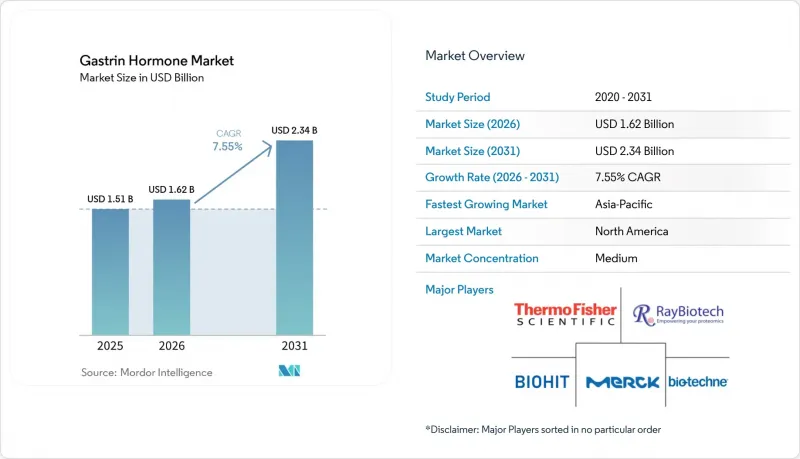
에 따르면 가스트린 호르몬 시장 규모는 2025년 15억 1,000만 달러, 2026년 16억 2,000만 달러에서 2031년까지 23억 4,000만 달러로 확대될 것으로 예측되고 있으며, 2026-2031년까지 연평균 성장률(CAGR)은 7.55%에 달할 전망입니다.
세계 가스트린 호르몬 시장의 동향 및 인사이트
합성 가스트린 및 펜타가스트린 시약의 접근성 향상
가스트린 호르몬 시장은 생물 유래 원료에 대한 의존도가 낮은 합성 제품의 공급으로 혜택을 보고 있습니다. GenScript에 따르면 이 회사의 마이크로파 지원형 PepPower 플랫폼은 95%를 넘는 합성 성공률을 달성하고 있으며, 영업일 기준 5일 이내에 순도 95% 이상의 펩티드를 납품할 수 있다고 합니다. 합성 속도가 빨라짐에 따라 맞춤형 펩티드를 필요로 하는 연구소에서 연구용 등급의 가스트린 및 펜타가스트린에 대한 접근성이 향상될 가능성이 있습니다. Merck KGaA는 Sigma-Aldrich사의 ‘Gastrin I’ 제품에 대해 HPLC 순도 95% 이상이라고 명시하고 있으며, 카탈로그에 등재된 합성 시약이 계속해서 구할 수 있음을 보이고 있습니다. 2025년 연구에 따르면 합성 펩티드에 포함된 잔류 트리플루오로아세트산이 대이온 교환이 이루어지지 않을 경우 세포를 이용한 연구에 영향을 미칠 가능성이 있다고 보고되었습니다. 이러한 품질상 우려로 인해 순도 및 대이온 프로파일이 검증된 시약에 대한 수요가 증가할 가능성이 있습니다.
위축성 위염 및 헬리코박터 파일로리 관련 질환에 대한 가스트린-17 검사의 확대
가스트린-17이 비침습적 위 위험 평가의 일부로 자리 잡음에 따라 가스트린 호르몬 시장은 임상적 지지를 얻고 있습니다. 2025년 MAPS III 지침에서는 내시경적 경과 관찰이 필요한 진행성 위축성 위염을 확인하기 위해 혈청 펩시노겐 I 및 펩시노겐 I 대 펩시노겐 II 비율 측정을 권장하고 있습니다. 2025년 'BMC Gastroenterology' 저널에 발표된 연구에 따르면 펩시노겐 I, 펩시노겐 II, 펩시노겐 비율 및 가스트린-17로 구성된 패널 검사를 통해 진행성 위축성 위염에 대해 AUC 0.759를 달성한 것으로 밝혀졌습니다. Biohit사는 칠레에서 자사의 GastroPanel 프로그램을 통해 내시경 검사 대기 리스트이 87% 감소했다고 보고했습니다. 의뢰 경로가 이를 지원하는 경우, 환자 곁에서 검사를 수행하는 방식을 통해 이 검사를 센트럴 랩 밖으로까지 확대할 수 있습니다. 이러한 프로그램은 분석 키트, 교정제 및 기타 소모품에 대한 지속적인 수요를 창출합니다.
공복 상태, 프로톤 펌프 억제제 사용, 신부전 및 비오틴으로 인한 전분석 변동
전분석적 변동성으로 인해 가스트린 호르몬 시장 전반에서 일상적인 사용이 제한되고 있습니다. 프로톤 펌프 억제제는 위산 분비를 억제하여 공복시 혈청 가스트린 수치를 상승시키므로, 환자는 일반적으로 검사 전에 복용을 중단해야 합니다. 비오틴은 스트렙토아비딘-비오틴 기술을 이용한 분석에 간섭을 일으킬 가능성이 있으므로, 환자에게는 추가적인 준비 요건이 부과됩니다. 하이델베르크의 검사 기관은 2026년 7월, 지멘스(Siemens) 사의 IMMULITE 시약 공급 중단이 반복됨에 따라 2026년 8월 1일부로 Yhlo 사의 iFlash 가스트린-17 분석법으로 전환했다고 보고했습니다. 이러한 공급 중단은 검사실의 업무 흐름을 방해하며, 기준 범위나 검사 절차의 재검토를 필요로 할 수 있습니다. 검사 기관은 피할 수 있는 결과의 편차를 줄이기 위해 검증된 검체 채취, 보관 및 측정 절차를 확립해야 합니다.
부문별 분석
가스트린-17은 2025년 가스트린 호르몬 시장 점유율의 34.31%를 차지했으며, 2031년까지 연평균 성장률(CAGR) 8.25%로 성장할 것으로 예측됩니다. 가스트린-17은 생물학적으로 활성인 순환 가스트린의 80-90%를 차지하며, 이는 임상 검사 및 연구에서의 활용을 지원합니다. PZ Cormay사의 AURYX 90 가스트린-17 ECLIA 키트의 측정 범위는 0.6-500 pmol/L이며, 키트내 안정 기간은 56일입니다. 이러한 특징 덕분에 일관된 처리 능력과 시약의 안정성이 요구되는 검사실 플랫폼에서의 사용이 지원됩니다.
가스트린-34, 미니가스트린 및 기타 단편은 신경내분비 연구와 종양 생물학 분야의 보다 전문적인 조사에 활용됩니다. 펜타가스트린은 위산 분비 검사 및 최대 산 분비량 평가에서 여전히 중요한 역할을 하고 있습니다. 검사실마다 사용하는 플랫폼과 측정 단위가 다르기 때문에 대조군 및 기준 물질의 중요성은 점점 더 커지고 있습니다. 2026년 7월, 독일의 한 연구소에서는 측정 플랫폼의 전환에 따라 가스트린의 보고 단위가 ng/L에서 pmol/L로 변경되었습니다. 이러한 전환에 따라 적절한 교정제, 대조군 및 측정법의 검증이 필요해졌습니다.
2025년에는 암모늄 아세테이트가 염 유형별 점유율에서 45.24%로 가장 큰 비중을 차지했습니다. 아세트산형 가스트린은 잔류 트리플루오로아세트산이 우려되는 세포 기반 응용 분야 및 바이오어세이에서 여전히 중요한 역할을 수행하고 있습니다. 2025년 과학 리뷰에서는 합성 펩티드에서 대이온의 분석 및 치환의 중요성에 대해 논의되었습니다. 이는 특정 측정 조건에 맞춰 선택된 염 형태의 지속적인 사용을 지원하는 것입니다.
트리플루오로아세트산염은 2031년까지 연평균 성장률(CAGR) 8.22%로 성장할 것으로 예측됩니다. Fmoc 고상 펩티드 합성에서는 일반적으로 트리플루오로아세트산염 펩티드가 생성되며, 트리플루오로아세트산은 HPLC를 이용한 순도 분석에도 사용되고 있습니다. 2025년판 미국약전(USP)의 펩티드내 트리플루오로아세트산에 관한 장에서는 불순물 및 대이온으로서 해당 물질의 정량 기준이 규정되어 있습니다. 이에 따라 화학, 제조 및 품질관리 업무에 공급되는 재료에 대한 품질관리 요구가 높아지고 있습니다. 아세토니트릴 염이나 염산염과 같은 다른 염 유형는 여전히 특수 제제로 취급되고 있습니다.
지역별 분석
2025년, 북미는 가스트린 호르몬 시장에서 35.61%의 지역 점유율을 차지했습니다. 미국에서는 첨단 면역 분석 인프라, 소화기 내과 서비스 및 내분비학 전문의 네트워크를 통해 검사가 지원되고 있습니다. 서모피셔 사이언티피크(Thermo Fisher Scientific)는 민감도 9.38 pg/mL, 측정 범위 15.63-1,000 pg/mL의 ‘인간 가스트린 ELISA 키트’를 판매하고 있습니다. 캐나다에서는 각 주의 중앙 참조 검사 기관을 통해 검사가 이루어지고 있습니다. 멕시코에서는 인구 기반의 헬리코박터 파일로리균 선별 검사 및 치료 프로그램이 시행됨에 따라 검사 역량이 더욱 확대될 가능성이 있습니다.
유럽은 2위를 차지하고 있으며, 가스트린 검사에 대한 각국의 접근 방식은 다양합니다. 독일, 영국, 프랑스, 이탈리아, 스페인에서는 병원이나 전문 검사 기관을 통해 검사 수요에 대응하고 있습니다. MAPS III 지침은 위축성 위염의 혈청학적 평가에서 일관성 향상을 권장하고 있습니다. 2026년 8월, MVZ Labor Dr. Limbach는 시약 공급난이 반복되자 지멘스(Siemens)사의 IMMULITE에서 Yhlo사의 iFlash Gastrin-17 분석법으로 전환했습니다. 이러한 변경은 검사 기관이 단일 플랫폼에 대한 의존에서 벗어나 대체 수단을 모색하는 이유를 보여줍니다.
아시아태평양은 2031년까지 8.25%라는 지역별 최고 연평균 성장률(CAGR)을 기록할 것으로 예측됩니다. 중국, 일본, 인도, 한국, 호주에서는 헬리코박터 파일로리 및 위축성 위염에 대한 검사 수요가 매우 높습니다. 중국은 2026년, 가스트린-17 CLIA 검사 키트에 관한 국가 표준 ‘T/GDMDMA 0054-2026’을 공표했습니다. 일본에서는 확립된 위암 검진 실시 방침에 따라 헬리코박터 파일로리 혈청학 검사와 펩시노겐 검사를 병행하고 있습니다. 인도에서는 2025년, Biohit사의 ‘GastroPanel Quick Test’에 대한 임상 시험이 실시되었으며, 위내시경 검사를 의뢰받은 환자 중 15.3%에서 생검을 통해 확인된 위축성 위염이 발견되었고, 이 검사는 위체부의 위축에 대해 AUC 0.990을 달성했습니다. 남미, 특히 브라질과 칠레에서도 체계적인 위 바이오마커 선별 프로그램이 구축되고 있습니다.
기타 혜택:
- 엑셀 형식의 시장 예측(ME) 시트
- 3개월간의 애널리스트 지원
자주 묻는 질문
목차
제1장 서론
- 조사 전제조건과 시장 정의
- 조사 범위
제2장 조사 방법
제3장 개요
제4장 시장 구도
- 시장 개요
- 시장 성장 촉진요인
- 시장 성장 억제요인
- 공급망 분석
- 규제 상황
- 기술 전망
- Porter's Five Forces 분석
제5장 시장 규모와 성장 예측
- 제품 유형별
- 소금 유형별
- 용도별
- 최종사용자별
- 지역별
- 북미
- 미국
- 캐나다
- 멕시코
- 유럽
- 독일
- 영국
- 프랑스
- 이탈리아
- 스페인
- 기타 유럽 국가
- 아시아태평양
- 중국
- 일본
- 인도
- 호주
- 한국
- 기타 아시아태평양 국가
- 중동 및 아프리카
- GCC
- 남아프리카공화국
- 기타 중동 및 아프리카 국가
- 남미
- 브라질
- 아르헨티나
- 기타 남미 국가
- 북미
제6장 경쟁 구도
- 시장 집중도
- 시장 점유율 분석
- 기업 개요
- Abcam plc
- Abcepta
- Biohit Oyj
- Bio-Techne Corporation
- Cayman Chemical Company
- CPC Scientific, Inc.
- Creative Peptides
- Epitope Diagnostics Inc.
- GenScript Biotech Corporation
- Hello Bio Ltd.
- Isca Biochemicals
- KareBay Biochem, Inc.
- Merck KGaA
- PZ Cormay S.A.
- Qingdao Echemi Technology Co., Ltd.
- RayBiotech Life, Inc.
- Siemens Healthineers AG
- Thermo Fisher Scientific Inc.
- Tocris Bioscience
제7장 시장 기회와 향후 전망
KSA 26.10.28According to Mordor Intelligence, the gastrin hormone market size is projected to expand from USD 1.51 billion in 2025 and USD 1.62 billion in 2026 to USD 2.34 billion by 2031, registering a CAGR of 7.55% between 2026 and 2031.
Global Gastrin Hormone Market Trends and Insights
Rising Availability of Synthetic Gastrin and Pentagastrin Reagents
The Gastrin hormone market benefits from synthetic supply that is less dependent on biological sourcing. GenScript states that its microwave-assisted PepPower platform achieves a synthesis success rate above 95% and can deliver peptides at 95% purity or higher within 5 business days. Faster synthesis can improve access to research-grade gastrin and pentagastrin for laboratories that require custom peptides. Merck KGaA lists its Sigma-Aldrich Gastrin I product at 95% or higher HPLC purity, showing the continued availability of catalog synthetic material. A 2025 study reported that residual trifluoroacetic acid in synthetic peptides can affect cell-based work when counterion exchange is not performed. These quality considerations can increase demand for materials with validated purity and counterion profiles.
Expansion of Gastrin-17 Testing for Atrophic Gastritis and Helicobacter pylori-Associated Disease
The Gastrin hormone market gains clinical support as Gastrin-17 becomes part of noninvasive gastric risk assessment. The 2025 MAPS III guideline recommends serum pepsinogen I and the pepsinogen I to pepsinogen II ratio for identifying advanced atrophic gastritis that requires endoscopic surveillance. A 2025 BMC Gastroenterology study found that a panel of pepsinogen I, pepsinogen II, pepsinogen ratio, and Gastrin-17 achieved an AUC of 0.759 for progressive atrophic gastritis. Biohit reported that its GastroPanel program in Chile was associated with an 87% reduction in endoscopy waiting lists. Near-patient formats can extend this testing beyond central laboratories when referral pathways support their use. These programs create recurring demand for assay kits, calibrators, and other consumables.
Preanalytical Variability From Fasting, Proton Pump Inhibitor Use, Kidney Failure, and Biotin
Preanalytical variability limits more routine use across the Gastrin hormone market. Proton pump inhibitors elevate fasting serum gastrin by suppressing gastric acid, and patients are generally asked to discontinue them before testing. Biotin can interfere with assays that use streptavidin-biotin technology, which adds another preparation requirement for patients. A Heidelberg laboratory reported in July 2026 that repeated Siemens IMMULITE reagent supply disruptions led it to switch to the Yhlo iFlash Gastrin-17 assay on August 1, 2026. Such disruptions can interrupt laboratory workflows and require revised reference intervals and test procedures. Laboratories need validated collection, storage, and assay procedures to reduce avoidable result variation.
Other drivers and restraints analyzed in the detailed report include:
- Growing Use of Gastrin in Gastric Organoid and Cancer Research
- Increasing Referral for Hypergastrinemia and Zollinger-Ellison Syndrome Workups
- Limited Clinical Translation of CCK2 Receptor Antagonists
For complete list of drivers and restraints, kindly check the Table Of Contents.
Segment Analysis
Gastrin-17 held 34.31% of the Gastrin hormone market share in 2025 and is projected to grow at a CAGR of 8.25% through 2031. Gastrin-17 represents 80-90% of biologically active circulating gastrin, supporting its use in clinical testing and research. The PZ Cormay AURYX 90 Gastrin-17 ECLIA kit has a measuring range of 0.6-500 pmol/L and 56-day onboard stability. These features support use on laboratory platforms that need consistent throughput and reagent stability.
Gastrin-34, minigastrin, and other fragments address more specialized work in neuroendocrine research and tumor biology. Pentagastrin retains a role in gastric acid secretion testing and maximal acid output assessment. Control and reference materials become more important as laboratories use different platforms and measurement units. The July 2026 method change at a German laboratory moved gastrin reporting from ng/L to pmol/L after a platform migration. This transition creates a need for suitable calibrators, controls, and method verification.
Ammonium acetate held the largest salt type share at 45.24% in 2025. Acetate-form gastrin remains relevant in cell-based and bioassay applications where residual trifluoroacetic acid can be a concern. A 2025 scientific review discussed the importance of counterion analysis and exchange for synthetic peptides. This supports continued use of salt forms selected for specific assay conditions.
Trifluoroacetate is projected to grow at a CAGR of 8.22% through 2031. Fmoc solid-phase peptide synthesis commonly produces trifluoroacetate-salt peptides, and trifluoroacetic acid is also used in HPLC-based purity work. The 2025 United States Pharmacopeia chapter on trifluoroacetic acid in peptides sets quantification expectations for the substance as an impurity and counterion. This raises quality-control needs for materials supplied for chemistry, manufacturing, and controls work. Other salt types, including acetonitrile and hydrochloride variants, remain specialized formulations.
Complete Report Scope:
- By Product Type
- Gastrin-17
- Gastrin-34
- Minigastrin and Gastrin Fragments
- Pentagastrin
- Gastrin-Related Control and Reference Materials
- By Salt Type
- Ammonium Acetate
- Trifluoroacetate
- Other Salt Types
- By Application
- Research Reagents and Cell Signaling
- Gastrin and Gastrin-17 Testing
- Atrophic Gastritis and H. pylori Assessment
- Hypergastrinemia and Zollinger-Ellison Syndrome Workup
- Pernicious Anemia and Achlorhydria Assessment
- Other Applications
- By End User
- Hospitals
- Diagnostic Laboratories
- Specialty Clinics and Gastroenterology Centers
- Biopharmaceutical and Pharmaceutical Companies
- Academic and Research Institutes
- Other End Users
- By Geography
- North America
- United States
- Canada
- Mexico
- Europe
- Germany
- United Kingdom
- France
- Italy
- Spain
- Rest of Europe
- Asia-Pacific
- China
- Japan
- India
- Australia
- South Korea
- Rest of Asia-Pacific
- Middle East and Africa
- GCC
- South Africa
- Rest of Middle East and Africa
- South America
- Brazil
- Argentina
- Rest of South America
- North America
Geography Analysis
North America held a 35.61% regional share of the Gastrin hormone market in 2025. The United States supports testing through advanced immunoassay infrastructure, gastroenterology services, and specialist endocrinology networks. Thermo Fisher Scientific lists its Human Gastrin ELISA Kit with 9.38 pg/mL sensitivity and an assay range of 15.63-1,000 pg/mL. Canada maintains testing through centralized provincial reference laboratories. Mexico could develop additional testing capacity as population-based Helicobacter pylori screen-and-treat programs are implemented.
Europe ranks second and has varied national approaches to gastrin testing. Germany, the United Kingdom, France, Italy, and Spain support demand through hospitals and specialist laboratories. The MAPS III guideline supports greater consistency in serology-based assessment of atrophic gastritis. In August 2026, MVZ Labor Dr. Limbach changed from Siemens IMMULITE to the Yhlo iFlash Gastrin-17 assay after recurrent reagent supply difficulties. The change shows why laboratories may seek alternatives to single-platform dependence.
Asia-Pacific is projected to record the highest regional CAGR at 8.25% through 2031. China, Japan, India, South Korea, and Australia have substantial Helicobacter pylori and atrophic gastritis testing needs. China published national standard T/GDMDMA 0054-2026 for Gastrin-17 CLIA testing kits in 2026. Japan combines Helicobacter pylori serology and pepsinogen testing within established gastric cancer screening practices. India was a clinical trial site for Biohit GastroPanel Quick Test in 2025, where biopsy-confirmed atrophic gastritis was found in 15.3% of gastroscopy referral patients, and the test achieved an AUC of 0.990 for corpus atrophy. South America, particularly Brazil and Chile, is also building structured gastric biomarker screening programs.
- Abcam
- Abcepta
- Biohit
- Bio-Techne
- Cayman Chemical Company
- CPC Scientific, Inc.
- Creative Peptides
- Epitope Diagnostics
- Genscript
- Hello Bio Ltd.
- Isca Biochemicals
- KareBay Biochem, Inc.
- Merck
- PZ Cormay S.A.
- Qingdao Echemi Technology Co., Ltd.
- RayBiotech Life, Inc.
- Siemens Healthineers
- Thermo Fisher Scientific
- Tocris Bioscience
Additional Benefits:
- The market estimate (ME) sheet in Excel format
- 3 months of analyst support
TABLE OF CONTENTS
1 Introduction
- 1.1 Study Assumptions and Market Definition
- 1.2 Scope of the Study
2 Research Methodology
3 Executive Summary
4 Market Landscape
- 4.1 Market Overview
- 4.2 Market Drivers
- 4.2.1 Rising Availability of Synthetic Gastrin and Pentagastrin Reagents
- 4.2.2 Expansion of Gastrin-17 Testing for Atrophic Gastritis and H. pylori-Associated Disease
- 4.2.3 Growing Use of Gastrin in Gastric Organoid and Cancer Research
- 4.2.4 Increasing Referral for Hypergastrinemia and Zollinger-Ellison Syndrome Workups
- 4.2.5 Near-Patient Gastric Biomarker Testing Adoption
- 4.2.6 Gastrin-Targeted Oncology and Receptor-Targeted Research
- 4.3 Market Restraints
- 4.3.1 Preanalytical Variability from Fasting, PPI Use, Kidney Failure, and Biotin
- 4.3.2 Limited Clinical Translation of CCK2 Receptor Antagonists
- 4.3.3 Low Disease-Specific Ordering Frequency for Gastrin Tests
- 4.3.4 Cold-Chain, Purity, and Lot-Consistency Requirements for Peptides and Assays
- 4.4 Supply-Chain Analysis
- 4.5 Regulatory Landscape
- 4.6 Technological Outlook
- 4.7 Porter's Five Forces Analysis
- 4.7.1 Threat of New Entrants
- 4.7.2 Bargaining Power of Suppliers
- 4.7.3 Bargaining Power of Buyers
- 4.7.4 Threat of Substitutes
- 4.7.5 Competitive Rivalry
5 Market Size & Growth Forecasts (Value, USD)
- 5.1 By Product Type
- 5.1.1 Gastrin-17
- 5.1.2 Gastrin-34
- 5.1.3 Minigastrin and Gastrin Fragments
- 5.1.4 Pentagastrin
- 5.1.5 Gastrin-Related Control and Reference Materials
- 5.2 By Salt Type
- 5.2.1 Ammonium Acetate
- 5.2.2 Trifluoroacetate
- 5.2.3 Other Salt Types
- 5.3 By Application
- 5.3.1 Research Reagents and Cell Signaling
- 5.3.2 Gastrin and Gastrin-17 Testing
- 5.3.3 Atrophic Gastritis and H. pylori Assessment
- 5.3.4 Hypergastrinemia and Zollinger-Ellison Syndrome Workup
- 5.3.5 Pernicious Anemia and Achlorhydria Assessment
- 5.3.6 Other Applications
- 5.4 By End User
- 5.4.1 Hospitals
- 5.4.2 Diagnostic Laboratories
- 5.4.3 Specialty Clinics and Gastroenterology Centers
- 5.4.4 Biopharmaceutical and Pharmaceutical Companies
- 5.4.5 Academic and Research Institutes
- 5.4.6 Other End Users
- 5.5 By Geography
- 5.5.1 North America
- 5.5.1.1 United States
- 5.5.1.2 Canada
- 5.5.1.3 Mexico
- 5.5.2 Europe
- 5.5.2.1 Germany
- 5.5.2.2 United Kingdom
- 5.5.2.3 France
- 5.5.2.4 Italy
- 5.5.2.5 Spain
- 5.5.2.6 Rest of Europe
- 5.5.3 Asia-Pacific
- 5.5.3.1 China
- 5.5.3.2 Japan
- 5.5.3.3 India
- 5.5.3.4 Australia
- 5.5.3.5 South Korea
- 5.5.3.6 Rest of Asia-Pacific
- 5.5.4 Middle East and Africa
- 5.5.4.1 GCC
- 5.5.4.2 South Africa
- 5.5.4.3 Rest of Middle East and Africa
- 5.5.5 South America
- 5.5.5.1 Brazil
- 5.5.5.2 Argentina
- 5.5.5.3 Rest of South America
- 5.5.1 North America
6 Competitive Landscape
- 6.1 Market Concentration
- 6.2 Market Share Analysis
- 6.3 Company Profiles (includes Global Level Overview, Market Level Overview, Core Segments, Financials as available, Strategic Information, Market Rank/Share, Products and Services, Recent Developments)
- 6.3.1 Abcam plc
- 6.3.2 Abcepta
- 6.3.3 Biohit Oyj
- 6.3.4 Bio-Techne Corporation
- 6.3.5 Cayman Chemical Company
- 6.3.6 CPC Scientific, Inc.
- 6.3.7 Creative Peptides
- 6.3.8 Epitope Diagnostics Inc.
- 6.3.9 GenScript Biotech Corporation
- 6.3.10 Hello Bio Ltd.
- 6.3.11 Isca Biochemicals
- 6.3.12 KareBay Biochem, Inc.
- 6.3.13 Merck KGaA
- 6.3.14 PZ Cormay S.A.
- 6.3.15 Qingdao Echemi Technology Co., Ltd.
- 6.3.16 RayBiotech Life, Inc.
- 6.3.17 Siemens Healthineers AG
- 6.3.18 Thermo Fisher Scientific Inc.
- 6.3.19 Tocris Bioscience
7 Market Opportunities and Future Outlook
- 7.1 White-Space and Unmet-Need Assessment


