

|
시장보고서
상품코드
2155215
라인 스캔 머신 비전 시스템 : 시장 점유율 분석, 업계 동향과 통계, 성장 예측(2026-2031년)Line-Scan Machine Vision Systems - Market Share Analysis, Industry Trends & Statistics, Growth Forecasts (2026 - 2031) |
||||||
 Mordor Intelligence
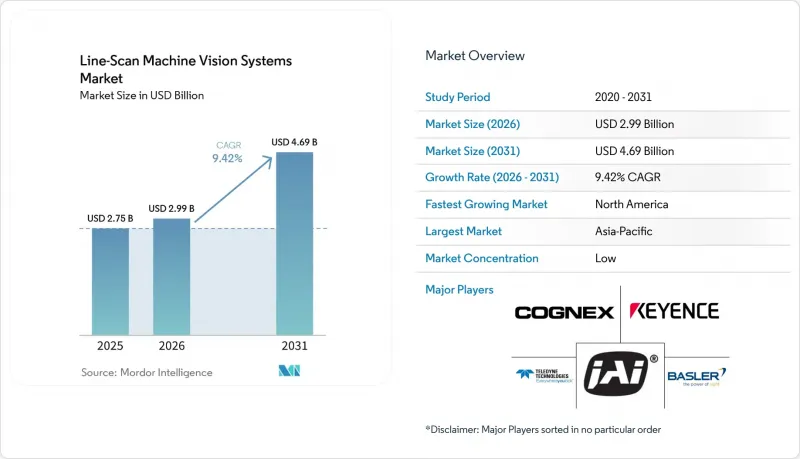
에 따르면 라인 스캔식 머신 비전 시스템 시장 규모는 2025년에 27억 5,000만 달러로 평가되며, 2026년 29억 9,000만 달러에서 2031년까지 46억 9,000만 달러에 달할 것으로 예측되고 있으며, 예측 기간(2026-2031년)에 CAGR은 9.42%에 달할 전망입니다.
전 세계 라인 스캔형 머신 비전 시스템 시장의 동향 및 인사이트
EV 배터리 및 반도체 생산 라인에서의 무결점 검사
배터리 전극 코팅 및 반도체 웨이퍼 검사에서는 모두 비용이 많이 드는 후공정으로 넘어가기 전에 결함을 감지해야 합니다. 이 때문에 많은 시설에서 검사 장비는 단순한 품질 향상을 위한 선택 사항이 아니라 생산상의 필수 요건이 되고 있습니다. 2025년 동료 심사를 거친 연구에 따르면 YOLOv8을 탑재한 배터리 전극 검사 시스템은 분당 30m의 속도로 98.5%의 검출 정확도를 달성한 것으로 보고되었습니다. 또한 같은 연구에서는 오경보율이 0.1% 미만, 결함률이 67% 감소, 품질관리 비용이 81% 절감된 것으로도 보고되었습니다. TSMC는 팹내 비전 기반 결함 분류를 위해 NVIDIA Metropolis 및 TAO Toolkit을 도입하고 있습니다. 새롭고 첨단인 패키징 설계로 인해 새로운 결함 패턴이 발생하고 있으며, 라인 스캔형 머신 비전 시스템 시장에서 TDI 카메라 설정을 반복적으로 변경해야 할 가능성이 있습니다.
연속 웹 제조의 확대
전극 코팅, 플라스틱 필름 압출 성형, 리튬 호일 캘린더 가공 및 제지 공정에서는 라인 속도로 전체 면적을 커버해야 합니다. 라인 스캔 카메라는 소재가 센서 아래를 이동함에 따라 연속적인 이미지를 구성하므로 이 작업에 적합합니다. 자료에 따르면 전극 코팅 속도는 400 m/min, 제지기의 생산 속도는 1,200 m/min을 초과하는 것으로 알려져 있습니다. 또한 인력 검사는 생산량의 5%만 커버할 수 있는 반면, AI가 탑재된 라인 스캔 시스템은 100%를 커버하며 결함 위치를 밀리미터 단위로 기록할 수 있다고 기재되어 있습니다. Procemex사에 따르면 자사의 AI 기반 웹 검사 시스템은 1초당 최대 600건의 결함을 분류할 수 있으며, 고객 현장에서 웹 단선을 최소 50% 감소시켰다고 합니다. 이러한 시스템 도입을 통해 생성되는 데이터는 공정 제어에 대한 의사결정을 지원하며, ‘라인 스캔 머신 비전 시스템 시장’에 소프트웨어 및 서비스의 부가가치를 창출합니다.
라인 스캔 통합 전문가 부족
효과적인 도입을 위해서는 센서, 광학 시스템, 조명, 인코더 동기화, PLC 연결 및 AI 모델 도입에 관한 지식이 필요합니다. 이러한 기술은 일반적으로 단일한 학문적 경로를 통해가 아니라 실무 경험을 통해 습득됩니다. 미국 노동통계국 보고서에 따르면 2026년 3월 기준 제조업 구인 건수는 46만 2,000건이었으며, 채용률은 2.3%였습니다. 본 초안에서는 경험이 풍부한 라인 스캔 통합 기술자를 채용하는 데 9-12주가 소요될 수 있다고 지적하고 있습니다. 시운전 지연은 승인된 검사 능력을 유휴 상태로 만들며, 기대되는 투자 회수를 늦출 우려가 있습니다. 이 문제는 사내에 대규모 프로젝트 팀을 보유하지 않은 식품, 음료, 포장 제조업체에게 더욱 심각해질 수 있습니다.
부문 분석
2025년, PC 기반 플랫폼은 라인 스캔형 머신 비전 시스템 시장 규모의 44.37%를 차지했습니다. 이러한 위상은 반도체, 평판 디스플레이 및 멀티 카메라를 활용한 웹 검사 분야에서 유연한 구성이 요구되고 있음을 반영합니다. 이러한 시스템은 프레임 그래버나 비전 소프트웨어를 통해 조명 시퀀스, 인코더 보정 및 이미지 융합을 조정할 수 있습니다. 또한 개방형 설계 덕분에 GPU 코프로세서나 AI 추론 보드도 지원합니다. 이를 통해 사용자는 핵심 시스템의 설계를 변경하지 않고도 로컬 처리 기능을 추가할 수 있습니다.
접촉형 이미지 센서 시스템은 2031년까지 연평균 성장률(CAGR) 11.28%로 성장할 것으로 예측됩니다. 광범위한 커버리지와 직접 접촉형 구조는 배터리 전극 검사에 적합하며, 평평한 웹에서는 시차 왜곡이 최소화된다는 장점이 있습니다. Teledyne Dalsa는 2026년 5월, 최대 1,800 dpi, 길이 1,500mm의 모델을 추가하여 AxCIS 제품군을 확충했습니다. 이 모델들은 최대 80 kHz의 흑백 라인 레이트와 최대 60 kHz의 네이티브 RGB 3라인 레이트를 지원합니다. 스마트 카메라 시스템은 수 킬로픽셀을 초과하는 출력이 사용 가능한 메모리 대역폭을 초과하는 경우 여전히 제한이 있습니다. 통합형 설계는 표준 카메라와 프레임 그래버 구성으로는 불충분한 특수한 하이퍼스펙트럼 및 멀티스펙트럼 용도에도 대응합니다.
2025년 라인 스캔 머신 비전 시스템 시장에서 표준 라인 스캔이 82.46%를 차지했습니다. 이는 식품, 포장, 물류, 금속 생산에 걸친 웹 검사, 표면 검사, 식별 작업에서 여전히 일반적인 선택지로 자리 잡고 있습니다. 저렴한 단가와 폭넓은 소프트웨어 호환성이 이러한 보급을 지원하고 있습니다. 많은 도입 사례에서 고속 멀티라인 CMOS 센서가 기존의 싱글라인 CCD 설계를 대체하고 있습니다. 이를 통해 TDI 시스템의 복잡성을 증가시키지 않으면서도 감도가 향상됩니다.
TDI 라인 스캔 시장은 2031년까지 연평균 성장률(CAGR) 10.83%로 확대될 것으로 예측됩니다. 첨단 반도체 패키지 검사에서는 조명 조건이 제한될 경우, 다단계 적층을 통한 신호 대 잡음비(S/N비) 향상이 요구됩니다. Teledyne DALSA는 2026년 6월, 1 MHz의 라인 레이트, 8K 해상도, 후면 조사형 TDI 센서, 5μm 픽셀 피치를 갖춘 ‘Linea HS2 8K’를 출시했습니다. 이 제품은 웨이퍼, 고밀도 상호 연결(HDI), 그리고 유전체학용 플로우 셀의 검사를 대상으로 합니다. CCD-TDI에서 sCMOS-TDI로의 전환을 통해 자외선 영역에서의 양자 효율이 향상되어 노출 시간을 단축할 수 있게 되었습니다. 유전체학 및 디지털 병리학은 기존 산업 용도와는 다른 새로운 수요원으로 부상하고 있습니다.
지역별 분석
2025년, 아시아태평양은 라인 스캔형 머신 비전 시스템 시장 점유율의 43.61%를 차지했습니다. 대만은 반도체 생태계에 팹, 장비 공급업체, 통합업체, 검사용 OEM(Original Equipment Manufacturer)가 포함되어 있으며, 중요한 역할을 하고 있습니다. TSMC는 AI 기반 웨이퍼 결함 분류에 NVIDIA의 기술을 채택하고 있습니다. 한국은 삼성과 SK하이닉스의 HBM 및 DRAM 생산 능력 확대에 힘입고 있습니다. 중국은 국내 팹 건설과 전기자동차(EV)용 배터리 공장의 집중을 동시에 갖추고 있습니다. 일본은 정밀 제조 거점 및 국내 전자기기 생산을 통해 여전히 중요한 위치를 차지하고 있습니다.
북미는 2031년까지 연평균 성장률(CAGR) 11.47%로 확대될 것으로 예측되며, 지역별 부문 중 가장 높은 성장률을 보일 것으로 전망됩니다. 2025년 시점에 북미와 유럽은 지역별 블록으로서 2위와 3위의 규모를 차지했습니다. 독일에서는 전기자동차 조립, 배터리 모듈 생산, 그리고 확립된 웹 가공 사업을 통해 수요가 지원되고 있습니다. EU의 배터리 규정에 따라 2024년부터 특정 전기자동차 배터리 카테고리에 대해 추적성 데이터 제출이 의무화됩니다. 이에 따라 표면 결함 데이터와 함께 검사 결과를 기록하는 시스템의 가치가 높아지고 있습니다. 북미의 수요는 반도체의 국내 복귀 및 자동차 생산 분야의 비전 유도형 로봇에 의해 지원되고 있습니다. 코그넥스(Cognex)는 30개국 이상에서 3만 개가 넘는 고객사에 서비스를 제공하고 있으며, 이는 해당 지역이 기술 허브인 동시에 최종사용자 시장으로서의 역할도 수행하고 있음을 입증합니다.
남미, 중동 및 아프리카는 라인 스캔형 머신 비전 시스템 시장에서 점유율은 작지만 성장세가 두드러지는 지역입니다. 브라질은 자동차 제조 및 식품 가공품 수출을 통해 남미의 주요 수요 거점으로 자리 잡고 있습니다. 식품 가공업체들은 이물질 검출 및 포장 무결성 검사에 라인 스캔 장비를 사용하고 있습니다. 사우디아라비아와 아랍에미리트는 산업 자동화에 투자하고 있으며, 전자기기 조립 및 식품 가공 분야의 초기 수요를 지원하고 있습니다. 남아프리카공화국에는 확립된 자동차 조립 거점이 있으며, 1차 공급업체들이 차체 패널 검사에 표준 라인 스캔 구성을 채택하고 있습니다. 이 지역들에서는 인프라가 정비되고 시스템 비용이 낮아짐에 따라 2028년 이후에는 더 높은 해상도의 시스템이 도입될 전망입니다.
기타 혜택:
- 엑셀 형식의 시장 예측(ME) 시트
- 3개월간의 애널리스트 지원
자주 묻는 질문
목차
제1장 서론
- 조사 전제조건과 시장 정의
- 조사 범위
제2장 조사 방법
제3장 개요
제4장 시장 구도
- 시장 개요
- 시장 성장 촉진요인
- 시장 성장 억제요인
- 거시경제 요인이 시장에 미치는 영향
- 업계의 공급망 분석
- 규제 상황
- 기술 전망
- Porter's Five Forces 분석
제5장 시장 규모와 성장 예측
- 시스템 아키텍처별
- 스캔 기술별
- 컬러 구성별
- 인터페이스 및 데이터 전송 규격별
- 용도별
- 최종사용자 산업별
- 지역별
- 북미
- 미국
- 캐나다
- 멕시코
- 남미
- 브라질
- 아르헨티나
- 기타 남미 국가
- 유럽
- 독일
- 영국
- 프랑스
- 이탈리아
- 스페인
- 기타 유럽 국가
- 아시아태평양
- 중국
- 일본
- 인도
- 한국
- 기타 아시아태평양 국가
- 중동 및 아프리카
- 중동
- 사우디아라비아
- 아랍에미리트
- 튀르키예
- 기타 중동 국가
- 아프리카
- 남아프리카공화국
- 나이지리아
- 기타 아프리카 국가
- 중동
- 북미
제6장 경쟁 구도
- 시장 집중도
- 전략적 동향
- 시장 점유율 분석
- 기업 개요
- Basler AG
- Teledyne Technologies Incorporated
- Cognex Corporation
- JAI A/S
- KEYENCE CORPORATION
- Vieworks Co., Ltd.
- Chromasens GmbH
- Nippon Electro-Sensory Devices Corporation
- Allied Vision Technologies GmbH
- IDS Imaging Development Systems GmbH
- Baumer Optronic GmbH
- SVS-Vistek GmbH
- Photonfocus AG
- LUCID Vision Labs Inc.
- Emergent Vision Technologies Inc.
- Alkeria S.r.l.
- Imperx, Inc.
- Raptor Photonics Limited
- OMRON SENTECH CO., LTD.
- Hefei I-TEK OptoElectronics Co., Ltd.
- Hikrobot Technology Co., Ltd.
- CMICRO Corporation
- PCO AG
- Adimec Advanced Image Systems B.V.
제7장 시장 기회와 향후 전망
KSA 26.10.28According to Mordor Intelligence, the Line-Scan machine vision systems market size was valued at USD 2.75 billion in 2025 and is estimated to grow from USD 2.99 billion in 2026 to reach USD 4.69 billion by 2031, at a CAGR of 9.42% during the forecast period (2026-2031).
Global Line-Scan Machine Vision Systems Market Trends and Insights
Zero-Defect Inspection in EV Battery and Semiconductor Lines
Battery electrode coating and semiconductor wafer inspection both require detecting defects before costly downstream processing. This makes inspection equipment a production requirement rather than an optional quality upgrade for many facilities. A 2025 peer-reviewed study reported 98.5% detection accuracy at 30 m/min for a YOLOv8 battery-electrode inspection system. The study also reported a false-alarm rate below 0.1%, a 67% reduction in defect rate, and an 81% reduction in quality-control cost. TSMC is deploying NVIDIA Metropolis and the TAO Toolkit for vision-based defect classification in fabs. New advanced packaging designs create fresh defect patterns, which can require recurring changes to TDI camera configurations in the Line-Scan Machine Vision Systems Market.
Expansion of Continuous-Web Manufacturing
Electrode coating, plastic film extrusion, lithium foil calendering, and paper production require full surface coverage at line speed. Line-scan cameras are suited to this work because they build a continuous image as material moves beneath the sensor. The input identifies electrode coating speeds of 400 m/min and paper machine output above 1,200 m/min. It also states that human inspection may cover 5% of output, while AI-enabled line-scan systems can cover 100% and record defect positions to the millimeter. Procemex states that its AI-based web inspection can classify up to 600 defects per second and has reduced web breaks by at least 50% at client sites. The data created by these installations can support process-control decisions, adding software and service value to the Line-Scan Machine Vision Systems Market.
Shortage of Line-Scan Integration Specialists
Effective deployment requires knowledge of sensors, optics, lighting, encoder synchronization, PLC connections, and AI model deployment. These skills are usually gained through production experience rather than through a single academic path. The U.S. Bureau of Labor Statistics reported 462,000 open manufacturing positions in March 2026 and a 2.3% hire rate. The draft notes that recruiting an experienced production line-scan integrator can take 9 to 12 weeks. Delayed commissioning can leave approved inspection capacity idle and postpone the expected return on investment. The issue can be more difficult for food, beverage, and packaging manufacturers that lack large internal project teams.
Other drivers and restraints analyzed in the detailed report include:
- Adoption of Edge AI for Real-Time Defect Classification
- Higher-Speed Interfaces and Sensor Resolution
- High Total Cost of Ownership for High-Resolution Systems
For complete list of drivers and restraints, kindly check the Table Of Contents.
Segment Analysis
PC-based platforms held 44.37% of the Line-Scan Machine Vision Systems Market size in 2025. Their position reflects the need for flexible configurations in semiconductor, flat-panel display, and multi-camera web inspection. These systems can coordinate lighting sequences, encoder compensation, and image fusion through frame grabbers and vision software. Their open design also accommodates GPU coprocessors and AI inference boards. This allows users to add local processing without replacing the core system design.
Contact Image Sensor systems are projected to grow at an 11.28% CAGR through 2031. Their wide-format coverage and direct contact geometry suit battery electrode inspection, where flat webs benefit from limited perspective distortion. Teledyne DALSA expanded its AxCIS family in May 2026 with models up to 1,800 dpi and 1,500 mm long. The models support monochrome line rates up to 80 kHz and native RGB 3-line rates up to 60 kHz. Smart-camera systems remain limited where multi-kilopixel output exceeds available memory bandwidth. Integrated designs also serve specialized hyperspectral and multispectral work that needs more than a standard camera and frame-grabber arrangement.
Standard line-scan accounted for 82.46% of the Line-Scan Machine Vision Systems Market in 2025. It remains the common choice for web, surface, and identification tasks across food, packaging, logistics, and metals production. Its lower unit cost and broad software compatibility support reach. High-speed multiline CMOS sensors are replacing older single-line CCD designs in many installations. This improves sensitivity while avoiding the added complexity of TDI systems.
TDI line-scan is forecast to expand at a 10.83% CAGR through 2031. Advanced semiconductor packaging inspection needs the signal-to-noise benefits of multi-stage integration when lighting is constrained. Teledyne DALSA released the Linea HS2 8K in June 2026 with a 1 MHz line rate, 8K resolution, a back-side-illuminated TDI sensor, and 5 µm pixel pitch. The product targets wafer, high-density interconnect, and genomics flow-cell inspection. The move from CCD-TDI to sCMOS-TDI improves quantum efficiency in the ultraviolet range and can shorten exposure times. Genomics and digital pathology add smaller sources of demand outside established industrial uses.
Complete Report Scope:
- By System Architecture
- PC-Based Line-Scan Systems
- Smart-Camera and Embedded/Edge-AI Line-Scan Systems
- Contact Image Sensor (CIS) Systems
- Other Integrated Line-Scan Systems
- By Scan Technique
- Standard Line-Scan
- TDI Line-Scan
- By Color Configuration
- Monochrome
- Color
- By Interface and Data-Transfer Standard
- USB3 Vision
- GigE Vision and 5GigE
- 10GigE and 25GigE
- Camera Link and Camera Link HS
- CoaXPress and CoaXPress-over-Fiber
- Proprietary and Hybrid Interfaces
- By Application
- Surface and Web Inspection
- Measurement and Metrology
- Identification, OCR, Barcode and Traceability
- Sorting and Classification
- Vision-Guided Robotics and Positioning
- Process Monitoring and Quality Control
- Other Applications
- Metals and Machinery
- Aerospace and Defense
- By End-User Industry
- Electronics and Semiconductors
- Automotive and EV/Battery
- Food and Beverage Processing
- Packaging and Printing
- Metals, Plastics, Glass and Textiles
- Pharmaceuticals and Medical Devices
- Logistics, Warehousing and E-Commerce
- Solar and Renewable Energy
- Aerospace and Defense
- Other Industrial Manufacturing
- By Geography
- North America
- United States
- Canada
- Mexico
- South America
- Brazil
- Argentina
- Rest of South America
- Europe
- Germany
- United Kingdom
- France
- Italy
- Spain
- Rest of Europe
- Asia-Pacific
- China
- Japan
- India
- South Korea
- Rest of Asia-Pacific
- Middle East and Africa
- Middle East
- Saudi Arabia
- United Arab Emirates
- Turkey
- Rest of the Middle East
- Africa
- South Africa
- Nigeria
- Rest of Africa
- Middle East
- North America
Geography Analysis
Asia-Pacific held 43.61% of the Line-Scan Machine Vision Systems Market share in 2025. Taiwan has a strong role because its semiconductor ecosystem includes fabs, equipment suppliers, integrators, and inspection OEMs. TSMC is using NVIDIA technology for AI-based wafer defect classification. South Korea is supported by Samsung and SK Hynix's capacity expansion in HBM and DRAM. China combines domestic fab construction with a large concentration of EV battery factories. Japan remains important through its precision manufacturing base and domestic electronics production.
North America is forecast to expand at an 11.47% CAGR through 2031, making it the fastest-growing regional segment. North America and Europe were the second- and third-largest regional blocs in 2025. Germany supports demand through EV assembly, battery-module production, and established web-converting activities. The EU Battery Regulation has required traceability data for certain EV battery categories since 2024. This increases the value of systems that log inspection results alongside surface-defect data. North American demand is supported by semiconductor reshoring and vision-guided robotics in automotive production. Cognex serves more than 30,000 customers across more than 30 countries, underscoring the region's role as both a technology hub and an end-user market.
South America, the Middle East, and Africa accounted for a smaller but developing share of the Line-Scan Machine Vision Systems Market. Brazil is the primary South American demand center due to automotive manufacturing and food-processing exports. Food processors use line-scan equipment for foreign-object detection and packaging-integrity checks. Saudi Arabia and the United Arab Emirates are investing in industrial automation, supporting early demand in electronics assembly and food processing. South Africa has an established automotive assembly base with Tier 1 suppliers using standard line-scan configurations for body-panel inspection. These regions are expected to adopt more high-resolution systems from 2028 as infrastructure develops and system costs decrease.
- Basler AG
- Teledyne Technologies Incorporated
- Cognex Corporation
- JAI A/S
- KEYENCE CORPORATION
- Vieworks Co., Ltd.
- Chromasens GmbH
- Nippon Electro-Sensory Devices Corporation
- Allied Vision Technologies GmbH
- IDS Imaging Development Systems GmbH
- Baumer Optronic GmbH
- SVS-Vistek GmbH
- Photonfocus AG
- LUCID Vision Labs Inc.
- Emergent Vision Technologies Inc.
- Alkeria S.r.l.
- Imperx, Inc.
- Raptor Photonics Limited
- OMRON SENTECH CO., LTD.
- Hefei I-TEK OptoElectronics Co., Ltd.
- Hikrobot Technology Co., Ltd.
- CMICRO Corporation
- PCO AG
- Adimec Advanced Image Systems B.V.
Additional Benefits:
- The market estimate (ME) sheet in Excel format
- 3 months of analyst support
TABLE OF CONTENTS
1 INTRODUCTION
- 1.1 Study Assumptions and Market Definition
- 1.2 Scope of the Study
2 RESEARCH METHODOLOGY
3 EXECUTIVE SUMMARY
4 MARKET LANDSCAPE
- 4.1 Market Overview
- 4.2 Market Drivers
- 4.2.1 Zero-Defect Inspection in EV Battery and Semiconductor Lines
- 4.2.2 Expansion of Continuous-Web Manufacturing
- 4.2.3 Adoption of Edge AI for Real-Time Defect Classification
- 4.2.4 Higher-Speed Interfaces and Sensor Resolution
- 4.2.5 Traceability and Quality Compliance in Regulated Production
- 4.2.6 Multispectral Imaging for Material-Level Defect Detection
- 4.3 Market Restraints
- 4.3.1 Shortage of Line-Scan Integration Specialists
- 4.3.2 High Total Cost of Ownership for High-Resolution Systems
- 4.3.3 Interface, Optics, Lighting, and Encoder Compatibility Complexity
- 4.3.4 Export Controls and Supply Volatility for Advanced Sensors
- 4.4 Impact of Macroeconomic Factors on the Market
- 4.5 Industry Supply Chain Analysis
- 4.6 Regulatory Landscape
- 4.7 Technological Outlook
- 4.8 Porter's Five Forces Analysis
- 4.8.1 Bargaining Power of Suppliers
- 4.8.2 Bargaining Power of Buyers
- 4.8.3 Threat of New Entrants
- 4.8.4 Threat of Substitutes
- 4.8.5 Intensity of Competitive Rivalry
5 MARKET SIZE AND GROWTH FORECASTS (VALUE)
- 5.1 By System Architecture
- 5.1.1 PC-Based Line-Scan Systems
- 5.1.2 Smart-Camera and Embedded/Edge-AI Line-Scan Systems
- 5.1.3 Contact Image Sensor (CIS) Systems
- 5.1.4 Other Integrated Line-Scan Systems
- 5.2 By Scan Technique
- 5.2.1 Standard Line-Scan
- 5.2.2 TDI Line-Scan
- 5.3 By Color Configuration
- 5.3.1 Monochrome
- 5.3.2 Color
- 5.4 By Interface and Data-Transfer Standard
- 5.4.1 USB3 Vision
- 5.4.2 GigE Vision and 5GigE
- 5.4.3 10GigE and 25GigE
- 5.4.4 Camera Link and Camera Link HS
- 5.4.5 CoaXPress and CoaXPress-over-Fiber
- 5.4.6 Proprietary and Hybrid Interfaces
- 5.5 By Application
- 5.5.1 Surface and Web Inspection
- 5.5.2 Measurement and Metrology
- 5.5.3 Identification, OCR, Barcode and Traceability
- 5.5.4 Sorting and Classification
- 5.5.5 Vision-Guided Robotics and Positioning
- 5.5.6 Process Monitoring and Quality Control
- 5.5.7 Other Applications
- 5.5.8 Metals and Machinery
- 5.5.9 Aerospace and Defense
- 5.6 By End-User Industry
- 5.6.1 Electronics and Semiconductors
- 5.6.2 Automotive and EV/Battery
- 5.6.3 Food and Beverage Processing
- 5.6.4 Packaging and Printing
- 5.6.5 Metals, Plastics, Glass and Textiles
- 5.6.6 Pharmaceuticals and Medical Devices
- 5.6.7 Logistics, Warehousing and E-Commerce
- 5.6.8 Solar and Renewable Energy
- 5.6.9 Aerospace and Defense
- 5.6.10 Other Industrial Manufacturing
- 5.7 By Geography
- 5.7.1 North America
- 5.7.1.1 United States
- 5.7.1.2 Canada
- 5.7.1.3 Mexico
- 5.7.2 South America
- 5.7.2.1 Brazil
- 5.7.2.2 Argentina
- 5.7.2.3 Rest of South America
- 5.7.3 Europe
- 5.7.3.1 Germany
- 5.7.3.2 United Kingdom
- 5.7.3.3 France
- 5.7.3.4 Italy
- 5.7.3.5 Spain
- 5.7.3.6 Rest of Europe
- 5.7.4 Asia-Pacific
- 5.7.4.1 China
- 5.7.4.2 Japan
- 5.7.4.3 India
- 5.7.4.4 South Korea
- 5.7.4.5 Rest of Asia-Pacific
- 5.7.5 Middle East and Africa
- 5.7.5.1 Middle East
- 5.7.5.1.1 Saudi Arabia
- 5.7.5.1.2 United Arab Emirates
- 5.7.5.1.3 Turkey
- 5.7.5.1.4 Rest of the Middle East
- 5.7.5.2 Africa
- 5.7.5.2.1 South Africa
- 5.7.5.2.2 Nigeria
- 5.7.5.2.3 Rest of Africa
- 5.7.5.1 Middle East
- 5.7.1 North America
6 COMPETITIVE LANDSCAPE
- 6.1 Market Concentration
- 6.2 Strategic Moves
- 6.3 Market Share Analysis
- 6.4 Company Profiles (includes Global Level Overview, Market Level Overview, Core Segments, Financials as available, Strategic Information, Market Rank/Share, Products and Services, Recent Developments)
- 6.4.1 Basler AG
- 6.4.2 Teledyne Technologies Incorporated
- 6.4.3 Cognex Corporation
- 6.4.4 JAI A/S
- 6.4.5 KEYENCE CORPORATION
- 6.4.6 Vieworks Co., Ltd.
- 6.4.7 Chromasens GmbH
- 6.4.8 Nippon Electro-Sensory Devices Corporation
- 6.4.9 Allied Vision Technologies GmbH
- 6.4.10 IDS Imaging Development Systems GmbH
- 6.4.11 Baumer Optronic GmbH
- 6.4.12 SVS-Vistek GmbH
- 6.4.13 Photonfocus AG
- 6.4.14 LUCID Vision Labs Inc.
- 6.4.15 Emergent Vision Technologies Inc.
- 6.4.16 Alkeria S.r.l.
- 6.4.17 Imperx, Inc.
- 6.4.18 Raptor Photonics Limited
- 6.4.19 OMRON SENTECH CO., LTD.
- 6.4.20 Hefei I-TEK OptoElectronics Co., Ltd.
- 6.4.21 Hikrobot Technology Co., Ltd.
- 6.4.22 CMICRO Corporation
- 6.4.23 PCO AG
- 6.4.24 Adimec Advanced Image Systems B.V.
7 MARKET OPPORTUNITIES AND FUTURE OUTLOOK
- 7.1 White-Space and Unmet-Need Assessment


