

|
시장보고서
상품코드
2155230
마이크로셀 플라스틱 : 시장 점유율 분석, 업계 동향과 통계, 성장 예측(2026-2031년)Microcellular Plastics - Market Share Analysis, Industry Trends & Statistics, Growth Forecasts (2026 - 2031) |
||||||
 Mordor Intelligence
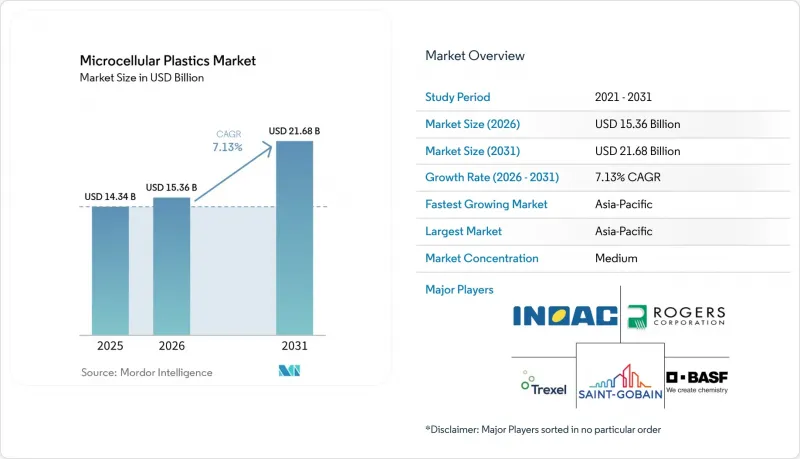
에 따르면 마이크로셀룰러 플라스틱 시장 규모는 2025년에 143억 4,000만 달러로 평가되며, 2026년 153억 6,000만 달러에서 2031년까지 216억 8,000만 달러에 달할 것으로 예측되고 있으며, 예측 기간(2026-2031년)에 CAGR은 7.13%에 달할 전망입니다.
글로벌 마이크로셀룰러 플라스틱 시장의 동향 및 인사이트
자동차 및 전기자동차의 경량화
배터리식 전기자동차는 400-700kg의 배터리 팩을 탑재하고 있으며, 다른 차량 시스템의 경량화 필요성이 높아지고 있습니다. 마이크로셀룰러 발포재의 사출성형을 통해 부품의 밀도를 8%-12% 낮추고, 대형 인테리어 어셈블리의 무게를 20%-30% 줄일 수 있습니다. Trexel사는 K 2025에서 계기판 캐리어, 도어 패널, 센터 콘솔에 대한 적용 사례를 소개했습니다. 2025년에는 전 세계 전기자동차 판매 대수가 1,700만 대를 넘어설 전망이며, 다양한 차종 플랫폼에서의 채택 확대에 따라 경량 성형 부품에 대한 수요도 증가할 것으로 예상됩니다. FORVIA사는 자사의 ‘Microject Advanced’ 공정이 2025년 10월까지 주요 자동차 제조사(OEM)에서 양산 단계에 진입하여, 부품 수명 주기 동안의 이산화탄소 환산 배출량을 최대 50% 감축했다고 발표했습니다. 또한 이 공정을 통해 특정 도장 공정이나 에어백 슈트 채널 공정을 생략할 수 있으므로, 다단계 생산 라인을 보유한 공급업체의 경우 금형 복잡성을 줄일 수 있습니다.
고성능 단열·방음재에 대한 수요
건축물의 에너지 요건으로 인해 단열 성능은 개발업체와 건설업체에게 구매시 중요한 고려 사항이 되고 있습니다. 개정된 ‘건축물의 에너지 성능에 관한 지침’은 회원국들에게 주택의 에너지 성능 향상을 의무화하고, 2030년까지 3,500만 채의 건물 개보수를 지원하기 위한 것입니다. 경질 미세 셀 구조 폴리우레탄 폼은 열전도율 0.022 W/m*K를 달성할 수 있으며, 벽체 시스템이 더 얇은 두께로도 더 엄격한 단열 요건을 충족하는 데 도움이 됩니다. BASF는 2025년 2월, 인도 다헤지에서 ‘Cellasto’ 미세 셀형 폴리우레탄 공장 기공식을 가졌으며, 해당 시설은 2026년 하반기에 가동을 시작할 전망입니다. 이번 투자는 인도 자동차 업계의 소음·진동·승차감(NVH) 대책 용도를 목표로 하고 있습니다.
높은 자재비, 설비비 및 검증 비용
높은 자재비, 설비비 및 검증 비용은 미세 발포 플라스틱 업계에 여전히 시급한 장벽으로 남아 있습니다. 초임계 유체 사출성형 장비에는 기존 성형 플랫폼에서는 필요하지 않은 특수한 스크류, 혼합부 및 압력 제어 하드웨어가 필요합니다. 자동차 업계에서 구조용 미세 발포 부품의 인증에는 대개 18-24개월이 소요되므로, 소규모 2차 공급업체의 경우 운전 자금 수요가 증가하게 됩니다. OEM이 부품을 승인하려면 시험을 통해 소음·진동·거칠기(NVH) 성능, 치수 안정성 및 충돌시 거동을 검증해야 합니다. Moldex3D나 Autodesk Moldflow와 같은 시뮬레이션 툴에는 마이크로셀룰러 성형 공정의 입력 데이터가 필요하지만, 소규모 가공 업체의 경우 해당 데이터를 유지하지 못할 수도 있습니다. ENGEL사가 2025년 10월에 Trexel사를 인수함에 따라 MuCell 하드웨어와 성형기 플랫폼을 연동함으로써 일부 가공업체의 총 소유 비용을 절감할 수 있을 가능성이 있습니다.
부문 분석
폴리우레탄은 2025년 마이크로셀룰러 플라스틱 시장의 28.57% 점유율을 차지하고 있으며, 2031년까지 연평균 성장률(CAGR) 7.86%로 확대될 것으로 예측됩니다. 이러한 위상은 자동차 NVH(소음·진동·불쾌감) 부품, 건축용 단열재, 신발 중창 및 산업용 실에 대한 사용을 반영한 것입니다. BASF의 Cellasto 소재는 소정의 경도와 휨 특성이 요구되는 조인스 범퍼, 탑 마운트, 코일 스프링 아이솔레이터 등에 사용되고 있습니다. 건물 개보수 수요와 자동차의 전동화로 인해 배터리 인클로저 주변 및 차량 실내 공간에서 저밀도 소재에 대한 수요가 증가하고 있습니다. BASF는 2025년 12월, 폴리우레탄 네트워크 내에 잔류하도록 설계되어 차량용 발포재 용도에서 요구되는 저배출 요건을 충족하는 반응성 아민계 촉매 ‘Lupragen N 208’을 출시했습니다.
폴리염화비닐은 내화학성 및 치수 안정성이 중요한 전선·케이블 피복이나 바닥재 분야에서 여전히 중요한 역할을 하고 있습니다. 폴리스티렌의 미세 발포 등급은 보호 포장이나 콜드 체인 물류에 이용되었으나, 일회용 플라스틱 규제로 인해 이러한 용도에는 압박이 가해졌습니다. 폴리카보네이트와 폴리에틸렌 테레프탈레이트는 높은 투명성과 높은 차단성이 요구되는 식품 및 전자기기 포장 용도를 지원했습니다. 폴리에틸렌 테레프탈레이트는 음료 포장 분야에서 이미 채택된 보증금 반환형 재활용 시스템에도 대응 가능합니다. 그 밖의 소재로는 폴리프로필렌, 폴리젖산, 그리고 엔지니어링 열가소성 플라스틱이 포함되었습니다. 세키스이 화학공업의 ‘어드밴셀(Advancell)’ 발포성 마이크로스피어 기술은 폴리염화비닐, 폴리프로필렌, 폴리에틸렌, 열가소성 가황 고무 및 에틸렌·프로필렌·디엔 단량체와 병용이 가능하며, 초임계 유체 장치를 사용하지 않고 매트릭스내 발포를 실현할 수 있는 선택의 폭을 넓혀주고 있습니다. 이러한 소재 옵션을 통해 가공업체는 강성, 완충성, 외관, 재활용성 및 가공 비용 간의 균형을 선택할 수 있습니다.
지역별 분석
아시아태평양은 2025년에 미세 발포 플라스틱 시장의 40.16%를 차지할 것으로 예상되며, 2031년까지 연평균 성장률(CAGR) 8.06%로 확대될 것으로 전망됩니다. 중국의 전기자동차 조립 활동이 배터리 케이스, 시트 프레임 및 계기판용 부품의 인증을 촉진했습니다. 인도의 자동차 및 주택 건설 부문에서는 미세 발포 폴리우레탄 소재에 대한 수요가 증가했습니다. BASF는 2025년 2월 다헤지(Dahheji)에 Cellasto 공장 건설을 시작했으며, 이 공장은 2026년 하반기에 가동을 시작할 것으로 예상됩니다. ARMACELL은 2025년 6월 푸네에 제조 시설을 개설하여 고온 및 극저온 용도의 ArmaGel XG 생산 능력을 확충했습니다. 일본과 한국은 전자기기 실링 및 완충재 분야에서 첨단 가공 기술을 제공했습니다. 세키스이 화학공업의 ‘어드밴셀(Advancell)’ 플랫폼은 양국의 정밀 전자기기 제조업체들에게 중요한 역할을 수행했습니다.
북미와 유럽은 규제에 따라 마이크로셀 플라스틱의 사용 사례가 강화된 성숙한 수요 클러스터였습니다. 미국의 연포장 부문은 연간 매출 415억 달러를 창출했으며, 식품 용도가 수요의 50% 가까이를 차지했습니다. 이러한 기반을 바탕으로, 식품 및 보호 포장 분야에서 소재 절감을 실현할 수 있는 컨버터들에게 마이크로셀 플라스틱 시장 내에서 비즈니스 기회가 창출되고 있습니다. 미국에서는 에너지 효율이 높은 주택 및 상업용 건물에 대한 세제 혜택이 단열재 교체 주기를 촉진했습니다. 독일은 자동차 부품 공급업체의 개발 및 외장 용도 분야에서 여전히 중요한 거점으로 남아 있습니다. 폴비아(Forvia)의 보고서에 따르면 마이크로젝트 첨단(Microject Advanced)는 주요 OEM(Original Equipment Manufacturer)와 양산 단계에 도달했으며, 2025년 10월에는 플라스틱 기술자 협회(SPE)의 혁신상을 수상했습니다. ‘포장 및 포장 폐기물에 관한 규정’과 ‘건축물의 에너지 성능에 관한 지침’에 따라 포장 용도와 건설 용도 모두에서 수요가 연동되게 되었습니다.
남미, 중동 및 아프리카는 미세 발포 플라스틱 시장에서 여전히 수요가 초기 단계에 있는 지역이었습니다. 브라질은 해당 지역에서 가장 발전된 자동차 조립 거점을 보유하고 있으며, 현지화된 차량 플랫폼을 위해 미세 발포 폴리프로필렌 및 폴리우레탄 부품의 인증을 시작했습니다. 아르헨티나를 비롯한 남미 시장에서는 포장 및 건설 용도를 통해 수요에 진입하기가 용이했습니다. NEOM 및 레드시 개발 구역을 포함한 사우디아라비아의 건설 프로젝트는 고온 환경 하의 프로젝트에서 단열재 수요를 지원했습니다. 남아프리카의 광업 및 산업 서비스 분야에서는 방진·밀봉재에 대한 틈새 수요가 발생했습니다. 두 지역 모두 가공 능력과 전문적인 노하우가 제한적이었기 때문에 현지에서의 성형 가공에는 제약이 있었습니다. 그 결과, 단기 수요의 대부분은 현지에서 가공된 발포재보다 수입된 성형 부품이 차지하고 있었으며, 컴파운딩 및 성형 가공에 대한 투자 여지가 남아 있었습니다.
기타 혜택:
- 엑셀 형식의 시장 예측(ME) 시트
- 3개월간의 애널리스트 지원
자주 묻는 질문
목차
제1장 서론
- 조사 전제조건과 시장 정의
- 조사 범위
제2장 조사 방법
제3장 개요
제4장 시장 구도
- 시장 개요
- 시장 성장 촉진요인
- 시장 성장 억제요인
- 밸류체인 분석
- Porter's Five Forces 분석
제5장 시장 규모와 성장 예측
- 소재 유형별
- 폼별
- 최종사용자 산업별
- 지역별
- 아시아태평양
- 중국
- 인도
- 일본
- 한국
- ASEAN 국가
- 기타 아시아태평양 국가
- 북미
- 미국
- 캐나다
- 멕시코
- 유럽
- 독일
- 영국
- 프랑스
- 이탈리아
- 북유럽 국가
- 기타 유럽 국가
- 남미
- 브라질
- 아르헨티나
- 기타 남미 국가
- 중동 및 아프리카
- 사우디아라비아
- 남아프리카공화국
- 기타 중동 및 아프리카 국가
- 아시아태평양
제6장 경쟁 구도
- 시장 집중도
- 전략적 동향
- 시장 점유율·순위 분석
- 기업 개요
- ARMACELL
- BASF
- Borealis AG
- Evonik Industries AG
- Formosa Plastics Corporation
- General Plastics Manufacturing Company
- INEOS
- INOAC CORPORATION
- LyondellBasell Industries N.V.
- Rogers Corporation
- Saint-Gobain
- Sekisui Chemical Co., Ltd.
- Trexel
제7장 시장 기회와 향후 전망
KSA 26.10.28According to Mordor Intelligence, the microcellular plastics market size was valued at USD 14.34 billion in 2025 and is estimated to grow from USD 15.36 billion in 2026 to reach USD 21.68 billion by 2031, at a CAGR of 7.13% during the forecast period (2026-2031).
Global Microcellular Plastics Market Trends and Insights
Automotive and Electric-Vehicle Lightweighting
Battery electric vehicles carry battery packs weighing 400-700 kg, increasing the need to reduce mass in other vehicle systems. Microcellular foam injection molding can lower component density by 8%-12% and reduce the weight of larger interior assemblies by 20%-30%. Trexel described applications for instrument panel carriers, door panels, and center consoles at K 2025. Global electric-vehicle sales exceeded 17 million units in 2025, and broader use across vehicle platforms can expand demand for lightweight molded parts. FORVIA stated that its Microject Advanced process was in serial production with leading original equipment manufacturers by October 2025 and reduced a part's lifetime carbon dioxide equivalent emissions by up to 50%. The process can also remove certain painting and airbag chute-channel steps, reducing tooling complexity for suppliers with multistep production lines.
Demand for High-Performance Thermal and Acoustic Insulation
Building energy requirements are making insulation performance a purchasing consideration for developers and contractors. The revised Energy Performance of Buildings Directive required member states to improve the energy performance of residential buildings and supported the renovation of 35 million buildings by 2030. Rigid microcellular polyurethane foam can reach thermal conductivity of 0.022 W/m*K, helping wall systems meet tighter thermal requirements with less thickness. BASF broke ground on a Cellasto microcellular polyurethane plant in Dahej, India, in February 2025, and the facility is expected to operate in the second half of 2026. The investment targets automotive noise, vibration, and harshness applications in India's vehicle sector.
High Material, Equipment, and Validation Costs
High material, equipment, and validation costs remain an immediate barrier for the microcellular plastics industry. Supercritical-fluid injection units need specialized screws, mixing sections, and pressure-control hardware that conventional molding platforms do not require. Automotive qualification for structural microcellular parts often takes 18-24 months, increasing the working-capital requirement for smaller Tier-2 suppliers. Testing must address noise, vibration, and harshness performance, dimensional stability, and crash behavior before an original equipment manufacturer can approve a component. Simulation tools such as Moldex3D and Autodesk Moldflow require microcellular process inputs that smaller processors may not maintain. ENGEL's October 2025 acquisition of Trexel could reduce total ownership cost for some processors by connecting MuCell hardware with machine platforms.
Other drivers and restraints analyzed in the detailed report include:
- Material Reduction and Carbon-Intensity Benefits
- Expansion of Sustainable Food and Protective Packaging
- Limited Processing Capacity and Specialist Know-How
For complete list of drivers and restraints, kindly check the Table Of Contents.
Segment Analysis
Polyurethane held 28.57% of the microcellular plastics market share in 2025 and is projected to expand at a 7.86% CAGR through 2031. Its position reflects use in automotive noise, vibration, and harshness components, building insulation, footwear midsoles, and industrial seals. BASF's Cellasto materials are used in jounce bumpers, top mounts, and coil spring isolators, where defined hardness and deflection behavior are required. Building renovation requirements and vehicle electrification support demand for low-density materials near battery enclosures and within vehicle interiors. BASF introduced Lupragen N 208 in December 2025, a reactive amine catalyst designed to remain in the polyurethane network and address low-emission requirements in interior foam applications.
Polyvinyl chloride retained relevance in wire and cable jacketing and flooring, where chemical resistance and dimensional stability are important. Polystyrene microcellular grades served protective packaging and cold-chain logistics, although the single-use plastics regulation created pressure on these applications. Polycarbonate and polyethylene terephthalate supported high-clarity and high-barrier food and electronics packaging applications. Polyethylene terephthalate can also fit deposit-return recycling systems that are already used for beverage packaging. Other materials included polypropylene, polylactic acid, and engineering thermoplastics. Sekisui Chemical's Advancell expandable microsphere technology can be used with polyvinyl chloride, polypropylene, polyethylene, thermoplastic vulcanizate, and ethylene propylene diene monomer, widening access to in-matrix foaming without supercritical-fluid equipment. These material options let processors select a balance of stiffness, cushioning, appearance, recyclability, and processing cost.
Complete Report Scope:
- By Material Type
- Polyurethane
- Polyvinyl Chloride
- Polystyrene
- Polycarbonate
- Polyethylene Terephthalate
- Others
- By Form
- Rigid Microcellular Plastics
- Flexible Microcellular Plastics
- Others
- By End-User Industry
- Food Packaging
- Automotive and Transportation
- Building and Construction
- Healthcare
- Electrical and Electronics
- Other End-User Industries
- By Geography
- Asia-Pacific
- China
- India
- Japan
- South Korea
- ASEAN Countries
- Rest of Asia-Pacific
- North America
- United States
- Canada
- Mexico
- Europe
- Germany
- United Kingdom
- France
- Italy
- NORDIC Countries
- Rest of Europe
- South America
- Brazil
- Argentina
- Rest of South America
- Middle East and Africa
- Saudi Arabia
- South Africa
- Rest of Middle East and Africa
- Asia-Pacific
Geography Analysis
Asia-Pacific held 40.16% of the microcellular plastics market share in 2025 and is projected to advance at an 8.06% CAGR through 2031. China's electric-vehicle assembly activity supported the qualification of components for battery enclosures, seat frames, and instrument panels. India's automotive and residential construction sectors increased demand for microcellular polyurethane materials. BASF began construction of its Dahej Cellasto plant in February 2025, and the plant is expected to operate in the second half of 2026. ARMACELL opened a manufacturing facility in Pune in June 2025, adding ArmaGel XG production capacity for high-temperature and cryogenic service. Japan and South Korea contributed advanced processing capabilities for electronics sealing and cushioning. Sekisui's Advancell platform was relevant to precision electronics manufacturers in both countries.
North America and Europe represented mature demand clusters where regulation strengthened the use case for microcellular plastics. The U.S. flexible packaging sector generated USD 41.5 billion in annual sales, and food applications accounted for nearly 50% of demand. This base creates an opportunity within the microcellular plastics market for converters that can achieve material savings in food and protective packaging. U.S. tax incentives for energy-efficient homes and commercial buildings supported insulation upgrade cycles. Germany remained an important location for automotive supplier development and visible-surface applications. FORVIA reported that Microject Advanced had reached serial production with leading original equipment manufacturers and had won a Society of Plastics Engineers innovation award in October 2025. The Packaging and Packaging Waste Regulation and the Energy Performance of Buildings Directive created aligned demand across packaging and construction applications.
South America and Middle East and Africa remained earlier-stage demand regions in the microcellular plastics market. Brazil had the region's most developed automotive assembly base and began qualifying microcellular polypropylene and polyurethane parts for localized vehicle platforms. Argentina and other South American markets were more accessible through packaging and construction applications. Saudi Arabia's construction pipeline, including NEOM and Red Sea development zones, supported demand for insulation in high-temperature projects. South Africa's mining and industrial services activities created niche demand for vibration-damping and sealing materials. Limited processing capacity and specialist know-how constrained local conversion in both regions. Imported fabricated parts, therefore, accounted for more near-term demand than locally processed foam, leaving an opening for compounding and conversion investment.
- ARMACELL
- BASF
- Borealis AG
- Evonik Industries AG
- Formosa Plastics Corporation
- General Plastics Manufacturing Company
- INEOS
- INOAC CORPORATION
- LyondellBasell Industries N.V.
- Rogers Corporation
- Saint-Gobain
- Sekisui Chemical Co., Ltd.
- Trexel
Additional Benefits:
- The market estimate (ME) sheet in Excel format
- 3 months of analyst support
TABLE OF CONTENTS
1 Introduction
- 1.1 Study Assumptions and Market Definition
- 1.2 Scope of the Study
2 Research Methodology
3 Executive Summary
4 Market Landscape
- 4.1 Market Overview
- 4.2 Market Drivers
- 4.2.1 Automotive and Electric-Vehicle Lightweighting
- 4.2.2 Demand for High-Performance Thermal and Acoustic Insulation
- 4.2.3 Material Reduction and Carbon-Intensity Benefits
- 4.2.4 Expansion of Sustainable Food and Protective Packaging
- 4.2.5 OEM Integration of Physical Foaming Equipment
- 4.3 Market Restraints
- 4.3.1 High Material, Equipment, and Validation Costs
- 4.3.2 Limited Processing Capacity and Specialist Know-How
- 4.3.3 Surface-Finish and Dimensional-Consistency Risk
- 4.4 Value Chain Analysis
- 4.5 Porter's Five Forces Analysis
- 4.5.1 Bargaining Power of Suppliers
- 4.5.2 Bargaining Power of Buyers
- 4.5.3 Threat of New Entrants
- 4.5.4 Threat of Substitutes
- 4.5.5 Competitive Rivalry
5 Market Size and Growth Forecasts (Value)
- 5.1 By Material Type
- 5.1.1 Polyurethane
- 5.1.2 Polyvinyl Chloride
- 5.1.3 Polystyrene
- 5.1.4 Polycarbonate
- 5.1.5 Polyethylene Terephthalate
- 5.1.6 Others
- 5.2 By Form
- 5.2.1 Rigid Microcellular Plastics
- 5.2.2 Flexible Microcellular Plastics
- 5.2.3 Others
- 5.3 By End-User Industry
- 5.3.1 Food Packaging
- 5.3.2 Automotive and Transportation
- 5.3.3 Building and Construction
- 5.3.4 Healthcare
- 5.3.5 Electrical and Electronics
- 5.3.6 Other End-User Industries
- 5.4 By Geography
- 5.4.1 Asia-Pacific
- 5.4.1.1 China
- 5.4.1.2 India
- 5.4.1.3 Japan
- 5.4.1.4 South Korea
- 5.4.1.5 ASEAN Countries
- 5.4.1.6 Rest of Asia-Pacific
- 5.4.2 North America
- 5.4.2.1 United States
- 5.4.2.2 Canada
- 5.4.2.3 Mexico
- 5.4.3 Europe
- 5.4.3.1 Germany
- 5.4.3.2 United Kingdom
- 5.4.3.3 France
- 5.4.3.4 Italy
- 5.4.3.5 NORDIC Countries
- 5.4.3.6 Rest of Europe
- 5.4.4 South America
- 5.4.4.1 Brazil
- 5.4.4.2 Argentina
- 5.4.4.3 Rest of South America
- 5.4.5 Middle East and Africa
- 5.4.5.1 Saudi Arabia
- 5.4.5.2 South Africa
- 5.4.5.3 Rest of Middle East and Africa
- 5.4.1 Asia-Pacific
6 Competitive Landscape
- 6.1 Market Concentration
- 6.2 Strategic Moves
- 6.3 Market Share (%)/Ranking Analysis
- 6.4 Company Profiles (includes Global Overview, Market Overview, Core Segments, Financials as available, Strategic Information, Products and Services, and Recent Developments)
- 6.4.1 ARMACELL
- 6.4.2 BASF
- 6.4.3 Borealis AG
- 6.4.4 Evonik Industries AG
- 6.4.5 Formosa Plastics Corporation
- 6.4.6 General Plastics Manufacturing Company
- 6.4.7 INEOS
- 6.4.8 INOAC CORPORATION
- 6.4.9 LyondellBasell Industries N.V.
- 6.4.10 Rogers Corporation
- 6.4.11 Saint-Gobain
- 6.4.12 Sekisui Chemical Co., Ltd.
- 6.4.13 Trexel
7 Market Opportunities and Future Outlook
- 7.1 White-Space and Unmet-Need Assessment


