

|
시장보고서
상품코드
2155260
독일의 전기자동차 CNC 선반 : 시장 점유율 분석, 업계 동향과 통계, 성장 예측(2026-2031년)Germany Electric Vehicle CNC Turning - Market Share Analysis, Industry Trends & Statistics, Growth Forecasts (2026 - 2031) |
||||||
 Mordor Intelligence
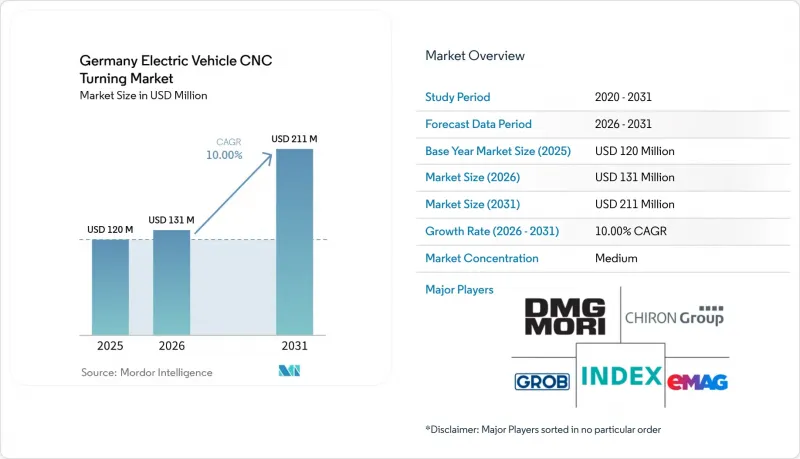
에 따르면 독일의 전기자동차용 CNC 선반 시장 규모는 2025년 1억 2,000만 달러, 2026년 1억 3,100만 달러에서 2031년까지 2억 1,100만 달러로 확대될 것으로 예측되고 있으며, 2026-2031년까지 연평균 성장률(CAGR)은 10%에 달할 전망입니다.
독일 전기자동차용 CNC 선반 시장의 동향 및 인사이트
고급 전기자동차(EV) 생산이 초정밀 선반 센터에 대한 수요를 가속화
독일의 고급차 제조 거점은 엄격한 형상 및 표면 마감 요건을 충족할 수 있는 선반 센터에 대한 수요를 지원하고 있습니다. 메르세데스-벤츠는 2026년 6월, 베를린 마리엔펠데 공장에서 축류형 전기 모터의 양산을 시작했습니다. 이 제조 공정에는 전 세계에서 새로 개발된 35개의 공정을 포함한 98개의 정밀 제조 공정이 채택되었습니다. 조립 공정에서는 실시간 품질관리를 통해 고정자의 위치 정밀도를 0.1mm 이내로 유지하고 있으며, 이에 따라 관련 부품의 정밀 가공에 대한 수요가 증가하고 있습니다. 독일의 전기자동차용 CNC 선반 시장은 모터 샤프트, 하우징 및 기타 정밀 부품을 제조하기 위한 다이렉트 드라이브 스핀들과 열 제어에 대한 공급업체의 수요로 인해 호황을 누리고 있습니다. BMW 뮌헨 공장은 2026년에 ‘노이에 클라세’의 프리시리즈 생산을 시작하고, 2026년 하반기에는 본격적인 양산을 시작할 예정이며, 이를 통해 구동계 장비 및 생산 시스템을 위한 새로운 조달 주기가 형성될 것입니다. BMW는 이러한 재설계된 생산 방식을 통해 차량당 제조 비용을 10% 절감할 수 있을 것으로 전망하고 있으며, 이에 따라 세팅 횟수를 줄이면서 여러 공정을 결합한 기계의 가치가 높아질 것입니다.
자동차의 전동화가 고성능 가공에 대한 투자를 촉진
자동차의 전동화로 인해 독일의 기계 가공 시설에서 처리되는 부품의 구성이 변화하고 있습니다. 독일에서는 2025년에 122만 대의 배터리식 전기자동차가 생산되었으나, 2026년에는 전기자동차 생산 대수가 176만 대에 달할 것으로 예상됩니다. E-액슬 하우징에는 얇은 두께의 알루미늄 구조에 대한 정밀 기계 가공이 요구되며, 로터 샤프트에는 여러 단계의 고정밀 선삭 공정이 필요합니다. 따라서 독일의 전기자동차용 CNC 선반 시장은 단순히 많은 내연기관용 가공 라인을 전용하는 것만으로는 충족할 수 없는 요구 사항에 대응하고 있습니다. ZF사는 2025년, 확장된 자르브뤼켄 공장에서 전동 액슬 구동 시스템의 양산을 시작했으며, 이로 인해 전동 액슬 하우징 및 감속기 샤프트에 대한 수요가 증가했습니다. EU의 차량 배기가스 규제는 각 OEM사의 제품 계획을 저배기가스 차량으로 지속적으로 유도하고 있으며, 이는 전동 드라이브트레인의 생산 능력에 대한 지속적인 투자를 지원하고 있습니다.
높은 에너지 비용과 운영 비용이 제조 비용을 상승시키고 있습니다.
에너지 비용의 급등으로 인해 중소 제조업체들의 CNC 설비 증설 의지가 위축되고 있습니다. 2026년 6월 DIHK 조사에 따르면 전기 요금과 가스 가격 상승이 독일 산업 기업의 40% 가까이에게 경쟁사와의 경쟁에 대한 직접적인 우려 사항으로 드러났습니다. 또한 같은 조사에서 산업 기업의 3곳 중 1곳이 핵심 생산 공정에 대한 투자를 연기하고 있는 것으로 밝혀졌습니다. 고속 CNC 선반은 가동 중에 막대한 전력을 필요로 하는 경우가 있으며, 에너지 효율은 투자 결정에 있으며, 중요한 요소가 됩니다. 독일의 전기자동차용 CNC 선반 시장에서는 대형 OEM 업체들이 전략적인 전동화 프로그램을 지속할 수 있는 반면, 중소규모의 수탁제조업체들은 자본 계획을 신중하게 재검토하고 있으며, 구매층이 양극화되고 있습니다. 또한 EU 에너지 효율 지침에 따라 에너지 감사 및 효율 요건이 부과됨에 따라 대규모 산업 사용자에게는 계획 수립 및 규정 준수 대응 부담이 증가하고 있습니다.
부문 분석
2025년, 독일의 전기자동차용 CNC 선반 시장에서 수평형 CNC 선반은 38.3%의 점유율을 차지했습니다. 이러한 위상은 모터 샤프트, 베어링 레이스, 로터 링 등의 대량 생산에 적합함을 반영합니다. 독일의 1차 공급업체들은 대개 이러한 기계를 자동화된 다교대 체제로 가동하고 있습니다. 수직형 CNC 선반은 대구경 하우징이나 디스크형 부품, 특히 얇은 두께의 알루미늄으로 제작된 eAxle 하우징 등에 적합하며, 이러한 부품의 경우 공작물의 안정적인 위치 결정이 최종 형상에 영향을 미칠 수 있습니다.
스위스형 CNC 선반은 커넥터, 패스너, 그리고 배터리 관리 및 전력 전자 어셈블리에 사용되는 핀형 부품 등 소경 부품의 가공에 적합합니다. 이러한 부품에는 0.005 mm 미만의 공차가 요구되는 경우가 있으며, 가공 조건의 관리가 점점 더 중요해지고 있습니다. 독일의 전기자동차용 CNC 선반 시장에서 선삭 및 밀링 가공을 겸용하는 멀티태스크 선반·밀링 가공 센터 시장 규모는 2026-2031년에 연평균 성장률(CAGR) 12%로 확대될 것으로 예측됩니다. 한 번의 세팅으로 일체형 eAxle 하우징의 선삭, 밀링, 드릴링, 나사 연삭을 완료할 수 있으므로, 각 공정 간의 위치 정렬 오차를 줄일 수 있습니다. INDEX-Werke사는 2026년 3월, 중량산 제조업체를 위한 컴팩트한 G 시리즈 모델로 5축 선반·밀링 가공 센터 ‘G160’을 출시했습니다. DMG MORI사는 2025년 9월 ‘NTX 3세대’를 발표하며, 전기자동차 제조를 주요 적용 분야로 제시했습니다.
기타 혜택:
- 엑셀 형식의 시장 예측(ME) 시트
- 3개월간의 애널리스트 지원
자주 묻는 질문
목차
제1장 서론
- 조사 전제조건과 시장 정의
- 조사 범위
제2장 조사 방법
제3장 개요
- 시장 상황 개요(2025년 대 2031년)
- 부문별 주요 조사 결과
- 투자 주목 분야와 미개발 분야
제4장 시장 구도
- 시장 개요
- 시장 성장 촉진요인
- 시장 성장 억제요인
- 시장의 기회
- EV 제조 밸류체인 분석
- 제조 프로세스 분석
- 무역 동향과 관세의 영향 분석
- 규제 상황
- 기술 동향
- AI와 디지털 제조가 CNC 선반 가공에 미치는 영향
- 시장에 대한 지정학적 영향
제5장 시장 규모 및 성장 예측(금액 : 달러)
- 기계 유형별
- 컴포넌트별 용도별
- 최종사용자별
제6장 경쟁 구도
- Market Structure
- Strategic Developments(2022-2026)
- New Product Launches
- Automation Partnerships
- EV Manufacturing Projects
- Capacity Expansion
- Acquisitions
- Digital Manufacturing Collaborations
- 시장 점유율 분석
- 기업 개요
- INDEX-Werke GmbH & Co. KG Hahn & Tessky
- EMAG GmbH & Co. KG
- DMG MORI AG
- CHIRON Group SE
- GROB-WERKE GmbH & Co. KG
- HELLER Maschinenfabrik GmbH
- SW Maschinen GmbH
- Spinner Werkzeugmaschinenfabrik GmbH
- TRAUB Werkzeugmaschinen GmbH
- NILES-SIMMONS Industrieanlagen GmbH
- MAG IAS GmbH
- Starrag GmbH
- Mazak Europe N.V.
- Okuma Europe GmbH
- Haas Automation Europe
- DN Solutions Europe GmbH
- Tsugami Europe GmbH
- Citizen Machinery Europe GmbH
- Star Micronics GmbH
- GF Machining Solutions GmbH
제7장 시장 기회와 향후 전망
KSAAccording to Mordor Intelligence, the Germany electric vehicle CNC turning market size is projected to expand from USD 120 million in 2025 and USD 131 million in 2026 to USD 211 million by 2031, registering a CAGR of 10% between 2026 and 2031.
Germany Electric Vehicle CNC Turning Market Trends and Insights
Premium EV Manufacturing Accelerates Demand for Ultra-Precision Turning Centers
Germany's premium vehicle manufacturing base supports demand for turning centers capable of meeting strict geometry and surface-finish requirements. Mercedes-Benz began series production of its axial-flux electric motor at Berlin-Marienfelde in June 2026, using 98 precision manufacturing steps, including 35 processes newly developed worldwide. The assembly process maintains stator positioning within 0.1 mm through real-time quality controls, which raises the need for accurate machining of related components. The German electric-vehicle CNC turning market benefits from suppliers' need for direct-drive spindles and thermal control to manufacture motor shafts, housings, and other precision parts. BMW Plant Munich entered pre-series production for the Neue Klasse in 2026 and plans full series production in the second half of 2026, creating a new procurement cycle for drivetrain equipment and production systems. BMW expects the redesigned production approach to reduce manufacturing costs per vehicle by 10%, which increases the value of machines that combine multiple processes in fewer setups.
Automotive Electrification Strengthens Investment in High-Performance Machining
Automotive electrification is changing the component mix processed by German machining facilities. Germany produced 1.22 million battery electric vehicles in 2025, while electrified vehicle production is expected to reach 1.76 million units in 2026. E-axle housings require controlled machining of thin-wall aluminum structures, and rotor shafts require several hard-turning steps. The Germany electric vehicle CNC turning market therefore serves requirements that cannot be met through simple reuse of many internal-combustion machining lines. ZF started series production of electric axle-drive variants at its expanded Saarbrucken facility in 2025, thereby increasing demand for e-axle housings and reduction gear shafts. EU fleet-emissions rules continue to direct OEM product plans toward lower-emission vehicles, supporting continued investment in electric drivetrain capacity.
High Energy and Operating Costs Increase Manufacturing Expenses
Energy costs limit smaller manufacturers' willingness to add CNC capacity. A June 2026 DIHK survey found that rising electricity and gas prices were a direct competitiveness concern for nearly 40% of German industrial enterprises. The same survey found that 1 in 3 industrial enterprises had deferred investment in core production processes. High-speed CNC turning centers can require substantial power during operation, making energy efficiency a material part of the investment case. The Germany electric vehicle CNC turning market faces a divided buyer base because large OEMs can continue strategic electrification programs while smaller contract manufacturers review capital plans more carefully. Energy audits and efficiency requirements also add planning and compliance work for larger industrial users under the EU Energy Efficiency Directive.
Other drivers and restraints analyzed in the detailed report include:
- Industry 4.0 and Smart Factory Adoption Enhance CNC Automation
- Growing Production of Electric Drivetrain Components Expands Turning Operations
- Shortage of Skilled CNC Operators and Automation Engineers
For complete list of drivers and restraints, kindly check the Table Of Contents.
Segment Analysis
Horizontal CNC turning centers held 38.3% of the Germany electric vehicle CNC turning market share in 2025. Their position reflects their suitability for high-volume production of motor shafts, bearing races, and rotor rings. German Tier-1 suppliers often operate these machines in automated, multi-shift configurations. Vertical CNC turning centers are well-suited to large-bore housings and disk-shaped parts, including thin-walled aluminum e-axle housings, where stable workpiece positioning can influence the final geometry.
Swiss-type CNC turning centers serve small-diameter parts, including connectors, fasteners, and pin-type components used in battery-management and power-electronics assemblies. These parts can require tolerances below 0.005 mm, increasing the importance of controlled machining conditions. The Germany electric vehicle CNC turning market size for multi-tasking turn-mill centers is projected to grow at a 12% CAGR between 2026 and 2031. A single setup can complete turning, milling, drilling, and thread grinding for integrated e-axle housings, reducing alignment errors between operations. INDEX-Werke introduced the G160 5-axis turn-mill center in March 2026 as a compact G-series model for mid-volume producers. DMG MORI introduced the NTX 3rd Generation in September 2025 and identified electric vehicle manufacturing as a target application.
Complete Report Scope:
- By Machine Type
- Horizontal CNC Turning Centers
- Vertical CNC Turning Centers
- Multi-Tasking Turn-Mill Centers
- Swiss-Type CNC Turning Centers
- Others
- By Component Application
- Electric Motor Components
- E-Axles & Transmission Components
- Battery System Components
- Others
- By End User
- EV OEM Manufacturing Plants
- Tier-1 Automotive Suppliers
- Tier-2 Component Manufacturers
- Precision Contract Manufacturers
List of Companies Covered in this Report:
- INDEX-Werke GmbH & Co. KG Hahn & Tessky
- EMAG GmbH & Co. KG
- DMG MORI AG
- CHIRON Group SE
- GROB-WERKE GmbH & Co. KG
- HELLER Maschinenfabrik GmbH
- SW Maschinen GmbH
- Spinner Werkzeugmaschinenfabrik GmbH
- TRAUB Werkzeugmaschinen GmbH
- NILES-SIMMONS Industrieanlagen GmbH
- MAG IAS GmbH
- Starrag GmbH
- Mazak Europe N.V.
- Okuma Europe GmbH
- Haas Automation Europe
- DN Solutions Europe GmbH
- Tsugami Europe GmbH
- Citizen Machinery Europe GmbH
- Star Micronics GmbH
- GF Machining Solutions GmbH
Additional Benefits:
- The market estimate (ME) sheet in Excel format
- 3 months of analyst support
TABLE OF CONTENTS
1 Introduction
- 1.1 Study Assumptions & Market Definition
- 1.2 Scope of the Study
2 Research Methodology
3 Executive Summary
- 3.1 Market Snapshot (2025 vs. 2031)
- 3.2 Key Findings by Segment
- 3.3 Investment Hotspots & White Space
4 Market Landscape
- 4.1 Market Overview
- 4.1.1 Role of CNC Turning Centers in the EV Manufacturing Value Chain
- 4.1.2 Evolution from ICE Component Machining to EV-Specific Machining Requirements
- 4.2 Market Drivers
- 4.2.1 Premium EV Manufacturing Accelerates Demand for Ultra-Precision Turning Centers
- 4.2.2 Automotive Electrification Strengthens Investment in High-Performance Machining
- 4.2.3 Industry 4.0 and Smart Factory Adoption Enhance CNC Automation
- 4.2.4 Growing Production of Electric Drivetrain Components Expands Turning Operations
- 4.2.5 German Machine Tool Innovation Supports High-Speed Multi-Axis Manufacturing
- 4.2.6 Rising Export of Precision Automotive Components Drives Advanced CNC Deployment
- 4.3 Market Restraints
- 4.3.1 High Energy and Operating Costs Increase Manufacturing Expenses
- 4.3.2 Economic Uncertainty Delays Capital Investment in New Machine Tools
- 4.3.3 Shortage of Skilled CNC Operators and Automation Engineers
- 4.3.4 Lengthy Procurement Cycles for High-End Precision Equipment
- 4.4 Market Opportunities
- 4.4.1 Battery Cell and Power Electronics Manufacturing Creates New Machining Demand
- 4.4.2 AI-Based Process Optimization Improves CNC Productivity and Quality
- 4.4.3 Lightweight EV Component Manufacturing Expands High-Precision Turning Applications
- 4.4.4 Nearshoring of European Automotive Supply Chains Encourages CNC Capacity Expansion
- 4.5 EV Manufacturing Value Chain Analysis
- 4.5.1 Raw Material Suppliers
- 4.5.2 Machine Tool Manufacturers
- 4.5.3 EV Component Manufacturers
- 4.5.4 EV OEMs
- 4.6 Manufacturing Process Analysis
- 4.6.1 Machine Selection by Production Volume
- 4.6.2 Prototype vs. Mass Production Requirements
- 4.7 Trade Flow & Tariff Impact Analysis
- 4.7.1 Key Machine Tool Export & Import Corridors
- 4.7.2 Regional Sourcing Shifts & Localization Trends
- 4.8 Regulatory Landscape
- 4.8.1 Manufacturing Incentives for EV Production
- 4.8.2 Local Content Requirements
- 4.8.3 Smart Manufacturing Policies
- 4.8.4 Energy Efficiency Regulations for Machine Tools
- 4.9 Technology Landscape
- 4.9.1 Multi-Tasking Turn-Mill Centers
- 4.9.2 AI-Based Tool Wear Monitoring
- 4.9.3 Digital Twin Integration
- 4.9.4 Robot Automation
- 4.10 Impact of AI & Digital Manufacturing on CNC Turning
- 4.11 Geopolitical Impact on Market
5 Market Size & Growth Forecasts Value (USD)
- 5.1 By Machine Type
- 5.1.1 Horizontal CNC Turning Centers
- 5.1.2 Vertical CNC Turning Centers
- 5.1.3 Multi-Tasking Turn-Mill Centers
- 5.1.4 Swiss-Type CNC Turning Centers
- 5.1.5 Others
- 5.2 By Component Application
- 5.2.1 Electric Motor Components
- 5.2.2 E-Axles & Transmission Components
- 5.2.3 Battery System Components
- 5.2.4 Others
- 5.3 By End User
- 5.3.1 EV OEM Manufacturing Plants
- 5.3.2 Tier-1 Automotive Suppliers
- 5.3.3 Tier-2 Component Manufacturers
- 5.3.4 Precision Contract Manufacturers
6 Competitive Landscape
- 6.1 Market Structure
- 6.2 Strategic Developments (2022-2026)
- 6.2.1 New Product Launches
- 6.2.2 Automation Partnerships
- 6.2.3 EV Manufacturing Projects
- 6.2.4 Capacity Expansion
- 6.2.5 Acquisitions
- 6.2.6 Digital Manufacturing Collaborations
- 6.3 Market Share Analysis
- 6.4 Company Profiles
- 6.4.1 INDEX-Werke GmbH & Co. KG Hahn & Tessky
- 6.4.2 EMAG GmbH & Co. KG
- 6.4.3 DMG MORI AG
- 6.4.4 CHIRON Group SE
- 6.4.5 GROB-WERKE GmbH & Co. KG
- 6.4.6 HELLER Maschinenfabrik GmbH
- 6.4.7 SW Maschinen GmbH
- 6.4.8 Spinner Werkzeugmaschinenfabrik GmbH
- 6.4.9 TRAUB Werkzeugmaschinen GmbH
- 6.4.10 NILES-SIMMONS Industrieanlagen GmbH
- 6.4.11 MAG IAS GmbH
- 6.4.12 Starrag GmbH
- 6.4.13 Mazak Europe N.V.
- 6.4.14 Okuma Europe GmbH
- 6.4.15 Haas Automation Europe
- 6.4.16 DN Solutions Europe GmbH
- 6.4.17 Tsugami Europe GmbH
- 6.4.18 Citizen Machinery Europe GmbH
- 6.4.19 Star Micronics GmbH
- 6.4.20 GF Machining Solutions GmbH
7 Market Opportunities & Future Outlook
- 7.1 White-Space Assessment
- 7.1.1 Emerging EV Manufacturing Hubs
- 7.1.2 Tier-2 Suppliers
- 7.1.3 Precision Machining for Next-Generation E-Mobility
- 7.1.4 AI-Driven Autonomous Machining
- 7.2 Strategic Recommendations


