

|
시장보고서
상품코드
2155304
비전 기반 로봇 안전 시스템 : 시장 점유율 분석, 업계 동향과 통계, 성장 예측(2026-2031년)Vision-Based Robot Safety Systems - Market Share Analysis, Industry Trends & Statistics, Growth Forecasts (2026 - 2031) |
||||||
 Mordor Intelligence
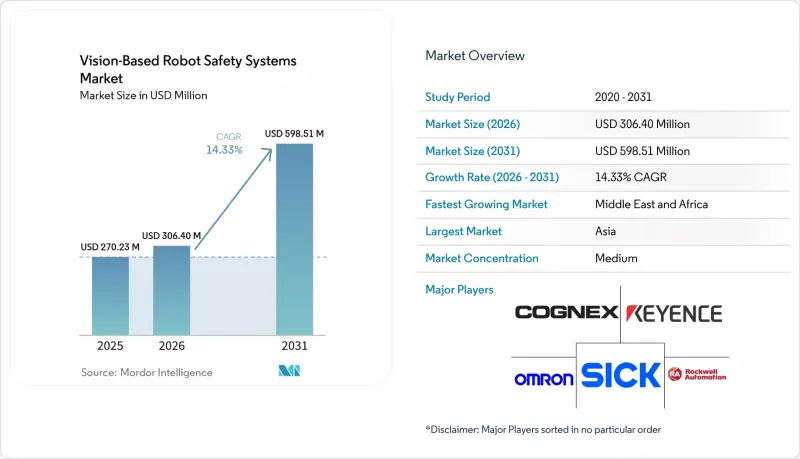
에 따르면 비전 기반 로봇 안전 시스템 시장 규모는 2025년 2억 7,023만 달러에서 2026년에는 3억 640만 달러로 확대하며, 2026-2031년에 CAGR 14.33%로 추이하며, 2031년까지 5억 9,851만 달러에 달할 것으로 예측됩니다.
전 세계 비전 기반 로봇 안전 시스템 시장의 동향 및 인사이트
AI, 엣지 컴퓨팅, 3D 지각의 통합이 안전 아키텍처를 혁신
고정된 보호 구역에서 변화하는 사람이나 로봇의 경로를 대응할 수 없는 경우, 엣지 기반 AI 비전은 품질 검사 영역에서 안전 계층으로 전환되고 있습니다. 2025년 IEEE 연구에 따르면 LiDAR, RGB 및 열화상 입력을 결합한 시스템은 초당 28-35프레임으로 92.3%의 탐지 정확도와 88.5%의 평균 정확도를 달성한 것으로 보고되었습니다. 코그넥스는 2026년 5월, 퀄컴의 Dragonwing 프로세서를 탑재하여 이전 세대 모델에 비해 최대 4배의 처리 속도를 실현한 ‘In-Sight 3900’을 출시했습니다. 또한 2026년 4월에는 고부하 로컬 워크로드를 처리하기 위해 NVIDIA Jetson을 탑재한 ‘In-Sight 6900’ 컨트롤러도 출시했습니다. 따라서 비전 기반 로봇 안전 시스템 시장에서는 문서화되고 인증된 시스템 동작을 유지하면서 지연 시간을 줄일 수 있는 공급업체가 우위를 점하게 됩니다. 모델 업데이트에는 도입 전에 안전성 검증이 여전히 필요하므로 업데이트 관리는 처리 성능과 마찬가지로 중요합니다.
협동 로봇의 워크셀 확대로 인해 접촉 구역에 노출되는 경우가 증가
협동 로봇은 하나의 고정된 셀 경계 대신 여러 개의 작고 변화하는 보호 구역을 생성합니다. 2024년 현재, 전 세계 산업용 로봇 가동 대수는 466만 4,000대에 달하며, 공간이 제한된 생산 환경에서 로봇 활용 확대를 지원하고 있습니다. SICK사와 Universal Robots사는 ‘End-of-Arm Safeguard’를 개발했습니다. 이는 워크셀의 점유 면적을 확대하는 대신, 공구 주위에 가동식 보호 영역을 형성하는 방식입니다. 워크셀이 소형화되고 다양화됨에 따라 각 설치에 대한 검증 비용이 증가합니다. 이에 따라 비전 기반 로봇 안전 시스템 시장에서 맞춤형 엔지니어링 부담이 적은 사전 인증 모듈에 대한 수요가 높아지고 있습니다. 또한 검증된 통합 패키지를 보유한 공급업체에게는 소규모 공장으로의 진출 경로가 더욱 명확해집니다.
기능 안전 검증 및 인증에 드는 막대한 비용이 통합 업체의 이익률을 압박
새로운 비전 기반 제품의 기능 안전 인증에는 하드웨어와 소프트웨어의 공동 인증이 필요한 경우, 12-18개월이 소요되며 50만 달러 이상의 비용이 들 수 있습니다. 이 비용은 중소규모 통합업체에게 지나치게 큰 부담입니다. Pilz사는 이종 시스템 간의 안전 통신을 위해 TÜV 인증을 획득한 ‘SEC2 Safety Ethernet Connection’ 기능 블록을 출시했습니다. 이 제품은 ISO 13849의 성능 수준 e 및 IEC 61508의 안전 무결성 수준 3 요건을 충족합니다. 일부 사용자는 대신 인증을 받지 않은 AI 비전을 모니터링 용도로 사용하는 경우가 있으며, 이 경우 규정 준수 여부가 불확실한 상태로 남게 됩니다. 따라서 기반 기술이 성숙해 있더라도 인증에 소요되는 비용과 기간으로 인해 비전 기반 로봇 안전 시스템 시장의 상용화 속도가 제한될 가능성이 있습니다.
부문 분석
2025년에는 ‘사람 존재 감지’가 27.71%로 가장 큰 점유율을 차지하며, 공유 작업 공간내 비전 기반 로봇 안전 시스템 수요의 핵심을 이루고 있습니다. 작업자의 위치 변화나 로봇의 의도된 동작에 대해 다른 보호 기능이 적절히 대응하기 위해서는 신뢰성 높은 감지가 필수적입니다. 속도 및 간격 모니터링, 안전 구역 감지, 충돌 감지는 복잡한 시설 내의 다층적 안전 설계에서 일반적으로 결합되어 사용됩니다. 이러한 기능들은 협동 로봇, 고정식 산업용 로봇, 그리고 작업자 근처에서 작동하는 이동식 플랫폼을 둘러싼 다양한 위험에 대처하기 위한 것입니다.
‘안전한 내비게이션 및 경로 모니터링’ 시장은 2031년까지 연평균 성장률(CAGR) 18.23%로 확대될 것으로 예측됩니다. 이러한 성장은 구역을 사전에 완벽하게 매핑할 수 없고, 보행자 경로와 확실하게 분리할 수도 없는 개방형 공간을 이동하는 이동 플랫폼의 운영을 반영한 것입니다. 2025년 'Frontiers in Robotics and AI' 저널의 조사에 따르면 엣지에 배치된 물류 로봇의 경우 150밀리초 미만의 지연 시간으로 88%의 장애물 회피 성공률이 보고되었습니다. 그 밖의 기능으로는 히트맵, 적재물 감지, 자세 분석 등이 있습니다. 이러한 기능들은 안전 감사나 공정 감사시 인체공학적 적합성이 검증되기도 하는 제약 생산 및 항공우주 분야의 조립 공정에서 그 중요성이 커지고 있습니다. 따라서 비전 기반 로봇 안전 시스템 시장은 위험 감지에 그치지 않고, 현장 고유의 운영 절차를 지원하는 보다 전문적인 워크플레이스 관리로 확대될 가능성이 있습니다.
2025년 기준, 3D 스테레오 비전은 비전 기반 로봇 안전 시스템 시장 점유율의 28.93%를 차지했습니다. 이러한 위상은 신뢰할 수 있는 깊이 정보, 결정론적 기하학적 출력, 그리고 자동차 화이트 바디 및 대형 부품 조립 셀에서의 오랜 도입 실적을 반영합니다. 구조화된 광 3D 비전 및 비행 시간(ToF) 센서도 다양한 작동 거리에서 정확한 깊이 측정이 필요한 용도에 대응하고 있습니다. SICK사는 2026년 4월, 설정 가능한 3차원 보호 영역을 갖춘 안전 인증을 받은 3D 비행 시간(ToF) 센서 ‘safeVisionary2’를 출시했습니다.
AI 및 딥러닝 비전 시장은 2031년까지 연평균 성장률(CAGR) 21.78%로 확대될 것으로 예측됩니다. 이 기술은 단순히 움직임이나 센서와의 거리를 측정할 뿐만 아니라, 물체를 유형별로 분류하고 보행자와 정지된 카트를 구별할 수 있습니다. 2025년 'Applied Sciences' 저널의 리뷰에서는 협동 로봇 공학 분야의 활발한 연구 분야로 멀티모달 센서 융합과 설명 가능한 AI가 꼽혔습니다. 설명 가능성은 안전 검증 및 후속 시스템 감사 과정에서 예측 가능한 동작에 대한 우려를 해소하는 데 도움이 됩니다. 2D 안전 비전은 통제된 환경이나 비용 효율성이 중시되는 환경에서 여전히 유용합니다. 그러나 깊이 인식을 필요로 하는 보호 영역이 필요한 공작 기계의 가드 용도에서 3차원 대체 기술의 활용이 점점 더 쉬워짐에 따라 2D 안전 비전의 상대적 위상은 위축되고 있습니다.
지역별 분석
2025년, 아시아태평양은 비전 기반 로봇 안전 시스템 시장 점유율의 37.41%를 차지했습니다. 중국에서는 2024년에 29만 5,000대의 산업용 로봇이 도입되었으며, 이는 전 세계 도입 대수의 54%에 해당하지만, 중국 시장에서는 국내 제조사가 57%를 차지했습니다. 일본에서는 2024년 가동 대수가 45만 500대로 전년 대비 3% 증가했습니다. 또한 한국에서는 2019년 이후 연간 도입 대수가 3만 1,000대 전후로 유지되고 있습니다. 인도에서는 2024년에 사상 최대인 9,100대의 산업용 로봇이 도입되었으며, 그중 45%가 자동차 업계에서 도입한 것이었습니다. 도입 대수의 증가와 ISO 10218 규격 준수에 힘입어, 이 지역 전체에서 국제 인증을 받은 안전 플랫폼에 대한 수요가 지원되고 있습니다.
2025년, 북미와 유럽은 도입 대수 측면에서 각각 2위와 3위를 차지한 지역 블록이 되었습니다. 독일에서는 2024년에 2만 6,982대의 로봇이 도입되어 전년 대비 8% 감소했으나, 유럽 전체 도입 대수의 32%를 차지했습니다. 유럽연합(EU)의 기계 규정 2023/1230에 따라 자율형 및 AI 탑재 기계에 대한 요건이 강화되면서, 자동차 및 공작기계 제조 시설에서 업그레이드의 필요성이 대두되고 있습니다. 북미에서는 2024년에 5만 100대의 로봇이 도입되었으며, 그중 미국이 3만 4,200대를 차지하며 지역 전체의 68%를 차지했습니다. 네트워크 격리 및 소프트웨어 무결성에 관한 요건 또한 현재의 사이버 보안 기준을 충족하도록 설계되지 않은 구형 안전 설비의 업데이트를 촉진하고 있습니다.
중동 및 아프리카는 2031년까지 연평균 성장률(CAGR) 15.56%로 확대될 것으로 예측되며, 이는 ‘비전 기반 로봇 안전 시스템 시장’에서 가장 높은 지역 성장률입니다. ‘사우디 비전 2030’ 및 아랍에미리트(UAE)의 ‘국가 산업 전략’은 제조 역량, 물류 허브, 창고 자동화 및 전용 모바일 로봇의 운영을 지원하고 있습니다. 신규 시설의 경우, 나중에 추가하는 것이 아니라 설계 단계에서 안전 시스템을 통합할 수 있으며, AMR 운영을 초기부터 계획함으로써 시스템의 가치를 더욱 높일 수 있습니다. 남미는 여전히 시장 규모가 작으며, 브라질과 아르헨티나가 지역내 도입 대수의 대부분을 차지하고 있지만, 멕시코에서는 연간 4%의 감소세가 나타났음에도 불구하고 2024년에는 5,600대의 로봇이 도입되었습니다.
기타 혜택:
- 엑셀 형식의 시장 예측(ME) 시트
- 3개월간의 애널리스트 지원
자주 묻는 질문
목차
제1장 서론
- 조사 전제조건과 시장 정의
- 조사 범위
제2장 조사 방법
제3장 개요
제4장 시장 구도
- 시장 개요
- 시장 성장 촉진요인
- 시장 성장 억제요인
- 거시경제 요인이 시장에 미치는 영향
- 업계의 공급망 분석
- 규제 상황
- 기술 전망
- Porter's Five Forces 분석
제5장 시장 규모와 성장 예측
- 안전 기능별
- 비전 기술별
- 로봇 유형별
- 최종사용자 산업별
- 지역별
- 북미
- 미국
- 캐나다
- 멕시코
- 남미
- 브라질
- 아르헨티나
- 기타 남미 국가
- 유럽
- 독일
- 영국
- 프랑스
- 이탈리아
- 스페인
- 기타 유럽 국가
- 아시아태평양
- 중국
- 일본
- 인도
- 한국
- 기타 아시아태평양 국가
- 중동 및 아프리카
- 중동
- 사우디아라비아
- 아랍에미리트
- 튀르키예
- 기타 중동 국가
- 아프리카
- 남아프리카공화국
- 나이지리아
- 기타 아프리카 국가
- 중동
- 북미
제6장 경쟁 구도
- 시장 집중도
- 전략적 동향
- 시장 점유율 분석
- 기업 개요
- Balluff GmbH
- Banner Engineering Corp.
- Basler AG
- Cognex Corporation
- DENSO CORPORATION
- FANUC CORPORATION
- Hans TURCK GmbH & Co. KG
- Hokuyo Automatic Co., Ltd.
- IDEC Corporation
- ifm electronic GmbH
- KEYENCE CORPORATION
- KUKA AG
- Leuze electronic GmbH+Co. KG
- OMRON Corporation
- Panasonic Holdings Corporation
- Pepperl+Fuchs SE
- Pilz GmbH & Co. KG
- Rockwell Automation, Inc.
- SICK AG
- Schneider Electric SE
- Teledyne Technologies Incorporated
- Universal Robots A/S
- Yaskawa Electric Corporation
제7장 시장 기회와 향후 전망
KSA 26.10.28According to Mordor Intelligence, the Vision-Based robot safety systems market size is expected to expand from USD 270.23 million in 2025 to USD 306.40 million in 2026, and is forecast to reach USD 598.51 million by 2031, at a 14.33% CAGR over 2026-2031.
Global Vision-Based Robot Safety Systems Market Trends and Insights
Integration of AI, Edge Computing, and 3D Perception Reshapes Safety Architecture
Edge-based AI vision is moving from quality inspection into the safety layer when fixed protective zones cannot account for changing human and robot paths. A 2025 IEEE study reported 92.3% detection precision and 88.5% mean average precision from a system combining LiDAR, RGB, and thermal inputs at 28 to 35 frames per second. Cognex launched the In-Sight 3900 in May 2026 with Qualcomm Dragonwing processing and up to 4X faster processing than its predecessor. It also launched the NVIDIA Jetson-powered In-Sight 6900 controller in April 2026 for demanding local workloads. The Vision-Based Robot Safety Systems Market, therefore, favors suppliers that reduce latency while maintaining documented, certified system behavior. Model updates still require safety validation before deployment, which makes update management as important as processing performance.
Expansion of Collaborative Robot Workcells Multiplies Contact-Zone Exposure
Collaborative robots create several small and changing protective zones instead of one fixed cell perimeter. The global operating stock of industrial robots reached 4.664 million units in 2024, supporting wider use of robots in constrained production settings. SICK and Universal Robots developed the End-of-Arm Safeguard, which creates a moving protective field around the tool rather than increasing the workcell footprint. Smaller, more varied workcells increase the cost of validating each installation. This supports demand in the Vision-Based Robot Safety Systems Market for pre-certified modules that require less custom engineering. It also gives suppliers with proven integration packages a clearer route into smaller factories.
High Functional Safety Validation and Certification Costs Compress Integrator Margins
Functional safety certification for a new vision-based product can take 12 to 18 months and cost more than USD 500,000 when hardware and software require joint certification. This expense is difficult for small and mid-sized integrators to absorb. Pilz released its TUV-certified SEC2 Safety Ethernet Connection function block for safety communication across heterogeneous systems. The product supports ISO 13849 Performance Level e and IEC 61508 Safety Integrity Level 3 requirements. Some users may instead place uncertified AI vision in a monitoring role, leaving compliance uncertain. The cost and duration of certification can therefore limit the commercial pace of the Vision-Based Robot Safety Systems Market, even where the underlying technology is mature.
Other drivers and restraints analyzed in the detailed report include:
- Growth of Autonomous Mobile Robots in Warehouses Creates Perpetual Safety Perimeter Demand
- Stricter Functional Safety and Machine Safety Requirements Raise the Certification Floor
- Integration Complexity Across Legacy Robot Controllers and Safety PLCs Slows Brownfield Adoption
For complete list of drivers and restraints, kindly check the Table Of Contents.
Segment Analysis
Human Presence Detection held the largest share at 27.71% in 2025, making it a core part of demand for Vision-Based Robot Safety Systems in shared workspaces. Reliable detection is necessary before other protective functions can respond appropriately to changing worker positions and intended robot motion. Speed and Separation Monitoring, safety zone detection, and collision detection are commonly combined in layered safety designs across complex facilities. These functions address different risks around collaborative equipment, fixed industrial robots, and mobile platforms operating near workers.
Safe Navigation and Path Monitoring is forecast to expand at an 18.23% CAGR through 2031. Its growth reflects mobile platforms operating through open floors where zones cannot be fully pre-mapped or reliably separated from pedestrian routes. A 2025 Frontiers in Robotics and AI study reported 88% obstacle avoidance success with sub-150-millisecond latency for an edge-deployed logistics robot. Other functions include heat mapping, load detection, and posture analysis. These functions have gained relevance in pharmaceutical production and aerospace assembly, where ergonomic compliance may be reviewed during safety and process audits. The Vision-Based Robot Safety Systems Market can therefore extend beyond hazard detection to more specialized workplace controls that support site-specific operating procedures.
3D Stereo Vision accounted for 28.93% of the Vision-Based Robot Safety Systems Market share in 2025. Its position reflects dependable depth information, deterministic geometric output, and long integration experience in automotive body-in-white and heavy-component assembly cells. Structured-light 3D vision and time-of-flight sensors also address applications that need accurate depth measurement in varying working distances. SICK launched the safeVisionary2 in April 2026 as a safety-certified 3D time-of-flight sensor with configurable three-dimensional protective fields.
AI and Deep-Learning Vision is forecast to expand at a 21.78% CAGR through 2031. It can classify objects by type, distinguishing a pedestrian from a stationary cart instead of simply measuring movement or distance from the sensing device. A 2025 Applied Sciences review identified multimodal sensor fusion and explainable AI as active research areas in collaborative robotics. Explainability can help address concerns about predictable behavior during safety validation and subsequent system audits. Two-dimensional safety vision remains useful in controlled and cost-sensitive settings. Its relative position is under pressure as three-dimensional alternatives become more accessible for machine-tool guarding applications requiring depth-aware protective fields.
Complete Report Scope:
- By Safety Function
- Human Presence Detection
- Speed and Separation Monitoring (SSM)
- Safety Zone / Intrusion Detection
- Collision / Proximity Detection
- Safe Navigation and Path Monitoring
- Other Safety Functions
- By Vision Technology
- 2D Safety Vision
- 3D Stereo Vision
- Structured-Light 3D Vision
- Time-of-Flight (ToF)
- AI / Deep-Learning Vision
- Other Vision Technologies
- By Robot Type
- Industrial Robots
- Collaborative Robots (Cobots)
- Mobile Robots (AMRs/AGVs)
- Industrial Mobile Manipulators
- Other Robot Types
- By End-User Industry
- Automotive and Mobility
- Electronics and Semiconductors
- General Manufacturing
- Food and Beverage
- Pharmaceutical and Medical Devices
- Logistics and Warehousing
- Aerospace and Defense
- Other End-User Industries
- By Geography
- North America
- United States
- Canada
- Mexico
- South America
- Brazil
- Argentina
- Rest of South America
- Europe
- Germany
- United Kingdom
- France
- Italy
- Spain
- Rest of Europe
- Asia-Pacific
- China
- Japan
- India
- South Korea
- Rest of Asia-Pacific
- Middle East and Africa
- Middle East
- Saudi Arabia
- United Arab Emirates
- Turkey
- Rest of the Middle East
- Africa
- South Africa
- Nigeria
- Rest of Africa
- Middle East
- North America
Geography Analysis
Asia-Pacific held 37.41% of the Vision-Based Robot Safety Systems Market share in 2025. China installed 295,000 industrial robots in 2024, representing 54% of global deployments, while domestic manufacturers accounted for 57% of the Chinese market. Japan operated a stock of 450,500 units in 2024, up 3% from the prior year, and South Korea maintained annual installations near 31,000 units since 2019. India installed a record 9,100 industrial robots in 2024, with automotive accounting for 45% of those deployments. Growing deployments and alignment with ISO 10218 provisions support demand for internationally certified safety platforms across the region.
North America and Europe were the second- and third-largest geographic blocs in 2025. Germany installed 26,982 robots in 2024, accounting for 32% of European installations, despite an 8% decline from the prior year. The European Union Machinery Regulation 2023/1230 tightens requirements for autonomous and AI-enabled machinery, creating upgrade needs in automotive and machine-tool facilities. North America installed 50,100 robots in 2024, and the United States accounted for 34,200 units, or 68% of the regional total. Network isolation and software integrity requirements also encourage the replacement of older safety installations that were not designed to meet current cybersecurity expectations.
The Middle East and Africa are forecast to expand at a 15.56% CAGR through 2031, the fastest regional rate in the Vision-Based Robot Safety Systems Market. Saudi Vision 2030 and the United Arab Emirates National Industry Strategy support manufacturing capacity, logistics hubs, warehouse automation, and purpose-built mobile robot operations. Greenfield facilities can specify safety systems during design rather than adding them later, supporting greater system value when AMR operations are planned from the start. South America remains smaller, with Brazil and Argentina holding most regional installations, while Mexico installed 5,600 robots in 2024 despite a 4% annual decline.
- Balluff GmbH
- Banner Engineering Corp.
- Basler AG
- Cognex Corporation
- DENSO CORPORATION
- FANUC CORPORATION
- Hans TURCK GmbH & Co. KG
- Hokuyo Automatic Co., Ltd.
- IDEC Corporation
- ifm electronic GmbH
- KEYENCE CORPORATION
- KUKA AG
- Leuze electronic GmbH + Co. KG
- OMRON Corporation
- Panasonic Holdings Corporation
- Pepperl+Fuchs SE
- Pilz GmbH & Co. KG
- Rockwell Automation, Inc.
- SICK AG
- Schneider Electric SE
- Teledyne Technologies Incorporated
- Universal Robots A/S
- Yaskawa Electric Corporation
Additional Benefits:
- The market estimate (ME) sheet in Excel format
- 3 months of analyst support
TABLE OF CONTENTS
1 INTRODUCTION
- 1.1 Study Assumptions and Market Definition
- 1.2 Scope of the Study
2 RESEARCH METHODOLOGY
3 EXECUTIVE SUMMARY
4 MARKET LANDSCAPE
- 4.1 Market Overview
- 4.2 Market Drivers
- 4.2.1 Expansion of Collaborative Robot Workcells
- 4.2.2 Growth of Autonomous Mobile Robots in Warehouses
- 4.2.3 Stricter Functional Safety and Machine Safety Requirements
- 4.2.4 Integration of AI, Edge Computing, and 3D Perception
- 4.2.5 Brownfield Retrofit Demand for Vision-Based Protection
- 4.2.6 Safety Data Integration With Industrial Automation Platforms
- 4.3 Market Restraints
- 4.3.1 High Functional Safety Validation and Certification Costs
- 4.3.2 Integration Complexity Across Legacy Robot Controllers and Safety PLCs
- 4.3.3 Performance Degradation Under Low-Light, Occlusion, and Contamination Conditions
- 4.3.4 Limited Availability of Safety-Validated Industrial AI Training Data
- 4.4 Impact of Macroeconomic Factors on the Market
- 4.5 Industry Supply Chain Analysis
- 4.6 Regulatory Landscape
- 4.7 Technological Outlook
- 4.8 Porter's Five Forces Analysis
- 4.8.1 Bargaining Power of Suppliers
- 4.8.2 Bargaining Power of Buyers
- 4.8.3 Threat of New Entrants
- 4.8.4 Threat of Substitutes
- 4.8.5 Intensity of Competitive Rivalry
5 MARKET SIZE AND GROWTH FORECASTS (VALUE)
- 5.1 By Safety Function
- 5.1.1 Human Presence Detection
- 5.1.2 Speed and Separation Monitoring (SSM)
- 5.1.3 Safety Zone / Intrusion Detection
- 5.1.4 Collision / Proximity Detection
- 5.1.5 Safe Navigation and Path Monitoring
- 5.1.6 Other Safety Functions
- 5.2 By Vision Technology
- 5.2.1 2D Safety Vision
- 5.2.2 3D Stereo Vision
- 5.2.3 Structured-Light 3D Vision
- 5.2.4 Time-of-Flight (ToF)
- 5.2.5 AI / Deep-Learning Vision
- 5.2.6 Other Vision Technologies
- 5.3 By Robot Type
- 5.3.1 Industrial Robots
- 5.3.2 Collaborative Robots (Cobots)
- 5.3.3 Mobile Robots (AMRs/AGVs)
- 5.3.4 Industrial Mobile Manipulators
- 5.3.5 Other Robot Types
- 5.4 By End-User Industry
- 5.4.1 Automotive and Mobility
- 5.4.2 Electronics and Semiconductors
- 5.4.3 General Manufacturing
- 5.4.4 Food and Beverage
- 5.4.5 Pharmaceutical and Medical Devices
- 5.4.6 Logistics and Warehousing
- 5.4.7 Aerospace and Defense
- 5.4.8 Other End-User Industries
- 5.5 By Geography
- 5.5.1 North America
- 5.5.1.1 United States
- 5.5.1.2 Canada
- 5.5.1.3 Mexico
- 5.5.2 South America
- 5.5.2.1 Brazil
- 5.5.2.2 Argentina
- 5.5.2.3 Rest of South America
- 5.5.3 Europe
- 5.5.3.1 Germany
- 5.5.3.2 United Kingdom
- 5.5.3.3 France
- 5.5.3.4 Italy
- 5.5.3.5 Spain
- 5.5.3.6 Rest of Europe
- 5.5.4 Asia-Pacific
- 5.5.4.1 China
- 5.5.4.2 Japan
- 5.5.4.3 India
- 5.5.4.4 South Korea
- 5.5.4.5 Rest of Asia-Pacific
- 5.5.5 Middle East and Africa
- 5.5.5.1 Middle East
- 5.5.5.1.1 Saudi Arabia
- 5.5.5.1.2 United Arab Emirates
- 5.5.5.1.3 Turkey
- 5.5.5.1.4 Rest of the Middle East
- 5.5.5.2 Africa
- 5.5.5.2.1 South Africa
- 5.5.5.2.2 Nigeria
- 5.5.5.2.3 Rest of Africa
- 5.5.5.1 Middle East
- 5.5.1 North America
6 COMPETITIVE LANDSCAPE
- 6.1 Market Concentration
- 6.2 Strategic Moves
- 6.3 Market Share Analysis
- 6.4 Company Profiles (includes Global Level Overview, Market Level Overview, Core Segments, Financials as available, Strategic Information, Market Rank/Share, Products and Services, Recent Developments)
- 6.4.1 Balluff GmbH
- 6.4.2 Banner Engineering Corp.
- 6.4.3 Basler AG
- 6.4.4 Cognex Corporation
- 6.4.5 DENSO CORPORATION
- 6.4.6 FANUC CORPORATION
- 6.4.7 Hans TURCK GmbH & Co. KG
- 6.4.8 Hokuyo Automatic Co., Ltd.
- 6.4.9 IDEC Corporation
- 6.4.10 ifm electronic GmbH
- 6.4.11 KEYENCE CORPORATION
- 6.4.12 KUKA AG
- 6.4.13 Leuze electronic GmbH + Co. KG
- 6.4.14 OMRON Corporation
- 6.4.15 Panasonic Holdings Corporation
- 6.4.16 Pepperl+Fuchs SE
- 6.4.17 Pilz GmbH & Co. KG
- 6.4.18 Rockwell Automation, Inc.
- 6.4.19 SICK AG
- 6.4.20 Schneider Electric SE
- 6.4.21 Teledyne Technologies Incorporated
- 6.4.22 Universal Robots A/S
- 6.4.23 Yaskawa Electric Corporation
7 MARKET OPPORTUNITIES AND FUTURE OUTLOOK
- 7.1 White-Space and Unmet-Need Assessment


