

|
시장보고서
상품코드
2155323
구조화광 프로젝터 : 시장 점유율 분석, 업계 동향과 통계, 성장 예측(2026-2031년)Structured Light Projector - Market Share Analysis, Industry Trends & Statistics, Growth Forecasts (2026 - 2031) |
||||||
 Mordor Intelligence
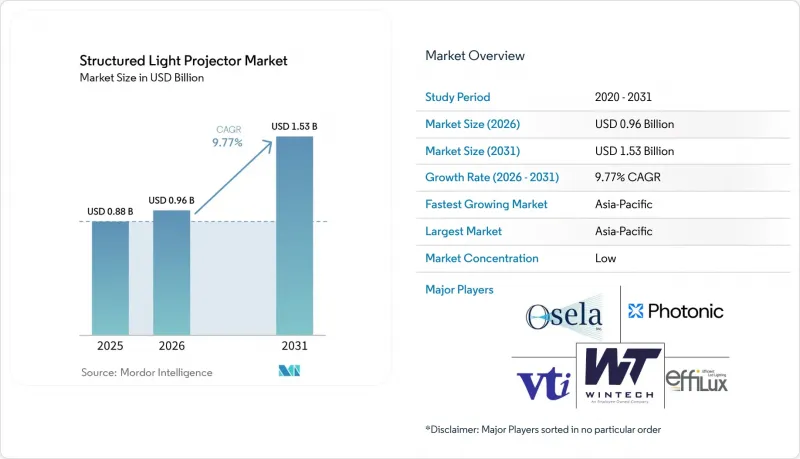
에 따르면 구조화광 프로젝터 시장 규모는 2025년에 8억 8,000만 달러, 2026년에 9억 6,000만 달러로, 2031년까지 15억 3,000만 달러에 달할 것으로 예측되고 있으며, 2026-2031년에 CAGR 9.77%로 확대할 것으로 전망되고 있습니다.
전 세계 구조화광 프로젝터 시장의 동향 및 인사이트
산업용 자동화 및 인라인 3D 검사에 대한 도입
혼합 모델 조립 라인에서는 컨베이어 작업을 지연시키지 않으면서 신속한 형상 검증이 요구됩니다. 접촉식 계측으로는 동등한 검사 빈도를 실현할 수 없으며, 각 생산 단계에서 비접촉 방식으로 전체 영역을 커버하는 측정 방법을 제공할 수 없기 때문에 이러한 요구 사항이 구조화 광 프로젝터에 대한 수요를 지원하고 있습니다. IEEE가 발표한 2025년 프레임워크에 따르면 3D 구조화 광 프로파일링 및 에지 분석을 통해 리튬이온 배터리의 연속 제조 공정에서 코팅 균일성, 캘린더 가공의 완전성, 전극 정렬 및 용접 품질을 모니터링할 수 있는 것으로 나타났습니다. 설치된 센서에서 전송되는 데이터 스트림은 공정 제어 및 최종 품질 검사를 지원하며, 생산 팀에 편차가 처음 발생한 지점에 대한 보다 명확한 기록을 제공합니다. 이러한 광범위한 역할 덕분에 이 장치는 독립적인 검사 스테이션이 아닌 생산 기계의 일부로 통합될 가능성이 있습니다.
차폐된 작업 공간에서 고밀도의 심도 데이터가 필요한 로봇 공학
로봇을 이용한 빈 피킹이나 협업 로봇의 유도에는 물건으로 가득 찬 작업 영역에서 신뢰할 수 있는 깊이 정보가 필요합니다. 구조화된 빛은 부분적으로 가려진 물체나 어두운 물체에 대해서도 고밀도의 점군 데이터와 픽셀 단위의 깊이 신뢰도를 제공할 수 있으며, 로봇이 선택한 품목을 인접한 부품과 구별하는 데 도움이 됩니다. 포토네오(Photoneo)는 2025년 5월, 시속 최대 144km로 이동하는 물체를 실시간으로 병렬 처리하여 구조화된 빛으로 스캔할 수 있는 ‘MotionCam-3D Color Blue’를 발표했습니다. 이 회사는 빈 피킹 1회당 처리 시간을 최대 2초 단축할 수 있었다고 보고했으며, 자동차 및 물류 분야의 품목 중 97%를 사전 분류 없이 피킹할 수 있다고 밝혔습니다. 이러한 요구 사항으로 인해 구조화광 프로젝터 시장의 공급업체 선정 기준은 처리 능력, 재구성된 점의 신뢰성, 그리고 온보드 연산 능력으로 점차 전환되고 있습니다.
열적 및 기계적 스트레스로 인한 보정 오차
열적 및 기계적 조건은 운영 환경내 프로젝터·카메라 시스템의 보정에 영향을 미칠 수 있습니다. 이로 인해 통제된 실험실 환경에서의 사용에 비해 산업 현장에 도입하기가 더 어려워지며, 온도 변동이 있는 공장에서 구조화 광 프로젝터 시장의 보급이 지연될 우려가 있습니다. 소프트웨어를 통한 보정으로 이러한 영향을 완화하는 것은 가능하지만, 이를 위해서는 보정 정보와 프로젝터 내부의 실시간 온도 감지가 필요합니다. 이러한 기능은 하드웨어 비용을 증가시키기 때문에 엔트리 레벨 시스템에서는 거의 채택되지 않고 있습니다. 따라서 변동하는 조건에서 시스템을 운영하는 시스템 통합사업자의 경우, 유지보수 요건이 추가 비용이나 책임 부담으로 작용할 가능성이 있습니다.
부문 분석
임베디드 프로젝터 모듈은 2025년에 구조화광 프로젝터 시장의 40.27% 점유율을 차지할 것으로 보이며, 2031년까지 연평균 성장률(CAGR) 11.73%로 확대될 것으로 예측됩니다. 이러한 높은 점유율과 성장은 개별 조립에서 보드 수준의 통합으로의 전환을 반영하며, 이를 통해 공급업체는 단일 호스트 시스템을 위해 광학, 전자 및 기계 요소를 설계할 수 있게 됩니다. 스마트폰 OEM(Original Equipment Manufacturer), 로봇 제조업체 및 소비자 가전 제조업체는 모듈 조달에 익숙한 부품 비용 관리 기법을 적용할 수 있을 뿐만 아니라, 개별 프로젝터를 카메라 및 처리 하드웨어와 연동하는 데 필요한 노력을 줄일 수도 있습니다. 또한 소형 모듈은 무게나 설치 공간에 제약이 있는 기기에도 적합하며, 핸드헬드 기기, 로봇 암, 소형 액세스 장치 및 고정식 자동화 스테이션의 제품 설계를 간소화합니다.
Orbbec사는 ‘Automate 2026’에서 0.5m 거리에서 0.07mm의 VDI/VDE 정밀도와 0.05mm의 Z축 반복 정밀도를 실현하는 DLP 구조화 광 카메라를 발표했습니다. 이 콤팩트한 설계는 로봇 암에 내장될 것을 염두에 둔 것입니다. 독립형 프로젝터는 대용량 스캔 및 항공우주 분야의 계측에서 여전히 중요한 역할을 수행하고 있습니다. 한편, 프로젝터와 카메라를 통합한 시스템은 고정형 스테이션에서의 품질관리에 계속해서 활용되고 있습니다. 메타서피스 광학 시스템은 기존의 여러 광학 기능을 더 얇은 구성 요소로 통합할 수 있으며, 이를 통해 구조화 광 프로젝터 업계 전반에 걸쳐 모듈의 소형화가 촉진됩니다.
레이저 다이오드 기반 시스템은 성숙한 설계와 높은 광 출력 밀도를 갖추고 있으며, 2025년에는 매출의 44.83%를 차지했습니다. VCSEL 기반 시스템은 2031년까지 연평균 성장률(CAGR) 12.27%로 확대될 것으로 예상되며, 이는 구조화광 프로젝터 시장의 광원 기술 중 가장 높은 성장률입니다. 다중 접합 VCSEL 어레이는 광 출력을 향상시키는 동시에, 기존에 고성능 시스템에서의 채택을 제한해 왔던 열 롤오버를 완화할 수 있습니다. 이 기능은 자동차 실내 모니터링 및 장거리 로봇 유도에서 중요하며, 안정적인 광원을 통해 정상적인 작동 주기 동안 일관된 심도 성능을 유지할 수 있게 해줍니다.
인피니온은 2025년 3월, 안정적인 작동 온도에서 더 높은 지속 광출력을 실현하기 위해 열 확산층을 통합한 VCSEL 어레이를 출시했습니다. LED 기반 광원은 식품 검사나 물류 분야의 높이 측정 등 저비용 및 단거리 용도에서 계속해서 활용되고 있습니다. 구조화광 프로젝터 시장 전체에서 정밀도 요구 사항이 높아짐에 따라 그 확대는 더욱 제한적입니다. 슈퍼루미네센트 다이오드(SLD) 시스템은 스펙클 억제가 요구되는 계측 및 생물 이미징을 위한, 여전히 소규모의 프리미엄 카테고리에 머물러 있습니다. 이러한 용도에서 스펙클 저감은 단순한 옵션 기능이 아니라 기술적 요구 사항이 되었습니다.
지역별 분석
아시아태평양은 2025년에 구조화 광 프로젝터 시장 점유율의 39.27%를 차지할 것으로 예상되며, 2031년까지 연평균 성장률(CAGR) 11.47%로 성장할 것으로 전망됩니다. 이 지역은 최대 소비 시장이자 프로젝터 기술의 주요 생산 거점을 겸하고 있으며, 이를 통해 시스템 공급업체는 전자, 자동차, 자동화 분야의 대규모 고객층에 접근할 수 있게 됩니다. 중국의 전자기기 조립 및 전기자동차(EV)용 배터리 제조는 산업용 검사 수요를 지원하고 있습니다. 한국의 디스플레이 및 메모리 생산에서는 고정밀 웨이퍼 및 패널 측정이 요구되고 있습니다. 일본의 정밀 로봇 생태계는 조립 가이드에 내장형 프로젝터의 활용을 지원하고 있으며, 구조화광 프로젝터 시장 수요의 중요한 원동력으로 계속 작용하고 있습니다.
대만의 첨단 로직 반도체 제조는 공정 제어 분야의 광학 계측 수요를 지원하고 있습니다. 인도는 글로벌 OEM 기업의 투자가 증가함에 따라 전자제품 제조의 거점으로 부상하고 있습니다. 북미에서는 자동차 자동화, 국내 반도체 제조 및 3D 비전 유도형 물류 시스템에서 수요가 발생하고 있으며, 이로 인해 구조화광 프로젝터 시장의 고객 기반이 확대되고 있습니다. 높은 수준의 보안이 요구되는 생체 인증 요건을 갖춘 북미의 프리미엄 스마트폰에서 얼굴 인식은 여전히 중요한 역할을 하고 있습니다. 유럽에서는 독일의 정밀 공학 및 자동차 계측 기술이 시장을 지원하고 있으며, VDI/VDE 2634 및 ISO/IEC 17025 요건에 따라 정밀도 인증을 받은 시스템이 중시되고 있습니다.
FARO CREAFORM사는 2026년 7월, 항공우주 및 자동차 분야의 대형 부품 측정을 위해 ‘HandySCAN 3D MAX EVO’ 및 ‘MAX EVO Elite’ 모델을 발표했습니다. 이 회사에 따르면 Elite 모델은 VDI/VDE 2634 규격에 따른 검증 결과, 체적 정밀도 0.075 mm+0.010mm/m를 달성했다고 합니다. 남미, 중동 및 아프리카는 매출 규모는 작지만, 항공우주, 스마트 팩토리, 자동차, 광업 등의 용도가 포함되어 있습니다. 이 지역 전체에 걸쳐 3D 비전 통합 기술이 충분히 확보되지 않은 점이 여전히 공통적인 제약 요인으로 작용하고 있습니다.
기타 혜택:
- 엑셀 형식의 시장 예측(ME) 시트
- 3개월간의 애널리스트 지원
자주 묻는 질문
목차
제1장 서론
- 조사 전제조건과 시장 정의
- 조사 범위
제2장 조사 방법
제3장 개요
제4장 시장 구도
- 시장 개요
- 시장 성장 촉진요인
- 시장 성장 억제요인
- 거시경제 요인이 시장에 미치는 영향
- 업계의 공급망 분석
- 기술 동향
- 규제 상황
- Porter's Five Forces 분석
제5장 시장 규모와 성장 예측
- 프로젝터 아키텍처별
- 광원 기술별
- 패턴 유형별
- 최종사용자별
- 지역별
- 북미
- 미국
- 캐나다
- 멕시코
- 남미
- 브라질
- 아르헨티나
- 기타 남미 국가
- 유럽
- 독일
- 영국
- 프랑스
- 이탈리아
- 스페인
- 기타 유럽 국가
- 아시아태평양
- 중국
- 일본
- 인도
- 한국
- 기타 아시아태평양 국가
- 중동
- 아랍에미리트
- 사우디아라비아
- 기타 중동 국가
- 아프리카
- 남아프리카공화국
- 기타 아프리카 국가
- 북미
제6장 경쟁 구도
- 시장 집중도
- 전략적 동향
- 시장 점유율 분석
- 기업 개요
- Wintech Digital Systems Technology Corp.
- Keynote Photonics Inc.
- Osela Inc.
- EFFILUX SAS
- RODER Vision GmbH
- Visitech International Ltd.
- Mantis Vision Ltd.
- Orbbec Inc.
- LMI Technologies Inc.
- Basler AG
- Cognex Corporation
- FARO Technologies, Inc.
- ZEISS Industrial Quality Solutions
- Hexagon AB
- GOM GmbH
- ATOS SE
- Photoneo s.r.o.
- MetraSCAN 3D Technologies Inc.
- MagikEye Inc.
- Metalenz, Inc.
제7장 시장 기회와 향후 전망
KSA 26.10.28According to Mordor Intelligence, the structured light projector market size was USD 0.88 billion in 2025, USD 0.96 billion in 2026, and is forecast to reach USD 1.53 billion by 2031, expanding at a CAGR of 9.77% over 2026-2031.
Global Structured Light Projector Market Trends and Insights
Industrial Automation and Inline 3D Inspection Adoption
Mixed-model assembly lines need fast geometric verification without slowing conveyor-based operations. This requirement supports demand for Structured Light Projectors because contact metrology cannot provide the same inspection cadence or offer a noncontact, full-field measurement method at each production stage. An IEEE-published 2025 framework showed that 3D structured-light profiling and edge analytics can monitor coating uniformity, calendering integrity, electrode alignment, and weld quality in a continuous lithium-ion battery workflow. The data stream from an installed sensor can support process control and final quality checks, giving production teams a clearer record of where deviations first appear. That broader role can make the equipment part of a production machine rather than a separate inspection station.
Robotics Requiring Dense Depth Data in Occluded Workspaces
Robotic bin picking and collaborative robot guidance require reliable depth information in cluttered work areas. Structured light can provide dense point clouds and per-pixel depth confidence for partially hidden or dark objects, which helps a robot distinguish the selected item from adjacent components. Photoneo introduced MotionCam-3D Color Blue in May 2025, featuring real-time, parallel structured-light scanning for objects moving at up to 144 km/h. The company reported a reduction of up to 2 seconds per bin-picking event and stated that 97% of automotive and logistics items could be picked without presorting. These requirements are shifting supplier selection in the Structured Light Projector Market toward throughput, reconstructed-point confidence, and onboard computing capability.
Calibration Drift from Thermal and Mechanical Stress
Thermal and mechanical conditions can affect the calibration of projector-camera systems in operating environments. This can make industrial deployment more demanding than controlled laboratory use and delay the wider adoption of the Structured Light Projector Market in factories with changing temperatures. Software compensation can reduce the effect, but it requires calibration information and real-time thermal sensing in the projector. Those features increase hardware costs and are uncommon in entry-level systems. Service requirements can therefore create added cost and liability for integrators operating in variable conditions.
Other drivers and restraints analyzed in the detailed report include:
- Smartphone and Consumer Device Face Authentication
- EV Battery and Semiconductor Manufacturing Expansion
- Reflective, Transparent, and Low-Texture Surface Limitations
For complete list of drivers and restraints, kindly check the Table Of Contents.
Segment Analysis
Embedded projector modules held 40.27% of the Structured Light Projector Market share in 2025 and are projected to expand at an 11.73% CAGR through 2031. This combination of leading share and expansion reflects a shift from discrete assemblies to board-level integration, in which suppliers can design the optical, electronic, and mechanical elements for a single intended host system. Smartphone OEMs, robotics builders, and consumer device makers can apply familiar component-cost disciplines to module procurement while also reducing the effort required to align a separate projector with cameras and processing hardware. Smaller modules also fit equipment where weight and installation space are limited, and they simplify product design for handheld equipment, robotic arms, compact access devices, and fixed automation stations.
Orbbec presented a DLP structured light camera at Automate 2026 with 0.07 mm VDI/VDE accuracy and 0.05 mm Z-repeatability at 0.5 m. The compact design was intended for robotic-arm integration. Standalone projectors remain relevant for large-volume scanning and aerospace metrology. Integrated projector-camera systems continue to serve fixed-station quality control. Metasurface optics can consolidate several conventional optical functions into a flatter component, which supports module miniaturization across the Structured Light Projector Industry.
Laser diode-based systems accounted for 44.83% of revenue in 2025 because they offer mature designs and high optical power density. VCSEL-based systems are projected to expand at a 12.27% CAGR through 2031, the highest rate among light source technologies in the Structured Light Projector Market. Multi-junction VCSEL arrays can increase optical power while mitigating thermal rollover, which has historically limited their use in higher-performance systems. This capability is relevant to automotive cabin monitoring and longer-range robotic guidance, where a stable source can support consistent depth performance through normal operating cycles.
Infineon released VCSEL arrays with integrated heat-spreading layers in March 2025 to enable higher sustained optical output at stable operating temperatures. LED-based sources continue to serve lower-cost and short-range tasks, including food inspection and logistics height measurement. Their expansion is more limited as precision requirements increase across the Structured Light Projector Market. Superluminescent diode systems remain a small premium category for speckle-suppressed metrology and biological imaging. In these applications, reduced speckle is a technical requirement rather than an optional feature.
Complete Report Scope:
- By Projector Architecture
- Standalone Projectors
- Embedded Projector Modules
- Integrated Projector-Camera Systems
- By Light Source Technology
- LED-Based
- Laser Diode-Based
- VCSEL-Based
- Superluminescent Diode-Based
- By Pattern Type
- Fringe / Phase-Shift Patterns
- Binary-Coded Patterns
- Dot / Random-Dot Patterns
- Line / Multi-Line / Cross Patterns
- Hybrid / Multi-Pattern Systems
- By End-User
- Electronics and Semiconductor
- Automotive
- Aerospace and Defense
- Healthcare and Life Sciences
- General Manufacturing and Machine Builders
- Research Institutes and Universities
- Consumer Electronics
- Other End-Users
- By Geography
- North America
- United States
- Canada
- Mexico
- South America
- Brazil
- Argentina
- Rest of South America
- Europe
- Germany
- United Kingdom
- France
- Italy
- Spain
- Rest of Europe
- Asia-Pacific
- China
- Japan
- India
- South Korea
- Rest of Asia-Pacific
- Middle East
- United Arab Emirates
- Saudi Arabia
- Rest of Middle East
- Africa
- South Africa
- Rest of Africa
- North America
Geography Analysis
Asia-Pacific held 39.27% of the Structured Light Projector Market share in 2025 and is projected to expand at an 11.47% CAGR through 2031. The region combines the largest consumption base with a major production base for projector technology, which gives system suppliers access to large electronics, automotive, and automation customer groups. China's electronics assembly and EV battery manufacturing support demand for industrial inspection. South Korean display and memory production requires high-specification wafer and panel measurement. Japan's precision robotics ecosystem supports the use of embedded projectors in assembly guidance and remains an important driver of demand for the Structured Light Projector Market.
Taiwan's advanced logic fabrication supports the demand for optical metrology in process control. India is emerging as an electronics manufacturing hub as global OEMs ' investment increases. North America has demand from automotive automation, domestic semiconductor construction, and 3D vision-guided logistics systems, which broadens the Structured Light Projector Market customer base. Face authentication remains important in North American premium smartphones with high-security biometric requirements. Europe is supported by German precision engineering and automotive metrology, where VDI/VDE 2634 and ISO/IEC 17025 requirements favor accuracy-certified systems.
FARO CREAFORM introduced HandySCAN 3D MAX EVO and MAX EVO Elite models in July 2026 for large-part aerospace and automotive work. The company stated that the Elite model achieved a volumetric accuracy of 0.075 mm + 0.010 mm/m after validation against the VDI/VDE 2634 standards. South America, the Middle East, and Africa have smaller revenue bases but include aerospace, smart factory, automotive, and mining applications. Limited availability of 3D vision integration skills remains a common constraint across these regions.
- Wintech Digital Systems Technology Corp.
- Keynote Photonics Inc.
- Osela Inc.
- EFFILUX SAS
- RODER Vision GmbH
- Visitech International Ltd.
- Mantis Vision Ltd.
- Orbbec Inc.
- LMI Technologies Inc.
- Basler AG
- Cognex Corporation
- FARO Technologies, Inc.
- ZEISS Industrial Quality Solutions
- Hexagon AB
- GOM GmbH
- ATOS SE
- Photoneo s.r.o.
- MetraSCAN 3D Technologies Inc.
- MagikEye Inc.
- Metalenz, Inc.
Additional Benefits:
- The market estimate (ME) sheet in Excel format
- 3 months of analyst support
TABLE OF CONTENTS
1 INTRODUCTION
- 1.1 Study Assumptions and Market Definition
- 1.2 Scope of the Study
2 RESEARCH METHODOLOGY
3 EXECUTIVE SUMMARY
4 MARKET LANDSCAPE
- 4.1 Market Overview
- 4.2 Market Drivers
- 4.2.1 Industrial Automation and In-Line 3D Inspection Adoption
- 4.2.2 Robotics Requiring Dense Depth Data in Occluded Workspaces
- 4.2.3 Smartphone and Consumer Device Face Authentication
- 4.2.4 EV Battery and Semiconductor Manufacturing Expansion
- 4.2.5 Privacy-Preserving On-Device Depth Processing
- 4.2.6 Pattern-Projection Reliability Gains From Speckle-Reduced Optics
- 4.3 Market Restraints
- 4.3.1 Calibration Drift From Thermal and Mechanical Stress
- 4.3.2 Reflective, Transparent, and Low-Texture Surface Limitations
- 4.3.3 Eye-Safety and Laser-Classification Compliance Burden
- 4.3.4 Integration Cost and Scarcity of 3D-Vision Engineering Talent
- 4.4 Impact of Macroeconomic Factors on the Market
- 4.5 Industry Supply-Chain Analysis
- 4.6 Technology Outlook
- 4.7 Regulatory Landscape
- 4.8 Porter's Five Forces Analysis
- 4.8.1 Threat of New Entrants
- 4.8.2 Bargaining Power of Suppliers
- 4.8.3 Bargaining Power of Buyers
- 4.8.4 Threat of Substitutes
- 4.8.5 Intensity of Competitive Rivalry
5 MARKET SIZE AND GROWTH FORECASTS (VALUE)
- 5.1 By Projector Architecture
- 5.1.1 Standalone Projectors
- 5.1.2 Embedded Projector Modules
- 5.1.3 Integrated Projector-Camera Systems
- 5.2 By Light Source Technology
- 5.2.1 LED-Based
- 5.2.2 Laser Diode-Based
- 5.2.3 VCSEL-Based
- 5.2.4 Superluminescent Diode-Based
- 5.3 By Pattern Type
- 5.3.1 Fringe / Phase-Shift Patterns
- 5.3.2 Binary-Coded Patterns
- 5.3.3 Dot / Random-Dot Patterns
- 5.3.4 Line / Multi-Line / Cross Patterns
- 5.3.5 Hybrid / Multi-Pattern Systems
- 5.4 By End-User
- 5.4.1 Electronics and Semiconductor
- 5.4.2 Automotive
- 5.4.3 Aerospace and Defense
- 5.4.4 Healthcare and Life Sciences
- 5.4.5 General Manufacturing and Machine Builders
- 5.4.6 Research Institutes and Universities
- 5.4.7 Consumer Electronics
- 5.4.8 Other End-Users
- 5.5 By Geography
- 5.5.1 North America
- 5.5.1.1 United States
- 5.5.1.2 Canada
- 5.5.1.3 Mexico
- 5.5.2 South America
- 5.5.2.1 Brazil
- 5.5.2.2 Argentina
- 5.5.2.3 Rest of South America
- 5.5.3 Europe
- 5.5.3.1 Germany
- 5.5.3.2 United Kingdom
- 5.5.3.3 France
- 5.5.3.4 Italy
- 5.5.3.5 Spain
- 5.5.3.6 Rest of Europe
- 5.5.4 Asia-Pacific
- 5.5.4.1 China
- 5.5.4.2 Japan
- 5.5.4.3 India
- 5.5.4.4 South Korea
- 5.5.4.5 Rest of Asia-Pacific
- 5.5.5 Middle East
- 5.5.5.1 United Arab Emirates
- 5.5.5.2 Saudi Arabia
- 5.5.5.3 Rest of Middle East
- 5.5.6 Africa
- 5.5.6.1 South Africa
- 5.5.6.2 Rest of Africa
- 5.5.1 North America
6 COMPETITIVE LANDSCAPE
- 6.1 Market Concentration
- 6.2 Strategic Moves
- 6.3 Market Share Analysis
- 6.4 Company Profiles (includes Global Level Overview, Market Level Overview, Core Segments, Financials as available, Strategic Information, Market Rank/Share, Products and Services, Recent Developments)
- 6.4.1 Wintech Digital Systems Technology Corp.
- 6.4.2 Keynote Photonics Inc.
- 6.4.3 Osela Inc.
- 6.4.4 EFFILUX SAS
- 6.4.5 RODER Vision GmbH
- 6.4.6 Visitech International Ltd.
- 6.4.7 Mantis Vision Ltd.
- 6.4.8 Orbbec Inc.
- 6.4.9 LMI Technologies Inc.
- 6.4.10 Basler AG
- 6.4.11 Cognex Corporation
- 6.4.12 FARO Technologies, Inc.
- 6.4.13 ZEISS Industrial Quality Solutions
- 6.4.14 Hexagon AB
- 6.4.15 GOM GmbH
- 6.4.16 ATOS SE
- 6.4.17 Photoneo s.r.o.
- 6.4.18 MetraSCAN 3D Technologies Inc.
- 6.4.19 MagikEye Inc.
- 6.4.20 Metalenz, Inc.
7 MARKET OPPORTUNITIES AND FUTURE OUTLOOK
- 7.1 White-Space and Unmet-Need Assessment


