

|
시장보고서
상품코드
2155553
강관 및 튜브 : 시장 점유율 분석, 업계 동향과 통계, 성장 예측(2026-2031년)Steel Pipes and Tubes - Market Share Analysis, Industry Trends & Statistics, Growth Forecasts (2026 - 2031) |
||||||
 Mordor Intelligence
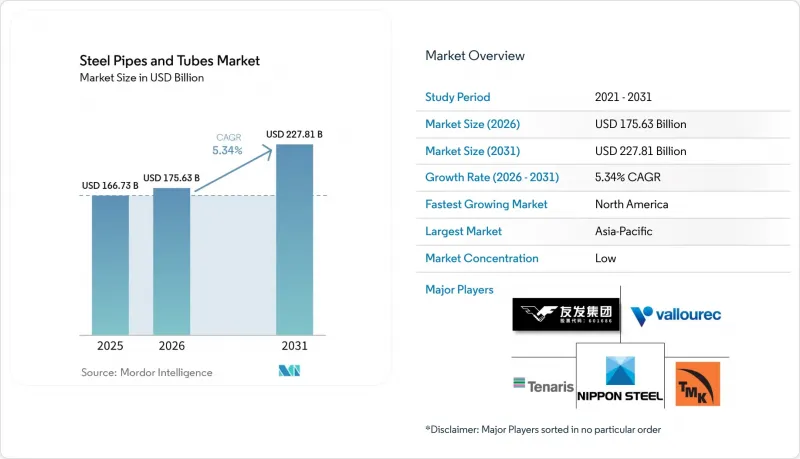
에 의하면, 강관 및 튜브 시장 규모는 2025년에 1,667억 3,000만 달러로 평가되었고, 2026년 1,756억 3,000만 달러에서 2031년까지 2,278억 1,000만 달러에 이를 것으로 예측되며, 예측 기간(2026년-2031년) CAGR은 5.34%를 기록할 전망입니다.
세계 강관 및 튜브 시장 동향 및 인사이트
인프라 현대화 및 도시 유틸리티 확대
노후화된 도시 인프라망을 배경으로, 신규 건설 주기에 대한 의존도가 낮으며, 계획, 조달, 설치, 수리, 유지보수 등 각 단계에 걸쳐 실행 가능한 배관 교체 프로그램이 추진되고 있습니다. 2025 회계연도에는 미국의 주 순환 기금(State Revolving Funds)을 통해 식수 및 하수도 인프라를 위해 120억 달러가 조성되었습니다. 이러한 자금 조달 체계를 통해 수요가 단일 건설 시즌에 집중되지 않고, 여러 조달 기간에 걸쳐 상수도 본관, 하수도 시스템 및 관련 배관 제품에 대한 수요가 뒷받침되고 있습니다. 지자체에서 고강도, 긴 수명, 또는 인구 밀집 지역에서 지표면에 미치는 영향을 줄이는 비개착 공법과의 호환성을 요구할 경우, 강관 시장은 그 혜택을 받게 됩니다. 개보수 프로그램은 소구경 정밀 제품을 취급하는 공급업체뿐만 아니라 기존 라인 파이프 공급업체에게도 유리하게 작용할 가능성이 있습니다. 이는 지역 네트워크 공사에서 다양한 제품 크기와 계약업체에 대한 확실한 납품이 요구되기 때문입니다. 이러한 공사는 대규모 신규 송수 프로젝트를 넘어 수요를 확대하고, 단일 최종 용도 주기에 대한 의존도를 낮추는 동시에, 다각적인 생산자들에게 일상적인 교체 공사와 기술적으로 더 정교한 공공시설의 업그레이드 모두에 대응할 기회를 제공합니다.
석유 및 가스 파이프라인의 갱신 및 확장
석유 및 가스에 대한 투자는 북미, 중동, 아시아태평양에서 여전히 파이프 수요의 주요 원천이 되고 있습니다. 이 지역들에서는 생산, 수송, 처리 및 기존 네트워크의 유지 관리와 관련된 프로젝트가 진행되고 있습니다. 개발업체들은 2026년부터 2027년에 걸쳐 미국에서 하루 449억 입방피트의 천연가스 파이프라인 용량 증설을 계획하고 있으며, 그 용량의 70%는 이미 건설 중입니다. LNG 수출 시설과 가스 화력 발전 모두 운송 및 공급 가스와의 연결이 필요하기 때문에 파이프 수요는 수출 인프라와 국내 전력 수요와 밀접하게 연결되어 있습니다. 또한, 신규 유전 개발이 둔화되더라도 파이프라인 사업자는 기존 시스템의 성능과 안전성을 유지해야 하므로, 구조적 건전성 요건이 신규 주문을 지속적으로 뒷받침하고 있습니다. 따라서 강관 시장은 확장 프로젝트와 기존 네트워크의 유지 관리 모두에서 수요를 창출하고 있으며, 그 요구 사항은 파이프라인의 직경, 두께, 재료 등급, 코팅 및 최종 용도 조건에 따라 달라집니다. 대구경·두꺼운 두께 사양의 제품의 경우, 여러 프로젝트가 동시에 건설 단계에 접어들면 제철소의 가동 능력이 한계에 달할 가능성이 있습니다. 따라서 제조 능력과 확실한 납품은 프로젝트 일정에 있어 매우 중요합니다.
철강, 고철, 에너지 비용의 변동
철강 원료 및 에너지 비용은 급격히 변동할 가능성이 있어 파이프 및 튜브의 이익률에 압박을 가합니다. 열간 압연 코일은 용접 제품의 주요 원자재인 반면, 빌렛 및 에너지 비용은 심리스 튜브 생산에 영향을 미칩니다. 업스트림 철강 생산 능력을 보유하고 있거나 장기 공급 계약을 체결한 제조업체는 이러한 변동을 보다 효과적으로 관리할 수 있습니다. 독립 제조업체는 투입 비용이 파이프 판매 가격보다 빠르게 상승할 경우, 이익률 압박에 직면할 가능성이 있습니다. 또한, 원자재 및 전력 비용이 계속 변동하는 상황에서는 구매자 역시 계약 가격의 변동에 직면할 가능성이 있습니다.
부문별 분석
2025년, 심리스 파이프는 강관 및 튜브 시장 점유율의 66.12%를 차지하며, 까다로운 요구 사항이 있는 석유 및 가스, 발전, 화학 처리 서비스 분야에서의 확고한 입지를 반영하고 있습니다. 이음매 없는 파이프는 용접 이음매가 없기 때문에 압력, 온도 또는 산성 환경 조건으로 인해 재료 성능에 높은 요구 사항이 부과되는 용도에 사용하기에 적합합니다. 석유용 파이프, 보일러 파이프 및 특정 수소 수송 라인은 이러한 용도의 중요한 예로 꼽힙니다. 이 제품의 역할은 초기 구매 비용의 저렴함보다는 주로 운전 조건이나 프로젝트 사양에 따라 결정됩니다. 따라서 이음매 없는 제품과 관련된 강관 시장 규모는 내압성, 일관된 금속 조직, 그리고 가동 신뢰성을 우선시하는 투자에 의해 뒷받침되고 있습니다.
전기저항용접(ERW)은 건설, 도시 유틸리티 및 저압 가스 배관 프로젝트에 힘입어 2031년까지 연평균 성장률(CAGR) 6.05%로 확대될 것으로 예측됩니다. 이 제조 방식은 그 성능이 운전 환경에 적합하며, 고객이 납품 비용을 중시하는 경우 효율적으로 대량 공급이 가능합니다. 저항 용접관은 특히 교체 공사에 적합합니다. 이는 지자체나 배관 시스템에서 표준화되고 쉽게 구할 수 있는 치수가 요구되는 경우가 많기 때문입니다. 잠수 아크 용접(SAW)은 다양한 요구 사항을 충족하며, 장거리 석유, 가스 및 물 수송 시스템을 위한 대구경 제품을 공급하고 있습니다. 이산화탄소 수송용 용접관 등급에 대한 조사를 통해, 인증된 ERW 공급업체가 대응할 수 있는 용도가 확대될 가능성이 있습니다. 이러한 발전은 중요한 조건 하에서 이음매 없는 파이프에 대한 수요를 대체하는 것은 아니지만, 용접 제품의 잠재적 수요를 확대시킬 가능성이 있습니다.
지역별 분석
2025년, 아시아태평양은 강관 시장의 58.51% 점유율을 차지하며, 이 지역은 전 세계 소비 및 제조에서 중심적인 역할을 수행하고 있습니다. 중국, 인도, 일본, 한국은 대규모 인프라 수요와 상당한 강관 생산 능력을 모두 갖추고 있습니다. 중국은 에너지 네트워크, 도시 유틸리티, 산업 투자, 그리고 광범위한 국내 제조거점을 통해 수요를 뒷받침하고 있습니다. 인도는 건설, 상수도 시스템, 산업 사용자, 그리고 국내 인프라 프로젝트를 충족하기 위해 강관 생산 능력을 확대되고 있습니다. 반면, 일본과 한국은 특수 에너지 용도, 해양 관련 분야 및 고부가가치 등급 제품에 중점을 두고 있습니다. 따라서 아시아태평양의 강관 시장은 비용 중심의 대량 생산과 특정 프리미엄 용도에서의 첨단 기술력을 모두 포함하고 있습니다.
북미에서는 LNG 인프라, 천연가스 파이프라인, 노후 설비 교체 프로그램 및 전력 수요 증가에 힘입어 2031년까지 연평균 성장률(CAGR) 5.89%를 나타낼 것으로 예측됩니다. 각 개발사는 2026년부터 2027년에 걸쳐 미국에서 하루 449억 입방피트의 천연가스 파이프라인 용량 증설을 계획하고 있습니다. 캐나다는 천연가스 수송 및 제강·파이프 마감 능력에 대한 투자에서 여전히 중요한 위치를 차지하고 있습니다. 테나리스(Tenaris)사의 온타리오주 사업 계획에는 세미 프리미엄 규격 및 미국석유협회(API) 규격의 연결부용 열간 압연, 연신 가공, 열처리, 시험, 마감, 나사 절삭 공정이 포함되어 있습니다.
유럽에서는 에너지 비용과 규정 준수 비용이 비교적 높은 상황이지만, 수소 네트워크 프로젝트로 인해 인증된 라인 파이프에 대한 수요가 발생할 가능성이 있습니다. 탄소 배출량 보고 요건이 강화됨에 따라 조달 결정 시 문서화된 배출 데이터와 저탄소강 인증의 중요성이 높아지고 있습니다. 남미에서는 프리미엄 파이프나 보호 코팅이 필요한 심해 프로젝트를 포함한 해양 석유 및 가스 사업이 호재로 작용하고 있습니다. 중동 및 아프리카 수요는 탄화수소 개발, 송수, 산업 인프라와 관련이 있습니다. 이 지역들의 강관 시장 점유율은 여전히 아시아태평양 수준보다 낮지만, 프로젝트에 따라 고부가가치 사양이 요구되는 경우가 있습니다. 국제적인 공급업체와 지역 제철소들은 장기적인 에너지 및 수자원 관련 투자 현장 근처에 생산 능력을 배치하고 있습니다.
기타 혜택:
- 엑셀 형식 시장 예측(ME) 시트
- 3개월간의 애널리스트 지원
자주 묻는 질문
목차
제1장 서론
- 조사의 전제조건과 시장의 정의
- 조사 범위
제2장 조사 방법
제3장 주요 요약
제4장 시장 구도
- 시장 개요
- 시장 성장 촉진요인
- 시장 성장 억제요인
- 밸류체인 분석
- Porter의 Five Forces 분석
제5장 시장 규모와 성장 예측
- 기술별
- 소재별
- 용도별
- 지역별
- 아시아태평양
- 중국
- 인도
- 일본
- 한국
- ASEAN 국가
- 기타 아시아태평양 국가
- 북미
- 미국
- 캐나다
- 멕시코
- 유럽
- 독일
- 영국
- 프랑스
- 이탈리아
- 북유럽 국가
- 러시아
- 기타 유럽 국가
- 남미
- 브라질
- 아르헨티나
- 기타 남미 국가
- 중동 및 아프리카
- 사우디아라비아
- 남아프리카공화국
- 기타 중동 및 아프리카 국가
- 아시아태평양
제6장 경쟁 구도
- 시장 집중도
- 전략적 동향
- 시장 점유율·순위 분석
- 기업 개요
- APL Apollo
- ArcelorMittal
- BAOWU Metal
- HYUNDAI STEELPIPE
- JFE Steel Corporation
- Jindal SAW Ltd.
- NIPPON STEEL CORPORATION
- SeAH Steel Corporation
- Tata Steel Limited
- Tenaris
- Tianjin Youfa Steel Pipe Group Co., Ltd.
- TMK
- United States Steel Corporation
- Vallourec
- Zekelman Industries
제7장 시장 기회와 향후 전망
LSH 26.10.29According to Mordor Intelligence, the steel pipes and Tubes Market size was valued at USD 166.73 billion in 2025 and is estimated to grow from USD 175.63 billion in 2026 to reach USD 227.81 billion by 2031, at a CAGR of 5.34% during the forecast period (2026-2031).
Global Steel Pipes and Tubes Market Trends and Insights
Infrastructure Renewal and Urban Utility Expansion
Aging municipal networks are supporting pipe replacement programs that are less dependent on new construction cycles and can extend through planning, procurement, installation, repair, and maintenance stages. In fiscal year 2025, State Revolving Funds provided USD 12 billion for drinking water and wastewater infrastructure in the United States. The funding framework supports demand for water mains, sewer systems, and related tubular products over several procurement periods, rather than concentrating demand only in a single construction season. The steel pipes and tubes market benefits where municipalities require strength, long service life, or compatibility with trenchless installation methods that reduce surface disruption in populated areas. Rehabilitation programs can favor suppliers with smaller-diameter precision products as well as suppliers of conventional line pipe, because local network work can require varied product sizes and reliable delivery to contractors. This work broadens demand beyond large greenfield transmission projects and reduces dependence on a single end-use cycle, while also giving diversified producers an opportunity to serve both routine replacement work and more technically demanding utility upgrades.
Oil and Gas Pipeline Replacement and Expansion
Oil and gas investment remains a major source of pipe demand in North America, the Middle East, and Asia-Pacific, where projects involve production, transportation, processing, and established network maintenance. Developers plan 44.9 billion cubic feet per day of natural gas pipeline capacity additions in the United States during 2026 and 2027, and 70% of that capacity is already under construction. LNG export facilities and gas-fired power generation both require transmission and feed gas connections, linking pipe demand to export infrastructure and domestic electricity needs. Integrity requirements also sustain replacement orders, even when new field development slows, because pipeline operators must maintain the performance and safety of existing systems. The steel pipes and tubes market, therefore, draws demand from both expansion projects and the maintenance of existing networks, with requirements differing by pipeline diameter, wall thickness, material grade, coatings, and end-use conditions. Large-diameter and heavy-wall specifications can tighten available mill capacity when several projects enter construction at the same time, making manufacturing capability and dependable delivery important to project schedules.
Volatility in Steel, Scrap and Energy Costs
Steel feedstock and energy costs can change quickly, placing pressure on pipe and tube margins. Hot-rolled coil is a key input for welded products, while billet and energy costs affect seamless tube production. Producers that own upstream steel capacity or have long-term supply arrangements can manage these changes more effectively. Independent mills may face margin pressure when input costs rise faster than pipe selling prices. Buyers may also face changing contract prices when raw materials and electricity costs remain volatile.
Other drivers and restraints analyzed in the detailed report include:
- Hydrogen, Carbon Capture and Geothermal Pipeline Development
- Expansion of Power Generation and Process Industries
- Decarbonization Capital Requirements and Emissions Compliance
For complete list of drivers and restraints, kindly check the Table Of Contents.
Segment Analysis
Seamless held 66.12% of the steel pipes and tubes market share in 2025, reflecting its established position in demanding oil and gas, power generation, and chemical processing services. It is produced without a welded seam, which supports its use where pressure, temperature, or sour-service conditions place greater demands on material performance. Oil country tubular goods, boiler tubes, and selected hydrogen transport lines remain important examples of these applications. The product's role is determined primarily by operating conditions and project specifications, rather than by the lowest initial purchase cost. The steel pipes and tubes market size connected to seamless products is, therefore, supported by investments that prioritize pressure tolerance, consistent metallurgy, and service reliability.
Electric resistance welded is projected to advance at a 6.05% CAGR through 2031, supported by construction, urban utilities, and lower-pressure gas distribution projects. The process can supply high volumes efficiently where its performance is suitable for the operating environment, and customers pay close attention on delivered cost. Electric resistance-welded pipe is particularly relevant for replacement work because municipal and distribution systems often require standardized, readily available dimensions. Submerged arc welded serves a different requirement, supplying large-diameter products for long-distance oil, gas, and water transmission systems. Research on welded pipe grades for carbon dioxide transport may widen the applications available to qualified ERW suppliers. These developments do not displace seamless pipe in critical conditions, but they can increase the addressable demand for welded products.
Complete Report Scope:
- By Technology
- Seamless
- Electric Resistance Welded
- Submerged Arc Welded
- By Material
- Carbon Steel
- Alloy Steel
- Stainless Steel
- Others
- By Application
- Oil and Gas
- Chemicals and Petrochemicals
- Automotive and Transportation
- Power Plant
- Construction
- Others
- By Geography
- Asia-Pacific
- China
- India
- Japan
- South Korea
- ASEAN Countries
- Rest of Asia-Pacific
- North America
- United States
- Canada
- Mexico
- Europe
- Germany
- United Kingdom
- France
- Italy
- NORDIC Countries
- Russia
- Rest of Europe
- South America
- Brazil
- Argentina
- Rest of South America
- Middle East and Africa
- Saudi Arabia
- South Africa
- Rest of Middle East and Africa
- Asia-Pacific
Geography Analysis
Asia-Pacific held 58.51% of the steel pipes and tubes market share in 2025, giving the region a central role in global consumption and manufacturing. China, India, Japan, and South Korea combine large infrastructure requirements with significant pipe and tube production capacity. China supports demand through energy networks, urban utility work, industrial investment, and a wide domestic manufacturing base. India is expanding pipe capacity to serve construction, distribution systems, industrial users, and domestic infrastructure projects. Japan and South Korea place more emphasis on specialized energy, offshore, and high-value grades. The steel pipes and tubes market in Asia-Pacific, therefore, includes both cost-focused volume production and advanced capability in selected premium applications.
North America is projected to advance at a 5.89% CAGR through 2031, supported by LNG infrastructure, natural gas pipelines, replacement programs, and growing electricity needs. Developers plan 44.9 billion cubic feet per day of natural gas pipeline capacity additions in the United States during 2026 and 2027. Canada remains important for natural gas transportation and for investment in steelmaking and pipe finishing capacity. Tenaris's Ontario program covers hot rolling, stretch reduction, heat treatment, testing, finishing, and threading for semi-premium and American Petroleum Institute connections.
Europe faces relatively high energy and compliance costs, although hydrogen network projects can create demand for qualified line pipe. Carbon reporting requirements are strengthening the importance of documented emissions data and low-carbon steel credentials in procurement decisions. South America benefits from offshore oil and gas work, including deepwater projects that need premium tubulars and protective coatings. The Middle East and Africa demand is associated with hydrocarbon development, water transmission, and industrial infrastructure. The steel pipes and tubes market share in these areas remains below Asia-Pacific's level, but the projects can require high-value specifications. International suppliers and regional mills are positioning capacity near long-cycle energy and water investments.
- APL Apollo
- ArcelorMittal
- BAOWU Metal
- HYUNDAI STEELPIPE
- JFE Steel Corporation
- Jindal SAW Ltd.
- NIPPON STEEL CORPORATION
- SeAH Steel Corporation
- Tata Steel Limited
- Tenaris
- Tianjin Youfa Steel Pipe Group Co., Ltd.
- TMK
- United States Steel Corporation
- Vallourec
- Zekelman Industries
Additional Benefits:
- The market estimate (ME) sheet in Excel format
- 3 months of analyst support
TABLE OF CONTENTS
1 Introduction
- 1.1 Study Assumptions and Market Definition
- 1.2 Scope of the Study
2 Research Methodology
3 Executive Summary
4 Market Landscape
- 4.1 Market Overview
- 4.2 Market Drivers
- 4.2.1 Infrastructure Renewal and Urban Utility Expansion
- 4.2.2 Oil and Gas Pipeline Replacement and Expansion
- 4.2.3 Hydrogen, Carbon Capture and Geothermal Pipeline Development
- 4.2.4 Expansion of Power Generation and Process Industries
- 4.2.5 Advanced Tubular Requirements for High-Pressure Applications
- 4.3 Market Restraints
- 4.3.1 Volatility in Steel, Scrap and Energy Costs
- 4.3.2 Decarbonization Capital Requirements and Emissions Compliance
- 4.3.3 Substitution by Plastic, Composite and Aluminum Piping
- 4.4 Value Chain Analysis
- 4.5 Porter's Five Forces Analysis
- 4.5.1 Threat of New Entrants
- 4.5.2 Bargaining Power of Suppliers
- 4.5.3 Bargaining Power of Buyers
- 4.5.4 Threat of Substitutes
- 4.5.5 Competitive Rivalry
5 Market Size and Growth Forecasts (Value)
- 5.1 By Technology
- 5.1.1 Seamless
- 5.1.2 Electric Resistance Welded
- 5.1.3 Submerged Arc Welded
- 5.2 By Material
- 5.2.1 Carbon Steel
- 5.2.2 Alloy Steel
- 5.2.3 Stainless Steel
- 5.2.4 Others
- 5.3 By Application
- 5.3.1 Oil and Gas
- 5.3.2 Chemicals and Petrochemicals
- 5.3.3 Automotive and Transportation
- 5.3.4 Power Plant
- 5.3.5 Construction
- 5.3.6 Others
- 5.4 By Geography
- 5.4.1 Asia-Pacific
- 5.4.1.1 China
- 5.4.1.2 India
- 5.4.1.3 Japan
- 5.4.1.4 South Korea
- 5.4.1.5 ASEAN Countries
- 5.4.1.6 Rest of Asia-Pacific
- 5.4.2 North America
- 5.4.2.1 United States
- 5.4.2.2 Canada
- 5.4.2.3 Mexico
- 5.4.3 Europe
- 5.4.3.1 Germany
- 5.4.3.2 United Kingdom
- 5.4.3.3 France
- 5.4.3.4 Italy
- 5.4.3.5 NORDIC Countries
- 5.4.3.6 Russia
- 5.4.3.7 Rest of Europe
- 5.4.4 South America
- 5.4.4.1 Brazil
- 5.4.4.2 Argentina
- 5.4.4.3 Rest of South America
- 5.4.5 Middle East and Africa
- 5.4.5.1 Saudi Arabia
- 5.4.5.2 South Africa
- 5.4.5.3 Rest of Middle East and Africa
- 5.4.1 Asia-Pacific
6 Competitive Landscape
- 6.1 Market Concentration
- 6.2 Strategic Moves
- 6.3 Market Share (%)/Ranking Analysis
- 6.4 Company Profiles (includes Global Overview, Market Overview, Core Segments, Financials as available, Strategic Information, Products and Services, and Recent Developments)
- 6.4.1 APL Apollo
- 6.4.2 ArcelorMittal
- 6.4.3 BAOWU Metal
- 6.4.4 HYUNDAI STEELPIPE
- 6.4.5 JFE Steel Corporation
- 6.4.6 Jindal SAW Ltd.
- 6.4.7 NIPPON STEEL CORPORATION
- 6.4.8 SeAH Steel Corporation
- 6.4.9 Tata Steel Limited
- 6.4.10 Tenaris
- 6.4.11 Tianjin Youfa Steel Pipe Group Co., Ltd.
- 6.4.12 TMK
- 6.4.13 United States Steel Corporation
- 6.4.14 Vallourec
- 6.4.15 Zekelman Industries
7 Market Opportunities and Future Outlook
- 7.1 White-Space and Unmet-Need Assessment


