

|
시장보고서
상품코드
2155617
복합 수지 : 시장 점유율 분석, 업계 동향과 통계, 성장 예측(2026-2031년)Composite Resin - Market Share Analysis, Industry Trends & Statistics, Growth Forecasts (2026 - 2031) |
||||||
 Mordor Intelligence
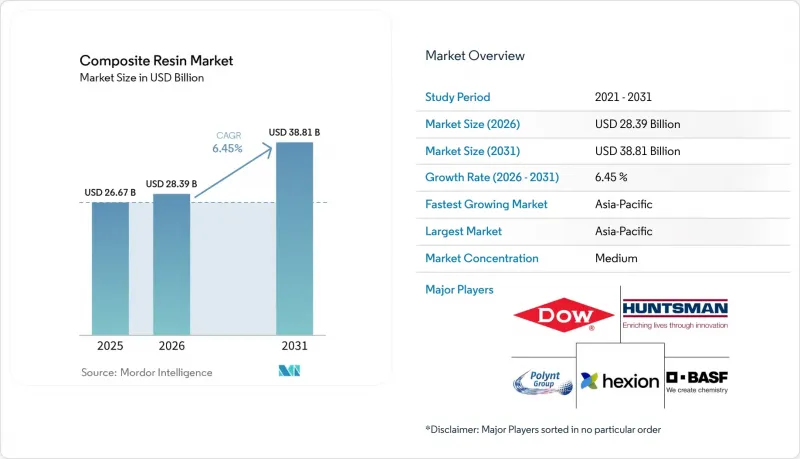
에 따르면 복합 수지 시장 규모는 2025년에 266억 7,000만 달러로 평가되며, 2026년 283억 9,000만 달러에서 2031년까지 388억 1,000만 달러에 달할 것으로 추정되며, 예측 기간(2026-2031년) 동안 CAGR은 6.45%가 될 전망입니다.
세계 복합 수지 시장의 동향 및 인사이트
경량화 및 연비 효율 요구 사항
경량화는 내연기관 차량과 배터리식 전기자동차 모두에서 자동차 제조사가 복합재료를 채택하는 핵심적인 이유로 계속해서 자리 잡고 있습니다. 복합 수지는 동등한 강재 용도와 비교하여 구조 중량을 30%에서 40%까지 줄일 수 있습니다. 배터리식 전기자동차는 동등한 내연기관 차량에 비해 중량 대비 15%에서 25% 더 많은 수지를 필요로 합니다. 이러한 추가 수요는 배터리 인클로저, 전력 전자 장치 하우징 및 경량 구조 부품에서 발생하고 있습니다. 이러한 부품에는 유전 성능과 난연성도 요구됩니다. 수지 등급은 특정 차량 프로그램의 인증을 받아야 하며, 해당 인증에는 18개월에서 36개월이 소요되기 때문에 복합 수지 시장은 그 혜택을 누리고 있습니다.
자동차 및 운송 플랫폼의 전동화
전동화로 인해 운송 분야에서 특수 수지의 성능이 더욱 중요해지고 있습니다. 2024년 전 세계 전기자동차 판매 대수는 1,700만 대를 넘어섰습니다. 배터리 주변 용도에서는 180°C 이상의 열 안정성, 낮은 이온 오염, 그리고 언더라이터스 래버러토리스(UL) 94V-0 난연 등급이 요구됩니다. SABIC은 2025년 2월, 인라인 도장이 가능한 전기자동차용 서비스 플랩용 ‘NORYL GTX LMX310’을 출시했습니다. 이 회사에 따르면, 이 소재는 기존의 폴리아미드 컴파운드에 비해 평형 흡습량이 85% 낮다고 합니다. 각 자동차 제조사들은 주요 구조부에는 계속해서 열경화성 수지를 사용하면서도, 내장 부품이나 반구조 부품에는 열가소성 복합재료를 채택하고 있으며, 이로 인해 복합 수지 시장 전체의 요구 사항 범위가 확대되고 있습니다.
복합재료의 제조 및 인증에 드는 높은 비용
수지 시스템의 인증에는 배합 설계부터 양산 도입까지 18-36개월이 소요될 수 있습니다. 항공우주, 자동차, 풍력발전 분야의 시험에는 수지 등급 및 고객 프로그램별로 50만-500만 달러의 추가 비용이 발생할 가능성이 있습니다. 이러한 부담은 여러 고객 프로그램에 동시에 자금을 투입해야 하는 중견 공급업체에게 특히 큰 과제가 되고 있습니다. 또한, 에폭시, 폴리에스테르, 비닐에스테르의 원료는 원유나 나프타의 가격 변동 영향을 받습니다. 비스페놀 A, 무수 말레산, 에피클로로히드린과 같은 원료를 통해 이러한 가격 변동이 제조사의 이익률에 파급됩니다. 동등한 밀도의 용도에서 복합 수지의 비용은 기존의 엔지니어링 열가소성 플라스틱의 3배에서 5배에 달하기 때문에 가격에 민감한 용도에서의 채택이 제한되고 있습니다.
부문별 분석
2025년, 열경화성 수지는 복합 수지 시장 점유율의 64.23%를 차지했습니다. 이러한 위상은 풍력발전용 블레이드, 항공우주용 패널 및 산업용 배관에서 입증된 적합성에 의해 뒷받침되었습니다. 가교 매트릭스는 많은 주요 구조용 분야에서 여전히 상업적으로 검증된 선택지로 남아 있습니다. 열경화성 수지는 가혹한 사용 조건에서도 열적 안정성과 내화학성을 제공합니다. 또한 열가소성 수지 시스템에 비해 가공 및 사용 후 제품 관리가 더 어렵습니다. 이러한 제약이 있음에도 불구하고, 고객들은 입증된 성능과 인증된 공급망을 신뢰하고 있기 때문에 핵심 구조용 분야에서 이를 대체하기는 여전히 어렵습니다.
열가소성 수지는 2031년까지 연평균 성장률(CAGR) 7.23%로 확대될 것으로 예측됩니다. 사출 성형 및 압축 성형의 사이클 시간이 짧기 때문에 자동차 서브스트럭처, 전자기기 케이스, 스포츠 용품에 대한 채택이 확대되고 있습니다. 또한, 이 소재의 재가공성은 유럽 및 북미의 사용 후 제품 처리 요건에도 부합합니다. 이러한 요건이 재료 사양에 반영됨에 따라 각 OEM 업체들은 인증 절차를 가속화하고 있습니다. 아르케마(Arkema)는 JEC World 2026에서 엘리움(Elium) 수지와 재생 탄소섬유를 사용한 재활용 가능한 스피드보드를 발표했습니다. 이 프로토타입은 탈중합을 통한 화학적 재활용 가능성을 입증함과 동시에, 액상 열가소성 수지 시스템이 인퓨즈드 구조 부품에 어떻게 활용될 수 있는지를 보여주었습니다.
지역별 분석
아시아태평양은 2025년 복합 수지 시장 점유율의 42.79%를 차지하고 있으며, 2031년까지 연평균 성장률(CAGR) 7.37%로 확대될 것으로 예측됩니다. 중국의 통합된 수지 생산 및 복합재료 제조 거점이 이러한 위상을 뒷받침하고 있습니다. 산둥성, 장쑤성, 광둥성의 제조 클러스터에서는 석유화학 원료 공급과 다운스트림 가공이 일체화되어 있습니다. 인도의 경우 2025년에 육상 풍력발전 용량이 6.34 GW 증가하여 전년 대비 85% 증가했습니다. 이로 인해 타밀나두주, 구자라트주, 라자스탄주에서 블레이드용 에폭시 수지 및 비닐에스테르 수지에 대한 수요가 뒷받침되고 있습니다. 일본과 한국은 탄소섬유 프리프레그 및 특수 배합 수지 분야에서 여전히 중요한 시장입니다.
북미에서는 항공우주 프로그램, 풍력발전 개발 및 자동차 재설계를 통해 수요가 견인되고 있습니다. 텍사스주 및 중서부 지역의 풍력발전 프로젝트는 블레이드용 복합재료 수요를 뒷받침하고 있습니다. 오대호 지역의 자동차 생산 또한 복합재료로 제작된 하위 어셈블리 수요를 뒷받침하고 있습니다. ‘인플레이션 억제법(Inflation Reduction Act)’은 국내 청정에너지 제조에 대한 투자를 지속적으로 뒷받침하고 있습니다. 유럽의 복합 수지 시장은 재생에너지 목표와 화학제품 규제에 의해 형성되고 있습니다. REACH 규정의 요건에 따라, 불포화 폴리에스테르 및 비닐에스테르 용도에서 저스티렌 및 스티렌 프리 배합 개발이 진행되고 있습니다.
독일, 영국, 프랑스, 이탈리아 및 북유럽 국가들은 여전히 유럽 내 중요한 최종사용자 제조 거점으로 자리 잡고 있습니다. Cefic UP/VE 부문 그룹 회원사들이 의뢰한 2025년 수명주기 인벤토리 조사에 따르면, 불포화 폴리에스테르 수지 및 비닐에스테르 수지의 지구 온난화 지수(GWP)는 기존 수치보다 2%에서 8% 낮은 것으로 보고되었습니다. 또한, 같은 조사에서 재생 폴리에틸렌 테레프탈레이트(rPET)를 기반으로 한 수지의 지구 온난화 지수가 16% 낮다고 보고되었습니다. 남미, 중동 및 아프리카는 여전히 규모는 작지만 특정 수요 요인을 가진 시장입니다. 브라질에서는 유리섬유 산업의 기반과 풍력발전 부문이 지역 소비를 뒷받침하고 있습니다. 스콧 베이다(Scott Bader)사는 2024년 6월 에스피리투 산투 주 세라에 ‘스콧 베이다 브라질’을 설립하고, Crystic 겔코트 및 금형 제품의 현지 생산을 시작했습니다.
기타 혜택:
- 엑셀 형식의 시장 예측(ME) 시트
- 3개월간의 애널리스트 지원
자주 묻는 질문
목차
제1장 소개
- 조사 가정과 시장 정의
- 조사 범위
제2장 조사 방법
제3장 주요 요약
제4장 시장 구도
- 시장 개요
- 시장 성장 촉진요인
- 시장 성장 억제요인
- 밸류체인 분석
- Porter's Five Forces 분석
제5장 시장 규모와 성장 예측
- 수지 유형별
- 제조 공정별
- 용도별
- 지역별
- 아시아태평양
- 중국
- 인도
- 일본
- 한국
- ASEAN 국가
- 기타 아시아태평양 국가
- 북미
- 미국
- 캐나다
- 멕시코
- 유럽
- 독일
- 영국
- 프랑스
- 이탈리아
- 북유럽 국가
- 기타 유럽 국가
- 남미
- 브라질
- 아르헨티나
- 기타 남미 국가
- 중동 및 아프리카
- 사우디아라비아
- 남아프리카공화국
- 기타 중동 및 아프리카 국가
- 아시아태평양
제6장 경쟁 구도
- 시장 집중도
- 전략적 동향
- 시장 점유율·순위 분석
- 기업 개요
- Arkema
- Ashland
- BASF
- Dow
- Evonik Industries AG
- Hexion Inc.
- Huntsman International LLC
- KUKDO CHEMICAL CO., LTD.
- Polynt S.p.A.
- SABIC
- Scott Bader Company Limited
- Sumitomo Bakelite Co., Ltd.
- TORAY INDUSTRIES, INC.
제7장 시장 기회와 향후 전망
KSM 26.10.30According to Mordor Intelligence, the composite resin market size was valued at USD 26.67 billion in 2025 and is estimated to grow from USD 28.39 billion in 2026 to reach USD 38.81 billion by 2031, at a CAGR of 6.45% during the forecast period (2026-2031).
Global Composite Resin Market Trends and Insights
Lightweighting and Fuel-Efficiency Requirements
Mass reduction remains a central reason for vehicle manufacturers to use composite materials in both combustion and battery-electric platforms. Composite resins can support structural weight savings of 30% to 40% compared with equivalent steel applications. Battery-electric vehicles require 15% to 25% more resin content by weight than comparable combustion-engine vehicles. Battery enclosures, power-electronics housings, and lightweight structural components create this added need. These components also require dielectric performance and flame resistance. The composite resin market benefits because resin grades must be qualified for specific vehicle programs, and qualification can take 18 to 36 months.
Electrification of Automotive and Transportation Platforms
Electrification increases the importance of specialty resin performance in transportation applications. Global electric-vehicle sales exceeded 17 million units in 2024. Battery-adjacent applications require thermal stability above 180 °C, low ionic contamination, and Underwriters Laboratories (UL) 94 V-0 flame ratings. SABIC introduced NORYL GTX LMX310 in February 2025 for inline-paintable electric-vehicle service flaps. The company stated that the material had 85% lower equilibrium moisture absorption than incumbent polyamide compounds. Vehicle makers continue to use thermosets in primary structures while adopting thermoplastic composites for interior and semi-structural parts, widening requirements across the composite resin market
High Composite Manufacturing and Qualification Costs
Qualifying a resin system from formulation through production deployment can take 18 to 36 months. Aerospace, automotive, and wind-energy testing can add USD 500,000 to USD 5 million for each resin grade and customer program. This burden is especially difficult for mid-tier suppliers that must fund several customer programs at the same time. Epoxy, polyester, and vinyl ester feedstocks are also exposed to crude-oil and naphtha cycles. Bisphenol-A, maleic anhydride, and epichlorohydrin transmit this volatility into producer margins. Composite resins can cost 3x to 5x more than conventional engineering thermoplastics in equivalent-density applications, which limits adoption in price-sensitive applications.
Other drivers and restraints analyzed in the detailed report include:
- Wind-Energy Capacity Expansion
- Automated High-Throughput Composite Processing
- Difficult Recycling of Cross-Linked Thermoset Matrices
For complete list of drivers and restraints, kindly check the Table Of Contents.
Segment Analysis
Thermoset resin held 64.23% of the composite resin market share in 2025. Its position was supported by established qualification in wind blades, aerospace panels, and industrial piping. Cross-linked matrices remain the commercially proven choice for many primary structural applications. Thermosets provide thermal stability and chemical resistance for demanding service conditions. They also involve more difficult processing and end-of-life management than thermoplastic systems. Despite these limits, replacement in core structural uses remains difficult because customers rely on tested performance and qualified supply chains.
Thermoplastic resin is projected to advance at a 7.23% CAGR through 2031. Shorter injection-molding and compression-molding cycles support its adoption in automotive substructures, electronics housings, and sports equipment. Its reprocessability is also aligned with end-of-life requirements in Europe and North America. Original equipment manufacturers are accelerating qualification as these requirements enter material specifications. Arkema presented a recyclable speed board at JEC World 2026 using Elium resin and recycled carbon fiber. The prototype demonstrated chemical recyclability through depolymerization and showed how liquid thermoplastic systems could serve infused structural parts.
Complete Report Scope:
- By Resin Type
- Thermoset Resin
- Thermoplastic Resin
- By Manufacturing Process
- Layup
- Filament Winding
- Injection Molding
- Pultrusion
- Compression Molding
- Resin Transfer Molding
- Other Manufacturing Processes
- By Application
- Automotive and Transportation
- Construction and Infrastructure
- Electrical and Electronics
- Pipes and Tanks
- Wind Energy
- Marine
- Aerospace and Defense
- Other Applications
- By Geography
- Asia-Pacific
- China
- India
- Japan
- South Korea
- ASEAN Countries
- Rest of Asia-Pacific
- North America
- United States
- Canada
- Mexico
- Europe
- Germany
- United Kingdom
- France
- Italy
- NORDIC Countries
- Rest of Europe
- South America
- Brazil
- Argentina
- Rest of South America
- Middle East and Africa
- Saudi Arabia
- South Africa
- Rest of Middle East and Africa
- Asia-Pacific
Geography Analysis
Asia-Pacific held 42.79% of the composite resin market share in 2025 and is projected to advance at a 7.37% CAGR through 2031. China's integrated resin production and composite manufacturing base support this position. Manufacturing clusters in Shandong, Jiangsu, and Guangdong combine petrochemical feedstock supply with downstream fabrication. India added 6.34 GW of onshore wind capacity in 2025, an 85% increase from the prior year. This supports demand for blade-grade epoxy and vinyl ester resins in Tamil Nadu, Gujarat, and Rajasthan. Japan and South Korea remain important for carbon-fiber prepregs and specialty formulations.
North America drives demand through aerospace programs, wind development, and vehicle redesign. Wind projects in Texas and the Midwest support blade-grade composite requirements. Automotive production in the Great Lakes corridor also supports demand for composite subassemblies. The Inflation Reduction Act continues to support domestic clean-energy manufacturing investment. Europe's composite resin market is shaped by renewable-energy targets and chemical regulation. REACH requirements are directing development toward low-styrene and styrene-free formulations in unsaturated polyester and vinyl ester uses.
Germany, the United Kingdom, France, Italy, and the Nordic countries remain important European end-user manufacturing locations. A 2025 Life Cycle Inventory study commissioned by members of the Cefic UP/VE Sector Group reported global-warming-potential values for unsaturated polyester and vinyl ester resins that were 2% to 8% lower than prior figures. The study reported a 16% lower global warming potential for recycled polyethylene terephthalate (rPET)-based resins. South America and the Middle East and Africa remain smaller revenue areas with specific demand drivers. Brazil's fiberglass base and wind sector support regional consumption. Scott Bader established Scott Bader Brasil in Serra, Espirito Santo, in June 2024 to produce Crystic gelcoats and tooling products locally.
- Arkema
- Ashland
- BASF
- Dow
- Evonik Industries AG
- Hexion Inc.
- Huntsman International LLC
- KUKDO CHEMICAL CO., LTD.
- Polynt S.p.A.
- SABIC
- Scott Bader Company Limited
- Sumitomo Bakelite Co., Ltd.
- TORAY INDUSTRIES, INC.
Additional Benefits:
- The market estimate (ME) sheet in Excel format
- 3 months of analyst support
TABLE OF CONTENTS
1 Introduction
- 1.1 Study Assumptions and Market Definition
- 1.2 Scope of the Study
2 Research Methodology
3 Executive Summary
4 Market Landscape
- 4.1 Market Overview
- 4.2 Market Drivers
- 4.2.1 Lightweighting and Fuel-Efficiency Requirements
- 4.2.2 Electrification of Automotive and Transportation Platforms
- 4.2.3 Wind-Energy Capacity Expansion
- 4.2.4 Infrastructure Demand for Corrosion-Resistant Materials
- 4.2.5 Automated High-Throughput Composite Processing
- 4.3 Market Restraints
- 4.3.1 High Composite Manufacturing and Qualification Costs
- 4.3.2 Difficult Recycling of Cross-Linked Thermoset Matrices
- 4.3.3 Limited Repair, Inspection, and End-of-Life Infrastructure
- 4.4 Value Chain Analysis
- 4.5 Porter's Five Forces Analysis
- 4.5.1 Bargaining Power of Suppliers
- 4.5.2 Bargaining Power of Buyers
- 4.5.3 Threat of New Entrants
- 4.5.4 Threat of Substitutes
- 4.5.5 Competitive Rivalry
5 Market Size and Growth Forecasts (Value)
- 5.1 By Resin Type
- 5.1.1 Thermoset Resin
- 5.1.2 Thermoplastic Resin
- 5.2 By Manufacturing Process
- 5.2.1 Layup
- 5.2.2 Filament Winding
- 5.2.3 Injection Molding
- 5.2.4 Pultrusion
- 5.2.5 Compression Molding
- 5.2.6 Resin Transfer Molding
- 5.2.7 Other Manufacturing Processes
- 5.3 By Application
- 5.3.1 Automotive and Transportation
- 5.3.2 Construction and Infrastructure
- 5.3.3 Electrical and Electronics
- 5.3.4 Pipes and Tanks
- 5.3.5 Wind Energy
- 5.3.6 Marine
- 5.3.7 Aerospace and Defense
- 5.3.8 Other Applications
- 5.4 By Geography
- 5.4.1 Asia-Pacific
- 5.4.1.1 China
- 5.4.1.2 India
- 5.4.1.3 Japan
- 5.4.1.4 South Korea
- 5.4.1.5 ASEAN Countries
- 5.4.1.6 Rest of Asia-Pacific
- 5.4.2 North America
- 5.4.2.1 United States
- 5.4.2.2 Canada
- 5.4.2.3 Mexico
- 5.4.3 Europe
- 5.4.3.1 Germany
- 5.4.3.2 United Kingdom
- 5.4.3.3 France
- 5.4.3.4 Italy
- 5.4.3.5 NORDIC Countries
- 5.4.3.6 Rest of Europe
- 5.4.4 South America
- 5.4.4.1 Brazil
- 5.4.4.2 Argentina
- 5.4.4.3 Rest of South America
- 5.4.5 Middle East and Africa
- 5.4.5.1 Saudi Arabia
- 5.4.5.2 South Africa
- 5.4.5.3 Rest of Middle East and Africa
- 5.4.1 Asia-Pacific
6 Competitive Landscape
- 6.1 Market Concentration
- 6.2 Strategic Moves
- 6.3 Market Share (%)/Ranking Analysis
- 6.4 Company Profiles (includes Global Overview, Market Overview, Core Segments, Financials as available, Strategic Information, Products and Services, and Recent Developments)
- 6.4.1 Arkema
- 6.4.2 Ashland
- 6.4.3 BASF
- 6.4.4 Dow
- 6.4.5 Evonik Industries AG
- 6.4.6 Hexion Inc.
- 6.4.7 Huntsman International LLC
- 6.4.8 KUKDO CHEMICAL CO., LTD.
- 6.4.9 Polynt S.p.A.
- 6.4.10 SABIC
- 6.4.11 Scott Bader Company Limited
- 6.4.12 Sumitomo Bakelite Co., Ltd.
- 6.4.13 TORAY INDUSTRIES, INC.
7 Market Opportunities and Future Outlook
- 7.1 White-Space and Unmet-Need Assessment


