

|
시장보고서
상품코드
2155668
고순도 보헤마이트 : 시장 점유율 분석, 업계 동향과 통계, 성장 예측(2026-2031년)High-Purity Boehmite - Market Share Analysis, Industry Trends & Statistics, Growth Forecasts (2026 - 2031) |
||||||
 Mordor Intelligence
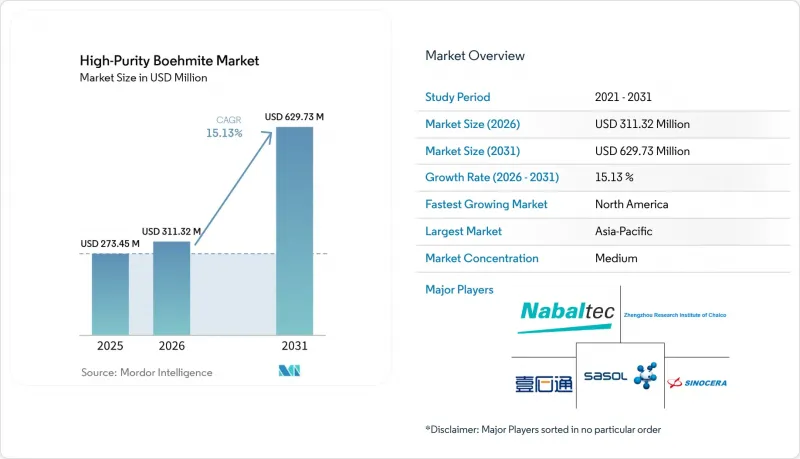
에 따르면 고순도 보헤마이트 시장 규모는 2025년에 2억 7,345만 달러로 평가되며, 2026년 3억 1,132만 달러에서 2031년까지 6억 2,973만 달러로 확대될 것으로 예측되며, 예측 기간의 CAGR은 15.13%입니다(2026-2031년) 사이에 CAGR 15.13%로 성장할 것으로 추정됩니다.
세계 초고순도 보헤마이트 시장의 동향 및 인사이트
전기자동차(EV) 및 에너지 저장용 배터리의 용량 확대
배터리 용량 확대는 고순도 보헤마이트 시장에서 분리막용 소재 수요를 견인하는 가장 큰 요인입니다. 이는 세라믹 코팅 필름이 가끔 구매되는 특수 원자재가 아니라, 셀 용량 확대에 맞춰 생산되기 때문입니다. 2025년 말까지 전 세계 리튬이온 배터리 생산능력은 4 TWh를 넘어설 전망이며, 총 생산량의 80% 이상을 중국이 차지하고 있습니다. 이러한 집중 현상으로 인해 중국의 셀 및 분리막 제조업체들은 보헤마이트의 순도 요건, 입자 크기 사양, 구매량 결정에 있어 핵심적인 역할을 수행하고 있습니다. 2025년, 전 세계 전기자동차 배터리 도입량은 1,187 GWh에 달했습니다. 세라믹 코팅 분리막의 생산량이 증가할 때마다, 이에 상응하는 보헤마이트 슬러리에 대한 지속적인 수요가 발생합니다. 또한, 기존 공장의 가동률이 높아지면 신규 시설이 가동을 시작하기도 전에 구매량이 증가할 가능성이 있습니다. 게다가, 분리막의 코팅층이 얇아짐에 따라 더 미세한 입자 크기에서도 분산성을 유지할 수 있어, 부가가치가 높은 제품 구성을 뒷받침할 수 있는 표면 개질 등급에 대한 수요도 증가하고 있습니다.
세라믹 코팅 분리기 안전 요건
세라믹 코팅 분리기는 고에너지 배터리 셀의 핵심 안전 부품으로서 점점 더 중요하게 여겨지고 있습니다. 특히, 급속 충전이나 고니켈계 화학 조성으로 인해 열적 및 전기화학적 제어의 중요성이 높아지고 있는 분야에서 이러한 경향이 두드러집니다. 제조업체가 유연한 코팅과 더 강력한 불화수소산 제거 성능을 필요로 하는 용도에서는 보헤마이트가 감마 알루미나를 대체하며 그 입지를 확고히 하고 있습니다. 또한 모스 경도 3-3.5라는 특성 덕분에, 더 단단한 무기계 대체 재료에 비해 설비의 마모를 줄일 수도 있습니다. 2025년 'Journal of Power Sources' 지에 발표된 연구에 따르면, 판상 보마이트 코팅은 구상 알루미나 코팅에 비해 더 높은 전해액 흡수성과 더 낮은 내부 저항을 나타내는 것으로 밝혀졌습니다. 이러한 특성은 급속 충전 및 사이클 안정성과 관련이 있으며, 이는 여전히 차량용 배터리 검증 및 셀 제조사의 인증 결정에 있어 핵심적인 역할을 하고 있습니다. 수성 보헤마이트 슬러리 시스템은 N-메틸-2-피롤리돈(NMP) 기반 공정과 비교하여 용제 배출량을 줄일 수 있으므로, 배터리 공장의 규제 준수 및 생산 체계 변경을 지원합니다. 분리막의 설계가 얇아짐에 따라, 일관된 미립자 분포를 제공할 수 있는 공급업체는 고순도 보헤마이트 시장에서 더 유리한 입지를 차지하게 될 것입니다.
초고순도 처리의 높은 비용
배터리 및 반도체 등급의 경우, 나트륨 및 금속 불순물을 엄격하게 관리하는 제조 공정이 요구되며, 셀 제조사는 나트륨, 칼슘, 철, 실리콘에 대해 대개 50-100ppm의 불순물 허용치를 설정하고 있습니다. 알루미늄 알콕사이드의 합성이나 고순도 기브사이트의 제어된 수열 변환에는 원료의 품질, 반응 조건, 입자 크기 분포에 대한 엄격한 관리를 포함하여 표준 등급 생산보다 더 정교한 공정 제어가 필요합니다. 2025년 연구에 따르면, 200°C에서 60분간 수열 합성을 수행함으로써 Na2O 함량 0.03%, D50이 4.18μm인 보헤마이트를 제조할 수 있는 것으로 밝혀졌습니다. 따라서 고순도 보헤마이트 시장은 등급별로 비용 구조가 현저히 다르기 때문에 생산량 증가만으로 평가할 수 없습니다. 생산자는 일부 공급 채널에서 저가 소재와의 경쟁에 직면하면서도 정제, 입자 제어 및 시험에 대한 투자를 회수해야 합니다. 이로 인해 기존 생산 거점 이외의 지역에서 고사양 생산능력을 확충하는 속도가 제한될 가능성이 있습니다.
부문 분석
2025년에는 수계 슬러리 처리가 분리기 코팅 용도로 정착됨에 따라, 수분산성 보헤마이트가 시장 가치의 46.78%를 차지하며 제품 유형 중 최대 점유율을 기록했습니다. 표면 개질형 분산성 보헤마이트는 2026년부터 2031년까지 연평균 성장률(CAGR) 16.45%로 성장할 것으로 예상되며, 이는 전체 제품 카테고리 중 가장 높은 성장률입니다. 이는 배터리 제조사들이 고니켈 셀 기판에서 더 얇은 코팅층을 요구하고 있기 때문입니다. 이 등급에 대한 수요는 입자가 수성 슬러리 내에서 안정적으로 유지되는지에 달려 있으며, 이를 통해 균일한 코팅과 결함률 제어가 가능해집니다. 표면 처리는 응집을 억제하고 침적의 일관성을 향상시킬 수 있지만, 한편으로는 입자 직경과 표면 화학적 특성을 확실하게 제어해야 할 필요성도 있습니다. 분리막의 사양이 D50 값의 감소 방향으로 나아가고 있기 때문에 입자 크기 분포의 좁아짐이 중요성을 더하고 있으며, 생산자에게는 설비 투자 및 연구에 대한 요구 사항이 높아지고 있습니다. 2025년 'Journal of Alloys and Compounds' 저널의 연구에 따르면, 산업용 기브사이트 및 보헤마이트로 제조된 이원 알루미나 세라믹스에서 밀도와 기계적 특성이 향상된 것으로 보고되었으며, 이는 첨단 세라믹 및 배터리 용도 모두에 대한 소재 로드맵을 뒷받침하는 것입니다. 산 분산성 등급은 산성 매체를 사용하는 촉매 지지체 및 내화물 용도에서 여전히 특수한 수요를 유지하고 있습니다. 수분산성 등급과 산 분산성 등급을 조합함으로써, 다양한 품목을 보유한 공급업체는 전기자동차 생산이 변동하는 상황에서도 보다 안정적인 수요 기반을 확보할 수 있습니다.
지역별 분석
2025년, 아시아태평양은 세계 시장 가치의 40.29%를 차지하며 고순도 보헤마이트의 최대 지역 시장이 되었습니다. 중국에는 기브사이트 정제, 보헤마이트 합성, 분리막 코팅, 배터리 셀 생산에 이르는 통합된 공급망이 있어, 소재 공급업체와 다운스트림 제조업체 간의 긴밀한 협력을 가능하게 하고 있습니다. 이 지역의 경쟁력은 대규모 분리막 제조, 밀집된 배터리 조달 네트워크, 그리고 셀 사양 변경에 따른 빈번한 기술 인증 필요성으로 인해 더욱 강화되고 있습니다. 한국은 배터리 제조 및 코팅 사업을 통해 기여하고 있는 반면, 일본은 분리막 용도 및 첨단 전자 세라믹용 특수 미세 등급을 공급하고 있습니다. 이러한 역량을 바탕으로 이 지역은 대량 생산되는 배터리 소재와 전문성이 더 높은 고순도 용도 모두에서 중요한 위치를 차지하고 있습니다. 인도 및 아세안(ASEAN) 국가들은 아직 초기 단계에 있지만, 인도의 첨단 화학계 셀을 위한 생산 연계형 인센티브 프로그램이 업스트림 소재에 대한 수요를 창출하고 있습니다. 현재의 역할은 중국, 일본, 한국에 비해 작지만, 현지 배터리 프로젝트를 통해 예측 기간 후반에는 보다 다양한 지역적 조달 기반이 형성될 가능성이 있습니다. 또한, 아시아태평양의 공급업체는 소재 선정을 결정짓는 원료, 코팅 및 셀 제조의 각 단계에 지리적으로 가깝다는 이점도 누리고 있습니다.
북미는 2026년부터 2031년까지 연평균 성장률(CAGR) 16.93%로 성장할 것으로 예측되며, 이는 고순도 보헤마이트 시장에서 지역별 가장 높은 성장률입니다. 미국의 정책은 국내 배터리 시설에 대한 투자를 촉진하고 있으며, 특히 국내 조달 요건이 조달 결정에 영향을 미치는 경우 현지 분리막 공급에 대한 관심을 높이고 있습니다. 이로 인해 분리막 제조 활동이 북미의 셀 생산 거점에 가까워지는 동시에 현지에서의 소재 인증에 대한 수요가 발생하고 있습니다. 공급망 혼란이 자재 확보 가능성이나 납기 신뢰성에 영향을 미치는 경우, 국내 인증의 중요성이 더욱 커지고 있습니다. 현지 시험, 일관된 로트 관리 및 용도 개발을 지원할 수 있는 공급업체는 신규 시설이 가동을 시작함에 따라 경쟁 우위를 확보할 가능성이 있습니다. 캐나다의 중요 광물 정책과 멕시코의 자동차 조립 거점 또한 지역적 수요를 더욱 부추기고 있습니다. 이 지역의 비즈니스 기회는 배터리 공장이 발표된 생산능력에서 지속가능한 생산으로 전환되는 속도, 그리고 분리막의 생산능력과 보마이트 공급이 병행하여 확대될지 여부에 따라 좌우됩니다. 이는 배터리 투자만으로는 인증된 코팅 재료에 대한 즉각적인 수요가 발생하지 않기 때문입니다.
유럽에서는 배터리 셀 개발과 할로겐계 난연제 대체라는 두 가지 서로 다른 수요 흐름이 뒷받침되고 있습니다. 난연재에 관한 규제는 케이블, 건설자재, 운송 용도, 자동차 배선 분야의 수요를 촉진하고 있으며, 이러한 분야에서는 규제 준수 및 방화 성능이 모두 소재 선정의 요인이 되고 있습니다. 독일, 프랑스, 스웨덴, 헝가리의 배터리 셀 프로젝트는 분리막 소재의 인증 절차를 진행 중이지만, 양산 개시 시기는 제각각입니다. 나발테크(Navaltech)는 슈반도르프에서 보마이트 생산능력을 확대했으나, 유럽의 셀 제조는 예상보다 완만한 속도로 확대되고 있습니다. 이러한 불일치로 인해 대량 구매는 지연되는 반면, 확립된 현지 공급 체계와 기술 문서의 가치는 높아질 가능성이 있습니다. 남미에서는 브라질과 아르헨티나에 수요가 집중되어 있으며, 이들 국가에서는 정유소 활동 및 건설 관련 용도가 여전히 중요한 위치를 차지하고 있습니다. 중동 및 아프리카의 수요는 걸프 연안 국가들의 정유소 확장 및 저유황 연료의 수소화 처리에 사용되는 보마이트 유래 촉매 지지체와 밀접한 관련이 있습니다. 이러한 수요원은 전기자동차 보급 일정에 대한 의존도가 낮아, 다양한 공급업체들에게 해당 지역 내 판매를 위한 대체 경로를 제공하고 있습니다.
기타 혜택:
- 엑셀 형식의 시장 예측(ME) 시트
- 3개월간의 애널리스트 지원
자주 묻는 질문
목차
제1장 소개
- 조사 가정과 시장 정의
- 조사 범위
제2장 조사 방법
제3장 주요 요약
제4장 시장 구도
- 시장 개요
- 시장 성장 촉진요인
- 시장 성장 억제요인
- 밸류체인 분석
- Porter's Five Forces 분석
제5장 시장 규모와 성장 예측
- 제품 유형별
- 용도별
- 최종 이용 산업별
- 지역별
- 아시아태평양
- 중국
- 인도
- 일본
- 한국
- ASEAN 국가
- 기타 아시아태평양 국가
- 북미
- 미국
- 캐나다
- 멕시코
- 유럽
- 독일
- 영국
- 프랑스
- 이탈리아
- 북유럽 국가
- 기타 유럽 국가
- 남미
- 브라질
- 아르헨티나
- 기타 남미 국가
- 중동 및 아프리카
- 사우디아라비아
- 남아프리카공화국
- 기타 중동 및 아프리카 국가
- 아시아태평양
제6장 경쟁 구도
- 시장 집중도
- 전략적 동향
- 시장 점유율·순위 분석
- 기업 개요
- Anhui Estone Material Technology Co., Ltd.
- Dequenne Chimie S.A.
- Henan Tianma New Material Co., Ltd.
- Kawai Lime Industry Co., Ltd.
- KC Corporation
- Nabaltec AG
- Osang Group Co., Ltd.
- Sasol
- Shandong Higiant High-Purity Aluminum Technology Co., Ltd.
- Shandong Sinocera Functional Material Co., Ltd.
- Silkem d.o.o.
- Tianjin Boyuan New Materials Co., Ltd.
- TOR Minerals
- Xuancheng Jingrui New Materials Co., Ltd.
- Zhengzhou Research Institute of Chalco
제7장 시장 기회와 향후 전망
KSM 26.10.30According to Mordor Intelligence, the High-Purity boehmite market size was valued at USD 273.45 million in 2025 and is estimated to grow from USD 311.32 million in 2026 to USD 629.73 million by 2031, at a CAGR of 15.13% during the forecast period (2026-2031).
Global High-Purity Boehmite Market Trends and Insights
EV and Energy-Storage Battery Capacity Expansion
Battery capacity expansion is the strongest driver of demand for separator-grade material in the high-purity boehmite market because ceramic-coated film is produced alongside cell capacity rather than purchased as an occasional specialty input. Global lithium-ion battery manufacturing capacity exceeded 4 TWh by the end of 2025, with China accounting for more than 80% of total output. This concentration gives Chinese cell and separator manufacturers a central role in setting boehmite purity requirements, particle-size specifications, and purchasing quantities. Global electric-vehicle battery deployment reached 1,187 GWh in 2025. Each increase in ceramic-coated separator output creates recurring demand for compatible boehmite slurries, while higher utilization of existing plants can increase purchases even before a new facility begins operation. Thinner separator coating layers also raise demand for surface-modified grades that can maintain dispersion at lower particle sizes and support a more valuable product mix.
Ceramic-Coated Separator Safety Requirements
Ceramic-coated separators are increasingly treated as a core safety component in high-energy battery cells, particularly where fast charging and high-nickel chemistries increase the importance of thermal and electrochemical control. Boehmite has gained ground against gamma-alumina in applications where producers require flexible coatings and stronger hydrofluoric acid scavenging performance. Its Mohs hardness of 3-3.5 can also reduce equipment wear compared with harder inorganic alternatives. A 2025 Journal of Power Sources study found that plate-shaped boehmite coatings provided higher electrolyte uptake and lower internal resistance than spherical alumina coatings. These attributes are relevant to fast charging and cycle stability, which remain central to vehicle battery validation and to qualification decisions made by cell manufacturers. Water-based boehmite slurry systems can reduce solvent emissions compared with N-methyl-2-pyrrolidone (NMP)-based processes, supporting compliance and production changes at battery plants. As separator designs become thinner, suppliers that can deliver consistent fine-particle distributions are better positioned in the high-purity boehmite market.
High Cost of Ultra-High-Purity Processing
Battery and semiconductor grades require production routes that tightly control sodium and metallic impurities, with cell manufacturers often applying impurity thresholds of 50-100 parts per million (ppm) for sodium, calcium, iron, and silicon. Aluminum alkoxide synthesis and controlled hydrothermal conversion of high-purity gibbsite require greater process control than standard-grade production, including tight control over feedstock quality, reaction conditions, and particle-size distribution. A 2025 study identified hydrothermal synthesis at 200°C for 60 minutes as a route to boehmite with 0.03% Na2O content and a D50 of 4.18 μm. The high-purity boehmite market, therefore, has a cost structure that differs materially across grades and cannot be assessed solely by output growth. Producers must recover investments in purification, particle control, and testing while competing against lower-priced material in some supply channels. This can limit the pace at which high-specification capacity is added outside established production centers.
Other drivers and restraints analyzed in the detailed report include:
- Halogen-Free Flame-Retardant Substitution
- Semiconductor and Advanced Ceramic Miniaturization
- Qualification Cycles and Switching Costs at Cell Manufacturers
For complete list of drivers and restraints, kindly check the Table Of Contents.
Segment Analysis
Water-dispersible boehmite accounted for 46.78% of the market value in 2025, giving it the largest share among product types, as water-based slurry processing has become established in separator-coating applications. Surface-modified dispersible boehmite is forecast to grow at a 16.45% CAGR from 2026 to 2031, the fastest rate across product categories, as battery producers seek thinner coating layers on high-nickel cell substrates. Demand for this grade depends on particles remaining stable in aqueous slurries, which enables uniform coatings and controlled defect rates. Surface treatment can limit aggregation and improve deposition consistency, but it also requires reliable control of particle size and surface chemistry. Separator specifications are moving toward smaller D50 values, which increases the importance of narrow particle distributions and raises capital and research requirements for producers. A 2025 Journal of Alloys and Compounds study reported improved density and mechanical properties in binary alumina ceramics produced from industrial gibbsite and boehmite, supporting material roadmaps for both advanced ceramics and battery applications. Acid-dispersible grades retain specialized demand in catalyst carriers and refractory applications that use acidic media. Together, water-dispersible and acid-dispersible grades give suppliers with multi-grade portfolios a more stable demand base when electric-vehicle production fluctuates.
Complete Report Scope:
- By Product Type
- Water Dispersible
- Acid Dispersible
- Surface Modified Dispersible
- By Application
- Lithium-Ion Battery
- Refractory Materials
- Electronics Ceramics
- Flame Retardants
- Catalysis
- Polymer Additives
- Rheology Control
- Other Applications
- By End-User Industry
- Automotive
- Electronics and Semiconductors
- Construction
- Consumer Goods
- Oil Refineries and Chemical Processing
- Other End-User Industries
- By Geography
- Asia-Pacific
- China
- India
- Japan
- South Korea
- ASEAN Countries
- Rest of Asia-Pacific
- North America
- United States
- Canada
- Mexico
- Europe
- Germany
- United Kingdom
- France
- Italy
- NORDIC Countries
- Rest of Europe
- South America
- Brazil
- Argentina
- Rest of South America
- Middle East and Africa
- Saudi Arabia
- South Africa
- Rest of Middle East and Africa
- Asia-Pacific
Geography Analysis
Asia-Pacific held 40.29% of the global market value in 2025, making it the largest regional market for high-purity boehmite. China has an integrated supply chain spanning gibbsite refining, boehmite synthesis, separator coating, and battery cell production, enabling close collaboration between material suppliers and downstream manufacturers. The regional position is reinforced by large-scale separator manufacturing, dense battery procurement networks, and the need for frequent technical qualification when cell specifications change. South Korea contributes through battery manufacturing and coating activity, while Japan supplies specialty fine grades for separator applications and advanced electronic ceramics. These capabilities make the region significant for both high-output battery materials and more specialized high-purity applications. India and ASEAN countries are at an earlier stage, although India's production-linked incentive program for advanced chemistry cells is generating demand for upstream materials. Their current role is small relative to China, Japan, and South Korea, but local battery projects could create a more diverse regional purchasing base later in the forecast period. Asia-Pacific suppliers also benefit from proximity to the feedstock, coating, and cell-manufacturing stages that determine material selection.
North America is forecast to grow at a 16.93% CAGR from 2026 to 2031, the fastest regional rate in the high-purity boehmite market. U.S. policy has encouraged investment in domestic battery facilities and increased interest in local separator supply, particularly where domestic-content requirements influence procurement decisions. This is drawing separator manufacturing activity closer to North American cell production and creating demand for local material qualification. Domestic qualification is becoming more important in cases where supply chain disruptions have affected material availability or delivery reliability. Suppliers that can support local testing, consistent lot control, and application development may gain an advantage as new facilities become operational. Canada's critical minerals policies and Mexico's automotive assembly base provide additional regional demand. The regional opportunity depends on the pace at which battery plants move from announced capacity to sustained production, and on whether separator capacity and boehmite availability develop in parallel, since battery investment alone does not create immediate demand for qualified coating materials.
Europe is supported by two separate demand streams: battery cell development and the replacement of halogenated flame retardants. Regulations affecting flame-retardant materials support demand in cables, construction products, transport applications, and automotive wiring, where both compliance and fire performance are material-selection factors. Battery cell projects in Germany, France, Sweden, and Hungary are progressing through separator-material qualification, although the timing of commercial production has been uneven. Nabaltec has expanded boehmite capacity at Schwandorf, but European cell manufacturing has ramped up more gradually than anticipated. This mismatch can delay quantity purchases while increasing the value of established local supply and technical documentation. South America is concentrated in Brazil and Argentina, where refinery activity and construction-related uses remain important. Demand in the Middle East and Africa is linked to Gulf refinery expansions and boehmite-derived catalyst supports used in hydroprocessing for low-sulfur fuels. These demand sources are less dependent on electric vehicle timelines and offer diversified suppliers an alternative route to regional sales.
- Anhui Estone Material Technology Co., Ltd.
- Dequenne Chimie S.A.
- Henan Tianma New Material Co., Ltd.
- Kawai Lime Industry Co., Ltd.
- KC Corporation
- Nabaltec AG
- Osang Group Co., Ltd.
- Sasol
- Shandong Higiant High-Purity Aluminum Technology Co., Ltd.
- Shandong Sinocera Functional Material Co., Ltd.
- Silkem d.o.o.
- Tianjin Boyuan New Materials Co., Ltd.
- TOR Minerals
- Xuancheng Jingrui New Materials Co., Ltd.
- Zhengzhou Research Institute of Chalco
Additional Benefits:
- The market estimate (ME) sheet in Excel format
- 3 months of analyst support
TABLE OF CONTENTS
1 Introduction
- 1.1 Study Assumptions and Market Definition
- 1.2 Scope of the Study
2 Research Methodology
3 Executive Summary
4 Market Landscape
- 4.1 Market Overview
- 4.2 Market Drivers
- 4.2.1 EV and Energy-Storage Battery Capacity Expansion
- 4.2.2 Ceramic-Coated Separator Safety Requirements
- 4.2.3 Halogen-Free Flame-Retardant Substitution
- 4.2.4 Semiconductor and Advanced-Ceramic Miniaturization
- 4.2.5 Refinery Catalyst-Support Replacement Demand
- 4.3 Market Restraints
- 4.3.1 High Cost of Ultra-High-Purity Processing
- 4.3.2 Qualification Cycles and Switching Costs at Cell Manufacturers
- 4.3.3 Tight Availability of Consistent Feedstock and Fine-Particle Capacity
- 4.4 Value Chain Analysis
- 4.5 Porter's Five Forces Analysis
- 4.5.1 Threat of New Entrants
- 4.5.2 Bargaining Power of Suppliers
- 4.5.3 Bargaining Power of Buyers
- 4.5.4 Threat of Substitutes
- 4.5.5 Competitive Rivalry
5 Market Size and Growth Forecasts (Value)
- 5.1 By Product Type
- 5.1.1 Water Dispersible
- 5.1.2 Acid Dispersible
- 5.1.3 Surface Modified Dispersible
- 5.2 By Application
- 5.2.1 Lithium-Ion Battery
- 5.2.2 Refractory Materials
- 5.2.3 Electronics Ceramics
- 5.2.4 Flame Retardants
- 5.2.5 Catalysis
- 5.2.6 Polymer Additives
- 5.2.7 Rheology Control
- 5.2.8 Other Applications
- 5.3 By End-User Industry
- 5.3.1 Automotive
- 5.3.2 Electronics and Semiconductors
- 5.3.3 Construction
- 5.3.4 Consumer Goods
- 5.3.5 Oil Refineries and Chemical Processing
- 5.3.6 Other End-User Industries
- 5.4 By Geography
- 5.4.1 Asia-Pacific
- 5.4.1.1 China
- 5.4.1.2 India
- 5.4.1.3 Japan
- 5.4.1.4 South Korea
- 5.4.1.5 ASEAN Countries
- 5.4.1.6 Rest of Asia-Pacific
- 5.4.2 North America
- 5.4.2.1 United States
- 5.4.2.2 Canada
- 5.4.2.3 Mexico
- 5.4.3 Europe
- 5.4.3.1 Germany
- 5.4.3.2 United Kingdom
- 5.4.3.3 France
- 5.4.3.4 Italy
- 5.4.3.5 NORDIC Countries
- 5.4.3.6 Rest of Europe
- 5.4.4 South America
- 5.4.4.1 Brazil
- 5.4.4.2 Argentina
- 5.4.4.3 Rest of South America
- 5.4.5 Middle East and Africa
- 5.4.5.1 Saudi Arabia
- 5.4.5.2 South Africa
- 5.4.5.3 Rest of Middle East and Africa
- 5.4.1 Asia-Pacific
6 Competitive Landscape
- 6.1 Market Concentration
- 6.2 Strategic Moves
- 6.3 Market Share (%)/Ranking Analysis
- 6.4 Company Profiles (includes Global Overview, Market Overview, Core Segments, Financials as available, Strategic Information, Products and Services, and Recent Developments)
- 6.4.1 Anhui Estone Material Technology Co., Ltd.
- 6.4.2 Dequenne Chimie S.A.
- 6.4.3 Henan Tianma New Material Co., Ltd.
- 6.4.4 Kawai Lime Industry Co., Ltd.
- 6.4.5 KC Corporation
- 6.4.6 Nabaltec AG
- 6.4.7 Osang Group Co., Ltd.
- 6.4.8 Sasol
- 6.4.9 Shandong Higiant High-Purity Aluminum Technology Co., Ltd.
- 6.4.10 Shandong Sinocera Functional Material Co., Ltd.
- 6.4.11 Silkem d.o.o.
- 6.4.12 Tianjin Boyuan New Materials Co., Ltd.
- 6.4.13 TOR Minerals
- 6.4.14 Xuancheng Jingrui New Materials Co., Ltd.
- 6.4.15 Zhengzhou Research Institute of Chalco
7 Market Opportunities and Future Outlook
- 7.1 White-Space and Unmet-Need Assessment


