

|
시장보고서
상품코드
2155675
유리섬유 성형 금형 : 시장 점유율 분석, 업계 동향과 통계, 성장 예측(2026-2031년)Fiberglass Mold - Market Share Analysis, Industry Trends & Statistics, Growth Forecasts (2026 - 2031) |
||||||
 Mordor Intelligence
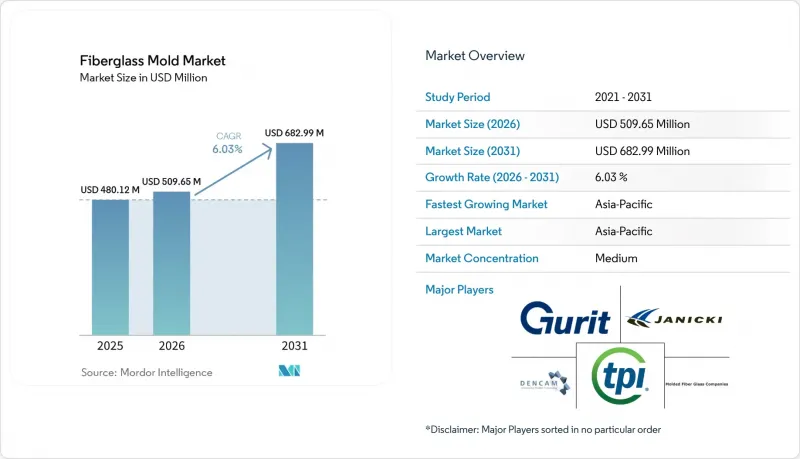
에 따르면 유리섬유 성형 금형 시장 규모는 2025년에 4억 8,012만 달러로 평가되며, 2026년 5억 965만 달러에서 2031년까지 6억 8,299만 달러로 확대되어, 예측 기간(2026-2031년) 동안 CAGR은 6.03%에 달할 것으로 추정됩니다.
세계 유리섬유 성형 금형 시장의 동향 및 인사이트
풍력 터빈 블레이드 생산 확대가 장기적인 금형 수요를 뒷받침하고 있습니다.
유리섬유 성형 금형 시장은 2031년까지 해상 풍력발전 개발의 혜택을 받고 있습니다. 특히, 제조업체들이 더 대형의 해상 풍력 터빈 플랫폼 및 관련 생산 라인에 투자하고 있는 것이 주요 요인입니다. 대형 터빈의 경우, 블레이드 쉘, 루트 어셈블리, 트레일링 에지 섹션 및 기타 블레이드 부품에 전용 금형이 필요합니다. 이러한 부품들은 생산 공정에서 일관되고 정확하게 조립되어야 합니다. 터빈의 정격 출력이 15MW를 초과하면 각 블레이드 플랫폼에는 더 크고 정밀한 금형 세트가 필요하며, 표면 품질 및 치수 관리에 대한 요구 사항이 높아집니다.
신장 진풍 과학기술(Goldwind)은 2026년 광둥성 양장시에서 16.2 MW 터빈을 납품했습니다. 이는 대형 터빈이 초기 개발 프로그램 단계를 넘어 상업적 납품 단계에 접어들었음을 보여줍니다. 차세대 블레이드의 경우, 기존 생산능력이 계속 가동되고 있더라도 전용 금형이 필요합니다. 이는 공기역학적 프로파일이나 뿌리 부분의 설계 변경으로 인해 구형 금형을 사용할 수 없게 될 가능성이 있기 때문입니다. 그 결과, 유리섬유 성형 금형 시장에는 단순한 연간 설치 대수뿐만 아니라, 터빈 설계 변경, 부품 라인에 대한 투자, 그리고 생산 계획과 연동된 지속적인 조달 수요가 존재합니다. 또한, 블레이드 제조업체가 기존 금형의 물리적 수명이 다하기 전에 개선된 프로파일을 도입하는 경우에도 교체 주문이 발생합니다.
자동차 및 운송 분야에서 경량 복합재료의 채택이 중견 시장으로의 금형 진출을 뒷받침하고 있습니다.
자동차 제조사들은 차량 경량화를 도모하고, 전기자동차의 배터리 팩 무게를 상쇄하기 위해 유리섬유 강화 폴리머(GFRP) 부품을 채택하고 있습니다. 이러한 용도에는 차체 패널, 플로어 모듈, 구조용 인서트 등이 포함됩니다. 이러한 추세는 대량 생산 부품 프로그램에서 일관된 표면 마감, 치수 정밀도 및 재현성 있는 생산 주기를 실현하는 유리섬유 강화 플라스틱용 금형에 대한 수요를 뒷받침하고 있습니다.
고압 수지 전사 성형(RTM) 및 진공 주입 성형은 섬유 함량 제어, 신뢰할 수 있는 부품 품질, 그리고 니어넷 쉐이프(near-net-shape) 복합재료 부품이 요구되는 차량 플랫폼에 적합합니다. 차량 중량을 10% 줄이면 연비를 6%에서 8%까지 향상시킬 수 있어, 경량 복합재 부품의 채택을 촉진하고 있습니다. 또한, 제조사가 기존의 금속 부품을 복합재 설계로 대체할 경우, 부품 통합으로 인해 부품 설계나 생산 방식이 변경되는 경우를 포함하여 금형 수요가 발생할 수도 있습니다. 따라서 유리섬유 성형 금형 시장은 차량 총 생산 대수에만 의존하지 않고, 재설계 활동, 생산 품질 요건 및 경량화 프로그램의 영향을 받습니다. 금속 부품에서 복합재료 부품으로의 전환은 확립된 차량 플랫폼 내에서도 새로운 생산용 금형이 필요할 수 있습니다.
시설 및 전용 설비에 대한 막대한 초기 투자가 신규 진입을 제약
실용 규모의 풍력발전용 블레이드 금형을 제조하려면 온도 조절이 가능한 시설, 고정밀 마스터 플러그, 그리고 넓은 표면적과 가공 중 발생하는 열을 감당할 수 있는 경화 장치가 필요합니다. 마스터 플러그는 넓은 작업면 전체에 걸쳐 엄격한 치수 정밀도를 유지해야 하므로, 그 결과 소형 복합재용 금형과는 다른 시설 및 기계 가공 요건이 발생합니다. 대형 블레이드용 금형 세트의 경우, 공급업체가 풍력발전 프로젝트에 참여하기 전에 수백만 달러 규모의 설비 투자가 필요할 수 있습니다. 해상용 가열식 금형의 경우, 내장형 가열 시스템, 강철 프레임, 선반 설비 등으로 인해 투자 요건이 더욱 높아집니다.
이러한 요건으로 인해 고부가가치 금형 제조 능력은 제조사가 생산 노하우와 지원 설비를 갖춘 유럽이나 중국의 시설에 집중되어 있습니다. 남미, 중동 및 아프리카에서도 특수 겔코트, 5축 가공기, 인증을 받은 복합재료 기술자에 대한 접근성은 제한적입니다. 그 결과, 유리섬유 금형 시장의 공급 능력은 신흥 수요 거점으로 서서히 이동하고 있으며, 이는 대규모 생산능력을 갖춘 시설의 우위를 뒷받침하고 있습니다.
부문별 분석
에폭시 수지는 2025년 유리섬유 성형 금형 시장에서 35.16%를 차지했으며, 2031년까지 연평균 성장률(CAGR) 6.78%로 확대될 것으로 전망됩니다. 이에 따라 에폭시 수지는 시장에서 가장 규모가 크고 가장 빠르게 성장하는 수지 카테고리가 되었습니다. 경화 특성으로 인해 폴리에스터계 수지에 비해 수축률이 낮기 때문에 성형 금형의 정밀도가 대형 복합재료 부품의 형상을 결정하는 데 있어 중요합니다. 미세한 치수 오차라도 대형 어셈블리 전체의 공기역학적 특성이나 부품의 결합에 영향을 미칠 수 있습니다. 또한, 에폭시 수지는 풍력발전, 항공우주, 선박용 금형 용도 등에서 채택되는 진공 주입 공정에도 대응하고 있으며, 이러한 분야에서는 제조업체가 안정적이고 재현성이 높은 결과를 요구받고 있습니다.
전미첨단재료성능센터(NCAMP)는 2025년 9월, PRISM EP2400을 항공우주 용도의 에폭시 수지 인퓨전용으로 인증했습니다. 이 인증을 통해 NMS 241 및 NPS 82401을 준수하는 오토클레이브 외 복합재료 제조에 관한 공인된 재료 데이터가 제공됩니다. 비닐에스테르는 염수에 노출되는 선체 용도에서 폴리에스테르계 수지에는 부족한 가수분해 안정성과 침투성 블리스터링에 대한 내성을 갖추고 있어, 선박용 금형에서 여전히 중요한 역할을 하고 있습니다. 폴리에스테르는 비구조용 및 건설 관련 금형 분야에서, 특히 가격에 민감한 남아시아 및 동남아시아 시장에서 다른 소재에 비해 비용 면에서 우위를 유지하고 있습니다. 저점도, 속경화 및 강화형 에폭시 등급은 에폭시에 적합한 용도의 범위를 확대하고 있으며, 정밀 용도에서의 유리섬유 성형 시장 성장을 뒷받침하는 한편, 저비용 수지 시스템의 역할을 축소시키고 있습니다.
지역별 분석
아시아태평양은 2025년 유리섬유 성형 금형 시장 규모의 40.78%를 차지하며, 2031년까지 연평균 성장률(CAGR) 6.85%로 확대될 것으로 예측됩니다. 중국의 해상 풍력발전 제조 거점은 연안부 부품 생산 시설 근처에 성형 거점이 위치해 있어 대형 블레이드용 금형에 대한 지역적 수요를 뒷받침하고 있습니다. 인도의 재생에너지 계획은 국내 터빈 제조 및 현지 복합재료 금형 생산능력에 대한 투자를 촉진하고 있습니다. 유럽의 금형 공급업체들은 완성된 금형을 수출하는 대신, 아시아태평양의 제조업체와 제휴하여 현지에서 블레이드용 금형 제조 역량을 구축하고 있습니다. 지역 생산자들은 풍력발전용 부품 생산 라인과의 근접성 및 확립된 복합재료 공급망에 대한 접근성을 활용하고 있습니다. 이러한 요인들 덕분에 제조업체는 블레이드, 부품, 자재 및 생산 시설의 일정에 맞춰 금형 납기일을 조정할 수 있게 됩니다. 또한, 현지 거점을 확보함으로써 대형 금형을 거점 간에 운송할 때 발생하는 물류상의 문제가 완화되며, 제조업체는 지역 풍력발전 부문에 서비스를 제공하는 공급업체에 대한 접근성도 확보하게 됩니다.
북미에서는 항공우주 및 방위 분야의 복합재 금형에 대한 수요가 뒷받침되고 있으며, 풍력발전이 추가적인 수요를 창출하고 있습니다. 2026년 6월, 자니키 인더스트리즈(Janicki Industries)는 몬태나주 그레이트폴스를 10년까지 200만 제곱피트 규모, 8억 달러 규모의 제조 단지를 건설할 부지로 선정했습니다. 이 확장 계획은 항공우주, 방위, 우주 분야의 복합재 금형 수요에 대응하기 위한 것으로, 첫 5년 동안 1,000명 이상의 일자리를 창출할 것으로 예상됩니다. 유럽은 매출액 기준 2위 지역으로, 덴마크, 독일, 영국의 해상 풍력발전 활동에 힘입고 있습니다. 제조업체는 수지 시스템에 관한 배출 규제도 준수해야 합니다. 이러한 규제는 폴리에스터나 비닐에스테르계 수지를 사용하는 금형 제조업체에게 여전히 운영상의 고려 사항이지만, 해상 풍력발전 및 항공우주 프로그램이 정밀 복합재 금형에 대한 수요를 뒷받침하고 있습니다.
남미, 중동 및 아프리카는 유리섬유 금형 시장에서 규모는 작지만, 여전히 발전 중인 지역으로 남아 있습니다. 브라질의 육상 풍력발전 확대는 기본적인 금형 조달을 뒷받침하고 있지만, 대형 금형의 현지 생산능력은 여전히 제한적이며, 금형 지출의 일부는 유럽 및 중국의 공급업체가 차지하고 있습니다. 사우디아라비아와 아랍에미리트는 에너지 및 복합재료 역량이 발전함에 따라 장기적인 잠재력을 지니고 있습니다. 대형 금형에 대한 정밀 가공, 인증받은 인력, 운송 인프라의 부족이 단기적인 현지 생산의 걸림돌로 남아 있습니다. 현지 공급업체가 대형 프로젝트에서 아시아나 유럽의 유서 깊은 제조업체들과 지속적으로 경쟁할 수 있으려면, 기계 가공, 자재 취급, 복합재료 제조 및 물류 분야의 역량을 강화해야 합니다.
기타 혜택:
- 엑셀 형식의 시장 예측(ME) 시트
- 3개월간의 애널리스트 지원
자주 묻는 질문
목차
제1장 소개
- 조사 가정과 시장 정의
- 조사 범위
제2장 조사 방법
제3장 주요 요약
제4장 시장 구도
- 시장 개요
- 시장 성장 촉진요인
- 시장 성장 억제요인
- 밸류체인 분석
- Porter's Five Forces 분석
제5장 시장 규모와 성장 예측
- 수지 유형별
- 최종 이용 산업별
- 지역별
- 아시아태평양
- 중국
- 인도
- 일본
- 한국
- ASEAN 국가
- 기타 아시아태평양 국가
- 북미
- 미국
- 캐나다
- 멕시코
- 유럽
- 독일
- 영국
- 프랑스
- 이탈리아
- 북유럽 국가
- 기타 유럽 국가
- 남미
- 브라질
- 아르헨티나
- 기타 남미 국가
- 중동 및 아프리카
- 사우디아라비아
- 남아프리카공화국
- 기타 중동 및 아프리카 국가
- 아시아태평양
제6장 경쟁 구도
- 시장 집중도
- 전략적 동향
- 시장 점유율·순위 분석
- 기업 개요
- AOC
- Dencam Composite
- EUROS GmbH
- Gurit Holding AG
- Indutch Composites Technology Pvt. Ltd.
- INEOS
- Janicki Industries, Inc.
- Molded Fiber Glass Companies
- Norco Composites & GRP
- Polynt S.p.A.
- Schutz GmbH & Co. KGaA.
- Scott Bader Company Limited
- Shandong Shuangyi Technology Co., Ltd.
- SSP Technology A/S
- TPI Composites, Inc.
제7장 시장 기회와 향후 전망
KSM 26.10.30According to Mordor Intelligence, the fiberglass mold market size was valued at USD 480.12 million in 2025 and is estimated to grow from USD 509.65 million in 2026 to USD 682.99 million by 2031, at a CAGR of 6.03% during the forecast period (2026-2031).
Global Fiberglass Mold Market Trends and Insights
Wind Turbine Blade Manufacturing Expansion Supports Long-Term Tooling Demand
The Fiberglass Mold Market benefits from offshore wind development through 2031, particularly as manufacturers invest in larger offshore turbine platforms and associated production lines. Larger turbines require dedicated tooling for blade shells, root assemblies, trailing-edge sections, and other blade components that must fit together consistently during production. As turbine ratings exceed 15 MW, each blade platform requires larger and more precise mold sets, increasing the need for surface quality and dimensional control.
Xinjiang Goldwind Science & Technology Co., Ltd. (Goldwind) delivered 16.2 MW turbines in Yangjiang, Guangdong, in 2026, indicating that large turbine formats have entered commercial delivery beyond early-stage development programs. New blade generations require purpose-built tooling, even when existing production capacity remains operational, because changes in aerodynamic profiles or root designs can render older molds unsuitable. Consequently, the Fiberglass Mold Market has a sustained source of procurement demand linked to turbine design modifications, component-line investments, and production plans rather than solely to annual installation levels. Replacement orders also arise when blade manufacturers introduce revised profiles before existing tools reach the end of their usable physical life.
Lightweight Composite Adoption in Automotive and Transportation Drives Mid-Market Tooling Entry
Automotive manufacturers use glass fiber-reinforced polymer components to reduce vehicle weight and offset the mass of battery packs in electric vehicles. These applications include body panels, floor modules, and structural inserts. This trend supports demand for fiberglass molds that deliver consistent surface finishes, controlled dimensions, and repeatable production cycles for higher-output component programs.
High-pressure resin transfer molding and vacuum infusion are relevant for vehicle platforms that require controlled fiber content, reliable part quality, and near-net-shape composite components. A 10% reduction in vehicle weight can improve fuel economy by 6% to 8%, supporting the use of lightweight composite components. Mold demand can also arise when manufacturers replace established metal components with composite designs, including instances where part consolidation changes the component design and production approach. Therefore, the Fiberglass Mold Market is exposed to redesign activity, production-quality requirements, and lightweighting programs that do not depend solely on total vehicle production. A shift from metal to composite parts can require new production tools even within an established vehicle platform.
High Initial Investment in Facilities and Specialized Equipment Constrains New Entrant Activity
Producing a mold for a utility-scale wind blade requires temperature-controlled facilities, a precision master plug, and curing equipment capable of accommodating large surface areas and the heat generated during processing. The master plug must maintain tight dimensional accuracy across a large working surface, resulting in facility and machining requirements that differ from those for smaller composite tools. Large-blade mold sets can require capital investments of several million dollars before a supplier can serve a wind program. Offshore heated molds further increase investment requirements through embedded heating systems, steel frames, and turning equipment.
These requirements concentrate high-value tooling capacity in facilities in Europe and China, where manufacturers have production expertise and supporting equipment. South America, the Middle East, and Africa also have limited access to specialized gel coats, five-axis machining equipment, and certified composite technicians. As a result, supply capacity in the Fiberglass Mold Market shifts slowly toward emerging demand centers, supporting the position of facilities with large-format production capabilities.
Other drivers and restraints analyzed in the detailed report include:
- Aerospace, Defense, and Marine Composite Production Establishes High-Value Tooling Demand
- Automated, Digitally Machined, and Additively Enabled Tooling Reshapes Cost and Speed Economics
- Skilled-Labor, Quality-Control, and Environmental-Compliance Burden Creates Ongoing Operational Drag
For complete list of drivers and restraints, kindly check the Table Of Contents.
Segment Analysis
Epoxy accounted for 35.16% of the Fiberglass Mold Market in 2025 and is forecast to expand at a CAGR of 6.78% through 2031. This makes epoxy the largest and fastest-growing resin category in the market. Its curing characteristics result in lower shrinkage than polyester alternatives, which is important when mold accuracy determines the shape of large finished composite parts. Minor dimensional variations can affect aerodynamic surfaces and component fit across large assemblies. Epoxy also supports vacuum infusion processes used in wind energy, aerospace, and marine tooling applications, where manufacturers require stable and reproducible results.
The National Center for Advanced Materials Performance (NCAMP) qualified PRISM EP2400 for epoxy resin infusion in aerospace applications in September 2025. This qualification provides recognized material data for out-of-autoclave composite fabrication in accordance with NMS 241 and NPS 82401. Vinyl ester remains relevant for marine molds because it provides hydrolytic stability and resistance to osmotic blistering, which polyester systems lack in saltwater hull applications. Polyester retains a cost advantage over other materials for nonstructural and construction-related tooling, particularly in price-sensitive South Asian and Southeast Asian markets. Low-viscosity, fast-curing, and toughened epoxy grades are expanding the range of applications suitable for epoxy, supporting growth in the Fiberglass Mold Market for precision applications while narrowing the role of lower-cost resin systems.
Complete Report Scope:
- By Resin Type
- Epoxy
- Vinyl Ester
- Polyester
- Other Resins
- By End-User Industry
- Wind Energy
- Marine
- Aerospace and Defense
- Automotive and Transportation
- Construction and Infrastructure
- Other End-User Industries
- By Geography
- Asia-Pacific
- China
- India
- Japan
- South Korea
- ASEAN Countries
- Rest of Asia-Pacific
- North America
- United States
- Canada
- Mexico
- Europe
- Germany
- United Kingdom
- France
- Italy
- NORDIC Countries
- Rest of Europe
- South America
- Brazil
- Argentina
- Rest of South America
- Middle East and Africa
- Saudi Arabia
- South Africa
- Rest of Middle East and Africa
- Asia-Pacific
Geography Analysis
Asia-Pacific accounted for 40.78% of the Fiberglass Mold Market size in 2025 and is projected to expand at a CAGR of 6.85% through 2031. China's offshore wind manufacturing base supports regional demand for large blade tooling, with molding activities located near coastal component production facilities. India's renewable energy plans are driving investment in domestic turbine manufacturing and local composite tooling capacity. European mold providers are pursuing partnerships with Asia-Pacific manufacturers to develop local blade-tooling capabilities rather than supplying completed tools for export. Regional producers benefit from proximity to wind-component production lines and access to an established composite supply chain. These factors help manufacturers align mold deliveries with schedules for blades, components, materials, and production facilities. Local presence also reduces the logistical challenges of transporting large tools between locations and provides manufacturers with access to suppliers serving the regional wind sector.
North America is supported by demand for aerospace and defense composite tooling, with wind energy providing additional demand. In June 2026, Janicki Industries selected Great Falls, Montana, for a USD 800 million manufacturing campus spanning 2 million square feet over a decade. The expansion targets aerospace, defense, and space composite tooling requirements and is expected to create more than 1,000 jobs within its first five years. Europe is the second-largest region by revenue, supported by offshore wind activity in Denmark, Germany, and the United Kingdom. Producers must also comply with emissions requirements for resin systems. These requirements remain an operational consideration for mold fabricators using polyester and vinyl ester systems, while offshore wind and aerospace programs support demand for precision composite tools.
South America, the Middle East, and Africa remain smaller but developing regions in the Fiberglass Mold Market. Brazil's onshore wind expansion supports baseline mold procurement; however, local production capacity for large-format molds remains limited, and European and Chinese suppliers receive a share of tooling expenditure. Saudi Arabia and the United Arab Emirates offer long-term potential as their energy and composites capabilities develop. Gaps in precision machining, certified labor, and transportation infrastructure for large molds continue to constrain near-term local production. Local suppliers must strengthen capabilities in machining, materials handling, composite fabrication, and logistics before they can compete consistently with established Asian and European manufacturers on large-format projects.
- AOC
- Dencam Composite
- EUROS GmbH
- Gurit Holding AG
- Indutch Composites Technology Pvt. Ltd.
- INEOS
- Janicki Industries, Inc.
- Molded Fiber Glass Companies
- Norco Composites & GRP
- Polynt S.p.A.
- Schutz GmbH & Co. KGaA.
- Scott Bader Company Limited
- Shandong Shuangyi Technology Co., Ltd.
- SSP Technology A/S
- TPI Composites, Inc.
Additional Benefits:
- The market estimate (ME) sheet in Excel format
- 3 months of analyst support
TABLE OF CONTENTS
1 Introduction
- 1.1 Study Assumptions and Market Definition
- 1.2 Scope of the Study
2 Research Methodology
3 Executive Summary
4 Market Landscape
- 4.1 Market Overview
- 4.2 Market Drivers
- 4.2.1 Wind-Turbine Blade Manufacturing Expansion
- 4.2.2 Lightweight Composite Adoption in Automotive and Transportation
- 4.2.3 Aerospace, Defense and Marine Composite Production
- 4.2.4 Automated, Digitally Machined and Additively Enabled Tooling
- 4.2.5 Model-Renewal Cycles Requiring Replacement Tooling
- 4.3 Market Restraints
- 4.3.1 High Initial Investment in Facilities and Specialized Equipment
- 4.3.2 Skilled-Labor, Quality-Control and Environmental-Compliance Burden
- 4.3.3 Long Tool Life Delaying Replacement Demand
- 4.4 Value Chain Analysis
- 4.5 Porter's Five Forces Analysis
- 4.5.1 Bargaining Power of Suppliers
- 4.5.2 Bargaining Power of Buyers
- 4.5.3 Threat of New Entrants
- 4.5.4 Threat of Substitutes
- 4.5.5 Competitive Rivalry
5 Market Size and Growth Forecasts (Value)
- 5.1 By Resin Type
- 5.1.1 Epoxy
- 5.1.2 Vinyl Ester
- 5.1.3 Polyester
- 5.1.4 Other Resins
- 5.2 By End-User Industry
- 5.2.1 Wind Energy
- 5.2.2 Marine
- 5.2.3 Aerospace and Defense
- 5.2.4 Automotive and Transportation
- 5.2.5 Construction and Infrastructure
- 5.2.6 Other End-User Industries
- 5.3 By Geography
- 5.3.1 Asia-Pacific
- 5.3.1.1 China
- 5.3.1.2 India
- 5.3.1.3 Japan
- 5.3.1.4 South Korea
- 5.3.1.5 ASEAN Countries
- 5.3.1.6 Rest of Asia-Pacific
- 5.3.2 North America
- 5.3.2.1 United States
- 5.3.2.2 Canada
- 5.3.2.3 Mexico
- 5.3.3 Europe
- 5.3.3.1 Germany
- 5.3.3.2 United Kingdom
- 5.3.3.3 France
- 5.3.3.4 Italy
- 5.3.3.5 NORDIC Countries
- 5.3.3.6 Rest of Europe
- 5.3.4 South America
- 5.3.4.1 Brazil
- 5.3.4.2 Argentina
- 5.3.4.3 Rest of South America
- 5.3.5 Middle East and Africa
- 5.3.5.1 Saudi Arabia
- 5.3.5.2 South Africa
- 5.3.5.3 Rest of Middle East and Africa
- 5.3.1 Asia-Pacific
6 Competitive Landscape
- 6.1 Market Concentration
- 6.2 Strategic Moves
- 6.3 Market Share (%)/Ranking Analysis
- 6.4 Company Profiles (includes Global Overview, Market Overview, Core Segments, Financials as available, Strategic Information, Products and Services, and Recent Developments)
- 6.4.1 AOC
- 6.4.2 Dencam Composite
- 6.4.3 EUROS GmbH
- 6.4.4 Gurit Holding AG
- 6.4.5 Indutch Composites Technology Pvt. Ltd.
- 6.4.6 INEOS
- 6.4.7 Janicki Industries, Inc.
- 6.4.8 Molded Fiber Glass Companies
- 6.4.9 Norco Composites & GRP
- 6.4.10 Polynt S.p.A.
- 6.4.11 Schutz GmbH & Co. KGaA.
- 6.4.12 Scott Bader Company Limited
- 6.4.13 Shandong Shuangyi Technology Co., Ltd.
- 6.4.14 SSP Technology A/S
- 6.4.15 TPI Composites, Inc.
7 Market Opportunities and Future Outlook
- 7.1 White-Space and Unmet-Need Assessment


