

|
시장보고서
상품코드
2155676
고성능 엘라스토머 : 시장 점유율 분석, 업계 동향과 통계, 성장 예측(2026-2031년)High Performance Elastomer - Market Share Analysis, Industry Trends & Statistics, Growth Forecasts (2026 - 2031) |
||||||
 Mordor Intelligence
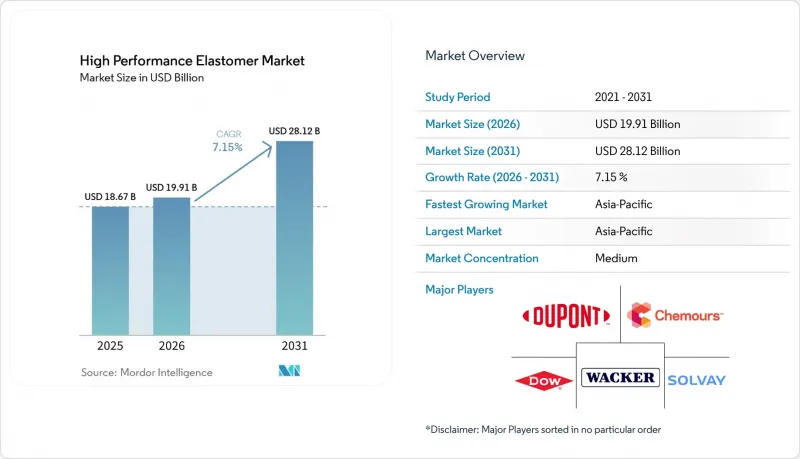
에 따르면 고성능 엘라스토머 시장 규모는 2025년에 186억 7,000만 달러로 평가되며, 예측 기간(2026-2031년) 동안 CAGR 7.15%로 확대되어, 2026년 199억 1,000만 달러에서 2031년에는 281억 2,000만 달러에 달할 것으로 추정됩니다.
세계 고성능 엘라스토머 시장의 동향 및 인사이트
자동차의 전동화와 열 부하 증가
배터리식 전기자동차(BEV) 플랫폼은 엘라스토머 씰에 대한 열적 및 화학적 요구 사항을 완전히 바꿔 놓았습니다. 고전압 차량 시스템에는 배터리, 모터, 충전 부품이 존재하는 환경에서 작동하는 절연재 및 씰링재가 필요합니다. 또한 배터리 팩에는 열 사이클 동안 열전달과 성능을 유지하는 갭 충전재도 필요합니다. 유럽연합(EU)의 배터리 규정에서는 배터리 부품의 폐기 처리에 관한 재료적 고려 사항이 도입되었습니다. Wacker Chemie AG는 배터리 포팅 및 틈새 충전 용도로 ‘ELASTOSIL RT 7616 TC’와 ‘ELASTOSIL RT 7624 TC’를 출시했습니다. 이 제품들은 충전제의 침전을 줄이도록 설계된 유변학적 특성을 갖추고 있습니다. 자동차 프로그램이 전기 절연, 열 관리 및 내구성 있는 밀봉 기능을 모두 갖춘 컴파운드로 전환됨에 따라 고성능 엘라스토머 시장이 활기를 띠고 있습니다.
가혹한 조건에서의 실링 솔루션에 대한 수요
고온, 압력 변동, 화학제품 노출 및 긴 유지보수 주기를 수반하는 용도에는 씰링재가 필요합니다. 반도체 장비, 산업용 펌프, 화학 처리 장비 및 자동차 시스템은 다양한 조건에서 작동하므로, 공급업체는 이에 맞춰 소재와 검증 방법을 최적화해야 합니다. 가혹한 작동 조건에서 씰이 성능을 유지해야 하는 경우, 기존의 고무는 부적합할 수 있습니다. 이러한 추세로 인해 청정도, 내화학성, 압축 영구 변형 성능이 관리된 특수 배합재에 대한 수요가 증가하고 있습니다. 또한, 고성능 엘라스토머 시장에서는 소재 공급 외에도 기술 지원이 요구되고 있습니다. 이는 고객이 컴파운드 선정 및 인증에 관한 지침이 필요한 경우가 많기 때문입니다. 이러한 요건으로 인해 공급업체가 중요한 용도에서 승인된 기존 소재를 대체하기가 더 어려워질 수 있습니다.
특수 원료의 가격 변동
고성능 엘라스토머의 배합은 표준 소재로는 반드시 대체할 수 없는 특수 화학 원료에 의존하고 있습니다. 니트릴계 배합은 아크릴로니트릴의 가격 변동에 영향을 받기 쉬우며, 플루오로엘라스토머는 특수한 불소화 단량체에 의존하고 있습니다. 공급 차질은 컴파운드 가격 상승을 초래하여 공급업체와 구매자 간의 계약 협상을 복잡하게 만들 수 있습니다. 이러한 가격 변동은 자동차 및 산업용 장비 프로그램에서 이미 지정된 소재에도 영향을 미칠 수 있습니다. 가격에 민감한 용도의 경우, 원자재 비용 상승으로 인해 고성능 엘라스토머 시장에서 고객의 구매 결정이 지연될 가능성이 있습니다. 원자재에 대한 접근성이 확보되어 있거나 장기 조달 계약을 체결한 공급업체는 공급 중단 시에도 공급의 연속성을 유지할 수 있을 것입니다.
부문 분석
2025년에는 실리콘 엘라스토머가 매출의 36.17%를 차지하며 고성능 엘라스토머 시장에서 가장 큰 점유율을 기록했습니다. 이러한 소재는 자동차 열 관리 시스템, 의료기기 및 고전압 전기 절연재에 사용됩니다. 액상 실리콘 고무(LSR), 고온 가황 실리콘 및 상온 가황 실리콘은 각각 서로 다른 가공 요건을 충족합니다. 듀폰은 2026년 2월, 의료기기용 ‘Liveo C6-8XX LSR’을 출시하여 쇼어 A 경도 30-70의 5가지 경도 옵션을 제공하고 있습니다.
다우(Dow)는 2026년 6월, 켄터키주 및 중국에 위치한 액상 실리콘 고무 생산 라인을 포함하여 특수 실리콘 분야에 1억 달러를 투자할 계획을 발표했습니다. 플루오로엘라스토머는 2031년까지 연평균 성장률(CAGR) 7.78%로 성장할 것으로 예상되며, 이는 유형별 부문 중 가장 높은 성장률입니다. 반도체 매출 및 화학 처리 활동이 플루오로카본의 성능을 여전히 대체하기 어려운 용도에 대한 수요를 뒷받침하고 있습니다. 3M이 2025년에 퍼플루오로알킬 물질(PFAS) 및 다이네온(Dyneon) 제조에서 철수한 데 따라, 고객의 인증 활동은 대체 공급업체로 전환되었습니다. 수소화 니트릴 부타디엔 고무(HNBR) 및 에틸렌-프로필렌 모노머(EPM)를 포함한 기타 특수 등급은 계속해서 자동차 및 재생에너지 용도로 활용되고 있습니다.
지역별 분석
아시아태평양은 2025년 매출의 45.03%를 차지하며, 2031년까지 연평균 성장률(CAGR) 7.93%로 성장할 것으로 예측됩니다. 이러한 성장은 중국 및 한국의 자동차 공급망, 일본 및 대만의 반도체 생산, 그리고 아세안(ASEAN) 국가들의 의료기기 조립에 의해 뒷받침되고 있습니다. ARLANXEO는 2025년 10월 1단계 가동을 시작한 데 이어, 2026년 2월 창저우에서 ‘Therban’ 수소화 니트릴 부타디엔 고무(HNBR) 공장 개소식을 가졌습니다. 이 시설의 1단계 연간 생산능력은 2,500톤이며, 향후 확장을 염두에 두고 설계되었습니다.
북미에서는 반도체 제조, 항공우주, 제약 제조와 같은 고부가가치 용도가 중심을 이루고 있습니다. 애리조나주, 텍사스주, 뉴욕주에서 진행 중인 새로운 반도체 제조 프로젝트가 특수 씰링재에 대한 수요를 뒷받침하고 있습니다. 또한, 자동차 산업 분야에서 멕시코가 수행하는 니어쇼어링 역할도 씰링재 수요를 뒷받침하고 있습니다. 이 지역의 고성능 엘라스토머 시장 규모는 수요 자체뿐만 아니라 고품질 제품에 대한 요구에 따라 좌우되고 있습니다.
유럽에서는 자동차 및 산업 기계 분야의 수요에 더해, 규제 준수 및 인증에 드는 비용이 높아지고 있습니다. 와커 케미(Wacker Chemie AG)는 2026년에 체코 공화국의 카를로비 바리에 특수 실리콘 생산 거점을 개설했습니다. 남미에서는 브라질의 자동차 및 석유 관련 사업에서 수요가 발생하고 있습니다. 중동 및 아프리카에서는 석유화학, 가스 처리, 광업 분야에서 수요가 발생하고 있습니다.
기타 혜택:
- 엑셀 형식의 시장 예측(ME) 시트
- 3개월간의 애널리스트 지원
자주 묻는 질문
목차
제1장 소개
- 조사 가정과 시장 정의
- 조사 범위
제2장 조사 방법
제3장 주요 요약
제4장 시장 구도
- 시장 개요
- 시장 성장 촉진요인
- 시장 성장 억제요인
- 밸류체인 분석
- Porter's Five Forces 분석
제5장 시장 규모와 성장 예측
- 유형별
- 용도별
- 최종 이용 산업별
- 지역별
- 아시아태평양
- 중국
- 인도
- 일본
- 한국
- ASEAN 국가
- 기타 아시아태평양 국가
- 북미
- 미국
- 캐나다
- 멕시코
- 유럽
- 독일
- 영국
- 프랑스
- 이탈리아
- 북유럽 국가
- 기타 유럽 국가
- 남미
- 브라질
- 아르헨티나
- 기타 남미 국가
- 중동 및 아프리카
- 사우디아라비아
- 남아프리카공화국
- 기타 중동 및 아프리카 국가
- 아시아태평양
제6장 경쟁 구도
- 시장 집중도
- 전략적 동향
- 시장 점유율·순위 분석
- 기업 개요
- 3M
- AGC Inc.
- ARLANXEO
- DAIKIN INDUSTRIES, Ltd.
- Dow
- DuPont
- Exxon Mobil Corporation
- Mitsubishi Chemical Corporation
- Mitsui Chemicals, Inc.
- Momentive
- Solvay
- The Chemours Company
- Trelleborg Group
- Wacker Chemie AG
- ZEON CORPORATION
제7장 시장 기회와 향후 전망
KSM 26.10.30According to Mordor Intelligence, the high performance elastomer market size was valued at USD 18.67 billion in 2025 and is estimated to grow from USD 19.91 billion in 2026 to USD 28.12 billion by 2031, at a CAGR of 7.15% during the forecast period (2026-2031).
Global High Performance Elastomer Market Trends and Insights
Electrification and Higher Thermal Loads in Vehicles
Battery-electric vehicle platforms have changed the thermal and chemical requirements for elastomer seals. High-voltage vehicle systems require insulation and sealing materials that operate in the presence of batteries, motors, and charging components. Battery packs also require gap-filling materials that support heat transfer and performance during thermal cycling. The European Union Battery Regulation introduces material considerations for the end-of-life treatment of battery components. Wacker Chemie AG introduced ELASTOSIL RT 7616 TC and ELASTOSIL RT 7624 TC for battery potting and gap-filling applications, with rheological properties designed to reduce filler sedimentation. The high performance elastomer market is supported as vehicle programs shift toward compounds that combine electrical insulation, thermal management, and durable sealing.
Demand for Extreme Condition Sealing Solutions
Sealing materials are required for applications involving high temperatures, pressure fluctuations, chemical exposure, and long service intervals. Semiconductor equipment, industrial pumps, chemical processing equipment, and vehicle systems operate under varying conditions, requiring suppliers to tailor materials and validation methods accordingly. Conventional rubbers may not be suitable when seals must maintain performance under demanding operating conditions. This trend supports specialty formulations with controlled cleanliness, chemical resistance, and compression-set performance. The high performance elastomer market also requires technical support in addition to material supply, as customers often need guidance on compound selection and qualification. These requirements can make it more difficult for suppliers to replace established materials after approval for critical applications.
Specialty Feedstock Price Volatility
High performance elastomer formulations rely on specialty chemical inputs that standard materials cannot always replace. Nitrile formulations are exposed to acrylonitrile price fluctuations, while fluoroelastomers depend on specialized fluorinated monomers. Supply disruptions can increase compound prices and complicate contract negotiations between suppliers and buyers. These price fluctuations can affect materials already specified in automotive and industrial equipment programs. In price-sensitive applications, higher input costs can delay customer purchasing decisions in the high performance elastomer market. Suppliers with access to feedstock or long-term procurement agreements may maintain supply continuity during disruptions.
Other drivers and restraints analyzed in the detailed report include:
- Semiconductor and High-Purity Electronics Expansion
- Increasing Medical Device and Pharmaceutical Manufacturing
- Fluorochemical Restrictions and PFAS Compliance Uncertainty
For complete list of drivers and restraints, kindly check the Table Of Contents.
Segment Analysis
Silicone elastomers accounted for 36.17% of revenue in 2025, representing the largest share of the high performance elastomer market. These materials are used in automotive thermal management systems, medical devices, and high-voltage electrical insulation. Liquid silicone rubber, high-temperature vulcanized silicone, and room-temperature vulcanized silicone serve distinct processing requirements. DuPont introduced Liveo C6-8XX LSR for healthcare devices in February 2026, offering five Shore A hardness options ranging from 30 to 70.
Dow announced targeted specialty silicone investments of USD 100 million in June 2026, including liquid silicone rubber manufacturing lines in Kentucky and China. Fluoroelastomers are projected to grow at a CAGR of 7.78% through 2031, the highest rate among type segments. Semiconductor sales and chemical processing activities support demand for applications in which fluorocarbon performance remains difficult to replace. 3M's 2025 exit from per- and polyfluoroalkyl substances (PFAS) and Dyneon manufacturing shifted customer qualification activity toward alternative suppliers. Other specialty grades, including hydrogenated nitrile-butadiene rubber (HNBR) and ethylene-propylene-monomer (EPM), continue to serve automotive and renewable energy applications.
Complete Report Scope:
- By Type
- Nitrile-Based Elastomers
- Silicone Elastomers
- Fluoroelastomers
- Others
- By Application
- Seals and Gaskets
- Hoses and Tubing
- Molded Parts
- Wires and Cables
- Others
- By End-User Industry
- Automotive and Transportation
- Industrial Machinery
- Healthcare
- Building and Construction
- Electrical and Electronics
- Others
- By Geography
- Asia-Pacific
- China
- India
- Japan
- South Korea
- ASEAN Countries
- Rest of Asia-Pacific
- North America
- United States
- Canada
- Mexico
- Europe
- Germany
- United Kingdom
- France
- Italy
- NORDIC Countries
- Rest of Europe
- South America
- Brazil
- Argentina
- Rest of South America
- Middle East and Africa
- Saudi Arabia
- South Africa
- Rest of Middle East and Africa
- Asia-Pacific
Geography Analysis
Asia-Pacific accounted for 45.03% of revenue in 2025 and is forecast to grow at a CAGR of 7.93% through 2031. Growth is supported by automotive supply chains in China and South Korea, semiconductor production in Japan and Taiwan, and medical device assembly across ASEAN countries. ARLANXEO inaugurated its Therban Hydrogenated Nitrile Butadiene Rubber (HNBR) plant in Changzhou in February 2026, following the commencement of Phase 1 operations in October 2025. The facility has an annual Phase 1 capacity of 2,500 tons and is designed for future expansion.
North America serves high-value applications in semiconductor fabrication, aerospace, and pharmaceutical manufacturing. New semiconductor fabrication projects in Arizona, Texas, and New York support demand for specialized seals. Mexico's role in automotive nearshoring also supports demand for sealing materials. Premium product requirements, rather than demand alone, influence the size of the high performance elastomer market in the region.
Europe combines automotive and industrial machinery demand with higher regulatory compliance and qualification costs. Wacker Chemie AG opened a specialty silicones production site in Karlovy Vary, Czech Republic, in 2026. South America has demand from Brazil's automotive and petroleum activities. The Middle East and Africa have demand from petrochemical, gas processing, and mining applications.
- 3M
- AGC Inc.
- ARLANXEO
- DAIKIN INDUSTRIES, Ltd.
- Dow
- DuPont
- Exxon Mobil Corporation
- Mitsubishi Chemical Corporation
- Mitsui Chemicals, Inc.
- Momentive
- Solvay
- The Chemours Company
- Trelleborg Group
- Wacker Chemie AG
- ZEON CORPORATION
Additional Benefits:
- The market estimate (ME) sheet in Excel format
- 3 months of analyst support
TABLE OF CONTENTS
1 Introduction
- 1.1 Study Assumptions and Market Definition
- 1.2 Scope of the Study
2 Research Methodology
3 Executive Summary
4 Market Landscape
- 4.1 Market Overview
- 4.2 Market Drivers
- 4.2.1 Electrification and Higher Thermal Loads in Vehicles
- 4.2.2 Demand for Extreme-Condition Sealing Solutions
- 4.2.3 Semiconductor and High-Purity Electronics Expansion
- 4.2.4 Increasing Medical Device and Pharmaceutical Manufacturing
- 4.2.5 Application-Specific Elastomer Qualification for New Energy Systems
- 4.3 Market Restraints
- 4.3.1 Specialty Feedstock Price Volatility
- 4.3.2 Fluorochemical Restrictions and PFAS Compliance Uncertainty
- 4.3.3 Qualification Delays for New Elastomer Formulations
- 4.4 Value Chain Analysis
- 4.5 Porter's Five Forces Analysis
- 4.5.1 Bargaining Power of Suppliers
- 4.5.2 Bargaining Power of Buyers
- 4.5.3 Threat of New Entrants
- 4.5.4 Threat of Substitutes
- 4.5.5 Competitive Rivalry
5 Market Size and Growth Forecasts (Value)
- 5.1 By Type
- 5.1.1 Nitrile-Based Elastomers
- 5.1.2 Silicone Elastomers
- 5.1.3 Fluoroelastomers
- 5.1.4 Others
- 5.2 By Application
- 5.2.1 Seals and Gaskets
- 5.2.2 Hoses and Tubing
- 5.2.3 Molded Parts
- 5.2.4 Wires and Cables
- 5.2.5 Others
- 5.3 By End-User Industry
- 5.3.1 Automotive and Transportation
- 5.3.2 Industrial Machinery
- 5.3.3 Healthcare
- 5.3.4 Building and Construction
- 5.3.5 Electrical and Electronics
- 5.3.6 Others
- 5.4 By Geography
- 5.4.1 Asia-Pacific
- 5.4.1.1 China
- 5.4.1.2 India
- 5.4.1.3 Japan
- 5.4.1.4 South Korea
- 5.4.1.5 ASEAN Countries
- 5.4.1.6 Rest of Asia-Pacific
- 5.4.2 North America
- 5.4.2.1 United States
- 5.4.2.2 Canada
- 5.4.2.3 Mexico
- 5.4.3 Europe
- 5.4.3.1 Germany
- 5.4.3.2 United Kingdom
- 5.4.3.3 France
- 5.4.3.4 Italy
- 5.4.3.5 NORDIC Countries
- 5.4.3.6 Rest of Europe
- 5.4.4 South America
- 5.4.4.1 Brazil
- 5.4.4.2 Argentina
- 5.4.4.3 Rest of South America
- 5.4.5 Middle East and Africa
- 5.4.5.1 Saudi Arabia
- 5.4.5.2 South Africa
- 5.4.5.3 Rest of Middle East and Africa
- 5.4.1 Asia-Pacific
6 Competitive Landscape
- 6.1 Market Concentration
- 6.2 Strategic Moves
- 6.3 Market Share (%)/Ranking Analysis
- 6.4 Company Profiles (includes Global Overview, Market Overview, Core Segments, Financials as available, Strategic Information, Products and Services, and Recent Developments)
- 6.4.1 3M
- 6.4.2 AGC Inc.
- 6.4.3 ARLANXEO
- 6.4.4 DAIKIN INDUSTRIES, Ltd.
- 6.4.5 Dow
- 6.4.6 DuPont
- 6.4.7 Exxon Mobil Corporation
- 6.4.8 Mitsubishi Chemical Corporation
- 6.4.9 Mitsui Chemicals, Inc.
- 6.4.10 Momentive
- 6.4.11 Solvay
- 6.4.12 The Chemours Company
- 6.4.13 Trelleborg Group
- 6.4.14 Wacker Chemie AG
- 6.4.15 ZEON CORPORATION
7 Market Opportunities and Future Outlook
- 7.1 White-Space and Unmet-Need Assessment


