

|
시장보고서
상품코드
2155678
황화셀레늄 : 시장 점유율 분석, 업계 동향과 통계, 성장 예측(2026-2031년)Selenium Sulfide - Market Share Analysis, Industry Trends & Statistics, Growth Forecasts (2026 - 2031) |
||||||
 Mordor Intelligence
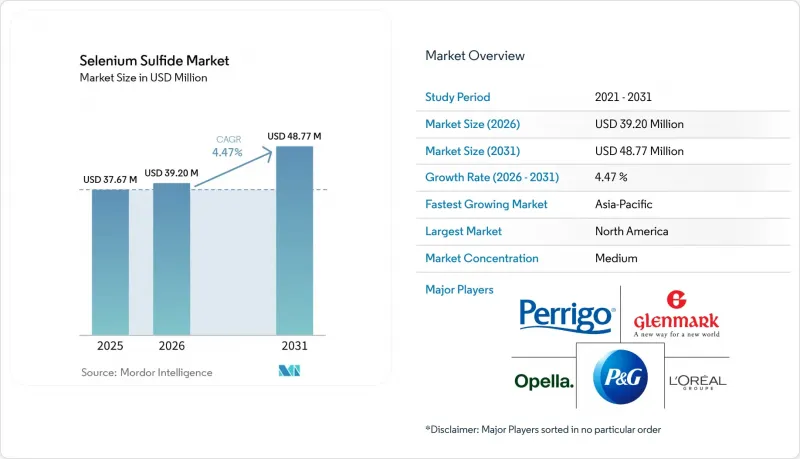
에 따르면 황화셀레늄 시장 규모는 2025년에 3,767만 달러로 평가되며, 2026년 3,920만 달러에서 2031년까지 4,877만 달러에 달할 것으로 예측되며, 예측 기간(2026-2031년) 동안 CAGR은 4.47%가 될 전망입니다.
세계 황화셀레늄 시장의 동향 및 인사이트
비듬 및 지루성 피부염 유병률 증가
황화셀레늄 시장은 종종 반복적인 치료가 필요한 두피 질환으로 인한 지속적인 부담과 관련이 있습니다. 2025년 총설에 따르면, 지루성 피부염의 전 세계 유병률은 4.38%였으며, 그중 성인의 유병률은 5.64%였습니다. 동 종합 보고서에 따르면, 남아프리카공화국의 유병률은 8.82%로 보고되었으며, 인용된 증거 중 국가별로는 가장 높은 수치입니다. 이 질환의 가장 경미한 증상인 비듬은 전 세계 성인 인구의 약 50%에 영향을 미치고 있습니다. 이러한 질환들은 만성적이고 재발하기 쉬운 특성을 가지고 있어, 가정용 제품의 반복적인 구매로 이어지고 있습니다. 또한, 청소년층에서 비듬 유병률이 높은 점도, 저농도로 두피의 장벽 기능에 중점을 둔 제제에 대한 수요에 기여하고 있습니다.
확대되는 피부과 및 항진균 치료 수요
황화셀레늄 시장은 피부과 의료와 의약외품의 통합으로 인한 혜택을 받고 있습니다. 피부과 전문의는 처방약 치료로 전환하기 전에 임상 수준의 효능을 지닌 일반의약품(OTC)을 권장하는 경우가 있습니다. 출처 자료에 인용된 FDA 표시 규정에 따르면, 자가 관리 제품에 1%의 황화셀레늄 사용이 허용되는 반면, 더 높은 농도의 제품 라인은 임상적 수요를 충족시키고 있습니다. 이러한 구분을 통해 제조사는 관련 제품 포트폴리오를 통해 다양한 환자의 요구를 충족시킬 수 있습니다. 원격 피부과 진료는 피부과 전문의가 부족한 지역에서 전문의 진료를 받는 데 따르는 장벽을 낮출 수 있습니다. 디지털 진료 및 약국에서의 구입 가능성은 황화셀레늄 제제에 대한 접근성을 확대할 가능성이 있습니다.
셀레늄 농도에 관한 규제상 제한
황화셀레늄 시장은 농도 제한 및 제품 분류가 서로 다른 각 관할 구역에서 전개되고 있습니다. EU 화장품 규정에서는 제조업체가 화장품을 EU 시장에 출시하기 전에 평가해야 할 조건이 정해져 있습니다. 출처 자료에 따르면, 2026년 5월부터 시행되는 옴니버스법 VIII에 따라 대상 제품에 대해 추가적인 제형 심사가 의무화될 예정이라고 합니다. 미국에서는 FDA의 표시 요건 및 일반의약품 요건에 따라 제품이 농도나 사용 목적에 따라 구분됩니다. 여러 지역에서 제품을 판매하는 기업은 개별 재고 관리 단위(SKU)가 필요할 수 있으며, 이로 인해 규정 준수 및 재고 관리 요건이 증가할 가능성이 있습니다. 또한, 제품 라벨에는 황화셀레늄이 함유된 샴푸는 pH를 6.5 미만으로 유지해야 한다고 명시되어 있어, 이로 인해 유효 성분과 컨디셔닝 성분의 조합이 제한될 가능성이 있습니다.
부문 분석
2025년, 황화셀레늄 시장 내 샴푸의 점유율은 58.13%를 차지했습니다. 이러한 위상은 일반의약품(OTC)으로서의 인지도, 가격 책정, 그리고 화장품과 치료제의 이중 용도를 반영한 것입니다. 씻어내는 타입의 제품은 전신에 대한 셀레늄 노출을 줄일 가능성이 있어, 장기적인 두피 관리 루틴에서의 사용을 촉진하고 있습니다. FDA의 표시 요건은 해당 요건을 충족하는 일반의약품(OTC) 황화셀레늄 제품에 대해 명확한 지침을 제시하고 있습니다. 약국 및 온라인 소매 채널을 통해 제품의 접근성이 향상되고 있습니다. 샴푸는 여전히 황화셀레늄의 주요 일반의약품 형태입니다.
로션은 2031년까지 연평균 성장률(CAGR) 4.78%로 성장할 것으로 예상되며, 이는 모든 제품 형태 중 가장 높은 성장률입니다. 이 제품의 사용은 백선 및 더 넓은 신체 부위에 걸친 치료가 필요한 기타 질환과 관련이 있습니다. 두피 이외의 피부에서 항진균제의 작용 시간을 연장해야 하는 경우, 피부과 전문의는 고농도 로션을 처방할 수 있습니다. 이러한 용도는 샴푸와는 다른 임상적 수요 경로를 창출하고 있습니다. 크림은 국소적인 병변에 대응하지만, 많은 시장에서 전문의의 처방전이 필요하다는 제약이 남아 있습니다. 폼이나 복합 현탁액은 소규모 제품 형태이지만, 유효 성분의 농도를 낮게 유지하면서 두피로의 분포를 개선하기 위해 미세화된 입자에 대한 평가가 진행되고 있습니다.
지역별 분석
2025년, 북미는 황화셀레늄 시장의 34.79%를 차지했습니다. 확립된 OTC(일반의약품) 소매 인프라와 명확한 미국 식품의약국(FDA)의 규제 체계가 이 지역의 시장 지위를 뒷받침하고 있습니다. 제품은 약국, 창고형 소매점 및 온라인 소매 채널을 통해 구입할 수 있습니다. 이 지역의 다음 성장 단계에서는 광범위한 판매량 확대보다는 고부가가치 제품에 초점이 맞춰질 것으로 예상됩니다. 각 브랜드는 임상 수준의 효능을 내세우고, 마이크로바이옴에 초점을 맞춘 처방, 그리고 여러 제품을 조합한 치료 루틴을 강조하고 있습니다.
아시아태평양은 2031년까지 황화셀레늄 시장에서 지역별 가장 높은 연평균 성장률(CAGR) 5.17%를 기록할 것으로 예측됩니다. 중국, 인도, 일본, 한국은 이 지역의 전망에서 중요한 국가들입니다. 중국의 효능 표기 근거에 관한 규정에서는 임상적 근거로 뒷받침되는 제품이 더욱 중시되고 있습니다. 인도 중앙의약품표준관리기구(CDSCO)의 체계에서는 황화셀레늄이 화장품과 의약품의 경계 영역에 속하는 성분으로 분류됩니다. 일본과 한국은 규모는 작지만 고부가가치 시장이며, 프리미엄 두피 관리가 중시되고 있습니다. 태국, 인도네시아, 베트남에서는 열대 기후가 말라세지아균과 관련된 두피 문제의 원인 중 하나가 되기 때문에 향후 수요가 더욱 증가할 잠재력이 예상됩니다.
유럽은 시장 분석에서 2위 규모의 지역을 자랑합니다. 씻어내지 않는 타입의 화장품에 대한 피리티온 아연 사용 규제로 인해, 씻어내는 타입의 항진균제 대체품으로서 황화셀레늄에 대한 관심이 높아지고 있습니다. 독일, 프랑스, 영국 및 북유럽 국가들은 이 지역의 주요 시장입니다. 남미, 중동 및 아프리카는 여전히 소규모 시장이며, 처방전이 필요한 제품 형태의 보급은 제한적입니다. 중동에서는 사우디아라비아와 아랍에미리트(UAE)에서 헬스케어 지출 증가, 피부과 클리닉의 확대, 그리고 임상적으로 입증된 두피 관리에 대한 관심이 높아지고 있습니다.
기타 혜택:
- 엑셀 형식의 시장 예측(ME) 시트
- 3개월간의 애널리스트 지원
자주 묻는 질문
목차
제1장 소개
- 조사 가정과 시장 정의
- 조사 범위
제2장 조사 방법
제3장 주요 요약
제4장 시장 구도
- 시장 개요
- 시장 성장 촉진요인
- 시장 성장 억제요인
- 밸류체인 분석
- Porter's Five Forces 분석
제5장 시장 규모와 성장 예측
- 제품 형태별
- 최종 이용 산업별
- 지역별
- 아시아태평양
- 중국
- 인도
- 일본
- 한국
- ASEAN 국가
- 기타 아시아태평양 국가
- 북미
- 미국
- 캐나다
- 멕시코
- 유럽
- 독일
- 영국
- 프랑스
- 이탈리아
- 북유럽 국가
- 기타 유럽 국가
- 남미
- 브라질
- 아르헨티나
- 기타 남미 국가
- 중동 및 아프리카
- 사우디아라비아
- 남아프리카공화국
- 기타 중동 및 아프리카 국가
- 아시아태평양
제6장 경쟁 구도
- 시장 집중도
- 전략적 동향
- 시장 점유율·순위 분석
- 기업 개요
- Abbott Laboratories
- Adisseo
- Anmol Chemicals
- Bayer AG
- G&W Laboratories
- Galentic Pharma(India) Pvt Ltd
- Glenmark Pharmaceuticals Ltd.
- Gujarat Organics Limited
- L'Oreal S.A.
- Macsen Laboratories
- Merck KGaA
- Omkar Speciality Chemicals Ltd.
- Opella
- Perrigo Company plc
- Procter & Gamble
- Thermo Fisher Scientific Inc.
제7장 시장 기회와 향후 전망
KSM 26.10.30According to Mordor Intelligence, the selenium sulfide market size was valued at USD 37.67 million in 2025 and is estimated to grow from USD 39.20 million in 2026 to reach USD 48.77 million by 2031, at a CAGR of 4.47% during the forecast period (2026-2031).
Global Selenium Sulfide Market Trends and Insights
Rising Prevalence of Dandruff and Seborrheic Dermatitis
The selenium sulfide market is associated with the persistent burden of scalp conditions that often require repeated treatment. A 2025 review reported a global prevalence of seborrheic dermatitis of 4.38%, including an adult prevalence of 5.64%. The same review reported a prevalence of 8.82% in South Africa, the highest nationally recorded figure among the cited evidence. Dandruff, the mildest manifestation of the condition, affects an estimated 50% of the global adult population. The chronic and relapsing nature of these conditions contributes to repeat purchases of home-use products. The high reported prevalence of dandruff among adolescents also contributes to demand for lower-concentration, scalp barrier-focused formulations.
Expanding Dermatology and Antifungal Treatment Demand
The selenium sulfide market benefits from the integration of dermatology and medicated personal care. Dermatologists may recommend clinical-strength over-the-counter (OTC) products before escalating treatment to prescription options. The FDA labeling cited in the source material permits the use of 1% selenium sulfide in self-care products, while higher-strength product pathways address clinical demand. This distinction enables manufacturers to serve different patient needs through related product portfolios. Teledermatology can reduce barriers to specialist consultation in areas with fewer dermatologists. Digital consultations and pharmacy access can expand access to selenium sulfide formulations.
Regulatory Restrictions on Selenium Concentrations
The selenium sulfide market operates across jurisdictions with varying concentration limits and product classifications. The EU Cosmetics Regulation establishes conditions that manufacturers must assess before placing cosmetic products on the EU market. The source material identifies Omnibus Act VIII, effective since May 2026, as requiring additional formulation reviews for affected products. In the United States, FDA labeling and over-the-counter (OTC) requirements differentiate products by concentration and intended use. Companies marketing products across multiple regions may require separate stock-keeping units (SKUs), increasing compliance and inventory management requirements. Product labels also specify that selenium sulfide shampoos must maintain a pH below 6.5, which may limit the combination of active and conditioning ingredients.
Other drivers and restraints analyzed in the detailed report include:
- Growth of Medicated Personal Care Products
- Rising Pet Dermatology and Veterinary Care Spending
- Skin Irritation, Hair Discoloration, and Safety Concerns
For complete list of drivers and restraints, kindly check the Table Of Contents.
Segment Analysis
Shampoo accounted for 58.13% of the selenium sulfide market share in 2025. Its position reflects OTC recognition, pricing, and dual cosmetic and therapeutic applications. The rinse-off format may reduce systemic selenium exposure, supporting its use in long-term scalp care routines. FDA labeling provides a defined pathway for OTC selenium sulfide products that meet applicable requirements. Pharmacy and online retail channels improve product accessibility. Shampoo remains the primary commercial format for selenium sulfide.
Lotion is forecast to grow at a CAGR of 4.78% through 2031, the highest rate among product forms. Its use is associated with tinea versicolor and other conditions requiring treatment over larger body surfaces. Dermatologists may prescribe higher-strength lotions when non-scalp skin requires extended antifungal contact time. This application creates a clinical-demand pathway distinct from that of shampoo. Creams address localized lesions but remain constrained by specialist prescription requirements in many markets. Foams and combination suspensions are smaller product formats; however, micronized particles are being evaluated to improve scalp distribution at lower active concentrations.
Complete Report Scope:
- By Product Form
- Selenium Sulfide Shampoo
- Selenium Sulfide Lotion
- Selenium Sulfide Cream
- Other Product Forms
- By End-User Industry
- Pharmaceutical Industry
- Personal Care Industry
- Cosmetics Industry
- Veterinary Industry
- Others
- By Geography
- Asia-Pacific
- China
- India
- Japan
- South Korea
- ASEAN Countries
- Rest of Asia-Pacific
- North America
- United States
- Canada
- Mexico
- Europe
- Germany
- United Kingdom
- France
- Italy
- NORDIC Countries
- Rest of Europe
- South America
- Brazil
- Argentina
- Rest of South America
- Middle East and Africa
- Saudi Arabia
- South Africa
- Rest of Middle East and Africa
- Asia-Pacific
Geography Analysis
North America accounted for 34.79% of the selenium sulfide market share in 2025. Established OTC retail infrastructure and a defined Food and Drug Administration (FDA) framework support the region's market position. Products are available through pharmacies, warehouse retailers, and online retail channels. The region's next growth phase is expected to focus on higher-value products rather than broad-based unit sales expansion. Brands are emphasizing clinical-strength claims, microbiome-focused formulations, and treatment routines involving more than one product.
Asia-Pacific is projected to record the highest regional CAGR of 5.17% through 2031 in the selenium sulfide market. China, India, Japan, and South Korea are key countries in the regional outlook. China's claim substantiation rules place greater emphasis on products supported by clinical evidence. India's Central Drugs Standard Control Organization (CDSCO) framework classifies selenium sulfide as a cosmetic-pharmaceutical crossover ingredient. Japan and South Korea are smaller, high-value markets where premium scalp care is relevant. Thailand, Indonesia, and Vietnam offer additional potential for demand, as tropical conditions can contribute to Malassezia-related scalp disorders.
Europe is the second-largest region in the market analysis. Restrictions on zinc pyrithione in leave-on cosmetics have increased attention on selenium sulfide as a rinse-off antifungal alternative. Germany, France, the United Kingdom, and the Nordic countries are key markets in the region. South America, the Middle East, and Africa remain smaller markets, with limited adoption of prescription-grade formats. In the Middle East, Saudi Arabia and the UAE are supported by healthcare spending, the expansion of dermatology clinics, and interest in clinically validated scalp care.
- Abbott Laboratories
- Adisseo
- Anmol Chemicals
- Bayer AG
- G&W Laboratories
- Galentic Pharma (India) Pvt Ltd
- Glenmark Pharmaceuticals Ltd.
- Gujarat Organics Limited
- L'Oreal S.A.
- Macsen Laboratories
- Merck KGaA
- Omkar Speciality Chemicals Ltd.
- Opella
- Perrigo Company plc
- Procter & Gamble
- Thermo Fisher Scientific Inc.
Additional Benefits:
- The market estimate (ME) sheet in Excel format
- 3 months of analyst support
TABLE OF CONTENTS
1 Introduction
- 1.1 Study Assumptions and Market Definition
- 1.2 Scope of the Study
2 Research Methodology
3 Executive Summary
4 Market Landscape
- 4.1 Market Overview
- 4.2 Market Drivers
- 4.2.1 Rising Prevalence of Dandruff and Seborrheic Dermatitis
- 4.2.2 Expanding Dermatology and Antifungal Treatment Demand
- 4.2.3 Growth of Medicated Personal-Care Products
- 4.2.4 Rising Pet Dermatology and Veterinary Care Spending
- 4.2.5 E-Commerce Expansion for OTC Dermatology Products
- 4.3 Market Restraints
- 4.3.1 Regulatory Restrictions on Selenium Concentrations
- 4.3.2 Skin Irritation, Hair Discoloration, and Safety Concerns
- 4.3.3 Competition From Ketoconazole, Zinc Pyrithione, and Botanical Alternatives
- 4.4 Value Chain Analysis
- 4.5 Porter's Five Forces Analysis
- 4.5.1 Bargaining Power of Suppliers
- 4.5.2 Bargaining Power of Buyers
- 4.5.3 Threat of New Entrants
- 4.5.4 Threat of Substitutes
- 4.5.5 Competitive Rivalry
5 Market Size and Growth Forecasts (Value)
- 5.1 By Product Form
- 5.1.1 Selenium Sulfide Shampoo
- 5.1.2 Selenium Sulfide Lotion
- 5.1.3 Selenium Sulfide Cream
- 5.1.4 Other Product Forms
- 5.2 By End-User Industry
- 5.2.1 Pharmaceutical Industry
- 5.2.2 Personal Care Industry
- 5.2.3 Cosmetics Industry
- 5.2.4 Veterinary Industry
- 5.2.5 Others
- 5.3 By Geography
- 5.3.1 Asia-Pacific
- 5.3.1.1 China
- 5.3.1.2 India
- 5.3.1.3 Japan
- 5.3.1.4 South Korea
- 5.3.1.5 ASEAN Countries
- 5.3.1.6 Rest of Asia-Pacific
- 5.3.2 North America
- 5.3.2.1 United States
- 5.3.2.2 Canada
- 5.3.2.3 Mexico
- 5.3.3 Europe
- 5.3.3.1 Germany
- 5.3.3.2 United Kingdom
- 5.3.3.3 France
- 5.3.3.4 Italy
- 5.3.3.5 NORDIC Countries
- 5.3.3.6 Rest of Europe
- 5.3.4 South America
- 5.3.4.1 Brazil
- 5.3.4.2 Argentina
- 5.3.4.3 Rest of South America
- 5.3.5 Middle East and Africa
- 5.3.5.1 Saudi Arabia
- 5.3.5.2 South Africa
- 5.3.5.3 Rest of Middle East and Africa
- 5.3.1 Asia-Pacific
6 Competitive Landscape
- 6.1 Market Concentration
- 6.2 Strategic Moves
- 6.3 Market Share (%)/Ranking Analysis
- 6.4 Company Profiles (includes Global Overview, Market Overview, Core Segments, Financials as available, Strategic Information, Products and Services, and Recent Developments)
- 6.4.1 Abbott Laboratories
- 6.4.2 Adisseo
- 6.4.3 Anmol Chemicals
- 6.4.4 Bayer AG
- 6.4.5 G&W Laboratories
- 6.4.6 Galentic Pharma (India) Pvt Ltd
- 6.4.7 Glenmark Pharmaceuticals Ltd.
- 6.4.8 Gujarat Organics Limited
- 6.4.9 L'Oreal S.A.
- 6.4.10 Macsen Laboratories
- 6.4.11 Merck KGaA
- 6.4.12 Omkar Speciality Chemicals Ltd.
- 6.4.13 Opella
- 6.4.14 Perrigo Company plc
- 6.4.15 Procter & Gamble
- 6.4.16 Thermo Fisher Scientific Inc.
7 Market Opportunities and Future Outlook
- 7.1 White-Space and Unmet-Need Assessment


