

|
시장보고서
상품코드
2155682
미토마이신 : 시장 점유율 분석, 업계 동향과 통계, 성장 예측(2026-2031년)Mitomycin - Market Share Analysis, Industry Trends & Statistics, Growth Forecasts (2026 - 2031) |
||||||
 Mordor Intelligence
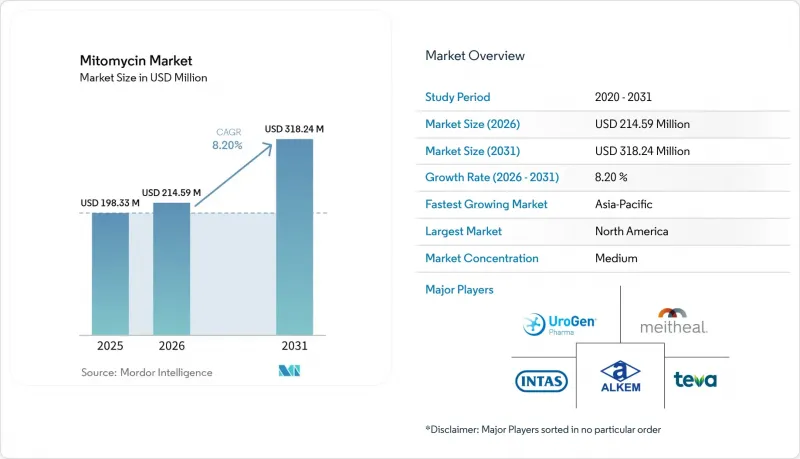
에 따르면 미토마이신 시장 규모는 2025년에 1억 9,833만 달러로 평가되며, 2026년 2억 1,459만 달러에서 2031년까지 3억 1,824만 달러에 달할 것으로 예측되며, 예측 기간(2026-2031년) 동안 CAGR은 8.20%가 될 전망입니다.
세계 미토마이신 시장의 동향 및 인사이트
비근층 침윤성 방광암 발병률 증가
2026년 미국에서 추정된 8만 4,530건의 신규 방광암 사례 중 80%를 비근층 침윤성 방광암이 차지했습니다. 전 세계적으로는 2024년에 61만 4,000건의 신규 방광암 사례가 기록되었습니다.
인구의 고령화와 증가에 따라 진단, 경과 관찰 및 재치료가 필요한 환자 수가 증가하고 있으며, 북미 및 동아시아에서는 여전히 큰 질병 부담이 남아 있는 반면, 인도와 아프리카 일부 지역에서는 사례 수가 증가하는 추세를 보이고 있습니다. 경요도 절제술 후 재발은 방광 내 치료의 재치료 수요를 유발하는 주요 요인으로 계속 작용하고 있으며, 환자의 최대 70%가 적어도 한 번의 재발을 경험하고 있어 미토마이신 시장에서 미토마이신 제제에 대한 지속적인 수요를 뒷받침하고 있습니다.
서방형 방광 내 제제의 확대
UroGen Pharma사의 RTGel 플랫폼은 요로 상피와의 약물 접촉 시간을 연장함으로써 미토마이신의 치료적 역할을 확대했습니다. 기존의 방광 내 투여용 미토마이신 C는 방광 내에 1-2시간 머무르는 반면, 역열반응성 하이드로겔은 체온에서 반고체 겔로 변하여, 적격 환자에 대해 전신 마취가 필요 없는 외래 화학 소작 요법을 가능하게 합니다. ZUSDURI는 3상 ENVISION 임상시험에서 3개월 시점에서 78%의 완전 반응률을 달성했으며, 반응자의 64.5%가 36개월 시점에서 반응을 유지하고 있었고, 추적 관찰 기간의 중앙값은 35.5개월이었습니다. UGN-103은 3상 UTOPIA 임상시험에서 3개월 시점에 77.8%의 완전 반응률을 달성했으며, 6개월 시점의 반응 지속률은 94.5%였습니다. UroGen사는 2026년 8월 17일에 신약 승인 신청(NDA)을 제출했으며, 이를 통해 미토마이신 시장에서 치료의 편의성과 임상적 지속성을 겨룰 기회가 생겨났습니다.
세포독성 약제의 취급 및 산업 안전에 관한 요건
미토마이신 C는 유해 의약품으로 취급되며, 전용 조제 공정, 훈련을 받은 약국 직원 및 보호 조치가 필요합니다. 이러한 요건은 병원, 외래 수술 센터 및 지역 암 진료소, 특히 조제 능력이나 전문 인력이 제한된 소규모 시설에서 운영의 복잡성과 비용을 증가시킵니다. RTGel 기반 제제는 투여 전에 온도 조절된 재구성 과정이 필요하지만, UroGen사는 이러한 부담을 줄이기 위해 UGN-103의 재구성 과정을 단순화하여 설계했습니다. 치료 적응 기간이 좁고 제제마다 고유한 투여 요건이 있기 때문에 지역 의료 현장이나 자원이 제한된 의료 시스템에서의 도입이 지연될 가능성이 있습니다.
부문 분석
2025년 시점에서, 주사용 마이토마이신 C는 마이토마이신 시장 점유율의 54.56%를 차지했습니다. 위암, 췌장암, 항문암에 대한 전신 치료 프로토콜과 비근층 침윤성 방광암에 대한 방광 내 치료에서 확립된 사용 실적이 병원의 수요를 뒷받침하고 있습니다. Accord Healthcare, Fresenius Kabi, Maiteal Pharmaceuticals 및 아시아 제조사들이 이 부문에서 경쟁하고 있으며, 조달 결정은 가격, 제조 신뢰성 및 원료의약품(API)의 가용성에 따라 좌우됩니다. 신우·신배용 미토마이신 및 안과용 미토마이신 키트는 규모는 작지만 확립된 수익원이 되고 있습니다. ‘JELMYTO’는 미국 내 실제 임상 증거의 확대와 보험 급여 적용 범위 확대의 혜택을 받고 있습니다. 2025년 1월, 15개 대학 병원 및 지역 의료 기관에서 최초 완전 반응자 56명을 대상으로 한 다기관 공동 분석 결과, 3년 무재발 생존율이 68%로 보고되었습니다.
방광 내 투여용 미토마이신은 2031년까지 연평균 성장률(CAGR) 9.45%로 성장할 것으로 예측됩니다. ZUSDURI는 2026년 2분기에 5,040만 달러의 매출을 기록했으며, UroGen사는 2026년 6월 30일 기준으로 1,444개의 진료 거점을 운영하며 452명의 처방 의사를 확보했습니다. UroGen사는 2026년 8월 17일, UGN-103의 신약허가신청서(NDA)를 제출했습니다. 이 차세대 제품은 조제 절차가 간소화되고 보관 기간이 연장되어 비뇨기과 전문 센터 이외의 곳에서도 실용성이 향상되었습니다. 안과용 키트는 최소침습 녹내장 수술에서 결막하 임플란트 강화를 위한 마이토마이신 사용이 확대되는 가운데, 안정적인 입지를 유지하고 있습니다. 제품 구성은 가격 압박에 직면한 대량 판매 제네릭 의약품에서 부가가치가 높은 전문 제제로 점차 전환되고 있습니다.
2025년, 미토마이신 시장 규모의 55.45%를 종양학 분야가 차지했습니다. 미토마이신 C는 위선암 및 췌장선암, 항문관암에 대한 병용요법, 그리고 복막 전이에 대한 HIPEC(복강 내 온열 화학요법)에 사용되고 있습니다. 이러한 다양한 치료 현장에서의 사용은 기존 제품에 대한 수요를 뒷받침하는 동시에, 단일 종양학 프로토콜에 대한 의존도를 낮추고 있습니다. 병원 종양학과 약국에서는 주사제의 조제 및 투여에 관한 확립된 워크플로가 유지되고 있습니다. 나머지 치료 수요는 안과 및 기타 외과적 용도가 차지하고 있으며, 특히 섬유주대 절제술과 관련된 사용은 여러 지역에서 정착되어 있습니다. 2025년 연구에 따르면, 원발성 및 이차성 녹내장에서 섬유주 절제술과 미토마이신 C의 병용요법을 시행한 경우, 8년 후 복합 성공률 또는 적격 성공률이 65.9%였던 것으로 보고되었습니다.
비뇨기과 분야는 2031년까지 연평균 성장률(CAGR) 10.52%로 성장할 것으로 예측됩니다. 이러한 성장은 비근층 침윤성 방광암 발병률의 증가, 화학적 절제 치료 옵션의 확대, 그리고 서방형 제제를 위한 상업적 인프라 확충에 의해 뒷받침되고 있습니다. 2026년 9월 미국 비뇨기과학회(AUA) 및 비뇨기종양학회(SOU)의 개정안에는 2025년 12월까지의 문헌 검토를 바탕으로 한 40건의 새로운 권고 사항이 포함되었습니다. 이 지침은 재발한 저악성도 질환을 가진 특정 환자에 대해 경요도 절제술의 반복을 대체할 대안으로 적극적인 경과 관찰, 외래 치료 및 화학적 소작 요법을 권장하고 있습니다. JELMYTO는 또한 저악성 상부 요로 요로상피암에 대한 신장 보존 요법을 지지하고 있습니다. 이러한 필요성은 특히 고령 환자에게 중요하며, 출처 자료에 따르면 이 환자군의 진단 당시 연령 중앙값은 73세였습니다.
지역별 분석
북미는 2025년 미토마이신 시장의 41.95% 점유율을 차지했습니다. 이는 FDA 승인을 받은 두 가지 특수 제제, 확립된 종양학 분야의 보험 급여 제도, 그리고 높은 방광암 유병률에 힘입은 결과입니다. 미국에서는 2021년에 0.101%의 방광암 유병률이 기록되었으며, 31개 주에서 0.1%를 초과하는 유병률이 보고되었습니다. ZUSDURI는 2026년 2분기에 1,444곳의 운영 중인 의료 시설을 보유하고 5,040만 달러의 매출을 기록했습니다. 한편, JELMYTO는 2025년에 9,400만 달러의 매출을 기록했으며, 2026년 매출 전망은 9,700만-1억 100만 달러로 예상됩니다. 캐나다와 멕시코에서는 병원 기반의 주사 프로토콜이 채택되고 있는 반면, 브라질과 아르헨티나에서는 공공 암 치료 프로그램과 등록된 공급망에 의존하고 있습니다.
본 분석에서 유럽은 2위 지역 시장으로 나타났습니다. 독일, 프랑스, 영국, 이탈리아는 비근층침윤성 방광암 및 녹내장 수술 프로토콜이 확립된, 치료 건수가 많은 종양학 중심지입니다. 2026년 EAU 가이드라인 개정에서는 BCG 무효 종양에 대한 치료표가 추가되고, 저악성도 재발 질환에 대한 치료 강도 경감에 관한 섹션이 마련되어 방광 내 치료법의 선택지가 보다 적극적으로 검토되게 되었습니다. 영국에서는 25개 기관에서 HIVEC-HEAT 3상 임상시험이 진행되고 있는 반면, 스페인을 비롯한 여러 국가에서는 공립병원 종양학과 및 비뇨기과 처방집에 기존의 마이토마이신 C가 여전히 등재되어 있습니다.
아시아태평양은 2031년까지 연평균 성장률(CAGR) 10.67%로 성장할 것으로 예측됩니다. 인도는 생산과 소비를 주도하고 있으며, 인타스 파마슈티컬스(Intas Pharmaceuticals)가 아코드 바이오파마(Accord BioPharma)를 위해 무타마이신을 제조하고 있습니다. 일본, 호주, 한국 및 기타 지역 국가에서는 장기 보존 치료, 녹내장 수술, 그리고 항암제 제네릭 의약품 조달을 통해 수요를 뒷받침하고 있는 반면, 중동 및 아프리카에서는 GCC(걸프협력회의)의 조달 및 남아프리카공화국 공립병원의 항암제 처방 목록을 통해 잠재적인 시장이 전망되고 있습니다.
기타 혜택:
- 엑셀 형식의 시장 예측(ME) 시트
- 3개월간의 애널리스트 지원
자주 묻는 질문
목차
제1장 소개
- 조사 가정과 시장 정의
- 조사 범위
제2장 조사 방법
제3장 주요 요약
제4장 시장 구도
- 시장 개요
- 시장 성장 촉진요인
- 시장 성장 억제요인
- 가치 및 공급망 분석
- 규제 상황
- 기술 전망
- Porter's Five Forces 분석
제5장 시장 규모와 성장 예측
- 제품 유형별
- 치료 분야별
- 최종사용자별
- 제형별
- 지역별
- 북미
- 미국
- 캐나다
- 멕시코
- 유럽
- 독일
- 영국
- 프랑스
- 이탈리아
- 스페인
- 기타 유럽 국가
- 아시아태평양
- 중국
- 인도
- 일본
- 호주
- 한국
- 기타 아시아태평양 국가
- 중동 및 아프리카
- GCC
- 남아프리카공화국
- 기타 중동 및 아프리카 국가
- 남미
- 브라질
- 아르헨티나
- 기타 남미 국가
- 북미
제6장 경쟁 구도
- 시장 집중도
- 시장 점유율 분석
- 기업 개요
- Accord Healthcare, Inc.
- AdvaCare Pharma
- Alkem Laboratories Limited
- Cipla Limited
- Eugia US LLC
- Fresenius Kabi AG
- Hikma Pharmaceuticals PLC
- Intas Pharmaceuticals Limited
- Lupin Limited
- Meitheal Pharmaceuticals, Inc.
- Pfizer Inc.
- Sun Pharmaceutical Industries Limited
- Teva Pharmaceutical Industries Ltd.
- UroGen Pharma Ltd.
- Zydus Lifesciences Limited
제7장 시장 기회와 향후 전망
KSM 26.10.30According to Mordor Intelligence, the mitomycin market size was valued at USD 198.33 million in 2025 and is estimated to grow from USD 214.59 million in 2026 to reach USD 318.24 million by 2031, at a CAGR of 8.20% during the forecast period (2026-2031).
Global Mitomycin Market Trends and Insights
Rising Incidence of Non-Muscle-Invasive Bladder Cancer
Non-muscle-invasive bladder cancer accounted for 80% of the estimated 84,530 new bladder cancer cases in the United States in 2026. Globally, bladder cancer recorded 614,000 new cases in 2024.
Population aging and growth have increased the number of patients requiring diagnosis, monitoring, and repeat treatment, with the disease burden remaining significant in North America and East Asia and case growth emerging in India and parts of Africa. Recurrence after transurethral resection remains a key driver of repeat intravesical treatment demand, with up to 70% of patients experiencing at least one recurrence, supporting recurring demand for mitomycin-based products in the mitomycin market.
Expansion of Sustained-Release Intravesical Formulations
UroGen Pharma's RTGel platform has expanded the treatment role of mitomycin by extending drug contact with the urothelium. Conventional intravesical mitomycin C remains in the bladder for one to two hours, while the reverse-thermal hydrogel becomes a semi-solid gel at body temperature, enabling outpatient chemoablation without general anesthesia for eligible patients. ZUSDURI achieved a 78% complete response rate at three months in the Phase 3 ENVISION trial, and 64.5% of responders maintained a response at 36 months, with a median follow-up of 35.5 months. UGN-103 achieved a 77.8% complete response rate at three months, and a 94.5% six-month duration of response in the Phase 3 UTOPIA study, and UroGen submitted its NDA on August 17, 2026, creating opportunities for the mitomycin market to compete on treatment convenience and clinical durability.
Cytotoxic-Handling and Occupational-Safety Requirements
Mitomycin C is handled as a hazardous drug and requires dedicated preparation processes, trained pharmacy staff, and protective controls. These requirements increase operational complexity and costs for hospitals, ambulatory surgery centers, and community oncology practices, particularly smaller sites with limited compounding capacity and specialized staff. RTGel-based formulations require temperature-controlled reconstitution before administration, while UroGen designed UGN-103 with simplified reconstitution to reduce this burden. Narrow treatment windows and formulation-specific administration requirements can slow adoption in community settings and lower-resource health systems.
Other drivers and restraints analyzed in the detailed report include:
- Increasing Use of Mitomycin in Ophthalmic Antifibrotic Surgery
- Formulation-Specific Supply Resilience as a Procurement Priority
- Competition from BCG, Gemcitabine, and Combination Intravesical Therapies
For complete list of drivers and restraints, kindly check the Table Of Contents.
Segment Analysis
Mitomycin C for Injection held 54.56% of the mitomycin market share in 2025. Its established use in systemic protocols for gastric, pancreatic, and anal cancers, as well as intravesical treatment for non-muscle-invasive bladder cancer, supports hospital demand. Accord Healthcare, Fresenius Kabi, Meitheal Pharmaceuticals, and Asian manufacturers compete in this category, where procurement decisions depend on pricing, manufacturing reliability, and API availability. Mitomycin for Pyelocalyceal Solution and Ophthalmic Mitomycin Kits represented smaller but established revenue pools. JELMYTO benefits from expanding real-world evidence and reimbursement access in the United States. A January 2025 multicenter analysis of 56 initial complete responders across 15 academic and community centers reported 68% recurrence-free survival at 3 years.
Mitomycin for Intravesical Solution is forecast to grow at a 9.45% CAGR through 2031. ZUSDURI generated USD 50.4 million in Q2 2026 revenue, while UroGen activated 1,444 sites of care and recorded 452 unique prescribers by June 30, 2026. UroGen submitted an NDA for UGN-103 on August 17, 2026. The next-generation product has simplified reconstitution and an extended shelf life, improving its practicality beyond specialist urology centers. Ophthalmic kits retain a stable role as minimally invasive glaucoma surgery expands mitomycin use for subconjunctival implant augmentation. The product mix is shifting toward high-volume generics, facing pricing pressure, and specialty formulations with higher value contribution.
Oncology accounted for 55.45% of the mitomycin market size in 2025. Mitomycin C is used in combination regimens for gastric and pancreatic adenocarcinoma, anal canal cancer, and HIPEC for peritoneal carcinomatosis. Its use across multiple treatment settings supports demand for conventional products and reduces reliance on a single oncology protocol. Hospital oncology pharmacies maintain established workflows for injectable preparation and administration. Ophthalmology and other surgical applications account for the remaining therapeutic demand, with trabeculectomy-associated use established across multiple geographies. A 2025 study reported 65.9% combined or qualified success at 8 years for trabeculectomy with mitomycin C in primary and secondary glaucoma.
Urology is forecast to grow at a 10.52% CAGR through 2031. Growth is supported by rising non-muscle-invasive bladder cancer incidence, chemoablative treatment options, and expanding commercial infrastructure for sustained-release products. The September 2026 AUA and Society of Urologic Oncology amendment included 40 new recommendations based on a literature review through December 2025. The guidance supports active surveillance, office-based treatment, and chemoablative therapies as alternatives to repeat transurethral resection for selected patients with recurrent low-grade disease. JELMYTO also supports kidney-sparing care for low-grade upper-tract urothelial carcinoma. This need is particularly relevant for older patients, whose median diagnosis age was 73 years in the source material.
Complete Report Scope:
- By Product Type
- Mitomycin C for Injection
- Mitomycin for Intravesical Solution
- Mitomycin for Pyelocalyceal Solution
- Ophthalmic Mitomycin Kits
- By Therapeutic Area
- Oncology
- Urology
- Ophthalmology
- Other Surgical Applications
- By End User
- Hospitals
- Specialty Cancer Centers
- Ambulatory Surgery Centers
- Ophthalmology Clinics
- Cancer Research Institutes
- Others
- By Dosage Form
- Intravenous
- Intravesicles
- Topical
- Others
- By Geography
- North America
- United States
- Canada
- Mexico
- Europe
- Germany
- United Kingdom
- France
- Italy
- Spain
- Rest of Europe
- Asia-Pacific
- China
- India
- Japan
- Australia
- South Korea
- Rest of Asia-Pacific
- Middle East and Africa
- GCC
- South Africa
- Rest of Middle East and Africa
- South America
- Brazil
- Argentina
- Rest of South America
- North America
Geography Analysis
North America held 41.95% of the mitomycin market share in 2025, supported by two FDA-approved specialty formulations, established oncology reimbursement, and high bladder cancer prevalence. The United States recorded a bladder cancer prevalence of 0.101% in 2021, with 31 states reporting prevalence above 0.1%. ZUSDURI had 1,444 activated sites of care and generated USD 50.4 million in Q2 2026 revenue, while JELMYTO generated USD 94 million in 2025 and has 2026 revenue guidance of USD 97-101 million. Canada and Mexico use hospital-based injectable protocols, while Brazil and Argentina rely on public oncology programs and registered supply chains.
Europe is the second-largest regional market in the analysis. Germany, France, the United Kingdom, and Italy are high-volume oncology hubs with established non-muscle-invasive bladder cancer and glaucoma surgery protocols. The 2026 EAU guideline update added treatment tables for BCG-unresponsive tumors and a section on de-intensification for low-grade recurrent disease, supporting greater consideration of intravesical treatment options. The United Kingdom hosts the 25-site HIVEC-HEAT Phase 3 trial, while Spain and other countries retain conventional mitomycin C in public hospital oncology and urology formularies.
Asia-Pacific is forecast to grow at a CAGR of 10.67% through 2031. India supports production and consumption, with Intas Pharmaceuticals manufacturing Mutamycin for Accord BioPharma. Japan, Australia, South Korea, and other regional countries support demand through organ-preserving care, glaucoma surgery, and generic oncology procurement, while the Middle East and Africa offer potential through GCC procurement and South African public oncology formularies.
- Accord Healthcare, Inc.
- AdvaCare
- Alkem Laboratories Limited
- Cipla
- Eugia US LLC
- Fresenius
- Hikma Pharmaceuticals
- Intas Pharmaceutical
- Lupin
- Meitheal Pharmaceuticals, Inc.
- Pfizer
- Sun Pharmaceuticals Industries
- Teva Pharmaceutical Industries
- UroGen Pharma Ltd.
- Zydus Lifesciences Limited
Additional Benefits:
- The market estimate (ME) sheet in Excel format
- 3 months of analyst support
TABLE OF CONTENTS
1 INTRODUCTION
- 1.1 Study Assumptions and Market Definition
- 1.2 Scope of the Study
2 RESEARCH METHODOLOGY
3 EXECUTIVE SUMMARY
4 MARKET LANDSCAPE
- 4.1 Market Overview
- 4.2 Market Drivers
- 4.2.1 Rising Incidence of Non-Muscle-Invasive Bladder Cancer
- 4.2.2 Expansion of Sustained-Release Intravesical Formulations
- 4.2.3 Increasing Use of Mitomycin in Ophthalmic Antifibrotic Surgery
- 4.2.4 Formulation-Specific Supply Resilience as a Procurement Priority
- 4.2.5 Growing Demand for Kidney-Sparing Upper-Tract Urothelial Cancer Treatment
- 4.3 Market Restraints
- 4.3.1 Cytotoxic-Handling and Occupational-Safety Requirements
- 4.3.2 Competition From BCG, Gemcitabine and Combination Intravesical Therapies
- 4.3.3 Narrow Treatment Windows and Formulation-Specific Administration Complexity
- 4.4 Value/Supply-Chain Analysis
- 4.5 Regulatory Landscape
- 4.6 Technological Outlook
- 4.7 Porter's Five Forces Analysis
- 4.7.1 Bargaining Power of Suppliers
- 4.7.2 Bargaining Power of Buyers
- 4.7.3 Threat of New Entrants
- 4.7.4 Threat of Substitutes
- 4.7.5 Competitive Rivalry
5 MARKET SIZE AND GROWTH FORECASTS (VALUE, USD)
- 5.1 By Product Type
- 5.1.1 Mitomycin C for Injection
- 5.1.2 Mitomycin for Intravesical Solution
- 5.1.3 Mitomycin for Pyelocalyceal Solution
- 5.1.4 Ophthalmic Mitomycin Kits
- 5.2 By Therapeutic Area
- 5.2.1 Oncology
- 5.2.2 Urology
- 5.2.3 Ophthalmology
- 5.2.4 Other Surgical Applications
- 5.3 By End User
- 5.3.1 Hospitals
- 5.3.2 Specialty Cancer Centers
- 5.3.3 Ambulatory Surgery Centers
- 5.3.4 Ophthalmology Clinics
- 5.3.5 Cancer Research Institutes
- 5.3.6 Others
- 5.4 By Dosage Form
- 5.4.1 Intravenous
- 5.4.2 Intravesicles
- 5.4.3 Topical
- 5.4.4 Others
- 5.5 By Geography
- 5.5.1 North America
- 5.5.1.1 United States
- 5.5.1.2 Canada
- 5.5.1.3 Mexico
- 5.5.2 Europe
- 5.5.2.1 Germany
- 5.5.2.2 United Kingdom
- 5.5.2.3 France
- 5.5.2.4 Italy
- 5.5.2.5 Spain
- 5.5.2.6 Rest of Europe
- 5.5.3 Asia-Pacific
- 5.5.3.1 China
- 5.5.3.2 India
- 5.5.3.3 Japan
- 5.5.3.4 Australia
- 5.5.3.5 South Korea
- 5.5.3.6 Rest of Asia-Pacific
- 5.5.4 Middle East and Africa
- 5.5.4.1 GCC
- 5.5.4.2 South Africa
- 5.5.4.3 Rest of Middle East and Africa
- 5.5.5 South America
- 5.5.5.1 Brazil
- 5.5.5.2 Argentina
- 5.5.5.3 Rest of South America
- 5.5.1 North America
6 COMPETITIVE LANDSCAPE
- 6.1 Market Concentration
- 6.2 Market Share Analysis
- 6.3 Company Profiles (includes Global Level Overview, Market Level Overview, Core Segments, Financials as available, Strategic Information, Market Rank/Share, Products and Services, Recent Developments)
- 6.3.1 Accord Healthcare, Inc.
- 6.3.2 AdvaCare Pharma
- 6.3.3 Alkem Laboratories Limited
- 6.3.4 Cipla Limited
- 6.3.5 Eugia US LLC
- 6.3.6 Fresenius Kabi AG
- 6.3.7 Hikma Pharmaceuticals PLC
- 6.3.8 Intas Pharmaceuticals Limited
- 6.3.9 Lupin Limited
- 6.3.10 Meitheal Pharmaceuticals, Inc.
- 6.3.11 Pfizer Inc.
- 6.3.12 Sun Pharmaceutical Industries Limited
- 6.3.13 Teva Pharmaceutical Industries Ltd.
- 6.3.14 UroGen Pharma Ltd.
- 6.3.15 Zydus Lifesciences Limited
7 MARKET OPPORTUNITIES AND FUTURE OUTLOOK
- 7.1 White-Space and Unmet-Need Assessment


