

|
시장보고서
상품코드
2156935
블랙 마스터배치 : 시장 점유율 분석, 업계 동향과 통계, 성장 예측(2026-2031년)Black Masterbatch - Market Share Analysis, Industry Trends & Statistics, Growth Forecasts (2026 - 2031) |
||||||
 Mordor Intelligence
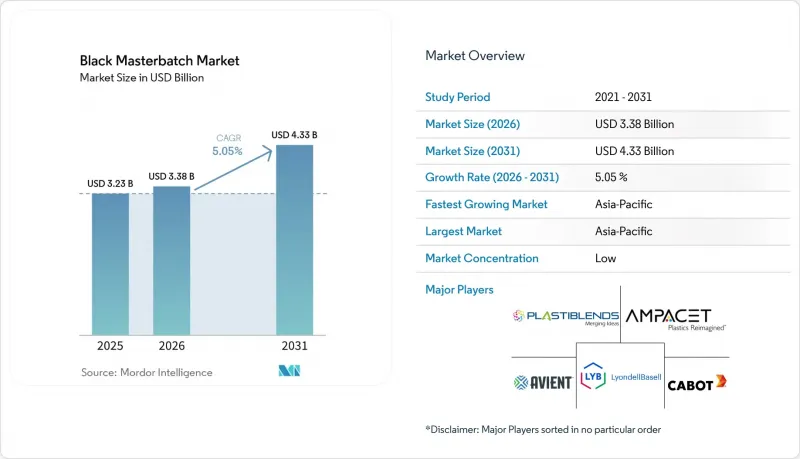
에 따르면 블랙 마스터배치 시장 규모는 2025년에 32억 3,000만 달러로 평가되어 예측 기간(2026-2031년)에 CAGR 5.05%로 확대하며, 2026년 33억 8,000만 달러에서 2031년에는 43억 3,000만 달러에 달할 것으로 추정되고 있습니다.
글로벌 블랙 마스터배치 시장의 동향 및 인사이트
유연 및 경질 플라스틱 포장 시장의 확대
연포장재는 여전히 블랙 마스터배치 시장의 수요를 견인하는 주요 요인입니다. 단일 소재인 폴리에틸렌 및 폴리프로필렌 필름으로의 전환에 따라 폴리프로필렌(PP) 및 선형 저밀도 폴리에틸렌(LLDPE) 캐리어 시스템에 대한 수요가 증가하고 있습니다. 이러한 필름 구조를 통해 컨버터는 접착층의 영향을 받지 않고 블랙 마스터배치의 배합량을 조절할 수 있습니다. 전자제품 반품 및 의료용품용 불투명 우편 봉투에는 고처리량 필름 생산 라인에서 일관된 자외선 차단 기능과 내습성이 요구됩니다. 브라질에서는 각 포장 변환업체들이 아열대 지역의 자외선으로부터 보호해야 하는 농업용 베일 랩 및 사일리지 필름의 생산을 확대하고 있습니다. 앰파셋(Ampaset)사는 2025년 3월, 포장 변환업체를 대상으로 착색, 자외선 차단 및 규제 대응 기능을 단일 농축제에 통합한 ‘UVBLOCK 1496’을 출시했습니다.
자동차의 경량화 및 전동화
자동차의 전동화로 인해 블랙 마스터배치 시장에서 자동차용 플라스틱 컴파운드의 성능 요구 사항이 변화하고 있습니다. 배터리식 전기자동차(BEV) 플랫폼에서는 배터리 하우징, 언더바디 클래딩, 공기역학 패널 등 더 대형의 열가소성 수지 부품이 사용되고 있습니다. 이러한 부품에는 내충격성을 저해하지 않으면서 불투명성, 자외선 안정성 및 제어된 전도성이 요구됩니다. 캐보트사는 2024년 5월, 자동차용 컴파운드 제조사를 대상으로 ‘REPLASBLAK reUN5285’ 및 ‘reUN5290’을 출시했습니다. 이 제품들은 각각 45% 및 20%의 국제 지속가능성·탄소 인증(ISCC) PLUS 질량 균형 인증을 받은 재생 원료를 함유하고 있습니다. 폐차에 관한 요건으로 인해 설계 단계에서 블랙 마스터배치의 중요성도 높아지고 있습니다. 인증된 재생 캐리어 배합 요건을 충족하는 공급업체는 향후 재료 요건에 대응하는 데 유리한 입장에 있습니다.
카본 블랙 및 폴리머 원료 비용의 변동
카본 블랙 및 폴리머 원료 비용은 여전히 블랙 마스터배치 시장에 있으며, 제약 요인으로 작용하고 있습니다. 2025년과 2026년, 산둥성의 카본 블랙 가격은 콜타르 비용 상승을 배경으로 톤당 6,250위안에서 8,800위안 사이를 오갔습니다. 무연탄 공급 부족과 타이어 업계의 구매 주기가 생산자들에게 추가적인 압박을 가했습니다. 2026년 초 호르무즈 해협에서 발생한 항해 장애 역시 가격이 하락하기 전에 원자재 비용을 상승시켰습니다. 포장 업계의 고객들은 현물 가격 상승에 저항하는 경우가 많아, 생산자들이 원가 회수에 어려움을 겪고 있습니다. Plastiblends India Ltd는 지정학적 요인과 공급망 혼란이 원자재 가격에 영향을 미쳤다고 보고했습니다.
부문별 분석
2025년, 스탠다드 블랙 마스터배치는 블랙 마스터배치 시장 점유율의 65.84%를 차지했습니다. 이 제품은 범용 필름의 압출 성형, 파이프 제조, 사출성형 분야에서 여전히 널리 사용되고 있습니다. 이러한 용도의 구매자들은 톤당 비용, 카본 블랙 함량, 분산 품질, 그리고 캐리어 수지와의 호환성을 중요하게 여깁니다. 하이 제트니스 블랙 마스터배치는 자동차 계기판, 전자기기 케이스, 고급 포장재 등 깊은 발색이 요구되고, 더 미세한 입자 직경이나 더 높은 카본 블랙 농도가 필요한 용도로 사용됩니다. 자외선 저항성 블랙 마스터배치는 재료가 풍화에 견뎌야 하는 인프라 및 농업 분야에서 사용되고 있습니다.
전도성 블랙 마스터배치는 2031년까지 연평균 성장률(CAGR) 5.67%로 성장할 것으로 전망됩니다. 전도성 등급에 대한 수요는 전기자동차(EV)의 전기 제어 플라스틱 부품 증가와 전자기기의 정전기 방전(ESD) 보호 요건 강화에 힘입어 증가하고 있습니다. 재생 폴리머 대응 등급은 여전히 규모가 가장 작은 유형 부문이지만, 소비 후 재생 원료의 색상 편차를 눈에 띄지 않게 하고, 다양한 재생 원료 스트림에서 상업적으로 이용 가능한 제품을 생산하는 데 기여하고 있습니다. Cabot사의 ‘REPLASBLAK’ 포트폴리오에는 국제 지속가능성 및 탄소 인증(ISCC) PLUS의 매스 밸런스 인증을 받은, 재생 캐리어 함유율이 최대 45%에 달하는 제품이 포함되어 있습니다. 리요넬바셀(Lyonel Basell)은 2026년 1월, 자사의 순환형 마스터배치 포트폴리오 ‘Circulen’의 상업적 채택이 시작되었다고 보고했으며, 이는 재생 캐리어 제품에 대한 조달 의지가 높아지고 있음을 보여줍니다.
재생 폴리머 대응 제품은 특유의 가공상 과제를 해결하기 위한 것입니다. 재생 소재는 혼합된 회수 스트림으로 인해 색상이나 특성이 불균일한 경우가 많습니다. 흑색 배합은 보다 균일한 마감 외관을 제공하여 이러한 소재의 상업적 실현 가능성을 높일 수 있습니다. 이는 외관상의 편차가 없는 재생 원료 함유 제품을 원하는 고객에게 특히 중요합니다. 근적외선(NIR)으로 감지 가능한 배합은 선별성이 요구되는 용도에서 추가적인 재활용 이점을 제공합니다. 따라서 블랙 마스터배치 시장에서는 재생 원료의 편차와 사용 후 제품 회수 요건 모두를 충족하는 등급이 개발되고 있습니다. 재활용 캐리어는 가공시 버진 수지와는 다른 거동을 보일 가능성이 있으므로, 제품의 적합성 평가는 여전히 중요합니다. 공급업체는 대상 수지 시스템 전반에 걸쳐 성능 요건이 유지될 수 있음을 입증해야 합니다. 또한 고객이 검증된 공급망 문서를 요구할 경우, 순환형 소재의 인증도 중요해집니다.
지역별 분석
아시아태평양은 2025년에 블랙 마스터배치 시장 점유율의 47.81%를 차지할 것으로 예상되며, 2031년까지 연평균 성장률(CAGR) 5.83%로 성장할 것으로 전망됩니다. 중국은 자동차, 전자기기, 포장 제품 생산을 통해 지역내 수요를 지원하고 있습니다. 인도는 플라스틱 가공 및 건설 관련 파이프 수요에 힘입어 두 번째 성장 거점으로 부상하고 있습니다. 일본과 한국은 자동차용 전자기기 및 광학 부품과 같은 고부가가치 수요에 대응하고 있습니다. 베트남과 태국은 포장 및 소비재 제조를 지속적으로 유치하고 있습니다. 이 지역의 카본 블랙 공급 기반은 표준품 및 범용 제품의 생산을 지원하고 있는 반면, 일본과 한국의 배합 제조업체들은 프리미엄 전도성 등급의 제품을 제공하고 있습니다.
유럽 및 북미에서는 생산량 증가 자체보다 규제 및 자동차 업계의 요구 사항이 시장 형성에 더 큰 영향을 미치고 있습니다. 유럽의 블랙 마스터배치 시장은 ‘포장 및 포장 폐기물 규정(PPWR)’ 요건과 차별화된 ‘확대 생산자 책임(EPR)’ 요금으로 인해 근적외선(NIR) 탐지가 가능하고 카본 블랙이 포함되지 않은 배합으로 전환되고 있습니다. 이러한 요건들은 포장 감축 조치로 인해 일부 플라스틱 소비가 제한되고 있는 상황에서도 고성능 배합에 대한 수요를 지원하고 있습니다. 리오넬바셀(Lyonel Basell)은 2026년 1분기부터 인터폴리머(Interpolymer)를 통해 독일 및 오스트리아로의 마스터배치 및 맞춤형 고성능 색상 유통을 확대했습니다. 북미에서는 지속가능한 블랙 컴파운드 및 고급 자동차 용도에 대한 수요가 나타나고 있습니다. 또한 재생 가능 에너지용 케이블 설치도 자외선 저항성 및 저연·할로겐 프리(LSZH) 규격을 준수하는 블랙 컴파운드에 대한 수요를 지원하고 있습니다.
남미, 중동 및 아프리카에서는 인프라 및 농업에 대한 투자 주기와 연동된 수요가 나타나고 있습니다. 이 지역에서는 식품 및 음료 생산 및 E-Commerce(EC)용 포장이 수요를 지원하고 있습니다. 사탕수수, 커피, 감귤류 재배에 사용되는 멀치 필름과 관개용 파이프에는 자외선 안정화 처리가 적용된 HDPE 및 LDPE 컴파운드가 채택되고 있습니다. 멕시코에서는 자동차 산업의 니어쇼어링과 트림 및 외장 패널용 컴파운드에 대한 수요 증가의 혜택을 받고 있습니다. 사우디아라비아와 남아프리카에서는 인프라 투자 및 상수도 시스템 개보수를 통해 프로젝트 주도형 자외선 안정화 HDPE 파이프용 컴파운드에 대한 수요가 지원되고 있습니다. 이 지역들의 투자 주기는 특정 건설, 관개, 농업 조달 프로그램과 수요를 연계하는 경향이 있으며, 성숙한 포장 시장에 비해 수주 패턴이 불안정해지기 쉽습니다. 실외의 고온과 일사에 노출되므로 이러한 용도에서는 자외선 차단이 특히 중요합니다. 공급업체는 파이프 및 필름 고객이 기대하는 수명을 충족시키기 위해 안정적인 분산성을 유지해야 합니다. 이러한 프로젝트에 따라 현지 가공 능력이 확대됨에 따라 블랙 마스터배치 시장에 비즈니스 기회가 창출되지만, 이를 실현하기 위해서는 안정적인 제품 공급과 지역 가공업체에 대한 기술 지원이 필수적입니다.
기타 혜택:
- 엑셀 형식의 시장 예측(ME) 시트
- 3개월간의 애널리스트 지원
자주 묻는 질문
목차
제1장 서론
- 조사 전제조건과 시장 정의
- 조사 범위
제2장 조사 방법
제3장 개요
제4장 시장 구도
- 시장 개요
- 시장 성장 촉진요인
- 시장 성장 억제요인
- 밸류체인 분석
- Porter's Five Forces 분석
제5장 시장 규모와 성장 예측
- 유형별
- 캐리어 수지별
- 최종사용자 산업별
- 지역별
- 아시아태평양
- 중국
- 인도
- 일본
- 한국
- ASEAN 국가
- 기타 아시아태평양 국가
- 북미
- 미국
- 캐나다
- 멕시코
- 유럽
- 독일
- 영국
- 프랑스
- 이탈리아
- 북유럽 국가
- 기타 유럽 국가
- 남미
- 브라질
- 아르헨티나
- 기타 남미 국가
- 중동 및 아프리카
- 사우디아라비아
- 남아프리카공화국
- 기타 중동 및 아프리카 국가
- 아시아태평양
제6장 경쟁 구도
- 시장 집중도
- 전략적 동향
- 시장 점유율·순위 분석
- 기업 개요
- Americhem
- Ampacet Corporation
- Avient Corporation
- Cabot Corporation
- Clariant AG
- Colloids
- Gabriel-Chemie
- Huber Engineered Materials
- Hubron International
- LyondellBasell Industries Holdings B.V.
- Penn Color, Inc.
- Plastiblends
- Plastika Kritis S.A.
- RTP Company
- Sukano
- Tosaf Compounds Ltd.
제7장 시장 기회와 향후 전망
KSA 26.10.29According to Mordor Intelligence, the black masterbatch market size was valued at USD 3.23 billion in 2025 and is estimated to grow from USD 3.38 billion in 2026 to USD 4.33 billion by 2031, at a CAGR of 5.05% during the forecast period (2026-2031).
Global Black Masterbatch Market Trends and Insights
Expansion of Flexible and Rigid Plastic Packaging
Flexible packaging remains the primary driver of demand in the black masterbatch market. The shift toward mono-material polyethylene and polypropylene films reinforces demand for polypropylene (PP) and linear low-density polyethylene (LLDPE) carrier systems. These film structures allow converters to control black masterbatch loading without interference from adhesive layers. Opaque mailers for electronics returns and medical supplies require consistent UV protection and moisture resistance on high-throughput film lines. In Brazil, packaging converters are expanding production of agricultural bale wrap and silage films that require protection from subtropical UV exposure. Ampacet launched UVBLOCK 1496 in March 2025 to combine pigmentation, UV protection, and regulatory support in a single concentrate for packaging converters.
Lightweighting and Electrification of Vehicles
Vehicle electrification is changing the performance requirements for automotive plastic compounds in the black masterbatch market. Battery electric vehicle platforms use larger thermoplastic parts, including battery housings, underbody cladding, and aerodynamic panels. These parts require opacity, UV stability, and controlled conductivity without compromising impact strength. Cabot launched REPLASBLAK reUN5285 and reUN5290 in May 2024, with 45% and 20% International Sustainability and Carbon Certification (ISCC) PLUS mass-balance-certified recycled content, respectively, for automotive compounders. End-of-life vehicle requirements also make black masterbatch more important at the design stage. Suppliers that qualify for certified recycled-carrier formulations are better positioned to meet future material requirements.
Volatility in Carbon Black and Polymer Feedstock Costs
Carbon black and polymer feedstock costs remain a restraint for the black masterbatch market. In 2025 and 2026, carbon black prices in Shandong ranged from CNY 6,250 to CNY 8,800 per ton amid rising coal tar costs. Limited availability of anthracite and tire-sector buying cycles added further pressure on producers. Disruption to traffic in the Strait of Hormuz in early 2026 also raised feedstock costs before prices retreated. Packaging customers often resist spot-price increases, making cost recovery difficult for producers. Plastiblends India Ltd reported that geopolitical factors and supply chain disruptions affected raw material prices.
Other drivers and restraints analyzed in the detailed report include:
- Rising UV-Stability Requirements in Infrastructure and Agriculture
- Growth of Conductive Plastics in Electronics and Electric Vehicles
- Carbon-Black-Induced Failure of Conventional NIR Sorting
For complete list of drivers and restraints, kindly check the Table Of Contents.
Segment Analysis
Standard Black Masterbatch held 65.84% of the black masterbatch market share in 2025. It remains widely used in commodity film extrusion, pipe production, and injection molding. Buyers in these applications prioritize cost per ton, carbon black loading, dispersion quality, and carrier-resin compatibility. High-Jetness Black Masterbatch is used in automotive instrument panels, electronic housings, and premium packaging, where deep color is required, and smaller particle sizes and higher carbon black concentrations may be necessary. UV-Resistant Black Masterbatch is used in infrastructure and agriculture, where materials must withstand weathering.
Conductive Black Masterbatch is expected to grow at a 5.67% CAGR through 2031. Demand for conductive grades is supported by a growing number of electrically managed plastic components in electric vehicles (EVs) and stricter electrostatic discharge (ESD) protection requirements in electronics. Recycled-polymer-compatible grades remain the smallest type segment, but they help mask color variation in post-consumer recycled feedstocks, supporting commercially usable output from variable recyclate streams. Cabot's REPLASBLAK portfolio includes options with up to 45% International Sustainability and Carbon Certification (ISCC) PLUS mass-balance certified recycled carrier content. LyondellBasell reported commercial uptake of its Circulen circular masterbatch portfolio in January 2026, indicating procurement interest in recycled-carrier products.
Recycled-polymer-compatible products address a distinct processing challenge. Recyclate often has varied colors and properties due to mixed collection streams. Black formulations can provide a more uniform finished appearance and improve the commercial viability of these materials. This is particularly relevant where customers require recycled-content products without inconsistent visual output. Near-infrared (NIR)-detectable formulations offer an additional recycling benefit in applications that require sortability. The black masterbatch market is therefore developing grades that address both variations in recycled feedstocks and end-of-life recovery requirements. Product qualification remains important because recycled carriers can behave differently from virgin resins during processing. Suppliers must demonstrate that performance claims can be maintained across the intended resin systems. Circular material certifications are also relevant when customers require verified supply chain documentation.
Complete Report Scope:
- By Type
- Standard Black Masterbatch
- High-Jetness Black Masterbatch
- UV-Resistant Black Masterbatch
- Conductive Black Masterbatch
- Recycled-Polymer Compatible Black Masterbatch
- By Carrier Resin
- Polypropylene
- Linear Low-Density Polyethylene
- Low-Density Polyethylene
- High-Density Polyethylene
- Polyethylene Terephthalate
- Polyvinyl Chloride
- Polystyrene
- Polyamide
- Other Carrier Resins
- By End-User Industry
- Automotive
- Packaging
- Infrastructure
- Electrical and Electronics
- Other End-Use Industries
- By Geography
- Asia-Pacific
- China
- India
- Japan
- South Korea
- ASEAN Countries
- Rest of Asia-Pacific
- North America
- United States
- Canada
- Mexico
- Europe
- Germany
- United Kingdom
- France
- Italy
- NORDIC Countries
- Rest of Europe
- South America
- Brazil
- Argentina
- Rest of South America
- Middle East and Africa
- Saudi Arabia
- South Africa
- Rest of Middle East and Africa
- Asia-Pacific
Geography Analysis
Asia-Pacific accounted for 47.81% of the black masterbatch market share in 2025 and is forecast to grow at a 5.83% CAGR through 2031. China supports regional demand through automotive, electronics, and packaging production. India is emerging as a second growth center, driven by plastics processing and construction-linked pipe demand. Japan and South Korea address higher-value demand for automotive electronics and optical components. Vietnam and Thailand continue to attract packaging and consumer goods manufacturing. The region's carbon black supply base supports standard and commodity production, while Japanese and Korean formulators serve premium conductive grades.
Europe and North America are shaped more by regulation and automotive requirements than by output growth alone. The black masterbatch market in Europe is moving toward Near-Infrared (NIR)-detectable and carbon-black-free formulations due to requirements under the Packaging and Packaging Waste Regulation (PPWR) and differentiated Extended Producer Responsibility (EPR) fees. These requirements support demand for performance formulations even as packaging-reduction measures limit some plastic consumption. LyondellBasell expanded masterbatch and custom performance color distribution into Germany and Austria through Interpolimeri, effective in Q1 2026. North America shows demand for sustainable black formulations and high-end automotive applications. Renewable energy cable installations also support demand for UV-resistant and low-smoke zero-halogen (LSZH)-compliant black compounds.
South America, the Middle East, and Africa follow infrastructure and agricultural investment cycles. Food and beverage output and e-commerce packaging support demand in these regions. Mulch films and irrigation pipes for sugarcane, coffee, and citrus cultivation use UV-stabilized HDPE and LDPE formulations. Mexico benefits from automotive near-shoring and higher demand for trim and exterior panel compounds. Saudi Arabia and South Africa support project-led demand for UV-stable HDPE pipe compounds through infrastructure investment and water-system rehabilitation. Investment cycles in these regions tend to link demand with specific construction, irrigation, and agricultural procurement programs, which can make order patterns less consistent than in mature packaging markets. UV protection is particularly important in these applications due to exposure to high outdoor temperatures and solar radiation. Suppliers must maintain stable dispersion to meet the service-life expectations of pipe and film customers. The black masterbatch market presents opportunities as local conversion capacity expands alongside these projects, though realizing them depends on consistent product supply and technical support for regional processors.
- Americhem
- Ampacet Corporation
- Avient Corporation
- Cabot Corporation
- Clariant AG
- Colloids
- Gabriel-Chemie
- Huber Engineered Materials
- Hubron International
- LyondellBasell Industries Holdings B.V.
- Penn Color, Inc.
- Plastiblends
- Plastika Kritis S.A.
- RTP Company
- Sukano
- Tosaf Compounds Ltd.
Additional Benefits:
- The market estimate (ME) sheet in Excel format
- 3 months of analyst support
TABLE OF CONTENTS
1 Introduction
- 1.1 Study Assumptions and Market Definition
- 1.2 Scope of the Study
2 Research Methodology
3 Executive Summary
4 Market Landscape
- 4.1 Market Overview
- 4.2 Market Drivers
- 4.2.1 Expansion of Flexible and Rigid Plastic Packaging
- 4.2.2 Lightweighting and Electrification of Vehicles
- 4.2.3 Rising UV-Stability Requirements in Infrastructure and Agriculture
- 4.2.4 Growth of Conductive Plastics in Electronics and Electric Vehicles
- 4.2.5 NIR-Sortable Black Formulations Driven by Recyclability Design Rules
- 4.3 Market Restraints
- 4.3.1 Volatility in Carbon Black and Polymer Feedstock Costs
- 4.3.2 Carbon-Black-Induced Failure of Conventional NIR Sorting
- 4.3.3 Batch-to-Batch Variability in Mixed Recycled Feedstocks
- 4.4 Value Chain Analysis
- 4.5 Porter's Five Forces Analysis
- 4.5.1 Bargaining Power of Suppliers
- 4.5.2 Bargaining Power of Buyers
- 4.5.3 Threat of New Entrants
- 4.5.4 Threat of Substitutes
- 4.5.5 Competitive Rivalry
5 Market Size And Growth Forecasts (Value)
- 5.1 By Type
- 5.1.1 Standard Black Masterbatch
- 5.1.2 High-Jetness Black Masterbatch
- 5.1.3 UV-Resistant Black Masterbatch
- 5.1.4 Conductive Black Masterbatch
- 5.1.5 Recycled-Polymer Compatible Black Masterbatch
- 5.2 By Carrier Resin
- 5.2.1 Polypropylene
- 5.2.2 Linear Low-Density Polyethylene
- 5.2.3 Low-Density Polyethylene
- 5.2.4 High-Density Polyethylene
- 5.2.5 Polyethylene Terephthalate
- 5.2.6 Polyvinyl Chloride
- 5.2.7 Polystyrene
- 5.2.8 Polyamide
- 5.2.9 Other Carrier Resins
- 5.3 By End-User Industry
- 5.3.1 Automotive
- 5.3.2 Packaging
- 5.3.3 Infrastructure
- 5.3.4 Electrical and Electronics
- 5.3.5 Other End-Use Industries
- 5.4 By Geography
- 5.4.1 Asia-Pacific
- 5.4.1.1 China
- 5.4.1.2 India
- 5.4.1.3 Japan
- 5.4.1.4 South Korea
- 5.4.1.5 ASEAN Countries
- 5.4.1.6 Rest of Asia-Pacific
- 5.4.2 North America
- 5.4.2.1 United States
- 5.4.2.2 Canada
- 5.4.2.3 Mexico
- 5.4.3 Europe
- 5.4.3.1 Germany
- 5.4.3.2 United Kingdom
- 5.4.3.3 France
- 5.4.3.4 Italy
- 5.4.3.5 NORDIC Countries
- 5.4.3.6 Rest of Europe
- 5.4.4 South America
- 5.4.4.1 Brazil
- 5.4.4.2 Argentina
- 5.4.4.3 Rest of South America
- 5.4.5 Middle East and Africa
- 5.4.5.1 Saudi Arabia
- 5.4.5.2 South Africa
- 5.4.5.3 Rest of Middle East and Africa
- 5.4.1 Asia-Pacific
6 Competitive Landscape
- 6.1 Market Concentration
- 6.2 Strategic Moves
- 6.3 Market Share (%)/Ranking Analysis
- 6.4 Company Profiles (includes Global Overview, Market Overview, Core Segments, Financials as available, Strategic Information, Products and Services, and Recent Developments)
- 6.4.1 Americhem
- 6.4.2 Ampacet Corporation
- 6.4.3 Avient Corporation
- 6.4.4 Cabot Corporation
- 6.4.5 Clariant AG
- 6.4.6 Colloids
- 6.4.7 Gabriel-Chemie
- 6.4.8 Huber Engineered Materials
- 6.4.9 Hubron International
- 6.4.10 LyondellBasell Industries Holdings B.V.
- 6.4.11 Penn Color, Inc.
- 6.4.12 Plastiblends
- 6.4.13 Plastika Kritis S.A.
- 6.4.14 RTP Company
- 6.4.15 Sukano
- 6.4.16 Tosaf Compounds Ltd.
7 Market Opportunities and Future Outlook
- 7.1 White-Space and Unmet-Need Assessment


