

|
시장보고서
상품코드
2156959
신경 섬유종증 치료 : 시장 점유율 분석, 업계 동향과 통계, 성장 예측(2026-2031년)Neurofibromatosis Treatment - Market Share Analysis, Industry Trends & Statistics, Growth Forecasts (2026 - 2031) |
||||||
 Mordor Intelligence
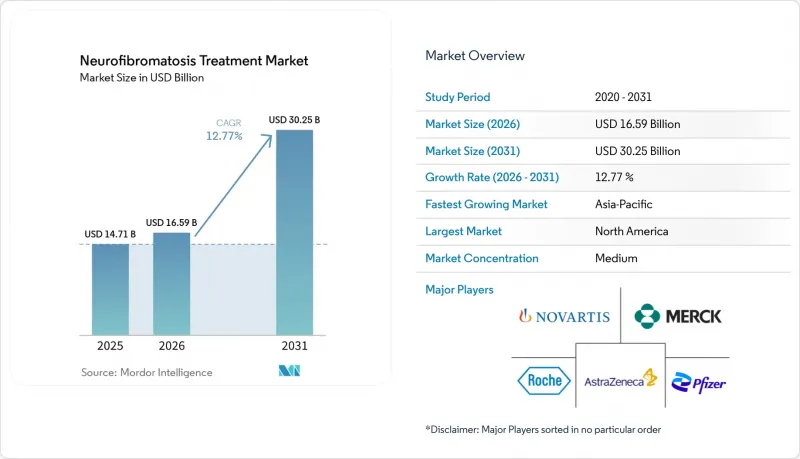
에 따르면 신경 섬유종증 치료 시장 규모는 2025년 147억 1,000만 달러에서 2026년에는 165억 9,000만 달러로 확대하며, 2026-2031년에 CAGR 12.77%로 추이하며, 2031년까지 302억 5,000만 달러에 달할 것으로 예측됩니다.
전 세계 신경섬유종증 치료 시장의 동향 및 인사이트
모든 연령대에서 MEK 억제제의 적응증 확대
FDA는 2025년 11월 19일, NF1 및 증상이 동반된 수술 불가능한 망상 신경섬유종을 가진 성인 환자에 대한 셀루메티닙의 승인을 내렸습니다. KOMET 3상 임상시험에는 13개국에서 145명의 환자가 참여했습니다. 이 임상시험에서 셀루메티닙의 확인된 전체 반응률은 20%, 위약군은 5%였으며, p-값은 0.011이었습니다. 이번 승인으로 신경섬유종증 치료 시장은 성인 환자층에서 더욱 폭넓은 치료 기반을 확보하게 되었습니다. FDA는 2025년 2월 11일, NF1-PN을 가진 성인 및 2세 이상의 소아를 대상으로 미르다메티닙을 승인했습니다. ReNeu 2b상 임상시험에서는 성인의 확인된 반응률이 41%, 소아의 경우 52%로 보고되었습니다. 유럽집행위원회는 2025년 7월, NF1-PN을 가진 성인 및 소아를 대상으로 EZMEKLY를 조건부로 승인했습니다. 비교 임상시험 결과가 나올 때까지는 심장에 대한 안전성, 내약성 및 정기적인 모니터링 측면에서의 차이가 의사의 선택에 영향을 미칠 수 있습니다.
유전자 검사 및 전문의 의뢰를 통한 진단 건수 증가
DNA와 cDNA 시퀀싱을 병행함으로써 NF1의 진단률은 95.9% 이상에 달합니다. 기존의 게놈 DNA 방법으로는 병인성 변이의 60%에서 90%만 검출되고 있었습니다. 스플라이싱 변이는 질병을 유발하는 변이의 22%에서 30%를 차지하며, 보다 광범위한 검사를 실시하지 않으면 간과될 가능성이 있습니다. 2025년 터키의 소아 환자 148명을 대상으로 한 연구에서는 NGS를 통해 사례의 94.5%에서 분자 변이가 검출되었습니다. MLPA를 추가함으로써 누적 검출률은 95.9%로 상승했습니다. 조기 분자학적 확인을 통해 신경섬유종증의 경과 관찰 및 치료 평가를 위한 의뢰가 개선될 가능성이 있습니다. 따라서 신경섬유종증 치료 시장은 증상 부담이 심각해지기 전에 적격 환자를 확보할 가능성이 있습니다. 한국에서 1,917명을 대상으로 실시한 평가에서는 재분류 및 전장 유전체 염기서열 분석 실시 후 81.6%의 누적 검출률이 달성되었습니다.
고액의 치료비와 보험 환급을 둘러싼 과제
아일랜드에서는 10세 환자의 셀루메티닙 연간 치료비를 20만 4,001유로(23만 6,691달러), 18세 환자의 경우 30만 5,642유로(35만 4,619달러)로 추정했습니다. 이 평가에 따르면 QALY 1단위당 ICER는 기준치인 5만 유로(19만 8,139 달러)에 비해 17만 774유로(19만 8,139 달러)에서 33만 2,319유로(38만 5,571달러) 범위인 것으로 보고되었습니다. 이 평가에 따르면 아일랜드의 심사 기준에 따라 보험 적용을 받으려면 70%에서 84%의 가격 인하가 필요한 것으로 나타났습니다. 정가가 고가인 경우, 규제 당국의 승인 후에도 환급 지연이나 처방 제한으로 이어질 가능성이 있습니다. 치료비를 부담하지 않는 지급 기관은 전문의 체계나 진단 인프라를 확충할 동기가 약해집니다. 이로 인해 진단과 치료가 동시에 제한될 가능성이 있습니다. 네덜란드의 권고 사항에는 셀루메티닙의 처방 및 모니터링에 관한 조건도 포함되어 있었습니다. 신경섬유종증 치료 시장은 앞으로도 각국의 보험 급여 제도에 따라 도입률이 달라지는 상황에 직면하게 될 것입니다.
부문 분석
2025년, NF1은 신경섬유종증 치료 시장 점유율의 38.31%를 차지했습니다. 이 질환의 유병률은 전 세계에서 2,500명에서 3,000명 중 1명꼴로 나타났습니다. 또한 이 질환에 대해서는 승인된 MEK 억제제에 의한 상업적 지원도 있었습니다. NF1은 2031년까지 질환 유형별 가장 높은 성장률을 기록할 것으로 예상됩니다. 이러한 추세는 신경섬유종증 치료 시장에서 매출 집중 현상이 앞으로도 지속될 것임을 지원합니다. 또한 다른 형태의 신경섬유종증에 비해 NF1에 대해 승인된 치료 옵션의 수가 더 많다는 점도 반영하고 있습니다.
일본에서는 2026년 6월 NF2에 대한 베바시주맙의 승인이 내려졌습니다. 이 승인은 NF2 치료제로서는 최초의 것이며, 일본내 12개 기관에서 62명의 환자를 대상으로 진행된 ‘BeatNF2’ 2상 임상시험 결과를 바탕으로 한 것이었습니다. NF2 및 슈반노마토시스 치료는 여전히 주로 수술 및 이 적응증 외의 임상시험을 통한 치료에 의존하고 있습니다. 이러한 질환의 근본적인 생물학적 기전은 메를린(Merlin) 종양 억제 유전자의 상실로 인해 NF1과는 다릅니다. 이러한 차이로 인해 NF1에서 MEK 억제제를 이용한 치료법의 직접적인 적용은 제한되고 있습니다. ‘PRIME-NF2’ 임상시험에서는 다제 병용 요법에 대한 보다 광범위한 평가가 진행되고 있습니다. 연구 활동이 활발해지고는 있지만, 이러한 질환 분야는 신경섬유종증 치료 시장에서 여전히 발전 단계에 머물러 있습니다.
2025년에는 MEK 억제제가 총매출의 26.24%를 차지했습니다. 셀루메티닙, 미르다메티닙, 루보메티닙은 모두 MAPK 경로 내의 MEK1/2를 표적으로 삼고 있으므로, 이들은 여전히 상업적 치료의 기반을 이루고 있습니다. 유전자 치료는 2031년까지 연평균 성장률(CAGR) 17.42%로 성장할 것으로 예측됩니다. 유전자 치료를 통한 신경섬유종증 치료 시장의 규모는 현재의 상업적 규모보다는 파이프라인 동향에 의해 형성되고 있습니다. 현재 NF의 하위 유형에 대해 규제 당국의 승인을 받은 유전자 치료제는 없습니다. 이러한 차이는 단기적인 매출 및 향후 임상적 가능성을 검토하는 데 있으며, 중요한 요소입니다.
2025년 9월 'Nature Communications'지에 게재된 연구에서는 NF1 관련 종양에 대한 AAV 벡터를 이용한 개념 증명(PoC)이 보고되었습니다. 이 연구에서는 MPNST, 신경섬유종 및 신경교종의 이종 이식 모델에서 종양의 증식이 유의미하게 억제되는 것이 확인되었습니다. 2026년 'Communications Biology'지에 게재된 연구에서는 치료군 마우스의 종양 침투율이 43%, 대조군은 83%였다고 보고되었습니다. 이러한 연구 결과는 향후 인간을 대상으로 한 임상 시험을 위한 전임상적 근거가 됩니다. 현재 시판 중인 MEK 억제제 중에서 임상의가 선택할 때, 내약성이나 제형의 편의성이 점점 더 중요한 요소가 될 가능성이 있습니다. MEK 억제제에 대한 접근이 제한된 경우, 통증 관리 요법, 수술 및 방사선 치료가 여전히 유효한 선택지가 됩니다. STARFISH 플랫폼 임상시험에서는 슈반노마토시스와 관련된 통증에 대한 치료법 평가도 진행되고 있습니다.
지역별 분석
2025년, 북미는 전 세계 매출의 42.61%를 차지했습니다. 미국에서는 2020년에 소아용 셀루메티닙, 2025년에 성인용 셀루메티닙, 그리고 2025년 2월에 미르다메티닙에 대한 주요 승인이 이루어졌습니다. 보험 적용에 대한 접근성은 다른 많은 지역에 비해 잘 정비되어 있지만, 여전히 완벽하다고는 할 수 없습니다. 캐나다의 ‘팬-캐나다 제약 연합(Pan-Canadian Pharmaceutical Alliance)’은 2024년 12월 코셀고(Coselgo)의 보험 환급에 관한 의향서에 합의했습니다. 그 후, 퀘벡주가 주 의약품 리스트에 최초로 등재했습니다. 이러한 진전을 통해 수년간 적용 기준 확대를 통해 접근성이 확보되어 온 데 이어, 공적 보험의 보장 범위가 강화되었습니다.
유럽에서는 국가에 따라 보험 급여 조건에 차이가 있습니다. 독일의 G-BA는 2026년 8월, 셀루메티닙의 연간 치료비를 환자 1인당 8만 1,237유로(9만 4,254달러)에서 9만 7,443유로(11만 3,057 달러)로 정한 결의안을 발표했으며, 2세에서 17세 소아를 대상으로 하는 미르다메티닙에 대해서는 비용 비교에 기반한 권고를 내렸습니다. 따라서 독일과 영국은 다른 몇몇 유럽 시장에 비해 접근성이 높은 상황입니다. 네덜란드와 아일랜드에서는 가격 협상을 통한 조정이 이루어지지 않은 채 셀루메티닙에 대해 부정적인 평가가 내려졌습니다. 프랑스, 스페인, 이탈리아 및 기타 유럽 국가에서는 보험 적용이 지연되고 있습니다. 이러한 차이는 앞으로도 유럽 전역의 신경섬유종증 치료 시장에 계속 영향을 미칠 것입니다.
아시아태평양은 2031년까지 연평균 성장률(CAGR) 15.25%로 성장할 것으로 예측되며, 이는 신경섬유종증 치료 시장에서 지역별 가장 높은 성장률입니다. 중국은 2025년 5월, 소아 NF1-PN 환자를 대상으로 복성제약(Fosun Pharma)이 국내에서 개발한 루보메티닙을 승인했습니다. 일본은 2026년 6월, NF2 치료제인 베바시주맙을 승인했습니다. 인도, 호주, 한국은 대상 환자 수가 매우 많음에도 불구하고 진단 인프라나 희귀질환 의약품의 보험 급여 측면에서 뒤처져 있습니다. 중동 및 아프리카 및 남미에서는 국가 차원의 보험 적용보다는 자비적 사용(Compassionate Use)이나 병원 측의 판단에 의존하는 경향이 강해지고 있습니다. 브라질, 아르헨티나, GCC 국가들, 남아프리카공화국에는 전문의와 학술적 역량이 있지만, 자금 면의 제약으로 인해 의약품 보급은 제한적입니다. 이러한 지역에서는 2031년까지 고가의 MEK 억제제나 유전자 치료의 매출보다 제네릭 의약품 및 외과적 치료의 기여도가 더 높을 것으로 예상됩니다.
기타 혜택:
- 엑셀 형식의 시장 예측(ME) 시트
- 3개월간의 애널리스트 지원
자주 묻는 질문
목차
제1장 서론
- 조사 전제조건과 시장 정의
- 조사 범위
제2장 조사 방법
제3장 개요
제4장 시장 구도
- 시장 개요
- 시장 성장 촉진요인
- 시장 성장 억제요인
- 규제 상황
- 기술 전망
- Porter's Five Forces 분석
제5장 시장 규모와 성장 예측
- 질환 유형별
- 요법 유형별
- 치료 단계별
- 최종사용자별
- 지역별
- 북미
- 미국
- 캐나다
- 멕시코
- 유럽
- 독일
- 영국
- 프랑스
- 이탈리아
- 스페인
- 기타 유럽 국가
- 아시아태평양
- 중국
- 일본
- 인도
- 호주
- 한국
- 기타 아시아태평양 국가
- 중동 및 아프리카
- GCC
- 남아프리카공화국
- 기타 중동 및 아프리카 국가
- 남미
- 브라질
- 아르헨티나
- 기타 남미 국가
- 북미
제6장 경쟁 구도
- 시장 집중도
- 시장 점유율 분석
- 기업 개요
- AstraZeneca PLC
- Bayer AG
- Chugai Pharmaceutical Co., Ltd.
- F. Hoffmann-La Roche Ltd
- Fosun Pharmaceutical Group Co., Ltd.
- Healx Limited
- Kechow Pharma, Inc.
- Merck KGaA
- NFlection Therapeutics, Inc.
- Novartis AG
- Pasithea Therapeutics Corp.
- Pfizer Inc.
- Recursion Pharmaceuticals, Inc.
- Sanofi S.A.
- Vivace Therapeutics, Inc.
제7장 시장 기회와 향후 전망
KSA 26.10.29According to Mordor Intelligence, the neurofibromatosis treatment market size is expected to grow from USD 14.71 billion in 2025 to USD 16.59 billion in 2026 and is forecast to reach USD 30.25 billion by 2031 at 12.77% CAGR over 2026-2031.
Global Neurofibromatosis Treatment Market Trends and Insights
Expansion of Approved MEK-Inhibitor Labels Across Age Groups
The FDA approved selumetinib for adults with NF1 and symptomatic, inoperable plexiform neurofibromas on November 19, 2025. The KOMET Phase III trial included 145 patients across 13 countries. It reported a confirmed overall response rate of 20% for selumetinib and 5% for placebo, with p=0.011. The neurofibromatosis treatment market gained a wider adult treatment base through this approval. FDA approved mirdametinib on February 11, 2025, for adults and children aged 2 years and older with NF1-PN. The ReNeu Phase 2b trial reported confirmed response rates of 41% in adults and 52% in children. The European Commission conditionally authorized EZMEKLY in July 2025 for adults and children with NF1-PN. Differences in cardiac safety, tolerability, and routine monitoring could shape physician choice before comparative studies become available.
Rising Diagnosis Through Genetic Testing and Specialist Referral
Combined DNA and cDNA sequencing can achieve a diagnostic yield above 95.9% for NF1. Traditional genomic DNA methods had detected 60% to 90% of pathogenic variants. Splicing variants account for 22% to 30% of disease-causing alterations and can be missed without broader testing. A 2025 study of 148 Turkish pediatric patients found molecular variants in 94.5% of cases through NGS. Adding MLPA increased the cumulative yield to 95.9%. Earlier molecular confirmation can improve referrals for plexiform neurofibroma surveillance and treatment assessment. The neurofibromatosis treatment market may therefore gain eligible patients before symptom burden becomes severe. A Korean assessment of 1,917 individuals achieved an 81.6% cumulative yield after reclassification and whole-genome sequencing.
High Treatment Cost and Reimbursement Friction
Ireland estimated annual selumetinib treatment costs at EUR 204,001 (USD 236,691) for a 10-year-old and EUR 305,642 (USD 354,619) for an 18-year-old. The assessment reported ICERs from EUR 170,774 (USD 198,139) to EUR 332,319 (USD 385,571) per QALY against a EUR 50,000 (USD 58,012) reference value. It indicated that price reductions of 70% to 84% would be needed for coverage under the assessed Irish thresholds. High list prices can delay reimbursement and constrain prescribing even after regulatory approval. Payers that do not fund treatment have less reason to expand specialist capacity or diagnostic infrastructure. This can restrict diagnosis and treatment at the same time. Dutch recommendations also included prescribing and monitoring conditions for selumetinib. The neurofibromatosis treatment market will continue to face different uptake rates across national reimbursement systems.
Other drivers and restraints analyzed in the detailed report include:
- Increased Investment in Rare-Disease Drug Development
- AI-Enabled Discovery for Genetically Defined Tumor Biology
- Long-Term Toxicity Monitoring and Treatment Discontinuation
For complete list of drivers and restraints, kindly check the Table Of Contents.
Segment Analysis
NF1 held 38.31% of the neurofibromatosis treatment market share in 2025. Its prevalence affected 1 in 2,500 to 3,000 people globally. The disease also had commercial support from approved MEK inhibitors. NF1 is expected to record the highest disease-type growth through 2031. This pattern supports continued revenue concentration in the neurofibromatosis treatment market. It also reflects the greater number of approved treatment options for NF1 than for other forms of neurofibromatosis.
Japan approved bevacizumab for NF2 in June 2026. The approval was the first for a medicine for NF2 and followed the BeatNF2 Phase II study of 62 patients at 12 Japanese institutions. NF2 and schwannomatosis still depend largely on surgery and investigational care outside this indication. Their underlying biology differs from NF1 because of the loss of the Merlin tumor suppressor. This difference limits the direct transfer of the NF1 MEK inhibitor approach. PRIME-NF2 is evaluating multi-agent approaches more broadly. These disease areas remain less developed portions of the neurofibromatosis treatment market, even as research activity rises.
MEK inhibitors represented 26.24% of total revenue in 2025. They remain the commercial treatment base because selumetinib, mirdametinib, and luvometinib each target MEK1/2 within the MAPK pathway. Gene-based therapies are forecast to grow at a 17.42% CAGR through 2031. The neurofibromatosis treatment market size for gene-based therapies is shaped by pipeline activity rather than current commercial scale. No gene therapy has regulatory approval for an NF subtype. This difference is important when considering near-term sales and later clinical potential.
A September 2025 Nature Communications study reported an AAV vector proof-of-concept for NF1-related tumors. The study found significant tumor growth suppression in xenograft models of MPNST, neurofibromas, and gliomas. A 2026 Communications Biology study reported 43% tumor penetrance in treated mice and 83% in controls. These findings provide preclinical support for later human testing. Clinician choice among current MEK inhibitors may increasingly depend on tolerability and formulation convenience. Pain-management therapies, surgery, and radiation remain relevant where access to MEK inhibitors is restricted. The STARFISH platform trial is also assessing treatments for schwannomatosis-related pain.
Complete Report Scope:
- By Disease Type
- Neurofibromatosis Type 1
- Neurofibromatosis Type 2
- Schwannomatosis
- By Therapy Type
- MEK Inhibitors
- Pain-Management Therapies
- Surgical Interventions
- Radiation Therapy
- Gene-Based Therapies
- Other Therapy Types
- By Treatment Stage
- First-Line Therapy
- Recurrent Disease Management
- Symptomatic Treatment
- Advanced Disease Management
- By End User
- Hospitals
- Specialty Centers
- Academic and Research Institutes
- Other End Users
- By Geography
- North America
- United States
- Canada
- Mexico
- Europe
- Germany
- United Kingdom
- France
- Italy
- Spain
- Rest of Europe
- Asia-Pacific
- China
- Japan
- India
- Australia
- South Korea
- Rest of Asia-Pacific
- Middle East and Africa
- GCC
- South Africa
- Rest of Middle East and Africa
- South America
- Brazil
- Argentina
- Rest of South America
- North America
Geography Analysis
North America held 42.61% of global revenue in 2025. The United States received major approvals for pediatric selumetinib in 2020, adult selumetinib in 2025, and mirdametinib in February 2025. Reimbursement access is more developed than in many other regions, although access remains incomplete. Canada's pan-Canadian Pharmaceutical Alliance reached a letter of intent on Koselugo reimbursement in December 2024. Quebec subsequently made its first provincial formulary listing. These developments strengthened public coverage after years of access through expanded criteria.
Europe has uneven reimbursement conditions across countries. Germany's G-BA issued an August 2026 resolution that listed annual selumetinib treatment costs of EUR 81,237 (USD 94,254) to EUR 97,443 (USD 113,057) per patient-issued a cost-comparison recommendation for mirdametinib in children aged 2 to 17. Germany and the United Kingdom are, therefore, more accessible than several European markets. The Netherlands and Ireland recorded adverse assessments for selumetinib without negotiated price adjustments. France, Spain, Italy, and the Rest of Europe remain behind in reimbursement execution. These variations will continue to affect the neurofibromatosis treatment market across Europe.
Asia-Pacific is forecast to grow at a 15.25% CAGR through 2031, the fastest regional rate in the neurofibromatosis treatment market. China approved Fosun Pharma's domestically developed luvometinib for pediatric NF1-PN in May 2025. Japan approved bevacizumab for NF2 in June 2026. India, Australia, and South Korea have substantial addressable populations but lag in diagnostic infrastructure and orphan-drug reimbursement. The Middle East and Africa, and South America rely more on compassionate use and hospital decisions than national coverage. Brazil, Argentina, the GCC, and South Africa have specialist or academic capacity, but funding constraints limit broad medicine uptake. These areas are expected to contribute more to generics and surgical care than to premium MEK inhibitor or gene-therapy sales through 2031.
- AstraZeneca
- Bayer
- Chugai Pharmaceutical
- Roche
- Fosun Pharmaceutical Group Co., Ltd.
- Healx Limited
- Kechow Pharma, Inc.
- Merck
- NFlection Therapeutics, Inc.
- Novartis
- Pasithea Therapeutics Corp.
- Pfizer
- Recursion Pharmaceuticals
- Sanofi
- Vivace Therapeutics, Inc.
Additional Benefits:
- The market estimate (ME) sheet in Excel format
- 3 months of analyst support
TABLE OF CONTENTS
1 Introduction
- 1.1 Study Assumptions and Market Definition
- 1.2 Scope of the Study
2 Research Methodology
3 Executive Summary
4 Market Landscape
- 4.1 Market Overview
- 4.2 Market Drivers
- 4.2.1 Expansion of Approved MEK-Inhibitor Labels Across Age Groups
- 4.2.2 Rising Diagnosis Through Genetic Testing and Specialist Referral
- 4.2.3 Increased Investment in Rare-Disease Drug Development
- 4.2.4 Disease-Specific Endpoint and Registry Standardization
- 4.2.5 AI-Enabled Discovery for Genetically Defined Tumor Biology
- 4.3 Market Restraints
- 4.3.1 High Treatment Cost and Reimbursement Friction
- 4.3.2 Long-Term Toxicity Monitoring and Treatment Discontinuation
- 4.3.3 Small, Geographically Fragmented Patient Populations
- 4.4 Regulatory Landscape
- 4.5 Technological Outlook
- 4.6 Porter's Five Forces Analysis
- 4.6.1 Threat of New Entrants
- 4.6.2 Bargaining Power of Suppliers
- 4.6.3 Bargaining Power of Buyers
- 4.6.4 Threat of Substitutes
- 4.6.5 Competitive Rivalry
5 Market Size & Growth Forecasts (Value, USD)
- 5.1 By Disease Type
- 5.1.1 Neurofibromatosis Type 1
- 5.1.2 Neurofibromatosis Type 2
- 5.1.3 Schwannomatosis
- 5.2 By Therapy Type
- 5.2.1 MEK Inhibitors
- 5.2.2 Pain-Management Therapies
- 5.2.3 Surgical Interventions
- 5.2.4 Radiation Therapy
- 5.2.5 Gene-Based Therapies
- 5.2.6 Other Therapy Types
- 5.3 By Treatment Stage
- 5.3.1 First-Line Therapy
- 5.3.2 Recurrent Disease Management
- 5.3.3 Symptomatic Treatment
- 5.3.4 Advanced Disease Management
- 5.4 By End User
- 5.4.1 Hospitals
- 5.4.2 Specialty Centers
- 5.4.3 Academic and Research Institutes
- 5.4.4 Other End Users
- 5.5 By Geography
- 5.5.1 North America
- 5.5.1.1 United States
- 5.5.1.2 Canada
- 5.5.1.3 Mexico
- 5.5.2 Europe
- 5.5.2.1 Germany
- 5.5.2.2 United Kingdom
- 5.5.2.3 France
- 5.5.2.4 Italy
- 5.5.2.5 Spain
- 5.5.2.6 Rest of Europe
- 5.5.3 Asia-Pacific
- 5.5.3.1 China
- 5.5.3.2 Japan
- 5.5.3.3 India
- 5.5.3.4 Australia
- 5.5.3.5 South Korea
- 5.5.3.6 Rest of Asia-Pacific
- 5.5.4 Middle East and Africa
- 5.5.4.1 GCC
- 5.5.4.2 South Africa
- 5.5.4.3 Rest of Middle East and Africa
- 5.5.5 South America
- 5.5.5.1 Brazil
- 5.5.5.2 Argentina
- 5.5.5.3 Rest of South America
- 5.5.1 North America
6 Competitive Landscape
- 6.1 Market Concentration
- 6.2 Market Share Analysis
- 6.3 Company Profiles (includes Global Level Overview, Market Level Overview, Core Segments, Financials as available, Strategic Information, Market Rank/Share, Products and Services, Recent Developments)
- 6.3.1 AstraZeneca PLC
- 6.3.2 Bayer AG
- 6.3.3 Chugai Pharmaceutical Co., Ltd.
- 6.3.4 F. Hoffmann-La Roche Ltd
- 6.3.5 Fosun Pharmaceutical Group Co., Ltd.
- 6.3.6 Healx Limited
- 6.3.7 Kechow Pharma, Inc.
- 6.3.8 Merck KGaA
- 6.3.9 NFlection Therapeutics, Inc.
- 6.3.10 Novartis AG
- 6.3.11 Pasithea Therapeutics Corp.
- 6.3.12 Pfizer Inc.
- 6.3.13 Recursion Pharmaceuticals, Inc.
- 6.3.14 Sanofi S.A.
- 6.3.15 Vivace Therapeutics, Inc.
7 Market Opportunities and Future Outlook
- 7.1 White-Space and Unmet-Need Assessment


